
Digestive System Carries out the chemical and mechanical

- Slides: 36
Digestive System • Carries out the chemical and mechanical breakdown of foods and the absorption of the resulting nutrients by cells. (Digestion) _____________ Digestion– breaks large pieces into smaller ones without altering their chemical composition. Chemical Digestion– breaks food into simpler chemicals.
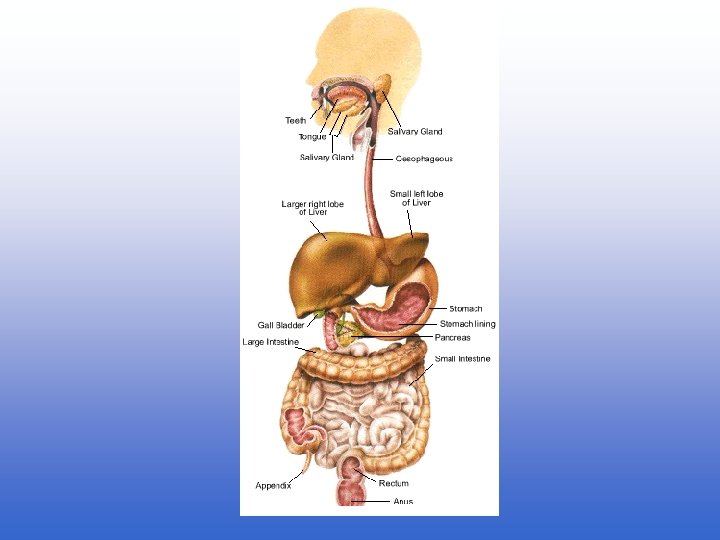
Alimentary Canal • Includes mouth, pharynx, esophagus, _________, small intestine, large intestine, rectum and anus • Plus accessory organs such as salivary glands, liver, gallbladder, and pancreas. • Approximately 8 meters long • Know the structure of the alimentary canals. . The different layers and what they do. • Lumen– tiny projections in the mucosa that extend into the passageway of the digestive tube to increase the absorptive surface area.
Movements of the Tube • Mixing movements and propelling movements • ____________– a ring of contraction appears in the wall of the tube, at the same time the muscular wall ahead of the ring relaxes. As the wave moves along, it pushes tubular contents ahead of it.
Mouth • Receives food and begins digestion by mechanically reducing the size of the solid particles • Called _____________.
Tongue • Lingual frenulum– a membranous fold connects the midline of the tongue to the floor of the mouth. • Mostly __________ muscle • Mixes food with saliva during chewing and moves food toward the pharynx during swallowing • ____________– rough projections on the surface provide friction which helps handle food and bear taste buds. • The root of the tongue is anchored to the hyoid bone in the back
Palate • Roof of the oral cavity • Consists of a hard palate (bony part of roof of mouth) and soft palate (muscular posterior part) • ________ – part of soft palate, cone-shaped projection in back of mouth. • Palatine tonsils– masses of lymphatic tissue on either side of tongue in soft palate • Pharyngeal tonsils– (adenoids) found above border of the soft palate
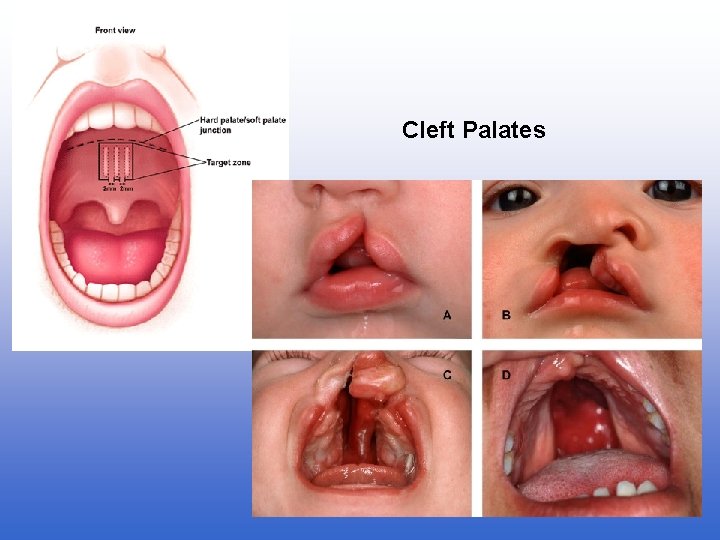
Cleft Palates
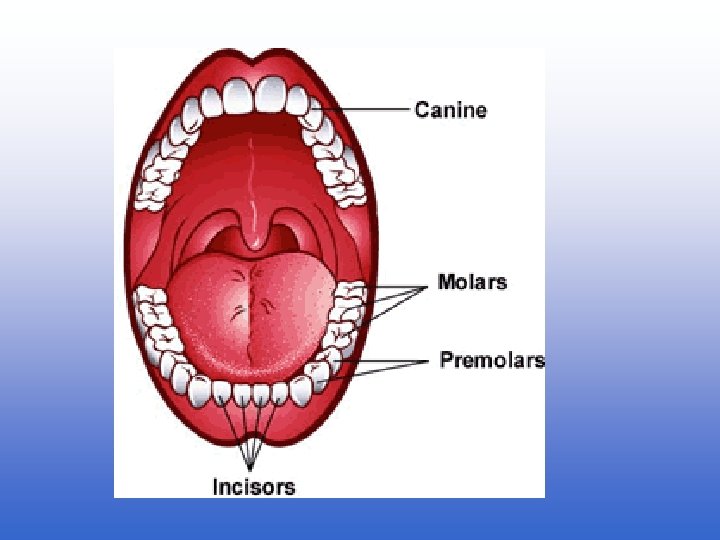
Teeth • Begin mechanical digestion by breaking pieces of food into smaller pieces • Primary teeth (deciduous teeth)– erupt thru gums between ages 6 months and 2 to 4 years -- 20 deciduous teeth • ___________ teeth (permanent teeth)– push primary teeth out of their sockets (after the primary teeth roots are resorbed) • Usually appear between ages 6 years to and may not be complete until 17 and 25 years. -- 32 permanent teeth
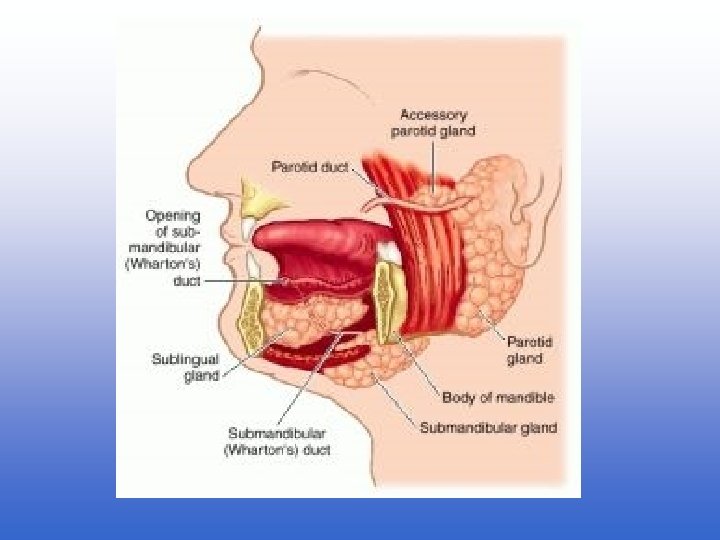
Salivary Glands • Secrete saliva which begins the chemical digestion of carbohydrates • Is a solvent to dissolve foods so they can be tasted • _________ cells secrete the enzyme salivary amylase which splits starch and glycogen molecules into disaccharides • Mucus cells secrete mucus which binds food particles and lubricates the food during swallowing
Types of Salivary Glands Parotid Glands– _______ salivary gland – Anterior and somewhat inferior to each ear – Secretes a clear watery fluid rich in amylase Submandibular glands • located in the floor of the mouth on the inside surface of the lower jaw • Secrete both mucus and serous Sublingual glands • located on the floor of the mouth inferior to the tonuue • Primarily mucus, thicker
Pharynx • A cavity posterior to the mouth from which the tubular esophagus leads to the stomach • Connects the nasal and oral cavity to larynx and esophagus Bolus– tongue rolls food mixed with saliva into a mass and forces it into pharynx • Food stimulates sensory receptors around pharyngeal opening which triggers swallowing reflex ( page 410) • __________ – closes of the top of larynx so that food is less likely to enter trachea (windpipe)
Esophagus • • Straight, collapsible tube about 25 cm long Food passageway from pharynx to stomach Behind trachea Mucus glands scattered throughout to lubricate lining • Has lower esophageal _______ just before the stomach which remains contracted and close entrance to stomach to prevent regurgitation of stomach contents • When peristaltic wave reaches end of esophagus, muscle fibers temporarily relax and allow swallowed food to enter stomach.
Stomach • J-shaped pouch-like organ that hangs inferior to the diaphragm in upper left portion of abdominal cavity • Thick folds (called rugae) of mucosal and submucosal layers mark the stomach’s inner lining and disappear when the stomach wall is _________ • Receives food from esophagus, mixes food with gastric juices, initiates protein digestion, moves food into the small intestines and some absorption
Stomach • Pyloric sphincter – muscle at end of stomach controls movement from stomach to small intestines • 3 types of gastric glands release different secretions which make up the: – ___________ juices– contains digestive enzymes, mucus and hydrochloric acid • Pepsin– most important enzyme– begins digestion of all types of dietary proteins into polypeptides • Mucus cells release a thick, alkaline secretion which coats the inside of stomach • Prevents stomach from digesting itself
Regulation of Gastric secretions 1. When a person tastes, smells or sees appetizing food or when food enters stomach, parasympathetic impulses stimulate release of _______ (Ach) 2. Ach stimulates gastric glands to secrete abundant gastric juices 3. As food moves into small intestine, acid triggers nerve impulses that inhibit gastric juices
Mixing and Emptying Stomach Actions • Mixing movements of the stomach produce a semifluid paste of food particles and gastric juices called _________. • When peristaltic waves push chyme toward pyloric sphincter, the muscle begins to relax and stomach contractions push chyme into small intestine a little at a time. • Fatty foods may remain in stomach 3 - 6 hrs • Foods high in protein move thru more quickly • Carbohydrates usually pass thru faster than proteins
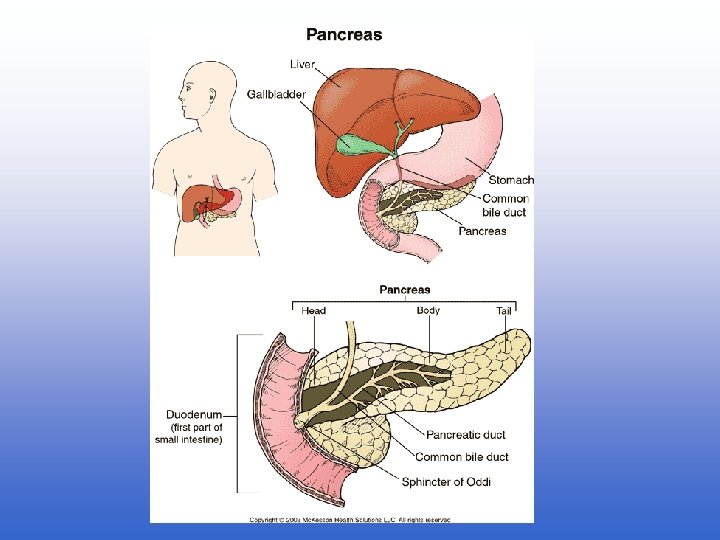
Pancreas • As chyme enters the duodenum, the pancreas, liver and gallbladder add their secretions • Mostly involved in lymphatic system • Connects with the duodenum at the same place where the bile duct and gallbladder join • Pancreatic juice contains enzymes that digest carbohydrates, fats, nucleic acids and proteins
Pancreas • Pancreatic amylase – enzyme that splits starch or glycogen (carbs) into disaccharides • Pancreatic lipase– enzyme that digests fats • Secretin – As acidic chyme, enters the duodenum, the hormone secretin is released into bloodstream… this stimulates secretion of pancreatic juices that have a high concentration of bicarbonate ions to neutralize the acidity of chyme before it enters small intestines
Liver • Found in upper right quandrant of the abdominal cavity, just inferior to the diaphragm • Has various functions, but only _____ secretion is important to digestion • Look on page 419 and list the functions of liver • Bile– yellowish green liquid continuously secreted from hepatic (liver) cells
Bile and Gallbladder • ___________– pear-shaped sac in a depression on the liver’s inferior surface (behind the liver) • Gallbladder stores bile from liver, contracts to release bile into small intestine • Bile salts break fat globules into smaller droplets (Emulsification) • Fat splitting enzymes (lipases) can then digest fat molecules more effectively • Bile also enhance absorption of fatty acids, cholesterol and fat-soluble vitamins A, D, E, and K…. Lack of bile results in poor lipid absorption and vitamin deficiencies
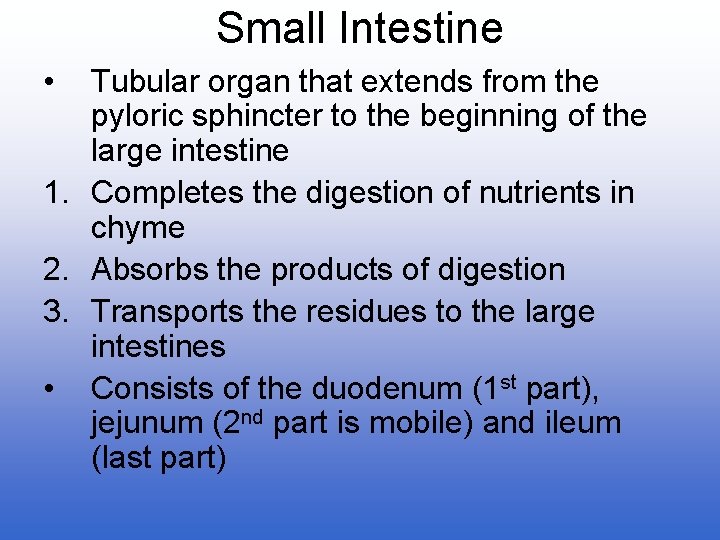
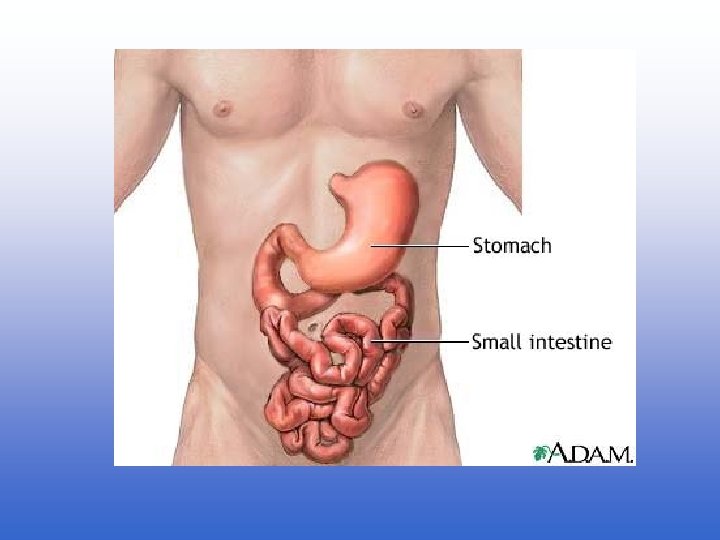
Small Intestine • Tubular organ that extends from the pyloric sphincter to the beginning of the large intestine 1. Completes the digestion of nutrients in chyme 2. Absorbs the products of digestion 3. Transports the residues to the large intestines • Consists of the duodenum (1 st part), jejunum (2 nd part is mobile) and ileum (last part)
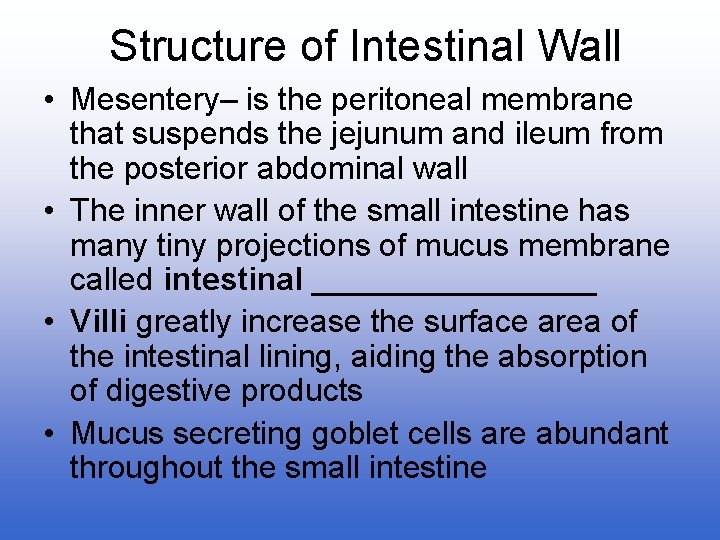
Structure of Intestinal Wall • Mesentery– is the peritoneal membrane that suspends the jejunum and ileum from the posterior abdominal wall • The inner wall of the small intestine has many tiny projections of mucus membrane called intestinal ________ • Villi greatly increase the surface area of the intestinal lining, aiding the absorption of digestive products • Mucus secreting goblet cells are abundant throughout the small intestine
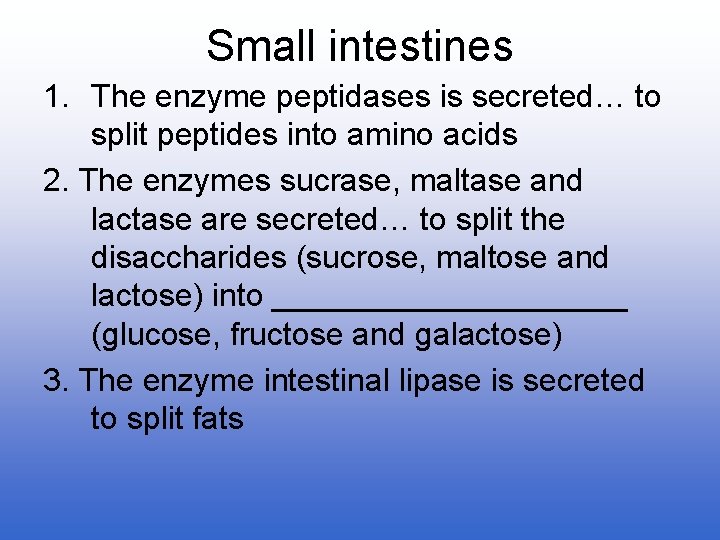
Small intestines 1. The enzyme peptidases is secreted… to split peptides into amino acids 2. The enzymes sucrase, maltase and lactase are secreted… to split the disaccharides (sucrose, maltose and lactose) into __________ (glucose, fructose and galactose) 3. The enzyme intestinal lipase is secreted to split fats
Small intestine • Distension of the intestinal wall triggers release of small intestine secretion • Small intestine is the most important absorbing organ of alimentary canal • The villi absorbs the monosacharides, amino acids and fat molecules and send them by blood to the cells to be used or lymphatic system • Also absorbs _______ and electrolytes • Food takes 3 to 10 hrs to travel the length
Small intestine to large intestine • If small intestine becomes overdistended or irritated, a strong peristaltic rush may pass along organ’s length • This sweeps contents into large intestine so quickly that water, nutrients and electrolytes are not absorbed, this is _________ characterized by watery stools and frequent defecation. • Ileocecal sphincter– joins small intestine to large intestine
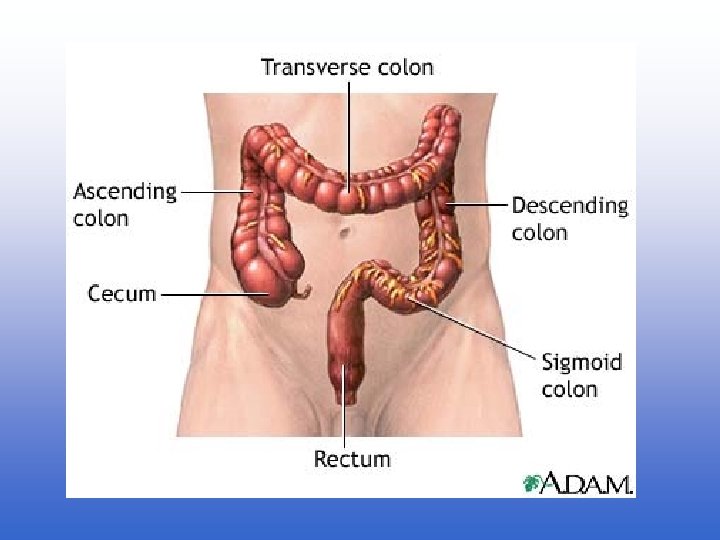
Large intestine • Diameter is greater than small intestine • 1. 5 meters long • Consists of the cecum, colon, rectum and anal canal • 4 Colon parts: ascending, __________, descending and sigmoid colon (page 427, picture) • Anal canal is last 2. 4 -4. 0 cm of LI • Anus– opens to the outside
Large intestine • • • Wall lacks villi Has little or no digestive function Mucus is only significant secretion which: 1. protects wall against abrasive materials 2. binds particles of fecal matter • • Absorbs water and electrolytes and proximal end Stores fecal matter at distal end
Large intestines • Intestinal _______ – bacteria that break down some molecules that escape human digestive enzymes • Cellulose (complex carbohydrates) do not get digested by human enzymes • Bacteria break it down and use it as energy, and make vitamins K, B 12, thiamine and riboflavin which the intestines absorb • Bacterial actions may produce gases
Large intestines • Peristaltic waves of large intestines only happen 2 or 3 times a day. • Mass movements in which a large section of the intestinal wall constrict vigorously, forcing the intestinal contents toward the rectum (usually follow a meal) • Feces– include materials that were not digested or absorbed, plus water, electrolytes, mucus, shed intestinal cells and bacteria – odor results from a variety of compounds that bacterial produce
Large intestines • Have 2 sphincter muscles: – Internal anal sphincter– involuntary – External anal sphincter– voluntary • A person can initiate defecation reflex by holding a deep breath and contracting the abdominal muscles • This forces feces into rectum and as rectum distends, triggers the defecation reflex that stimulate peristaltic waves in the descending colon