
DIGESTIVE SYSTEM BIOLOGY Grade 11 November 28 2012
DIGESTIVE SYSTEM BIOLOGY • Grade 11 • November 28, 2012
MAJOR FUNCTION • The physical and chemical breakdown of food • Occurs in the gastrointestinal tract FOUR STAGES OF FOOD PROCESSING: 1. Ingestion – taking in food 2. Digestion – the breakdown of complex organic molecules into smaller components by physical and chemical means 3. Absorption – the taking up of digested molecules into the cells of the digestive tracts 4. Egestion – the removal of waste food materials from the body
INGESTION AND DIGESTION MOUTH TO ESOPHAGUS MOUTH: Physical breakdown: • Teeth Chemical breakdown: • Salivary glands • Amylase in the saliva Starts the breakdown of carbohydrate • Tongue pushes food around and back to the Pharynx • Epiglottis blocks the wind pipe (larynx) • Food moves down ESOPHAGUS by peristalsis
DIGESTION STOMACH • Sphincters – muscles that close the opening to the organs • Cardiac sphincter • Pyloric sphincter Physical: • Muscles contract and relax to churn food Chemical: • Hydrochloric acid - destroys bacteria - with enzymes breaks down food • Pepsin enzyme • Mucus - breaks down proteins - protects the stomach lining
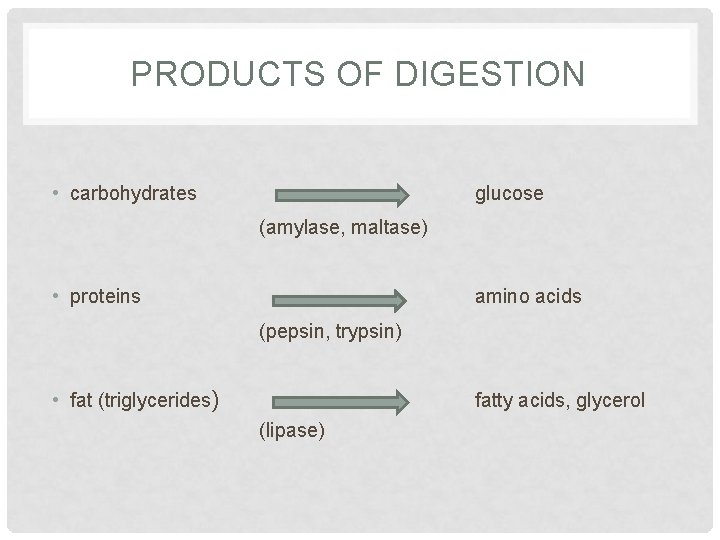
PRODUCTS OF DIGESTION • carbohydrates glucose (amylase, maltase) • proteins amino acids (pepsin, trypsin) • fat (triglycerides) fatty acids, glycerol (lipase)
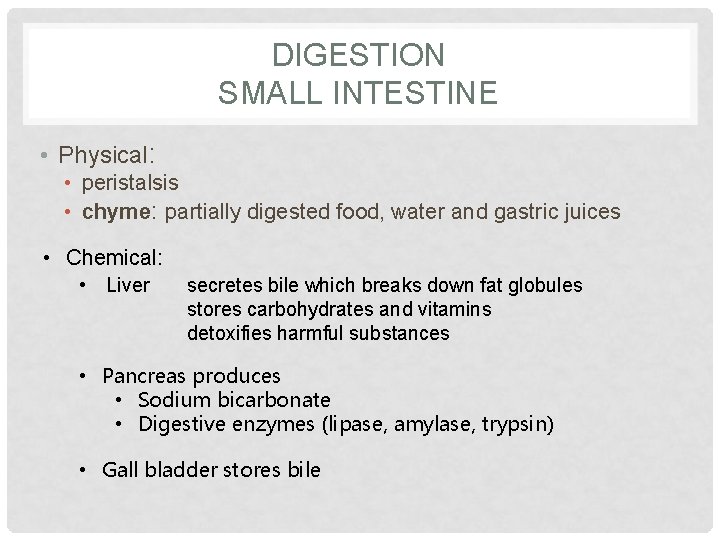
DIGESTION SMALL INTESTINE • Physical: • peristalsis • chyme: partially digested food, water and gastric juices • Chemical: • Liver secretes bile which breaks down fat globules stores carbohydrates and vitamins detoxifies harmful substances • Pancreas produces • Sodium bicarbonate • Digestive enzymes (lipase, amylase, trypsin) • Gall bladder stores bile
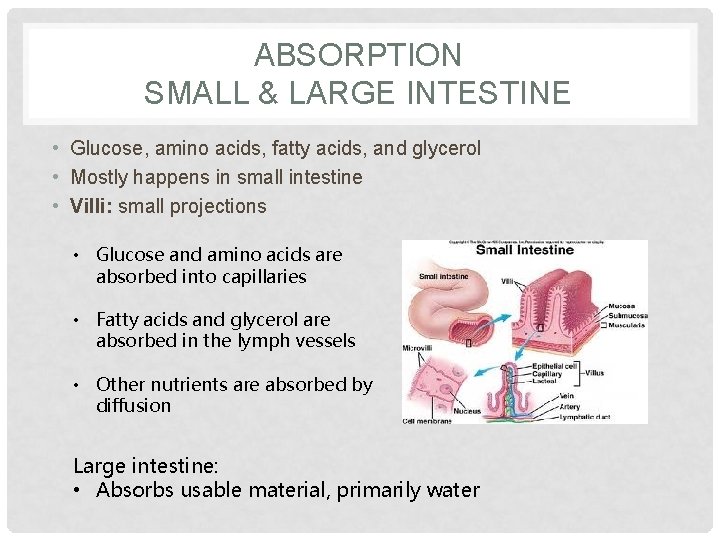
ABSORPTION SMALL & LARGE INTESTINE • Glucose, amino acids, fatty acids, and glycerol • Mostly happens in small intestine • Villi: small projections • Glucose and amino acids are absorbed into capillaries • Fatty acids and glycerol are absorbed in the lymph vessels • Other nutrients are absorbed by diffusion Large intestine: • Absorbs usable material, primarily water
EGESTION LARGE INTESTINE • The removal of food waste material • Cellulose: • Long chain carbohydrate • Found in plant cell walls • Does not get digested When large intestine is full, it sends a message to the Brain which in turn prompts the system to void the waste
DIGESTION HOMEOSTASIS • Maintenance of a healthy balance of all chemical reactions in an organism. • The nervous, endocrine, circulatory and digestive system interact to control digestion. • Hormones help to maintain homeostasis by controlling and coordinating the function of almost all organ systems. • Other factors can also regulate the speed of digestion.
- Slides: 9