
DIGESTIVE DRUG AGENTS Contents Antacids Histamine 2 blockers
DIGESTIVE DRUG AGENTS.
Contents Antacids Histamine 2 blockers Proton pump inhibitors (PPI) Anti-diarroheal drugs Laxatives Anti-emetics
Peptic ulcer occurs in that part of the gastrointestinal tract which is exposed to gastric acid and pepsin. The etiology of peptic ulcer is not clearly known. It results probably due to an imbalance between the aggressive (acid, pepsin, bile, and H. pylori) and defensive ( gastric mucus, bicarbonate secretion, prostaglandins, and nitric oxide )
Approaches for the treatment PUD H 2 -blockers: Cimetidine, ranitidine, Famotidine, and roxitidine Proton pump inhibitors: Omeprazole, lansoprazole, pantoprazole, rabeprazole, Esomeprazole. Anticholinergic: Pirenzepine, propantheline, oxyphenonium. Prostaglandin analogue: misoprostol
Continued 1. 2. Neutralization of gastric acid systemic: sodium bicarbonate and sodium citrate Nonsystemic: mg hydroxide, magnesium trisilicate, aluminum hydroxide gel, and calcium carbonate
Continued Ulcer protective's: Sucralfate, and bismuth subsalicyte. Anti-h-pylori drugs: amoxicillin, Clarithromycin, Metronidazole, Tinidazole, and tetracycline.
Antacids • • • Antacids have been used for centuries in the treatment of patients with acid related disorders. They were the principle of anti-ulcer treatment until the availability of histamine 2 blockers in the late of 1970 s. The ancient Greece used crushed coral (calcium carbonate)in the first century to treat patients of dyspepsia
Continued These are basic substances which neutralize gastric acid and raise PH of gastric contents. Antacids donot decrease acid production, rather agents that raise the antral PH to greater than 4.
Sodium bicarbonate It is water soluble but the duration of action is short. It is potent neutralizer, Ph may rise above 7. It is absorbed systematically, large doses will induce alkalosis Produces carbon dioxide in stomach, distention, discomfort, belching, risk of ulcer perforation. Increases sodium load, may worsen edema and CHF.
Continue 1. 2. 3. However antacids are extensively used, especially on OTC market. In addition many antacids contain simethicone which reduces gas and bloating. Basically there are three forms of antacids: Aluminum antacid Calcium antacid Magnesium antacid
Continue 1. 2. 3. 4. 5. The OTC antacid formulations are available: Capsules Tablets Powders Chewable tablets Suspension
Mechanism of action 1. 2. 3. Antacids originally believed to work by neutralization of gastric acidity. They donot nothing for prevent over production of acid. They do this by stimulating: Mucus Prostaglandin Bicarbonate secretion
Drug Effects The primarily drug effect of antacids is the reduction of the symptoms associated with various acid related disorders such as peptic ulcer disease and hyperacidity. The ability of antacids to reduce the pain associated with acid related disorders is thought to be result, inhibition of protein digesting ability of pepsin.
Side-Effects Mg results diarrhea Al & Ca can result constipation. Rebound hyperacidity
Aluminum 1. 2. 3. The amount of antacid necessary to neutralize hydrochloric acid depends on the: Patient Condition been treated Buffering capacity of the preparation used. Adult dosage is 5 -10 ml 3 -4 times a day, Hs.
Calcium Calcium carbonate neutralization will produce gas and possible belching, for this reason it may be combined with an anti-flatulent type of drug such as simethicone. Calcium containing products have a long duration of acid action, which can cause hyperacidity rebound. Calcium carbonate is available 1 -2 tabs Prn.
Magnesium Mg containing antacids commonly cause a laxative effect and frequent administration of these antacids alone often cannot be tolerated. Administration of Mg containing antacids is dangerous in patients with renal failure, because of failing of kidney cannot excrete extra Mg and accumulation may occur.
Histamine-2 Blockers 1. 2. 3. Histamine -2 blockers reduce Hcl but donot abolish stimulated acid secretion. They have become the most popular drugs for the treatment of many acid related disorders. These can be attributed by their: Efficacy Safety profile Patient acceptance
Drugs Cimetidine Famotidine Nizatidine Ranitidine
Mechanism of action They have ability of blocking parietal cells. They reduce the amount of Hcl in the parietal cells.
Side-Effects Confusion Lethargy Headache Abdominal cramp
Cimetidine In 1977 Cimetidine was the first agent in this class to be released in the market. Cimetidine comes available 200, 300, 400, 800 mg tablets, 300 mg/ml, 200 mg/ml, 150 mg/ml parentral injection.
Proton pump inhibitors (PPI) 1. 2. 3. 4. 5. PPI is introduced for the treatment of acid related disorders. The enzyme H+/K+ ATPase is the final common step in acid Secretory processes. PPI drugs are: Omeprazole 20 mg Lanzomeprazole 30 mg Esomeprazole 40 mg Pantoprazole 20, 10 mg Rapiprazole 20 mg
Mechanism of action PPI irreversible binds to H+/K+ATPase. The binding of this enzyme prevents the movement of hydrogen ions out of the parietal cell into the stomach, there by blocking all gastric acid secretion. PPI makes the patient achlorhydric.
Side-effects Headache Dizziness Vomiting Nausea Rash Fatigue
Omeprazole Omeprazole is a prodrug. Omeprazole is degraded at low PH and must be given in granules. Omeprazole inhibits cytochrome P 450 system, decreasing metabolism of Warfarin, diazepam, Carbamazepine, and phenytoin and enhancing the effect of these drugs.
Continue 1. 2. 3. Omeprazole is currently approved only for the acute treatment of severe gastrointestinal reflux disease un responsive to: Antacids Antiflatulents H 2 -blockers Adult dosage is 20 mg/day for 4 -8 weeks.
Ulcer protective agents Sucralfate: it is compound of aluminum and sucrose which coats the base of the ulcer protecting it from pepsin and acid allowing it to heal. Dosage is 1 gm 1 hour before each meal.
Bismuth Compound It protects the ulcer by causing coagulation at the base of the ulcer. It has also anti H. pylori action. It should not be combined with antacids. The tongue and the stool may appear black after taking dosage 120 gm 1 hour before meals and at the bed time.
Prostaglandins exert some protective effect on the gastric mucosa and this is why NSAIDs which inhibits prostaglandin synthesis can cause peptic ulceration. One of the prostaglandin preparation misoprostol reduces the risk of gastric ulcers in patients who are taking NSAIDS, especially in elderly patients having history of ulcers.
Treatment of H. pylori 1. 2. For helicobacter pylori associated ulcers, there are two therapeutic goals: Heal the ulcer Eradication of the organism The best treatment regimen is for a 10 -14 days of Triple Drug regimen.
Continue 1. 2. 3. The regimen consists of: PPI, E. g omeprazole 20 mg BD Clarithromycin 500 mg BD Metronidazole 400 mg BD
Treatment of NSAIDS associated ulcers For treatment of aspirin or other NSAIDS induced ulcers the best treatment is to give a proton pump inhibitor, which provides prompt healing of the ulcer. PPI are also useful in bleeding ulcers as they raise the gastric PH. It is observed that intra gastric PH above 6 may enhance coagulation and platelet aggregation.
Magnesium Case study ID/CC: A 22 year old female presents to the ER with severe abdominal colic and a history of profuse watery diarrhea of several days duration. HPI: She also complains dizziness and desire to lose weight, that she has been taken by magnesium sulfate. PE: Hypotension, lethargy. Labs: Hypokalemia Discussion: Treatment:
Anti-diarrheals Agents 1. 2. Diarrhea is defined as the abnormal frequent passage of loose stools. Diarrhea is the abnormal passage of stools with increased frequency, fluidity and weight. Diarrhea is divided into: Acute diarrhea Chronic diarrhea
Causes of Diarrhea 1. 2. 3. 4. 5. Acute Diarrhea Bacterial Drug induced Viral Nutritional Protozoal
Continue 1. 2. 3. 4. 5. Chronic Diarrhea Tumors Diabetes mellitus Hyperthyroidism Addison's disease Irritable bowl syndrome
Anti-diarrhoe Agents Electrolytes Bulk agents Absorbents Anti-inflammatory Opioids Intestinal flora modifiers
Bismthus subsalicyte Bismuth subsalicte is a pregnancy category C agent. It should be used with caution in children and teenagers who have or are recovering from chicken pox or flu because of attendance risk of Reyes syndrome.
Continue 1. 2. Bismuth subsalicyte have two harmless sideeffects: Darkening of the stool Darkening of the tongue It is available in a OTC drug. Available 262 mg chewable tablet and 262 mg/15 ml suspension.
Attapulgite Attapulgite has replaced the use of kaolinpectin in this preparation. Kaolin is a naturally hydrated aluminum compound that is now rarely used as an antidiarrheal agents. How ever pectin which is extracted from the apples or citrus fruit and is used in many combination products.
Continue The original kaopectate contained 980 mg/5 ml of kaolin and 21. 7 mg/5 ml of pectin. Attapulgite is an OTC agent. It is a pregnancy category C agent. Available 300 mg chewable tablet and 600 mg/15 ml solution.
Diphenoxylate & Atropine (Lomotil) Lomotil is a synthetic opiate agonist that is structurally related to meperidine. It has little or no analgesic activity. It is classified in a pregnancy category C agent. Available as 2. 5 mg/5 ml + 0. 025 mg/5 ml atropine solution, and 2. 5 mg + 0. 025 mg, diphenoxylate and atropine respectively.
Loperamide Loperamide is a synthetic anti-diarrheal that similar to diphenoxylate. Decreases the number of stools and water content. It is the only opiate anti-diarrheal agent that is available as an OTC medication. Loperamide is a pregnancy category B agent. Available 1 mg tab, 1 mg/5 ml oral.
Lactobacillus acidophilus is an acid producing bacteria prepared in a concentrated oral administration. Has been used for more than 75 years in the treatment of uncomplicated diarrhea, particularly that caused by antibiotic treatment that destroys normal florae.
Continue It is an OTC medication. Available 1 g powder, 1 g tablet, and 1 g capsules.
Laxatives are used for the treatment of constipation, which is defined as a condition of abnormally infrequent and difficult passage of feces through the lower GIT. Constipation is not a disease but it is a symptom of disease.
Causes of Constipation Pregnancy Hypothyroidism Hypokalemia Parkinsons disease Iron supplements Anti-cholinergics Poor fluid intake
Continue Lack of exercise Anxiety Stress AL-antacids
Classification of Drugs 1. 2. 3. Bulk-forming agents Methylcellulose Psyllium Polycarbophil Stool Softeners- Emollient Docusate salts Mineral oil Glycerin
Continue 1. 2. 3. Hyperosmotic Lactulose Sorbitol Saline Mg sulphate Mg phosphate Mg citrate
Continue 1. 2. Ø 1. 2. 3. Stimulant Castor oil Anthraquinones Diphenylmethane Derivatives Bisacodyl Laxocodyl Phenolphthalein
Continue 1. 1. 2. 3. Chloride channel activator Lubiprostone: stimulate the chloride channel 2 in the intestine by increasing the secretion. Opiod receptor antagonist Methylnaltrexone Alvimopan 5 HT 4 receptor antagonist Tegaserod Cisapride Prucalopride
Side-Effects Decreased absorption of vitamins Nutrient malabsorption Gastric irritation Skin rash Mg toxicity
Methylcellulose 1. 2. Methylcellulose is a synthetic bulk forming laxative that attracts water into intestine, absorbs excess water into stool and stimulating intestines. Contraindicated in patients who have shown Hypersensitivity Hepatitis
Continue It is a pregnancy category C agent. It is an OTC medication. Available 105 mg, 364 mg powder and 500 mg tablets. Adult dosage is 1 tabs, 1 -3 times per day.
Mineral Oil Mineral oil is the only lubricant laxative in the emollient category. Prevent water from escaping the stool and lubricating the intestines. It is a mixture of liquid hydrocarbons derived from petroleum. It is classified in a pregnancy category C agent.
Continue Mineral oil agents are available as enemas or as suspensions, 1. 4, 2. 75, 4. 75 mg/5 ml. Adult dosage is 15 -45 ml as a single daily dose. Peadtric dose is 5 -15 ml per day.
Lactulose • • It is a disaccharide sugar containing one molecule of galactose and one molecule of fructose. It is a synthetic derivative of the natural sugar lactose, which is not digested in the stomach or absorbed in the small intestine. Lactulose is classified pregnancy category C agent. Available 3. 33 g/5 ml oral or rectal solution.
Glycerin promotes bowel movements by increasing osmotic pressure. It is very mild laxative, commonly used in children. It is classified pregnancy category C agent. Available 4 ml per applicator rectal solution.
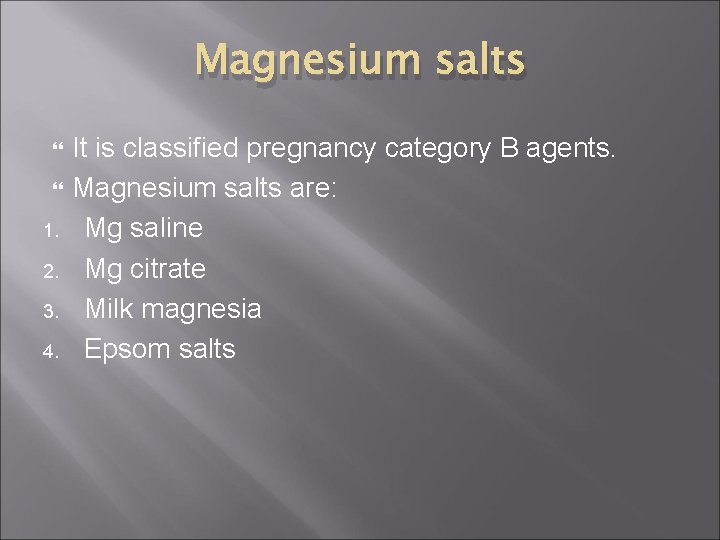
Magnesium salts 1. 2. 3. 4. It is classified pregnancy category B agents. Magnesium salts are: Mg saline Mg citrate Milk magnesia Epsom salts
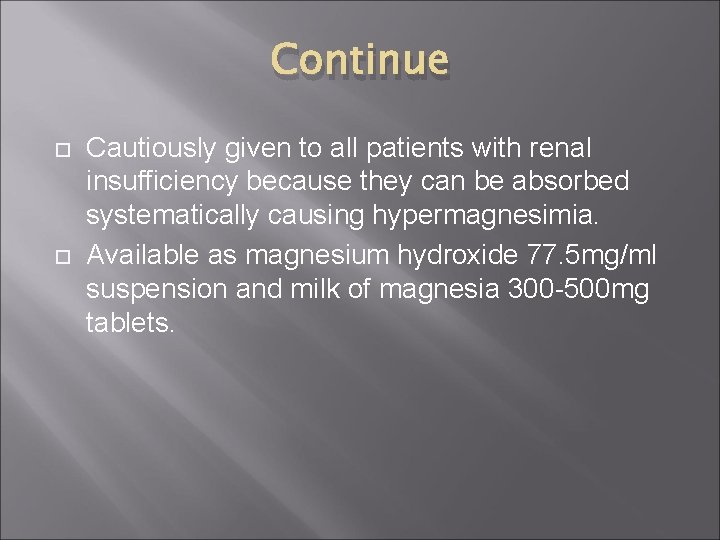
Continue Cautiously given to all patients with renal insufficiency because they can be absorbed systematically causing hypermagnesimia. Available as magnesium hydroxide 77. 5 mg/ml suspension and milk of magnesia 300 -500 mg tablets.
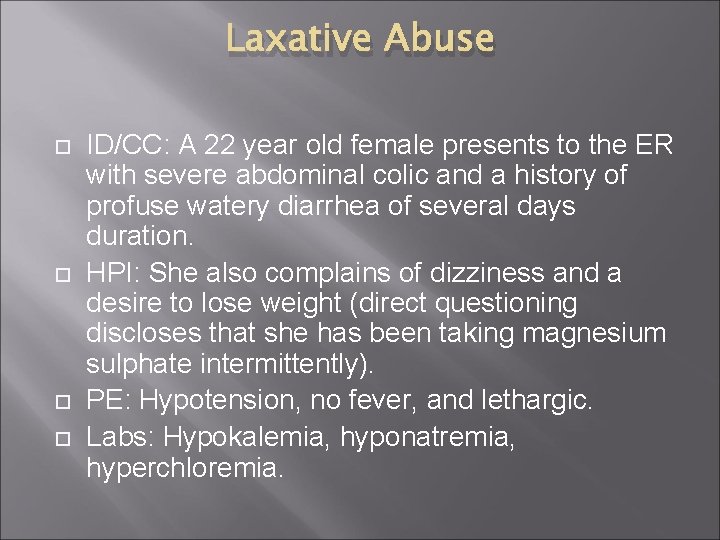
Laxative Abuse ID/CC: A 22 year old female presents to the ER with severe abdominal colic and a history of profuse watery diarrhea of several days duration. HPI: She also complains of dizziness and a desire to lose weight (direct questioning discloses that she has been taking magnesium sulphate intermittently). PE: Hypotension, no fever, and lethargic. Labs: Hypokalemia, hyponatremia, hyperchloremia.
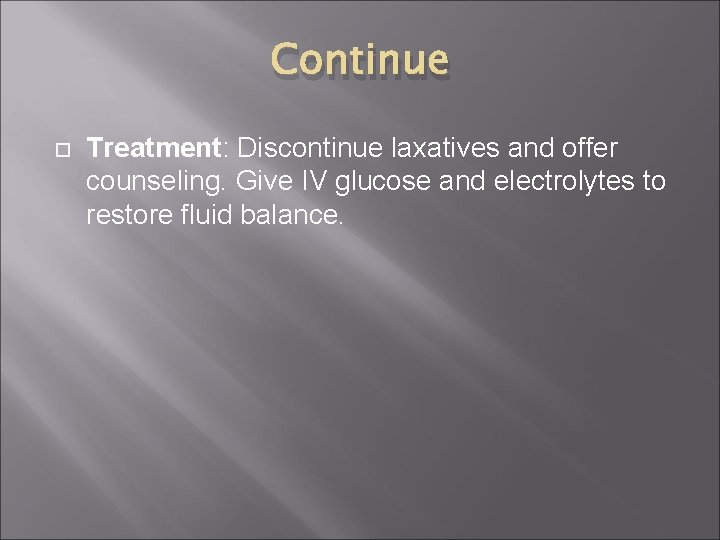
Continue Treatment: Discontinue laxatives and offer counseling. Give IV glucose and electrolytes to restore fluid balance.
Continue Discussion: Laxative abuse remains a common way people attempt to lose weight; abuse is also common among psychiatric patients. Laxatives can interfere with the absorption of several medications such as tetracycline and calcium supplements. Continued abuse may lead to melanosis coli, colonic neuronal degeneration and the lazy intestine syndrome. Patients with chronic constipation abuse laxatives to the point of being dependant on them for evacuation.
Anti-emetic Agents • • Nausea and vomiting are the two gastrointestinal disorders that can be not only extremely unpleasant but also lead to other more serious complications if not treated promptly. Vomiting which is also known emesis, is the forcible emptying or expulsion of gastric and occasionally intestinal contents through the mouth.
Continue 1. 2. 3. 4. 5. There is variety of stimuli that can induce nausea and vomiting and these are: Foul odors Foul tastes Irritation of stomach Irritation of the stomach Certain drugs
Classification of Drugs Anti-cholinergics 1. Scopolamine 2. Hyocine 3. Hyoscyamine Antihistamines 1. Meclizine
Continue Neuroleptic agents 1. Metoclopramide 2. Domperidone Serotonin blockers Tetrahydrocannabinoid (THC) 1. Dronabinol
Mechanism of Action 1. 2. 3. 4. 5. These drugs blocks: Acetylcholine Histamine Dopamine Serotonin Stimulation of THC.
Scopolamine • • • Scopolamine is the primary anti-cholinergic drug used as an anti-emetic. It has potent effects on the vestibular nuclei, which are located in the inner ear and represent the area of the brain that controls balance. Works by blocking ACH, correcting and imbalance between the two neurotransmitters ACH and nor-epinephrine.
Continue This makes the scopolamine of the most commonly used drugs for the treatment and prevention of motion sickness. It is classified pregnancy category C agent. Available as 0. 3, 0. 4, 1 mg/ml parentral. Scopolamine hydrobromide salt that is used for ophthalmic purposes.
Meclizine (Bonamine) 1. 2. 3. 4. It is a pregnancy category B agent. Most commonly treated disorders are: Dizziness Vertigo Nausea Vomiting
Continue 1. 2. 3. Contraindicated by: Hypersensitivity Shock Lactation Available as 12. 5, 25, 50 mg tablets and 15, 25, 50 mg capsules.
Prochlorperazine 1. 2. 3. 4. It is classified in a pregnancy category C agent. Contraindicated by: Hypersensitivity Coma Seizure Bone marrow depression Available as 2. 5, 5, 25 mg suppository and 5 mg/5 ml solution, 5 mg/ml injection.
Metoclopramide Metoclopramide is the oldest and most commonly used drug in the anti-emetic drugs. It is available by prescription. Classified pregnancy category B agent.
Continue 1. 2. 3. 4. Available as 5 mg, 10 mg/5 ml oral solution, 5, 10 mg tablets and 5 mg/ml injection. Contraindicated by: Breast cancer Seizure Hypersensitivity GI obstruction
Dronabinol is the only currently available THC. Approved by FDA in 1985 for the treatment of nausea and vomiting related to cancer chemotherapy. It is a pregnancy category C agent. Available in 2. 5, 5, 10 mg capsules.
Reyes syndrome case study • • ID/CC: A 6 year old boy is brought by his parents to the emergency room in a comatose state. HPI: The child had been suffering from chickenpox and had been given bismuth subsalicyte by the family physician for diarrhoe. PE: Fever, comatose Labs: Marked hypoglycemia, increased blood ammonia concentration.
Continue Pathology: severe cerebral edema, acute hepatic necrosis. Imaging: CT scan reveals generalized cerebral edema.
Treatment & Discussion: although the cause of the highly lethal reyes syndrome is unknown, epidemiologic evidence strongly links this disorder with outbreaks of viral diseases especially influenza B and chickenpox. Treatment: speacific therapy not available. Supportive measures include lactulose to control hyperammonia, fresh frozen plasma to replenish clotting factors, mannitol or dexamethasone to lower increased intracranial pressure and mechanical ventilation. Exchange transfusion, dialysis.
Cimetidine case study ID/CC: A 39 year old male presents to his family doctor because of increasing embarrassment and concern over breast enlargement.
Continue HPI: The patient has a long history of burning epigastric pain on awakening in the mornings and between meals that decreases with food antacids (peptic ulcer disease), for which he has been taken Cimetidine. Directed questioning reveals that he has also been suffering from hallucinations and impotence. Imaging: CXR: normal
Treatment & Discussion: All the H 2 blockers are well tolerated, although Cimetidine is associated with several side effects, particularly reversible gynecomastia. H 2 blockers produce an increase in serum prolactin levels (especially ranitidine) and alter estrogen metabolism in men. Other side effects include headache, confusion, low sperm counts, and hematologic abnormalities.
Continue Treatment: Switch to other histamine receptor antagonists such as ranitidine or famotidine.
Appetite stimulant case study ID/CC: A 64 year old male with metastatic lung cancer is seen with complaints of severe bone pain and anorexia. HPI: He spends most of his time in bed because of profound weakness and chronic nausea. PE: Mild fever (38 degree), tachycardia, underweight (45 kg), and sunken eyes.
Treatment & Discussion: Anorexia syndrome is characterized by progressive weight loss, lipolysis, loss of muscle mass, anorexia, diarrhea and fever. Some drugs that have proven effective in improving appetite include megestrol acetate and dronabinol. Megestrol acetate is a synthetic progesterone that stimulates the appetite, resulting in weight gain and recovery of muscle mass.
Continue It is relatively non-toxic. Side effects are rare and include altered menses with unpredictable bleeding and mild edema. Dronabinol a synthetic THC is the active component in marijuana and is used to treat nausea and vomiting associated with cancer chemotherapy as well as to stimulate appetite. Side effects are due mainly to the pyschoactive effects of the drug and include dizziness, ataxia, hallucinations, tachycardia, hypertension, URI symptoms.
Continue Treatment: Treat with megestrol acetate or Dronabinol to increase the appetite, adequate palliatative pain medications.

Continue THANK YOU…
- Slides: 90