
Diffusive Equilibrium and Chemical Potential Lets fix VA
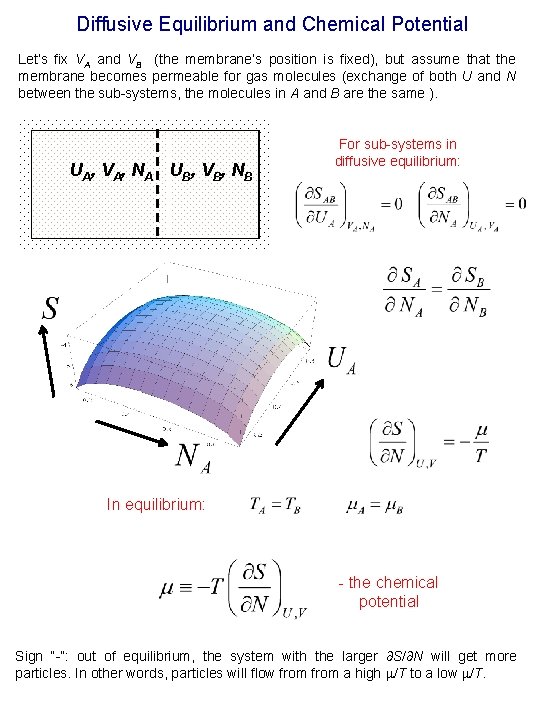
Diffusive Equilibrium and Chemical Potential Let’s fix VA and VB (the membrane’s position is fixed), but assume that the membrane becomes permeable for gas molecules (exchange of both U and N between the sub-systems, the molecules in A and B are the same ). UA , V A , N A UB , V B , N B For sub-systems in diffusive equilibrium: In equilibrium: - the chemical potential Sign “-”: out of equilibrium, the system with the larger S/ N will get more particles. In other words, particles will flow from a high /T to a low /T.
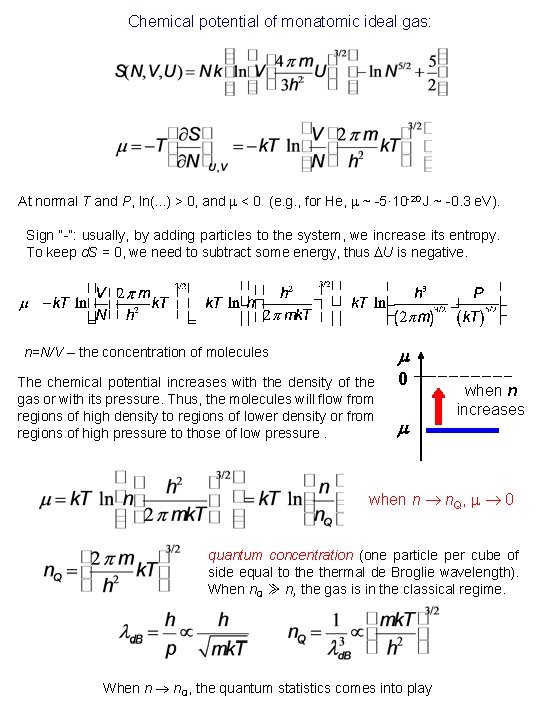
Chemical potential of monatomic ideal gas: At normal T and P, ln(. . . ) > 0, and < 0 (e. g. , for He, ~ -5· 10 -20 J ~ -0. 3 e. V). Sign “-”: usually, by adding particles to the system, we increase its entropy. To keep d. S = 0, we need to subtract some energy, thus U is negative. n=N/V – the concentration of molecules The chemical potential increases with the density of the gas or with its pressure. Thus, the molecules will flow from regions of high density to regions of lower density or from regions of high pressure to those of low pressure. 0 when n increases when n n. Q, 0 quantum concentration (one particle per cube of side equal to thermal de Broglie wavelength). When n. Q ≫ n, the gas is in the classical regime. When n n. Q, the quantum statistics comes into play
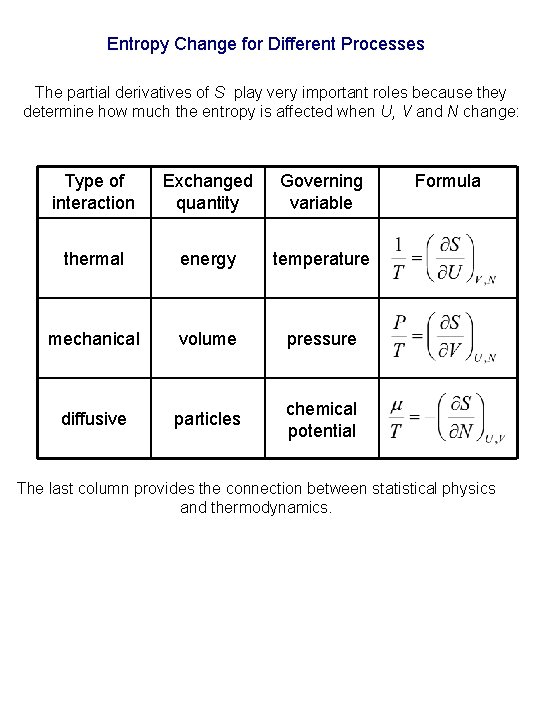
Entropy Change for Different Processes The partial derivatives of S play very important roles because they determine how much the entropy is affected when U, V and N change: Type of interaction Exchanged quantity Governing variable thermal energy temperature mechanical volume pressure diffusive particles chemical potential Formula The last column provides the connection between statistical physics and thermodynamics.
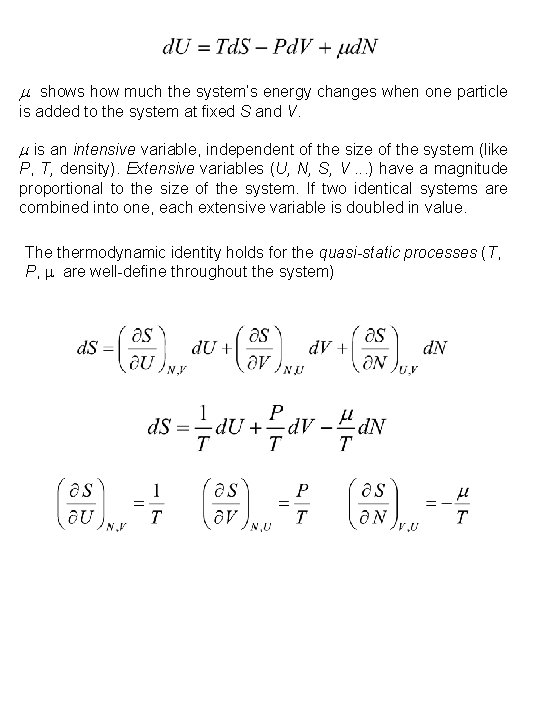
shows how much the system’s energy changes when one particle is added to the system at fixed S and V. is an intensive variable, independent of the size of the system (like P, T, density). Extensive variables (U, N, S, V. . . ) have a magnitude proportional to the size of the system. If two identical systems are combined into one, each extensive variable is doubled in value. The thermodynamic identity holds for the quasi-static processes (T, P, are well-define throughout the system)
- Slides: 4