
Diffusion What is Engineering What do these processes
- Slides: 21
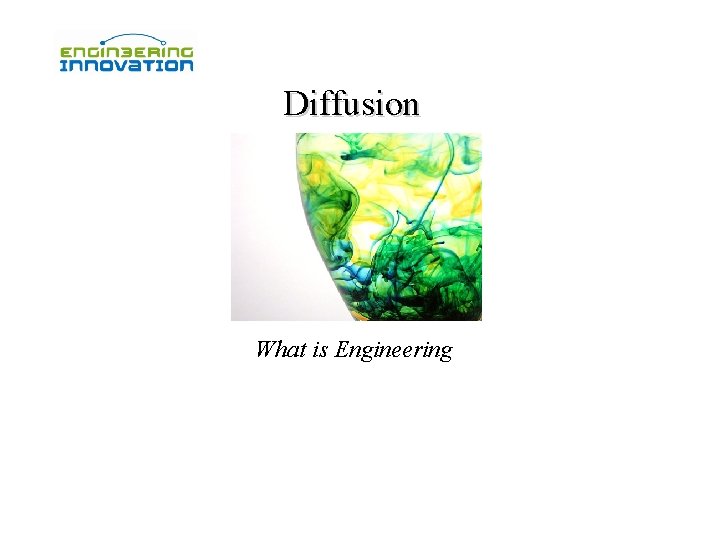
Diffusion What is Engineering
What do these processes have in common? 1) Hydrogen embrittlement of pressure vessels in nuclear power plants 2) Flow of electrons through conductors 3) Dispersion of pollutants from smoke stacks 4) Transdermal drug delivery 5) Influenza epidemics 6) Chemical reactions 7) Absorption of oxygen into the bloodstream
They all depend on Diffusion (conduction) What is diffusion? The transport of material--atoms or molecules--by random motion What is conduction? The transport of heat or electrons by random motion.
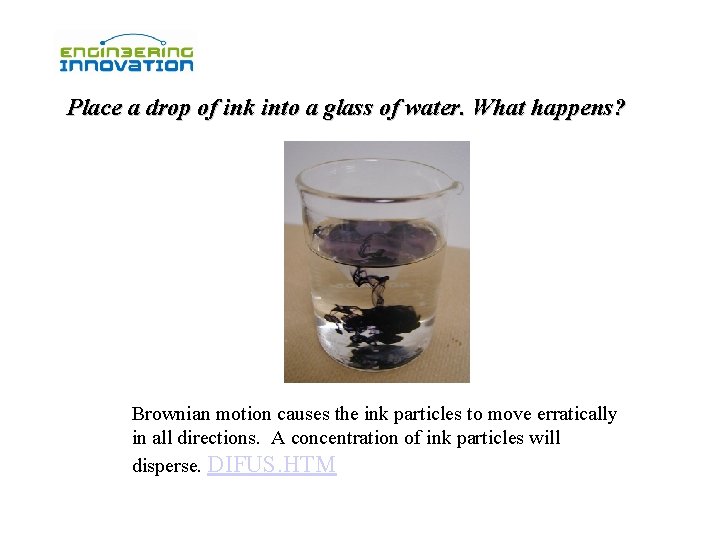
Place a drop of ink into a glass of water. What happens? Brownian motion causes the ink particles to move erratically in all directions. A concentration of ink particles will disperse. DIFUS. HTM
Why does random motion cause spreading of a concentration of particles? Because there are more ways for the particles to drift apart than there are for the particles to drift closer together. We can also explain the spreading of a concentration by entropy. The second law of thermodynamics says that systems tend towards maximum entropy – or maximum disorder. Area of high concentration and low/zero concentration is an ordered state and the mixed state is the disordered state!
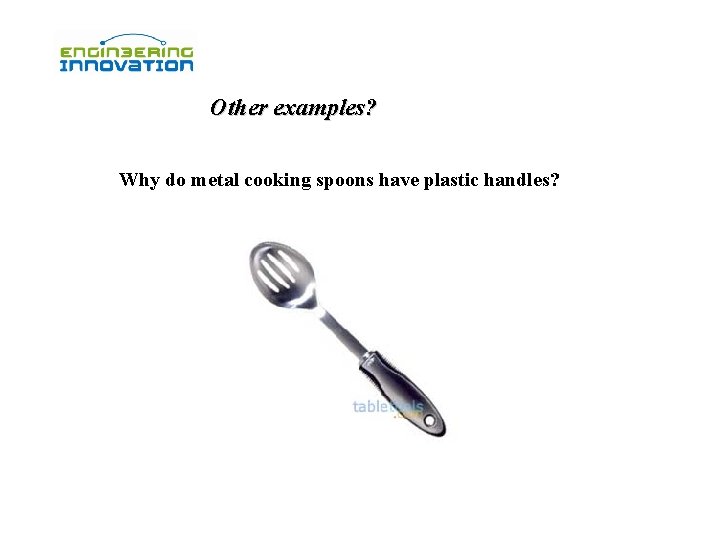
Other examples? Why do metal cooking spoons have plastic handles?
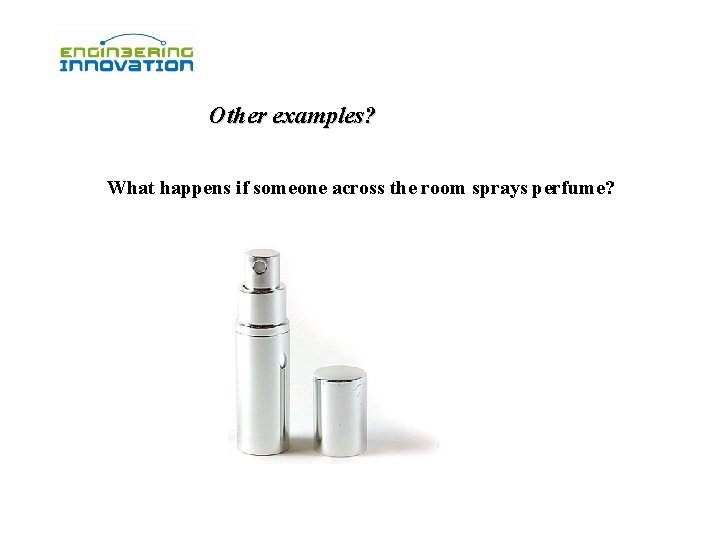
Other examples? What happens if someone across the room sprays perfume? Perfume diffusion simulation
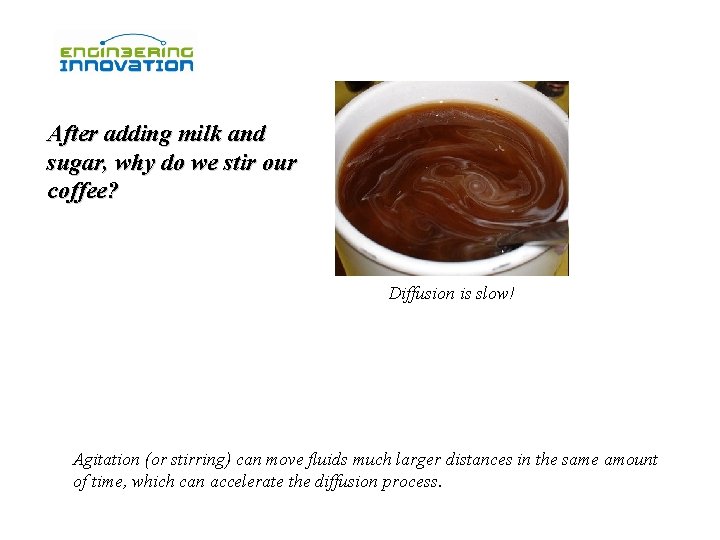
After adding milk and sugar, why do we stir our coffee? Diffusion is slow! Agitation (or stirring) can move fluids much larger distances in the same amount of time, which can accelerate the diffusion process.
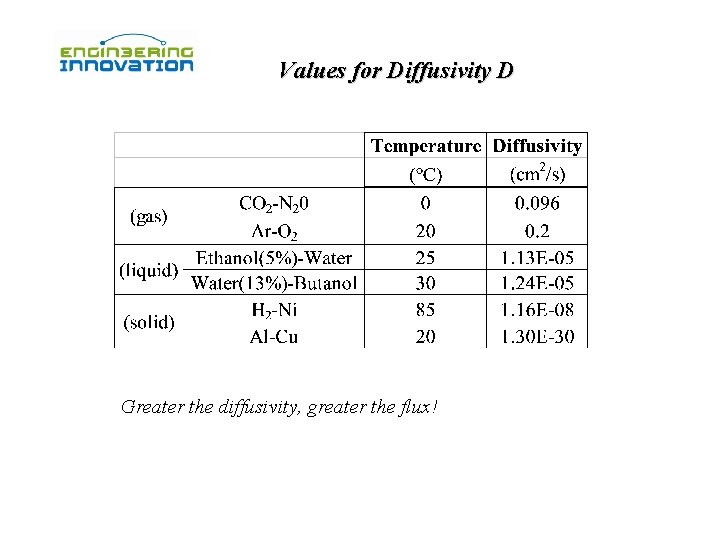
Values for Diffusivity D Greater the diffusivity, greater the flux!
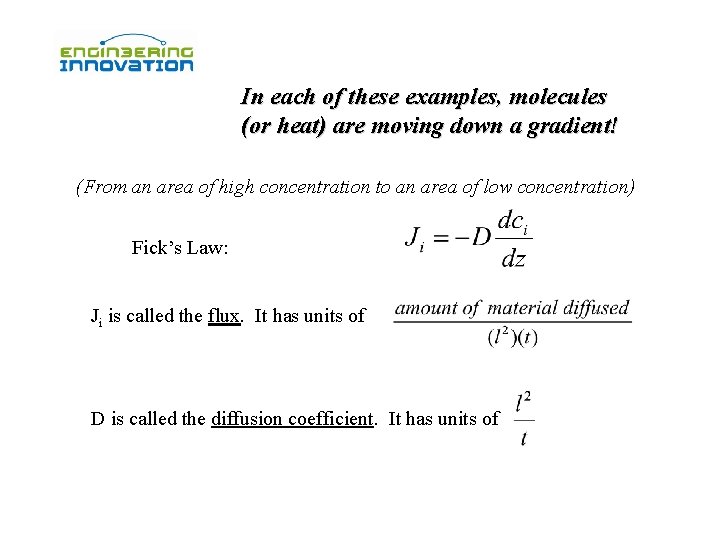
In each of these examples, molecules (or heat) are moving down a gradient! (From an area of high concentration to an area of low concentration) Fick’s Law: Ji is called the flux. It has units of D is called the diffusion coefficient. It has units of
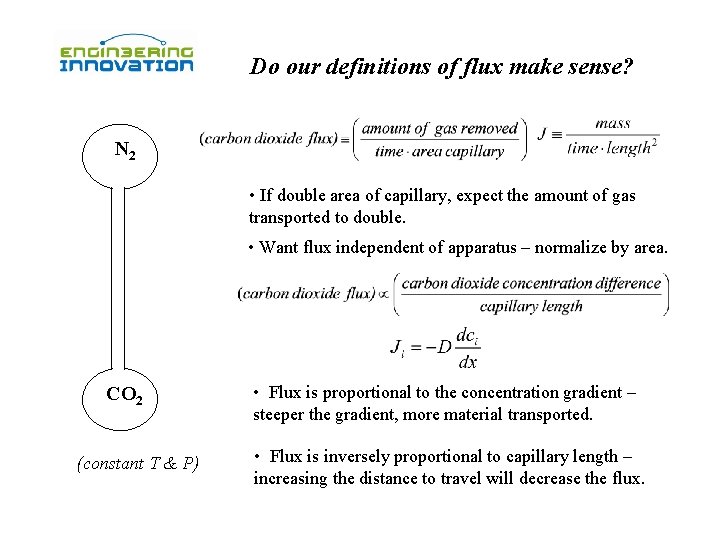
Do our definitions of flux make sense? N 2 • If double area of capillary, expect the amount of gas transported to double. • Want flux independent of apparatus – normalize by area. CO 2 (constant T & P) • Flux is proportional to the concentration gradient – steeper the gradient, more material transported. • Flux is inversely proportional to capillary length – increasing the distance to travel will decrease the flux.
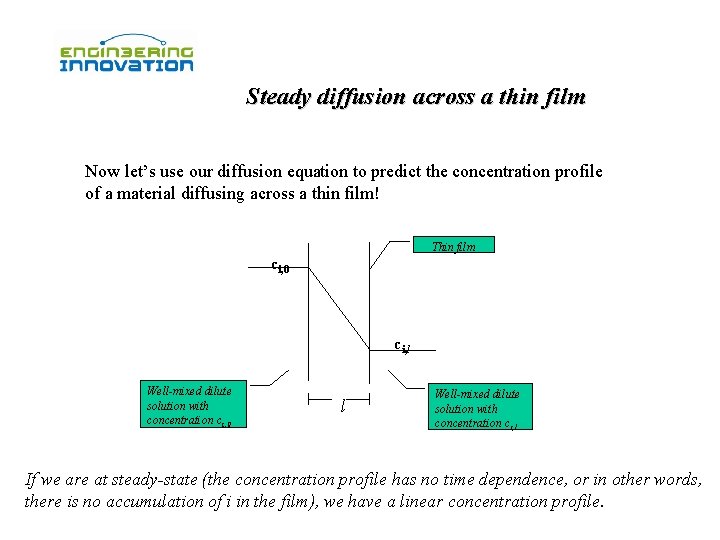
Steady diffusion across a thin film Now let’s use our diffusion equation to predict the concentration profile of a material diffusing across a thin film! Thin film ci, 0 ci, l Well-mixed dilute solution with concentration ci, 0 l Well-mixed dilute solution with concentration ci, l If we are at steady-state (the concentration profile has no time dependence, or in other words, there is no accumulation of i in the film), we have a linear concentration profile.
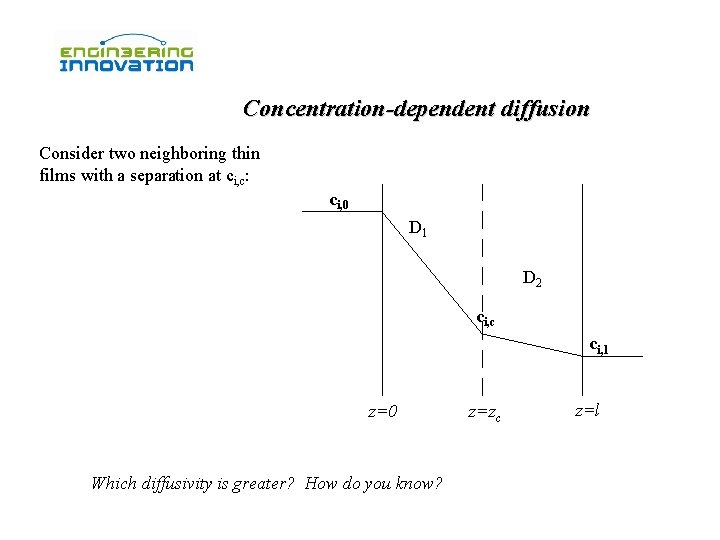
Concentration-dependent diffusion Consider two neighboring thin films with a separation at ci, c: ci, 0 D 1 D 2 ci, c ci, l z=0 Which diffusivity is greater? How do you know? z=zc z=l
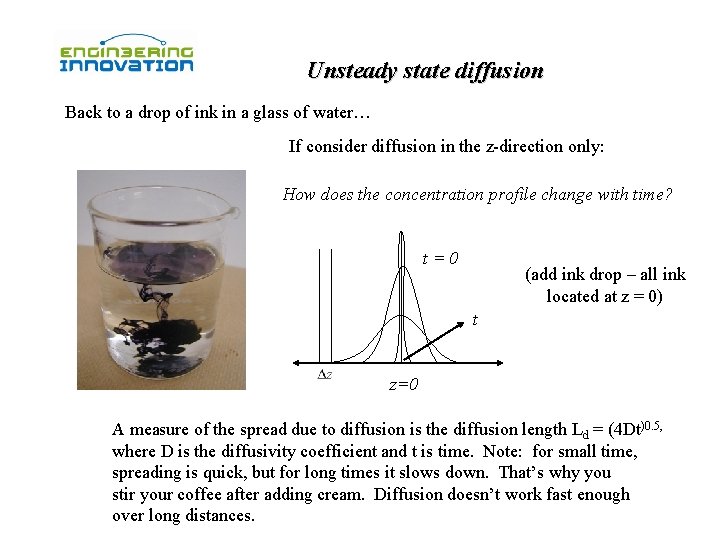
Unsteady state diffusion Back to a drop of ink in a glass of water… If consider diffusion in the z-direction only: How does the concentration profile change with time? t=0 (add ink drop – all ink located at z = 0) t z=0 A measure of the spread due to diffusion is the diffusion length Ld = (4 Dt)0. 5, where D is the diffusivity coefficient and t is time. Note: for small time, spreading is quick, but for long times it slows down. That’s why you stir your coffee after adding cream. Diffusion doesn’t work fast enough over long distances.
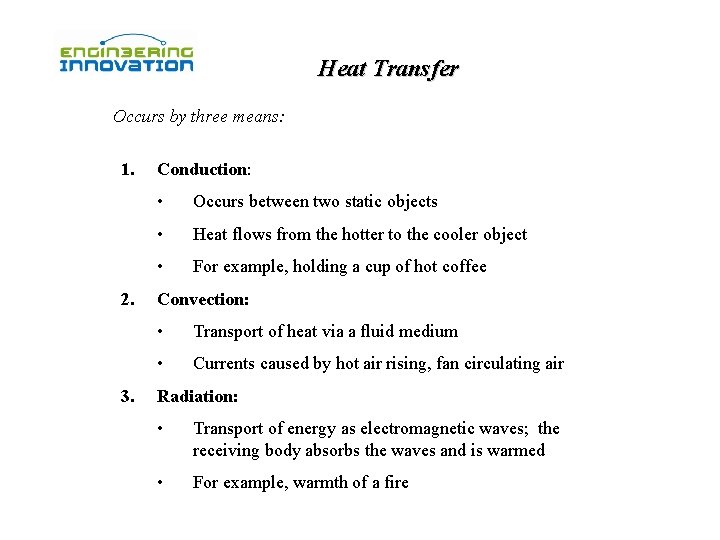
Heat Transfer Occurs by three means: 1. 2. 3. Conduction: • Occurs between two static objects • Heat flows from the hotter to the cooler object • For example, holding a cup of hot coffee Convection: • Transport of heat via a fluid medium • Currents caused by hot air rising, fan circulating air Radiation: • Transport of energy as electromagnetic waves; the receiving body absorbs the waves and is warmed • For example, warmth of a fire
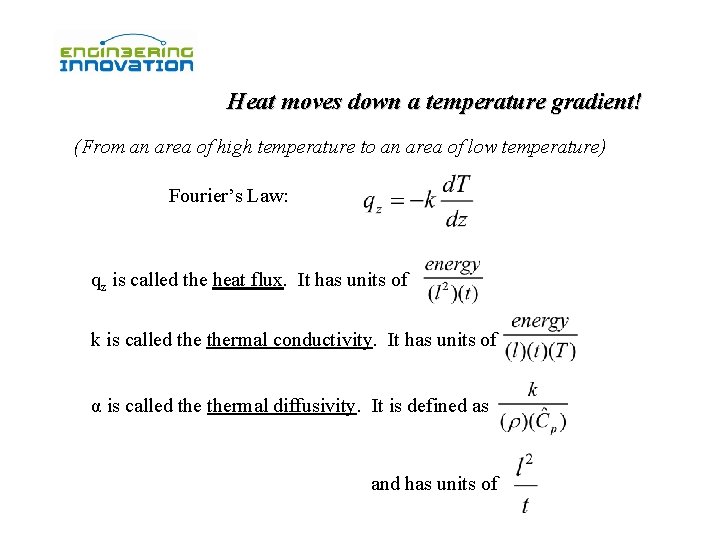
Heat moves down a temperature gradient! (From an area of high temperature to an area of low temperature) Fourier’s Law: qz is called the heat flux. It has units of k is called thermal conductivity. It has units of α is called thermal diffusivity. It is defined as and has units of
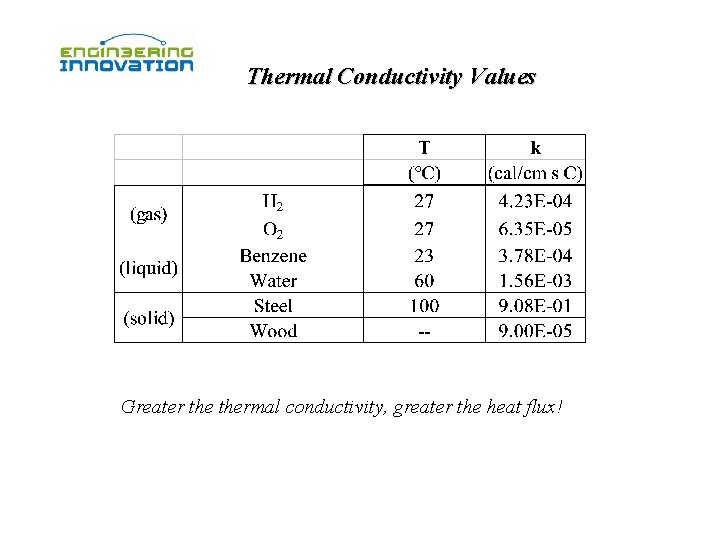
Thermal Conductivity Values Greater thermal conductivity, greater the heat flux!
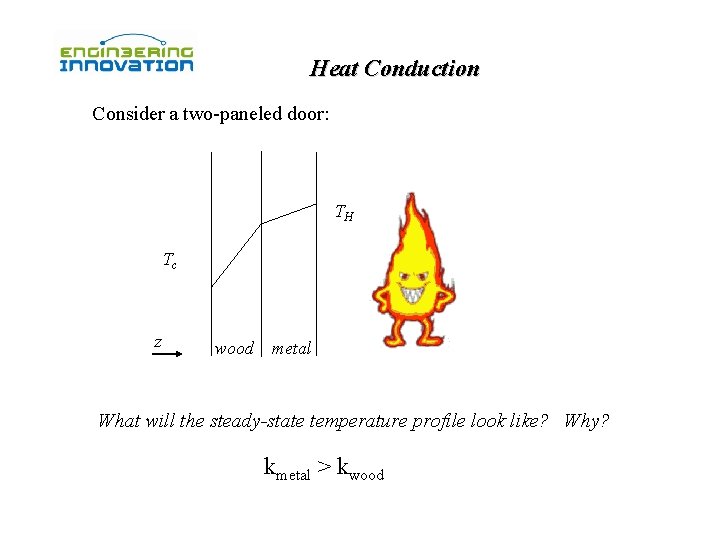
Heat Conduction Consider a two-paneled door: TH Tc z wood metal What will the steady-state temperature profile look like? Why? kmetal > kwood
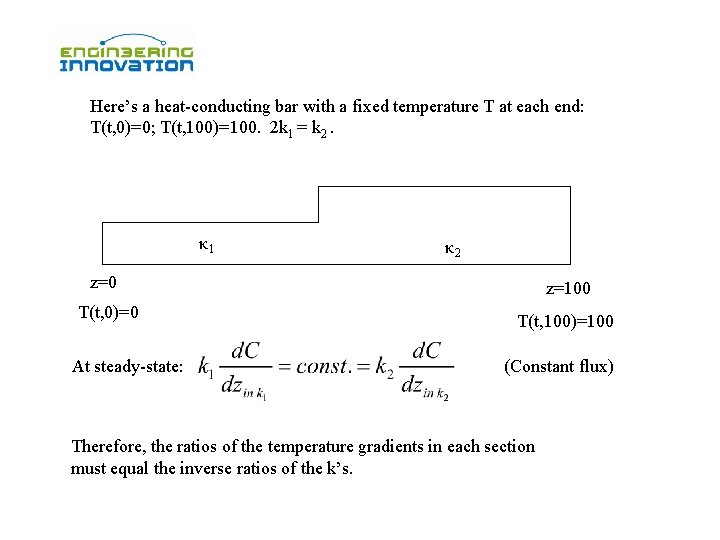
Here’s a heat-conducting bar with a fixed temperature T at each end: T(t, 0)=0; T(t, 100)=100. 2 k 1 = k 2. κ 1 κ 2 z=0 z=100 T(t, 0)=0 T(t, 100)=100 At steady-state: (Constant flux) Therefore, the ratios of the temperature gradients in each section must equal the inverse ratios of the k’s.
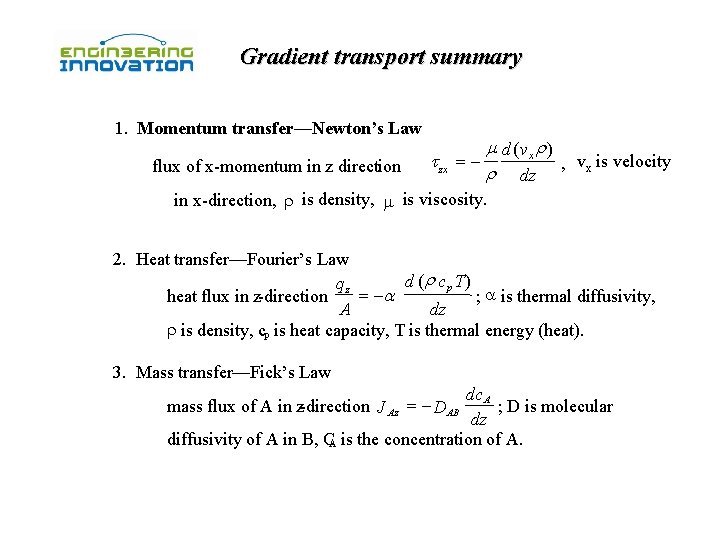
Gradient transport summary 1. Momentum transfer—Newton’s Law flux of x-momentum in z direction t zx = - m d (v x r ) , vx is velocity r dz in x-direction, r is density, m is viscosity. 2. Heat transfer—Fourier’s Law d (r c p. T ) qz = -a heat flux in z-direction ; a is thermal diffusivity, A dz r is density, cp is heat capacity, T is thermal energy (heat). 3. Mass transfer—Fick’s Law dc A mass flux of A in z-direction J A z ; D is molecular dz diffusivity of A in B, CA is the concentration of A. = - D AB
Diffusion processes Heat conduction Diffusion-limited aggregation