
Diffusion Tensor Imaging Davide Bono Roser Caigueral Methods
Diffusion Tensor Imaging Davide Bono & Roser Cañigueral Methods for Dummies – 15 th March 2017
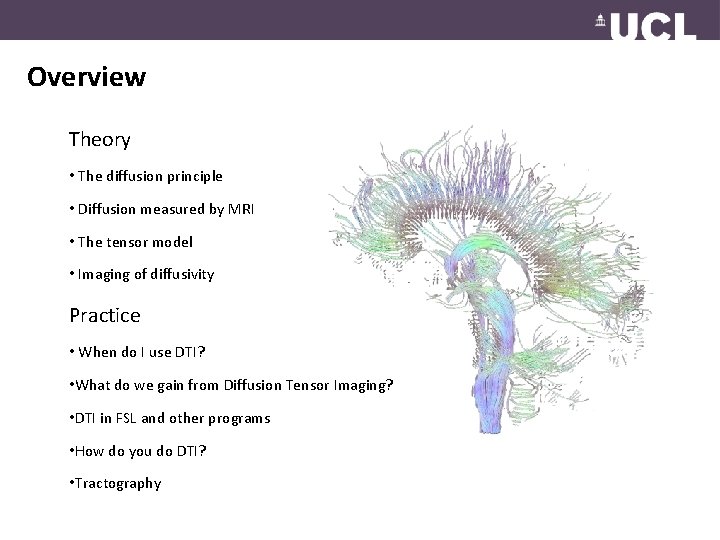
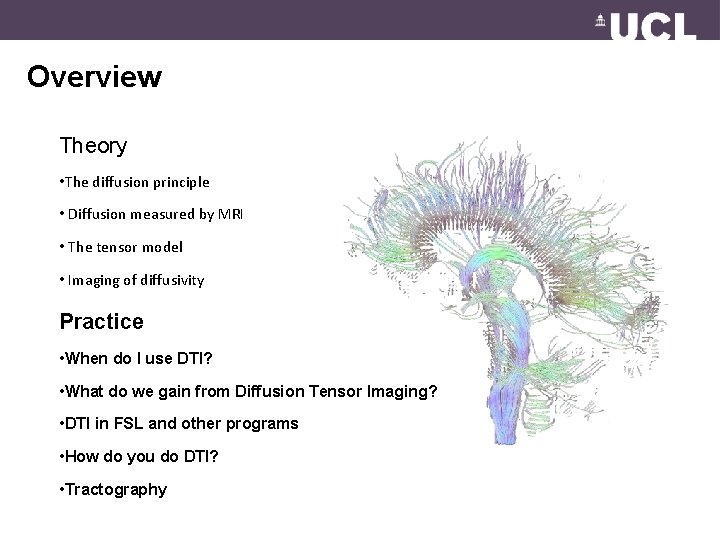
Overview Theory • The diffusion principle • Diffusion measured by MRI • The tensor model • Imaging of diffusivity Practice • When do I use DTI? • What do we gain from Diffusion Tensor Imaging? • DTI in FSL and other programs • How do you do DTI? • Tractography
Overview Theory • The diffusion principle • Diffusion measured by MRI • The tensor model • Imaging of diffusivity Practice • When do I use DTI? • What do we gain from Diffusion Tensor Imaging? • DTI in FSL and other programs • How do you do DTI? • Tractography
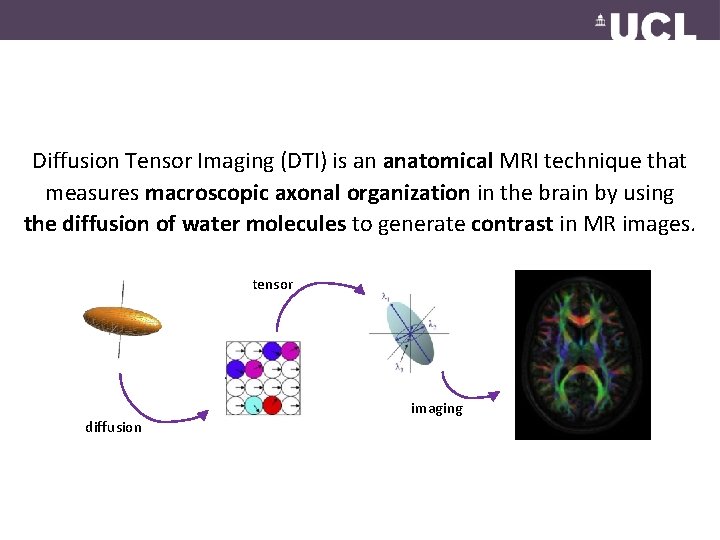
Diffusion Tensor Imaging (DTI) is an anatomical MRI technique that measures macroscopic axonal organization in the brain by using the diffusion of water molecules to generate contrast in MR images. tensor diffusion imaging

The diffusion principle Diffusion Tensor Imaging Brownian/translational motion of water molecules. This motion is influenced by Fick’s Law.

The diffusion principle Diffusion Tensor Imaging In an unrestricted environment, water molecules move randomly Isotropy
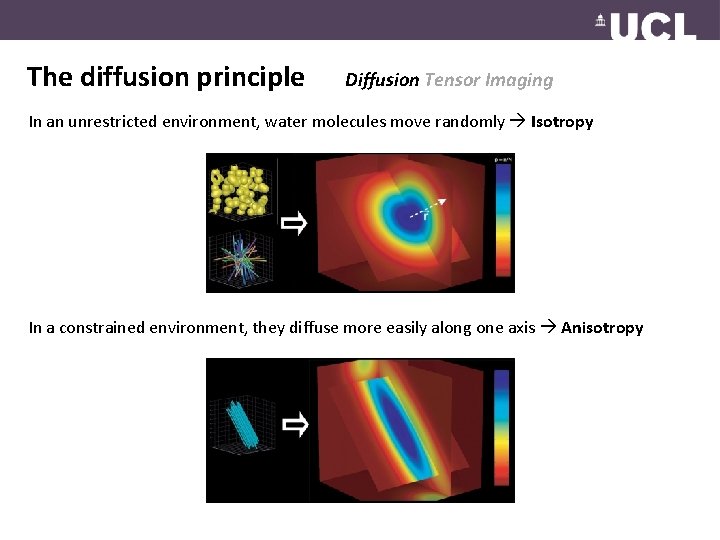
The diffusion principle Diffusion Tensor Imaging In an unrestricted environment, water molecules move randomly Isotropy In a constrained environment, they diffuse more easily along one axis Anisotropy
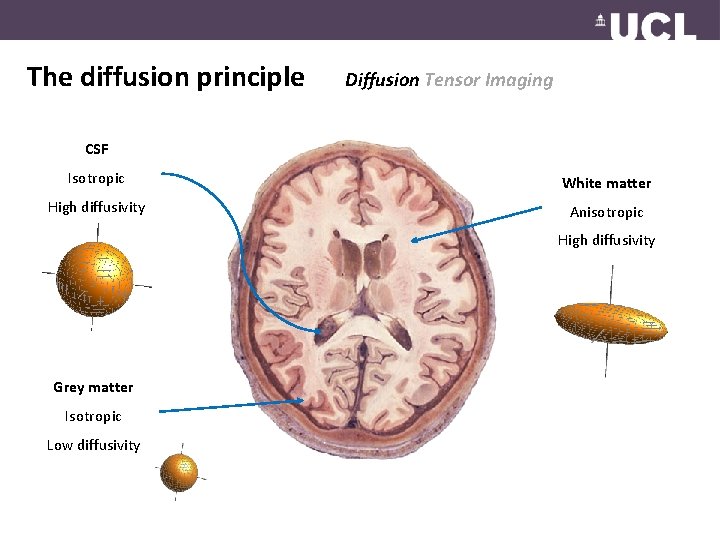
The diffusion principle Diffusion Tensor Imaging CSF Isotropic White matter High diffusivity Anisotropic High diffusivity Grey matter Isotropic Low diffusivity
Diffusion measured by MRI Diffusion Tensor Imaging MRI: • Signal from proton nuclei in water molecules. • Grayscale images that have poor contrast.
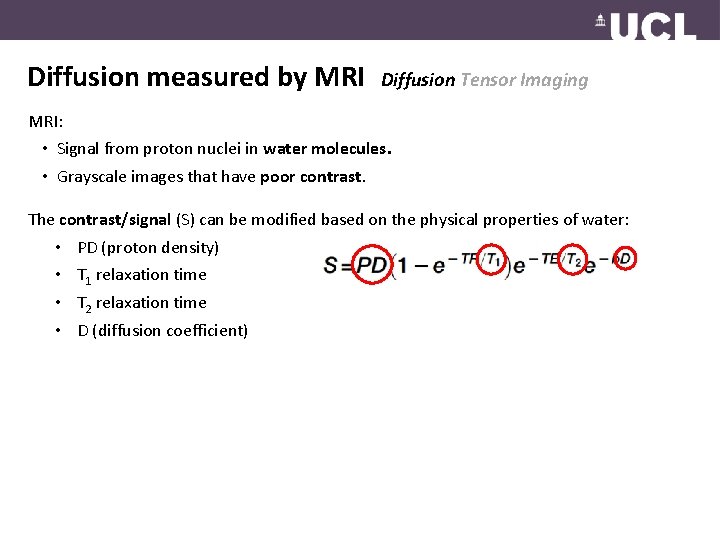
Diffusion measured by MRI Diffusion Tensor Imaging MRI: • Signal from proton nuclei in water molecules. • Grayscale images that have poor contrast. The contrast/signal (S) can be modified based on the physical properties of water: • • PD (proton density) T 1 relaxation time T 2 relaxation time D (diffusion coefficient)
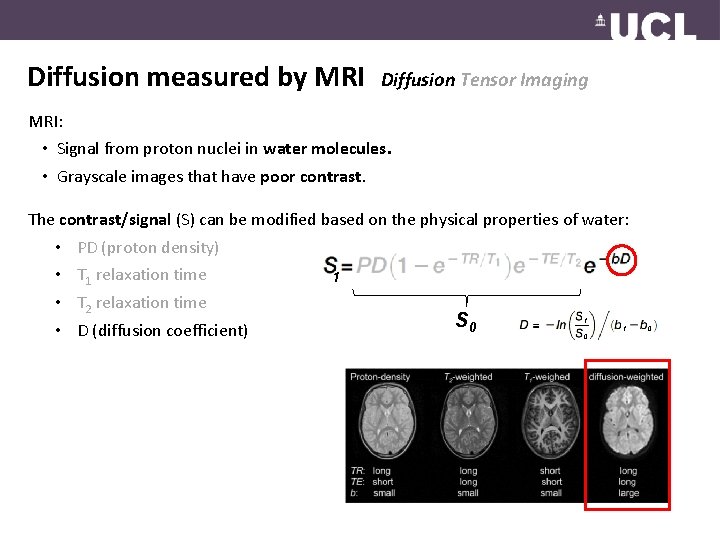
Diffusion measured by MRI Diffusion Tensor Imaging MRI: • Signal from proton nuclei in water molecules. • Grayscale images that have poor contrast. The contrast/signal (S) can be modified based on the physical properties of water: • • PD (proton density) T 1 relaxation time T 2 relaxation time D (diffusion coefficient) 1 S 0 1 0
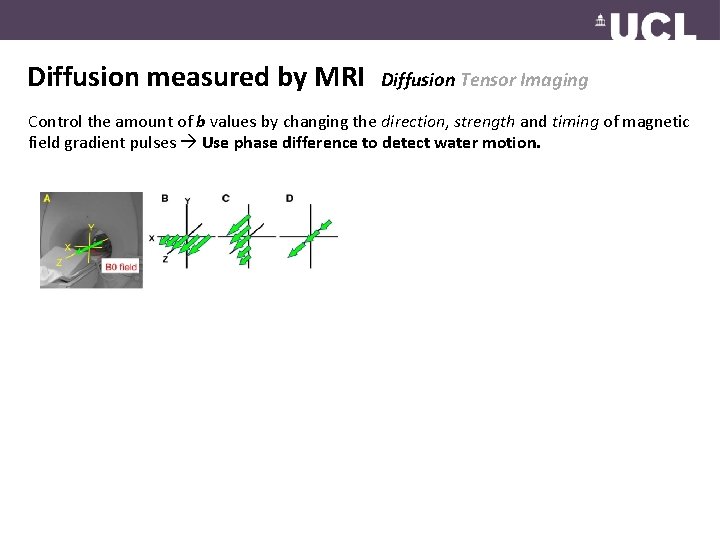
Diffusion measured by MRI Diffusion Tensor Imaging Control the amount of b values by changing the direction, strength and timing of magnetic field gradient pulses Use phase difference to detect water motion.
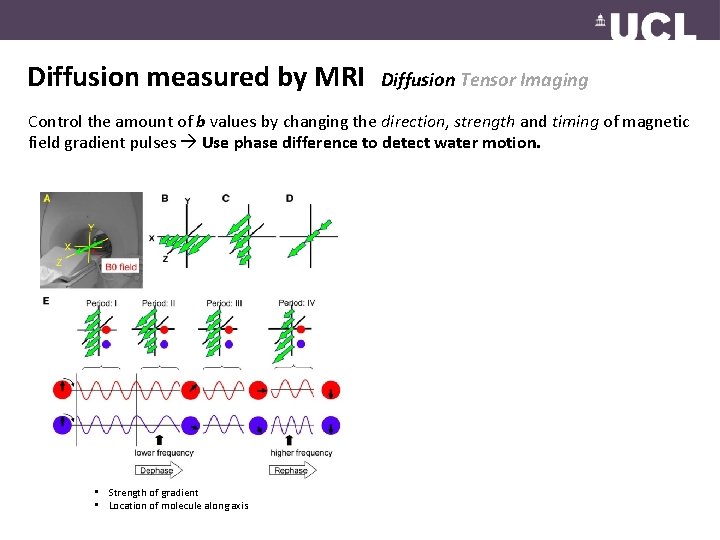
Diffusion measured by MRI Diffusion Tensor Imaging Control the amount of b values by changing the direction, strength and timing of magnetic field gradient pulses Use phase difference to detect water motion. • Strength of gradient • Location of molecule along axis

Diffusion measured by MRI Diffusion Tensor Imaging Control the amount of b values by changing the direction, strength and timing of magnetic field gradient pulses Use phase difference to detect water motion. Signal loss (higher b or D = lower S) • Strength of gradient • Location of molecule along axis
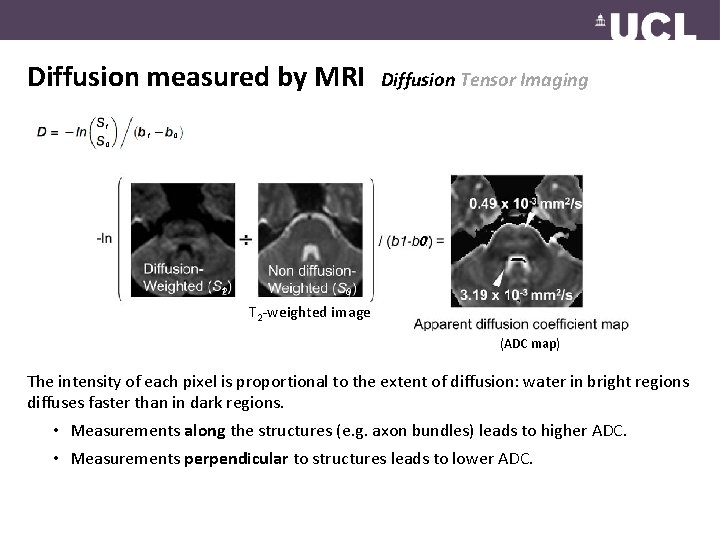
Diffusion measured by MRI Diffusion Tensor Imaging 1 1 0 0 0 1 0 T 2 -weighted image (ADC map) The intensity of each pixel is proportional to the extent of diffusion: water in bright regions diffuses faster than in dark regions. • Measurements along the structures (e. g. axon bundles) leads to higher ADC. • Measurements perpendicular to structures leads to lower ADC.
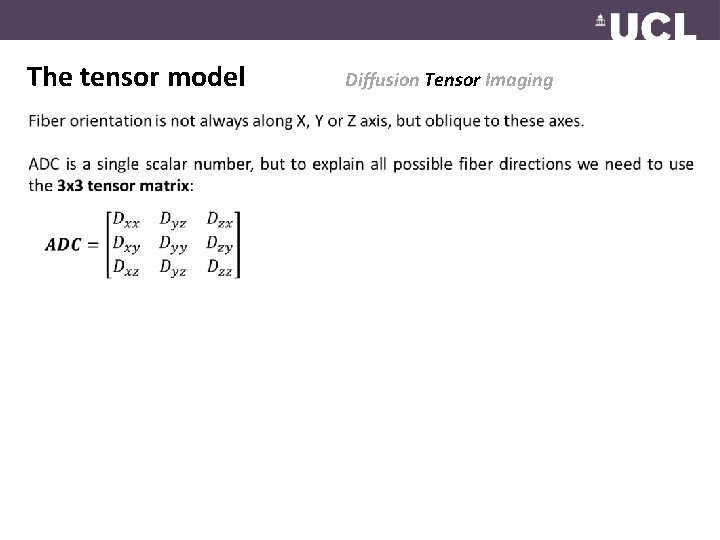
The tensor model Diffusion Tensor Imaging Eigenvalues Eigenvectors
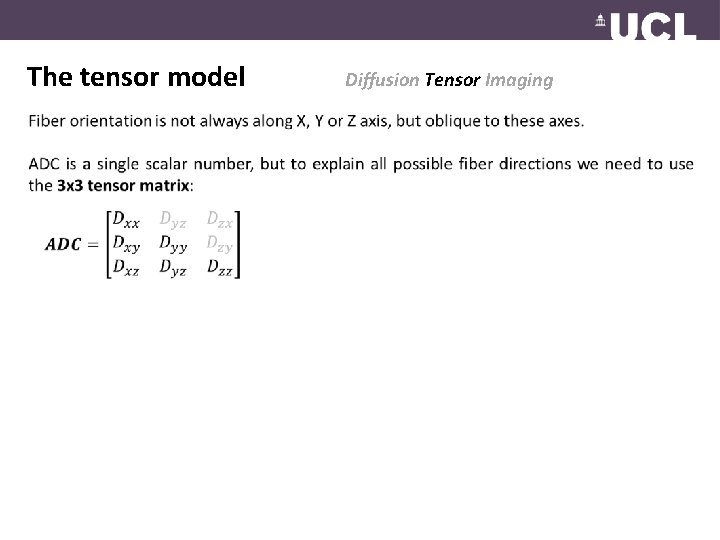
The tensor model Diffusion Tensor Imaging Eigenvalues Eigenvectors
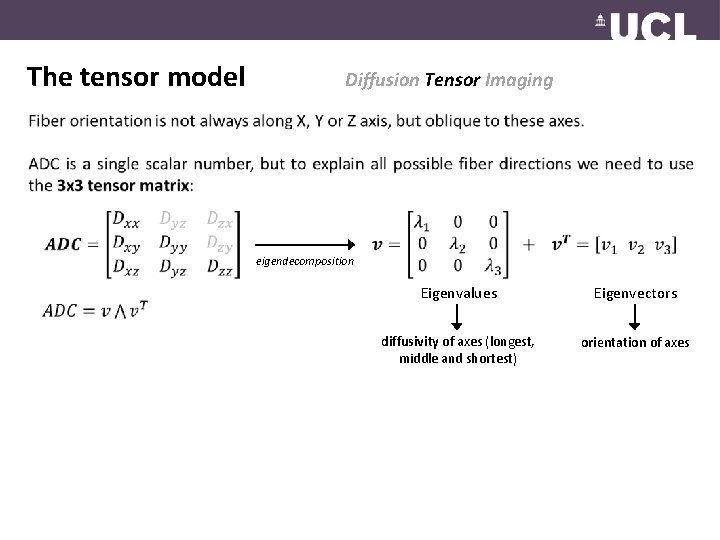
The tensor model Diffusion Tensor Imaging eigendecomposition Eigenvalues Eigenvectors diffusivity of axes (longest, middle and shortest) orientation of axes
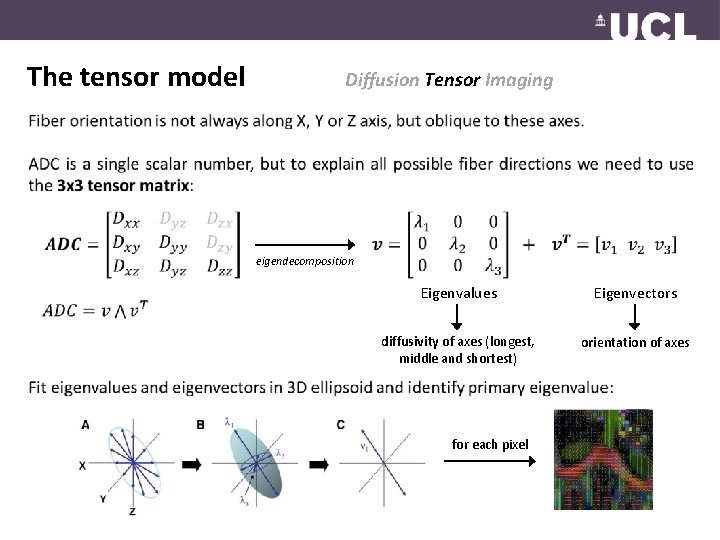
The tensor model Diffusion Tensor Imaging eigendecomposition Eigenvalues Eigenvectors diffusivity of axes (longest, middle and shortest) orientation of axes for each pixel
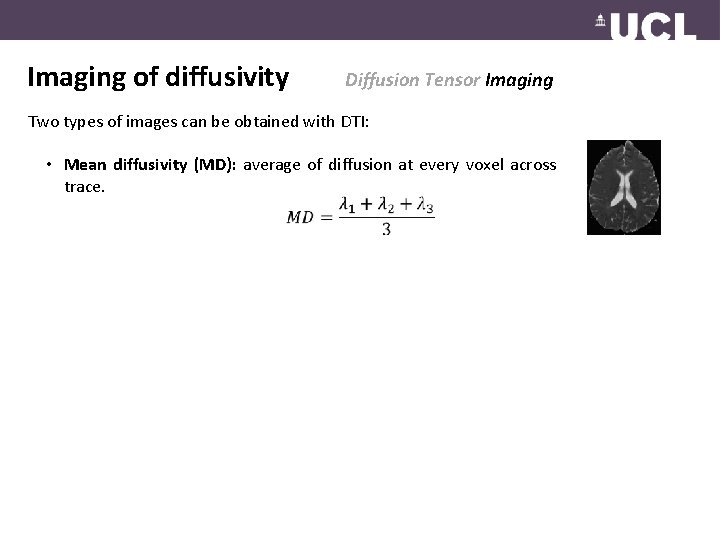
Imaging of diffusivity Diffusion Tensor Imaging Two types of images can be obtained with DTI: • Mean diffusivity (MD): average of diffusion at every voxel across trace.
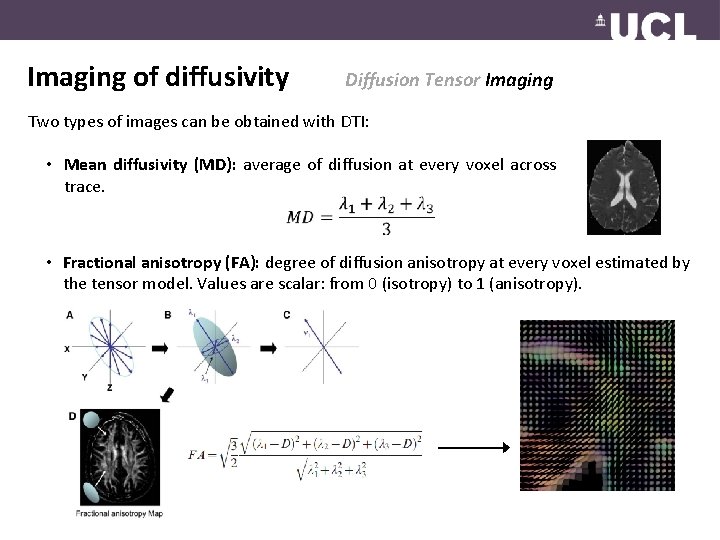
Imaging of diffusivity Diffusion Tensor Imaging Two types of images can be obtained with DTI: • Mean diffusivity (MD): average of diffusion at every voxel across trace. • Fractional anisotropy (FA): degree of diffusion anisotropy at every voxel estimated by the tensor model. Values are scalar: from 0 (isotropy) to 1 (anisotropy).
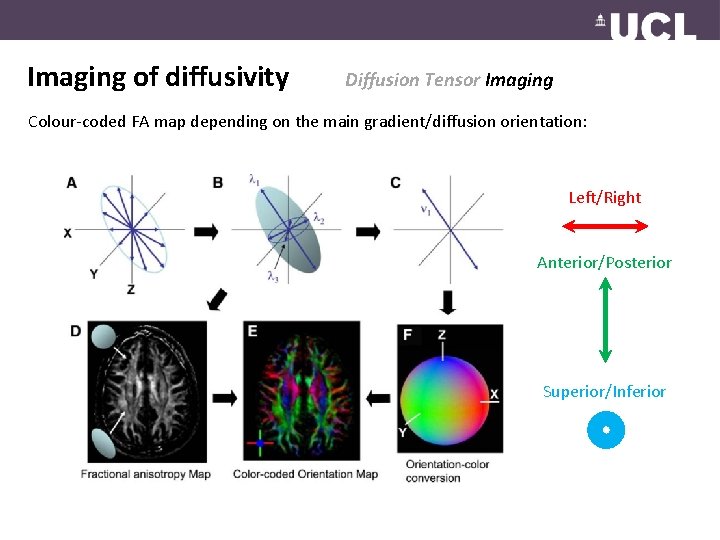
Imaging of diffusivity Diffusion Tensor Imaging Colour-coded FA map depending on the main gradient/diffusion orientation: Left/Right Anterior/Posterior Superior/Inferior
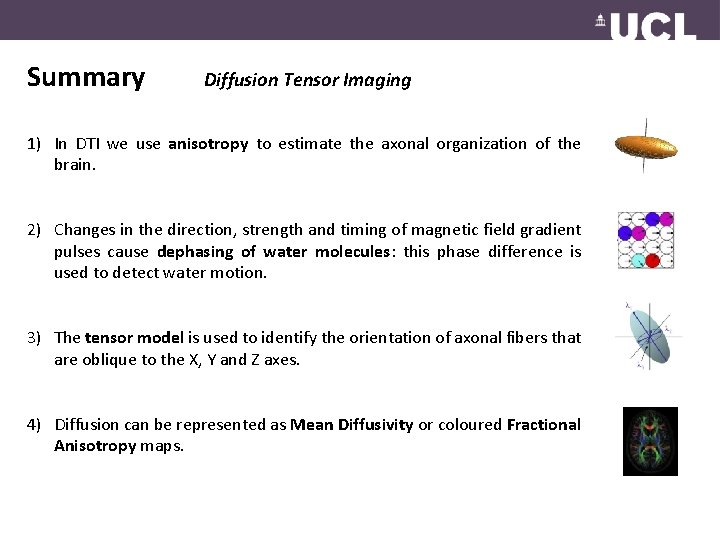
Summary Diffusion Tensor Imaging 1) In DTI we use anisotropy to estimate the axonal organization of the brain. 2) Changes in the direction, strength and timing of magnetic field gradient pulses cause dephasing of water molecules: this phase difference is used to detect water motion. 3) The tensor model is used to identify the orientation of axonal fibers that are oblique to the X, Y and Z axes. 4) Diffusion can be represented as Mean Diffusivity or coloured Fractional Anisotropy maps.
Overview Theory • The diffusion principle • Diffusion measured by MRI • The tensor model • Imaging of diffusivity Practice • When do I use DTI? • What do we gain from Diffusion Tensor Imaging? • DTI in FSL and other programs • How do you do DTI? • Tractography
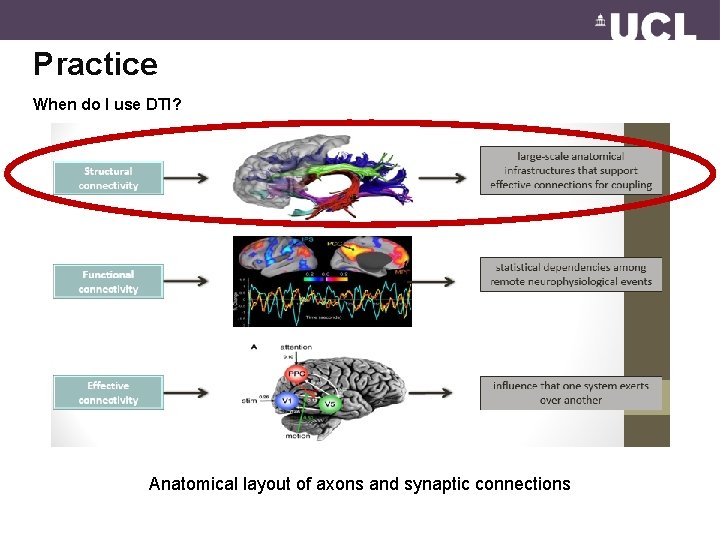
Practice When do I use DTI? Anatomical layout of axons and synaptic connections
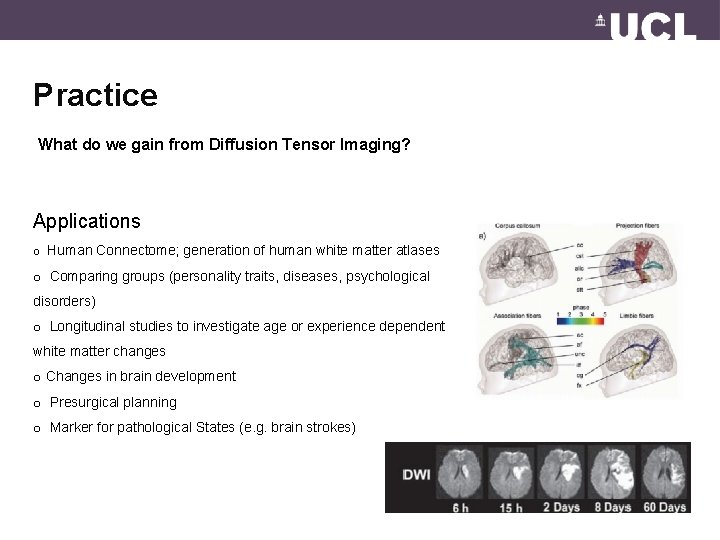
Practice What do we gain from Diffusion Tensor Imaging? Applications o Human Connectome; generation of human white matter atlases o Comparing groups (personality traits, diseases, psychological disorders) o Longitudinal studies to investigate age or experience dependent white matter changes o Changes in brain development o Presurgical planning o Marker for pathological States (e. g. brain strokes)
Limitations o Not reflective of individual structures (no measure of individual axons) rather linked to tracts of structural coherence in the brain o The exact effect of specific structures is not known o No gold standard available
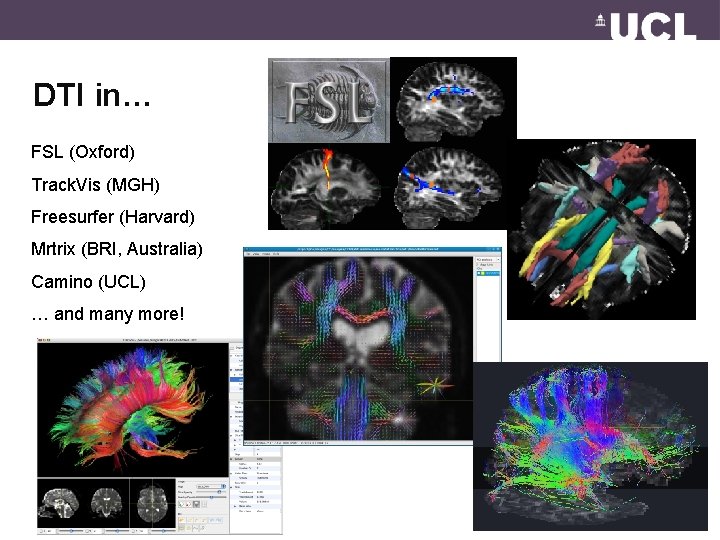
DTI in… FSL (Oxford) Track. Vis (MGH) Freesurfer (Harvard) Mrtrix (BRI, Australia) Camino (UCL) … and many more!
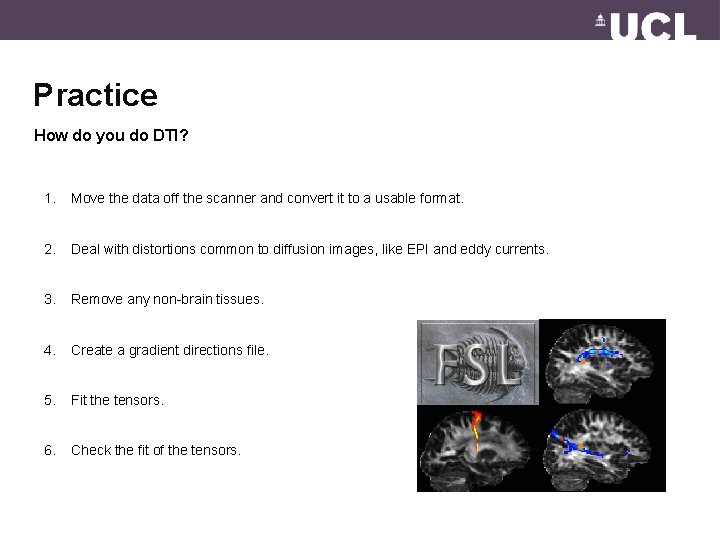
Practice How do you do DTI? 1. Move the data off the scanner and convert it to a usable format. 2. Deal with distortions common to diffusion images, like EPI and eddy currents. 3. Remove any non-brain tissues. 4. Create a gradient directions file. 5. Fit the tensors. 6. Check the fit of the tensors.
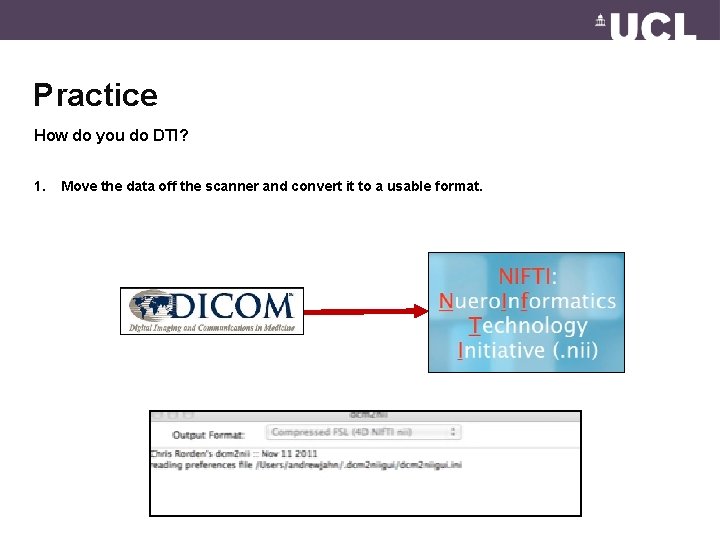
Practice How do you do DTI? 1. Move the data off the scanner and convert it to a usable format.
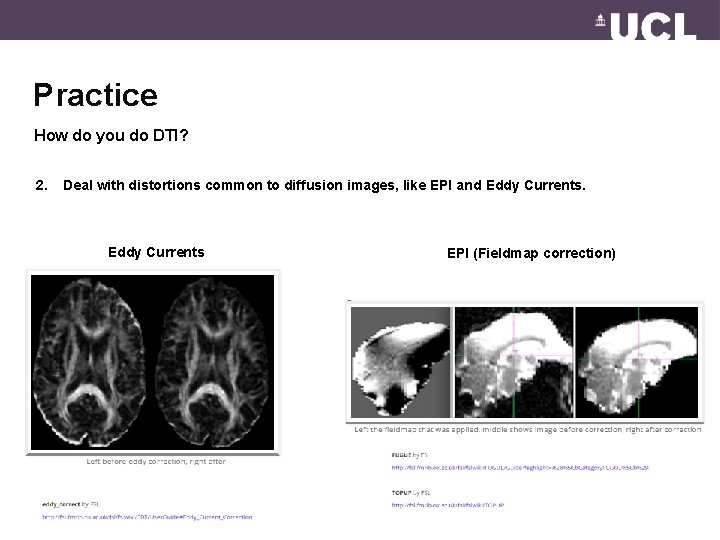
Practice How do you do DTI? 2. Deal with distortions common to diffusion images, like EPI and Eddy Currents EPI (Fieldmap correction)
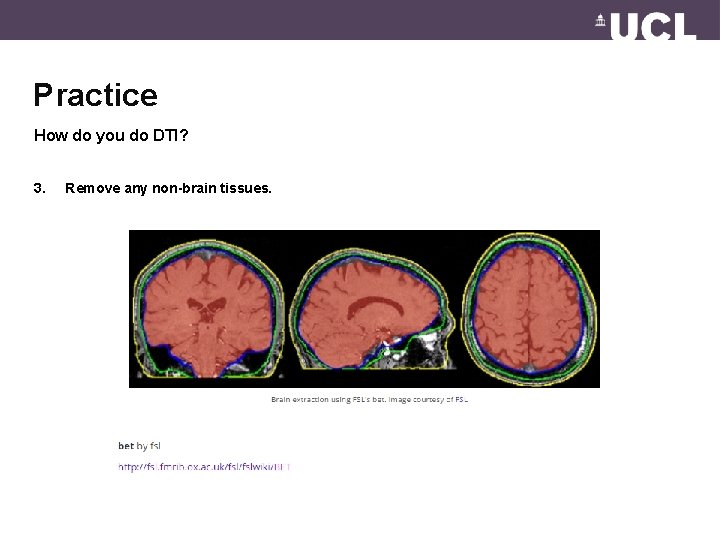
Practice How do you do DTI? 3. Remove any non-brain tissues.
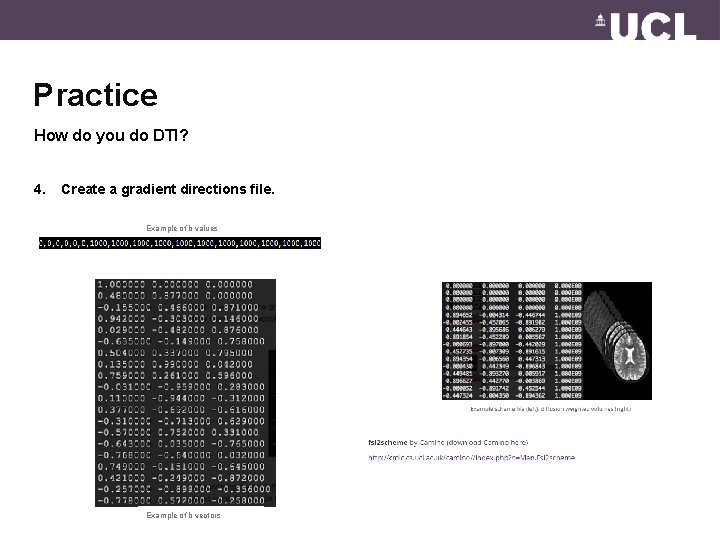
Practice How do you do DTI? 4. Create a gradient directions file. Example of b values Example of b vectors
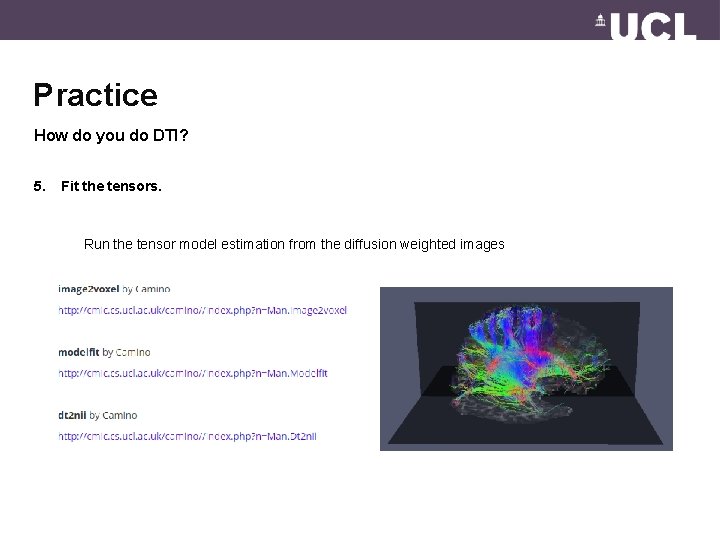
Practice How do you do DTI? 5. Fit the tensors. Run the tensor model estimation from the diffusion weighted images
Practice How do you do DTI? 6. Check the fit of the tensors. Tensor fitting quality control
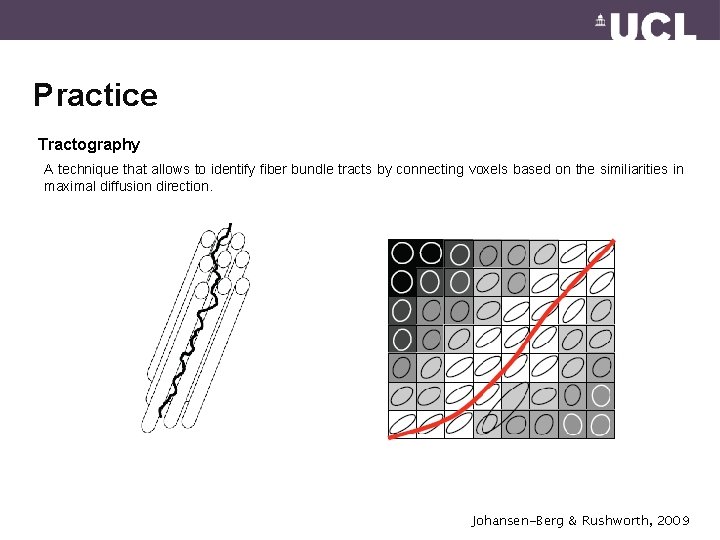
Practice Tractography A technique that allows to identify fiber bundle tracts by connecting voxels based on the similiarities in maximal diffusion direction. Johansen-Berg & Rushworth, 2009
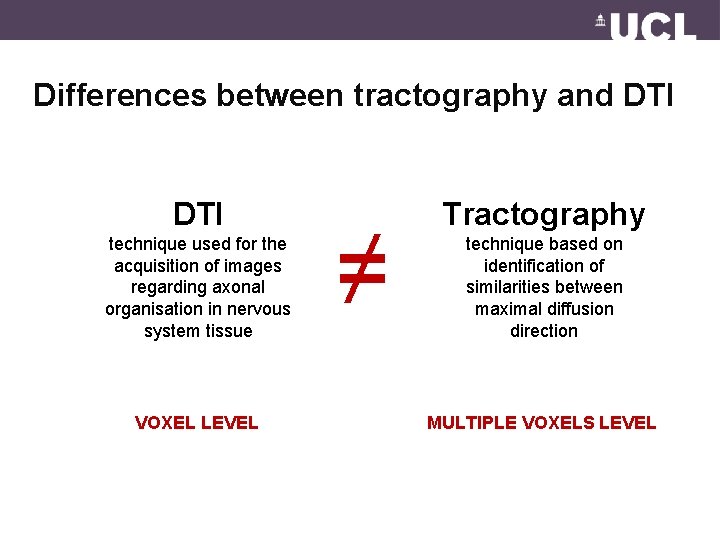
Differences between tractography and DTI technique used for the acquisition of images regarding axonal organisation in nervous system tissue VOXEL LEVEL ≠ Tractography technique based on identification of similarities between maximal diffusion direction MULTIPLE VOXELS LEVEL
Practice Tractography Deterministic: A point estimate of the principal diffusion direction at each voxel is used to draw a single line. Probabilistic: Provides a probability distribution on the diffusion direction at each voxel (the broader the distribution, the higher the uncertainty of connections in that area) which is then used to draw thousands of streamlines to build up a connectivity distribution Advantages: - Allows to continue tracking in areas of high uncertainty (with very curvy tracts) - Provides a quantitative measure of the probability of a pathway being traced between two points
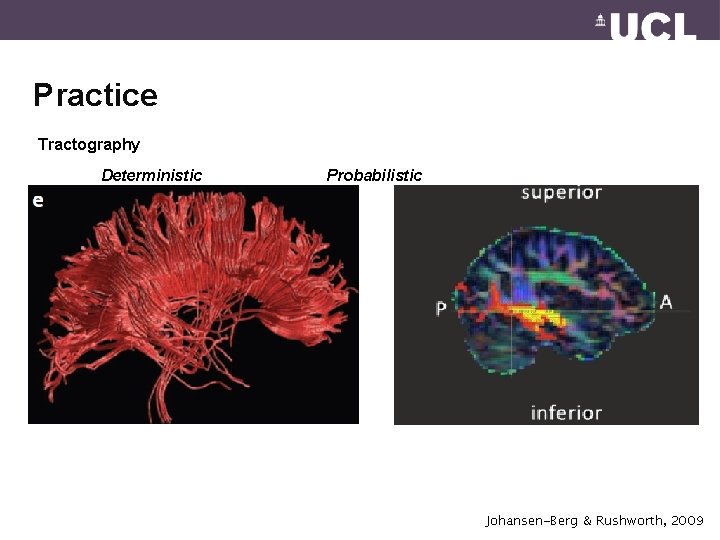
Practice Tractography Deterministic Probabilistic Johansen-Berg & Rushworth, 2009
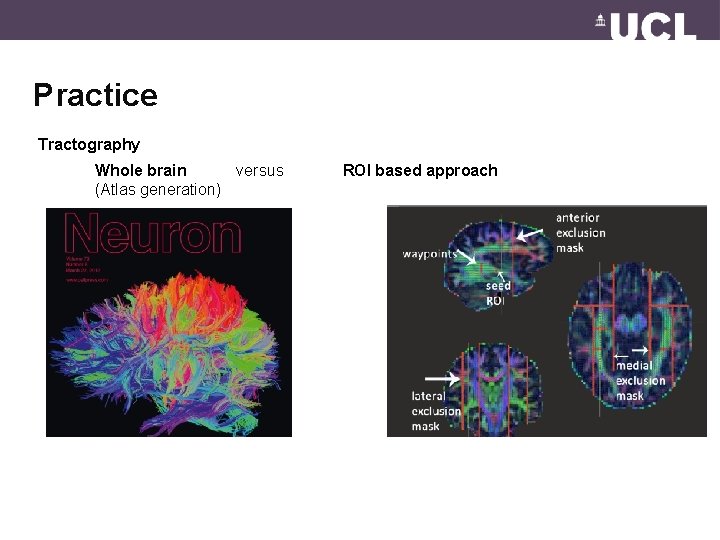
Practice Tractography Whole brain versus (Atlas generation) ROI based approach
Software links FSL’s diffusion toolbox http: //www. fmrib. ox. ac. uk/fsl/fdt/index. html Track. Vis and Diffusion Toolkit http: //trackvis. org/ Freesufer’s TRACULA http: //surfer. nmr. mgh. harvard. edu/fswiki/Tracula MRTrix http: //www. brain. org. au/software/mrtrix/ Camino Diffusion MRI toolkit http: //cmic. cs. ucl. ac. uk/camino/ Tracto. R http: //www. homepages. ucl. ac. uk/~sejjjd 2/software/

Thank you for your attention!! And special thanks to our expert : Dr. Enrico Kaden
References Hagmann et al. (2006). Understanding diffusion MR imaging techniques: From scalar diffusion-weighted imaging to diffusion tensor imaging and beyond. Radiographics, 26, S 205 -S 223. Hagmann P, Kurant M, Gigandet X, Thiran P, Wedeen VJ, et al. (2007). Mapping Human Whole-Brain Structural Networks with Diffusion MRI. PLo. S ONE, 2(7), e 597. Johansen-Berg and Rushworth (2009). Using Diffusion Imaging to Study Human connectional Anatomy. Annu. Rev. Neurosci, 32, 75– 94 Mori S & Zhang J. (2006) Principles of Diffusion Tensor Imaging and its Applications to Basic Neuroscience Research. Neuron, 51, 527 -39.
- Slides: 43