
DIFFUSION OSMOSIS ACTIVE TRANSPORT BUTTONS Click here Clicking
DIFFUSION, OSMOSIS, ACTIVE TRANSPORT BUTTONS Click here; Clicking here will allow you to hear some information Clicking here will move you back a page. Clicking here will bring you back to this page. on the Clicking here will reveal answer Clicking here will reveal some information Clicking here will move you toan the next page topic. Clicking here again will stop the sound. TOPICS Jump to… …Diffusion (two pages). Jump to… …Osmosis (five pages). Jump to… …Active transport – higher tier (one page). Jump to… …practice questions (four pages). Jump to… …exam questions (five pages).
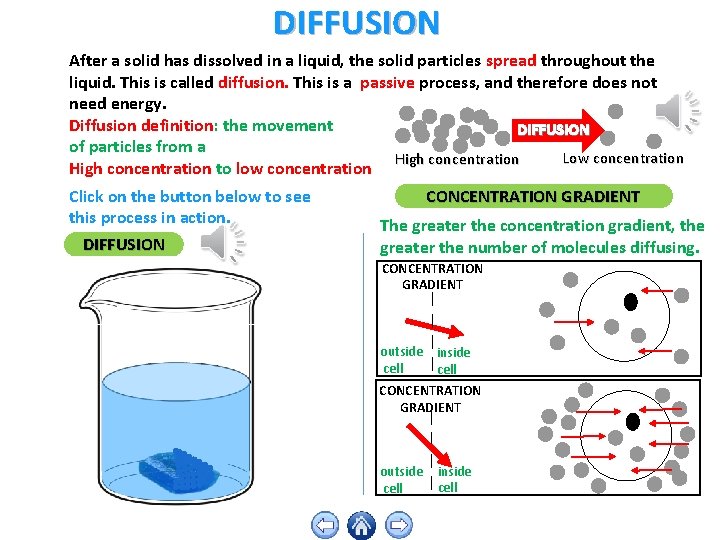
DIFFUSION After a solid has dissolved in a liquid, the solid particles spread throughout the liquid. This is called diffusion. This is a passive process, and therefore does not need energy. Diffusion definition: the movement DIFFUSION of particles from a Low concentration High concentration to low concentration Click on the button below to see this process in action. DIFFUSION CONCENTRATION GRADIENT The greater the concentration gradient, the greater the number of molecules diffusing. CONCENTRATION GRADIENT outside cell inside cell
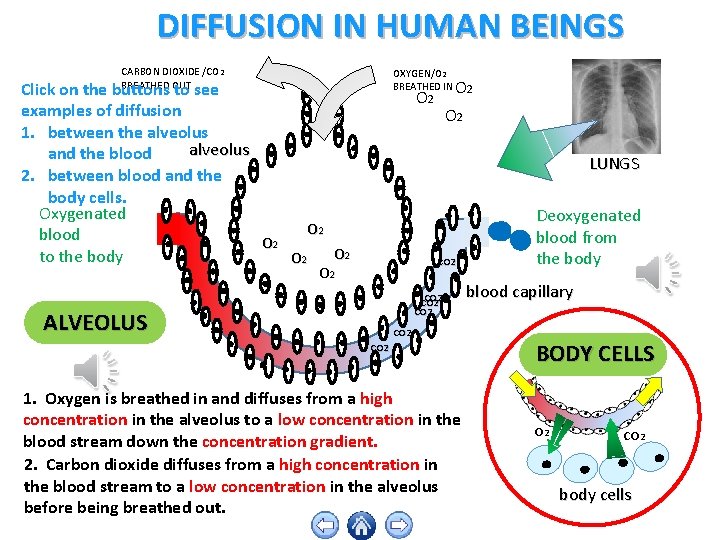
DIFFUSION IN HUMAN BEINGS CARBON DIOXIDE /CO 2 BREATHED OUT OXYGEN/O 2 BREATHED IN Click on the buttons to see examples of diffusion 1. between the alveolus and the blood 2. between blood and the body cells. Oxygenated O 2 blood O 2 to the body O 2 O 2 LUNGS CO 2 O 2 CCO 2 ALVEOLUS CO 2 1. Oxygen is breathed in and diffuses from a high concentration in the alveolus to a low concentration in the blood stream down the concentration gradient. 2. Carbon dioxide diffuses from a high concentration in the blood stream to a low concentration in the alveolus before being breathed out. Deoxygenated blood from the body blood capillary BODY CELLS o 2 co 2 body cells

OSMOSIS DEFINITION: The diffusion of water from a high concentration of water to a low concentration of water, through a selectively permeable membrane Click on the button below learn more. Selectively permeable membrane Osmosis animation A membrane with microscopic Selectively pores which only allows certain VOLUME INCREASING permeable particles through. membrane VOLUME DECREASING OSMOSIS Here, only the blue particles are small enough to fit through the pores in the membrane
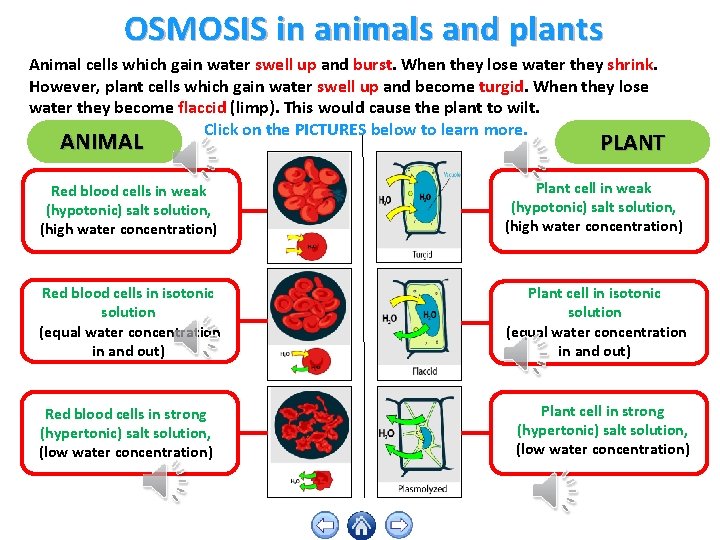
OSMOSIS in animals and plants Animal cells which gain water swell up and burst. When they lose water they shrink. However, plant cells which gain water swell up and become turgid. When they lose water they become flaccid (limp). This would cause the plant to wilt. Click on the PICTURES below to learn more. ANIMAL PLANT Red blood cells in weak (hypotonic) salt solution, (high water concentration) Plant cell in weak (hypotonic) salt solution, (high water concentration) Red blood cells in isotonic solution (equal water concentration in and out) Plant cell in isotonic solution (equal water concentration in and out) Red blood cells in strong (hypertonic) salt solution, (low water concentration) Plant cell in strong (hypertonic) salt solution, (low water concentration)
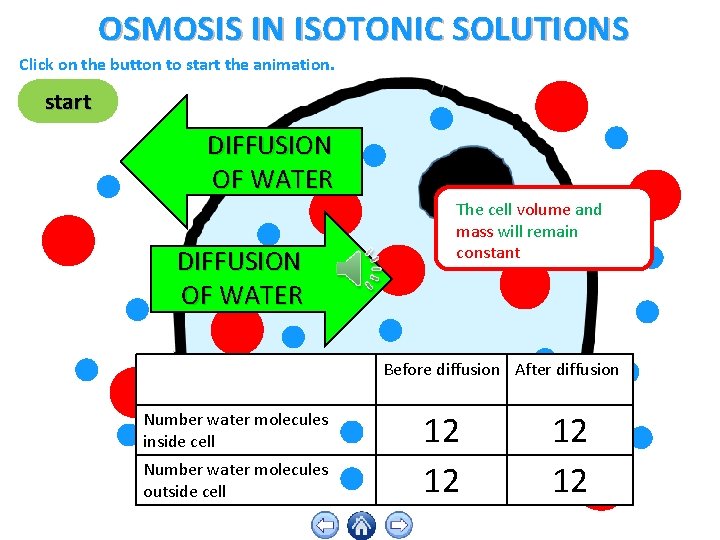
OSMOSIS IN ISOTONIC SOLUTIONS Click on the button to start the animation. start DIFFUSION OF WATER The cell volume and mass will remain constant ssy DIFFUSION OF WATER Before diffusion After diffusion Number water molecules inside cell Number water molecules outside cell 12 12
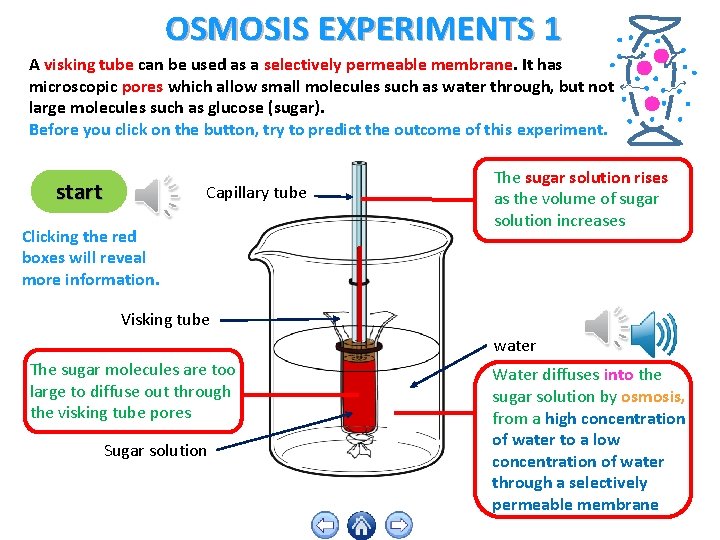
OSMOSIS EXPERIMENTS 1 A visking tube can be used as a selectively permeable membrane. It has microscopic pores which allow small molecules such as water through, but not large molecules such as glucose (sugar). Before you click on the button, try to predict the outcome of this experiment. start Capillary tube Clicking the red boxes will reveal more information. The sugar solution rises as the volume of sugar solution increases Visking tube water The sugar molecules are too large to diffuse out through the visking tube pores Sugar solution Water diffuses into the sugar solution by osmosis, from a high concentration of water to a low concentration of water through a selectively permeable membrane
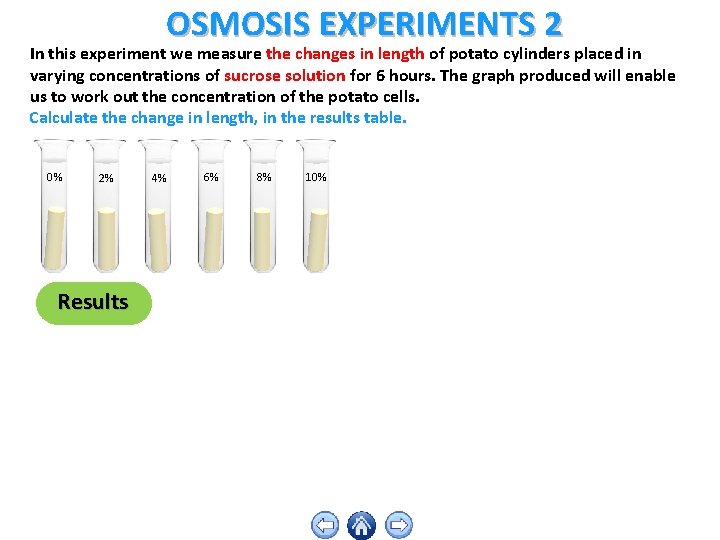
OSMOSIS EXPERIMENTS 2 In this experiment we measure the changes in length of potato cylinders placed in varying concentrations of sucrose solution for 6 hours. The graph produced will enable us to work out the concentration of the potato cells. At a sucrose concentration of Calculate the change in length, in the results table. 5. 2% there is no change in length as there is no net flow of water in or out of the potato cells by osmosis. Both concentrations are equal. +2. 0 2% 4% 6% 8% Concentration of sucrose solution /% Initial length /cm Final length /cm Change in length /cm 0. 0 5. 0 6. 5 +1. 5 2. 0 5. 0 6. 2 +1. 2 4. 0 5. 5 +0. 5 6. 0 5. 0 4. 8 -0. 2 8. 0 5. 0 4. 0 -1. 0 10. 0 5. 0 3. 5 -1. 5 Results +1. 5 10% change in length/cm 0% +1. 0 +0. 5 0. 0 -0. 5 2. 0 4. 0 6. 0 8. 0 10. 0 sucrose solution concentration/% -1. 0 -1. 5 -2. 0 We can also say that concentration of the water in the sucrose solution is equal to the concentration of the water in the cells.
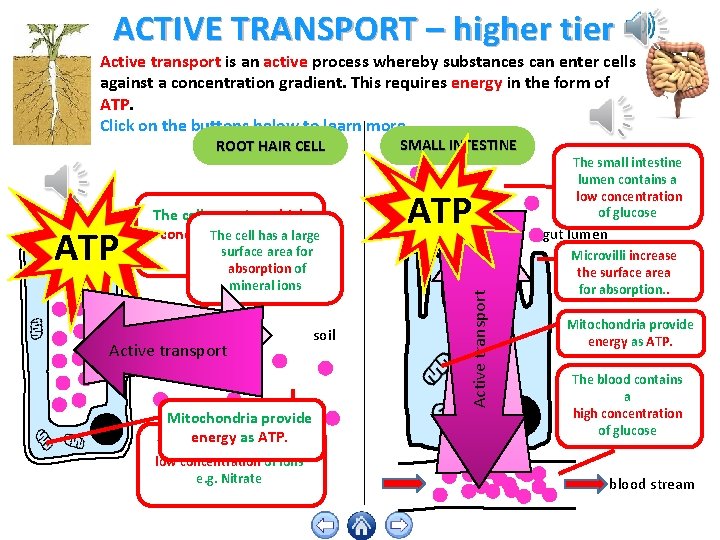
ACTIVE TRANSPORT – higher tier Active transport is an active process whereby substances can enter cells against a concentration gradient. This requires energy in the form of ATP. Click on the buttons below to learn more. ATP The cell contains a high concentration The cell of hasions a large surface area for e. g. Nitrate absorption of mineral ions Concentration gradient Active transport Mitochondria provide energy ATP. a The soil water as contains low concentration of ions e. g. Nitrate soil SMALL INTESTINE ATP Active transport Concentration gradient ROOT HAIR CELL The small intestine lumen contains a low concentration of glucose gut lumen Microvilli increase the surface area for absorption. . Mitochondria provide energy as ATP. The blood contains a high concentration of glucose blood stream

TEST YOUR UNDERSTANDING- FOUNDATION Click on the statements. DIFFUSION or OSMOSIS buttons which match the DIFFUSION Can occur in the absence of a cell membrane OSMOSIS DIFFUSION Responsible for maintaining plant cell shape OSMOSIS DIFFUSION Occurs through a selectively permeable membrane OSMOSIS DIFFUSION Diffusion of water across a membrane OSMOSIS DIFFUSION Movement of water molecules from high to low concentration of water OSMOSIS DIFFUSION This is how gas exchange occurs in the lung’s alveoli OSMOSIS Movement of particles from high to low concentration OSMOSIS DIFFUSION
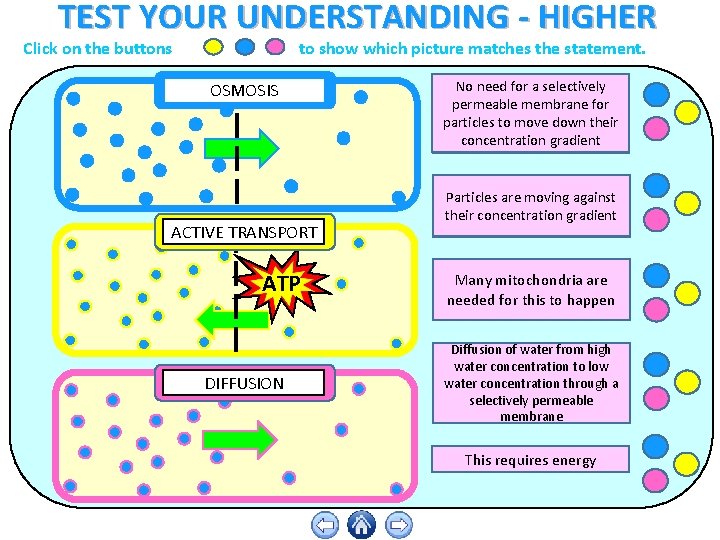
TEST YOUR UNDERSTANDING - HIGHER Click on the buttons to show which picture matches the statement. OSMOSIS ACTIVE TRANSPORT ATP DIFFUSION No need for a selectively permeable membrane for particles to move down their concentration gradient Particles are moving against their concentration gradient Many mitochondria are needed for this to happen Diffusion of water from high water concentration to low water concentration through a selectively permeable membrane This requires energy
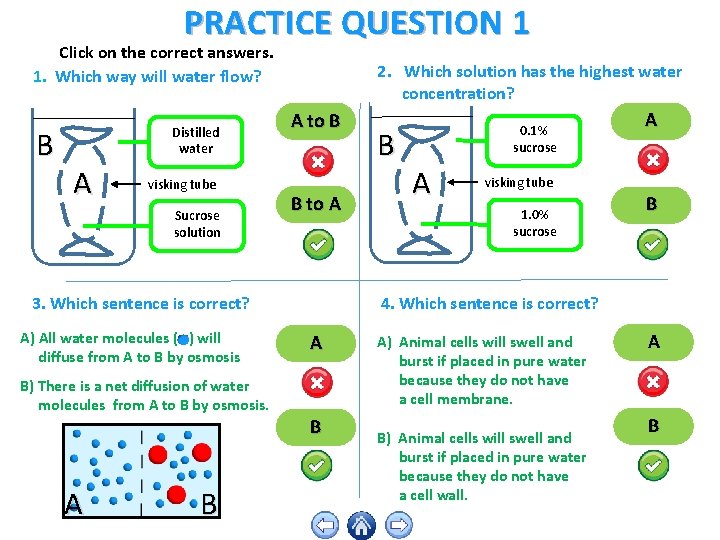
PRACTICE QUESTION 1 Click on the correct answers. 1. Which way will water flow? B Distilled water A visking tube Sucrose solution 2. Which solution has the highest water concentration? A to B B to A B) There is a net diffusion of water molecules from A to B by osmosis. A B A A visking tube 1. 0% sucrose B 4. Which sentence is correct? 3. Which sentence is correct? A) All water molecules ( ) will diffuse from A to B by osmosis B 0. 1% sucrose A B A) Animal cells will swell and burst if placed in pure water because they do not have a cell membrane. B) Animal cells will swell and burst if placed in pure water because they do not have a cell wall. A B
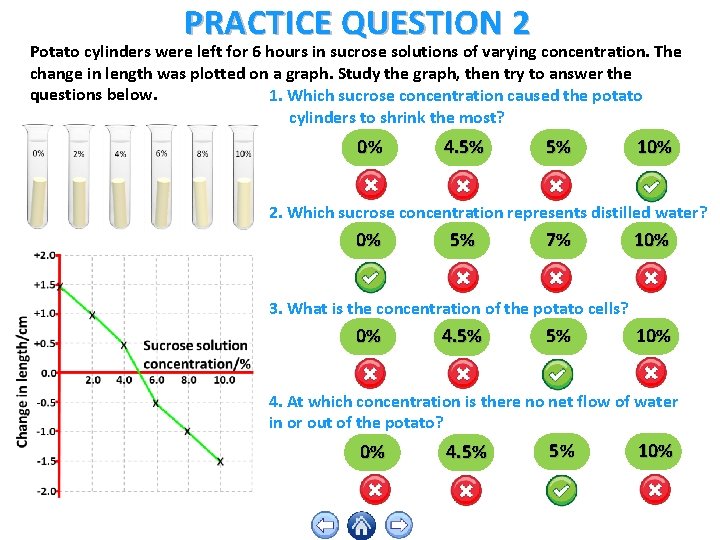
PRACTICE QUESTION 2 Potato cylinders were left for 6 hours in sucrose solutions of varying concentration. The change in length was plotted on a graph. Study the graph, then try to answer the questions below. 1. Which sucrose concentration caused the potato cylinders to shrink the most? 0% 4. 5% 5% 10% 2. Which sucrose concentration represents distilled water? 0% 5% 7% 10% 3. What is the concentration of the potato cells? 0% 4. 5% 5% 10% 4. At which concentration is there no net flow of water in or out of the potato? 0% 4. 5% 5% 10%
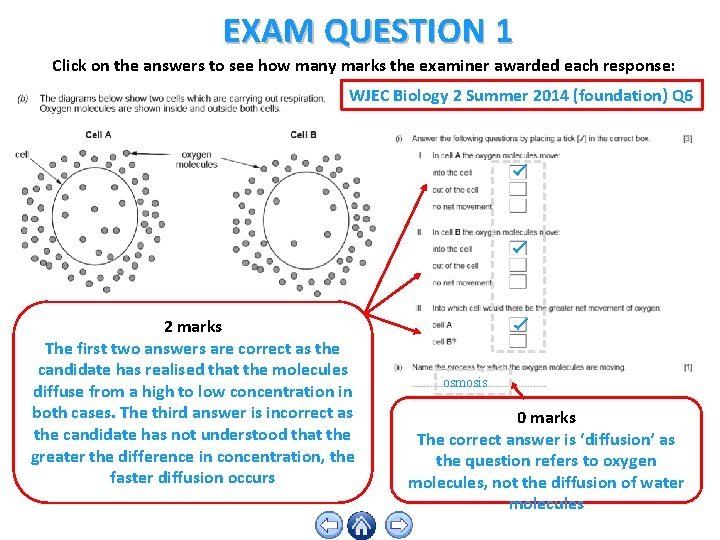
EXAM QUESTION 1 Click on the answers to see how many marks the examiner awarded each response: WJEC Biology 2 Summer 2014 (foundation) Q 6 2 marks The first two answers are correct as the candidate has realised that the molecules diffuse from a high to low concentration in both cases. The third answer is incorrect as the candidate has not understood that the greater the difference in concentration, the faster diffusion occurs osmosis 0 marks The correct answer is ‘diffusion’ as the question refers to oxygen molecules, not the diffusion of water molecules
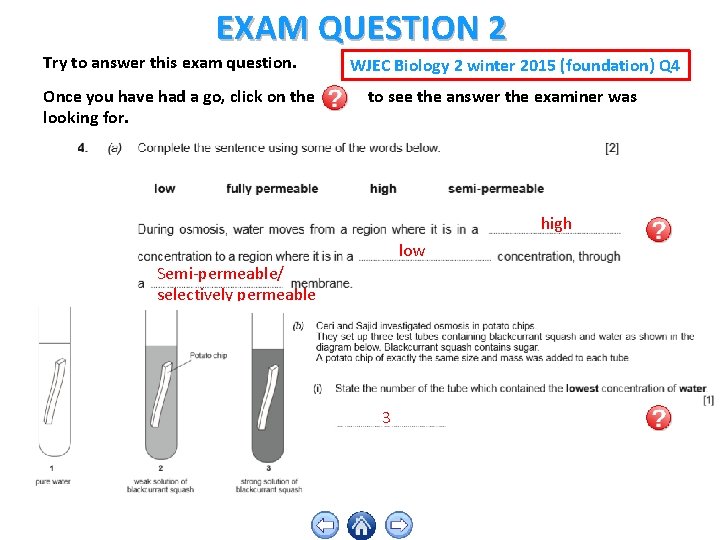
EXAM QUESTION 2 Try to answer this exam question. Once you have had a go, click on the looking for. WJEC Biology 2 winter 2015 (foundation) Q 4 to see the answer the examiner was high low Semi-permeable/ selectively permeable 3
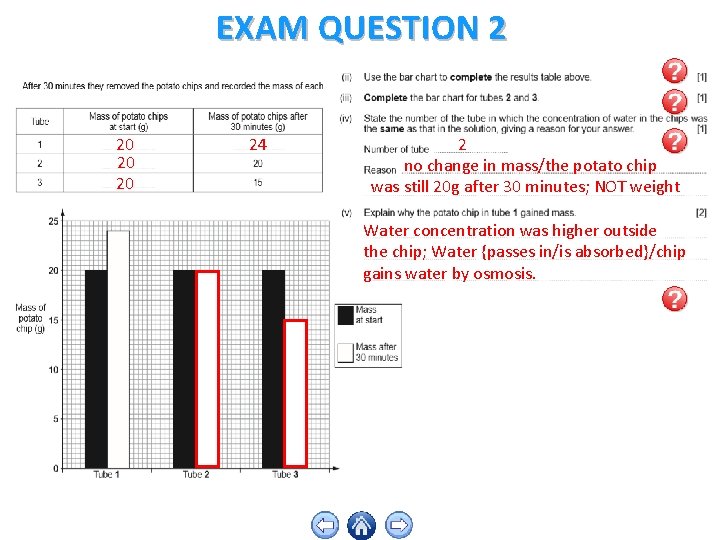
EXAM QUESTION 2 20 20 20 24 2 no change in mass/the potato chip was still 20 g after 30 minutes; NOT weight Water concentration was higher outside the chip; Water {passes in/is absorbed}/chip gains water by osmosis.
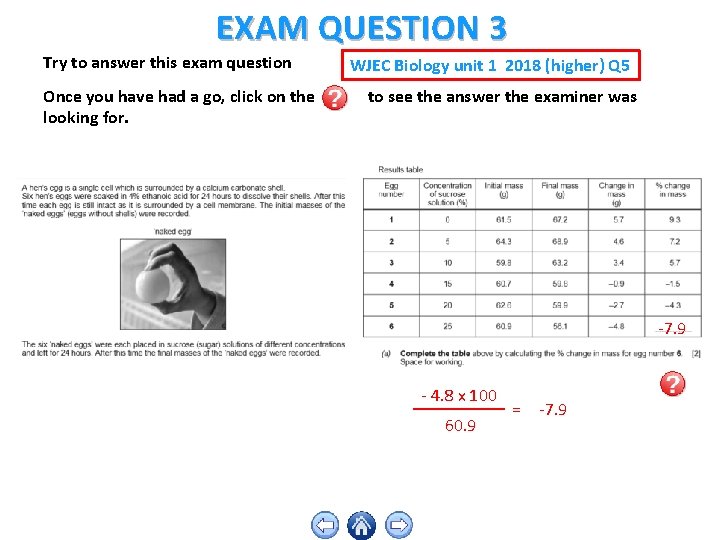
EXAM QUESTION 3 Try to answer this exam question Once you have had a go, click on the looking for. WJEC Biology unit 1 2018 (higher) Q 5 to see the answer the examiner was -7. 9 - 4. 8 x 100 60. 9 = -7. 9
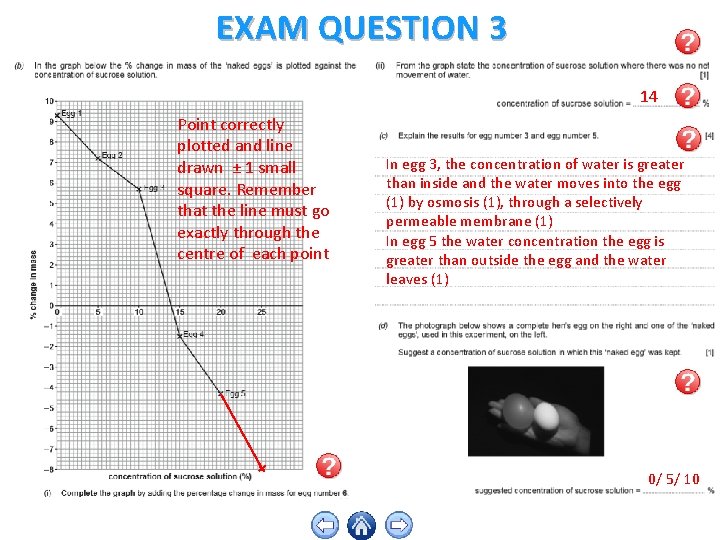
EXAM QUESTION 3 14 Point correctly plotted and line drawn ± 1 small square. Remember that the line must go exactly through the centre of each point In egg 3, the concentration of water is greater than inside and the water moves into the egg (1) by osmosis (1), through a selectively permeable membrane (1) In egg 5 the water concentration the egg is greater than outside the egg and the water leaves (1) 0/ 5/ 10
- Slides: 18