
Diffusion of Responsibility and the Bystander Effect John
Diffusion of Responsibility and the Bystander Effect John Cessna Megan Remec Nicole Meehan
Overview n What is the diffusion of responsibility? n What is the bystander effect? n Examples of the Diffusion of Responsibility n Examples of the Bystander Effect n Boondock Saints and the diffusion of Responsibility and the Bystander Effect.
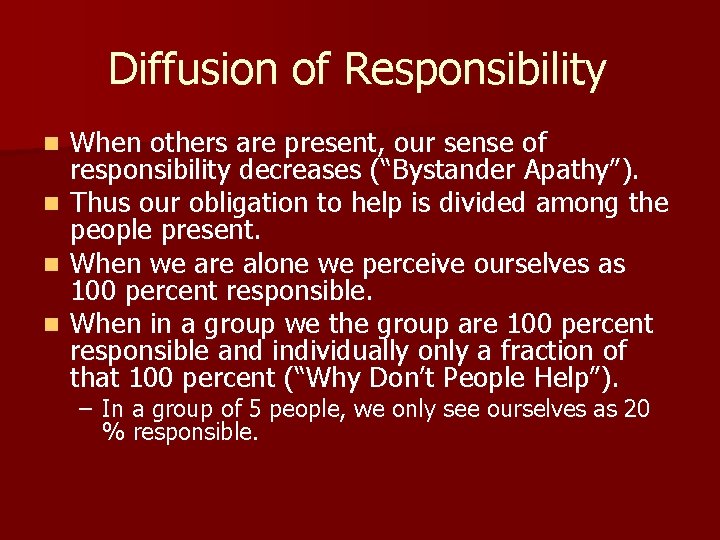
Diffusion of Responsibility When others are present, our sense of responsibility decreases (“Bystander Apathy”). n Thus our obligation to help is divided among the people present. n When we are alone we perceive ourselves as 100 percent responsible. n When in a group we the group are 100 percent responsible and individually only a fraction of that 100 percent (“Why Don’t People Help”). n – In a group of 5 people, we only see ourselves as 20 % responsible.
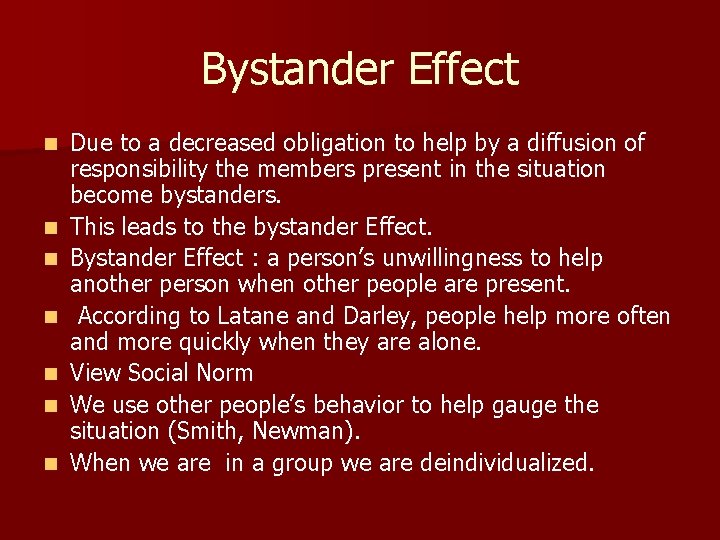
Bystander Effect n n n n Due to a decreased obligation to help by a diffusion of responsibility the members present in the situation become bystanders. This leads to the bystander Effect. Bystander Effect : a person’s unwillingness to help another person when other people are present. According to Latane and Darley, people help more often and more quickly when they are alone. View Social Norm We use other people’s behavior to help gauge the situation (Smith, Newman). When we are in a group we are deindividualized.
Examples… n To show further how responsibility is diffused… – Elevator § Confederates actually dropped coins, to see the helping behavior that was exhibited. § 1 v 1 40 % exhibited helping behavior § 6 bystanders, 20 % exhibited helping behavior.
Examples… – Boondock Saints – Kitty Genovese – 38 people witnessed the murder of Kitty Genovese and did nothing. – The brothers viewed the whole city of Boston as bystanders. They no longer wanted to be bystanders. They began to take action. No longer exhibiting the bystander effect.
References n “Bystander Apathy. ” 7 3 (2005). Psych-Info. http: //gateway. ut. ovid. com/gw 2/ovidweb. cgi. Myers. D. The Adaptive Mind. 7 th ed. New York: Worth, 2003. “Social Psyhcholgy: once overlooked now a staple. ” APA Monitor Online. 12 (1999). http: //www. apa. org/monitor/dec 99/ss 8. html. n Newman, D. Smith, R. “Why Don’t People Help? ” 14 9 (1999). http: //www. pineforge. com/newman. n “Social Psyhcholgy: once overlooked now a staple. ” APA Monitor Online. 12 (1999). http: //www. apa. org/monitor/dec 99/ss 8. html. n
- Slides: 7