
Diffusion of point defects and SIA clusters in
![7 SIAs [111] 900 K 600 K 450 K [1 -10] 4 th Workshop](https://slidetodoc.com/presentation_image_h/07f8354b6d7c6c2d4b20c658aab34eb7/image-9.jpg "7 SIAs [111] 900 K 600 K 450 K [1 -10] 4 th Workshop")
- Slides: 15
Diffusion of point defects and SIA clusters in dilute Fe-Ni alloys (EU Project PERFORM 60) A. Serra 1, N. Anento 1, D. Terentyev 2 & Y. N. Osetsky 3 1. Universitat Politècnica de Catalunya (UPC), Spain 2. Institute of Nuclear Materials Science (SCK-CEN), Belgium 3. Oak Ridge National Laboratory, TN, USA 4 th Workshop on Nuclear Fe Alloys, Edinburgh
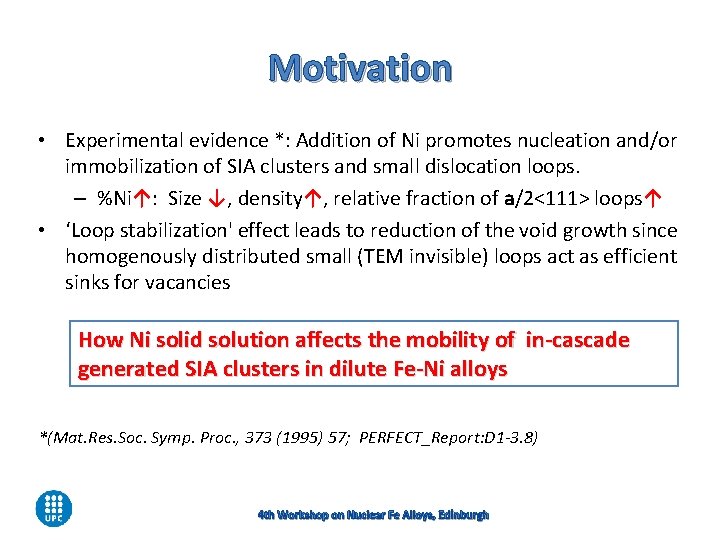
Motivation • Experimental evidence *: Addition of Ni promotes nucleation and/or immobilization of SIA clusters and small dislocation loops. – %Ni↑: Size ↓, density↑, relative fraction of a/2<111> loops↑ • ‘Loop stabilization' effect leads to reduction of the void growth since homogenously distributed small (TEM invisible) loops act as efficient sinks for vacancies How Ni solid solution affects the mobility of in-cascade generated SIA clusters in dilute Fe-Ni alloys *(Mat. Res. Soc. Symp. Proc. , 373 (1995) 57; PERFECT_Report: D 1 -3. 8) 4 th Workshop on Nuclear Fe Alloys, Edinburgh
Outline • Point defects (PD) – PD - Ni Interaction energy – PD diffusion in Fe and Fe-Ni • SIA clusters (7, 19 & 37) (Radius < 1 nm) – Cluster – Ni Interaction energy – Cluster diffusion in Fe-0. 8%Ni 4 th Workshop on Nuclear Fe Alloys, Edinburgh
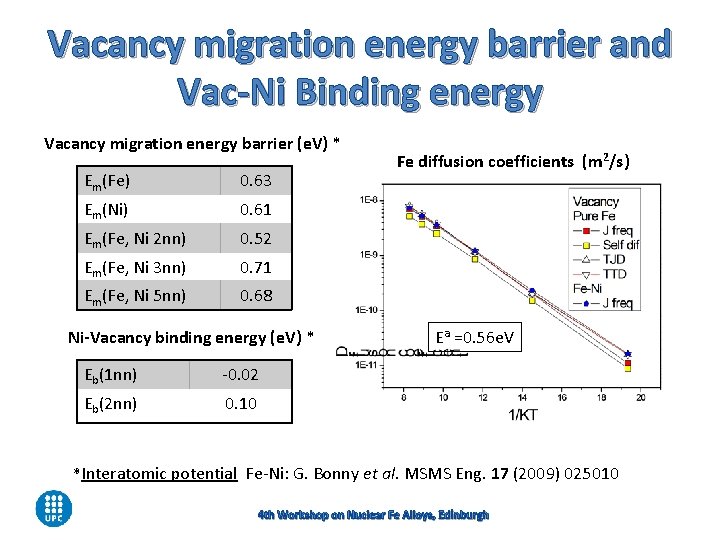
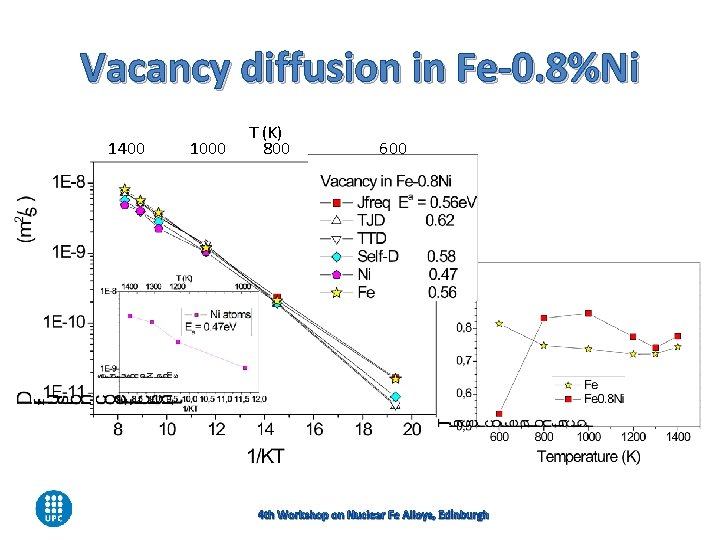
Vacancy migration energy barrier and Vac-Ni Binding energy Vacancy migration energy barrier (e. V) * Em(Fe) 0. 63 Em(Ni) 0. 61 Em(Fe, Ni 2 nn) 0. 52 Em(Fe, Ni 3 nn) 0. 71 Em(Fe, Ni 5 nn) 0. 68 Ni-Vacancy binding energy (e. V) * Eb(1 nn) -0. 02 Eb(2 nn) 0. 10 Fe diffusion coefficients (m 2/s) Ea =0. 56 e. V *Interatomic potential Fe-Ni: G. Bonny et al. MSMS Eng. 17 (2009) 025010 4 th Workshop on Nuclear Fe Alloys, Edinburgh
Vacancy diffusion in Fe-0. 8%Ni T (K) 1400 1000 800 600 4 th Workshop on Nuclear Fe Alloys, Edinburgh
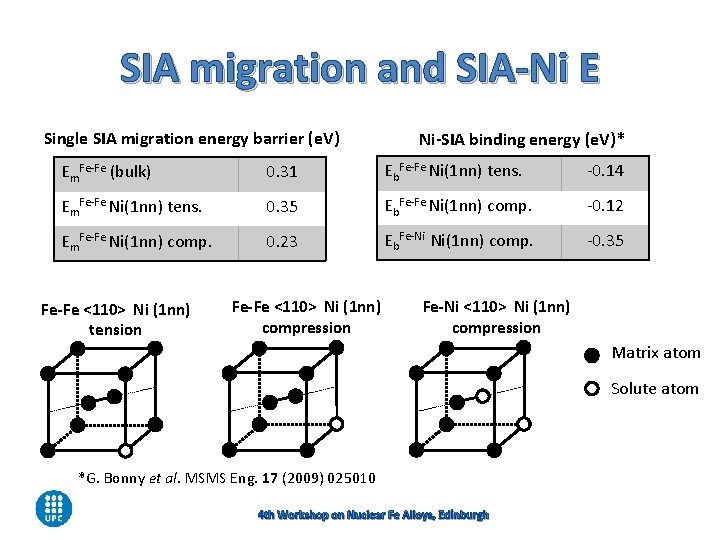
SIA migration and SIA-Ni E Single SIA migration energy barrier (e. V) Ni-SIA binding energy (e. V)* Em. Fe-Fe (bulk) 0. 31 Eb. Fe-Fe Ni(1 nn) tens. -0. 14 Em. Fe-Fe Ni(1 nn) tens. 0. 35 Eb. Fe-Fe Ni(1 nn) comp. -0. 12 Em. Fe-Fe Ni(1 nn) comp. 0. 23 Eb. Fe-Ni Ni(1 nn) comp. -0. 35 Fe-Fe <110> Ni (1 nn) tension Fe-Fe <110> Ni (1 nn) compression Fe-Ni <110> Ni (1 nn) compression Matrix atom Solute atom *G. Bonny et al. MSMS Eng. 17 (2009) 025010 4 th Workshop on Nuclear Fe Alloys, Edinburgh
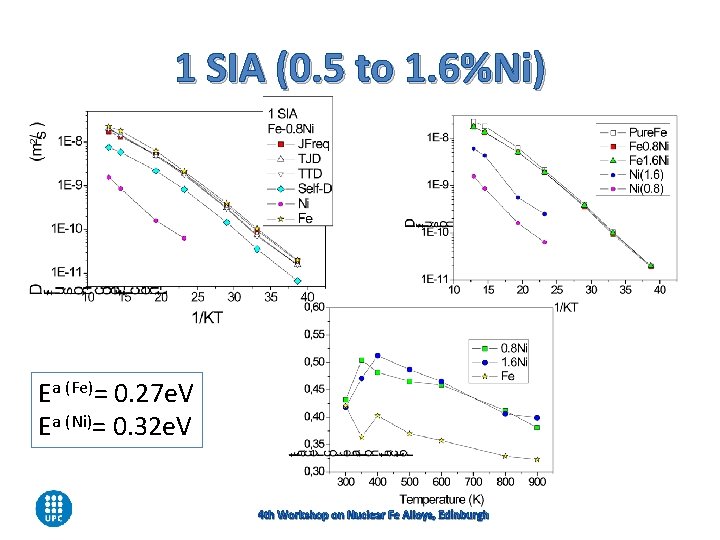
1 SIA (0. 5 to 1. 6%Ni) Ea (Fe)= 0. 27 e. V Ea (Ni)= 0. 32 e. V 4 th Workshop on Nuclear Fe Alloys, Edinburgh
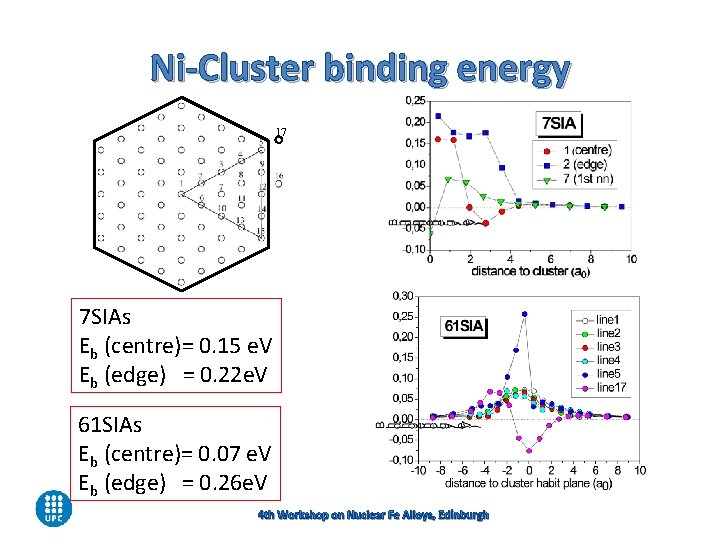
Ni-Cluster binding energy 17 7 SIAs Eb (centre)= 0. 15 e. V Eb (edge) = 0. 22 e. V 61 SIAs Eb (centre)= 0. 07 e. V Eb (edge) = 0. 26 e. V 4 th Workshop on Nuclear Fe Alloys, Edinburgh
7 SIAs [111] 900 K 600 K 450 K [1 -10] 4 th Workshop on Nuclear Fe Alloys, Edinburgh
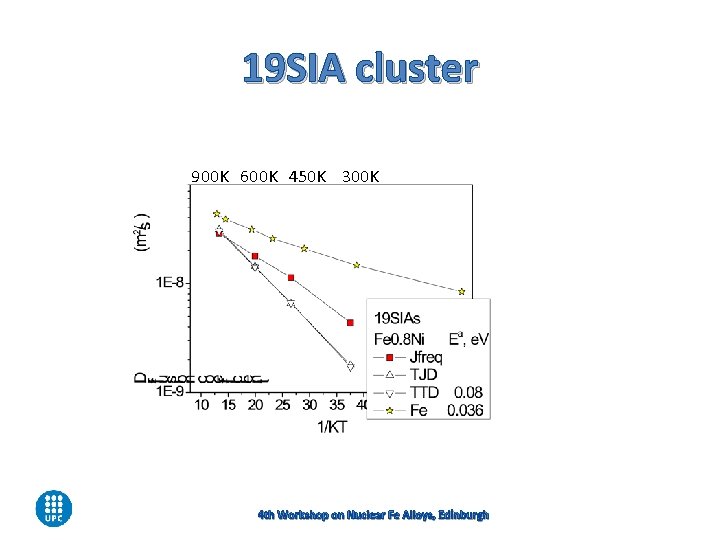
19 SIA cluster 900 K 600 K 450 K 300 K 4 th Workshop on Nuclear Fe Alloys, Edinburgh
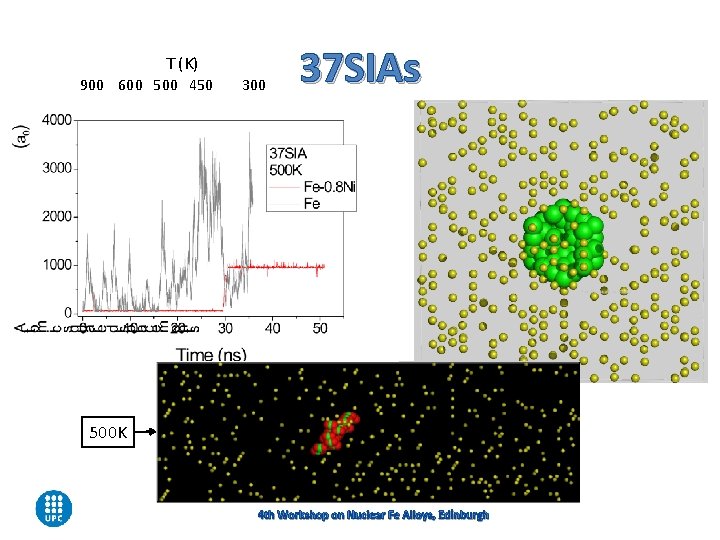
T (K) 900 600 500 450 300 37 SIAs 500 K 4 th Workshop on Nuclear Fe Alloys, Edinburgh
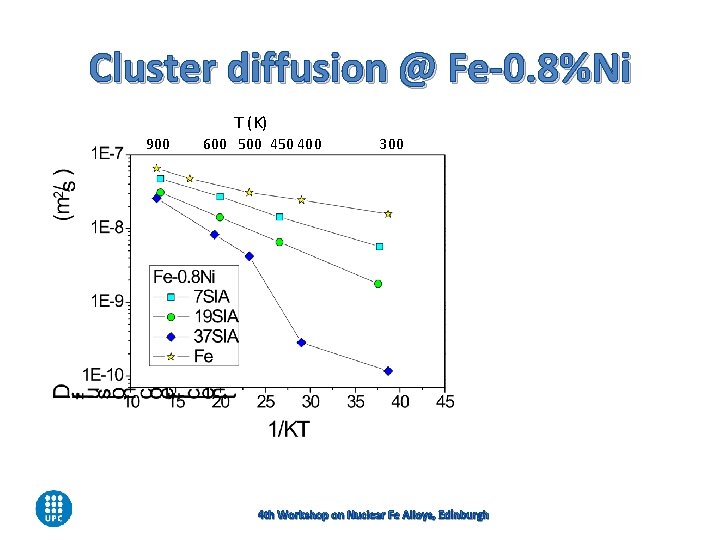
Cluster diffusion @ Fe-0. 8%Ni T (K) 900 600 500 450 400 300 4 th Workshop on Nuclear Fe Alloys, Edinburgh
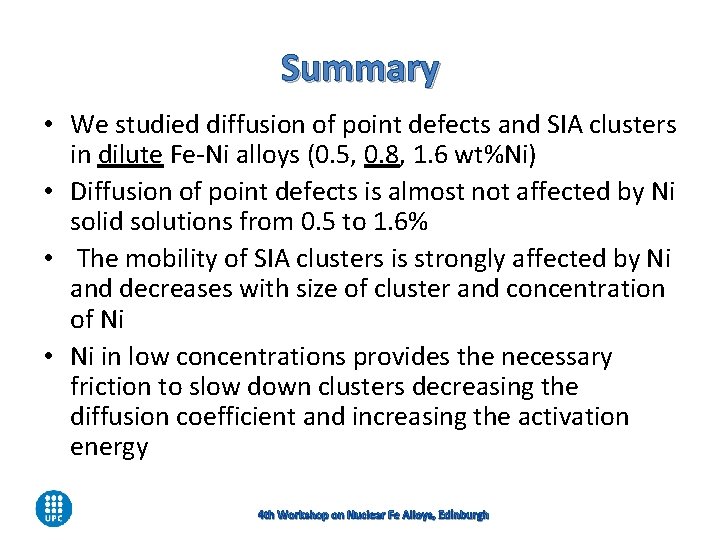
Summary • We studied diffusion of point defects and SIA clusters in dilute Fe-Ni alloys (0. 5, 0. 8, 1. 6 wt%Ni) • Diffusion of point defects is almost not affected by Ni solid solutions from 0. 5 to 1. 6% • The mobility of SIA clusters is strongly affected by Ni and decreases with size of cluster and concentration of Ni • Ni in low concentrations provides the necessary friction to slow down clusters decreasing the diffusion coefficient and increasing the activation energy 4 th Workshop on Nuclear Fe Alloys, Edinburgh
4 th Workshop on Nuclear Fe Alloys, Edinburgh
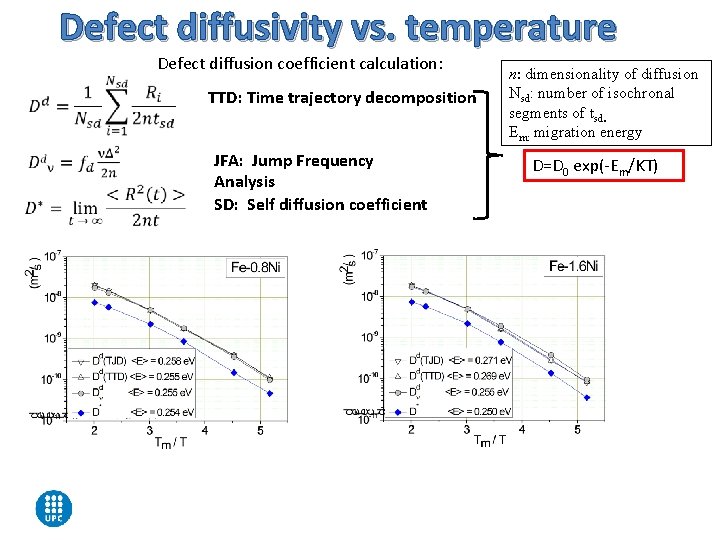
Defect diffusivity vs. temperature Defect diffusion coefficient calculation: TTD: Time trajectory decomposition JFA: Jump Frequency Analysis SD: Self diffusion coefficient n: dimensionality of diffusion Nsd: number of isochronal segments of tsd. Em: migration energy D=D 0 exp(-Em/KT)