
Diffusion of Innovation Theory By Everette M Rogers
Diffusion of Innovation Theory By Everette M. Rogers (1962)
Introduction �How, over time, an idea or product gains momentum and diffuses (or spreads) through a specific population or social system. �Adoption means that a person does something differently than what they had previously been doing. �Innovation is an idea, cause, product, service or behavior.
Five established adopter categories � Innovators: first to try the innovation, venturesome and no appealing strategy � Early Adopters : opinion leaders, embrace change, appealing strategy includes how to manual or implement information � Early Majority : rarely leaders, need to see evidence , appealing strategy includes success stories and evidence of the innovation's effectiveness � Late Majority : skeptical of change, following majority, appealing strategy includes no. of people who have tried innovation successfully � Laggards: conservative, hardest group , appealing strategy includes statistics, fear appeals, and pressure from people
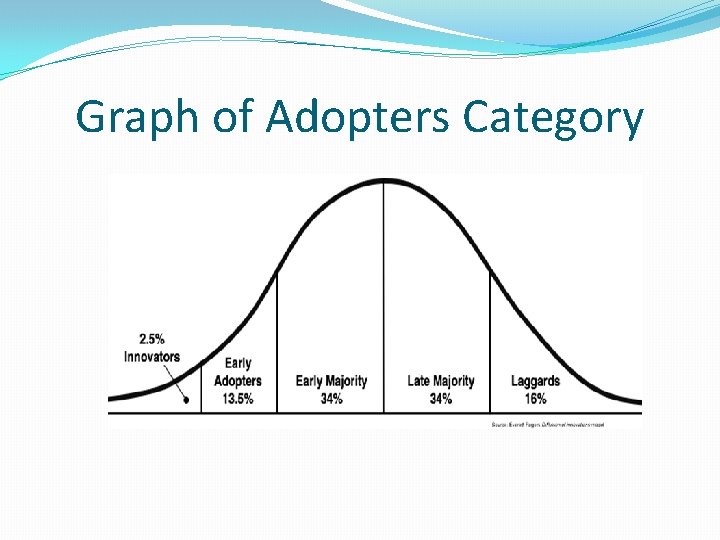
Graph of Adopters Category
Factors That Influence Adoption � Relative Advantage - The degree to which an innovation is seen as better than the idea, program, or product it replaces. � Compatibility - How consistent the innovation is with the values, experiences, and needs of the potential adopters. � Complexity - How difficult the innovation is to understand and/or use. � Triability - The extent to which the innovation can be tested or experimented with before a commitment to adoption is made. � Observability - The extent to which the innovation provides tangible results.
The Mechanism of Diffusion/ Stages of Process of DOI �Knowledge – person becomes aware of an innovation and has some idea of how it functions, �Persuasion – person forms a favorable or unfavorable attitude toward the innovation, �Decision – person engages in activities that lead to a choice to adopt or reject the innovation, �Implementation – person puts an innovation into use, �Confirmation – person evaluates the results of an innovationdecision already made.
Limitations of Diffusion of Innovation Theory �Much of the evidence for this theory, including the adopter categories, did not originate in public health and it was not developed to explicitly apply to adoption of new behaviors or health innovations. �It does not foster a participatory approach to adoption of a public health program. �It works better with adoption of behaviors rather than cessation or prevention of behaviors. �It doesn't take into account an individual's resources or social support to adopt the new behavior (or innovation).
- Slides: 7