
Diffusion Do now activity Explain the differences between
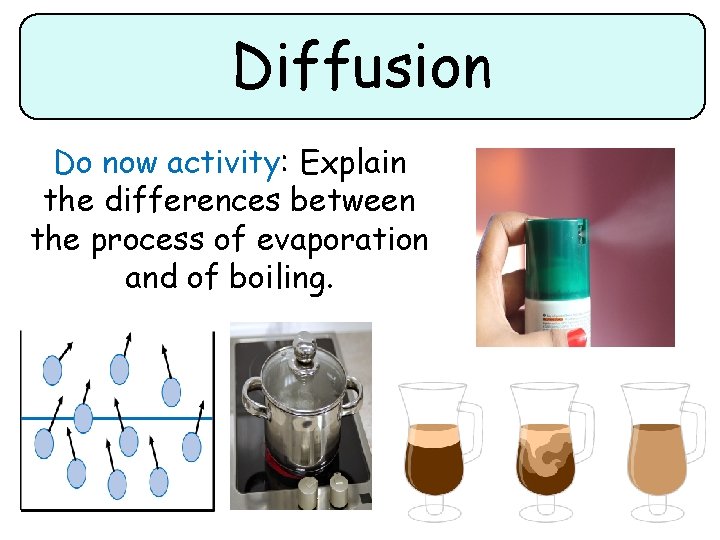
Diffusion Do now activity: Explain the differences between the process of evaporation and of boiling.
Progress indicators GOOD PROGRESS: • Recall the definition of diffusion • Describe evidence for diffusion OUTSTANDING PROGRESS: • Use the particle model to explain diffusion
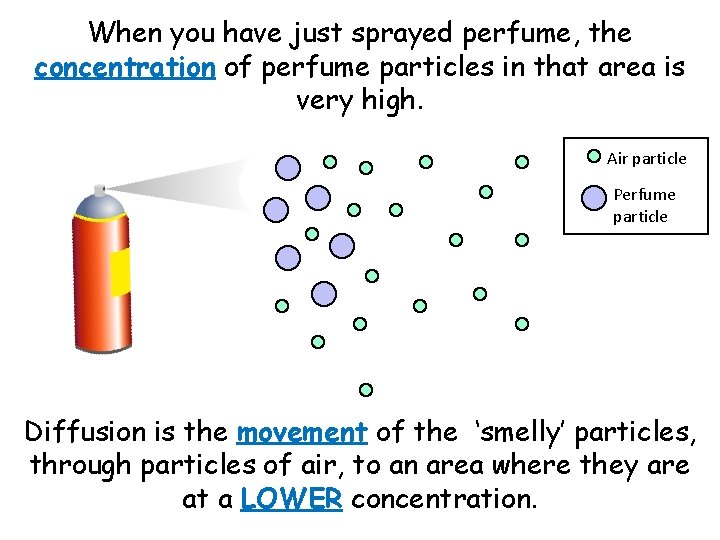
When you have just sprayed perfume, the concentration of perfume particles in that area is very high. Air particle Perfume particle Diffusion is the movement of the ‘smelly’ particles, through particles of air, to an area where they are at a LOWER concentration.
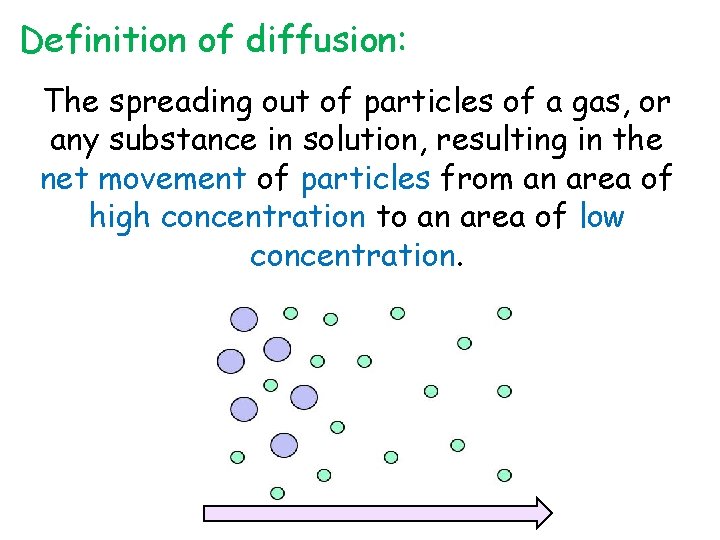
Definition of diffusion: The spreading out of particles of a gas, or any substance in solution, resulting in the net movement of particles from an area of high concentration to an area of low concentration.
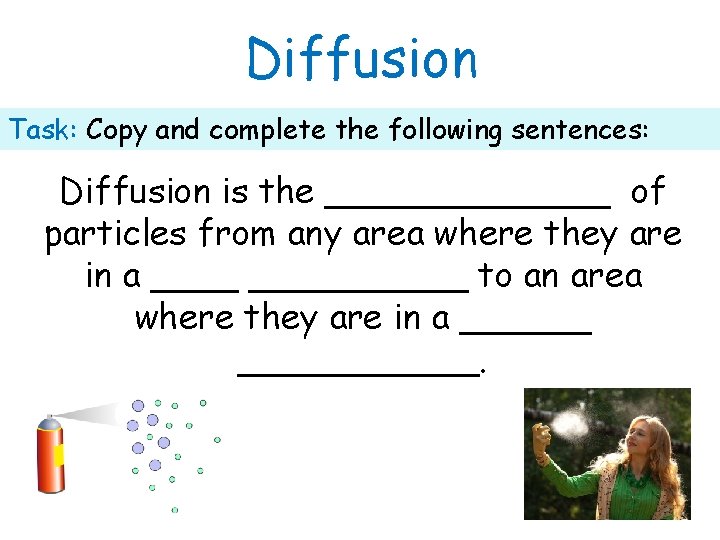
Diffusion Task: Copy and complete the following sentences: Diffusion is the _______ of particles from any area where they are in a __________ to an area where they are in a ___________.
Self-assessment: Diffusion is the movement of particles from any area where they are in a high concentration to an area where they are in a low concentration.
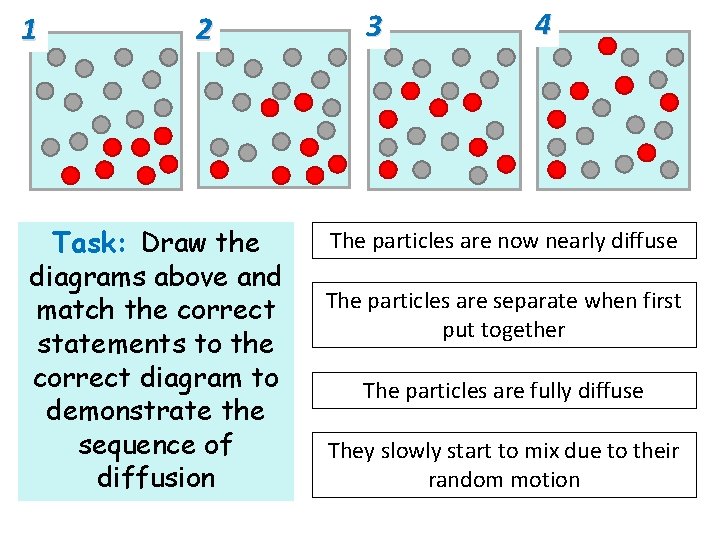
1 2 Task: Draw the diagrams above and match the correct statements to the correct diagram to demonstrate the sequence of diffusion 3 4 The particles are now nearly diffuse The particles are separate when first put together The particles are fully diffuse They slowly start to mix due to their random motion
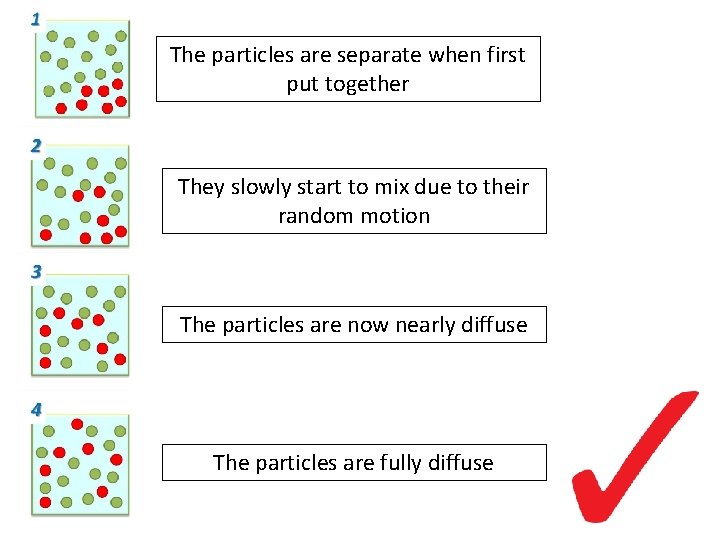
The particles are separate when first put together They slowly start to mix due to their random motion The particles are now nearly diffuse The particles are fully diffuse
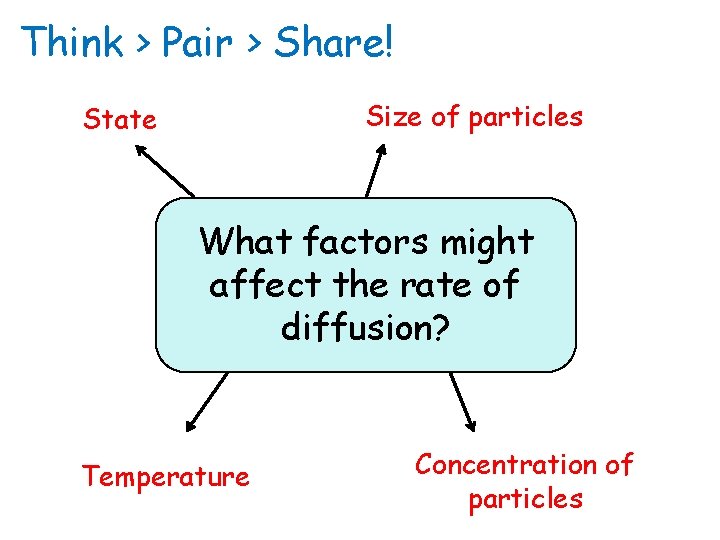
Think > Pair > Share! Size of particles State What factors might affect the rate of diffusion? Temperature Concentration of particles
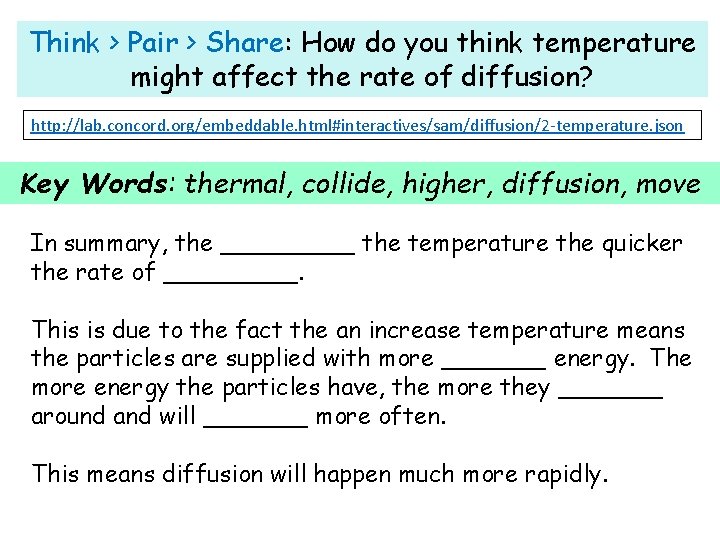
Think > Pair > Share: How do you think temperature might affect the rate of diffusion? http: //lab. concord. org/embeddable. html#interactives/sam/diffusion/2 -temperature. json Key Words: thermal, collide, higher, diffusion, move In summary, the _____ the temperature the quicker the rate of _____. This is due to the fact the an increase temperature means the particles are supplied with more _______ energy. The more energy the particles have, the more they _______ around and will _______ more often. This means diffusion will happen much more rapidly.
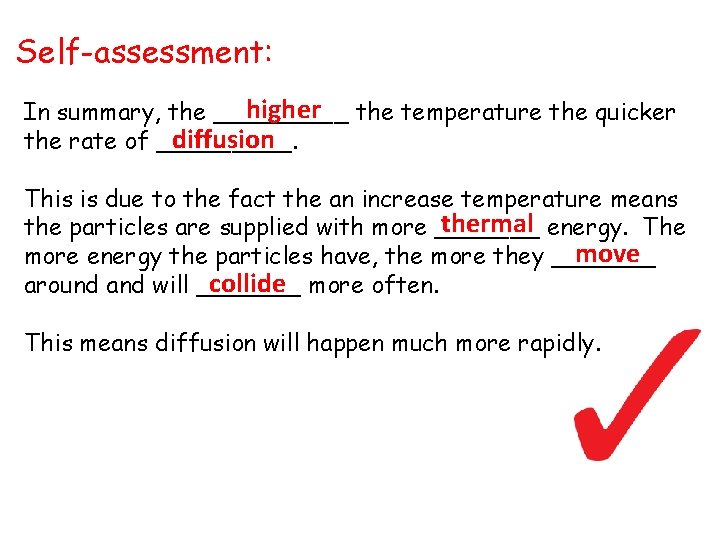
Self-assessment: higher the temperature the quicker In summary, the _____ diffusion the rate of _____. This is due to the fact the an increase temperature means thermal energy. The the particles are supplied with more _______ move more energy the particles have, the more they _______ collide more often. around and will _______ This means diffusion will happen much more rapidly.
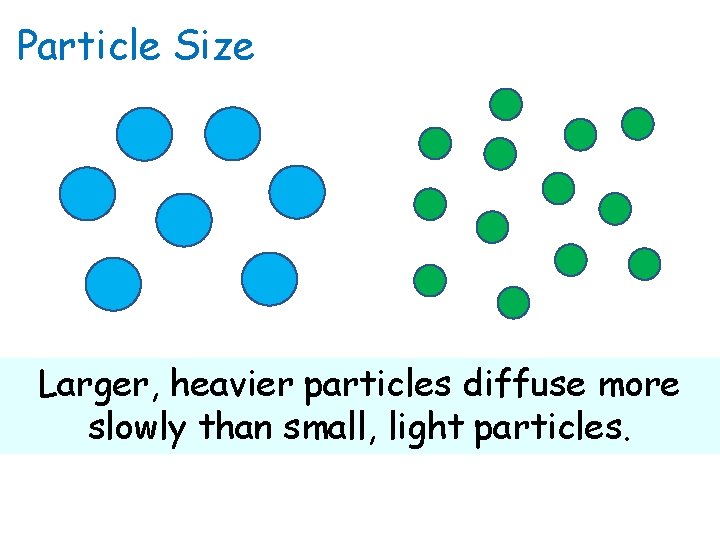
Particle Size Larger, heavier particles diffuse more slowly than small, light particles.
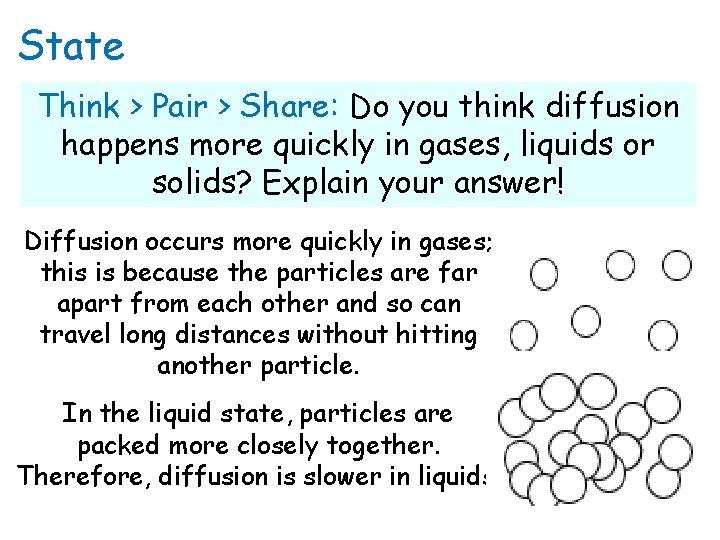
State Think > Pair > Share: Do you think diffusion happens more quickly in gases, liquids or solids? Explain your answer! Diffusion occurs more quickly in gases; this is because the particles are far apart from each other and so can travel long distances without hitting another particle. In the liquid state, particles are packed more closely together. Therefore, diffusion is slower in liquids.
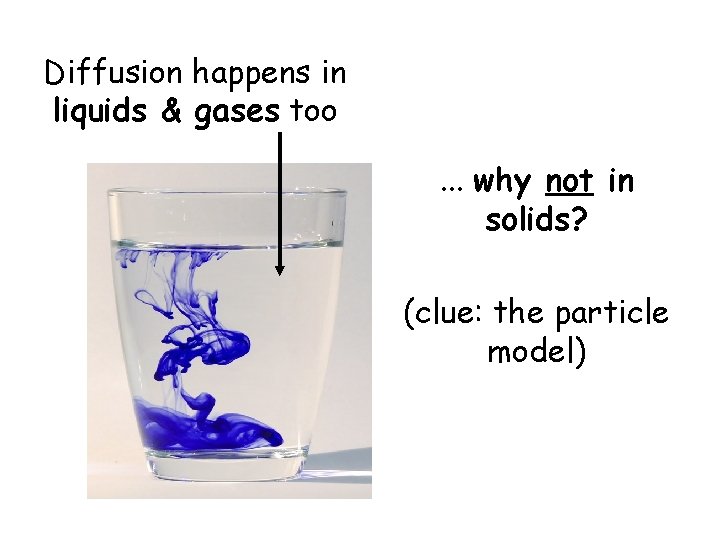
Diffusion happens in liquids & gases too. . . why not in solids? (clue: the particle model)
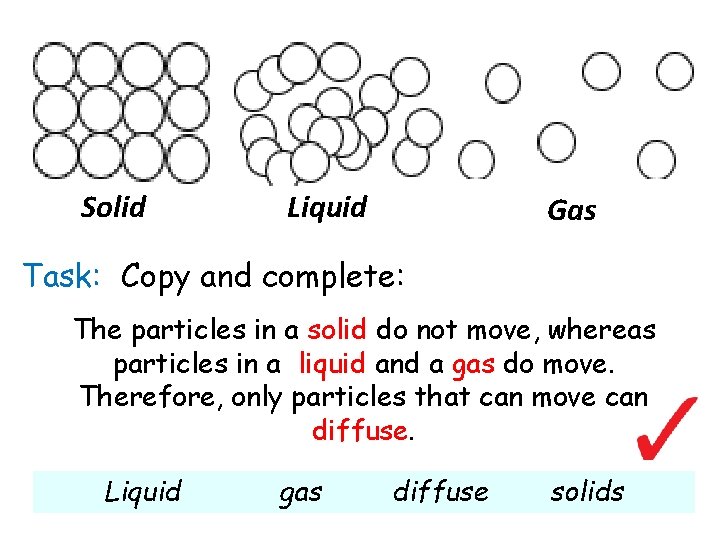
Solid Liquid Gas Task: Copy and complete: The particles _______ not whereas move, The particles inin aa solid do not do move, whereas in aand ____ and a particles in a liquid a gas do move. _______ do only move. Therefore, particles that only can move can that can move can _____. diffuse. Liquid gas diffuse solids
Plenary – What did you learn this lesson? • 3 facts • 3 key words • 1 question to test your peers
- Slides: 16