
DIFFUSION Diffusion process by which an idea or
DIFFUSION • Diffusion: process by which an idea or innovation is transmitted from one group or individual to another • Cultural Hearth: point of origin • Carriers: those conditions that assist the transmission of ideas • Barriers: any conditions that hinder the flow of people or information
TYPES OF DIFFUSION • Relocation Diffusion • Group of people move and take their culture with them • Examples? • Expansion Diffusion • Information about an innovation or idea may spread throughout society • Things being diffused remain, and often intensify, in the originating region
TYPES OF DIFFUSION CONT. • Contagious Diffusion • • Depends on direct contact Strongly influenced by distance Distance decay – intensity of an idea or innovation decreases as distance increases Examples? • Hierarchical Diffusion • • Transferring ideas first between larger places or prominent people and only later to smaller or less important points or people Examples?
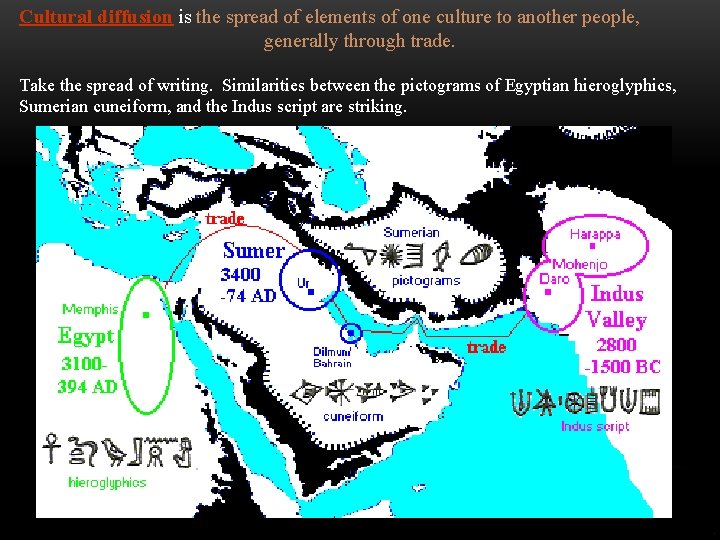
Cultural diffusion is the spread of elements of one culture to another people, generally through trade. Take the spread of writing. Similarities between the pictograms of Egyptian hieroglyphics, Sumerian cuneiform, and the Indus script are striking. .

RELIGIONS OF THE WORLD: DIFFUSION IN ACTION
NOW, IT’S YOUR TURN… • In a group, come up with at least 2 examples of each type of diffusion that your group can share with the class. • Examples are all around you in our culture.
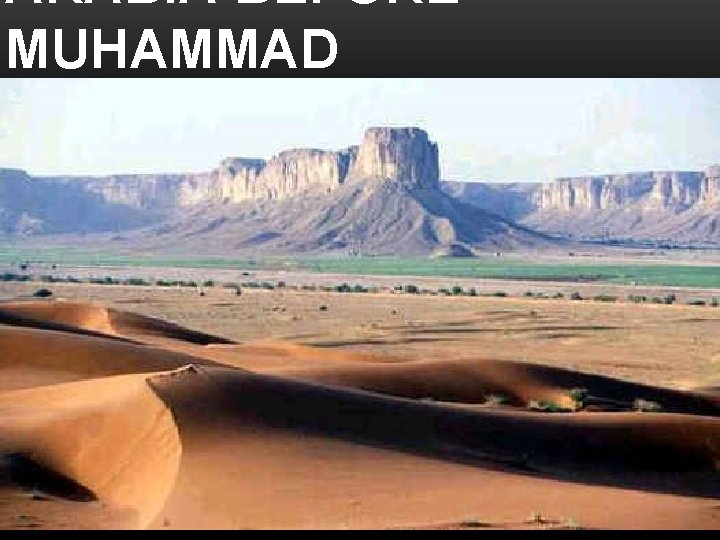
ARABIA BEFORE MUHAMMAD
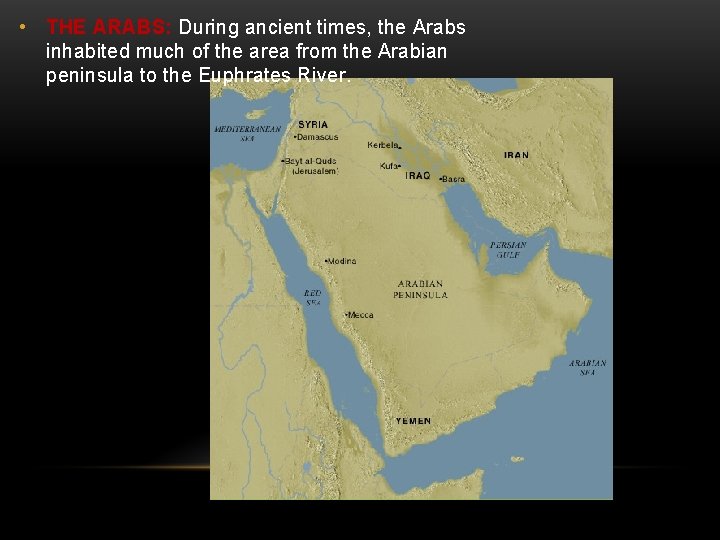
• THE ARABS: During ancient times, the Arabs inhabited much of the area from the Arabian peninsula to the Euphrates River.
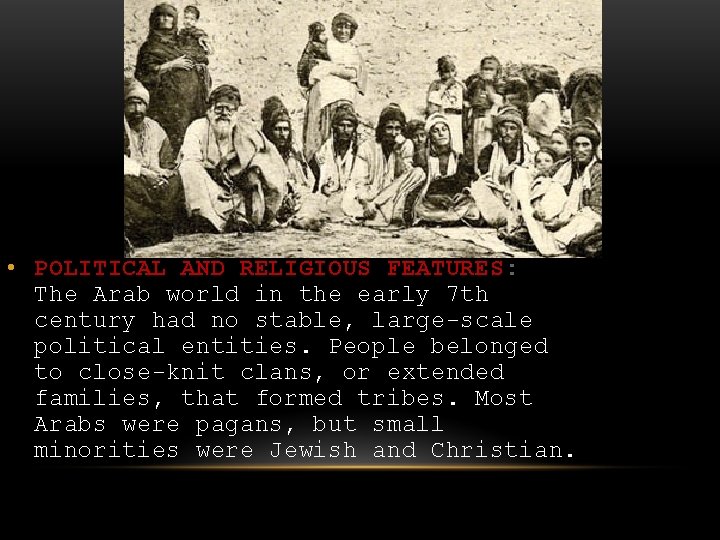
• POLITICAL AND RELIGIOUS FEATURES: The Arab world in the early 7 th century had no stable, large-scale political entities. People belonged to close-knit clans, or extended families, that formed tribes. Most Arabs were pagans, but small minorities were Jewish and Christian.
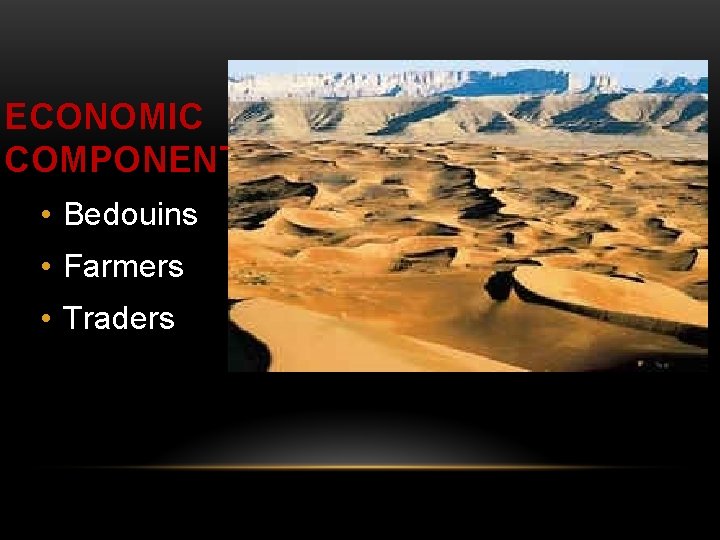
ECONOMIC COMPONENTS: • Bedouins • Farmers • Traders
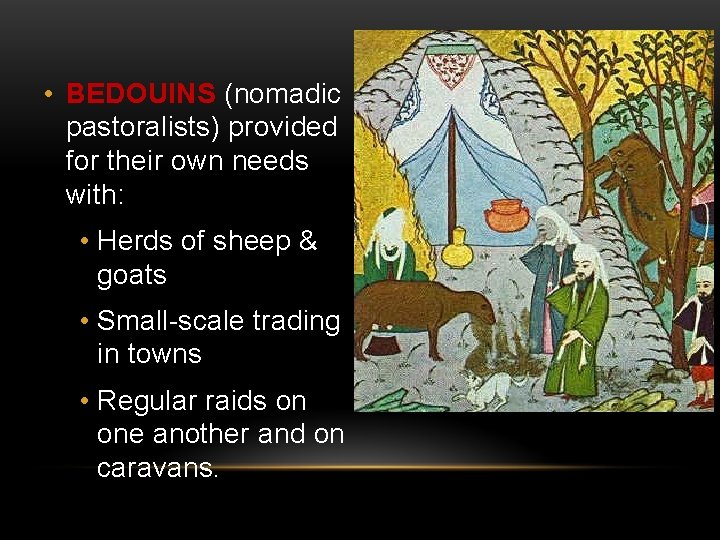
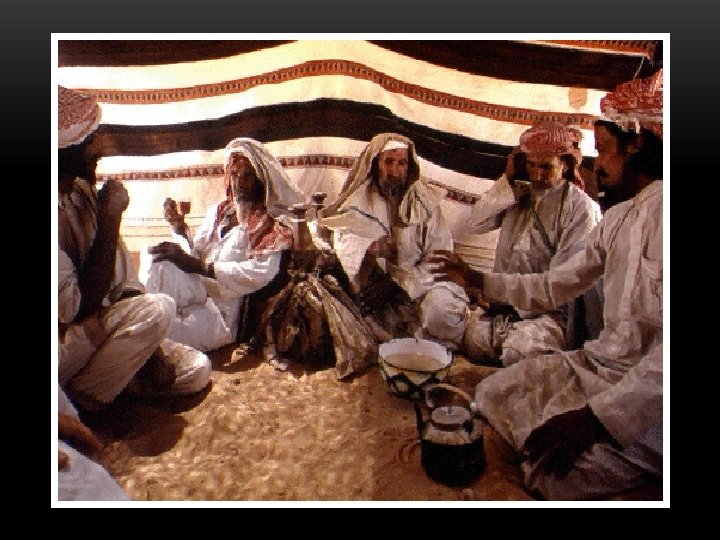
• BEDOUINS (nomadic pastoralists) provided for their own needs with: • Herds of sheep & goats • Small-scale trading in towns • Regular raids on one another and on caravans.
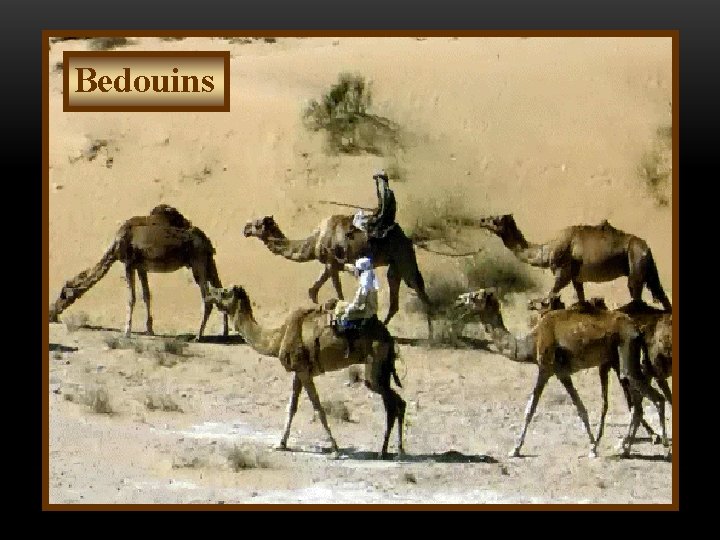
Bedouins
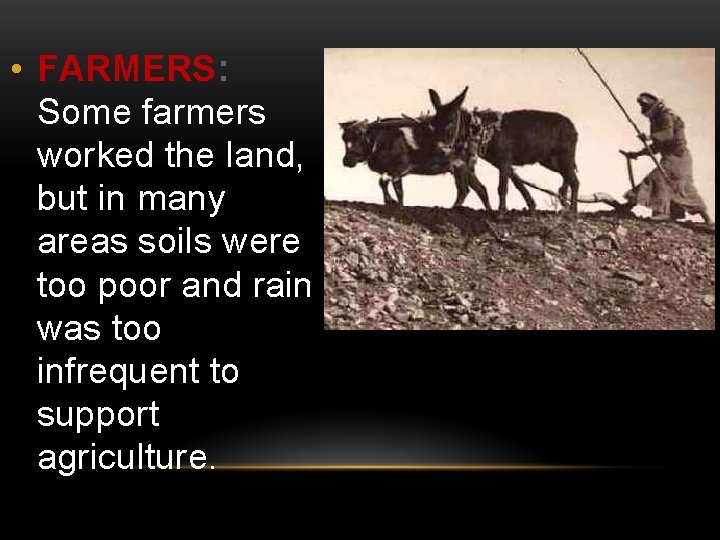
• FARMERS: Some farmers worked the land, but in many areas soils were too poor and rain was too infrequent to support agriculture.
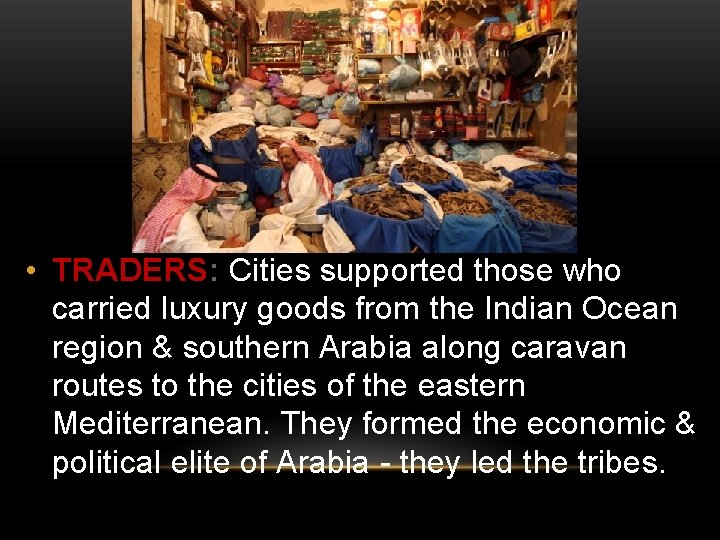
• TRADERS: Cities supported those who carried luxury goods from the Indian Ocean region & southern Arabia along caravan routes to the cities of the eastern Mediterranean. They formed the economic & political elite of Arabia - they led the tribes.
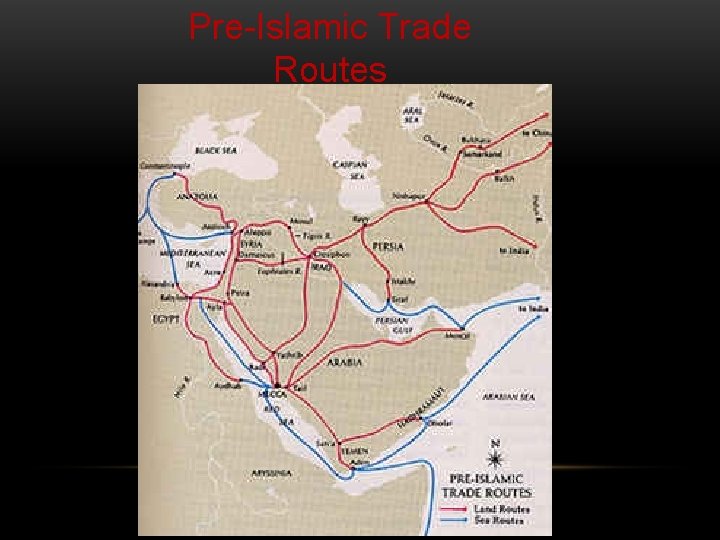
Pre-Islamic Trade Routes
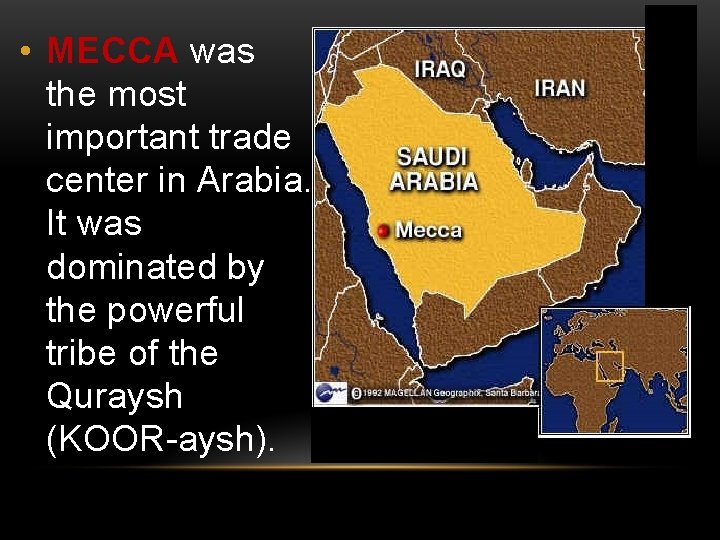
• MECCA was the most important trade center in Arabia. It was dominated by the powerful tribe of the Quraysh (KOOR-aysh).
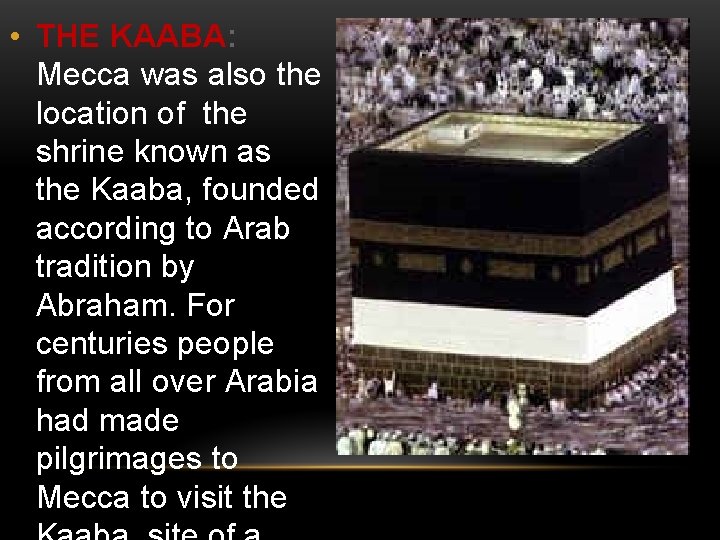
• THE KAABA: Mecca was also the location of the shrine known as the Kaaba, founded according to Arab tradition by Abraham. For centuries people from all over Arabia had made pilgrimages to Mecca to visit the
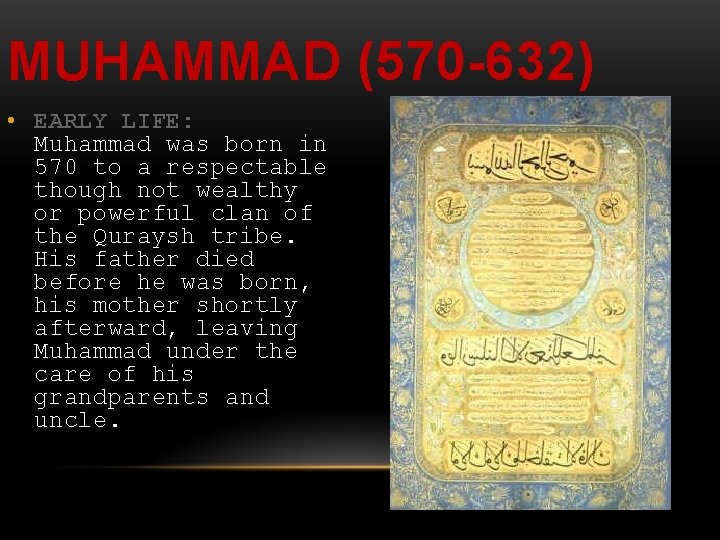
MUHAMMAD (570 -632) • EARLY LIFE: Muhammad was born in 570 to a respectable though not wealthy or powerful clan of the Quraysh tribe. His father died before he was born, his mother shortly afterward, leaving Muhammad under the care of his grandparents and uncle.
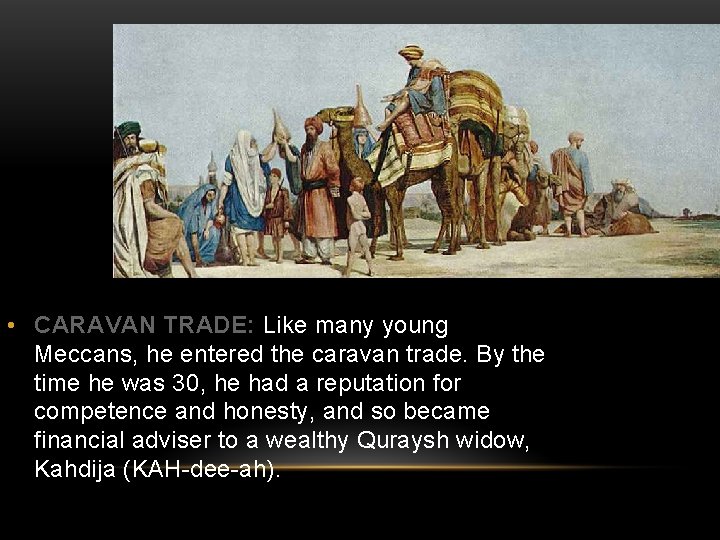
• CARAVAN TRADE: Like many young Meccans, he entered the caravan trade. By the time he was 30, he had a reputation for competence and honesty, and so became financial adviser to a wealthy Quraysh widow, Kahdija (KAH-dee-ah).
• MARRIAGE: Although older than Muhammad, Khadija became his wife in 596, and they had a loving marriage until her death. She bore him three sons (all died in childhood) and four girls (all survived). Only one daughter, Fatima, lived after him.
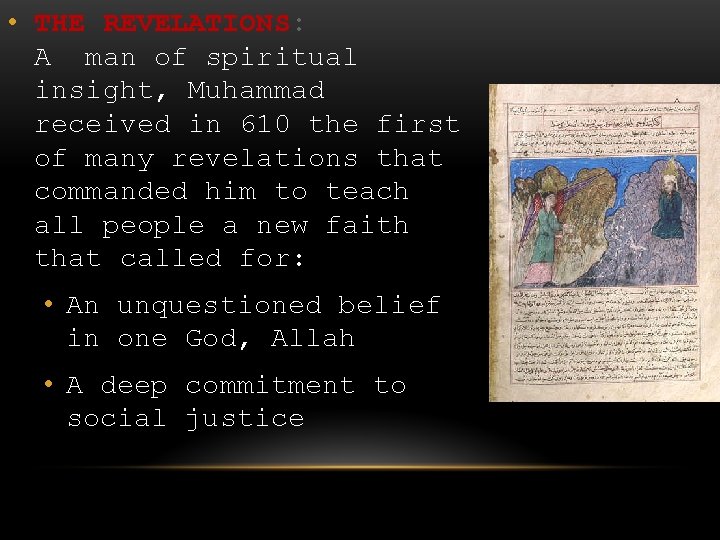
• THE REVELATIONS: A man of spiritual insight, Muhammad received in 610 the first of many revelations that commanded him to teach all people a new faith that called for: • An unquestioned belief in one God, Allah • A deep commitment to social justice
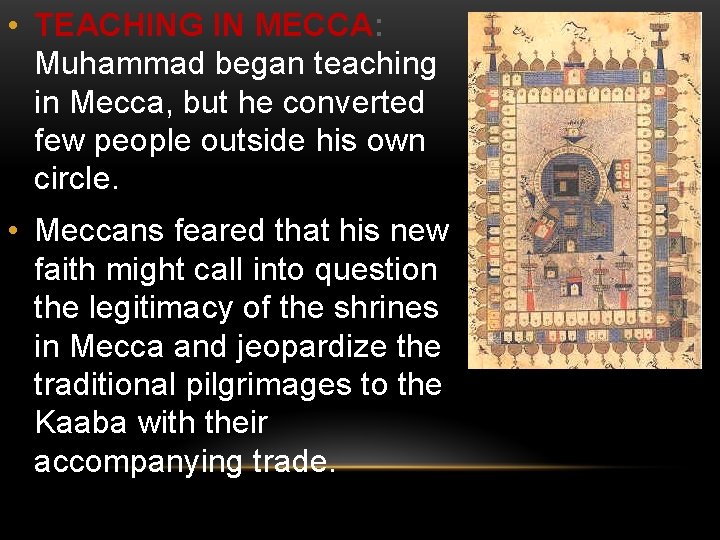
• TEACHING IN MECCA: Muhammad began teaching in Mecca, but he converted few people outside his own circle. • Meccans feared that his new faith might call into question the legitimacy of the shrines in Mecca and jeopardize the traditional pilgrimages to the Kaaba with their accompanying trade.
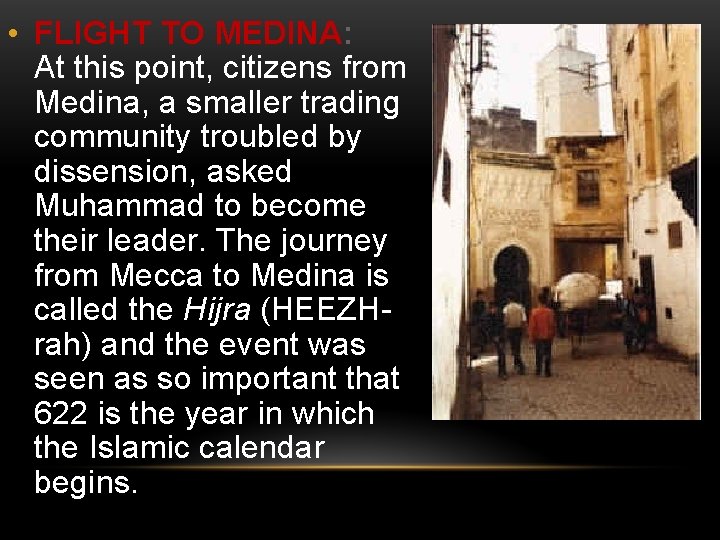
• FLIGHT TO MEDINA: At this point, citizens from Medina, a smaller trading community troubled by dissension, asked Muhammad to become their leader. The journey from Mecca to Medina is called the Hijra (HEEZHrah) and the event was seen as so important that 622 is the year in which the Islamic calendar begins.
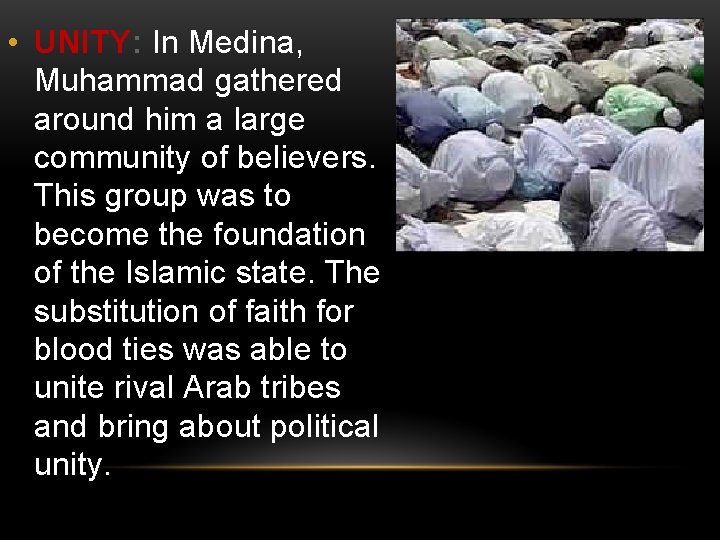
• UNITY: In Medina, Muhammad gathered around him a large community of believers. This group was to become the foundation of the Islamic state. The substitution of faith for blood ties was able to unite rival Arab tribes and bring about political unity.
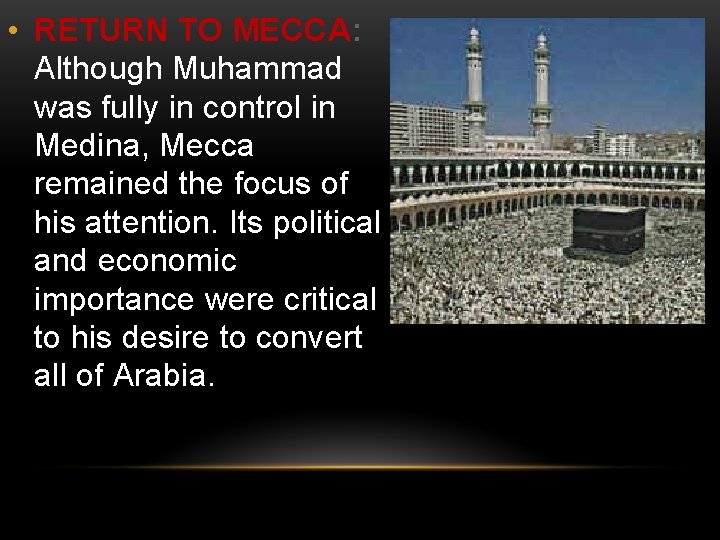
• RETURN TO MECCA: Although Muhammad was fully in control in Medina, Mecca remained the focus of his attention. Its political and economic importance were critical to his desire to convert all of Arabia.
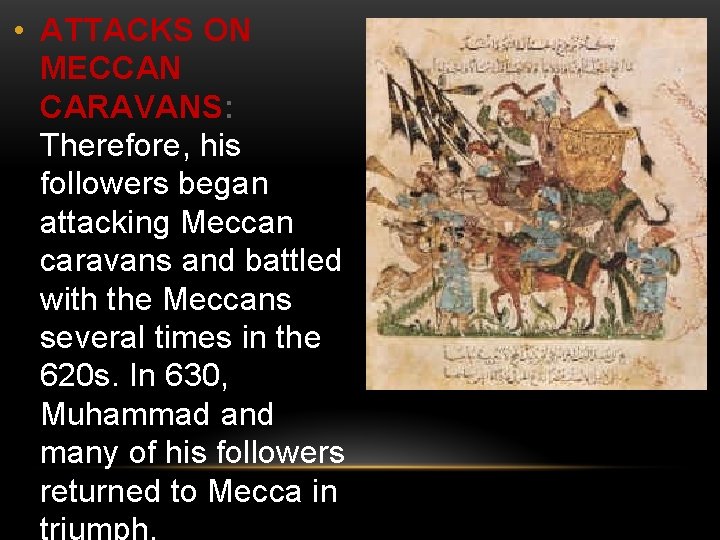
• ATTACKS ON MECCAN CARAVANS: Therefore, his followers began attacking Meccan caravans and battled with the Meccans several times in the 620 s. In 630, Muhammad and many of his followers returned to Mecca in triumph.
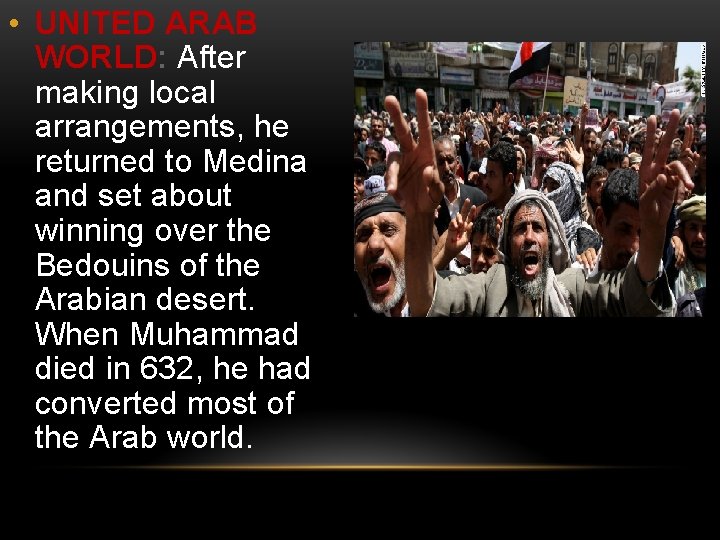
• UNITED ARAB WORLD: After making local arrangements, he returned to Medina and set about winning over the Bedouins of the Arabian desert. When Muhammad died in 632, he had converted most of the Arab world.
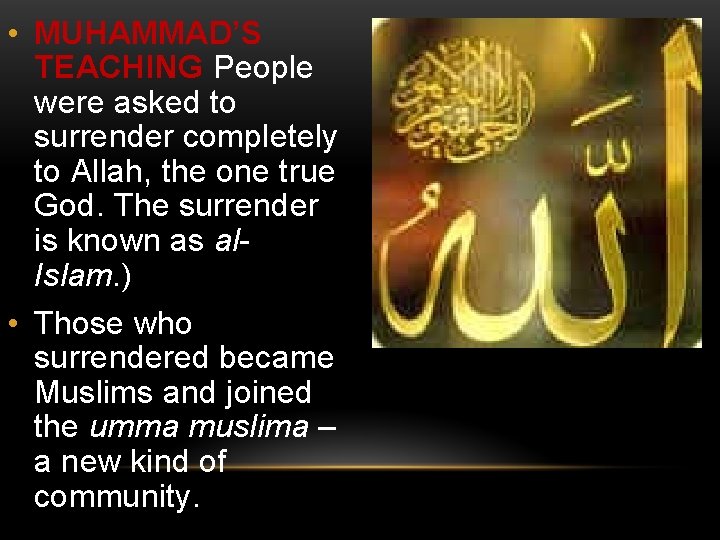
• MUHAMMAD’S TEACHING People were asked to surrender completely to Allah, the one true God. The surrender is known as al. Islam. ) • Those who surrendered became Muslims and joined the umma muslima – a new kind of community.
- Slides: 31