
DIFFUSION After today you should be able to
DIFFUSION. .
After today you should be able to: Define the term ‘diffusion’. Explain that diffusion is faster if there is a bigger concentration difference. Give examples of substances that diffuse into and out of cells.
Teacher Demo – set up. .
Today’s question… Why can’t you smell it straight away?
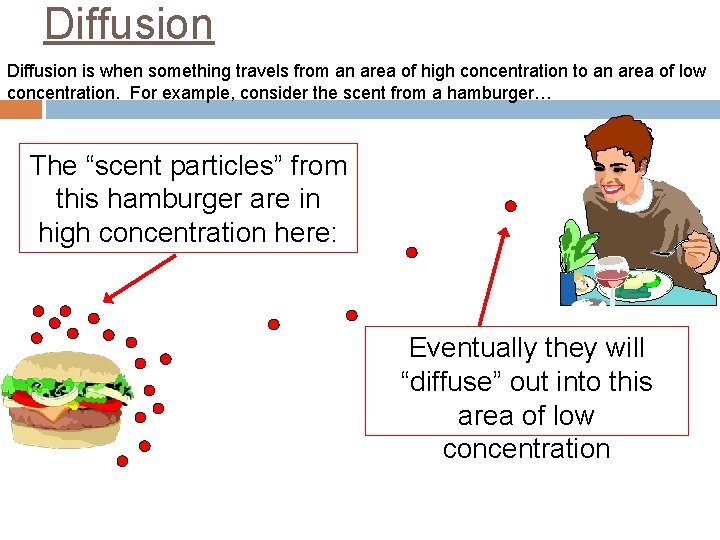
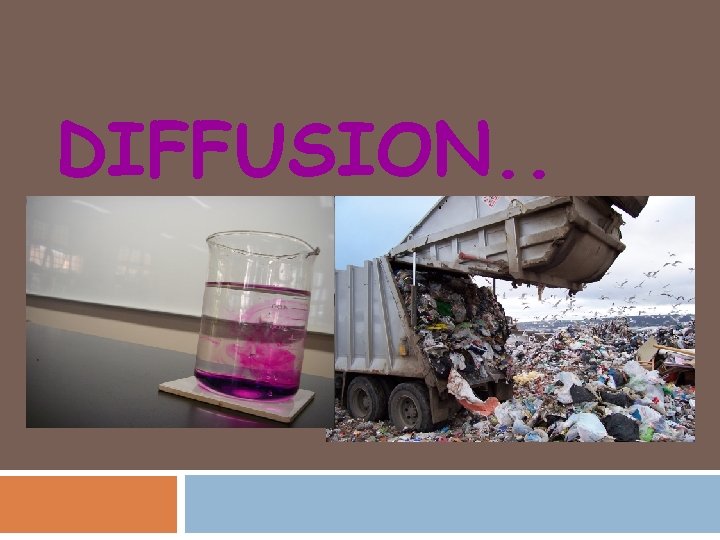
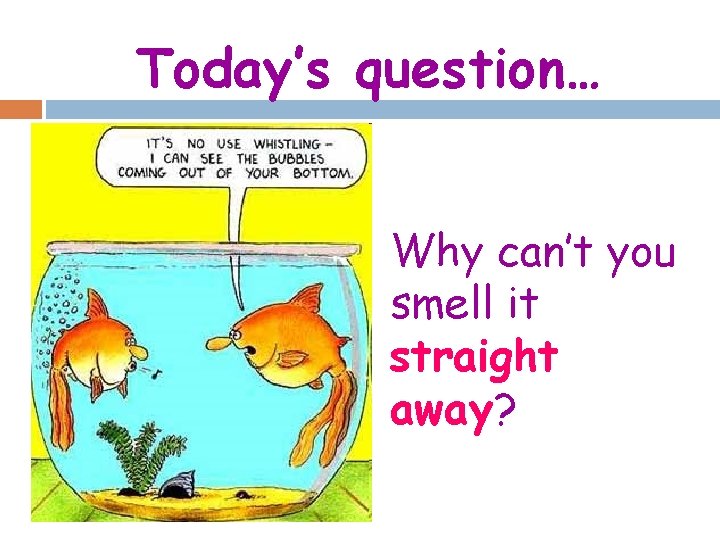
Diffusion is when something travels from an area of high concentration to an area of low concentration. For example, consider the scent from a hamburger… The “scent particles” from this hamburger are in high concentration here: Eventually they will “diffuse” out into this area of low concentration
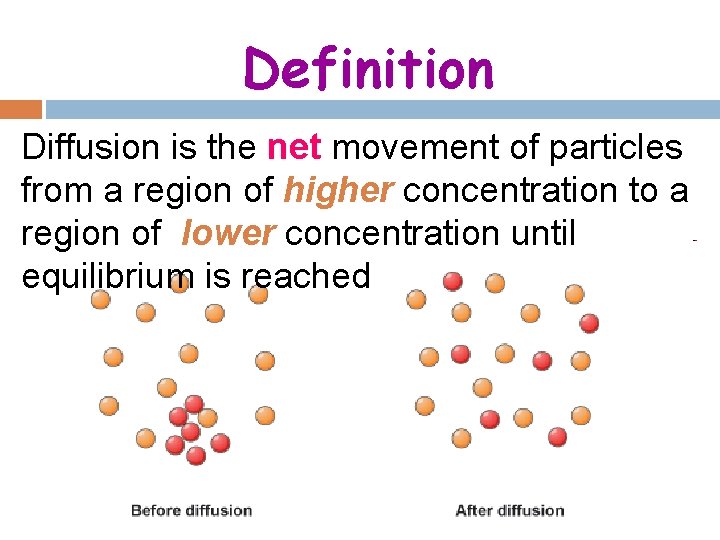
Definition Diffusion is the net movement of particles from a region of higher concentration to a region of lower concentration until equilibrium is reached

Video time… http: //www. youtube. com/watch? v =H 7 Qs. Ds 8 ZRMI&feature=related
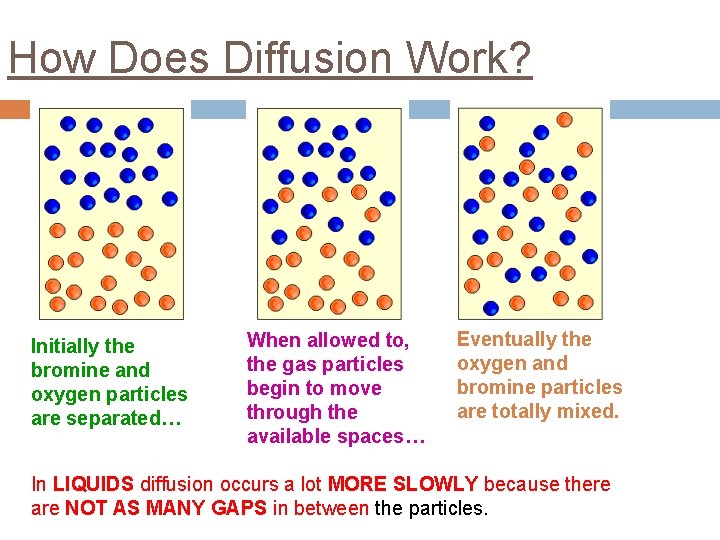
How Does Diffusion Work? Initially the bromine and oxygen particles are separated… When allowed to, the gas particles begin to move through the available spaces… Eventually the oxygen and bromine particles are totally mixed. In LIQUIDS diffusion occurs a lot MORE SLOWLY because there are NOT AS MANY GAPS in between the particles.

Diffusion experiment In this experiment, two gases diffuse towards each other in a sealed glass tube. cotton wool soaked in ammonia solution gases meet here cotton wool soaked in concentrated hydrochloric acid When the gases meet, they react to form a ring of ammonium chloride which is closer to one end of the tube than the other.

Questions? Use the particle model to explain these facts about diffusion: l Diffusion occurs in liquids and gases but hardly at all in solids. l Diffusion happens more quickly for gases than for liquids. l Diffusion happens more quickly at warm temperatures than at cooler temperatures.
Crossing borders. . Substances often get across body surfaces by diffusion!! Alveolar wall, capillary wall, red blood cell membrane (In and out), capillary wall, cell membranes in tissues, mitochondria membranes
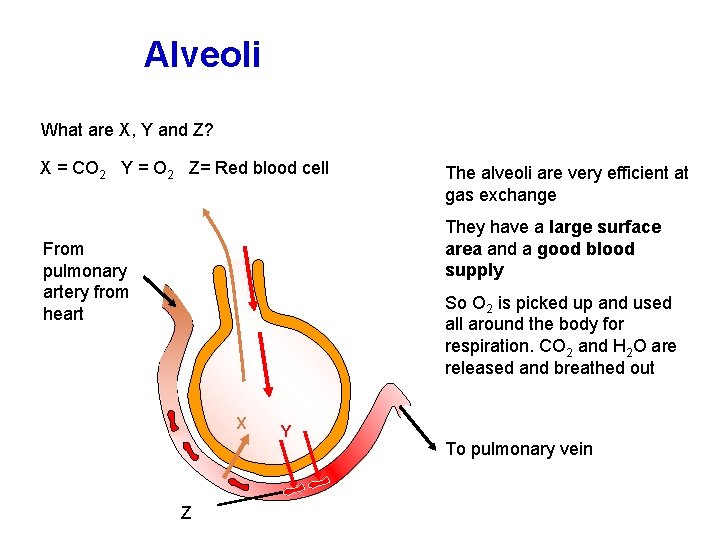
Alveoli What are X, Y and Z? X = CO 2 Y = O 2 Z= Red blood cell The alveoli are very efficient at gas exchange They have a large surface area and a good blood supply From pulmonary artery from heart So O 2 is picked up and used all around the body for respiration. CO 2 and H 2 O are released and breathed out X Z Y To pulmonary vein
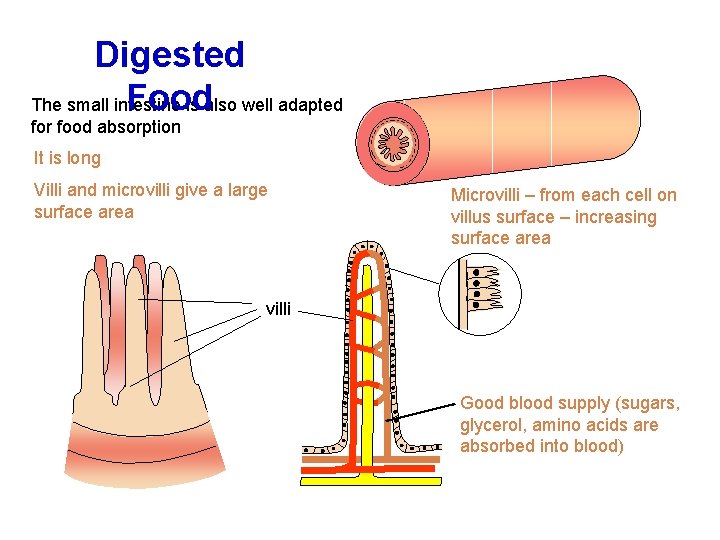
Digested Food The small intestine is also well adapted for food absorption It is long Villi and microvilli give a large surface area Microvilli – from each cell on villus surface – increasing surface area villi Good blood supply (sugars, glycerol, amino acids are absorbed into blood)
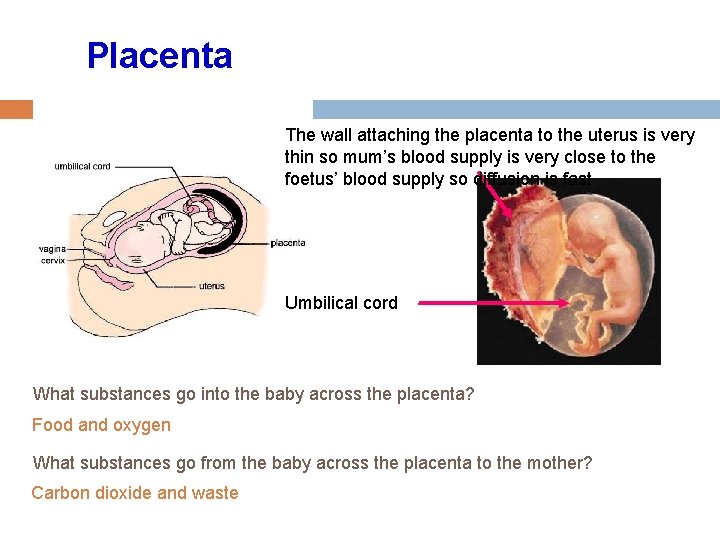
Placenta The wall attaching the placenta to the uterus is very thin so mum’s blood supply is very close to the foetus’ blood supply so diffusion is fast Umbilical cord What substances go into the baby across the placenta? Food and oxygen What substances go from the baby across the placenta to the mother? Carbon dioxide and waste
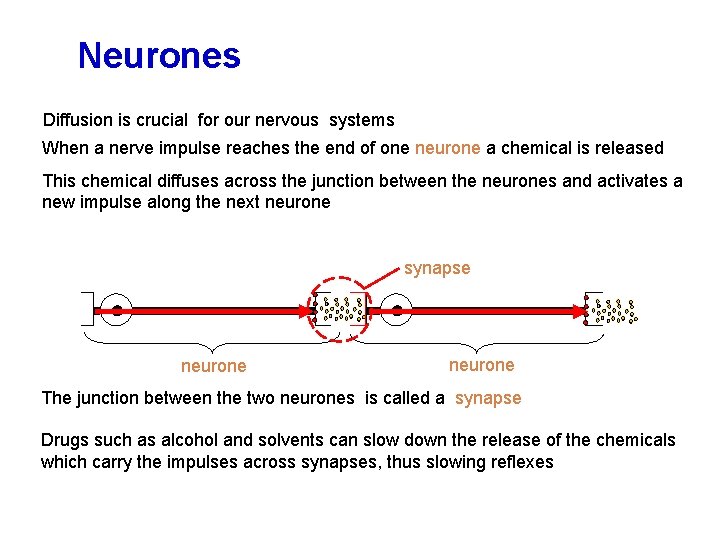
Neurones Diffusion is crucial for our nervous systems When a nerve impulse reaches the end of one neurone a chemical is released This chemical diffuses across the junction between the neurones and activates a new impulse along the next neurone synapse neurone The junction between the two neurones is called a synapse Drugs such as alcohol and solvents can slow down the release of the chemicals which carry the impulses across synapses, thus slowing reflexes
- Slides: 15