
Diffuse Xray Emission of Disk Galaxies 1 Extraplanar


- Slides: 19
Diffuse X-ray Emission of Disk Galaxies 1. Extraplanar diffuse X-ray emission – a survey of highly inclined disk galaxies – How is the emission correlated with galaxy properties? – How are observations compared to simulations? 2. Nature of the emission – X-ray line spectroscopy Q. Daniel Wang University of Massachusetts
1. Survey of highly inclined disk galaxies: galaxy sample • • Highly-inclination angles (i > 60 o) D < 30 Mpc Each with Chandra ACIS exposure > 10 kses Size: 53, compared to < 10 in previous studies Allowing for statistical analysis and comparison with cosmological simulations. Li & Wang 2013 a, b Li, Crain, & Wang 2014
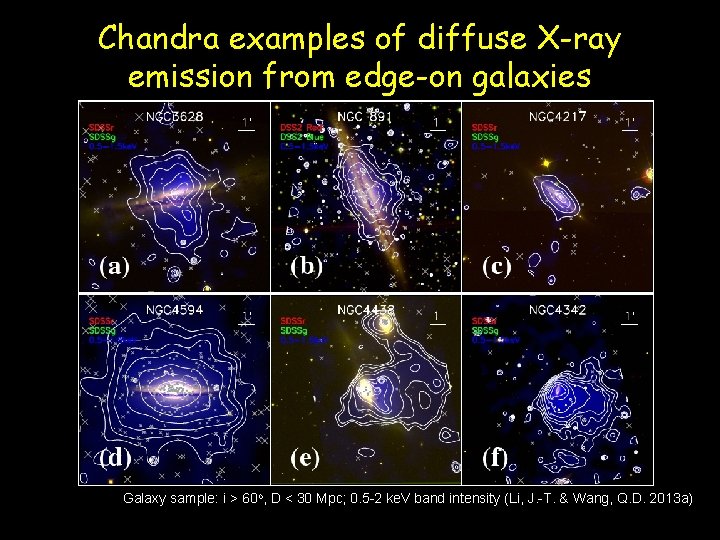
Chandra examples of diffuse X-ray emission from edge-on galaxies Galaxy sample: i > 60 o, D < 30 Mpc; 0. 5 -2 ke. V band intensity (Li, J. -T. & Wang, Q. D. 2013 a)
Lx vs. energy Cfeedback rate • Adding Type Ia SNe to the total energy input improves the E SNLX correlation for normal galaxies • LX/ĖSN ~ 1% and is weakly correlated with the surface mass density of a galaxy disks. • LX/ĖSN ~ 5% in face-on galaxies (Mineo et al. 2012). Li & Wang (2013 b)
Comparison with elliptical/S 0 galaxies Why do (cool gas-rich) disk galaxies tend to have higher Lx and T than elliptical or S 0 galaxies?
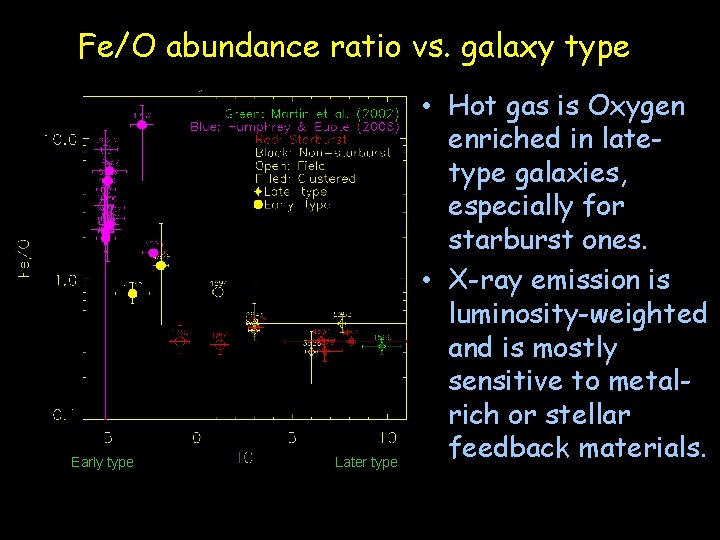
Fe/O abundance ratio vs. galaxy type Early type Later type • Hot gas is Oxygen enriched in latetype galaxies, especially for starburst ones. • X-ray emission is luminosity-weighted and is mostly sensitive to metalrich or stellar feedback materials.
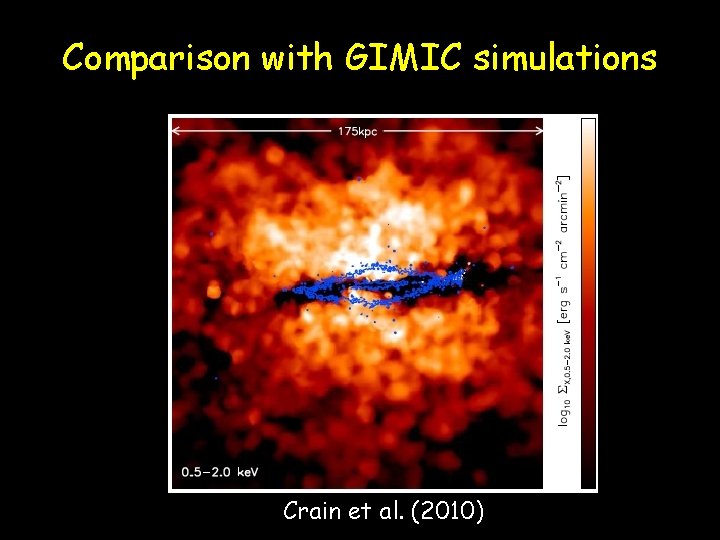
Comparison with GIMIC simulations Crain et al. (2010)
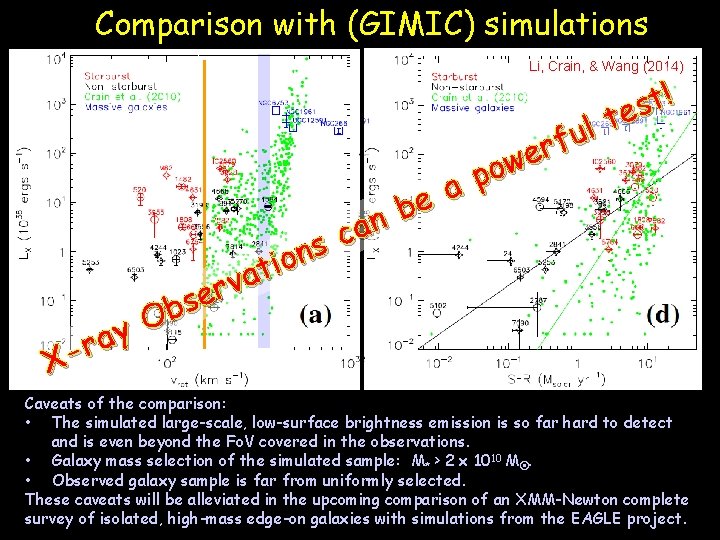
Comparison with (GIMIC) simulations Li, Crain, & Wang (2014) ! t s e t l u f r e ow p a e b an c s n o i t a v r e s b O y a r X- Caveats of the comparison: • The simulated large-scale, low-surface brightness emission is so far hard to detect and is even beyond the Fo. V covered in the observations. • Galaxy mass selection of the simulated sample: M* > 2 x 10¹⁰ M. • Observed galaxy sample is far from uniformly selected. These caveats will be alleviated in the upcoming comparison of an XMM-Newton complete survey of isolated, high-mass edge-on galaxies with simulations from the EAGLE project.
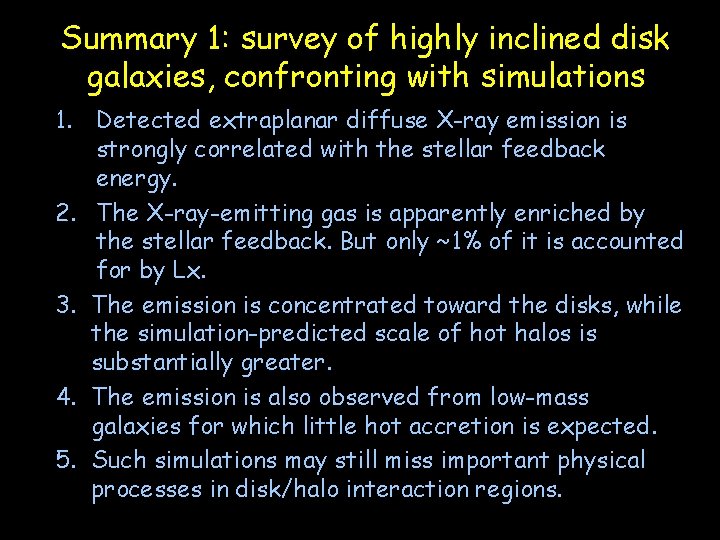
Summary 1: survey of highly inclined disk galaxies, confronting with simulations 1. Detected extraplanar diffuse X-ray emission is strongly correlated with the stellar feedback energy. 2. The X-ray-emitting gas is apparently enriched by the stellar feedback. But only ~1% of it is accounted for by Lx. 3. The emission is concentrated toward the disks, while the simulation-predicted scale of hot halos is substantially greater. 4. The emission is also observed from low-mass galaxies for which little hot accretion is expected. 5. Such simulations may still miss important physical processes in disk/halo interaction regions.
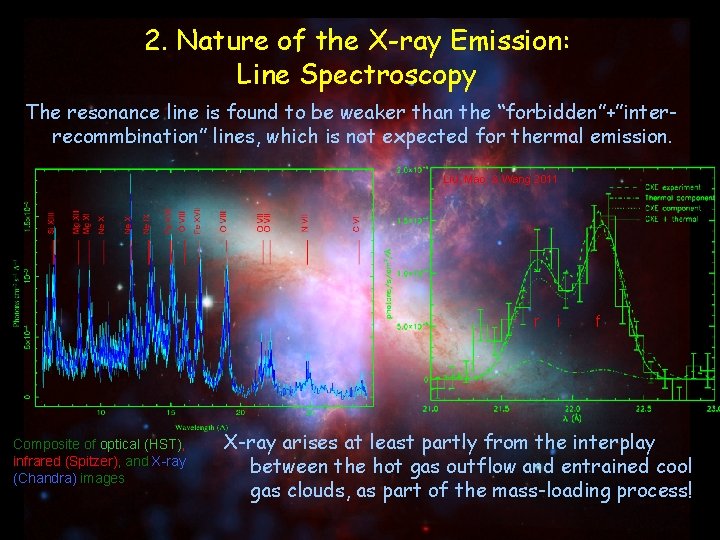
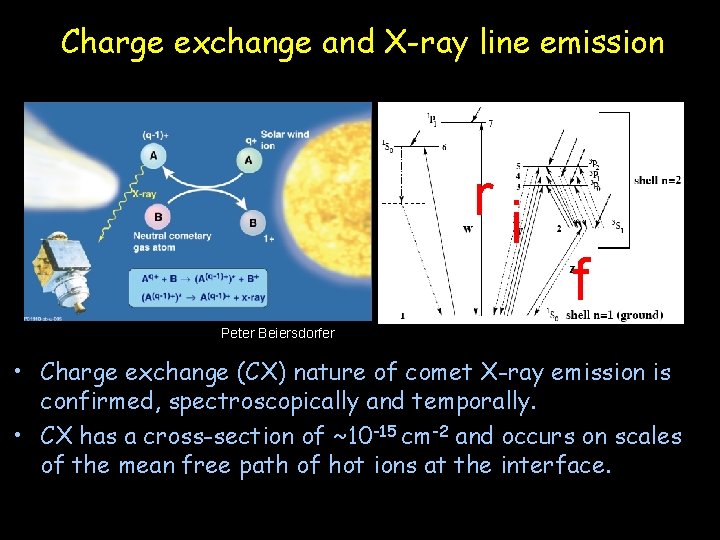
2. Nature of the X-ray Emission: Line Spectroscopy The resonance line is found to be weaker than the “forbidden”+”interrecommbination” lines, which is not expected for thermal emission. Liu, Mao, & Wang 2011 r Composite of optical (HST), infrared (Spitzer), and X-ray (Chandra) images i f X-ray arises at least partly from the interplay between the hot gas outflow and entrained cool gas clouds, as part of the mass-loading process!
Charge exchange and X-ray line emission ri f Peter Beiersdorfer • Charge exchange (CX) nature of comet X-ray emission is confirmed, spectroscopically and temporally. • CX has a cross-section of ~10 -15 cm-2 and occurs on scales of the mean free path of hot ions at the interface.
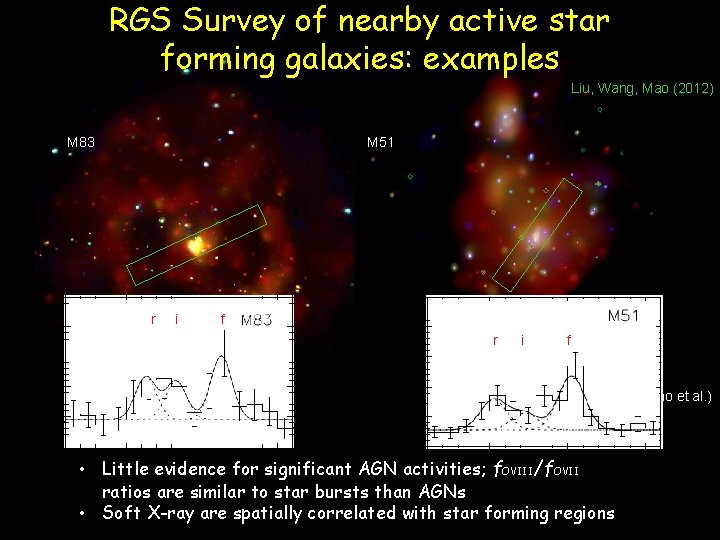
RGS Survey of nearby active star forming galaxies: examples Liu, Wang, Mao (2012) M 83 M 51 r i f r Soria & Wu (2002) i f (Credit: NASA/CXC/SAO/R. Di. Stefano et al. ) • Little evidence for significant AGN activities; f. OVIII/f. OVII ratios are similar to star bursts than AGNs • Soft X-ray are spatially correlated with star forming regions
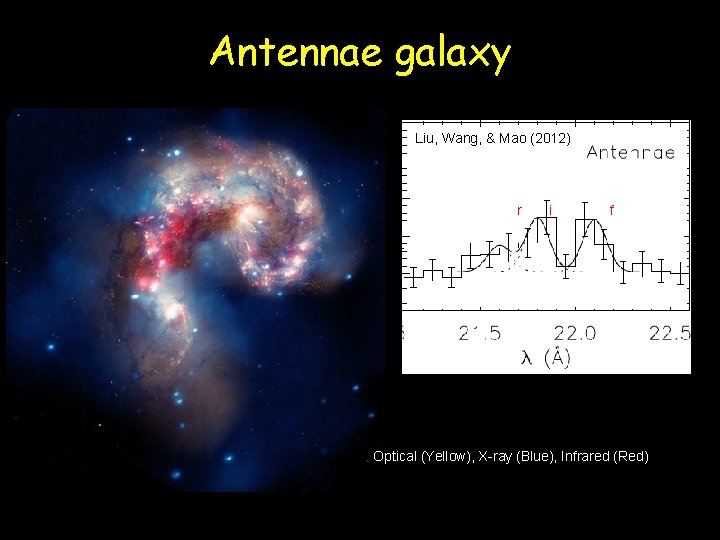
Antennae galaxy Liu, Wang, & Mao (2012) r i f Optical (Yellow), X-ray (Blue), Infrared (Red)
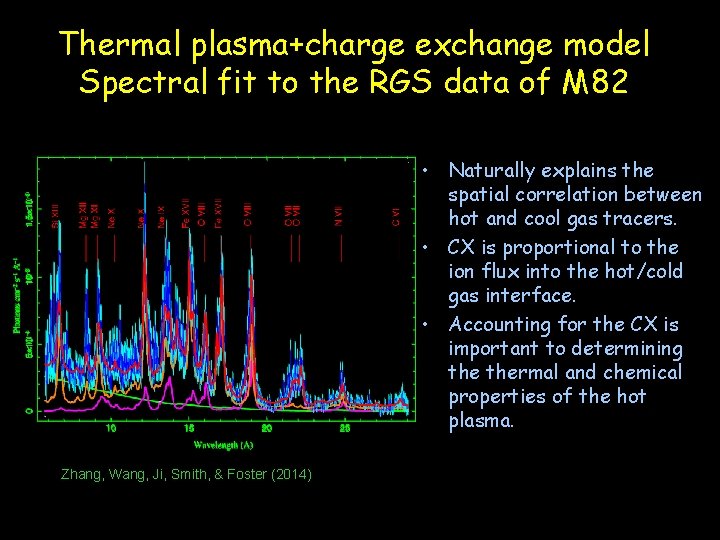
Thermal plasma+charge exchange model Spectral fit to the RGS data of M 82 • Naturally explains the spatial correlation between hot and cool gas tracers. • CX is proportional to the ion flux into the hot/cold gas interface. • Accounting for the CX is important to determining thermal and chemical properties of the hot plasma. Zhang, Wang, Ji, Smith, & Foster (2014)
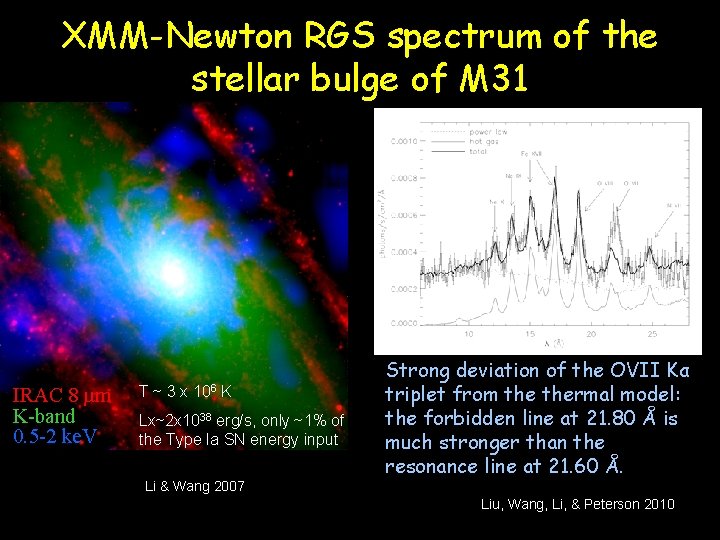
XMM-Newton RGS spectrum of the stellar bulge of M 31 IRAC 8 μm K-band 0. 5 -2 ke. V T ~ 3 x 10⁶ K Lx~2 x 1038 erg/s, only ~1% of the Type Ia SN energy input Strong deviation of the OVII Kα triplet from thermal model: the forbidden line at 21. 80 Å is much stronger than the resonance line at 21. 60 Å. Li & Wang 2007 Liu, Wang, Li, & Peterson 2010
Summary 2: X-ray line spectroscopy and nature of the X-ray emission • Spectroscopy shows that a substantial fraction of the diffuse soft X-ray emission appears to arise from the CX. • Such an interface mechanism naturally explains the enhanced X-ray emission in the immediate vicinity of galactic disks and the spatial correlation between X-ray and cool gas tracers. • CX measurements can potentially provide a powerful tool for probing thermal, chemical, and kinematical properties of the hot plasma and its interplay with cool gas. • But other processes such as fast cooling of outflows and AGN relics may produce similar spectroscopic phenomena.
X-ray mapping outer regions of hot halos around disk galaxies Questions to address: • What fraction of the stellar energy feedback gets into the halo? • What drives outflows from SF galaxies? – Radiation, B field/CRs, and/or hot gas? – Strongly dependent on SF rate and stage? • Does a hot outflow expand freely? Approach: Deep large-scale X-ray mapping • Individual observations have to be deep to remove enough background sources, which causes the cosmic variance. • To check physical properties of hot plasma near outer boundaries if they are present.
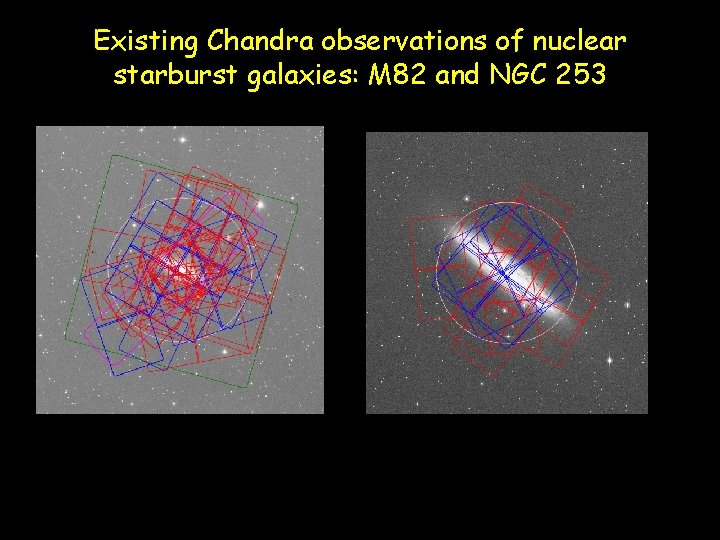
Existing Chandra observations of nuclear starburst galaxies: M 82 and NGC 253
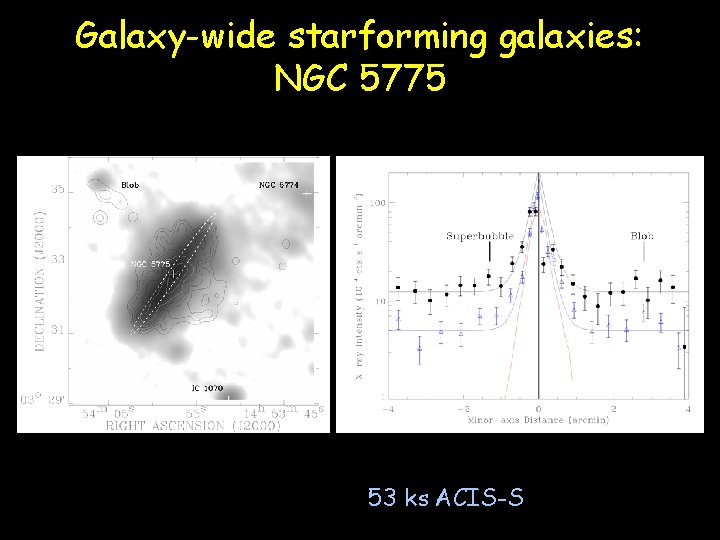
Galaxy-wide starforming galaxies: NGC 5775 53 ks ACIS-S