
Diffuse Large BCell Lymphoma of Spleen with Rib
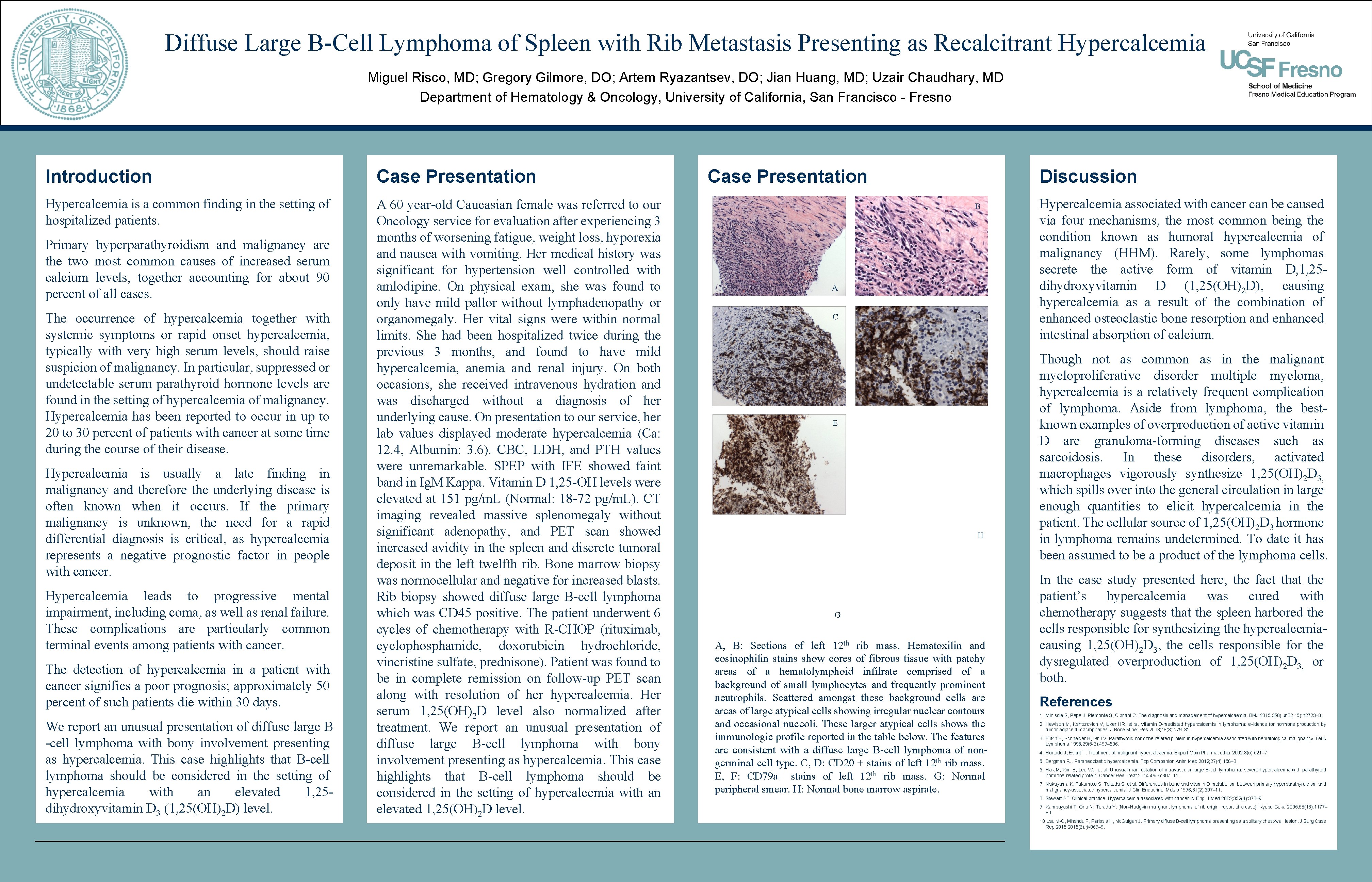
Diffuse Large B-Cell Lymphoma of Spleen with Rib Metastasis Presenting as Recalcitrant Hypercalcemia Miguel Risco, MD; Gregory Gilmore, DO; Artem Ryazantsev, DO; Jian Huang, MD; Uzair Chaudhary, MD Department of Hematology & Oncology, University of California, San Francisco - Fresno Introduction Case Presentation Hypercalcemia is a common finding in the setting of hospitalized patients. A 60 year-old Caucasian female was referred to our Oncology service for evaluation after experiencing 3 months of worsening fatigue, weight loss, hyporexia and nausea with vomiting. Her medical history was significant for hypertension well controlled with amlodipine. On physical exam, she was found to only have mild pallor without lymphadenopathy or organomegaly. Her vital signs were within normal limits. She had been hospitalized twice during the previous 3 months, and found to have mild hypercalcemia, anemia and renal injury. On both occasions, she received intravenous hydration and was discharged without a diagnosis of her underlying cause. On presentation to our service, her lab values displayed moderate hypercalcemia (Ca: 12. 4, Albumin: 3. 6). CBC, LDH, and PTH values were unremarkable. SPEP with IFE showed faint band in Ig. M Kappa. Vitamin D 1, 25 -OH levels were elevated at 151 pg/m. L (Normal: 18 -72 pg/m. L). CT imaging revealed massive splenomegaly without significant adenopathy, and PET scan showed increased avidity in the spleen and discrete tumoral deposit in the left twelfth rib. Bone marrow biopsy was normocellular and negative for increased blasts. Rib biopsy showed diffuse large B-cell lymphoma which was CD 45 positive. The patient underwent 6 cycles of chemotherapy with R-CHOP (rituximab, cyclophosphamide, doxorubicin hydrochloride, vincristine sulfate, prednisone). Patient was found to be in complete remission on follow-up PET scan along with resolution of her hypercalcemia. Her serum 1, 25(OH)2 D level also normalized after treatment. We report an unusual presentation of diffuse large B-cell lymphoma with bony involvement presenting as hypercalcemia. This case highlights that B-cell lymphoma should be considered in the setting of hypercalcemia with an elevated 1, 25(OH)2 D level. Primary hyperparathyroidism and malignancy are the two most common causes of increased serum calcium levels, together accounting for about 90 percent of all cases. The occurrence of hypercalcemia together with systemic symptoms or rapid onset hypercalcemia, typically with very high serum levels, should raise suspicion of malignancy. In particular, suppressed or undetectable serum parathyroid hormone levels are found in the setting of hypercalcemia of malignancy. Hypercalcemia has been reported to occur in up to 20 to 30 percent of patients with cancer at some time during the course of their disease. Hypercalcemia is usually a late finding in malignancy and therefore the underlying disease is often known when it occurs. If the primary malignancy is unknown, the need for a rapid differential diagnosis is critical, as hypercalcemia represents a negative prognostic factor in people with cancer. Hypercalcemia leads to progressive mental impairment, including coma, as well as renal failure. These complications are particularly common terminal events among patients with cancer. The detection of hypercalcemia in a patient with cancer signifies a poor prognosis; approximately 50 percent of such patients die within 30 days. We report an unusual presentation of diffuse large B -cell lymphoma with bony involvement presenting as hypercalcemia. This case highlights that B-cell lymphoma should be considered in the setting of hypercalcemia with an elevated 1, 25 dihydroxyvitamin D 3 (1, 25(OH)2 D) level. Case Presentation Discussion B A D C C D E F E H G A, B: Sections of left 12 th rib mass. Hematoxilin and eosinophilin stains show cores of fibrous tissue with patchy areas of a hematolymphoid infilrate comprised of a background of small lymphocytes and frequently prominent neutrophils. Scattered amongst these background cells areas of large atypical cells showing irregular nuclear contours and occasional nuceoli. These larger atypical cells shows the immunologic profile reported in the table below. The features are consistent with a diffuse large B-cell lymphoma of nongerminal cell type. C, D: CD 20 + stains of left 12 th rib mass. E, F: CD 79 a+ stains of left 12 th rib mass. G: Normal peripheral smear. H: Normal bone marrow aspirate. Hypercalcemia associated with cancer can be caused via four mechanisms, the most common being the condition known as humoral hypercalcemia of malignancy (HHM). Rarely, some lymphomas secrete the active form of vitamin D, 1, 25 dihydroxyvitamin D (1, 25(OH)2 D), causing hypercalcemia as a result of the combination of enhanced osteoclastic bone resorption and enhanced intestinal absorption of calcium. Though not as common as in the malignant myeloproliferative disorder multiple myeloma, hypercalcemia is a relatively frequent complication of lymphoma. Aside from lymphoma, the bestknown examples of overproduction of active vitamin D are granuloma-forming diseases such as sarcoidosis. In these disorders, activated macrophages vigorously synthesize 1, 25(OH)2 D 3, which spills over into the general circulation in large enough quantities to elicit hypercalcemia in the patient. The cellular source of 1, 25(OH)2 D 3 hormone in lymphoma remains undetermined. To date it has been assumed to be a product of the lymphoma cells. In the case study presented here, the fact that the patient’s hypercalcemia was cured with chemotherapy suggests that the spleen harbored the cells responsible for synthesizing the hypercalcemiacausing 1, 25(OH)2 D 3, the cells responsible for the dysregulated overproduction of 1, 25(OH)2 D 3, or both. References 1. Minisola S, Pepe J, Piemonte S, Cipriani C. The diagnosis and management of hypercalcaemia. BMJ 2015; 350(jun 02 15): h 2723– 3. 2. Hewison M, Kantorovich V, Liker HR, et al. Vitamin D-mediated hypercalcemia in lymphoma: evidence for hormone production by tumor-adjacent macrophages. J Bone Miner Res 2003; 18(3): 579– 82. 3. Firkin F, Schneider H, Grill V. Parathyroid hormone-related protein in hypercalcemia associated with hematological malignancy. Leuk Lymphoma 1998; 29(5 -6): 499– 506. 4. Hurtado J, Esbrit P. Treatment of malignant hypercalcaemia. Expert Opin Pharmacother 2002; 3(5): 521– 7. 5. Bergman PJ. Paraneoplastic hypercalcemia. Top Companion Anim Med 2012; 27(4): 156– 8. 6. Ha JM, Kim E, Lee WJ, et al. Unusual manifestation of intravascular large B-cell lymphoma: severe hypercalcemia with parathyroid hormone-related protein. Cancer Res Treat 2014; 46(3): 307– 11. 7. Nakayama K, Fukumoto S, Takeda S, et al. Differences in bone and vitamin D metabolism between primary hyperparathyroidism and malignancy-associated hypercalcemia. J Clin Endocrinol Metab 1996; 81(2): 607– 11. 8. Stewart AF. Clinical practice. Hypercalcemia associated with cancer. N Engl J Med 2005; 352(4): 373– 9. 9. Kambayashi T, Ono N, Terada Y. [Non-Hodgkin malignant lymphoma of rib origin: report of a case]. Kyobu Geka 2005; 58(13): 1177– 80. 10. Lau M-C, Mhandu P, Parissis H, Mc. Guigan J. Primary diffuse B-cell lymphoma presenting as a solitary chest-wall lesion. J Surg Case Rep 2015; 2015(6): rjv 069– 9.
- Slides: 1