
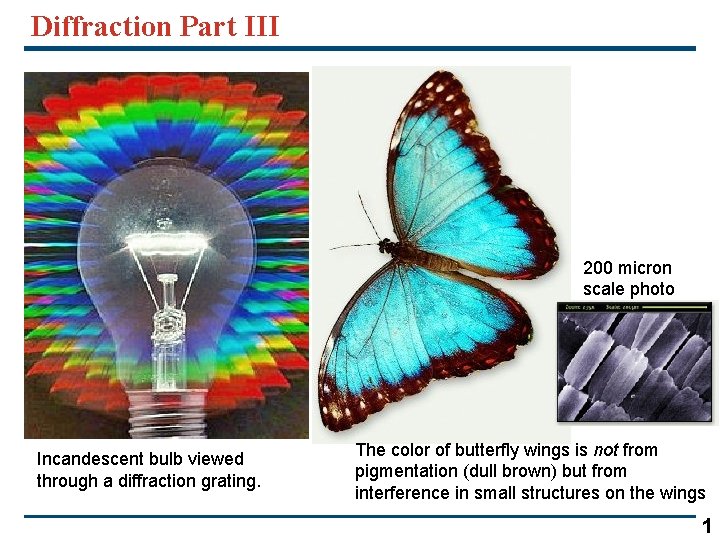
Diffraction Part III 200 micron scale photo Incandescent






- Slides: 36
Diffraction Part III 200 micron scale photo Incandescent bulb viewed through a diffraction grating. The color of butterfly wings is not from pigmentation (dull brown) but from interference in small structures on the wings 1
Resources (update) Office Hours: I am available before class 11: 30 -12: 10 MWF and after class on Monday and Friday in WAT 233 and by arrangement (teb#phys. hawaii. edu). [PHYS 480 L sections rescheduled: Tues 1 -4, Wed 1: 30 -4: 30] Grader: Tommy Lam (e-mail: tommy 9#hawaii. edu) will provide feedback on homework, hints, answer questions, and to help solve issues with Mastering Physics. Link to homework hints on the course web page and Laulima.
Today • Quiz • N Slits • Diffraction grating (extension of N slits) • Diffraction limit and Rayleigh criterion. • Crystal Diffraction. • Next time: Holography, review of diffraction (Chap 36) Read 36. 7, 36. 8 for next time. Start looking at special relativity (37. 1, 37. 2) 3
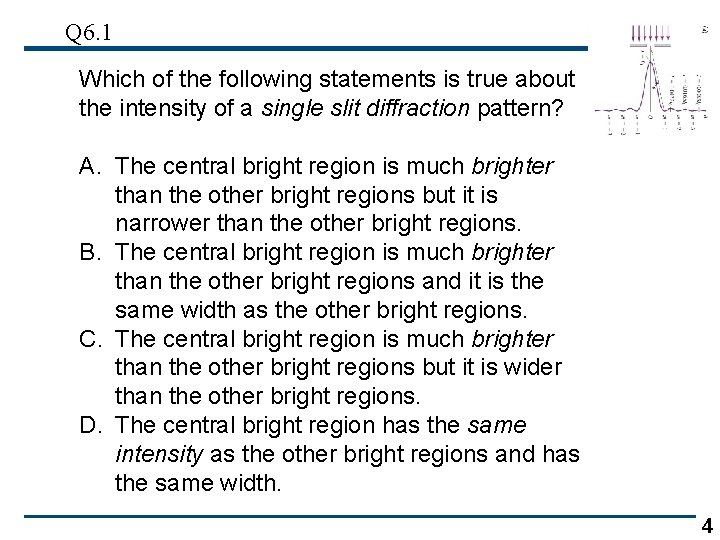
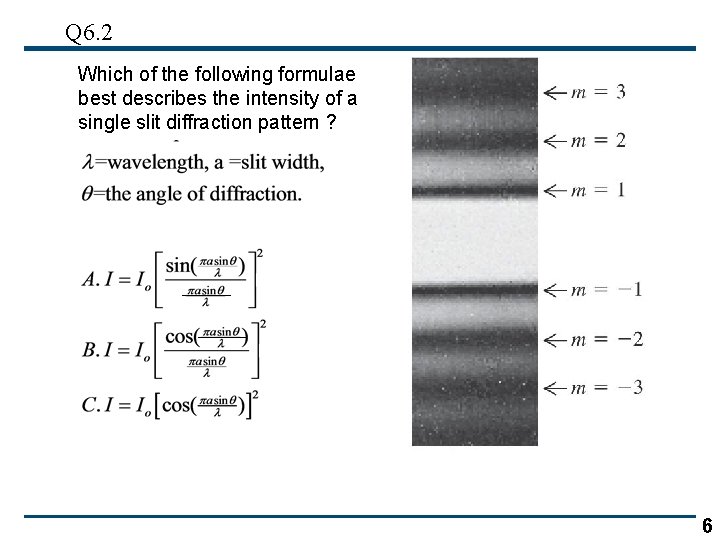
Q 6. 1 Which of the following statements is true about the intensity of a single slit diffraction pattern? A. The central bright region is much brighter than the other bright regions but it is narrower than the other bright regions. B. The central bright region is much brighter than the other bright regions and it is the same width as the other bright regions. C. The central bright region is much brighter than the other bright regions but it is wider than the other bright regions. D. The central bright region has the same intensity as the other bright regions and has the same width. 4
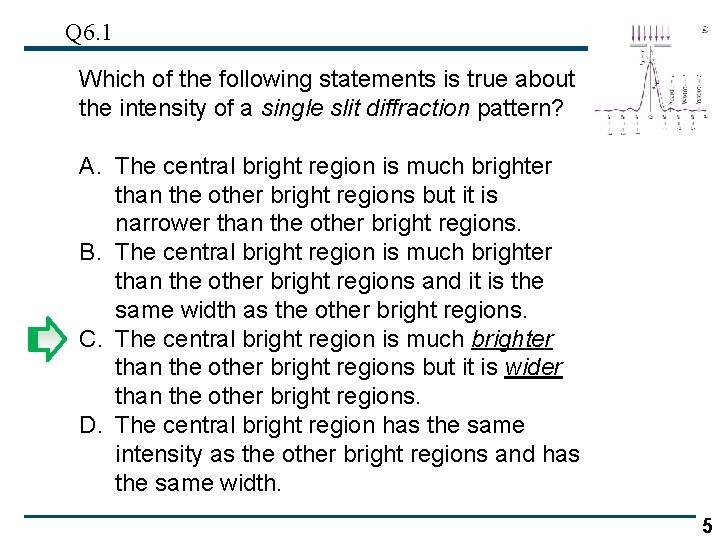
Q 6. 1 Which of the following statements is true about the intensity of a single slit diffraction pattern? A. The central bright region is much brighter than the other bright regions but it is narrower than the other bright regions. B. The central bright region is much brighter than the other bright regions and it is the same width as the other bright regions. C. The central bright region is much brighter than the other bright regions but it is wider than the other bright regions. D. The central bright region has the same intensity as the other bright regions and has the same width. 5
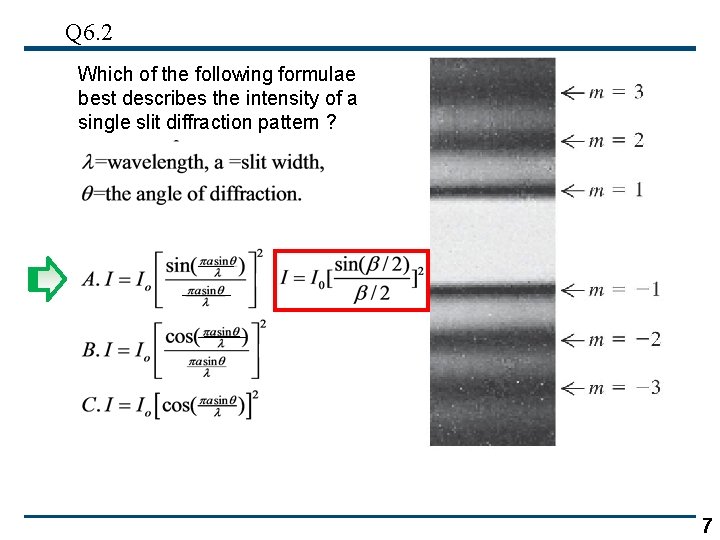
Q 6. 2 Which of the following formulae best describes the intensity of a single slit diffraction pattern ? 6
Q 6. 2 Which of the following formulae best describes the intensity of a single slit diffraction pattern ? 7
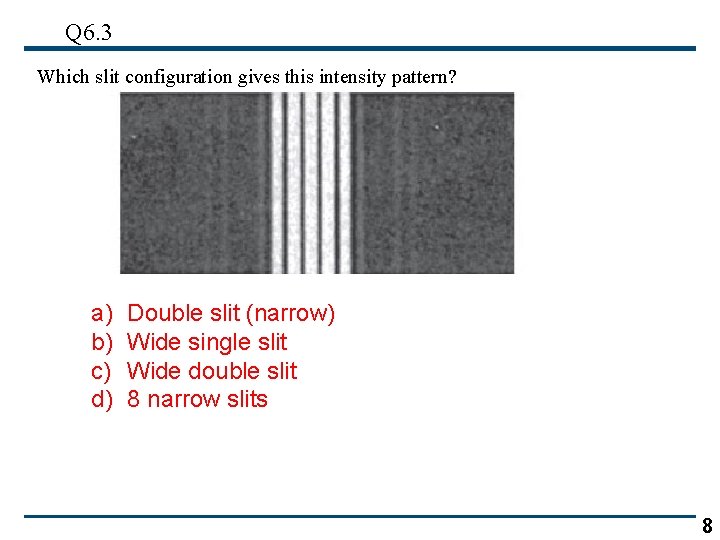
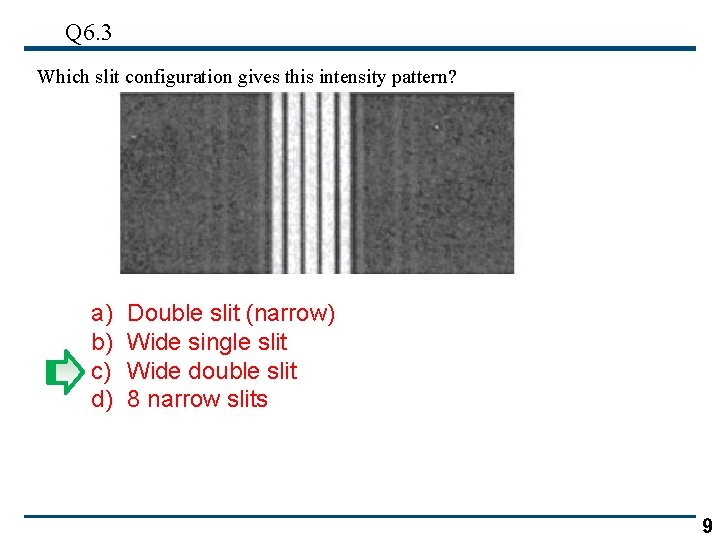
Q 6. 3 Which slit configuration gives this intensity pattern? a) b) c) d) Double slit (narrow) Wide single slit Wide double slit 8 narrow slits 8
Q 6. 3 Which slit configuration gives this intensity pattern? a) b) c) d) Double slit (narrow) Wide single slit Wide double slit 8 narrow slits 9
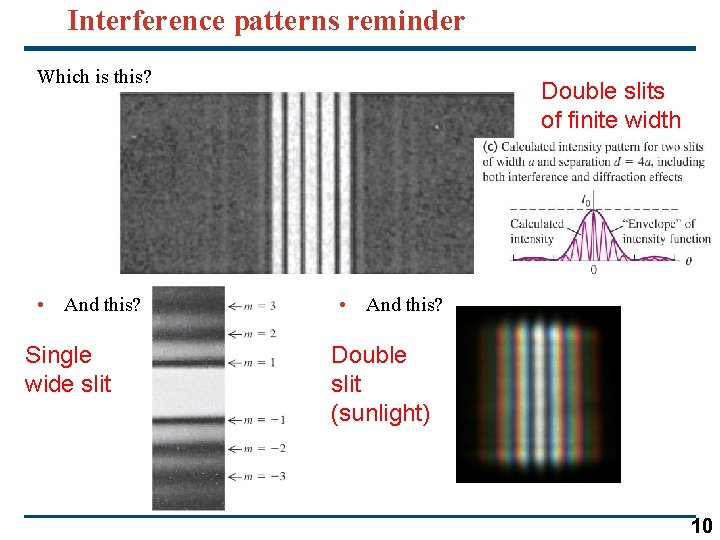
Interference patterns reminder Which is this? • And this? Single wide slit Double slits of finite width • And this? Double slit (sunlight) 10
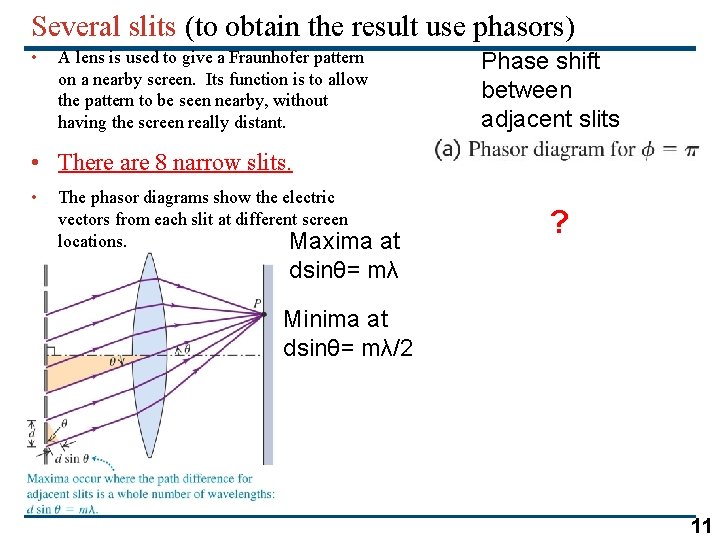
Several slits (to obtain the result use phasors) • A lens is used to give a Fraunhofer pattern on a nearby screen. Its function is to allow the pattern to be seen nearby, without having the screen really distant. Phase shift between adjacent slits • There are 8 narrow slits. • The phasor diagrams show the electric vectors from each slit at different screen locations. Maxima at dsinθ= mλ ? Minima at dsinθ= mλ/2 11
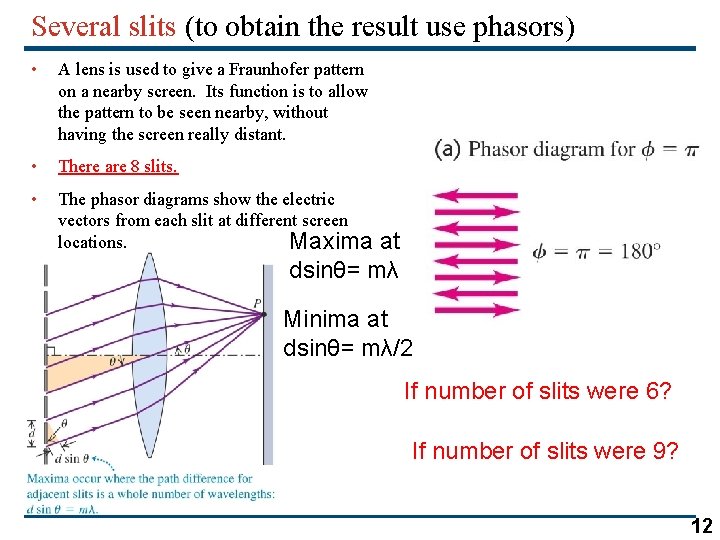
Several slits (to obtain the result use phasors) • A lens is used to give a Fraunhofer pattern on a nearby screen. Its function is to allow the pattern to be seen nearby, without having the screen really distant. • There are 8 slits. • The phasor diagrams show the electric vectors from each slit at different screen locations. Maxima at dsinθ= mλ Minima at dsinθ= mλ/2 If number of slits were 6? If number of slits were 9? 12
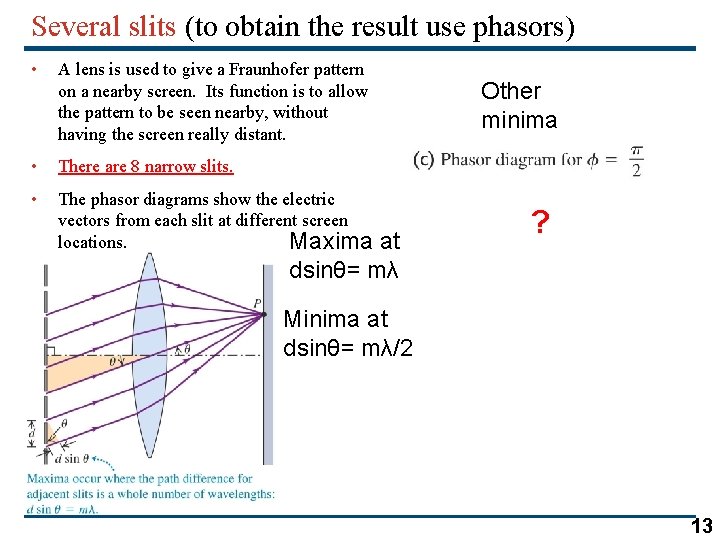
Several slits (to obtain the result use phasors) • A lens is used to give a Fraunhofer pattern on a nearby screen. Its function is to allow the pattern to be seen nearby, without having the screen really distant. • There are 8 narrow slits. • The phasor diagrams show the electric vectors from each slit at different screen locations. Maxima at dsinθ= mλ Other minima ? Minima at dsinθ= mλ/2 13
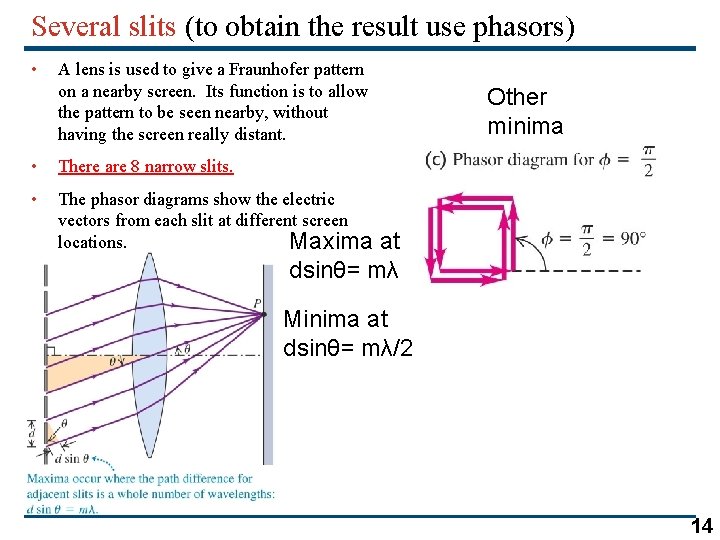
Several slits (to obtain the result use phasors) • A lens is used to give a Fraunhofer pattern on a nearby screen. Its function is to allow the pattern to be seen nearby, without having the screen really distant. • There are 8 narrow slits. • The phasor diagrams show the electric vectors from each slit at different screen locations. Maxima Other minima at dsinθ= mλ Minima at dsinθ= mλ/2 14
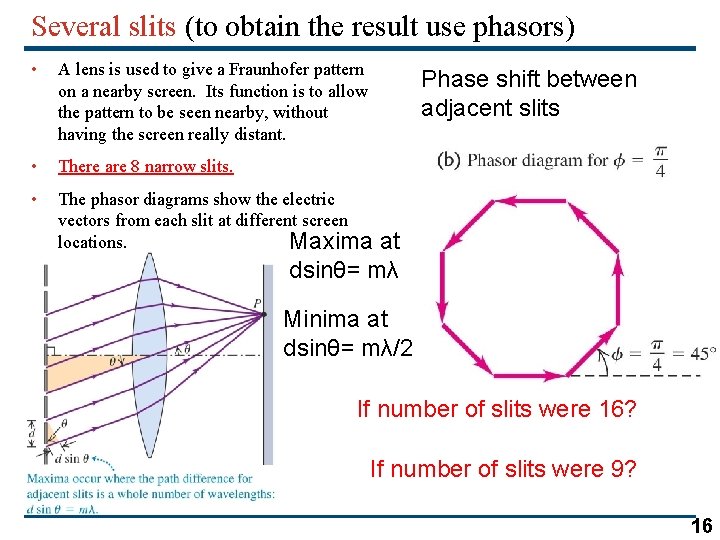
Several slits (to obtain the result use phasors) • A lens is used to give a Fraunhofer pattern on a nearby screen. Its function is to allow the pattern to be seen nearby, without having the screen really distant. • There are 8 narrow slits. • The phasor diagrams show the electric vectors from each slit at different screen locations. Maxima Phase shift between adjacent slits at dsinθ= mλ ? Minima at dsinθ= mλ/2 15
Several slits (to obtain the result use phasors) • A lens is used to give a Fraunhofer pattern on a nearby screen. Its function is to allow the pattern to be seen nearby, without having the screen really distant. • There are 8 narrow slits. • The phasor diagrams show the electric vectors from each slit at different screen locations. Maxima Phase shift between adjacent slits at dsinθ= mλ Minima at dsinθ= mλ/2 If number of slits were 16? If number of slits were 9? 16
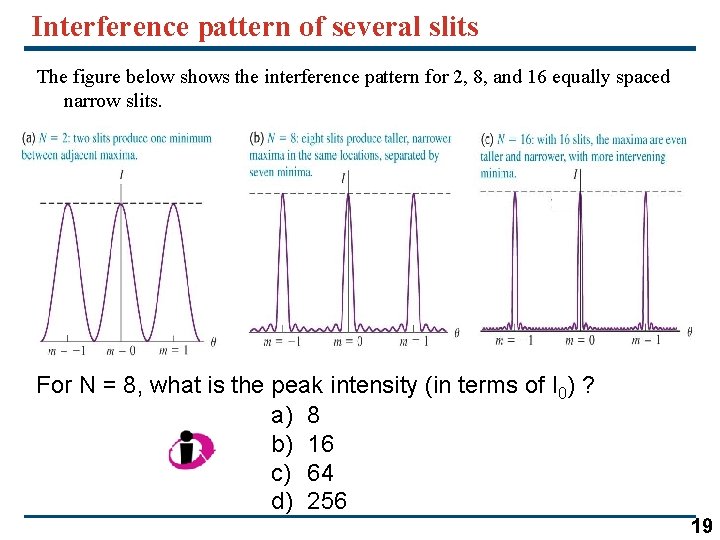
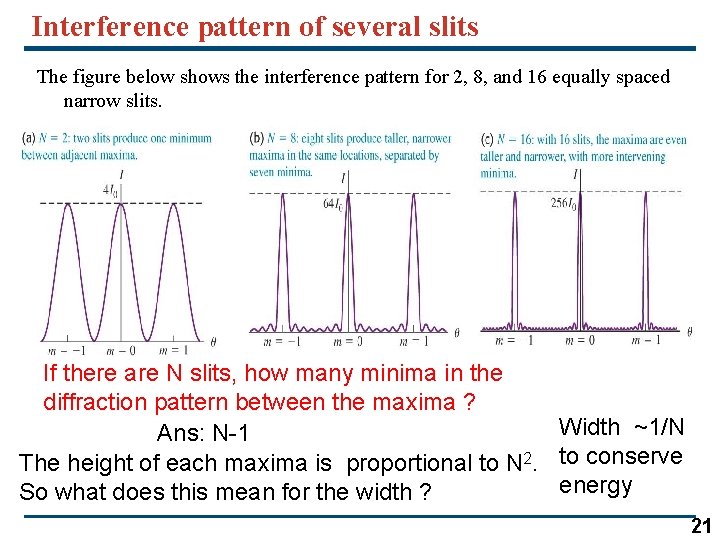
Interference pattern of several slits The figure below shows the interference pattern for 2, 8, and 16 equally spaced narrow slits. By making the slits very close together, the maxima become more separated. If the light falling on the slits contains more than one wavelength (color), there will be more than one pattern, separated more or less according to wavelength, although all colors have a maximum at m = 0. 17
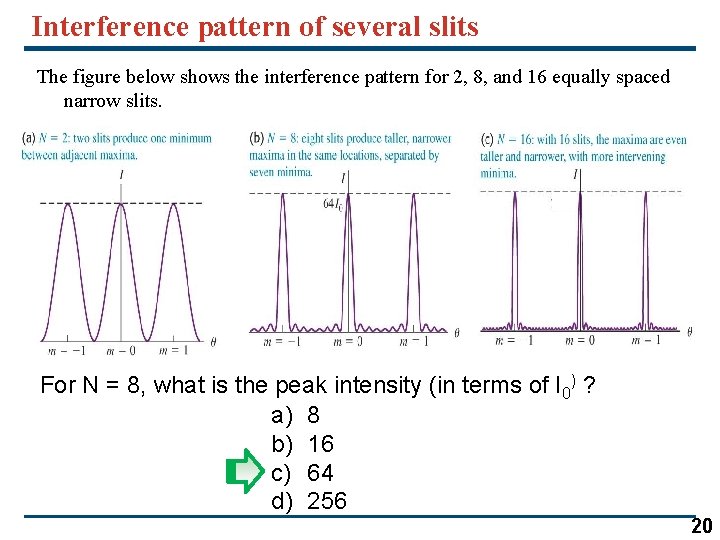
Interference pattern of several slits • The figure below shows the interference pattern for 2, 8, and 16 equally spaced narrow slits. If there are N slits, how many minima in the diffraction pattern between the maxima ? Ans: N-1 The height of each maxima is proportional to N 2. So what does this mean for the width ? Width ~1/N to conserve energy 18
Interference pattern of several slits The figure below shows the interference pattern for 2, 8, and 16 equally spaced narrow slits. For N = 8, what is the peak intensity (in terms of I 0) ? a) 8 b) 16 c) 64 d) 256 19
Interference pattern of several slits The figure below shows the interference pattern for 2, 8, and 16 equally spaced narrow slits. For N = 8, what is the peak intensity (in terms of I 0) ? a) 8 b) 16 c) 64 d) 256 20
Interference pattern of several slits The figure below shows the interference pattern for 2, 8, and 16 equally spaced narrow slits. If there are N slits, how many minima in the diffraction pattern between the maxima ? Width ~1/N Ans: N-1 The height of each maxima is proportional to N 2. to conserve energy So what does this mean for the width ? 21
Interference patterns reminder Which is this? • And this? Single wide slit Double slits of finite width • And this? Double slit (sunlight) 22
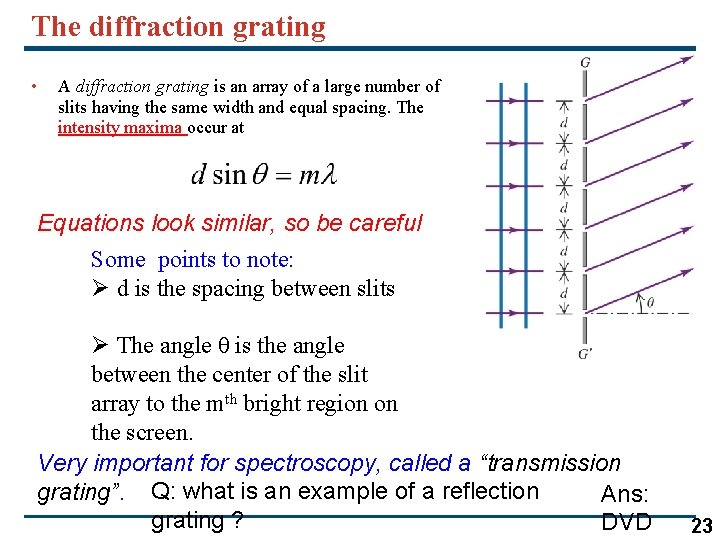
The diffraction grating • A diffraction grating is an array of a large number of slits having the same width and equal spacing. The intensity maxima occur at Equations look similar, so be careful Some points to note: Ø d is the spacing between slits Ø The angle θ is the angle between the center of the slit array to the mth bright region on the screen. Very important for spectroscopy, called a “transmission grating”. Q: what is an example of a reflection Ans: grating ? DVD 23
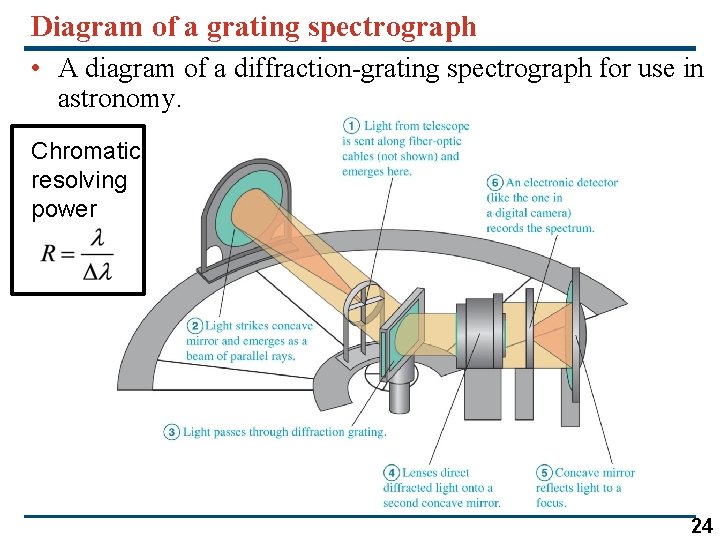
Diagram of a grating spectrograph • A diagram of a diffraction-grating spectrograph for use in astronomy. Chromatic resolving power 24
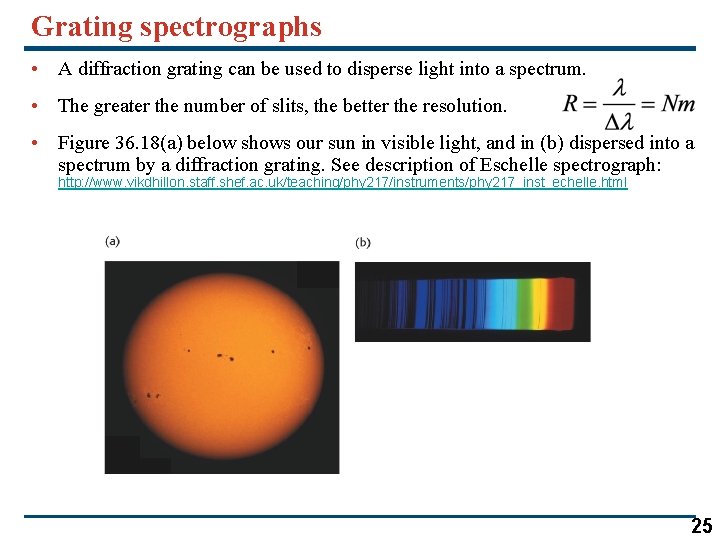
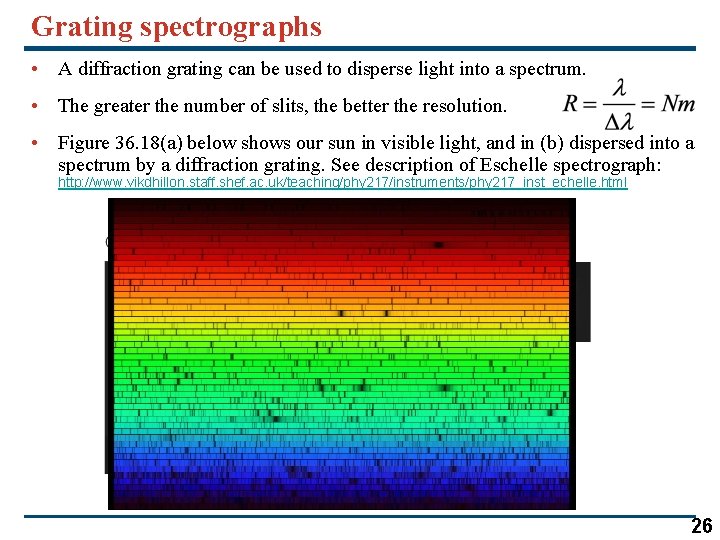
Grating spectrographs • A diffraction grating can be used to disperse light into a spectrum. • The greater the number of slits, the better the resolution. • Figure 36. 18(a) below shows our sun in visible light, and in (b) dispersed into a spectrum by a diffraction grating. See description of Eschelle spectrograph: http: //www. vikdhillon. staff. shef. ac. uk/teaching/phy 217/instruments/phy 217_inst_echelle. html 25
Grating spectrographs • A diffraction grating can be used to disperse light into a spectrum. • The greater the number of slits, the better the resolution. • Figure 36. 18(a) below shows our sun in visible light, and in (b) dispersed into a spectrum by a diffraction grating. See description of Eschelle spectrograph: http: //www. vikdhillon. staff. shef. ac. uk/teaching/phy 217/instruments/phy 217_inst_echelle. html 26
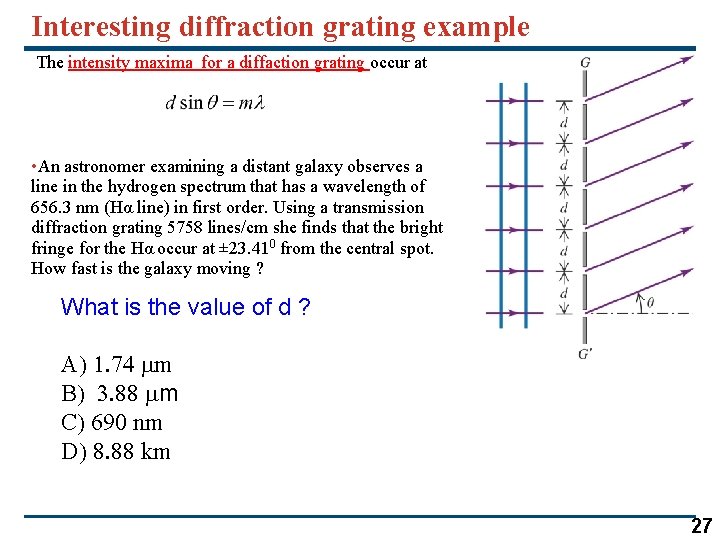
Interesting diffraction grating example The intensity maxima for a diffaction grating occur at • An astronomer examining a distant galaxy observes a line in the hydrogen spectrum that has a wavelength of 656. 3 nm (Hα line) in first order. Using a transmission diffraction grating 5758 lines/cm she finds that the bright fringe for the Hα occur at ± 23. 410 from the central spot. How fast is the galaxy moving ? What is the value of d ? A) 1. 74 mm B) 3. 88 mm C) 690 nm D) 8. 88 km 27
Interesting diffraction grating example The intensity maxima for a diffaction grating occur at • An astronomer examining a distant galaxy observes a line in the hydrogen spectrum that has a wavelength of 656. 3 nm (Hα line) in first order. Using a transmission diffraction grating 5758 lines/cm she finds that the bright fringe for the Hα occur at ± 23. 410 from the central spot. How fast is the galaxy moving ? = 1. 74 mm What is the value of λ ? A) 1. 74 mm B) 3. 88 mm C) 690 nm D) 8. 88 km 28
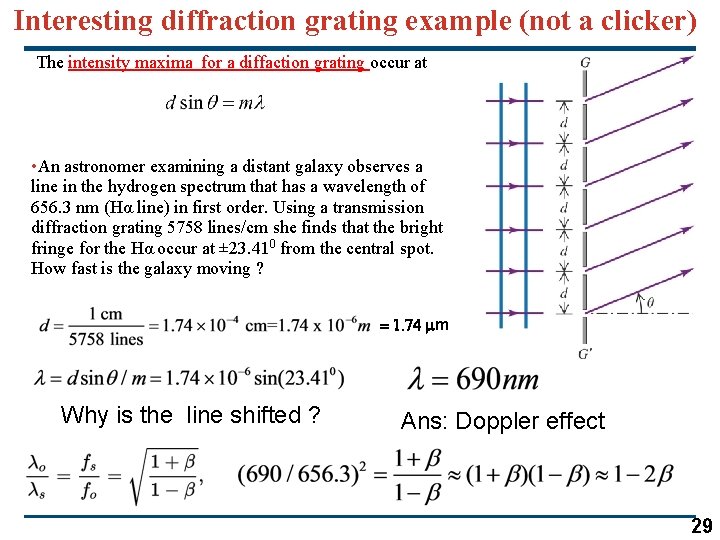
Interesting diffraction grating example (not a clicker) The intensity maxima for a diffaction grating occur at • An astronomer examining a distant galaxy observes a line in the hydrogen spectrum that has a wavelength of 656. 3 nm (Hα line) in first order. Using a transmission diffraction grating 5758 lines/cm she finds that the bright fringe for the Hα occur at ± 23. 410 from the central spot. How fast is the galaxy moving ? = 1. 74 mm Why is the line shifted ? Ans: Doppler effect 29
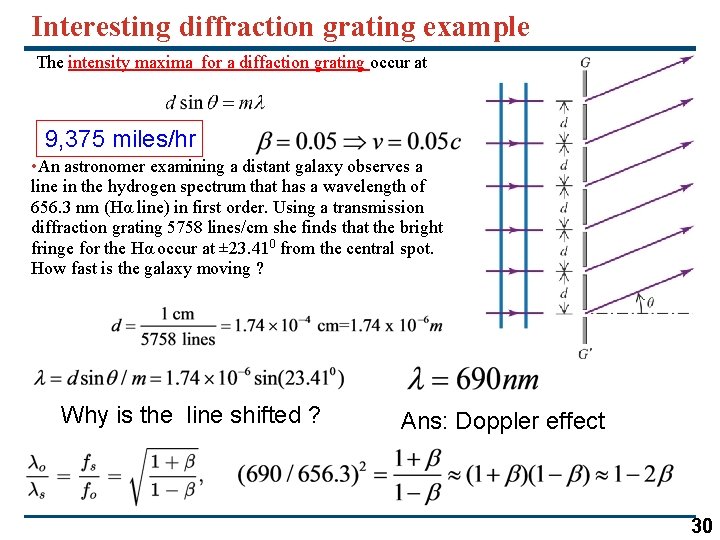
Interesting diffraction grating example The intensity maxima for a diffaction grating occur at 9, 375 miles/hr • An astronomer examining a distant galaxy observes a line in the hydrogen spectrum that has a wavelength of 656. 3 nm (Hα line) in first order. Using a transmission diffraction grating 5758 lines/cm she finds that the bright fringe for the Hα occur at ± 23. 410 from the central spot. How fast is the galaxy moving ? Why is the line shifted ? Ans: Doppler effect 30
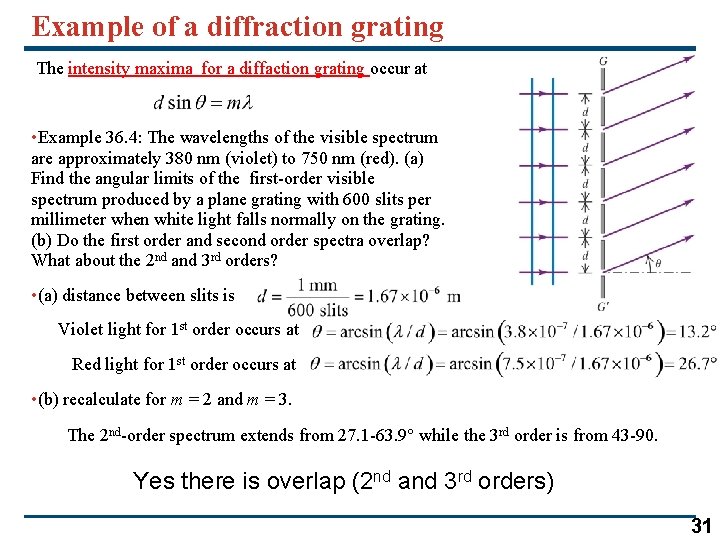
Example of a diffraction grating The intensity maxima for a diffaction grating occur at • Example 36. 4: The wavelengths of the visible spectrum are approximately 380 nm (violet) to 750 nm (red). (a) Find the angular limits of the first-order visible spectrum produced by a plane grating with 600 slits per millimeter when white light falls normally on the grating. (b) Do the first order and second order spectra overlap? What about the 2 nd and 3 rd orders? • (a) distance between slits is Violet light for 1 st order occurs at Red light for 1 st order occurs at • (b) recalculate for m = 2 and m = 3. The 2 nd-order spectrum extends from 27. 1 -63. 9° while the 3 rd order is from 43 -90. Yes there is overlap (2 nd and 3 rd orders) 31
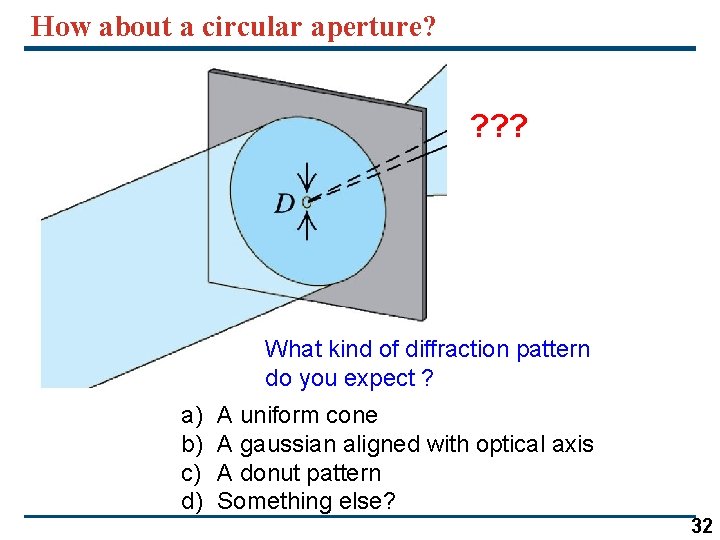
How about a circular aperture? ? ? ? What kind of diffraction pattern do you expect ? a) b) c) d) A uniform cone A gaussian aligned with optical axis A donut pattern Something else? 32
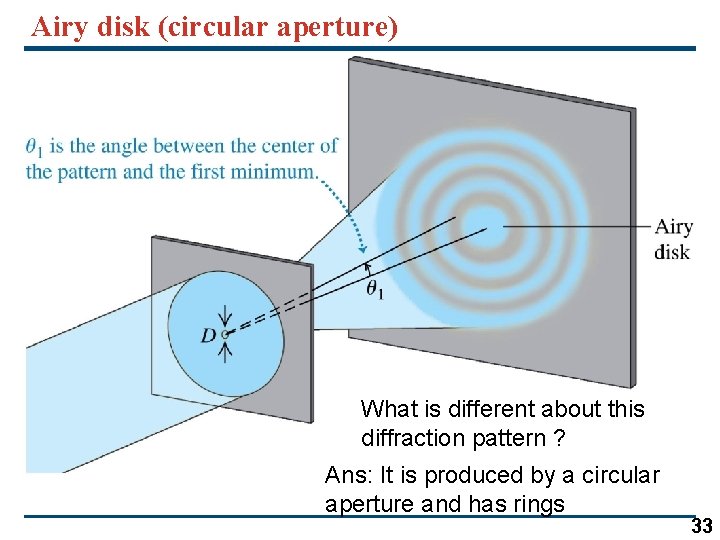
Airy disk (circular aperture) What is different about this diffraction pattern ? Ans: It is produced by a circular aperture and has rings 33
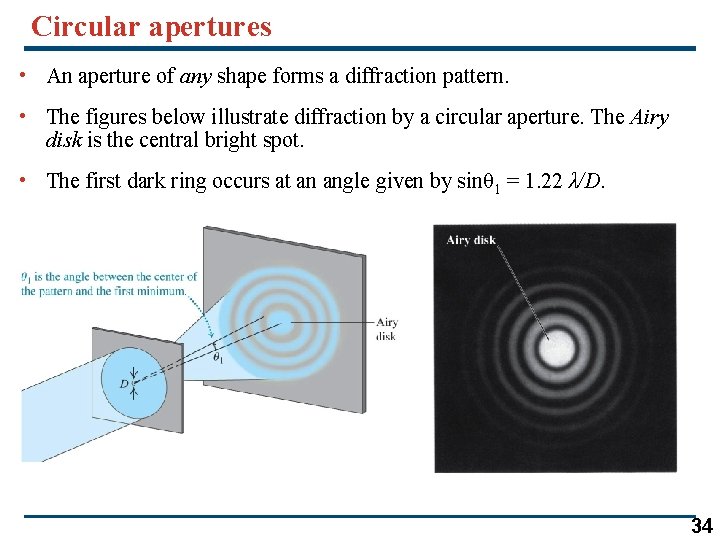
Circular apertures • An aperture of any shape forms a diffraction pattern. • The figures below illustrate diffraction by a circular aperture. The Airy disk is the central bright spot. • The first dark ring occurs at an angle given by sinθ 1 = 1. 22 λ/D. 34
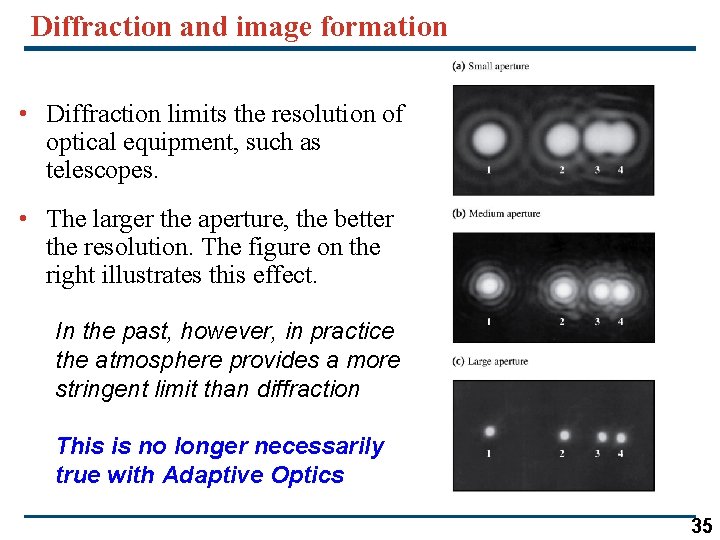
Diffraction and image formation • Diffraction limits the resolution of optical equipment, such as telescopes. • The larger the aperture, the better the resolution. The figure on the right illustrates this effect. In the past, however, in practice the atmosphere provides a more stringent limit than diffraction This is no longer necessarily true with Adaptive Optics 35
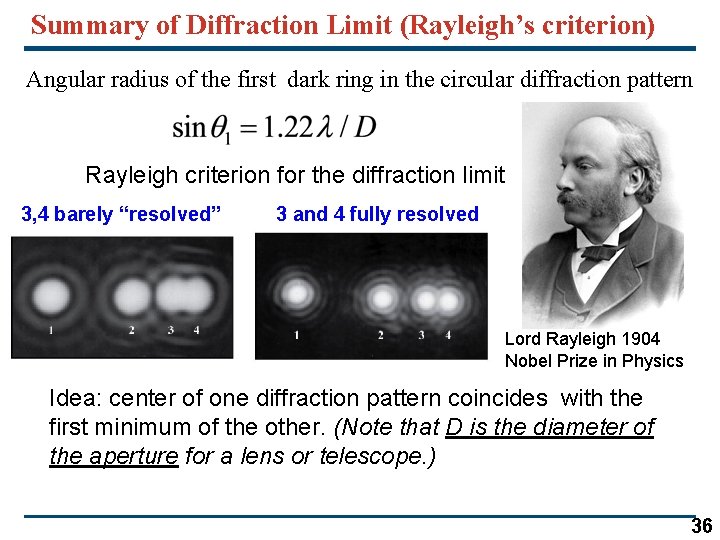
Summary of Diffraction Limit (Rayleigh’s criterion) Angular radius of the first dark ring in the circular diffraction pattern Rayleigh criterion for the diffraction limit 3, 4 barely “resolved” 3 and 4 fully resolved Lord Rayleigh 1904 Nobel Prize in Physics Idea: center of one diffraction pattern coincides with the first minimum of the other. (Note that D is the diameter of the aperture for a lens or telescope. ) 36