
Diffraction in TEM Samples can exhibit diffraction contrast

Diffraction in TEM Samples can exhibit diffraction contrast, whereby the electron beam undergoes Bragg scattering, which in the case of a crystalline sample. Selected area electron diffraction (SAED) can be used to determine whether a specimen is single crystal, polycrystalline, or amorphous; identify the crystallographic structure, symmetry, and orientation of samples; measure the lattice parameter; identify if more than one phase is present. Single spots appear only when the beam is diffracted by a single crystal. Polycrystalline materials gives ring patterns analogous Fig -6 - SAED for single crystal (left image), polycrystalline ( right image)
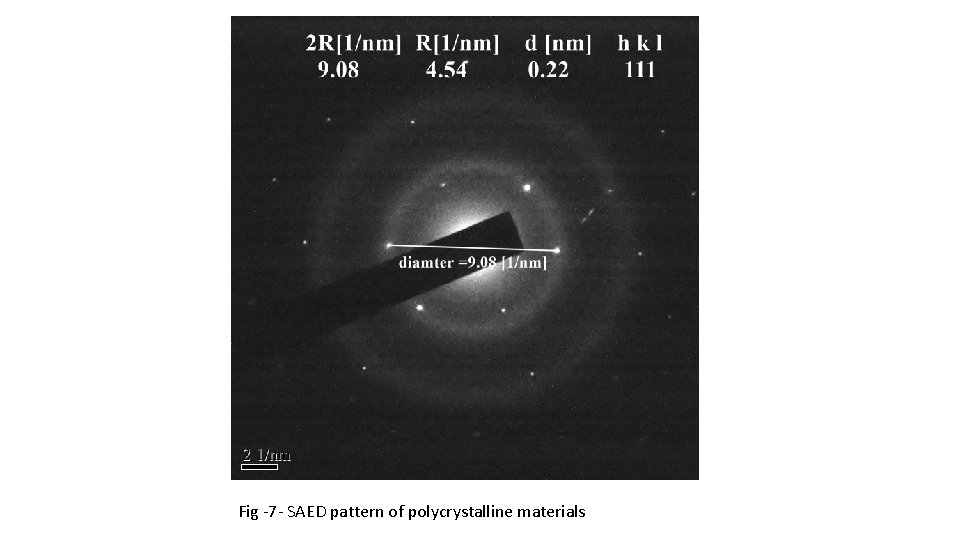
Fig -7 - SAED pattern of polycrystalline materials
Electron energy-loss spectroscopy (EELS) is an analytical technique that measures the change in kinetic energy of electrons after they have interacted with a specimen. Electron energy-loss spectroscopy (EELS) involves measurement of the amount of energy needs to remove the electron from the shells Zero-loss peak at 0 e. V: It mainly contains electrons that still have the original beam energy E 0, i. e. , they have only interacted elastically or not at all with the specimen ( incident electrons do not loss any energy). Low-loss region (< 100 e. V) Here, the electrons that have induced plasmon oscillations occur. High-Loss region (> 100 e. V) For the ionization of atoms, a specific minimum energy, the critical ionization energy E C or ionization threshold, must be transferred from the incident electron to the expelled inner-shell electron, which leads to ionization edges in the spectrum at energy losses that are characteristic for an element. Thus, EELS is complementary to. X-ray spectroscopy, and it can be utilized for qualitative and quantitative element analysis as well.
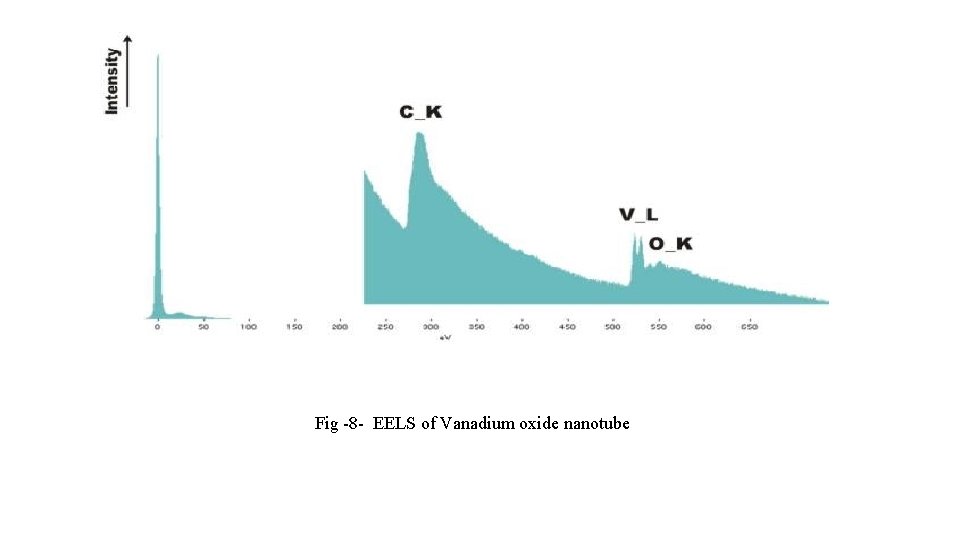
Fig -8 - EELS of Vanadium oxide nanotube
- Slides: 4