
Diffraction Enhanced Imaging at the UK Synchrotron Radiation


- Slides: 18
Diffraction Enhanced Imaging at the UK Synchrotron Radiation Source M. Ibison, K. C. Cheung, K. Siu, C. J. Hall, R. A. Lewis, A. Hufton, S. J. Wilkinson, K. D. Rogers, A. Round
Principal Objectives of DEI Development Activities at the SRS 1. reduce the proportion of available time spent on alignment, in preparation for useful imaging 2. increase reliability and stability in mechanics and software, to improve image quality 3. approach a ‘turn-key’ facility for DEI users without need for expertise in the detailed method. Also: § obtain useful experience for designing 2 nd generation DEI on higher-energy SRS station.
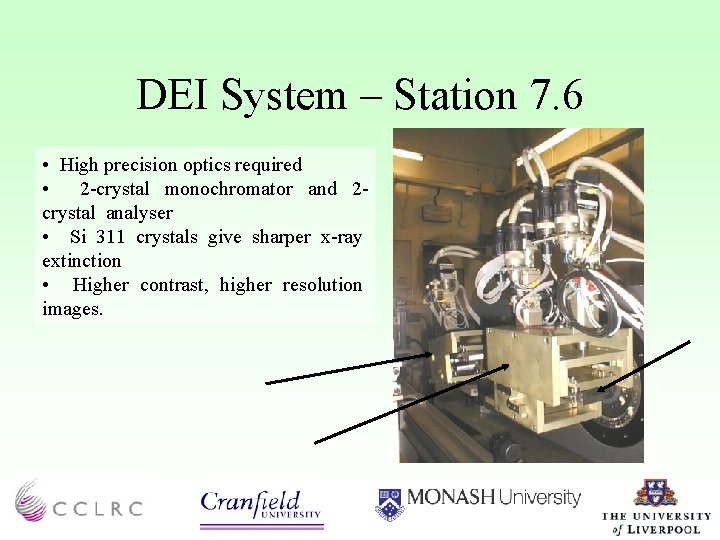
DEI System – Station 7. 6 • High precision optics required • 2 -crystal monochromator and 2 crystal analyser • Si 311 crystals give sharper x-ray extinction • Higher contrast, higher resolution images.
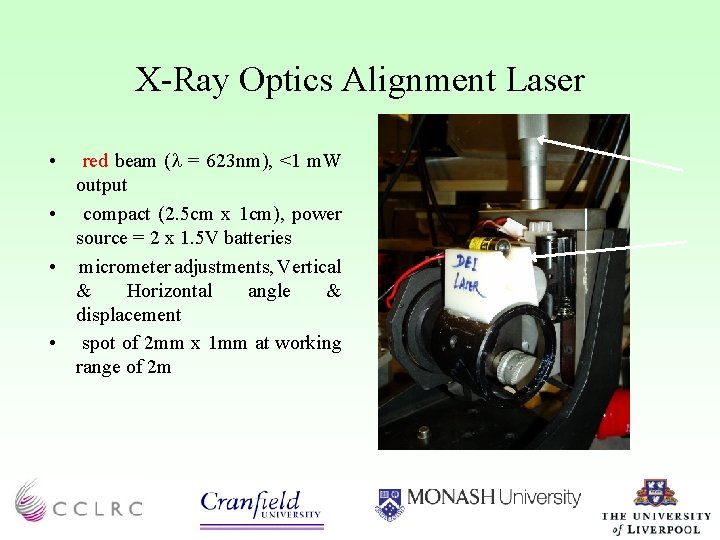
X-Ray Optics Alignment Laser • red beam (l = 623 nm), <1 m. W output • compact (2. 5 cm x 1 cm), power source = 2 x 1. 5 V batteries • micrometer adjustments, Vertical & Horizontal angle & displacement • spot of 2 mm x 1 mm at working range of 2 m
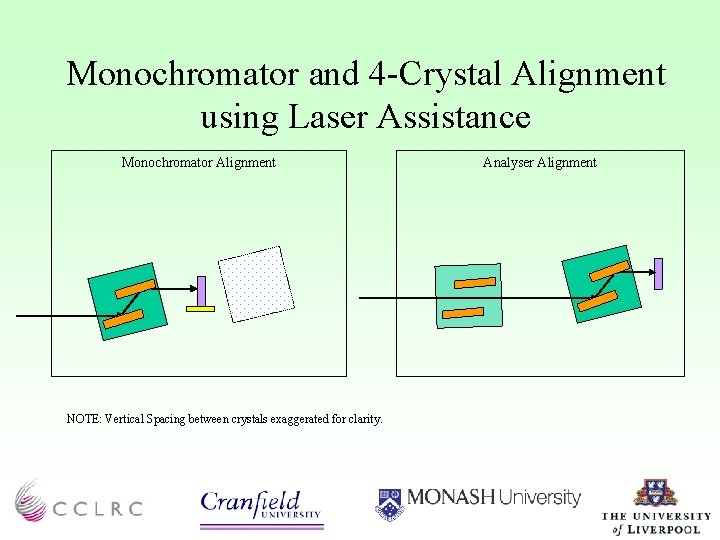
Monochromator and 4 -Crystal Alignment using Laser Assistance Monochromator Alignment NOTE: Vertical Spacing between crystals exaggerated for clarity. Analyser Alignment
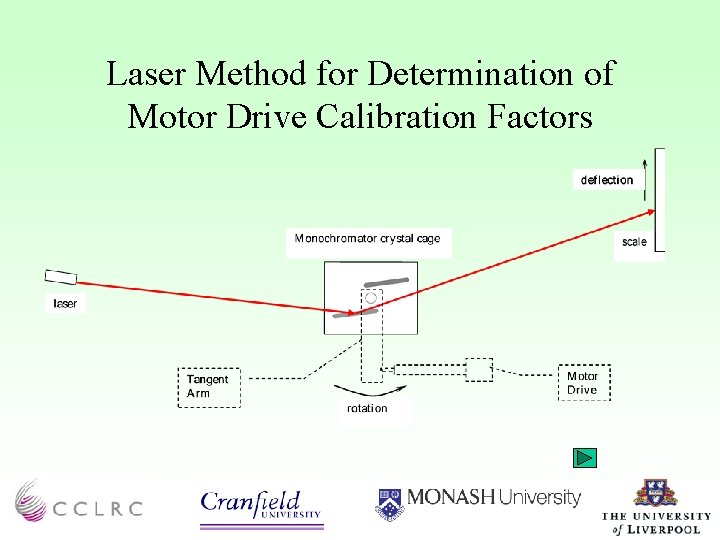
Laser Method for Determination of Motor Drive Calibration Factors
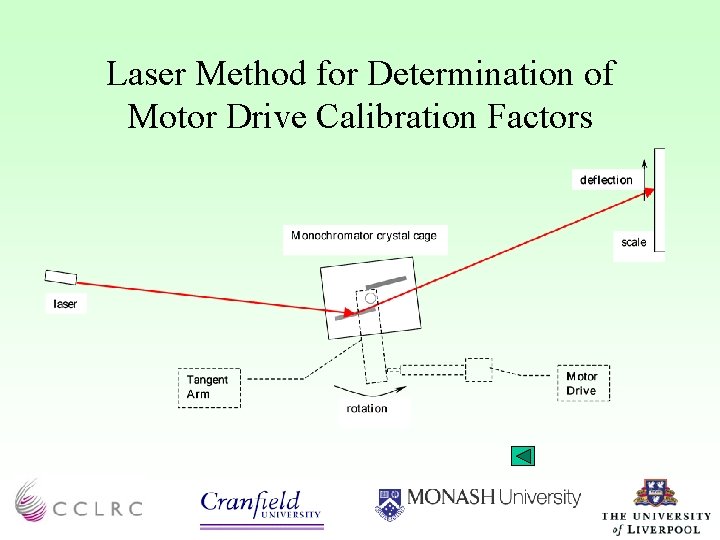
Laser Method for Determination of Motor Drive Calibration Factors
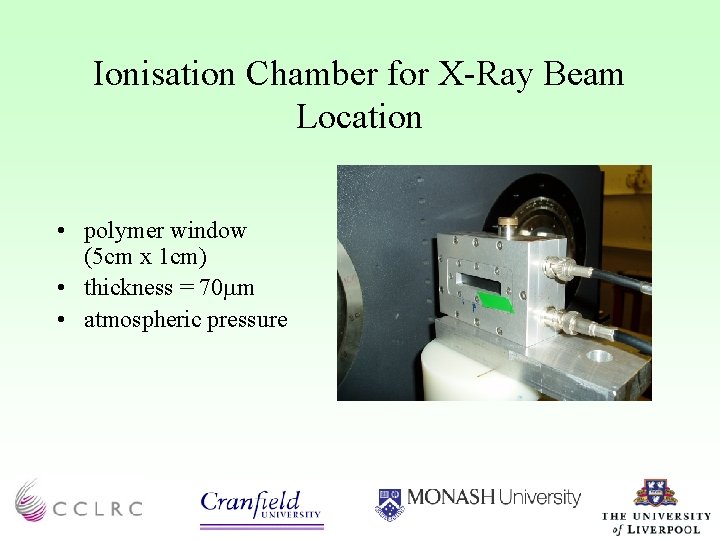
Ionisation Chamber for X-Ray Beam Location • polymer window (5 cm x 1 cm) • thickness = 70 mm • atmospheric pressure
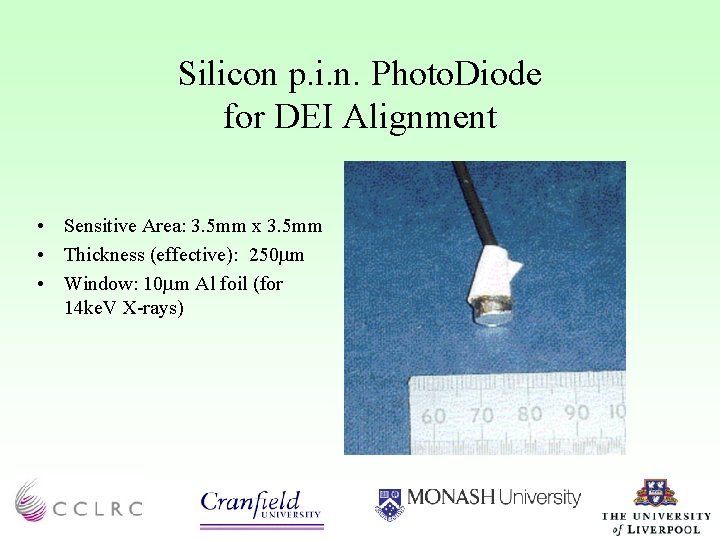
Silicon p. i. n. Photo. Diode for DEI Alignment • Sensitive Area: 3. 5 mm x 3. 5 mm • Thickness (effective): 250 mm • Window: 10 mm Al foil (for 14 ke. V X-rays)
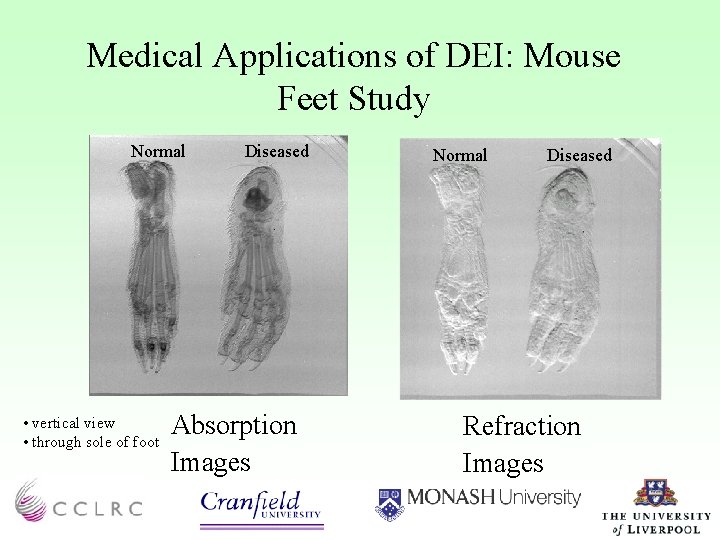
Medical Applications of DEI: Mouse Feet Study Normal • vertical view • through sole of foot Diseased Absorption Images Normal Diseased Refraction Images
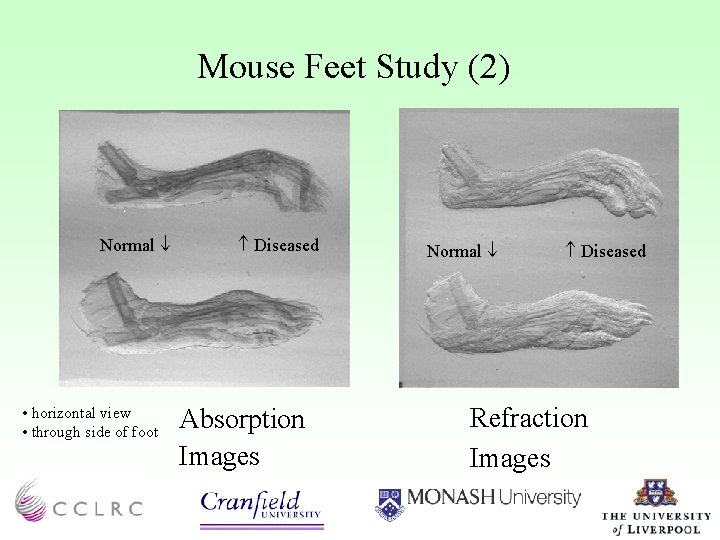
Mouse Feet Study (2) Normal • horizontal view • through side of foot Diseased Absorption Images Normal Diseased Refraction Images
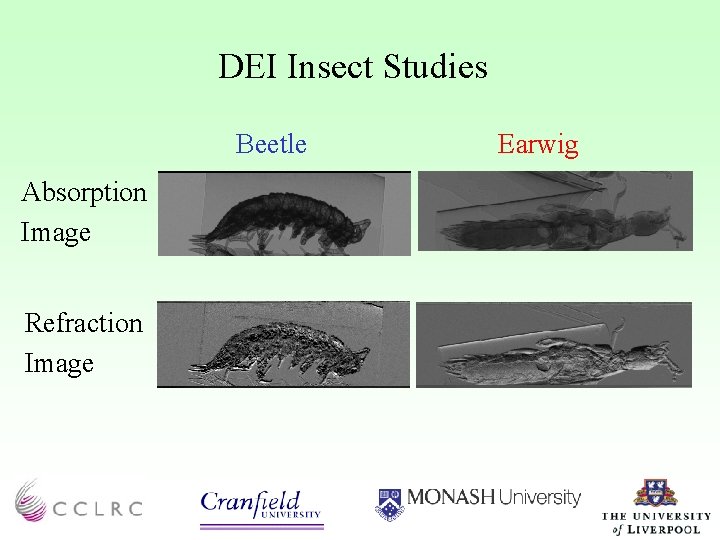
DEI Insect Studies Beetle Absorption Image Refraction Image Earwig
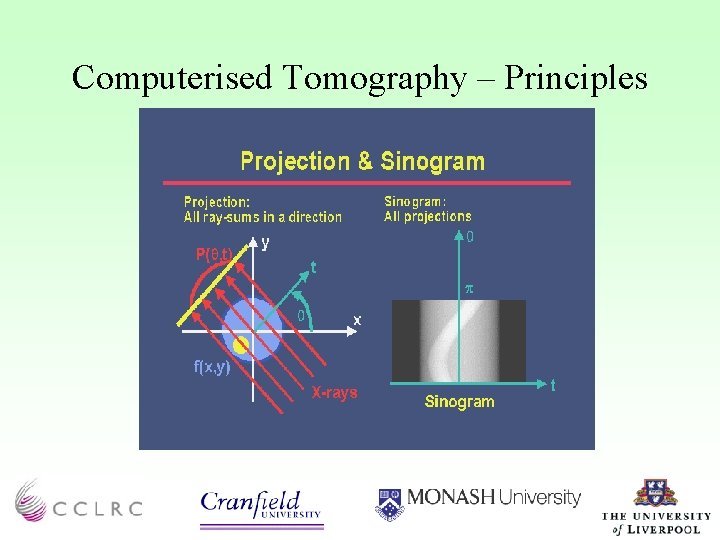
Computerised Tomography – Principles
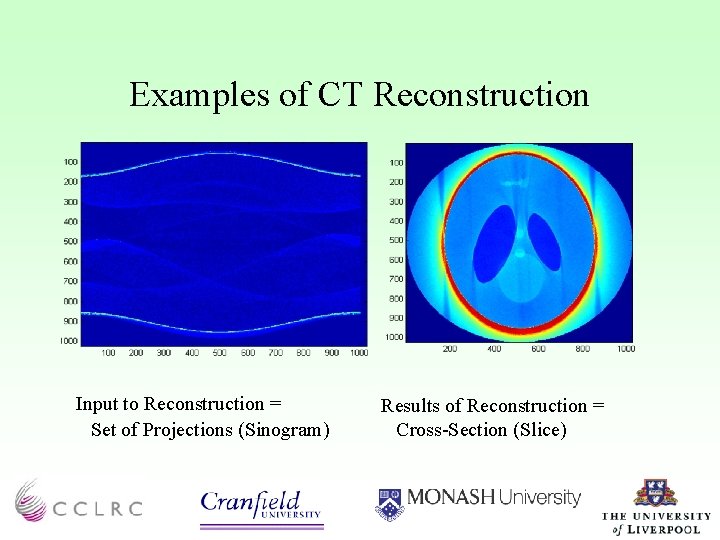
Examples of CT Reconstruction Input to Reconstruction = Set of Projections (Sinogram) Results of Reconstruction = Cross-Section (Slice)
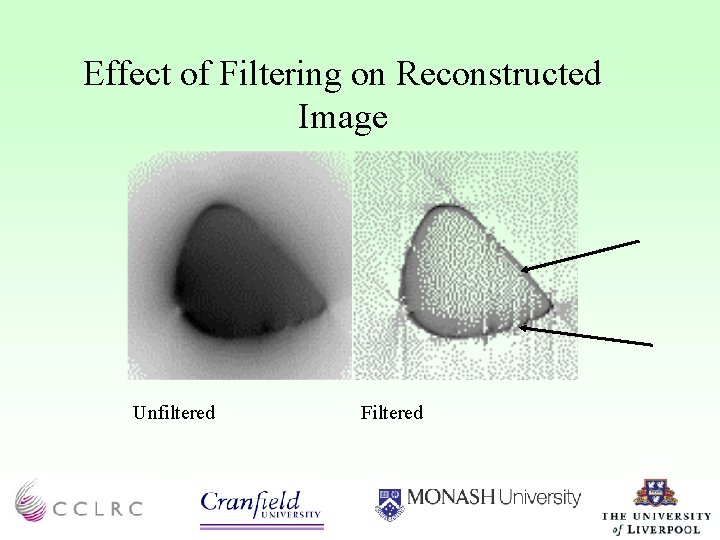
Effect of Filtering on Reconstructed Image Unfiltered Filtered
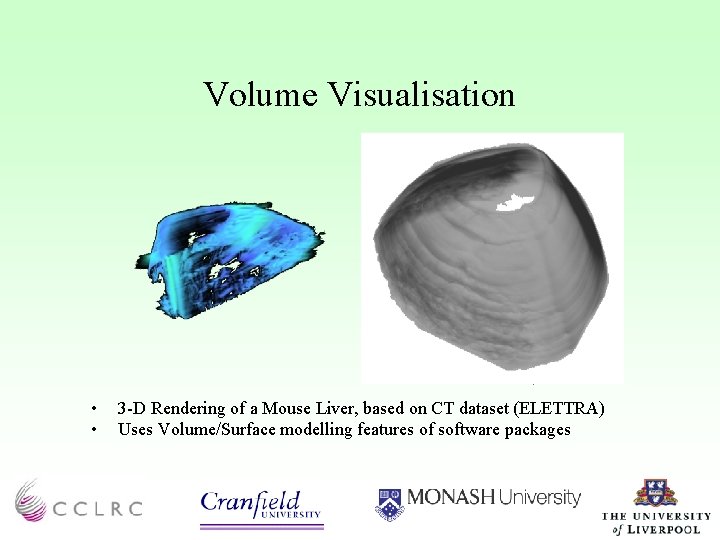
Volume Visualisation • • 3 -D Rendering of a Mouse Liver, based on CT dataset (ELETTRA) Uses Volume/Surface modelling features of software packages
Second-Generation DEI System: Some Design Considerations 1. higher energy and greater flux (on wiggler Station) better penetration, lower subject dose 2. channel-cut crystals - facilitate alignment, reduce drift 3. rigidity and anti-vibration built into support structure 4. mountings optimize use of existing framework - station sharing remains feasible 5. vacuum enclosure of the monochromator - avoids convection currents and ozone damage risk 6. cooling provision for the 1 st crystal - highest heat loading from ‘white’ beam.
Acknowledgements The authors would like to thank: Medical Research Council - for funding this research programme Giuseppe Salvini and Janet Groves (CLRC Daresbury) - design and construction of the p. i. n. diode device Greg Johnson (CLRC Rutherford Appleton Laboratory) - design and implementation of DSP reconstruction system Andrew Mather (Liverpool University) - Java implementation of the FBP reconstruction software.