
Diffraction at HERA Alice Valkrov Charles University Prague


- Slides: 23
Diffraction at HERA Alice Valkárová (Charles University, Prague) on behalf of H 1 and ZEUS collaborations 17. 1. 2007 Photoproduction at collider energies 1
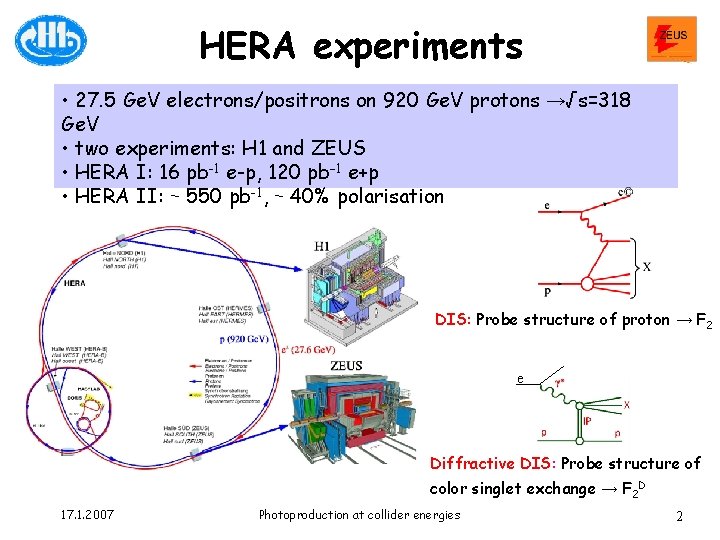
HERA experiments • 27. 5 Ge. V electrons/positrons on 920 Ge. V protons →√s=318 Ge. V • two experiments: H 1 and ZEUS • HERA I: 16 pb-1 e-p, 120 pb– 1 e+p • HERA II: ∼ 550 pb-1, ∼ 40% polarisation DIS: Probe structure of proton → F 2 e Diffractive DIS: Probe structure of color singlet exchange → F 2 D 17. 1. 2007 Photoproduction at collider energies 2
Diffraction and diffraction kinematics HERA: ~10% of low-x DIS events are diffractive Why to study diffraction? • fundamental aim: to understand high energy limit of QCD ´ (gluodynamics) • novelty: for the first time probe partonic structure of diffractive exchange • practical motivations: to study factorisation properties of diffraction – try to transport to hh scattering (e. g. predict diffractive Higgs production at LHC) momentum fraction of color single exchange W My fraction of exchange momentum, coupling to γ* t 17. 1. 2007 4 -momentum transfer squared Photoproduction at collider energies 3
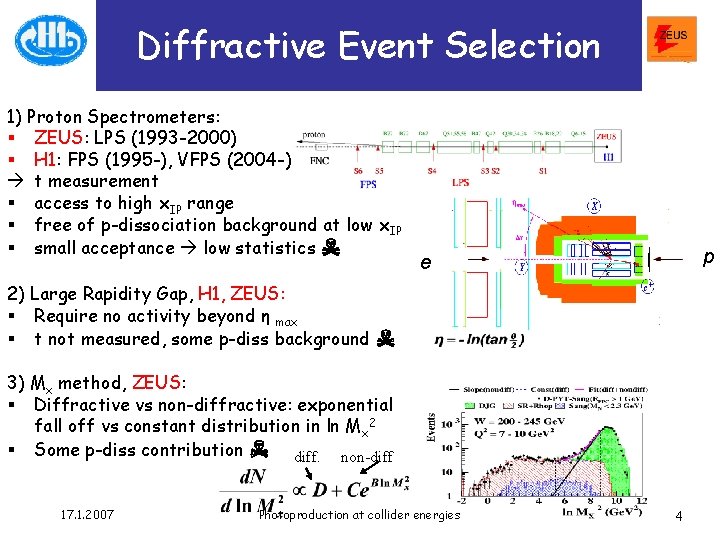
Diffractive Event Selection 1) Proton Spectrometers: § ZEUS: LPS (1993 -2000) § H 1: FPS (1995 -), VFPS (2004 -) t measurement § access to high x. IP range § free of p-dissociation background at low x. IP § small acceptance low statistics ☠ p e 2) Large Rapidity Gap, H 1, ZEUS: § Require no activity beyond η max § t not measured, some p-diss background ☠ 3) Mx method, ZEUS: § Diffractive vs non-diffractive: exponential fall off vs constant distribution in ln Mx 2 § Some p-diss contribution ☠ diff. non-diff 17. 1. 2007 Photoproduction at collider energies 4
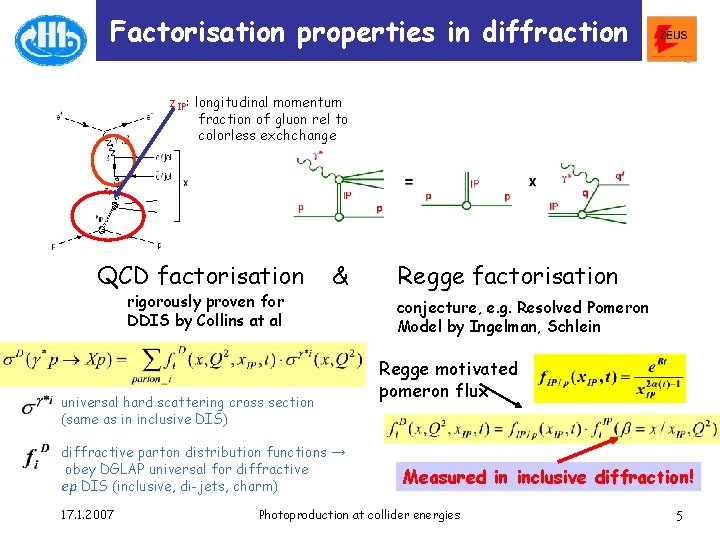
Factorisation properties in diffraction z. IP: longitudinal momentum fraction of gluon rel to colorless exchchange QCD factorisation rigorously proven for DDIS by Collins at al & universal hard scattering cross section (same as in inclusive DIS) diffractive parton distribution functions → obey DGLAP universal for diffractive ep DIS (inclusive, di-jets, charm) 17. 1. 2007 Regge factorisation conjecture, e. g. Resolved Pomeron Model by Ingelman, Schlein Regge motivated pomeron flux Measured in inclusive diffraction! Photoproduction at collider energies 5
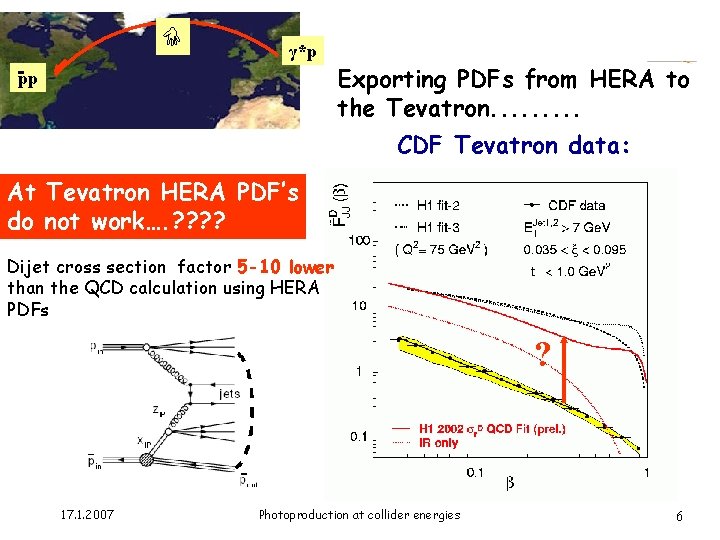
γ*p pp Exporting PDFs from HERA to the Tevatron. . CDF Tevatron data: At Tevatron HERA PDF’s do not work…. ? ? Dijet cross section factor 5 -10 lower than the QCD calculation using HERA PDFs ? 17. 1. 2007 Photoproduction at collider energies 6
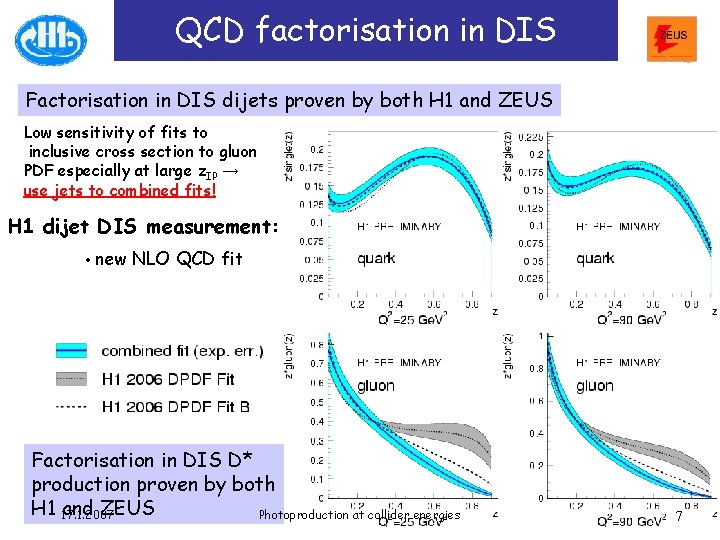
QCD factorisation in DIS Factorisation in DIS dijets proven by both H 1 and ZEUS Low sensitivity of fits to inclusive cross section to gluon PDF especially at large z. IP → use jets to combined fits! H 1 dijet DIS measurement: • new NLO QCD fit Factorisation in DIS D* production proven by both H 1 17. 1. 2007 and ZEUS Photoproduction at collider energies 7
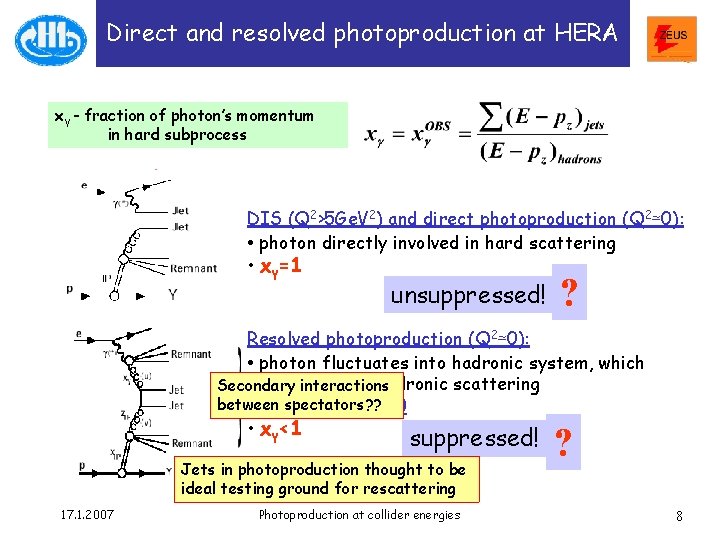
Direct and resolved photoproduction at HERA xγ - fraction of photon’s momentum in hard subprocess DIS (Q 2>5 Ge. V 2) and direct photoproduction (Q 2≃0): • photon directly involved in hard scattering • xγ=1 unsuppressed! ? Resolved photoproduction (Q 2≃0): • photon fluctuates into hadronic system, which takesinteractions part in hadronic scattering Secondary between spectators? ? • dominant at Q 2≃0 • xγ<1 suppressed! Jets in photoproduction thought to be ideal testing ground for rescattering 17. 1. 2007 Photoproduction at collider energies ? 8
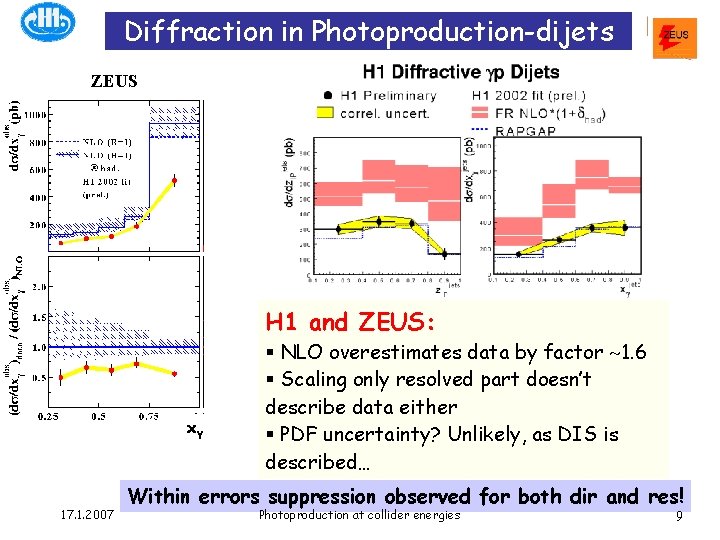
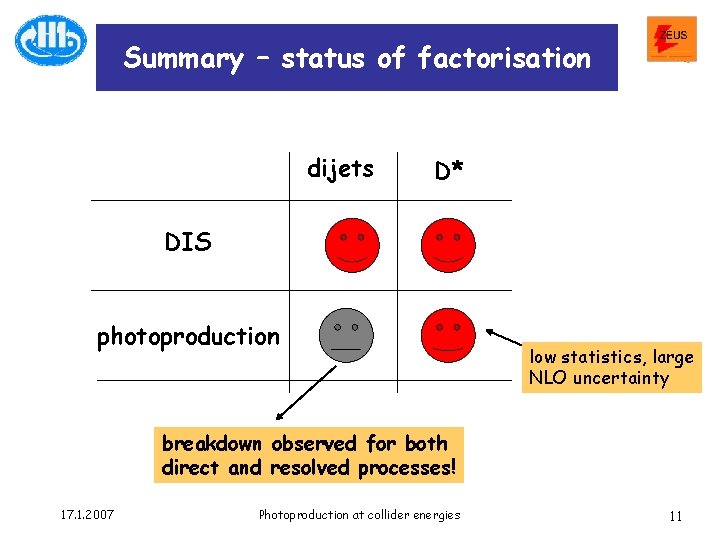
Diffraction in Photoproduction-dijets ZEUS H 1 and ZEUS: xγ 17. 1. 2007 § NLO overestimates data by factor 1. 6 § Scaling only resolved part doesn’t describe data either § PDF uncertainty? Unlikely, as DIS is described… Within errors suppression observed for both dir and res! Photoproduction at collider energies 9
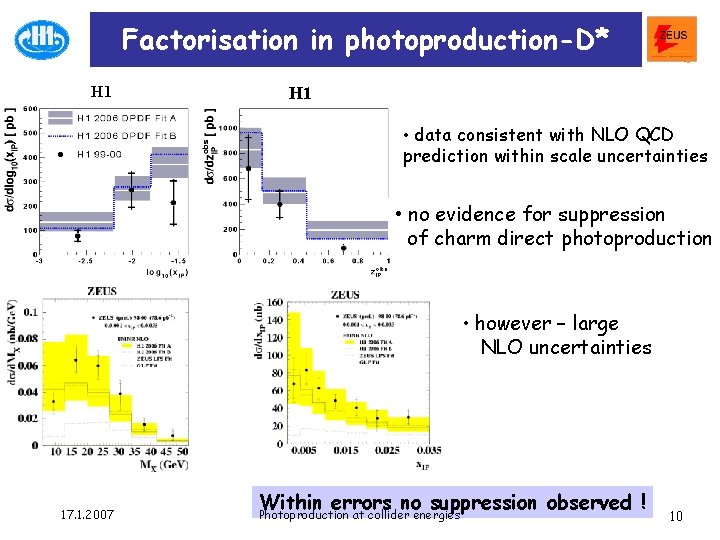
Factorisation in photoproduction-D* H 1 • data consistent with NLO QCD prediction within scale uncertainties • no evidence for suppression of charm direct photoproduction • however – large NLO uncertainties 17. 1. 2007 Within errors no suppression observed ! Photoproduction at collider energies 10
Summary – status of factorisation dijets D* DIS photoproduction low statistics, large NLO uncertainty breakdown observed for both direct and resolved processes! 17. 1. 2007 Photoproduction at collider energies 11
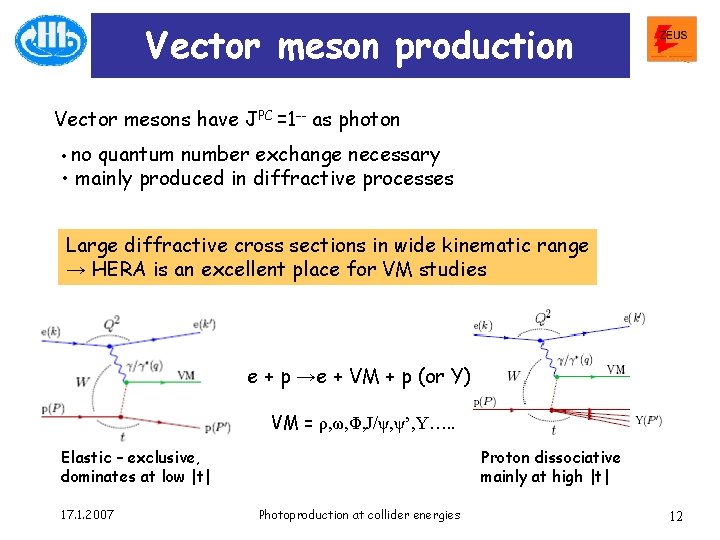
Vector meson production Vector mesons have JPC =1–- as photon • no quantum number exchange necessary • mainly produced in diffractive processes Large diffractive cross sections in wide kinematic range → HERA is an excellent place for VM studies e + p →e + VM + p (or Y) VM = ρ, ω, Φ, J/ψ, ψ’, Y…. . Elastic – exclusive, dominates at low |t| 17. 1. 2007 Proton dissociative mainly at high |t| Photoproduction at collider energies 12
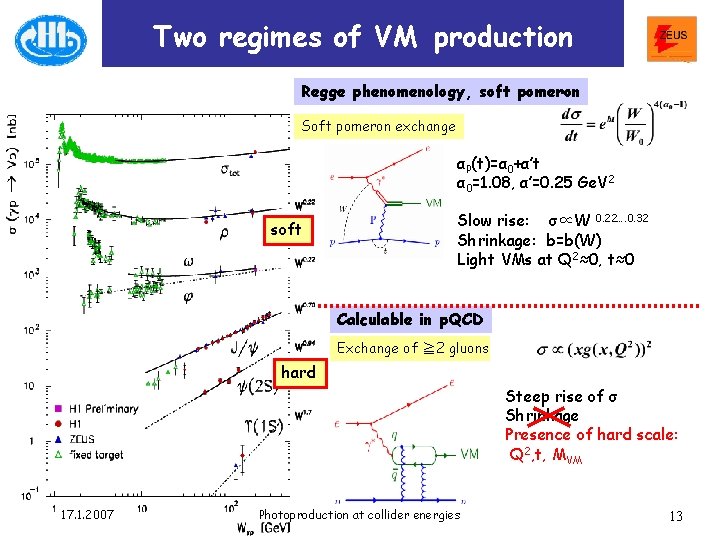
Two regimes of VM production Regge phenomenology, soft pomeron Soft pomeron exchange αP(t)=α 0+α’t α 0=1. 08, α’=0. 25 Ge. V 2 soft Slow rise: σ∝W 0. 22…. 0. 32 Shrinkage: b=b(W) Light VMs at Q 2≈0, t≈0 Calculable in p. QCD Exchange of ≧ 2 gluons hard Steep rise of σ Shrinkage Presence of hard scale: Q 2, t, MVM 17. 1. 2007 Photoproduction at collider energies 13
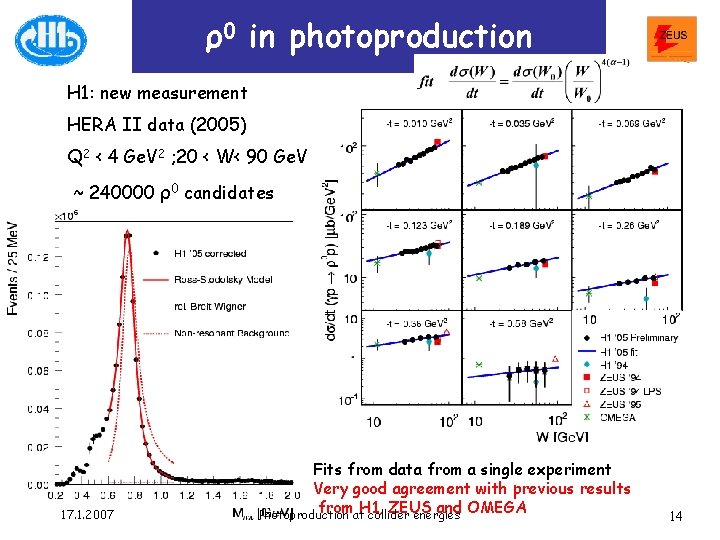
ρ0 in photoproduction H 1: new measurement HERA II data (2005) Q 2 < 4 Ge. V 2 ; 20 < W< 90 Ge. V ~ 240000 ρ0 candidates 17. 1. 2007 Fits from data from a single experiment Very good agreement with previous results fromat. H 1, ZEUS and OMEGA Photoproduction collider energies 14
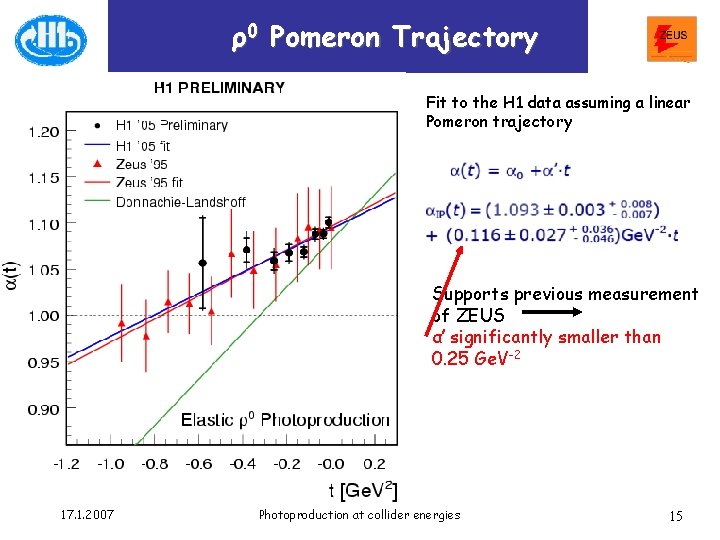
ρ0 Pomeron Trajectory Fit to the H 1 data assuming a linear Pomeron trajectory Supports previous measurement of ZEUS α’ significantly smaller than 0. 25 Ge. V-2 17. 1. 2007 Photoproduction at collider energies 15
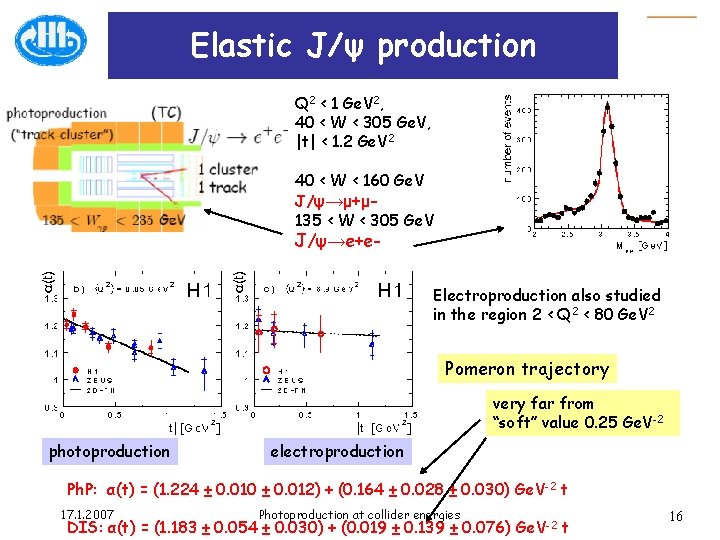
Elastic J/ψ production Q 2 < 1 Ge. V 2, 40 < W < 305 Ge. V, |t| < 1. 2 Ge. V 2 40 < W < 160 Ge. V J/ψ→μ+μ 135 < W < 305 Ge. V J/ψ→e+e- Electroproduction also studied in the region 2 < Q 2 < 80 Ge. V 2 Pomeron trajectory very far from “soft” value 0. 25 Ge. V-2 photoproduction electroproduction Ph. P: α(t) = (1. 224 ± 0. 010 ± 0. 012) + (0. 164 ± 0. 028 ± 0. 030) Ge. V-2 t 17. 1. 2007 Photoproduction at collider energies DIS: α(t) = (1. 183 ± 0. 054 ± 0. 030) + (0. 019 ± 0. 139 ± 0. 076) Ge. V-2 t 16
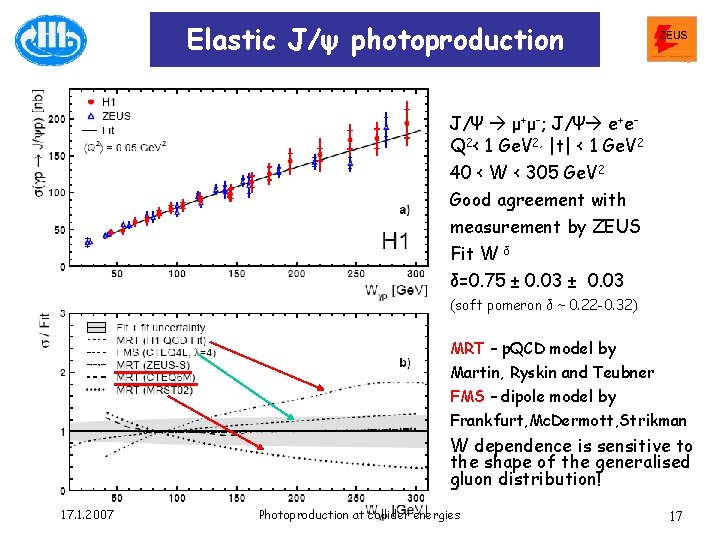
Elastic J/ψ photoproduction J/Ψ μ+μ-; J/Ψ e+e. Q 2< 1 Ge. V 2, |t| < 1 Ge. V 2 40 < W < 305 Ge. V 2 Good agreement with measurement by ZEUS Fit W δ δ=0. 75 ± 0. 03 (soft pomeron δ ∼ 0. 22 -0. 32) MRT – p. QCD model by Martin, Ryskin and Teubner FMS – dipole model by Frankfurt, Mc. Dermott, Strikman W dependence is sensitive to the shape of the generalised gluon distribution! 17. 1. 2007 Photoproduction at collider energies 17
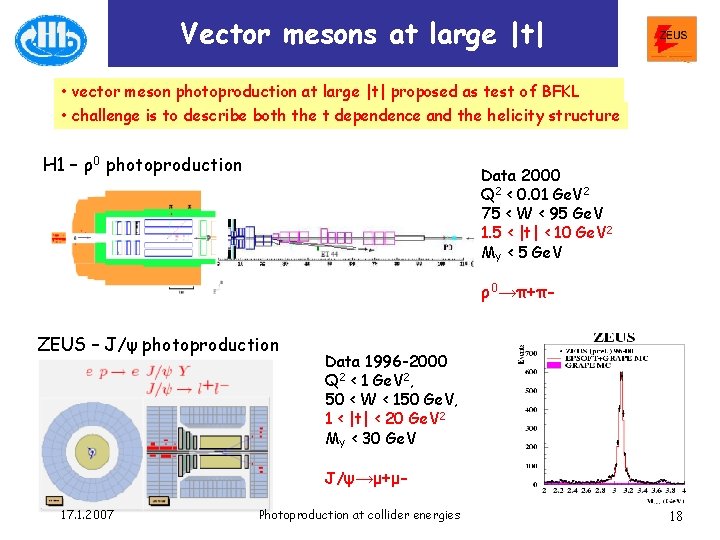
Vector mesons at large |t| • vector meson photoproduction at large |t| proposed as test of BFKL • challenge is to describe both the t dependence and the helicity structure H 1 – ρ0 photoproduction Data 2000 Q 2 < 0. 01 Ge. V 2 75 < W < 95 Ge. V 1. 5 < |t| < 10 Ge. V 2 MY < 5 Ge. V ρ0→π+πZEUS – J/ψ photoproduction Data 1996 -2000 Q 2 < 1 Ge. V 2, 50 < W < 150 Ge. V, 1 < |t| < 20 Ge. V 2 MY < 30 Ge. V J/ψ→μ+μ- 17. 1. 2007 Photoproduction at collider energies 18
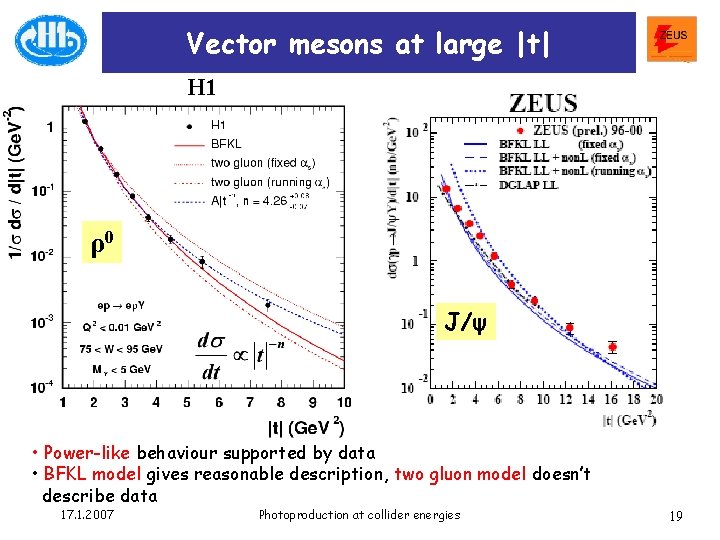
Vector mesons at large |t| H 1 ρ0 J/ψ • Power-like behaviour supported by data • BFKL model gives reasonable description, two gluon model doesn’t describe data 17. 1. 2007 Photoproduction at collider energies 19
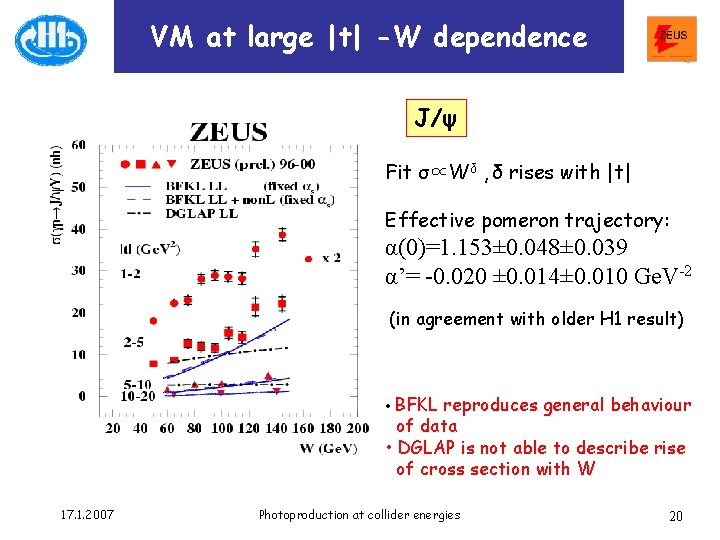
VM at large |t| -W dependence J/ψ Fit σ∝Wδ , δ rises with |t| Effective pomeron trajectory: α(0)=1. 153± 0. 048± 0. 039 α’= -0. 020 ± 0. 014± 0. 010 Ge. V-2 (in agreement with older H 1 result) • BFKL reproduces general behaviour of data • DGLAP is not able to describe rise of cross section with W 17. 1. 2007 Photoproduction at collider energies 20
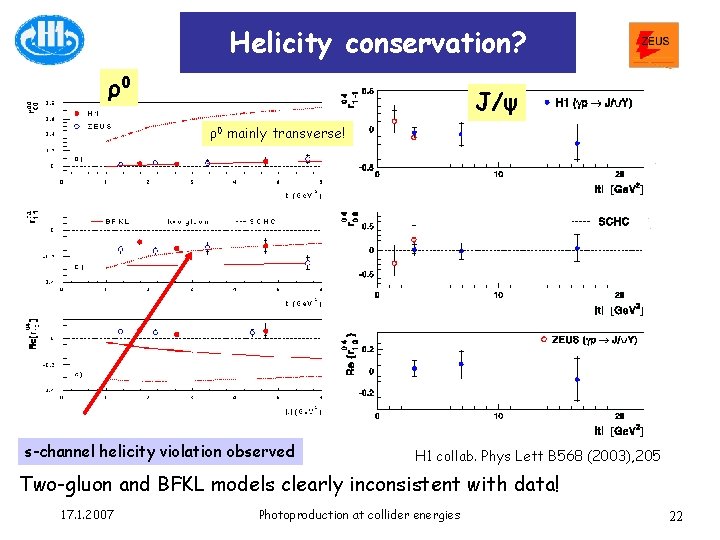
Testing the Meson Wavefunction Helicity = component of spin along direction of the particle’s motion SDMEs are bilinear combinations on the helicity amplitudes • in photoproduction can only measure θ* & Φ* ⇒ allows measurement of 3 of the 15 spin density matrix elements (SDME) • s-channel helicity conservation (SCHC) ⇒ vector meson retains helicity of photon ⇒ all 3 SDMEs are predicted to be zero 17. 1. 2007 p. QCD: • During the interaction, the orbital momentum of qq can be modified through the transverse momentum carried by gluons • The helicity of the outgoing vector meson can be different from that of the incoming photon, helicity flip between photon and meson is possible Photoproduction at collider energies 21
Helicity conservation? ρ0 J/ψ ρ0 mainly transverse! s-channel helicity violation observed H 1 collab. Phys Lett B 568 (2003), 205 Two-gluon and BFKL models clearly inconsistent with data! 17. 1. 2007 Photoproduction at collider energies 22
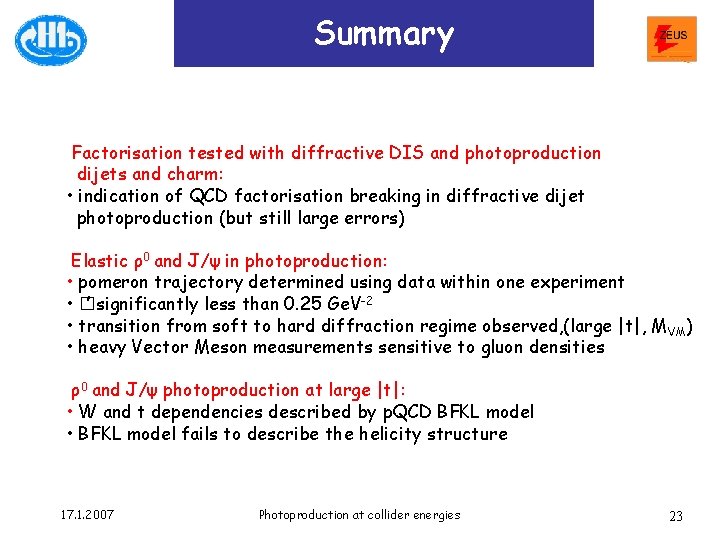
Summary Factorisation tested with diffractive DIS and photoproduction dijets and charm: • indication of QCD factorisation breaking in diffractive dijet photoproduction (but still large errors) Elastic ρ0 and J/ψ in photoproduction: • pomeron trajectory determined using data within one experiment • �’ significantly less than 0. 25 Ge. V-2 • transition from soft to hard diffraction regime observed, (large |t|, M VM) • heavy Vector Meson measurements sensitive to gluon densities ρ0 and J/ψ photoproduction at large |t|: • W and t dependencies described by p. QCD BFKL model • BFKL model fails to describe the helicity structure 17. 1. 2007 Photoproduction at collider energies 23