
Difficult overlooked institutional issues in natural resource management
- Slides: 40
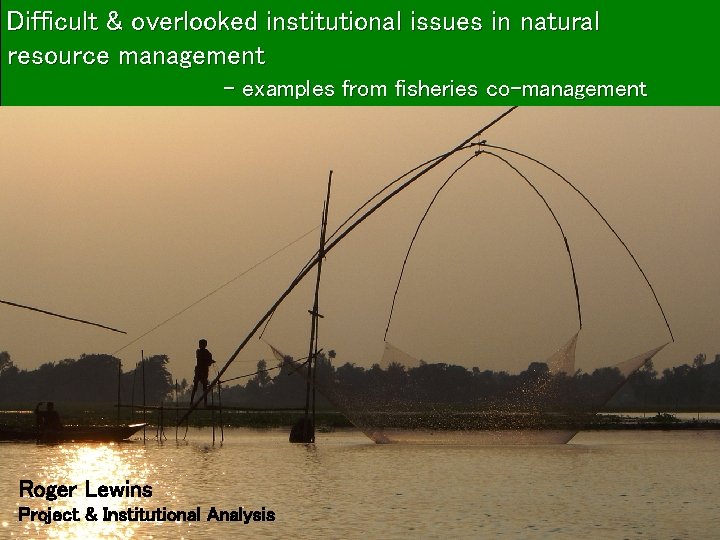
Difficult & overlooked institutional issues in natural resource management - examples from fisheries co-management Roger Lewins Project & Institutional Analysis
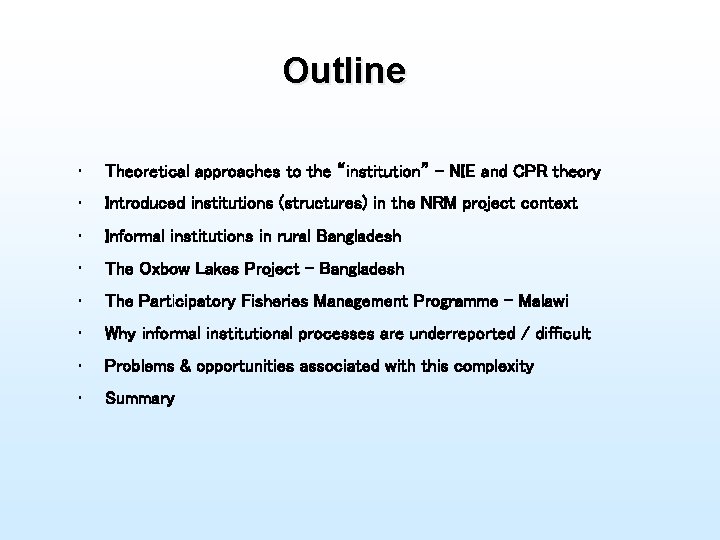
Outline • Theoretical approaches to the “institution” – NIE and CPR theory • Introduced institutions (structures) in the NRM project context • Informal institutions in rural Bangladesh • The Oxbow Lakes Project – Bangladesh • The Participatory Fisheries Management Programme – Malawi • Why informal institutional processes are underreported / difficult • Problems & opportunities associated with this complexity • Summary
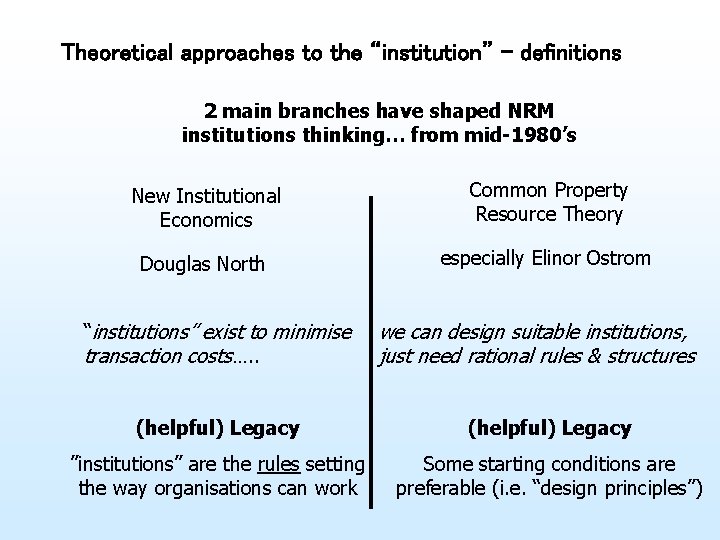
Theoretical approaches to the “institution” - definitions 2 main branches have shaped NRM institutions thinking… from mid-1980’s New Institutional Economics Common Property Resource Theory Douglas North especially Elinor Ostrom “institutions” exist to minimise transaction costs…. . we can design suitable institutions, just need rational rules & structures (helpful) Legacy ”institutions” are the rules setting the way organisations can work Some starting conditions are preferable (i. e. “design principles”)
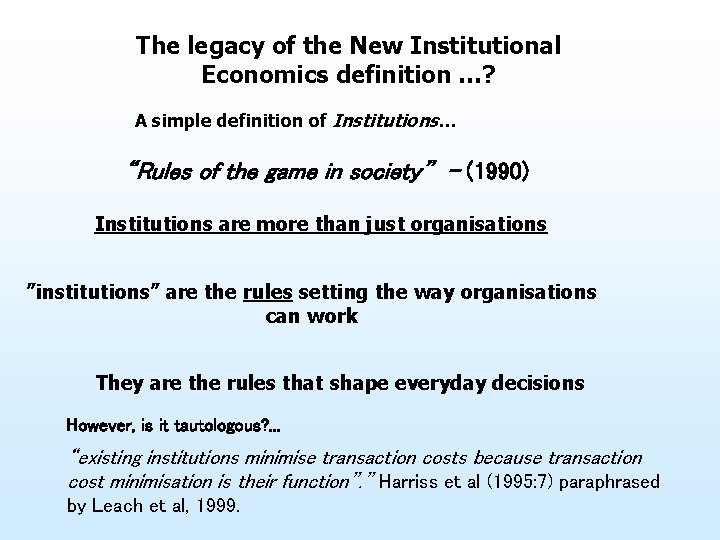
The legacy of the New Institutional Economics definition …? A simple definition of Institutions… “Rules of the game in society” - (1990) Institutions are more than just organisations ”institutions” are the rules setting the way organisations can work They are the rules that shape everyday decisions However, is it tautologous? . . . “existing institutions minimise transaction costs because transaction cost minimisation is their function”. ” Harriss et al (1995: 7) paraphrased by Leach et al, 1999.
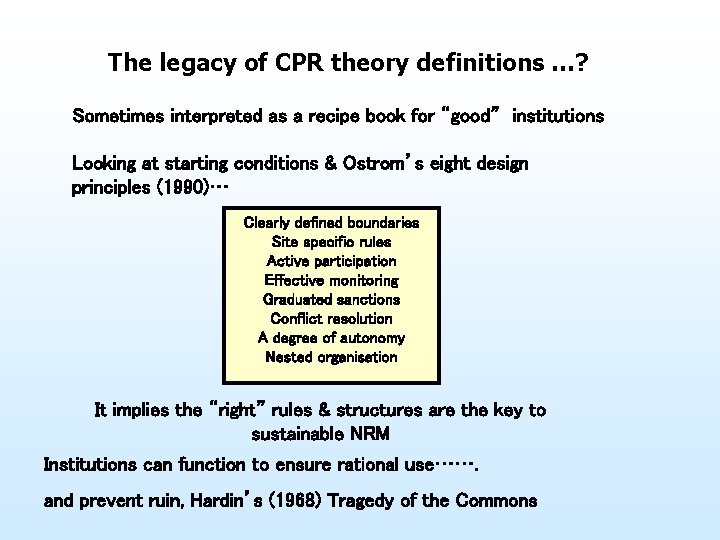
The legacy of CPR theory definitions …? Sometimes interpreted as a recipe book for “good” institutions Looking at starting conditions & Ostrom’s eight design principles (1990)… Clearly defined boundaries Site specific rules Active participation Effective monitoring Graduated sanctions Conflict resolution A degree of autonomy Nested organisation It implies the “right” rules & structures are the key to sustainable NRM Institutions can function to ensure rational use……. and prevent ruin, Hardin’s (1968) Tragedy of the Commons
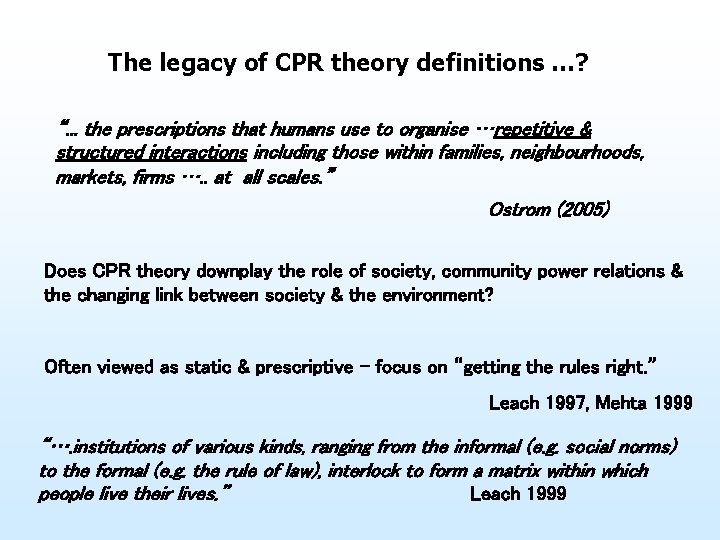
The legacy of CPR theory definitions …? “. . . the prescriptions that humans use to organise …repetitive & structured interactions including those within families, neighbourhoods, markets, firms …. . at all scales. ” Ostrom (2005) Does CPR theory downplay the role of society, community power relations & the changing link between society & the environment? Often viewed as static & prescriptive – focus on “getting the rules right. ” Leach 1997, Mehta 1999 “…. institutions of various kinds, ranging from the informal (e. g. social norms) to the formal (e. g. the rule of law), interlock to form a matrix within which people live their lives. ” Leach 1999
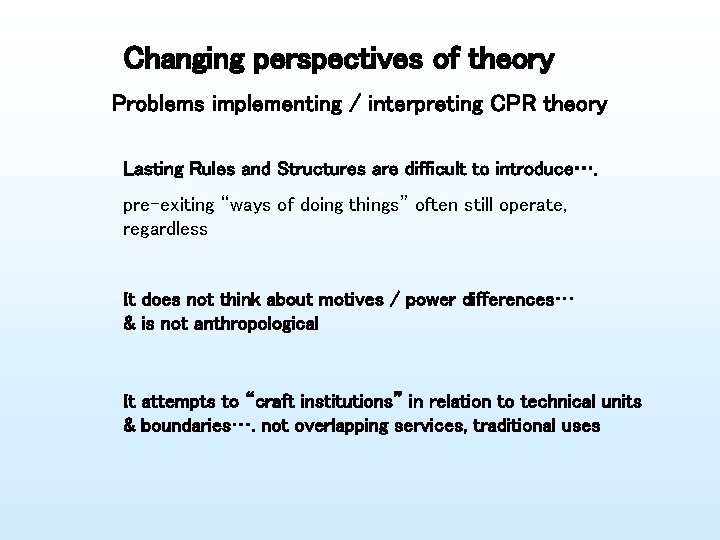
Changing perspectives of theory Problems implementing / interpreting CPR theory Lasting Rules and Structures are difficult to introduce…. pre-exiting “ways of doing things” often still operate, regardless It does not think about motives / power differences… & is not anthropological It attempts to “craft institutions” in relation to technical units & boundaries…. not overlapping services, traditional uses
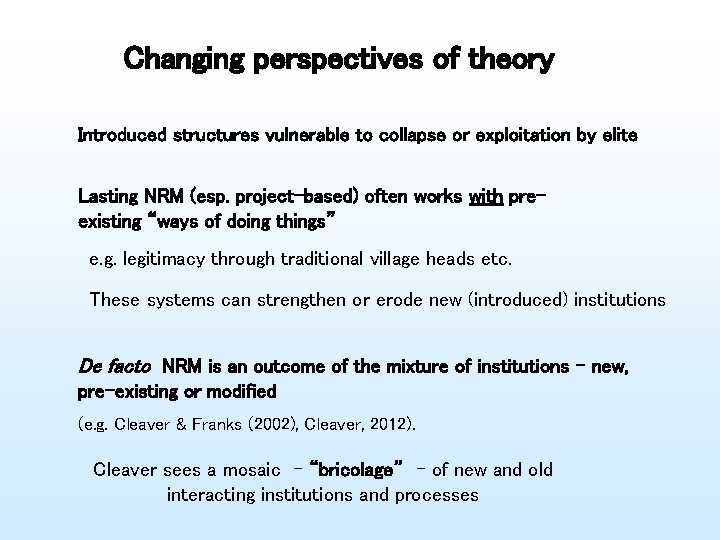
Changing perspectives of theory Introduced structures vulnerable to collapse or exploitation by elite Lasting NRM (esp. project-based) often works with preexisting “ways of doing things” e. g. legitimacy through traditional village heads etc. These systems can strengthen or erode new (introduced) institutions De facto NRM is an outcome of the mixture of institutions – new, pre-existing or modified (e. g. Cleaver & Franks (2002), Cleaver, 2012). Cleaver sees a mosaic - “bricolage” - of new and old interacting institutions and processes
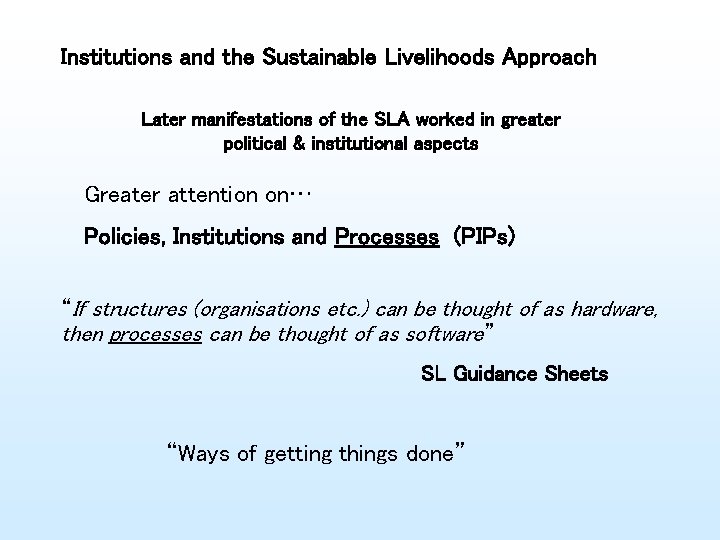
Institutions and the Sustainable Livelihoods Approach Later manifestations of the SLA worked in greater political & institutional aspects Greater attention on… Policies, Institutions and Processes (PIPs) “If structures (organisations etc. ) can be thought of as hardware, then processes can be thought of as software” SL Guidance Sheets “Ways of getting things done”
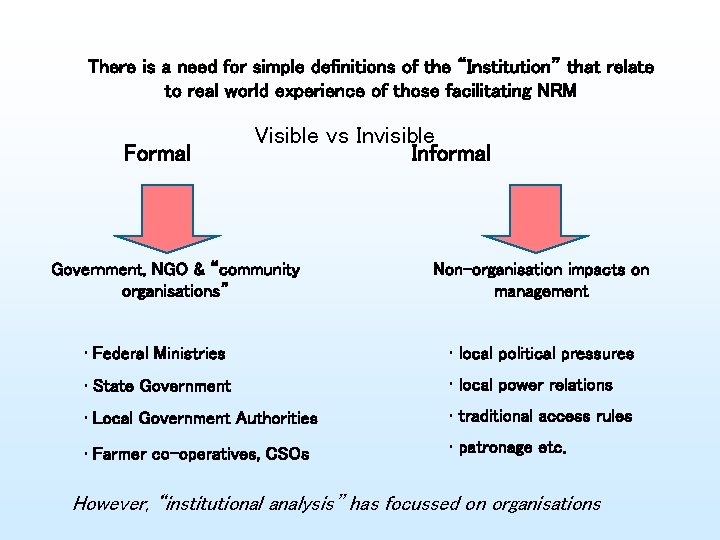
There is a need for simple definitions of the “Institution” that relate to real world experience of those facilitating NRM Formal Visible vs Invisible Informal Government, NGO & “community organisations” Non-organisation impacts on management • Federal Ministries • local political pressures • State Government • local power relations • Local Government Authorities • traditional access rules • Farmer co-operatives, CSOs • patronage etc. However, “institutional analysis” has focussed on organisations
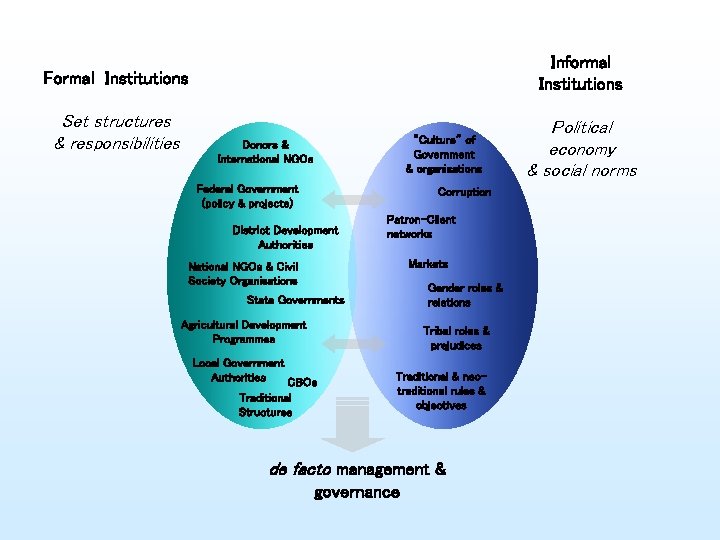
Informal Institutions Formal Institutions Set structures & responsibilities “Culture” of Government & organisations Donors & International NGOs Federal Government (policy & projects) Corruption District Development Authorities Patron-Client networks Markets National NGOs & Civil Society Organisations Gender roles & relations State Governments Agricultural Development Programmes Tribal roles & prejudices Local Government Authorities CBOs Traditional Structures Traditional & neotraditional rules & objectives de facto management & governance Political economy & social norms
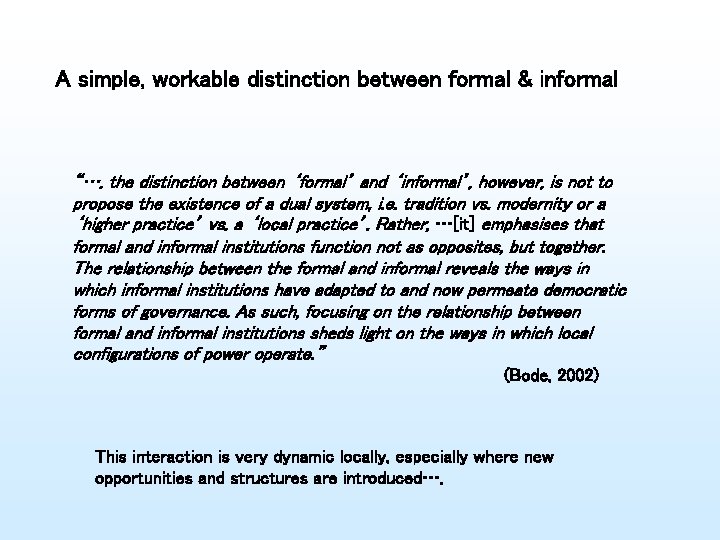
A simple, workable distinction between formal & informal “…. the distinction between ‘formal’ and ‘informal’, however, is not to propose the existence of a dual system, i. e. tradition vs. modernity or a ‘higher practice’ vs. a ‘local practice’. Rather, …[it] emphasises that formal and informal institutions function not as opposites, but together. The relationship between the formal and informal reveals the ways in which informal institutions have adapted to and now permeate democratic forms of governance. As such, focusing on the relationship between formal and informal institutions sheds light on the ways in which local configurations of power operate. ” (Bode, 2002) This interaction is very dynamic locally, especially where new opportunities and structures are introduced….
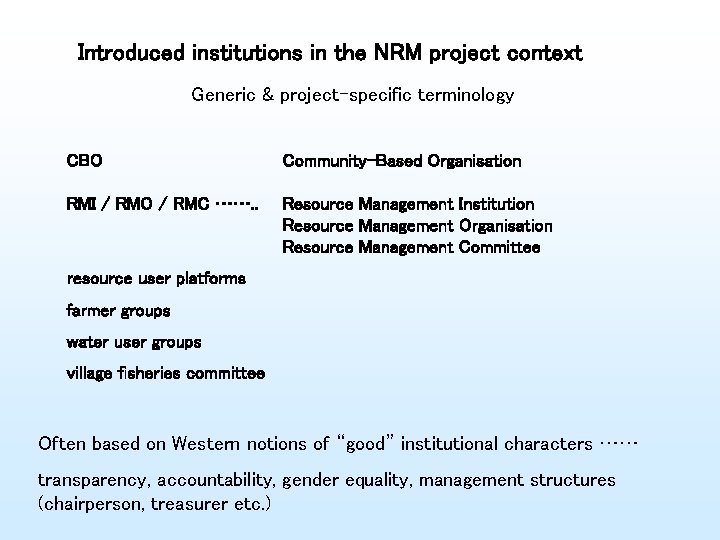
Introduced institutions in the NRM project context Generic & project-specific terminology CBO Community-Based Organisation RMI / RMO / RMC ……. . Resource Management Institution Resource Management Organisation Resource Management Committee resource user platforms farmer groups water user groups village fisheries committee Often based on Western notions of “good” institutional characters …… transparency, accountability, gender equality, management structures (chairperson, treasurer etc. )
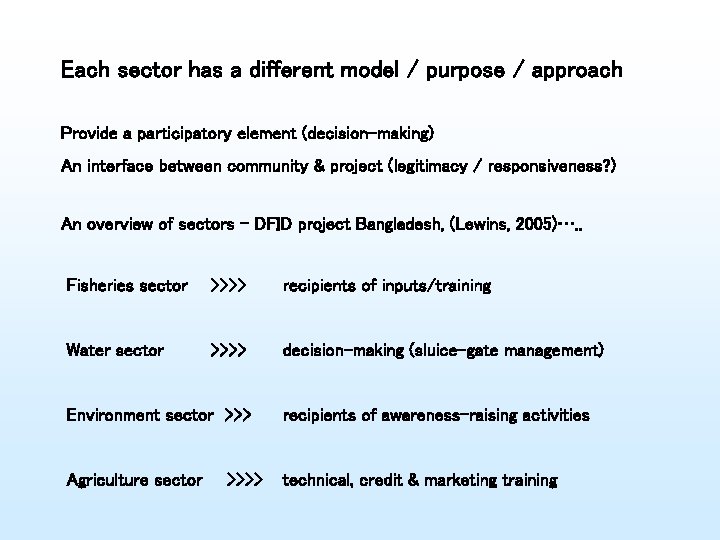
Each sector has a different model / purpose / approach Provide a participatory element (decision-making) An interface between community & project (legitimacy / responsiveness? ) An overview of sectors – DFID project Bangladesh, (Lewins, 2005)…. . Fisheries sector >>>> recipients of inputs/training Water sector >>>> decision-making (sluice-gate management) Environment sector >>> recipients of awareness-raising activities Agriculture sector technical, credit & marketing training >>>>
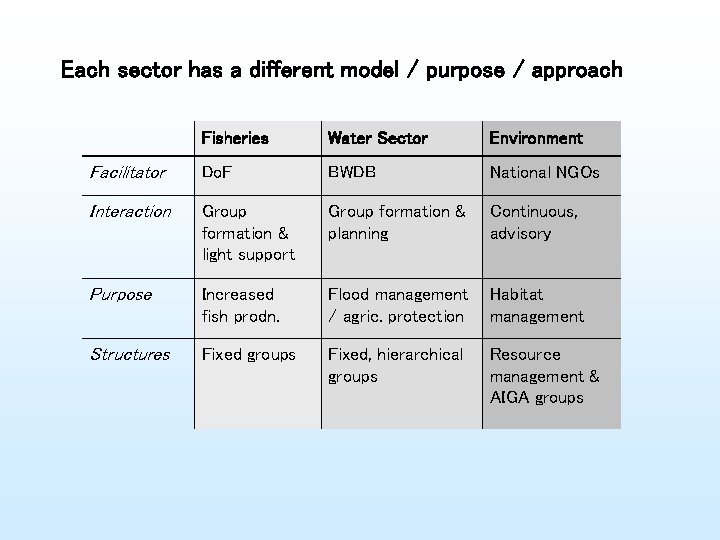
Each sector has a different model / purpose / approach Fisheries Water Sector Environment Facilitator Do. F BWDB National NGOs Interaction Group formation & light support Group formation & planning Continuous, advisory Purpose Increased fish prodn. Flood management / agric. protection Habitat management Structures Fixed groups Fixed, hierarchical groups Resource management & AIGA groups
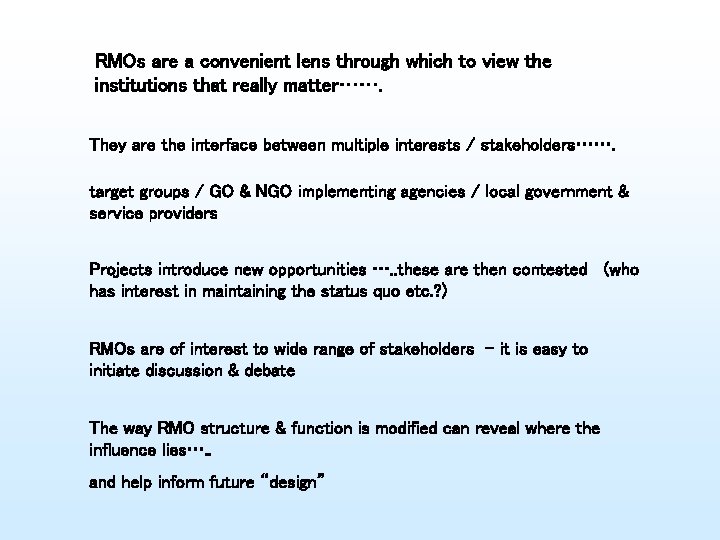
RMOs are a convenient lens through which to view the institutions that really matter……. They are the interface between multiple interests / stakeholders……. target groups / GO & NGO implementing agencies / local government & service providers Projects introduce new opportunities …. . these are then contested (who has interest in maintaining the status quo etc. ? ) RMOs are of interest to wide range of stakeholders - it is easy to initiate discussion & debate The way RMO structure & function is modified can reveal where the influence lies…. . and help inform future “design”
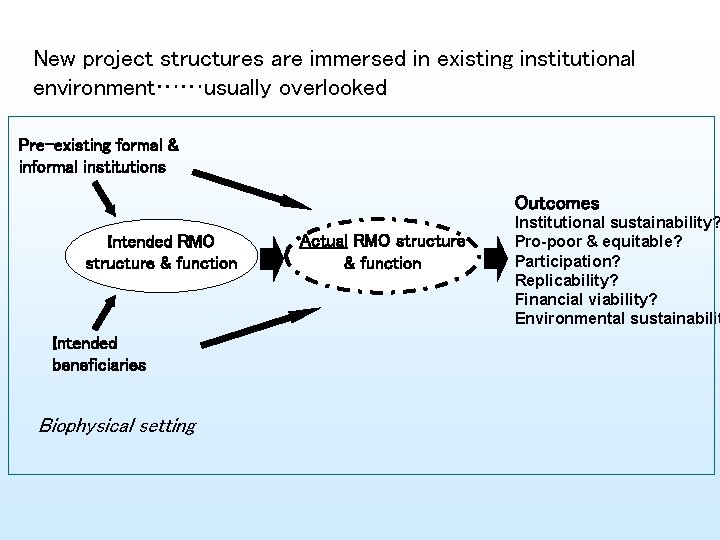
New project structures are immersed in existing institutional environment……usually overlooked Pre-existing formal & informal institutions Outcomes Intended RMO structure & function Intended beneficiaries Biophysical setting Actual RMO structure & function Institutional sustainability? Pro-poor & equitable? Participation? Replicability? Financial viability? Environmental sustainabilit
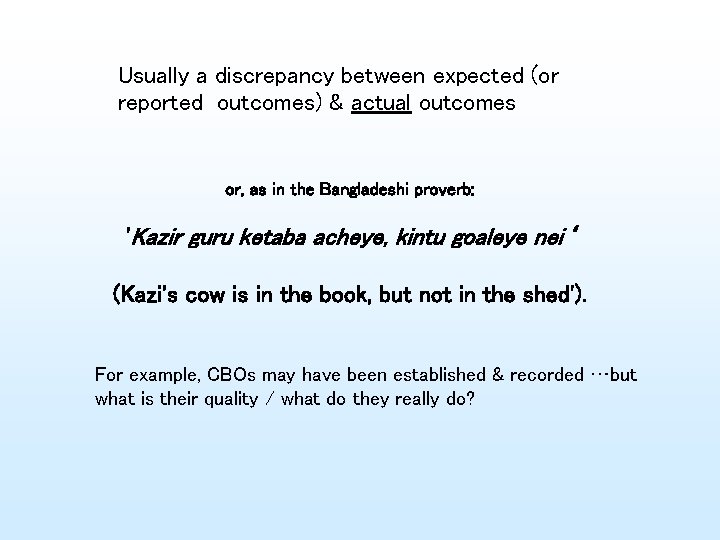
Usually a discrepancy between expected (or reported outcomes) & actual outcomes or, as in the Bangladeshi proverb: 'Kazir guru ketaba acheye, kintu goaleye nei‘ (Kazi's cow is in the book, but not in the shed'). For example, CBOs may have been established & recorded …but what is their quality / what do they really do?
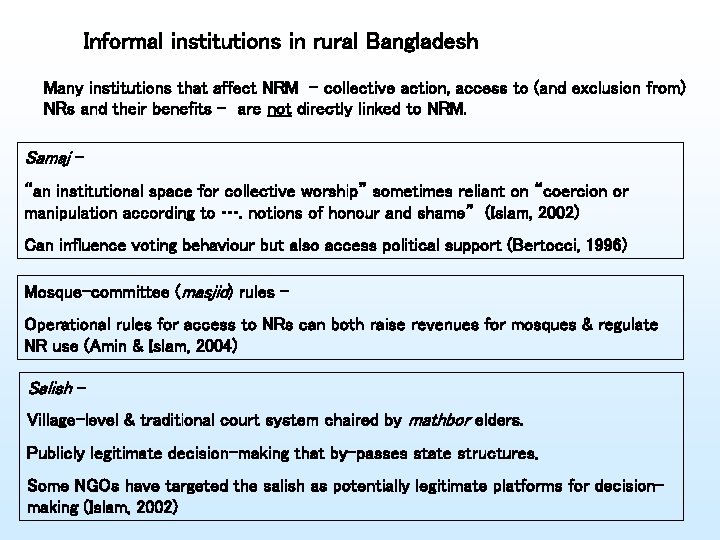
Informal institutions in rural Bangladesh Many institutions that affect NRM - collective action, access to (and exclusion from) NRs and their benefits – are not directly linked to NRM. Samaj – “an institutional space for collective worship” sometimes reliant on “coercion or manipulation according to …. notions of honour and shame” (Islam, 2002) Can influence voting behaviour but also access political support (Bertocci, 1996) Mosque-committee (masjid) rules – Operational rules for access to NRs can both raise revenues for mosques & regulate NR use (Amin & Islam, 2004) Salish – Village-level & traditional court system chaired by mathbor elders. Publicly legitimate decision-making that by-passes state structures. Some NGOs have targeted the salish as potentially legitimate platforms for decisionmaking (Islam, 2002)
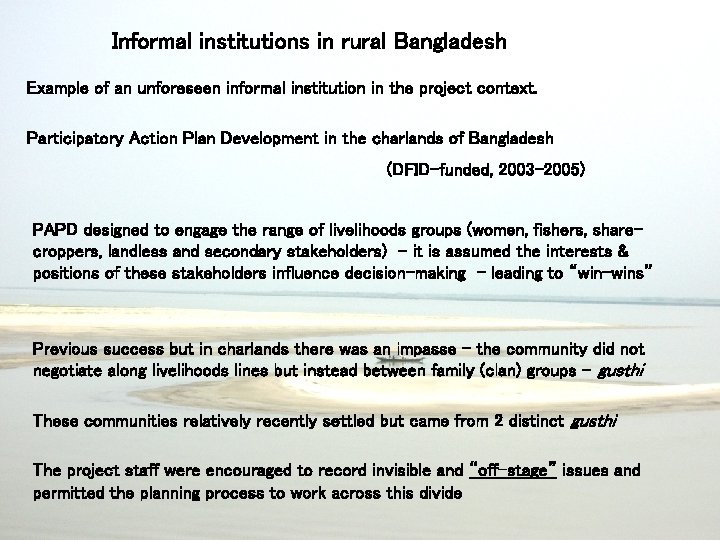
Informal institutions in rural Bangladesh Example of an unforeseen informal institution in the project context. Participatory Action Plan Development in the charlands of Bangladesh (DFID-funded, 2003 -2005) PAPD designed to engage the range of livelihoods groups (women, fishers, sharecroppers, landless and secondary stakeholders) - it is assumed the interests & positions of these stakeholders influence decision-making - leading to “win-wins” Previous success but in charlands there was an impasse – the community did not negotiate along livelihoods lines but instead between family (clan) groups – gusthi These communities relatively recently settled but came from 2 distinct gusthi The project staff were encouraged to record invisible and “off-stage” issues and permitted the planning process to work across this divide
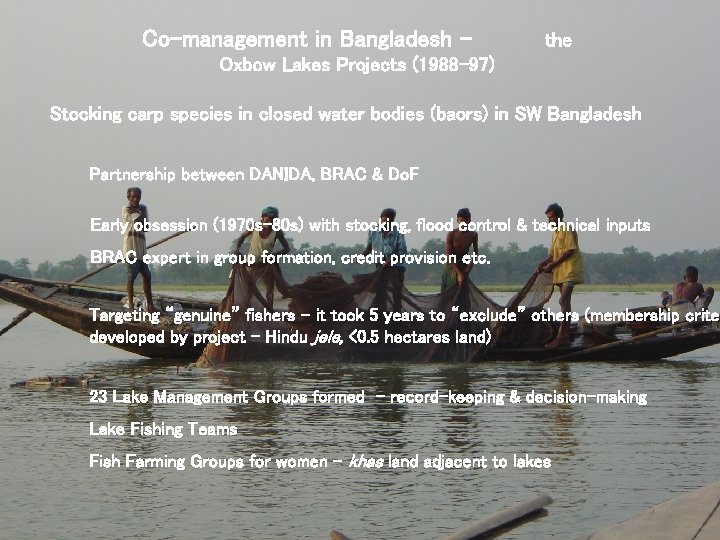
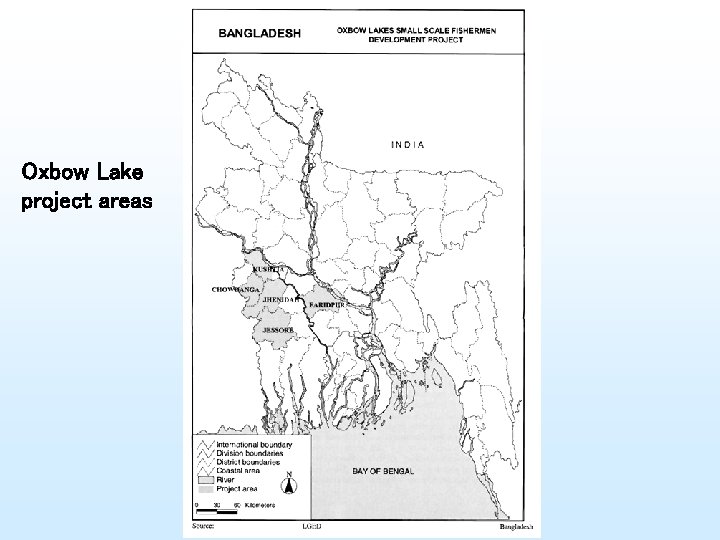
Co-management in Bangladesh – the Oxbow Lakes Projects (1988 -97) Stocking carp species in closed water bodies (baors) in SW Bangladesh Partnership between DANIDA, BRAC & Do. F Early obsession (1970 s-80 s) with stocking, flood control & technical inputs BRAC expert in group formation, credit provision etc. Targeting “genuine” fishers – it took 5 years to “exclude” others (membership criter developed by project – Hindu jele, <0. 5 hectares land) 23 Lake Management Groups formed – record-keeping & decision-making Lake Fishing Teams Fish Farming Groups for women – khas land adjacent to lakes
Oxbow Lake project areas
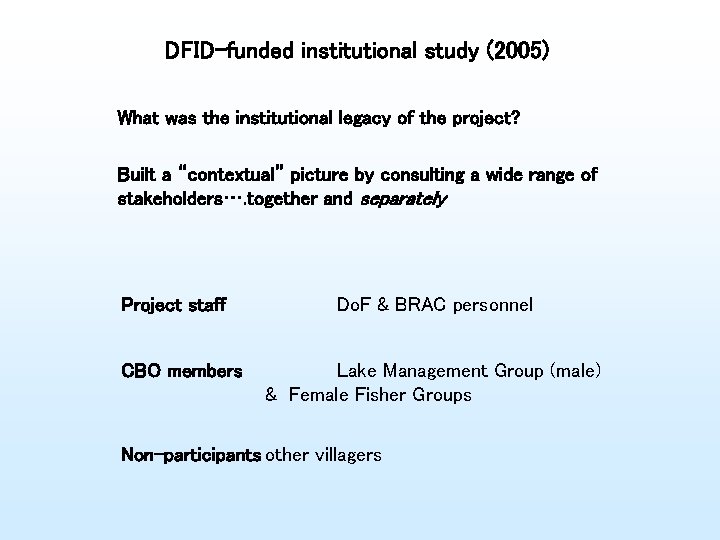
DFID-funded institutional study (2005) What was the institutional legacy of the project? Built a “contextual” picture by consulting a wide range of stakeholders…. together and separately Project staff CBO members Do. F & BRAC personnel Lake Management Group (male) & Female Fisher Groups Non-participants other villagers
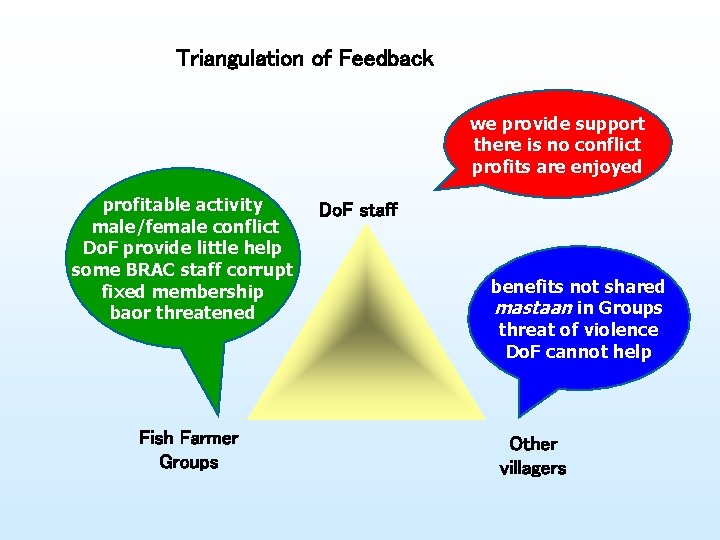
Triangulation of Feedback we provide support there is no conflict profits are enjoyed profitable activity male/female conflict Do. F provide little help some BRAC staff corrupt fixed membership baor threatened Fish Farmer Groups Do. F staff benefits not shared mastaan in Groups threat of violence Do. F cannot help Other villagers
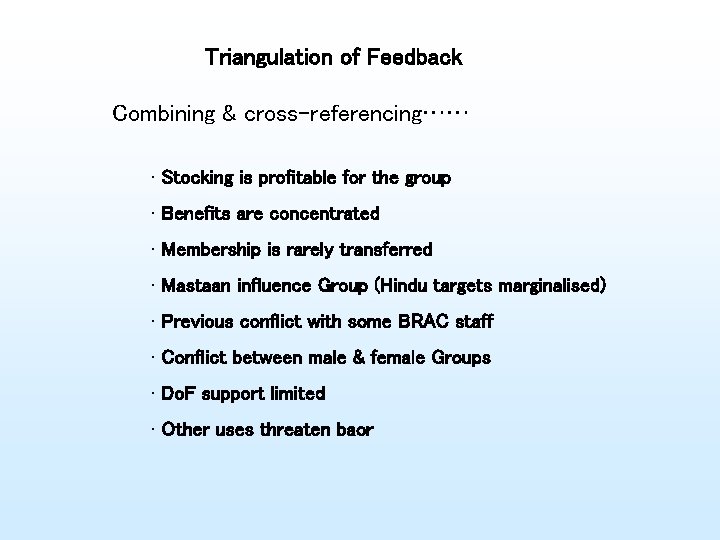
Triangulation of Feedback Combining & cross-referencing…… • Stocking is profitable for the group • Benefits are concentrated • Membership is rarely transferred • Mastaan influence Group (Hindu targets marginalised) • Previous conflict with some BRAC staff • Conflict between male & female Groups • Do. F support limited • Other uses threaten baor
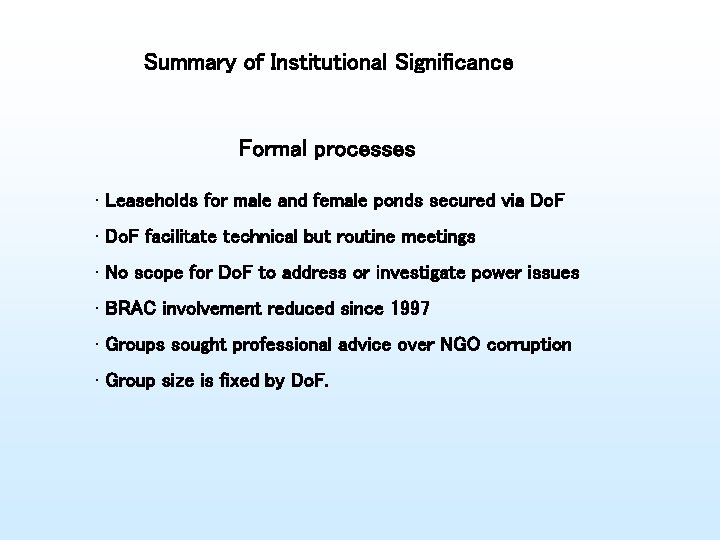
Summary of Institutional Significance Formal processes • Leaseholds for male and female ponds secured via Do. F • Do. F facilitate technical but routine meetings • No scope for Do. F to address or investigate power issues • BRAC involvement reduced since 1997 • Groups sought professional advice over NGO corruption • Group size is fixed by Do. F.
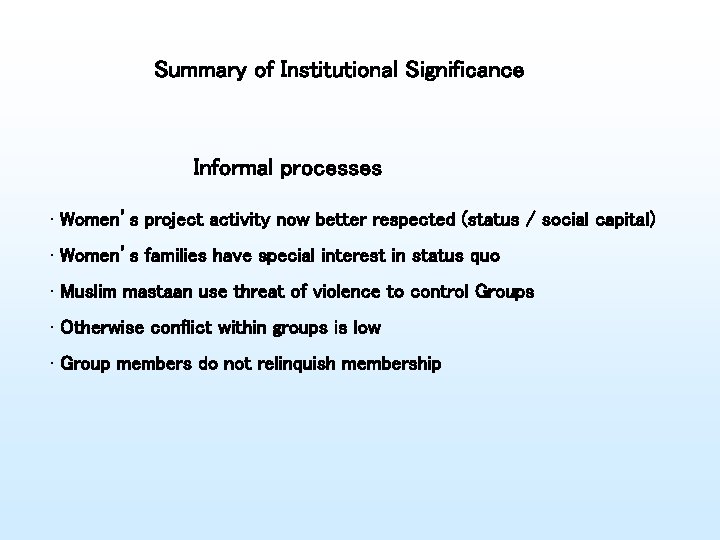
Summary of Institutional Significance Informal processes • Women’s project activity now better respected (status / social capital) • Women’s families have special interest in status quo • Muslim mastaan use threat of violence to control Groups • Otherwise conflict within groups is low • Group members do not relinquish membership
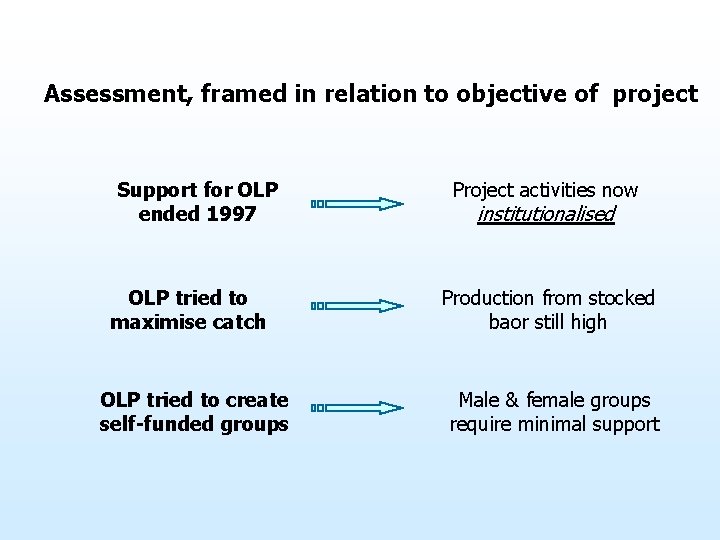
Assessment, framed in relation to objective of project Support for OLP ended 1997 OLP tried to maximise catch OLP tried to create self-funded groups Project activities now institutionalised Production from stocked baor still high Male & female groups require minimal support
However…. . The situation in 2005 represented a three-way, sub-optimal pact that marginalised the vulnerable & resisted change The constraints to women particularly disappointing - their husbands made the real economic decisions ‘. . grabbing productive assets or looting the income of women requires a number of factors, which men alone have in Bangladesh' Nathan and Apu (2002) “…there was local political pressure to drop women from leases and replace them with young men who supported the new ruling party. ” Lewins (2005) What made OLP economically viable (closed water body, subsidised inputs & exclusive rules of use) – attracted unwanted attention & made it hard for poor to secure gains …a feature of many “technical” fisheries initiatives in Bangladesh
Co-management in Malawi – the Participatory Fisheries Management Programme (1991 - ) Objective to improve regulation of Lake Malombe & Upper Shire fisheries in response to serious decline UK-funded with Do. F as key partner Running parallel to national decentralisation process 31 Beach Village Committees as interface between community & Do. F…… Purpose, to improve compliance to new technical controls & regulations BVCs to enforce rules (largely designed by Do. F) & publicise impact of illegal fishing , (Sources include: Hara, 2001; Donda, 2001; Allison et al, 2002)
Co-management in Malawi – the Participatory Fisheries Management Programme (1991 - ) Some problems… 30% of BVC members were non-fishers Primary stakeholders entrusted with very narrow range of responsibilities. Lack of legitimacy & power struggles with traditional leaders ‘…there is some input from government but the overall picture is that there is dominance of control of resource access by chiefs ’ (Njaya, 2006). There remains confusion over the precise roles of BVCs and their relationship to decentralised structures such as District Assemblies. Decentralisation Policy (1998) has seen each sector transfer authority at different rates – the fisheries sector slowest to decentralise real responsibility (Njaya et al. 2011). Failure to establish explicit roles for traditional authorities & to draw on their potential to demarcate socially legitimate fishing areas or to mediate disputes and violations. “. . scepticism undermined , the initial success of the co-management arrangement”.
Co-management in Malawi – the Participatory Fisheries Management Programme (1991 - ) ‘. . [constraints] … relate to confusion & conflict over the roles & responsibilities of the various management structures & the nature of the relationships between them. These relationships, in turn, are a function of the informal institutional landscape – the struggle between traditional leaders, appointed individuals (BVC etc) & government stakeholders seeking patronage & influence (Béné et al. 2009)’. Lewins et al 2014 International financial support withdrawn since the beginning of the 2000 s. Legacy? ‘Quite resilient local level structures, not wholly representing the interests of local fishers & contesting their role with the Do. F & the public’ (Njaya et al. 2011). ,
Informal institutional effects & processes are underreported …. . why? Project staff can be fixated on log-frame activities & predetermined indicators (visual) ---an emphasis on the visible, quantifiable things. e. g. The number of committees, the apparent membership, a signed plan Local field staff drawn from wide range of technical backgrounds (agriculture extension, fisheries management, engineering etc. ) But may lack socio-political expertise Modus operandum of each sector - the legacy of past interventions and “ways of doing things” Some social norms (e. g. fixed local “roles” for women & the poorest) can be viewed as undesirable & embarrassing to development stakeholders Informal institutional issues are seen as a messy distraction & infer failure of implementing agencies (donors & those on the ground)
However, informal institutional & processes can represent opportunities! Why re- invent the wheel…. In Bangladesh, some water projects recognised “Local Initiatives” to manage water & used them instead of setting up new rules & structures. (public meetings chaired by mathbor elders to decide when to flood & drain fields) Powerful local individuals can act as champions of local plans / needs – communicating them to service providers and seeking funds on behalf of public Local people can shape structures and project activities to make them more relevant not necessarily as desired by the project There is evidence of successful planning in Bangladesh where communities explore options independently of project facilitators…… Planning works well when it publicly acknowledges power differentials (public pressure on government officials) In summary, these processes may be viewed as socially legitimate …introduced ones often are not viewed this way
Institutional performance issues in Bangladesh (Lewins 2005) The way the existing institutional environment interacts with projects depends on their design (purpose, approach, activities) • Production-oriented projects are prone to manipulation (especially interventions that subsidise access or inputs) • Sector-specific interventions can widen differences between livelihoods groups, creating conflict • RMI design cannot be viewed in isolation from “approach” (i. e. the purpose & approach of RMIs can be as significant as the form & design of the committee) • RMIs can fail because the incentive for participation & support does not exist • Participation levels relate to perceived value & legitimacy • GO or NGO staff & local stakeholders can develop their own informal institutions (“ways of doing things”) that can consolidate management arrangements (e. g. Oxbow Lakes Project)
Opportunities • Relate participation to co-learning & awareness rather than formation of RMIs with set roles & functions (“blue-print” approach) • All stakeholders should understand the problem of assuming homogenous & harmonious “communities” • Project staff must be aware of the type of processes that can evolve (socio-economists & social scientists could play a key role in the entire process, not just the scoping & inception phase). • Relevant tools to map relationships & institutional performance (e. g. “process documentation”) should be communicated to local staff & be integral to M&E • Staff should be aware of the potential of existing institutions (such as the mosque committee) in supporting sustainability & pro-poor objectives • Tools like institutional mapping may reveal “platforms” such as the salish or mosque committee that already perform similar function to intended RMIs • The “elite” should not always be avoided or confronted – they can operate as powerful brokers & add legitimacy, gain additional political &
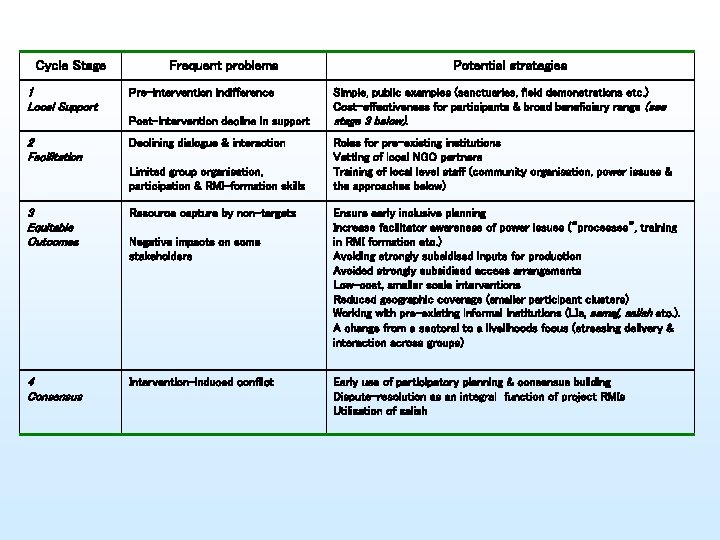
Cycle Stage 1 Local Support 2 Facilitation Frequent problems Potential strategies Pre-intervention indifference Simple, public examples (sanctuaries, field demonstrations etc. ) Cost-effectiveness for participants & broad beneficiary range (see Post-intervention decline in support stage 3 below). Declining dialogue & interaction Roles for pre-existing institutions Vetting of local NGO partners Training of local level staff (community organisation, power issues & the approaches below) Limited group organisation, participation & RMI-formation skills 3 Equitable Outcomes Resource capture by non-targets 4 Consensus Intervention-induced conflict Negative impacts on some stakeholders Ensure early inclusive planning Increase facilitator awareness of power issues (“processes”, training in RMI formation etc. ) Avoiding strongly subsidised inputs for production Avoided strongly subsidised access arrangements Low-cost, smaller scale interventions Reduced geographic coverage (smaller participant clusters) Working with pre-existing informal institutions (LIs, samaj, salish etc. ). A change from a sectoral to a livelihoods focus (stressing delivery & interaction across groups) Early use of participatory planning & consensus building Dispute-resolution as an integral function of project RMIs Utilisation of salish
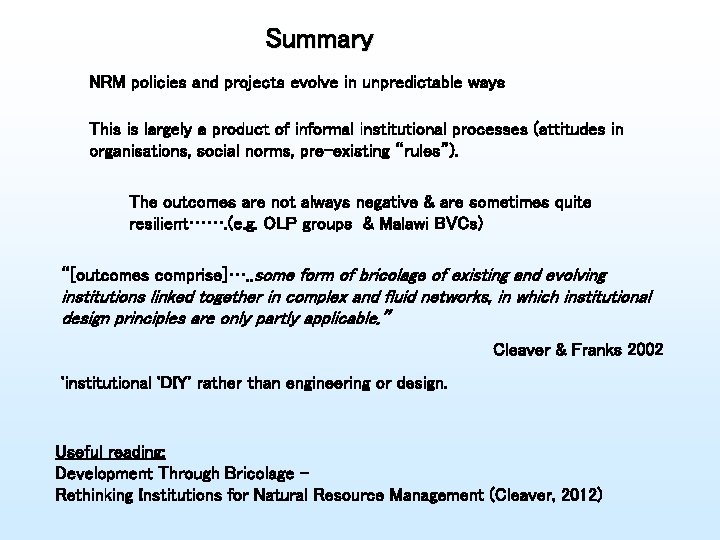
Summary NRM policies and projects evolve in unpredictable ways This is largely a product of informal institutional processes (attitudes in organisations, social norms, pre-existing “rules”). The outcomes are not always negative & are sometimes quite resilient……. (e. g. OLP groups & Malawi BVCs) “[outcomes comprise]…. . some form of bricolage of existing and evolving institutions linked together in complex and fluid networks, in which institutional design principles are only partly applicable. ” Cleaver & Franks 2002 'institutional 'DIY' rather than engineering or design. Useful reading: Development Through Bricolage Rethinking Institutions for Natural Resource Management (Cleaver, 2012)
Difficult & overlooked institutional issues in natural resource management - examples from fisheries co-management Thank you Roger Lewins Project & Institutional Analysis
Discussion topics General The consequence for decentralised NRM Parallels outside of NRM? The arrogance of “institution building”? Specific Special features of fisheries (physical, livelihoods / socio-economic, psychological(!) & institutional) How does this theory relate to other sectors - examples (rangelands, forest, agriculture etc. )? Is the concept of “community” still useful in the context of decentralised NRM?