
Differentiation with cluster groups of gifted students Upper
- Slides: 37
Differentiation with cluster groups of gifted students: Upper Elementary (3 rd-5 th) Dr. Elissa F. Brown Hunter College eb 177@hunter. cuny. edu York County School Division January 2019
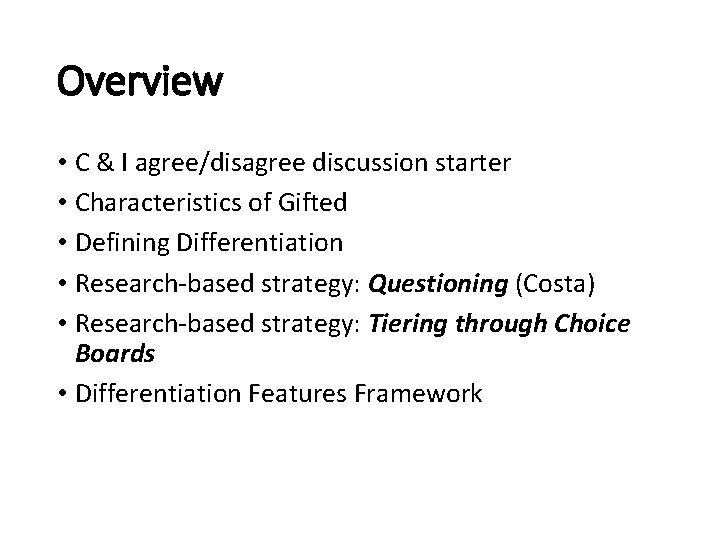
Overview • C & I agree/disagree discussion starter • Characteristics of Gifted • Defining Differentiation • Research-based strategy: Questioning (Costa) • Research-based strategy: Tiering through Choice Boards • Differentiation Features Framework
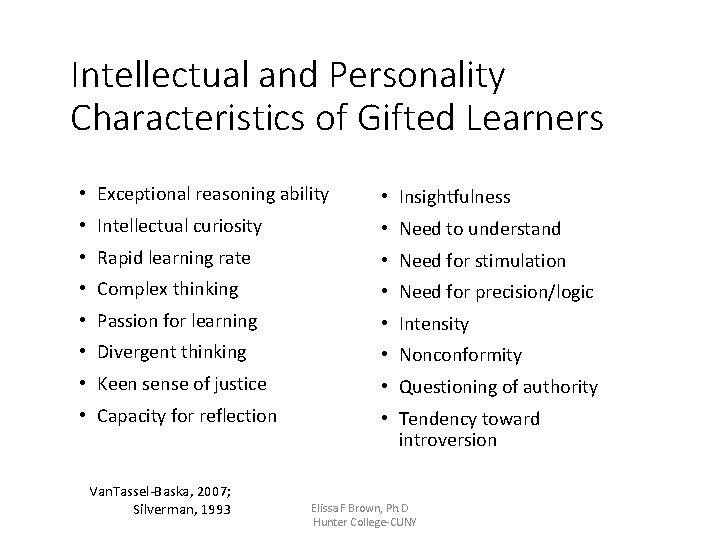
Intellectual and Personality Characteristics of Gifted Learners • Exceptional reasoning ability • Insightfulness • Intellectual curiosity • Need to understand • Rapid learning rate • Need for stimulation • Complex thinking • Need for precision/logic • Passion for learning • Intensity • Divergent thinking • Nonconformity • Keen sense of justice • Questioning of authority • Capacity for reflection • Tendency toward introversion Van. Tassel-Baska, 2007; Silverman, 1993 Elissa F Brown, Ph. D Hunter College-CUNY
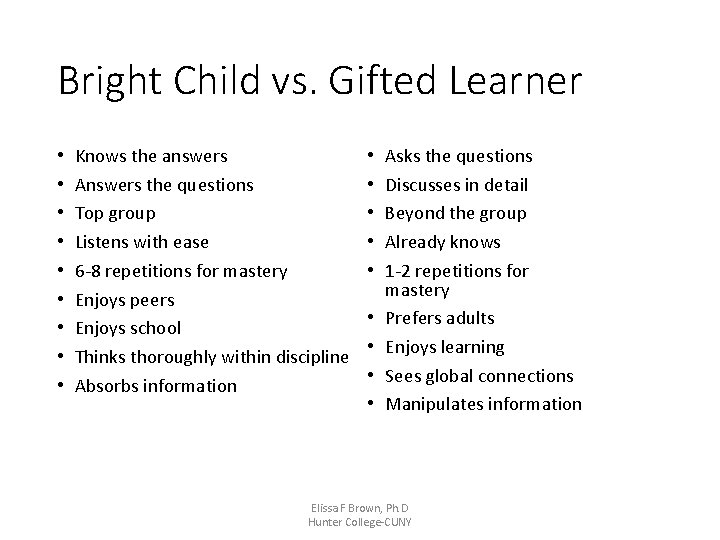
Bright Child vs. Gifted Learner • • • Knows the answers Answers the questions Top group Listens with ease 6 -8 repetitions for mastery Enjoys peers Enjoys school Thinks thoroughly within discipline Absorbs information • • • Asks the questions Discusses in detail Beyond the group Already knows 1 -2 repetitions for mastery Prefers adults Enjoys learning Sees global connections Manipulates information Elissa F Brown, Ph. D Hunter College-CUNY
What is Differentiation? The process of differentiation is the deliberate adaptation and modification of the curriculum, instructional processes, and assessments to respond to the needs of gifted learners. -Van. Tassel-Baska, 2012 Elissa F Brown, Ph. D Hunter College-CUNY
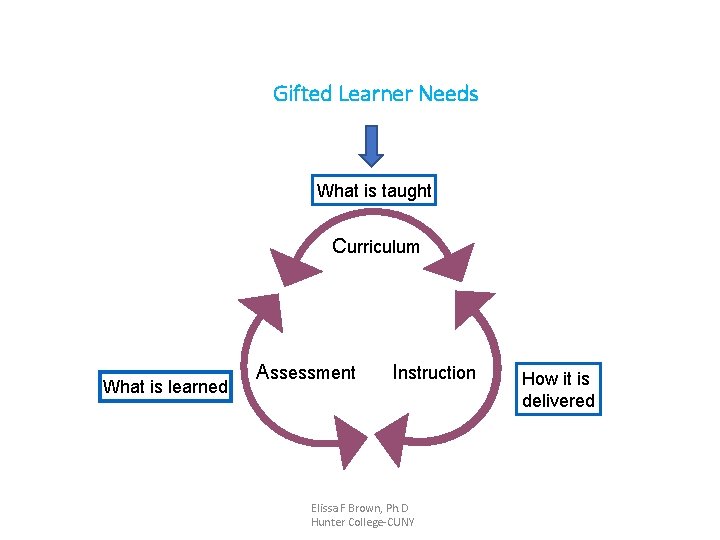
Gifted Learner Needs What is taught Curriculum What is learned Assessment Instruction Elissa F Brown, Ph. D Hunter College-CUNY How it is delivered
A. Harry Passow • Would, Should, Could • Would every student want to do it? • Should every student do it? • Could every student do it?
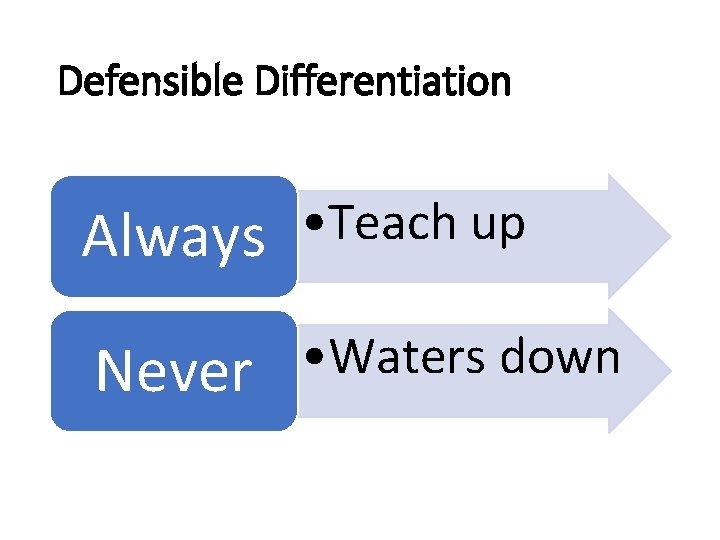
Defensible Differentiation • Teach up Always • Waters down Never
Strategy: Questioning Questions are the most frequently used teaching technique in the classroom.
• Improving Your Questioning may be the Single Most Powerful Change You can Make in Your Classroom • It costs very little • It requires no new books, consumables or computers • You won’t sacrifice achievement • You can start …Tomorrow • When you get observed, they will be looking for your questioning techniques.
STATUS OF QUESTIONING IN THE CLASSROOM • Teachers ask questions that require students to respond with facts. 90% of all questions asked by instructors are low level questions. • Students ask questions about clarifying the homework assignment Classroom Questioning by Kathleen Cotton http: //www. learner. org/workshops/socialstudies/pdf/session 6/6. Classroom. Questioning. pdf
REASONS WE ASK QUESTIONS? • • • To determine what students know and don’t know To develop critical and creative thinking skills To provide a review of material and content To prepare students for what is to be learned To check for comprehension or level of understanding To attract student attention To practice life-long learning skills To have fun learning To engage students in discussion To teach students to ask questions
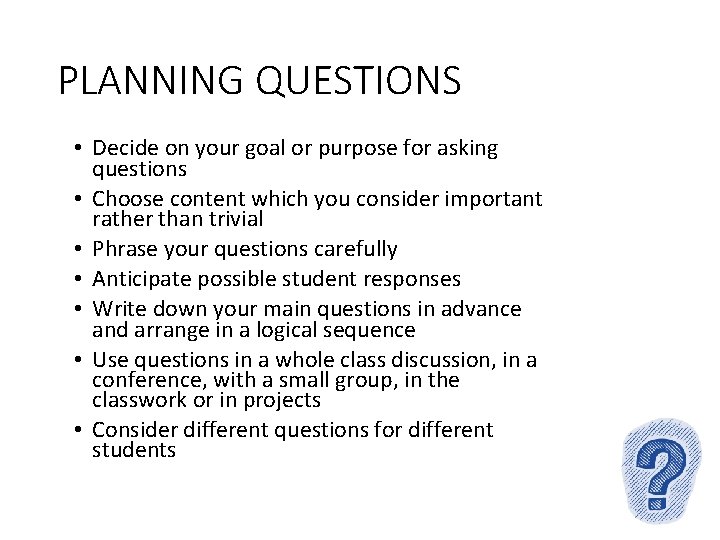
PLANNING QUESTIONS • Decide on your goal or purpose for asking questions • Choose content which you consider important rather than trivial • Phrase your questions carefully • Anticipate possible student responses • Write down your main questions in advance and arrange in a logical sequence • Use questions in a whole class discussion, in a conference, with a small group, in the classwork or in projects • Consider different questions for different students
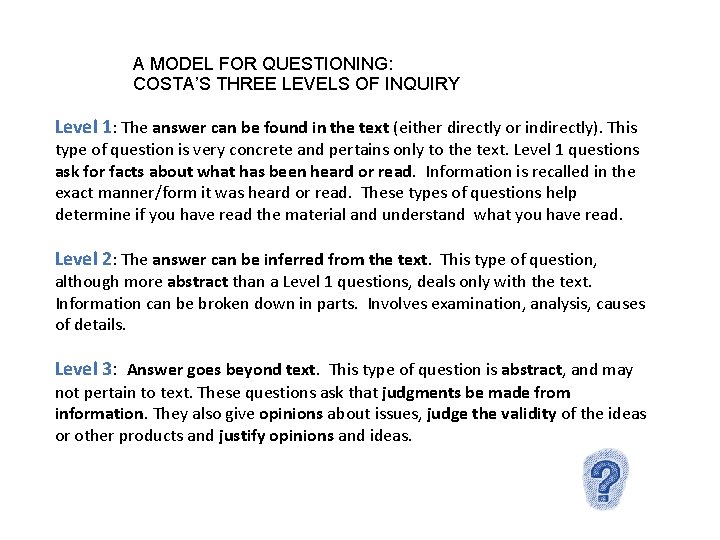
A MODEL FOR QUESTIONING: COSTA’S THREE LEVELS OF INQUIRY Level 1: The answer can be found in the text (either directly or indirectly). This type of question is very concrete and pertains only to the text. Level 1 questions ask for facts about what has been heard or read. Information is recalled in the exact manner/form it was heard or read. These types of questions help determine if you have read the material and understand what you have read. Level 2: The answer can be inferred from the text. This type of question, although more abstract than a Level 1 questions, deals only with the text. Information can be broken down in parts. Involves examination, analysis, causes of details. Level 3: Answer goes beyond text. This type of question is abstract, and may not pertain to text. These questions ask that judgments be made from information. They also give opinions about issues, judge the validity of the ideas or other products and justify opinions and ideas.
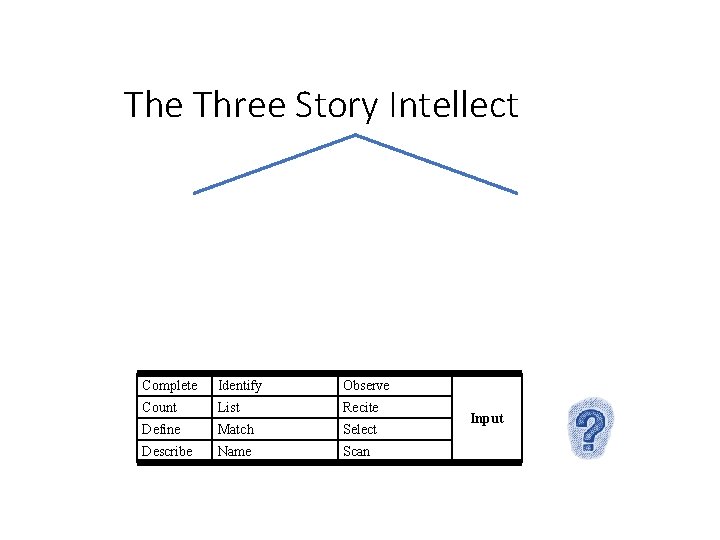
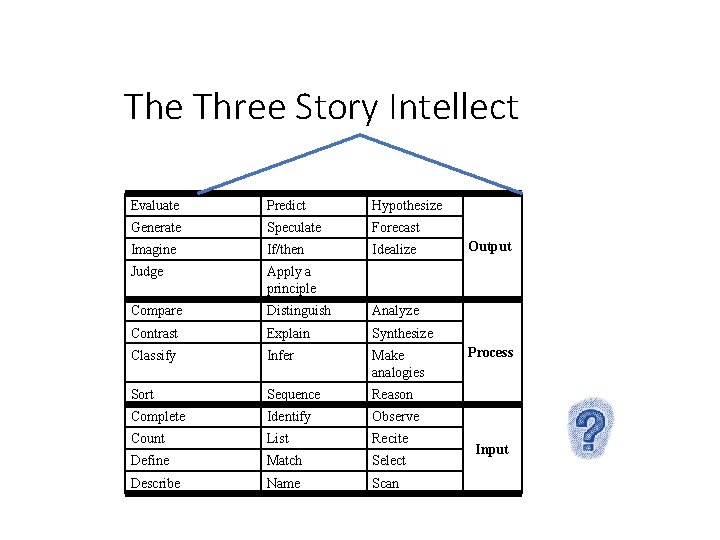
The Three Story Intellect Complete Identify Observe Count List Recite Define Match Select Describe Name Scan Input
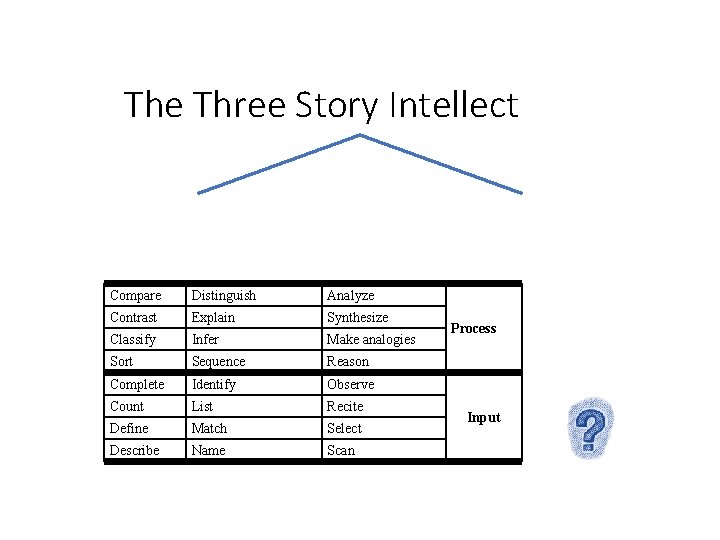
The Three Story Intellect Compare Distinguish Analyze Contrast Explain Synthesize Classify Infer Make analogies Sort Sequence Reason Complete Identify Observe Count List Recite Define Match Select Describe Name Scan Process Input
The Three Story Intellect Evaluate Predict Hypothesize Generate Speculate Forecast Imagine If/then Idealize Judge Apply a principle Compare Distinguish Analyze Contrast Explain Synthesize Classify Infer Make analogies Sort Sequence Reason Complete Identify Observe Count List Recite Define Match Select Describe Name Scan Output Process Input
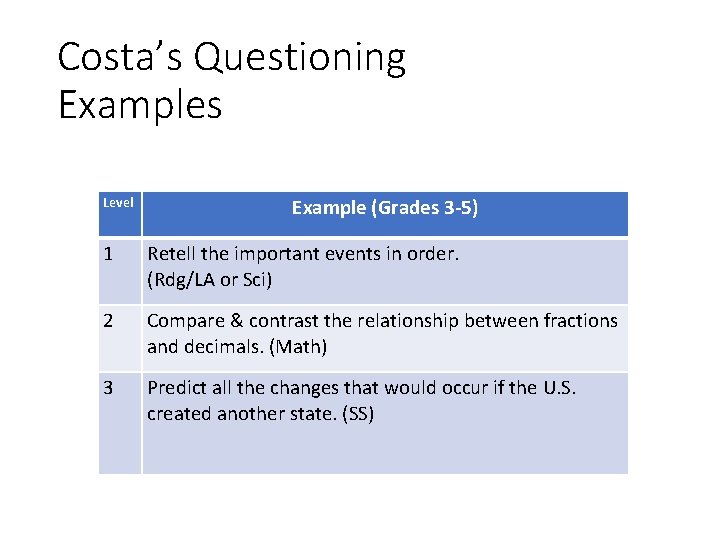
Costa’s Questioning Examples Level Example (Grades 3 -5) 1 Retell the important events in order. (Rdg/LA or Sci) 2 Compare & contrast the relationship between fractions and decimals. (Math) 3 Predict all the changes that would occur if the U. S. created another state. (SS)
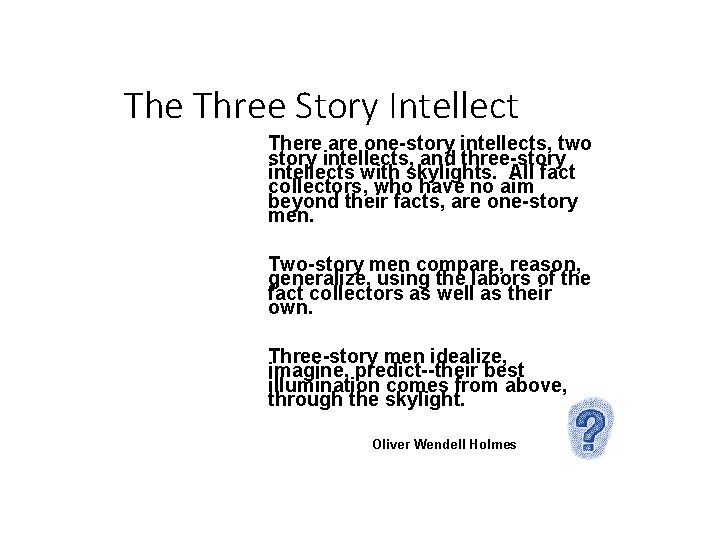
The Three Story Intellect There are one-story intellects, two story intellects, and three-story intellects with skylights. All fact collectors, who have no aim beyond their facts, are one-story men. Two-story men compare, reason, generalize, using the labors of the fact collectors as well as their own. Three-story men idealize, imagine, predict--their best illumination comes from above, through the skylight. Oliver Wendell Holmes
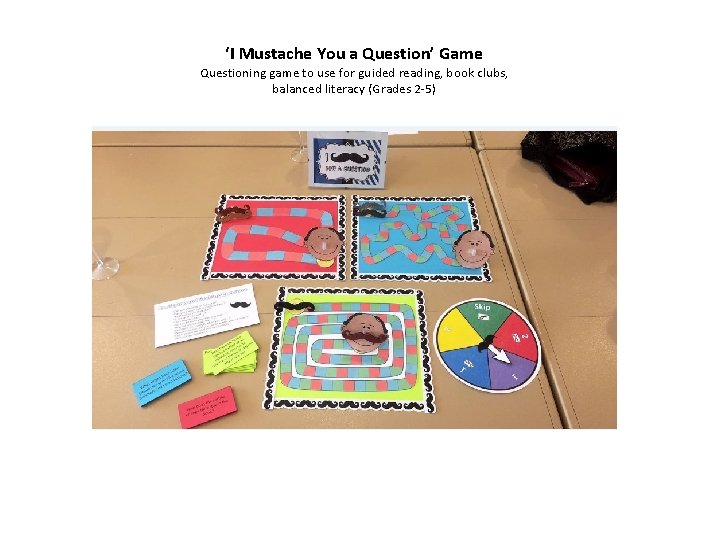
‘I Mustache You a Question’ Game Questioning game to use for guided reading, book clubs, balanced literacy (Grades 2 -5)
LET’S PRACTICE – Polar bears live along shores and on sea ice in the icy cold Arctic. When sea ice forms over the ocean in cold weather, many polar bears, except pregnant females, head out onto the ice to hunt seals. Polar bears have been spotted on sea ice hundreds of miles from shore. When the warm weather causes the sea ice to melt, polar bears move back toward shore. Polar bears primarily eat seals. Polar bears often rest silently at a seal's breathing hole in the ice, waiting for a seal in the water to surface. Once the seal comes up, the bear will spring and sink its jagged teeth into the seal's head. Sometimes the polar bear stalks its prey. It may see a seal lying near its breathing hole and slowly move toward it, then charge it, biting its head or grabbing it with its massive claws. A polar bear may also hunt by swimming beneath the ice.
LET’S PRACTICE From the Polar Bears story, create the following questions: Level 1 (Input) Level 2 (Process) Level 3 (Output) You may use your handout on Costa’s Levels of Inquiry to help you. Be ready to share your findings with your partner!
We find that some teachers ask surface questions that do not take students deeper into …issues; we think of those students as walking on a path that surrounds a beautiful forest without ever stepping into the forest to look at the trees. Other teachers ask questions that [probe] do not build carefully toward key concepts. We think of these students as stepping in and out of the forest, catching glimpses of trees and flowers but not learning where they are …or how they may navigate their way through the forest. Other teachers ask questions that target key concepts and build carefully to enable students to find their way around. Those students experience the forest fully –they walk through, looking at the trees and flowers, and they also climb some trees and look at the whole terrain, getting a sense of where they are…. the questions that teachers use to guide students become the pathways that students walk along and that shape their experience of the terrain. ~Boaler & Humphreys, 2005
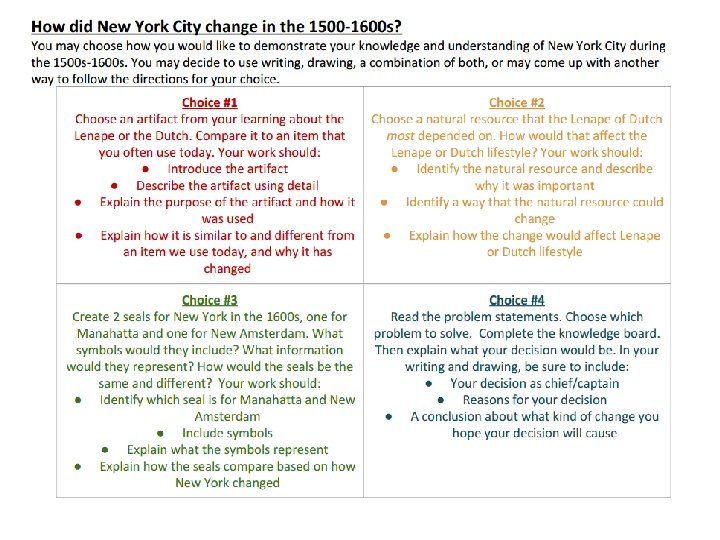
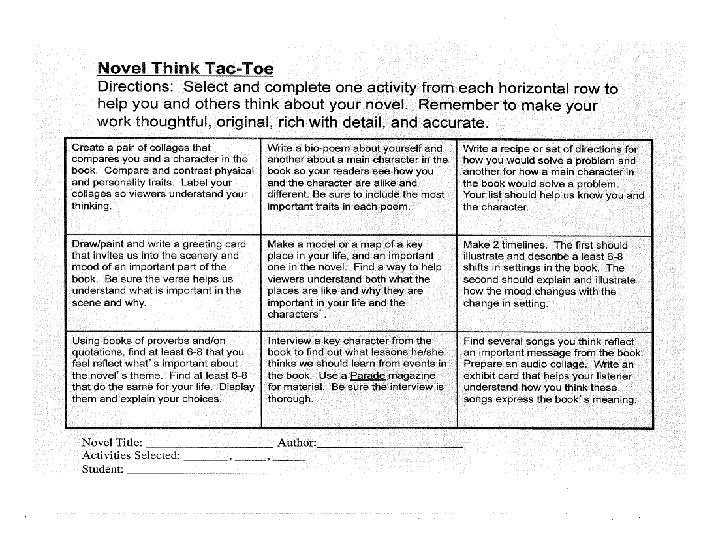
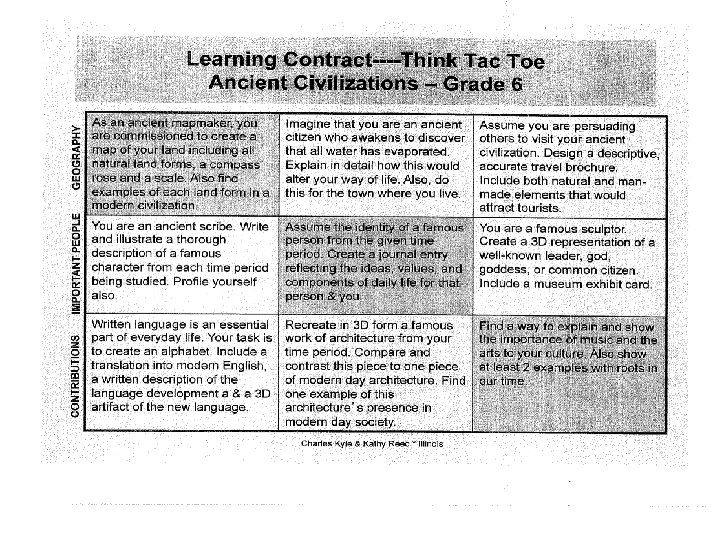
Research-based Strategy: Tiering with Choice Boards What are high level choice boards? What does it look like in practice? • Choice boards are generally used to differentiate product and can be valuable tools for assessing student progress. They allow choice for the student, but are deliberately developed with curricular goals and complex challenges that require students to use a repertoire of knowledge and skills to complete complex tasks (Stephens & Karnes, 2015).
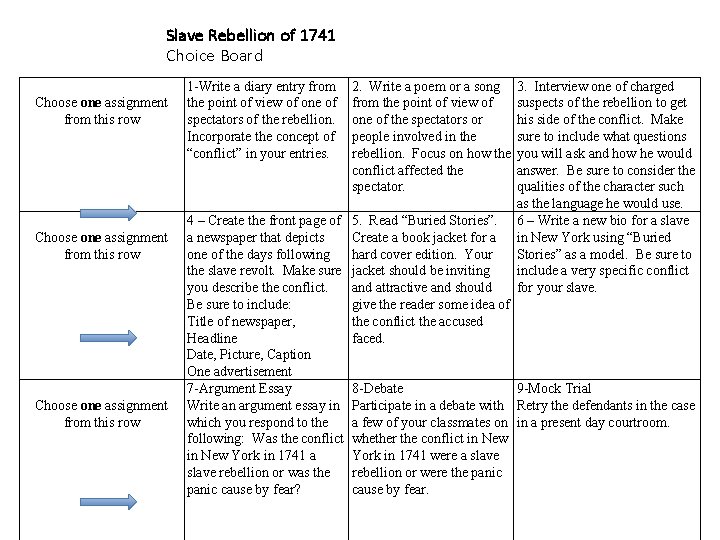
Slave Rebellion of 1741 Choice Board Choose one assignment from this row 1 -Write a diary entry from the point of view of one of spectators of the rebellion. Incorporate the concept of “conflict” in your entries. 2. Write a poem or a song from the point of view of one of the spectators or people involved in the rebellion. Focus on how the conflict affected the spectator. 4 – Create the front page of a newspaper that depicts one of the days following the slave revolt. Make sure you describe the conflict. Be sure to include: Title of newspaper, Headline Date, Picture, Caption One advertisement 7 -Argument Essay Write an argument essay in which you respond to the following: Was the conflict in New York in 1741 a slave rebellion or was the panic cause by fear? 5. Read “Buried Stories”. Create a book jacket for a hard cover edition. Your jacket should be inviting and attractive and should give the reader some idea of the conflict the accused faced. 3. Interview one of charged suspects of the rebellion to get his side of the conflict. Make sure to include what questions you will ask and how he would answer. Be sure to consider the qualities of the character such as the language he would use. 6 – Write a new bio for a slave in New York using “Buried Stories” as a model. Be sure to include a very specific conflict for your slave. 8 -Debate 9 -Mock Trial Participate in a debate with Retry the defendants in the case a few of your classmates on in a present day courtroom. whether the conflict in New York in 1741 were a slave rebellion or were the panic cause by fear.
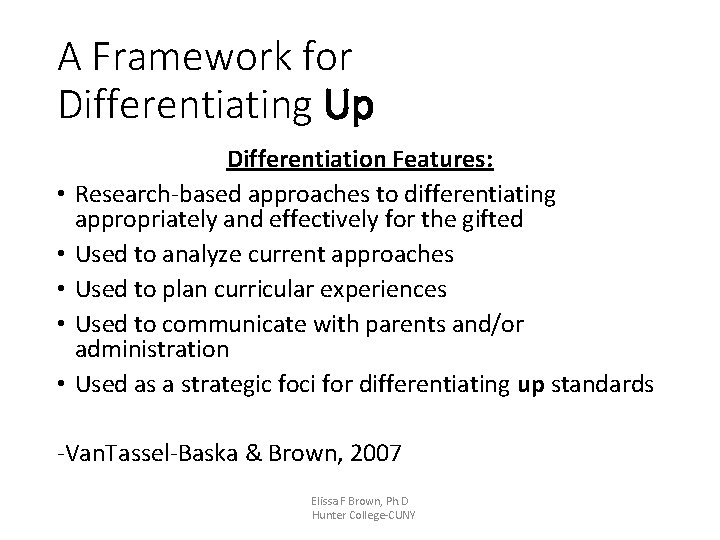
A Framework for Differentiating Up • • • Differentiation Features: Research-based approaches to differentiating appropriately and effectively for the gifted Used to analyze current approaches Used to plan curricular experiences Used to communicate with parents and/or administration Used as a strategic foci for differentiating up standards -Van. Tassel-Baska & Brown, 2007 Elissa F Brown, Ph. D Hunter College-CUNY
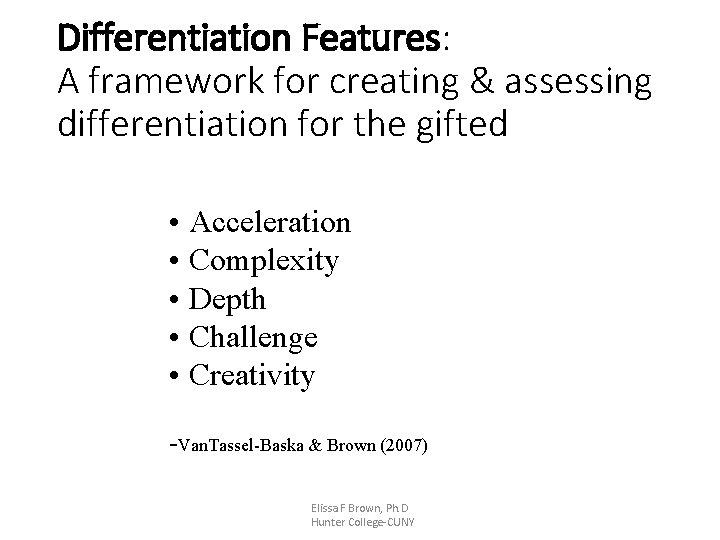
Differentiation Features: A framework for creating & assessing differentiation for the gifted • Acceleration • Complexity • Depth • Challenge • Creativity -Van. Tassel-Baska & Brown (2007) Elissa F Brown, Ph. D Hunter College-CUNY
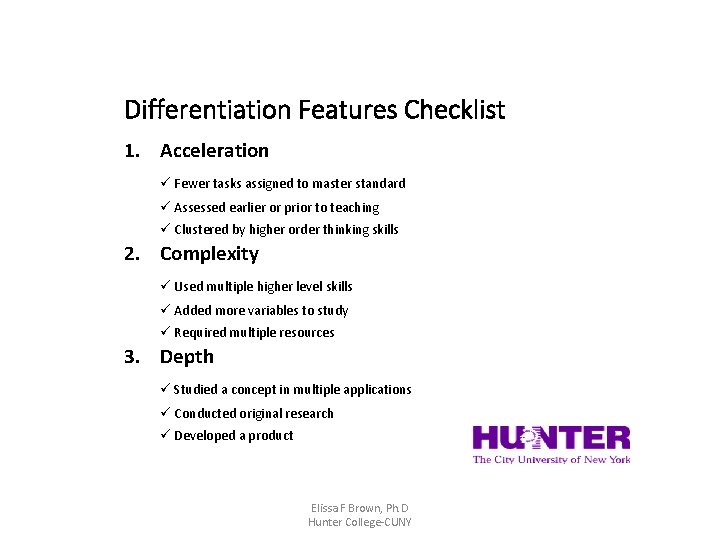
Differentiation Features Checklist 1. Acceleration Fewer tasks assigned to master standard Assessed earlier or prior to teaching Clustered by higher order thinking skills 2. Complexity Used multiple higher level skills Added more variables to study Required multiple resources 3. Depth Studied a concept in multiple applications Conducted original research Developed a product Elissa F Brown, Ph. D Hunter College-CUNY
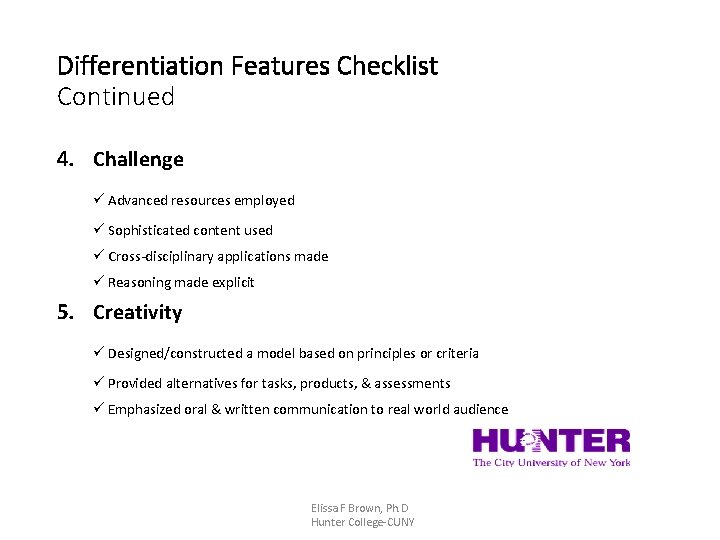
Differentiation Features Checklist Continued 4. Challenge Advanced resources employed Sophisticated content used Cross-disciplinary applications made Reasoning made explicit 5. Creativity Designed/constructed a model based on principles or criteria Provided alternatives for tasks, products, & assessments Emphasized oral & written communication to real world audience Elissa F Brown, Ph. D Hunter College-CUNY
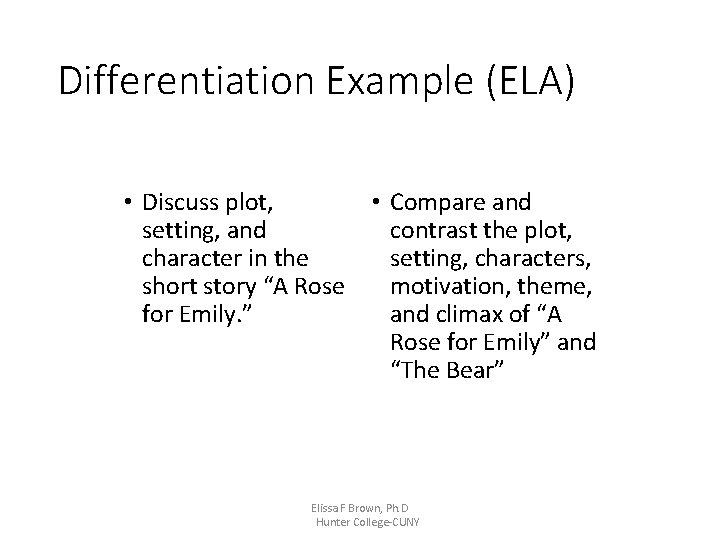
Differentiation Example (ELA) • Discuss plot, setting, and character in the short story “A Rose for Emily. ” • Compare and contrast the plot, setting, characters, motivation, theme, and climax of “A Rose for Emily” and “The Bear” Elissa F Brown, Ph. D Hunter College-CUNY
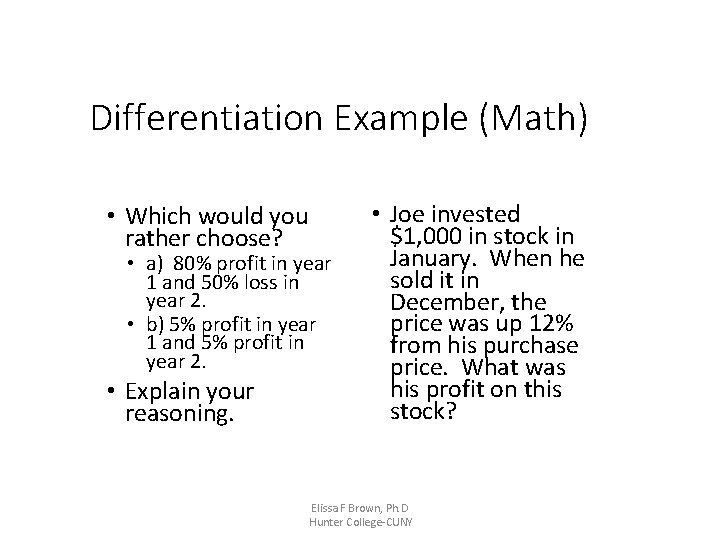
Differentiation Example (Math) • Which would you rather choose? • a) 80% profit in year 1 and 50% loss in year 2. • b) 5% profit in year 1 and 5% profit in year 2. • Explain your reasoning. • Joe invested $1, 000 in stock in January. When he sold it in December, the price was up 12% from his purchase price. What was his profit on this stock? Elissa F Brown, Ph. D Hunter College-CUNY
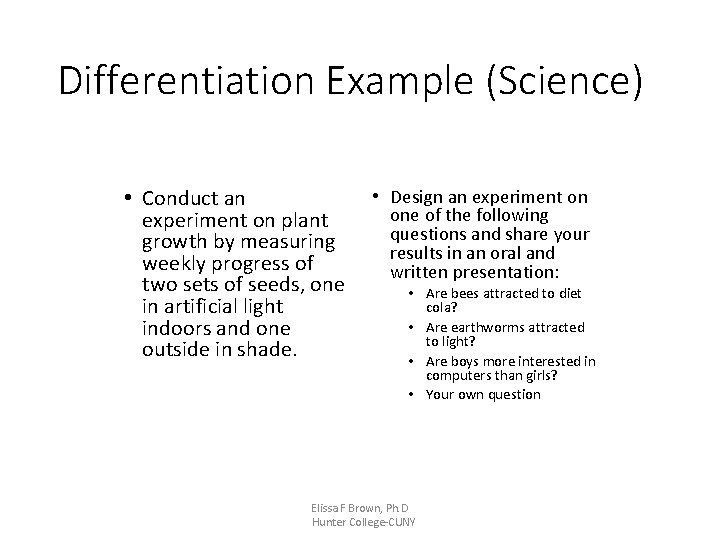
Differentiation Example (Science) • Conduct an experiment on plant growth by measuring weekly progress of two sets of seeds, one in artificial light indoors and one outside in shade. • Design an experiment on one of the following questions and share your results in an oral and written presentation: • Are bees attracted to diet cola? • Are earthworms attracted to light? • Are boys more interested in computers than girls? • Your own question Elissa F Brown, Ph. D Hunter College-CUNY
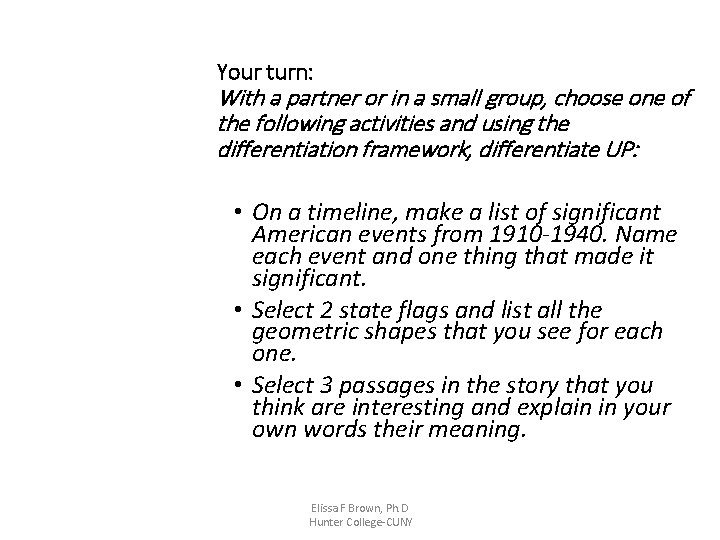
Your turn: With a partner or in a small group, choose one of the following activities and using the differentiation framework, differentiate UP: • On a timeline, make a list of significant American events from 1910 -1940. Name each event and one thing that made it significant. • Select 2 state flags and list all the geometric shapes that you see for each one. • Select 3 passages in the story that you think are interesting and explain in your own words their meaning. Elissa F Brown, Ph. D Hunter College-CUNY
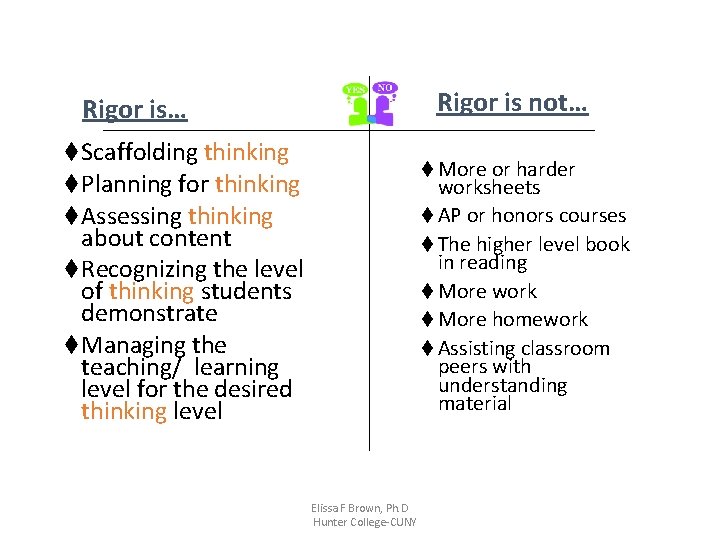
Rigor is not… Rigor is… t Scaffolding thinking t Planning for thinking t Assessing thinking t More or harder worksheets t AP or honors courses t The higher level book in reading t More work t More homework t Assisting classroom peers with understanding material about content t Recognizing the level of thinking students demonstrate t Managing the teaching/ learning level for the desired thinking level Elissa F Brown, Ph. D Hunter College-CUNY