
Differentiation Practices of Five Teachers Working with the



- Slides: 23
Differentiation Practices of Five Teachers Working with the Same Class Alaster Scott Douglas alaster. douglas@roehampton. ac. uk
Relates CHAT concepts (object, subject, tool, activity system) to my research in school subject departments Research Questions 1. What are the opportunities for student teacher learning as constructed and reconstructed in different subject departments in one school? 2. To what extent and why are these learning opportunities constructed differently?
The Object Engeström focuses on collective phenomena and uses the notion of object to scrutinize the dialectical process between the subjects and their communities. This implies that the object is tied to the collective level, works over longer time spans, and signifies the potential and direction for change. It is not static and not reducible to short-term goals but should rather be understood as jointly constructed and potentially, and not necessarily, shared. (Rasmussen and Ludvigsen 2009)
Tool Design and Appropriation • The only way to get an insight into the nature of the object-related activity is to understand the material production of tools, the social exchanges among people, and the individual subjective processes that participate in regulating the production of tools and social exchanges. (Kaptelinin and Miettinen 2005)
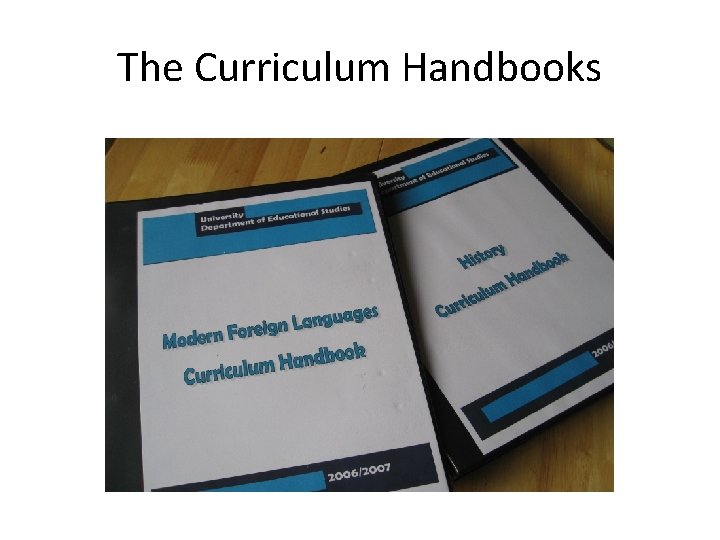
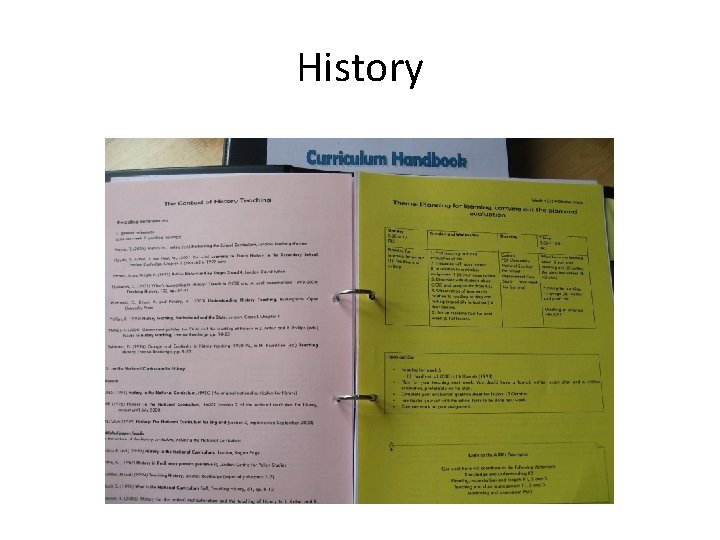
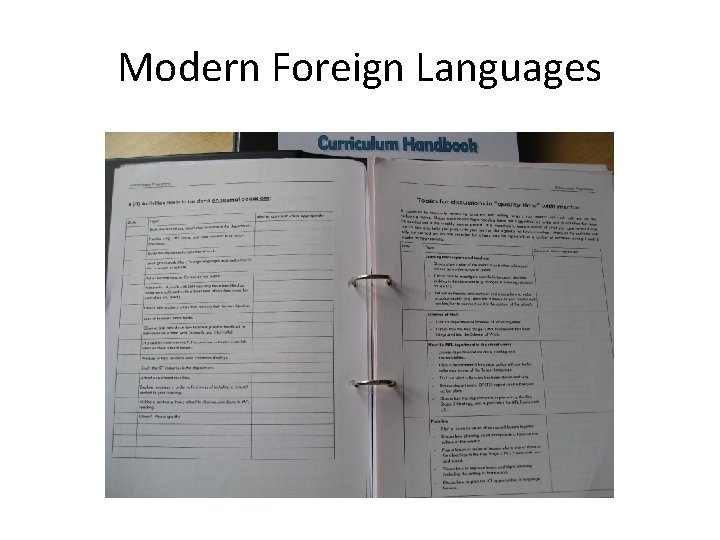
The Curriculum Handbooks
History
Modern Foreign Languages
History Mentor: Shall we try looking in the book at what we’re meant to be talking about, because we keep forgetting to do that? Student teacher: What should we have done? (Field notes – 22 nd November) We are not trying to distort a reality there, but work with it. (Interview with History tutor – 14 th August)
Mentor: What kind of questions can you use in class? Would you change them on reflection? How are you developing inference skills? Student teacher: Some could develop that in poster lessons. I see [History teacher 2] and [History teacher 3] in lessons trying to draw out inferences from sources. Would that be worth doing? Scaffolding – pros and cons of frameworks. I presume they [the pupils] ignore me when they don't want to do it. Mentor: [History tutor] has quite strong views – exams assume students know strengths and weaknesses of sources and bias. How do we tell higher attainers? What is the evidence base, next step? Student teacher: I don't know, what is the next step? Mentor: You don't have to answer now – maybe next year. How do you make source evaluation part of the scheme of work? [The school] suddenly throws sources in rather than dripfeeding, and that’s an issue. (Field notes – 17 th January)
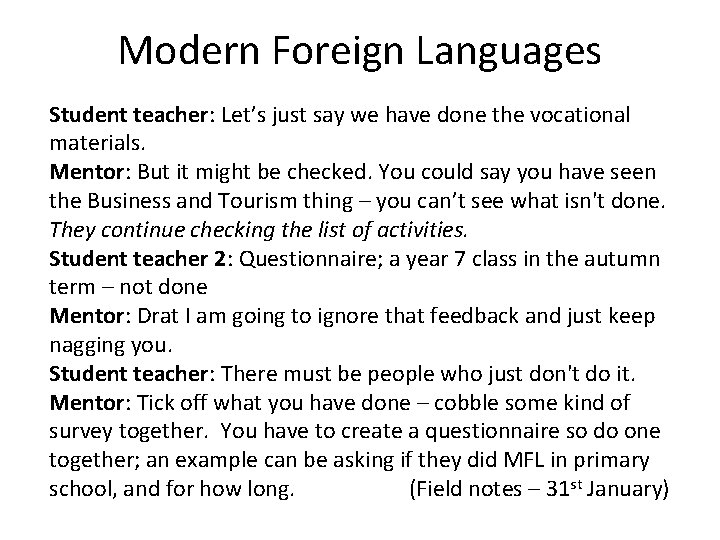
Modern Foreign Languages Student teacher: Let’s just say we have done the vocational materials. Mentor: But it might be checked. You could say you have seen the Business and Tourism thing – you can’t see what isn't done. They continue checking the list of activities. Student teacher 2: Questionnaire; a year 7 class in the autumn term – not done Mentor: Drat I am going to ignore that feedback and just keep nagging you. Student teacher: There must be people who just don't do it. Mentor: Tick off what you have done – cobble some kind of survey together. You have to create a questionnaire so do one together; an example can be asking if they did MFL in primary school, and for how long. (Field notes – 31 st January)
Contradiction / Tension The mentor saw her role in part as ‘keeping an eye, and making them [the student teachers] keep an eye on the enormous amount of paperwork’. (Interview with MFL mentor – 10 th January) Tension: The university’s motive of enabling student teacher learning is in tension with the mentor’s perceptions of fulfilling course requirements
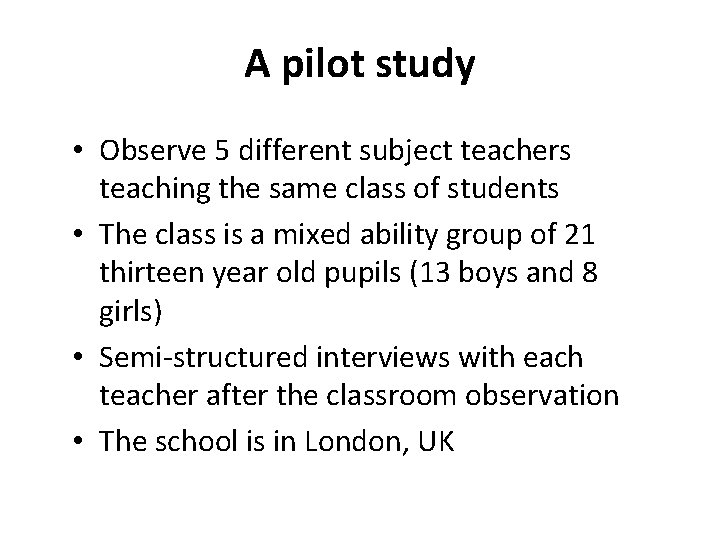
A pilot study • Observe 5 different subject teachers teaching the same class of students • The class is a mixed ability group of 21 thirteen year old pupils (13 boys and 8 girls) • Semi-structured interviews with each teacher after the classroom observation • The school is in London, UK
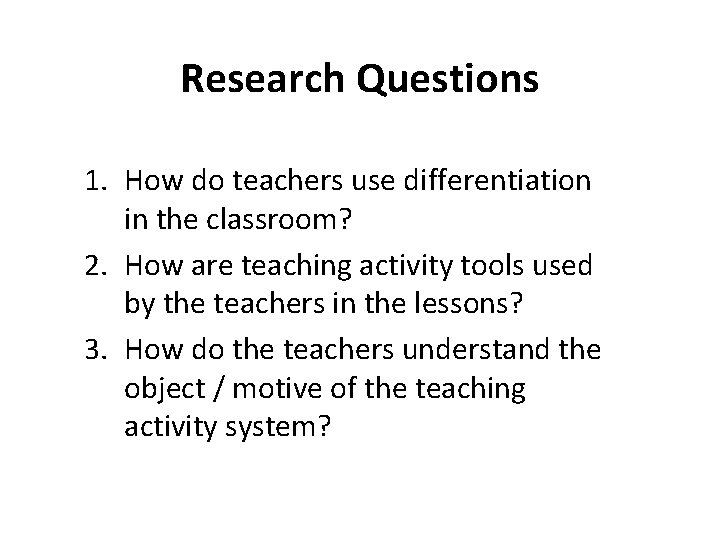
Research Questions 1. How do teachers use differentiation in the classroom? 2. How are teaching activity tools used by the teachers in the lessons? 3. How do the teachers understand the object / motive of the teaching activity system?
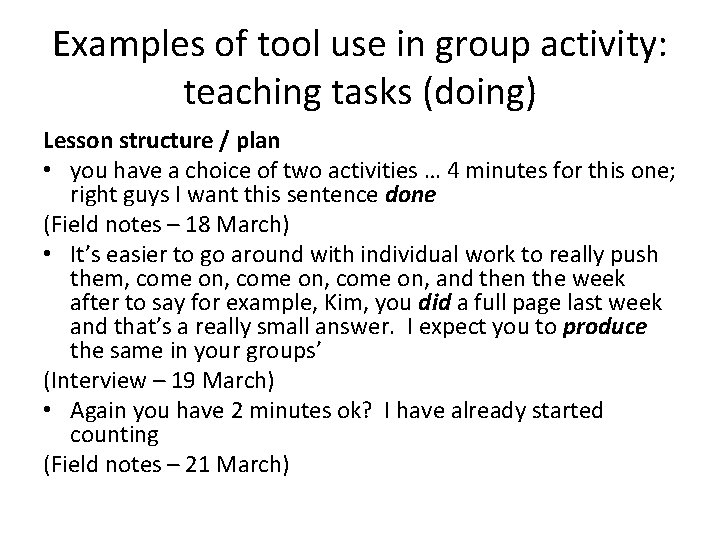
Examples of tool use in group activity: teaching tasks (doing) Lesson structure / plan • you have a choice of two activities … 4 minutes for this one; right guys I want this sentence done (Field notes – 18 March) • It’s easier to go around with individual work to really push them, come on, and then the week after to say for example, Kim, you did a full page last week and that’s a really small answer. I expect you to produce the same in your groups’ (Interview – 19 March) • Again you have 2 minutes ok? I have already started counting (Field notes – 21 March)
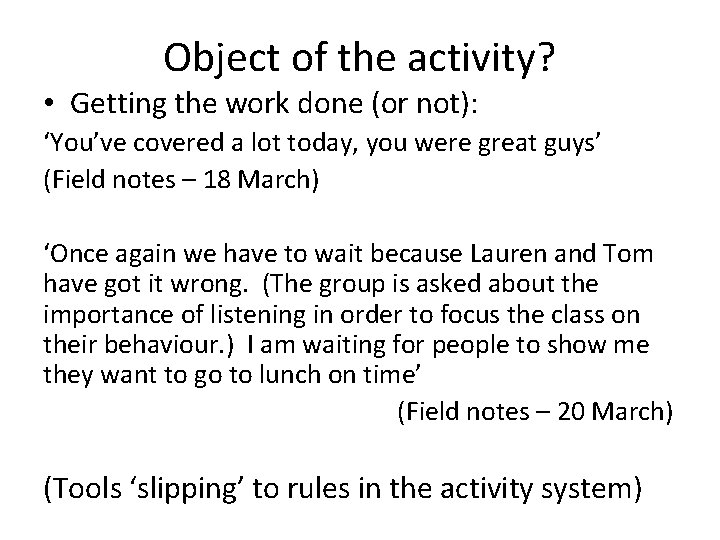
Object of the activity? • Getting the work done (or not): ‘You’ve covered a lot today, you were great guys’ (Field notes – 18 March) ‘Once again we have to wait because Lauren and Tom have got it wrong. (The group is asked about the importance of listening in order to focus the class on their behaviour. ) I am waiting for people to show me they want to go to lunch on time’ (Field notes – 20 March) (Tools ‘slipping’ to rules in the activity system)
The plenary • An emphasis on completing tasks (regardless of their value): Example: ‘We are not going to plenarise, let’s traffic light today. I can have 4 people not able to do this to get green … I think we can green that one’ • Or an opportunity to focus on learning: Example: ‘think of one thing you will try and remember to do next time when writing an essay’ (silence followed by answers which include the use of planning, evidence, sources, conclusions). Even though the lunch bell has gone ‘challenging’ pupil adds: ‘I’ve got another one. ’
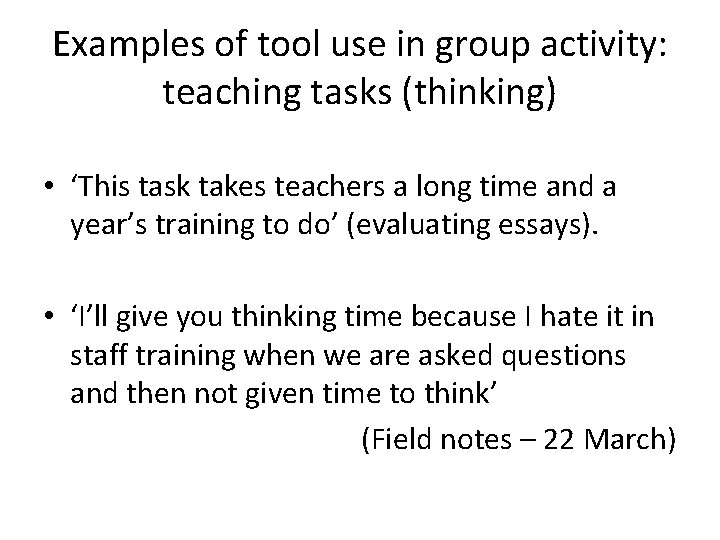
Examples of tool use in group activity: teaching tasks (thinking) • ‘This task takes teachers a long time and a year’s training to do’ (evaluating essays). • ‘I’ll give you thinking time because I hate it in staff training when we are asked questions and then not given time to think’ (Field notes – 22 March)
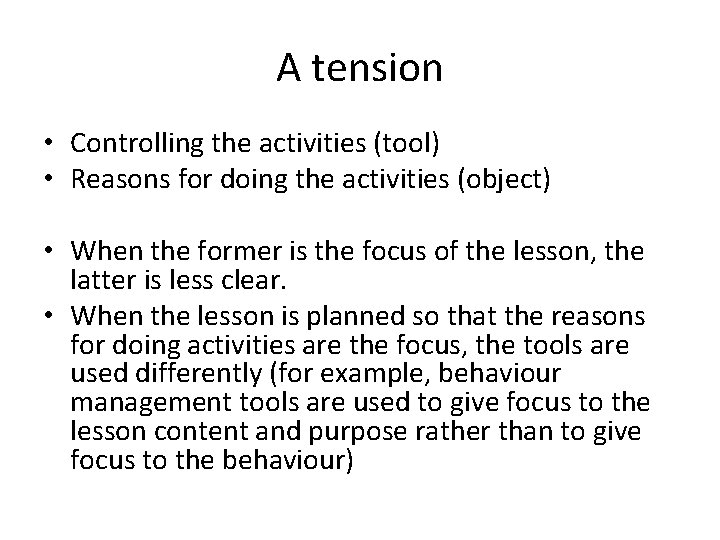
A tension • Controlling the activities (tool) • Reasons for doing the activities (object) • When the former is the focus of the lesson, the latter is less clear. • When the lesson is planned so that the reasons for doing activities are the focus, the tools are used differently (for example, behaviour management tools are used to give focus to the lesson content and purpose rather than to give focus to the behaviour)
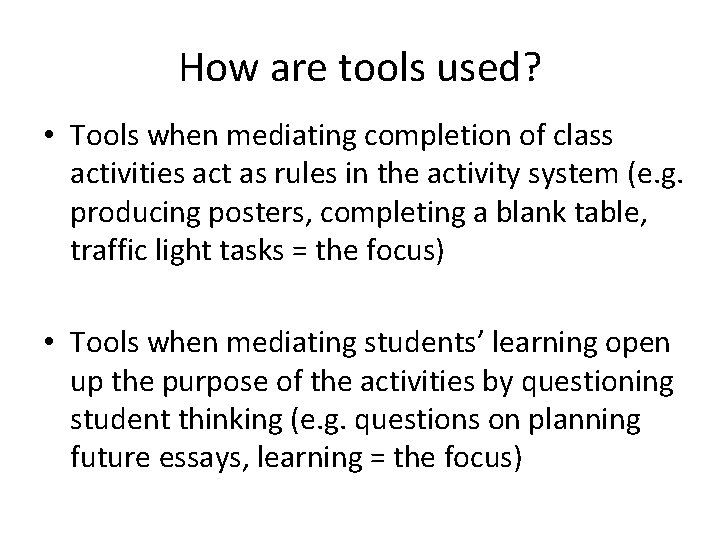
How are tools used? • Tools when mediating completion of class activities act as rules in the activity system (e. g. producing posters, completing a blank table, traffic light tasks = the focus) • Tools when mediating students’ learning open up the purpose of the activities by questioning student thinking (e. g. questions on planning future essays, learning = the focus)
Object-as-motive The term object (and object-as-motive) should be clarified as denoting not some reified things separate from people and their social practice, but as social processes themselves. That is, although they are sometimes embodied in things (e. g. , as a ‘dream house’ that might motivate somebody), they only matter to people as moments of social practices, embodying and representing these practices, always imbued with social (i. e. , transformative and relational) dimensions behind their surface. (Stetsenko 2005)
The object motive When tools slip to rules in the teaching activity, they mediate work on different objects (‘differentiation by outcome’ appears the only differentiation strategy). When tools open up all students’ ideas (rather than relying on separate ‘differentiation’ tasks for high achievers) everyone is encouraged to think about the purpose of the classroom tasks. The tools then achieve ‘functional coherence’ (Miettinen 2005, 60) with the object of the activity system, if this is student learning.
Mediation of tools in relation to the object 1. When ideas from the tools (course handbooks, group work on essay evaluation) inhabit social exchanges, the tools are implicitly mediated through the dialogue. 2. This suggests a shared object (through continuing joint work on a shared problem). 3. Sometimes tools (handbooks, lesson activities) are associated with the regulations of the university / school and the authority of the university tutor / classroom teacher. 4. Then the object is more difficult to interpret, and the focus appears to be on the school’s relationship with the tutor or the teacher’s management of the class, but here the objects are not shared across. 5. The tools then appear to act as rules for participation. 6. And the tools mediate work on different objects.
References • Kaptelinin, V. , and Miettinen, R. (2005). Introduction: perspectives on the object of activity, Mind, Culture and Activity 12(1): 1 -3. • Miettinen, R. (2005). Object of activity and individual motivation. Mind, Culture, and Activity, 12(1): 52 -69. • Rasmussen, I. and Ludwigsen, S. (2009) ‘The hedgehog and the fox: a discussion of the approaches to the analysis of ICT reforms in teacher education of Larry Cuban and Yrjö Engeström’ Mind, Culture, and Activity 16: 82 -103. • Stetsenko, A. (2005) ‘Activity as Object-Related: Resolving the Dichotomy of Individual and Collective Planes of Activity’ Mind, Culture, and Activity 12: 70 -88.