
Differentiation of Instruction for Visual Auditory Tactile Spartanburg
Differentiation of Instruction for Visual, Auditory, Tactile Spartanburg School District Six Summer 2013
Topics to be Covered • Who are Visual, Auditory, and Tactile Learners? • How do we identify learning styles for our students? • How can we help our students understand their own learning styles? • How can we meet the needs of various learning styles in the classroom?
Visual Learners…. • Learn best by seeing information • Easily remember information presented in pictures, charts, or diagrams. • Have strong visualization skills. They can look up (often up to the left) and "see" the information. • Pay close attention to body language of others – Can “read” others well • Have a keen awareness of aesthetics, visual media, and art
Visual Learners… • Learn holistically rather than step-by-step or sequentially • Need to see the whole picture before understanding parts • Processes information in pictures instead of words • This can slow processing speed for struggling learners • Can have a heightened sensory awareness to stimuli (smells, noises, bright lights)
In class, visual learners need… • To see an example of a final product • New information connected to prior knowledge • Lessons and activities to include color, graphs, charts, pictures, thinking maps, video clips, etc. • pictures or colors used with words when information is presented on the board

Auditory Learners… • Learn best by hearing information • Have strong language skills, typically with a welldeveloped vocabulary and an appreciation for words • Have strong oral communication skills and can articulate their ideas clearly • Are often musically talented • Don’t immediately understand graphs, diagrams, or maps

Auditory Learners… • • Enjoy talking (to themselves and others!) Like explaining concepts to others Recognize variations in a person’s tone of voice Are distracted by background noise Enjoy group assignments and oral reports Use repetition to memorize/learn facts Follow oral directions better than written ones
In class, auditory learners need… • • • Need information presented orally To read aloud (or whisper read to themselves) To be read to (by teacher, audio books, etc. ) To use music, rhyming, and rhythms/beats Background noises to be minimal Opportunities for group interactions
Tactile Learners • Prefer opportunities where they can actually touch, build, or do something physically with the information they learn. • Memory is stimulated by feeling objects. • Needs to touch or manipulate what is being learned. • Takes notes and likes to write on the board, but will struggle to sit still and stay focused during traditional instruction.
Tactile Learners Are typically athletic Like adventure books, movies, etc. Like building things Likes Role playing Tend to be less organized and easily loose track of time • Most likely to be an “At-Risk” Student • • •
In class, tactile learners need… • Movement or working in a standing position • Activities instead of watching/listening to instruction • Hands-on teaching techniques • Manipulatives • The activity of highlighting while reading, using bright colors • Music while studying • Frequent study breaks to briefly move around • To draw or doodle while taking notes in class
Identifying Learning Types – Learning Survey Questionnaires • presents specific situations and asks for specific responses • http: //www. vark-learn. com/english/page. asp? p=younger – Learning Style Inventories/Surveys • ask general statements with responses based on a rating scale • http: //www. ldpride. net/learning-style-test. html
Group Activity Using the sample questionnaire and survey questions, identify which learning style is described in each answer choice. It is possible that the choice could be multiple styles
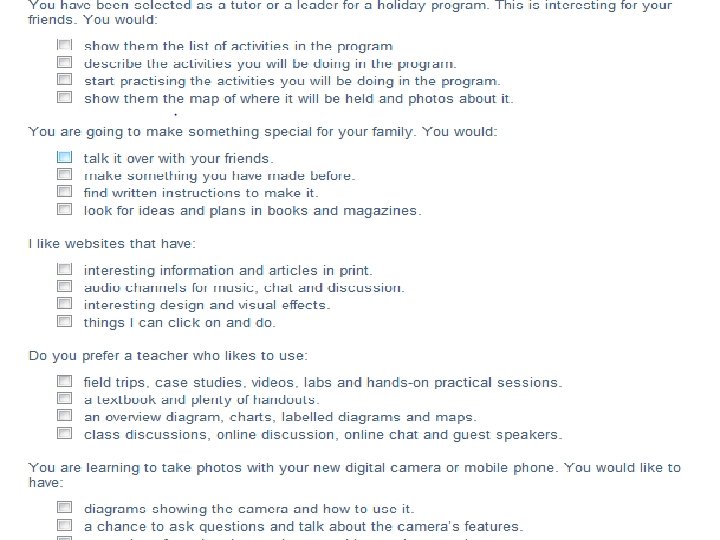
Is it grade level appropriate? • It is difficult for a second or third grader to interpret and rate their feelings on a scale of one to four on a learning survey. – Ex: I am verbally articulate and enjoy participating in discussions or classroom debates. • The wording and some of the language used on the questionnaire seem to advanced. – Ex: Other than price, what would most influence your decision to buy a new non-fiction book? • Young children cannot relate to the scenarios presented. – Ex: You have a problem with your heart. You would prefer that the doctor: (scenarios are presented)
What can you do? • CHANGE IT! – Modify the surveys or questionnaires to fit your students. • For 2 nd grade, consider changing the wording on the questions, possibly shorten the survey, and instead of using a rating scale of 1 -4, use a smiley face rating scale.
Helping Students to Understand Their Learning Style • Introduce the ideas of the three learning styles -teach one lesson, three different ways • Tell students which learning style appears strongest for them • Guide them in choosing options that best fit their individual learning styles
Meeting the Needs of Different Types of Learners in the Classroom • Allow students choices in demonstrating learned material – Orally, making a video, build a model, etc • Provide options for homework assignments – Homework Grid (for options in spelling homework)
Meeting the Needs of Different Types of Learners in the Classroom • Formal and Informal Seating Options • Reading Center that contains rugs, pillows, bean bags, soft furniture • Class Aesthetics: lighting, temperature, background noise, scents • use lamps, turn off one set of overhead lights
• Allow for movement within the classroom • assign words/definitions certain movements • play learning games • provide options for cooperative learning activities
How Do We Identify Student Learning Styles? • http: //www. educationplanner. org/students/s elf-assessments/learning-styles. shtml • http: //www. berghuis. co. nz/abiator/lsitest 1. html • http: //www. literacyworks. org/mi/assessment /findyourstrengths. html • http: //www. ldpride. net/learning-styletest. html
Resources • http: //www. literacyworks. org/mi/practice/ind ex. html • www. ascd. org/publications/educational_lead ership/mar 10/vol 67/num 06/what_helps_atrisk_adolescent_readers%c 2%a 2. aspx • www. learning-styles-online. com/style/visualspatial/
- Slides: 22