
Differentiation by Content Presentation Objectives Participants will know
Differentiation by Content
Presentation Objectives • Participants will know why it is important to differentiate content in the classroom. • Participants will know and be able to identify: Readiness Differentiation Interest Differentiation Learning Profile Differentiation Curriculum Compact Concept-based Teaching
What lessons/activities do you already do in your classroom that would be examples of differentiation?
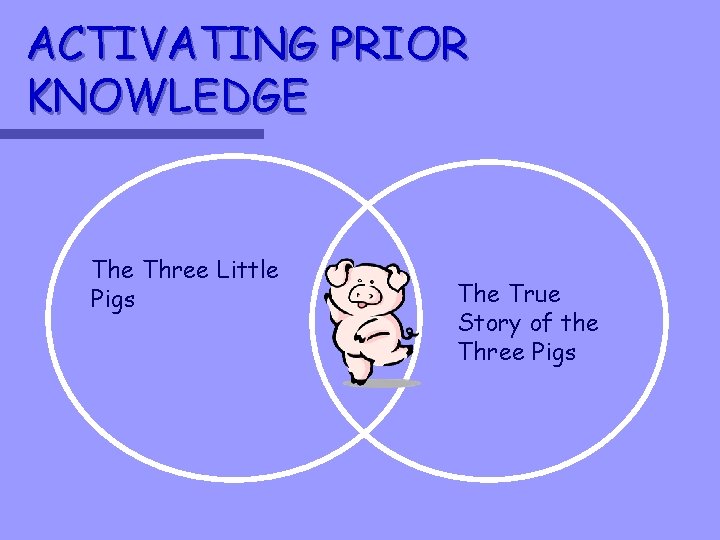
ACTIVATING PRIOR KNOWLEDGE The Three Little Pigs The True Story of the Three Pigs
WORD SPLASH
VOCABULARY WORD SORT Using the vocabulary topics as headings – sort the examples
Readiness Differentiation • Leveling reading materials • Ability level activities choices • Temporary similar ability groups
Interest Differentiation • Self selection of materials • Choice of center activities • Survey of activity preferences
Learning Profile Differentiation • Gender-based preferences • Intelligence preferences • Modality preferences
PUZZLE ACTIVITY
CONCEPT-BASED TEACHING • Understand rather than memorize • Retain meaningful ideas • Real life connections
CURRICULUM COMPACTING • Teacher assesses and documents what the student already knows. • Teacher indicates what the student does not know about the topic or skill and plans how they will learn them. • Teacher plans meaningful and challenging use of the time a student can “buy” because they already know much about the topic skills.
USING VARIOUS TEXT AND RESOUCE MATERIALS • Rather than buying a single text for each child, buy three classroom sets of different texts on three different levels. • Use the internet to supplement materials. • Match the levels of complexity, abstractness, depth, and breadth to abilities.
LEVELED TEXT ACTIVITY n n Read the three articles on computers. Decide which is the low, middle, and high level. Highlight the vocabulary that helps create the levels. Create 2 questions for each article that show different levels of questioning. Brainstorm assessments you could use for these articles.
LEARNING CONTRACTS Use standards – what, how, why to be taught • Identifies work conditions • Establishes criteria for successful completion of quality work • Includes signatures of teacher and student •
MINI-LESSONS Use assessments to identify areas that need re-teaching • Find another strategy to teach a group of students • Meet with another group to extend their understanding or skill •
VARIED SUPPORT SYSTEMS • • • Audio/video recorders Note taking organizers Highlighted print materials Digests of key ideas Peer and adult mentors
Check your knowledge: Answer the following questions by: Thumbs Up – answer A Thumbs Sideways – answer B Thumbs Down – answer C
compacting curriculum: A. Condense intense curriculum into a shorter period of time B. Assess what a student knows, plan to teach what they don’t know, and free time for enrichment C. Convert regular lessons into several shorter lessons
content differentiation: A. Adapt how we give students access to what we want them to learn. B. Adapt projects that students can complete. C. Adapt activities that students can do.
equilizer: A. Like sliding the buttons of a stereo to get the best outcome B. Putting all students on the same playing field C. Making all lessons the same length of time
differentiating by interest: A. Grouping by learning preferences B. Grouping by assessment results C. Grouping by student choice
CONTRACT BRAINSTORMING ACTIVITY Turn to a partner and brainstorm a list of activities that you could have a student contract to do, that would extend and enrich a topic or skill that you teach. Share ideas with the group.
Evaluation Remember to develop a rubrics or evaluation piece for your content. Tests can differentiated by reducing the number of choices, changing the types of questions, or changing the number of matching items.
Reflection Complete the reflection as part of your next steps.
- Slides: 25