
Differentiating Instruction Day 2 Evelyn Blalock Columbus State

Differentiating Instruction Day 2 Evelyn Blalock Columbus State University Evelyn Blalock 1
Check your Group Assignment Evelyn Blalock 2
Agenda for Today n Differentiated Instruction Review ¨ Math Learning Styles ¨ Content, Process, Product n Differentiated Strategy ¨ Menu ¨ Tiered Instruction n Flexible Grouping n Plan of Implementation Activity ¨ Create a Tiered Menu for a Math 3 lesson/objective ¨ How can you use Flexible Grouping in Math 3 Evelyn Blalock 3

4 Math Instructional Styles n 4 Instructional Styles: (6 th grade) all studying area and perimeter n Mastery ¨ ¨ n Apply formulas, compute accurately, reinforce skills through practice EX-apply formulas you already know EX Understanding Discover patterns, make generalizations, develop mathematical explanations ¨ EX-explain the process you used to figure out your answer EX ¨ n Self-expression Think creatively, develop new problems, try our a variety of problem solving approaches ¨ EX-create your own area & perimeter problem using shapes EX ¨ n Interpersonal ¨ ¨ Make personal connections and solve real world problems EX-draw floor plan of your house, How much carpet? EX Evelyn Blalock 4
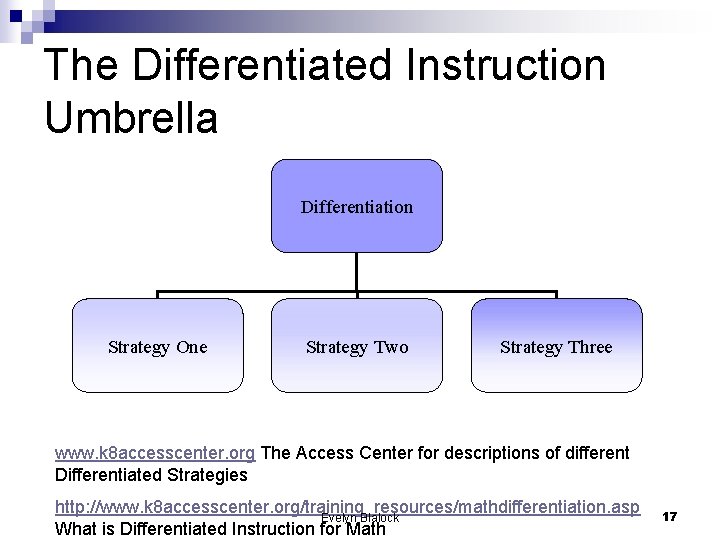
The Differentiated Instruction Umbrella Differentiation Strategy One Strategy Two Strategy Three www. k 8 accesscenter. org The Access Center for descriptions of different Differentiated Strategies http: //www. k 8 accesscenter. org/training_resources/mathdifferentiation. asp Evelyn Blalock What is Differentiated Instruction for Math 5
Learning & Math Instructional Style Activity Individual Activity Learning Objective: Students will investigate the relationships between lines and circles. 1. What Math Instructional Style do you use most often? Find 1 Math Tool to teach Conics ¨ Use the matrix to find a Math Tool ¨ 2. Pick a style that you use least often. Find 1 Math Tool to teach Conics ¨ Use the matrix to find a Math Tool Evelyn Blalock ¨ 6
Learning & Math Instructional Style Activity Group Activity – How to teach content n Share with your Group ¨ Math Style n Tool for preferred Math Instructional Style Tool for least used Math Instructional Expand it ¨ Create a way to use a Math Tool to teach content for any Math Instructional Style not covered ¨ Alter your instructional plans using the Math Tools to use them as a group to differentiate for an entire class Evelyn Blalock 7

Teachers Can Differentiate Content Process Product According to Students’ Readiness Interest Adapted from The Differentiated Classroom: Responding to the Needs. Blalock of All Learners (Tomlinson, 1999) Evelyn Learning Profile 8
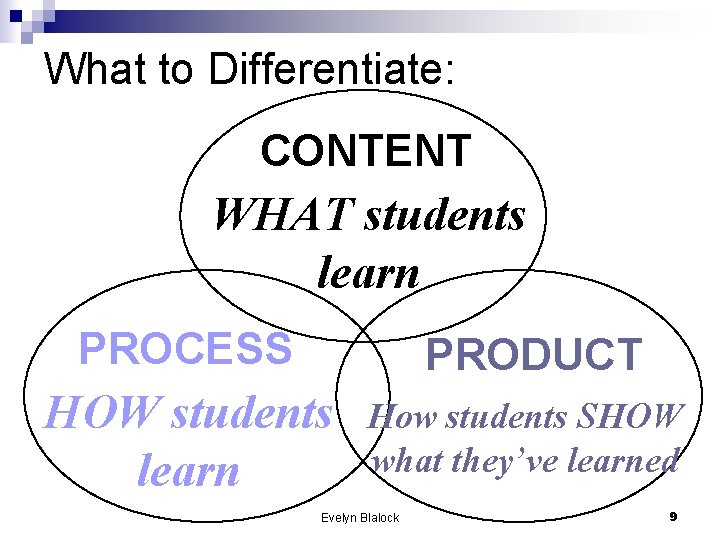
What to Differentiate: CONTENT WHAT students learn PROCESS PRODUCT HOW students learn How students SHOW what they’ve learned Evelyn Blalock 9

Content n Content: What is being taught. ¨ ¨ n differentiate the actual content being presented to students remediate, accelerate, or enrich using basic or more complex resources Examples: ¨ Connecting learning to real life uses ¨ Leveling or Tiering materials; Adjustable Assignments (Gregory & Chapman, p. 71 -76) ¨ Using a variety of instructional materials ¨ Providing choice (Gregory & Chapman, p. 152 -158) ¨ Using selective abandonment ¨ Acceleration, compacting, flexible pacing ¨ (Gregory & Chapman (2007) Differentiated Instructional Strategies: One Size Doesn’t Fit All) Evelyn Blalock 10
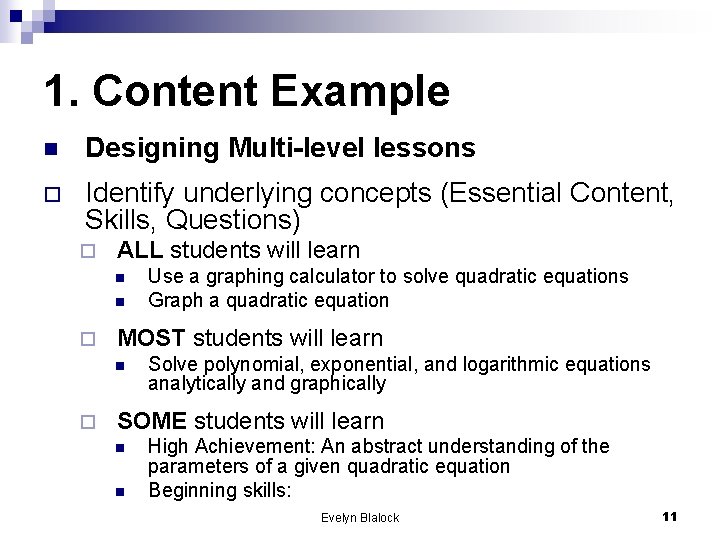
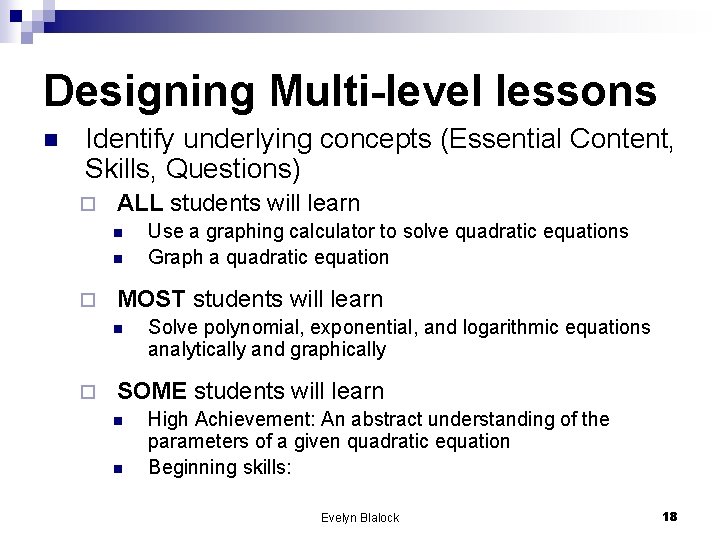
1. Content Example n Designing Multi-level lessons o Identify underlying concepts (Essential Content, Skills, Questions) ¨ ALL students will learn n n ¨ MOST students will learn n ¨ Use a graphing calculator to solve quadratic equations Graph a quadratic equation Solve polynomial, exponential, and logarithmic equations analytically and graphically SOME students will learn n n High Achievement: An abstract understanding of the parameters of a given quadratic equation Beginning skills: Evelyn Blalock 11
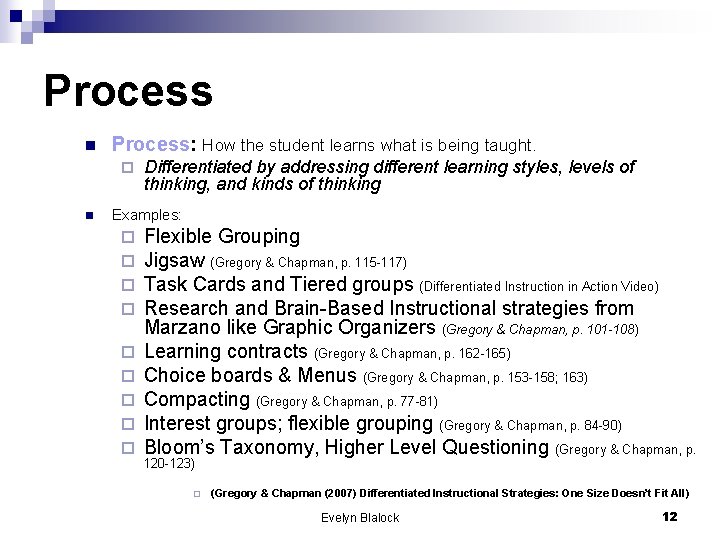
Process n Process: How the student learns what is being taught. ¨ n Differentiated by addressing different learning styles, levels of thinking, and kinds of thinking Examples: ¨ ¨ ¨ ¨ ¨ Flexible Grouping Jigsaw (Gregory & Chapman, p. 115 -117) Task Cards and Tiered groups (Differentiated Instruction in Action Video) Research and Brain-Based Instructional strategies from Marzano like Graphic Organizers (Gregory & Chapman, p. 101 -108) Learning contracts (Gregory & Chapman, p. 162 -165) Choice boards & Menus (Gregory & Chapman, p. 153 -158; 163) Compacting (Gregory & Chapman, p. 77 -81) Interest groups; flexible grouping (Gregory & Chapman, p. 84 -90) Bloom’s Taxonomy, Higher Level Questioning (Gregory & Chapman, p. 120 -123) ¨ (Gregory & Chapman (2007) Differentiated Instructional Strategies: One Size Doesn’t Fit All) Evelyn Blalock 12
2. Process Example n Teach to assure that ALL students can answer the essential question (s) ¨ Has the skills & knowledge needed for products ¨ Using a Variety of teaching methods ¨ To meet the needs of diverse students Varying ability levels and academic performance levels n Variety of student strengths, learning styles, and interests n Evelyn Blalock 13
Product n Product: How the student shows what he or she has learned. ¨ ¨ ¨ n differentiated by addressing different learning styles providing choice in variety different levels of complexity of products Performance tasks Examples (Gregory & Chapman, p. 119) ¨ ¨ ¨ ¨ ¨ Oral presentation Math Log or journal Draw a picture Record findings Play Who Wants to be a Millionaire or Jeopardy Design a brochure for the process Color code a sequence Write a song Make a bar graph and interpret the data Learning Contract (Gregory & Chapman, p. 162 -165) (Gregory & Chapman, 2007 Differentiated Strategies: One Size Doesn’t Fit All) Evelyn Blalock 14
3. Product Example Choice Board Strategy n Multiple Intelligence Choice board (See Gregory & Chapman, 2007, p. 33 -43, 158) n ¨ Leveled/ Tiered /Scaffolded ¨ Choice ¨ Varied learning styles ¨ Includes assessment plan Evelyn Blalock 15
Differentiated Learning Strategies n n n n n Acceleration Curriculum Compacting Flexible Grouping Literature Circles Mentoring Contracting Independent Study Telescoping Inquiry Based Learning n n n n n Evelyn Blalock Post-holing Learning Centers Tiered Instruction Tic-Tac-Toe Choices Differentiated Assessment Brain Compatible Learning Collaborative Learning Project Based Learning Creative Problem Solving 16
The Differentiated Instruction Umbrella Differentiation Strategy One Strategy Two Strategy Three www. k 8 accesscenter. org The Access Center for descriptions of different Differentiated Strategies http: //www. k 8 accesscenter. org/training_resources/mathdifferentiation. asp Evelyn Blalock What is Differentiated Instruction for Math 17
Designing Multi-level lessons n Identify underlying concepts (Essential Content, Skills, Questions) ¨ ALL students will learn n n ¨ MOST students will learn n ¨ Use a graphing calculator to solve quadratic equations Graph a quadratic equation Solve polynomial, exponential, and logarithmic equations analytically and graphically SOME students will learn n n High Achievement: An abstract understanding of the parameters of a given quadratic equation Beginning skills: Evelyn Blalock 18
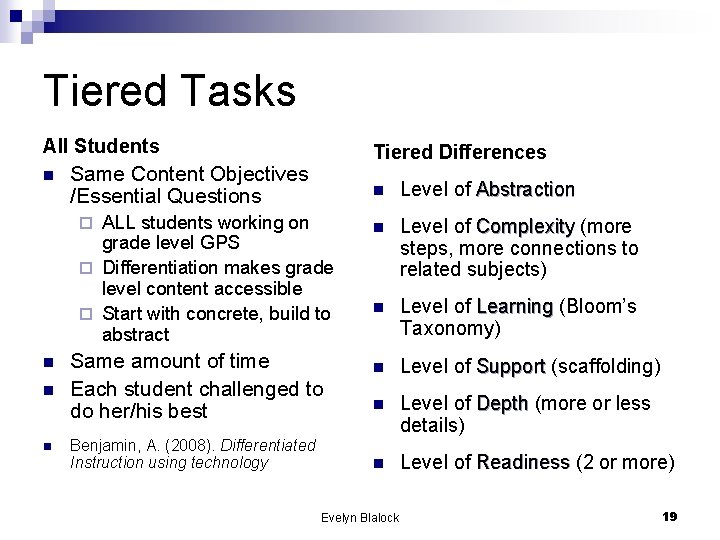
Tiered Tasks All Students n Tiered Differences Same Content Objectives /Essential Questions ALL students working on grade level GPS ¨ Differentiation makes grade level content accessible ¨ Start with concrete, build to abstract ¨ n n n Same amount of time Each student challenged to do her/his best Benjamin, A. (2008). Differentiated Instruction using technology n Level of Abstraction n Level of Complexity (more steps, more connections to related subjects) n Level of Learning (Bloom’s Taxonomy) n Level of Support (scaffolding) n Level of Depth (more or less details) n Level of Readiness (2 or more) Evelyn Blalock 19
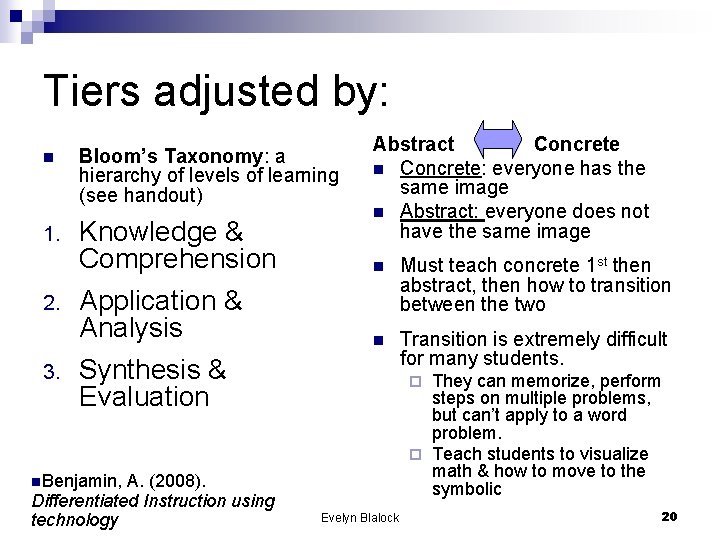
Tiers adjusted by: n Bloom’s Taxonomy: a hierarchy of levels of learning (see handout) 1. Knowledge & Comprehension Application & Analysis Synthesis & Evaluation 2. 3. A. (2008). Differentiated Instruction using technology Abstract Concrete n Concrete: everyone has the same image n Abstract: everyone does not have the same image n Must teach concrete 1 st then abstract, then how to transition between the two n Transition is extremely difficult for many students. They can memorize, perform steps on multiple problems, but can’t apply to a word problem. ¨ Teach students to visualize math & how to move to the symbolic ¨ n. Benjamin, Evelyn Blalock 20
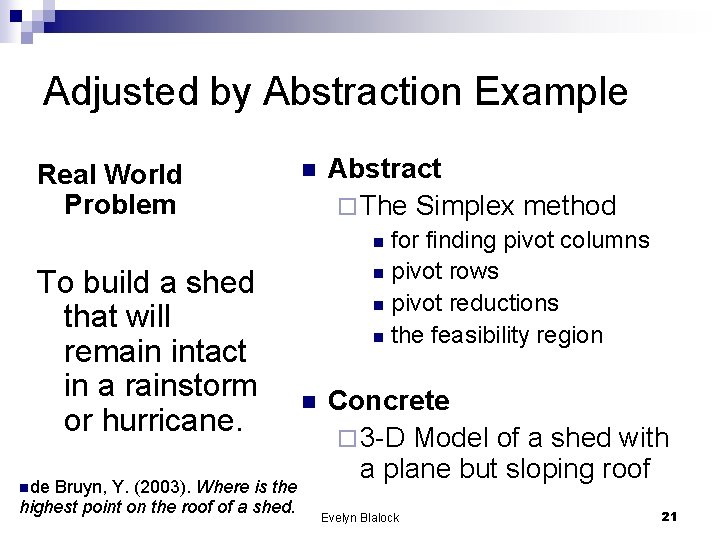
Adjusted by Abstraction Example Real World Problem n Abstract ¨ The Simplex method for finding pivot columns n pivot rows n pivot reductions n the feasibility region n To build a shed that will remain intact in a rainstorm or hurricane. nde Bruyn, Y. (2003). Where is the highest point on the roof of a shed. n Concrete ¨ 3 -D Model of a shed with a plane but sloping roof Evelyn Blalock 21
High Interest Activities n Applying the abstract n Real-world connections n Allow students to practice n Example ¨ Building a shed (Simplex method for feasibility region) ¨ Putting carpet in the den (Area) ¨ NASA Satellite Activity (Quadratic Equations) Evelyn Blalock 22
Think-Pair-Share n Think of at least 3 ways you currently differentiate; Think of at least 1 way you Tier content ¨ Content ¨ Process ¨ Product n n Pair Share with Group Evelyn Blalock 23

The Differentiated Instruction Umbrella Differentiation Strategy One Strategy Two Strategy Three www. k 8 accesscenter. org The Access Center for descriptions of different Differentiated Strategies http: //www. k 8 accesscenter. org/training_resources/mathdifferentiation. asp Evelyn Blalock What is Differentiated Instruction for Math 24
Choice Board Strategy, p. 215 (Content + Process + Product) n Organizers for curriculum ¨ Variety of activities (types of product) of interests & learning styles (ways to process) ¨ Addressing different topics by interest (content) ¨ Use for choices within a unit; choices within class routine n Choose activities & products to learn skill or content n Choose more than one project/product n Flexible Grouping: working alone, pair, small & whole group Evelyn Blalock 25
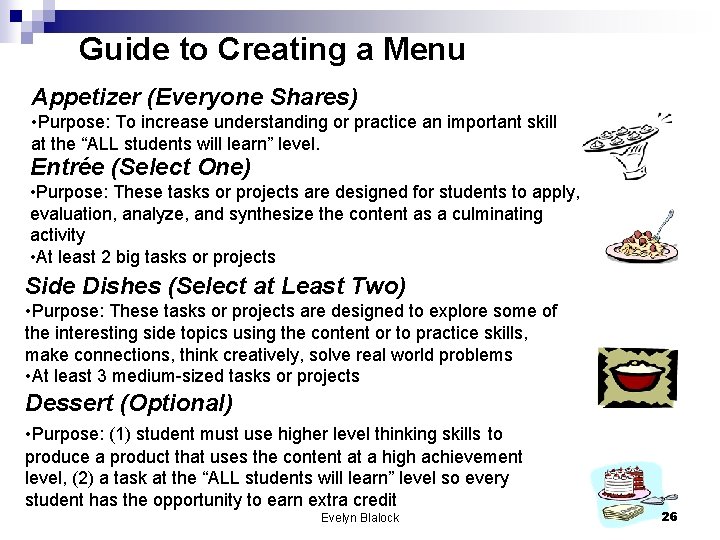
Guide to Creating a Menu Appetizer (Everyone Shares) • Purpose: To increase understanding or practice an important skill at the “ALL students will learn” level. Entrée (Select One) • Purpose: These tasks or projects are designed for students to apply, evaluation, analyze, and synthesize the content as a culminating activity • At least 2 big tasks or projects Side Dishes (Select at Least Two) • Purpose: These tasks or projects are designed to explore some of the interesting side topics using the content or to practice skills, make connections, think creatively, solve real world problems • At least 3 medium-sized tasks or projects Dessert (Optional) • Purpose: (1) student must use higher level thinking skills to produce a product that uses the content at a high achievement level, (2) a task at the “ALL students will learn” level so every student has the opportunity to earn extra credit Evelyn Blalock 26
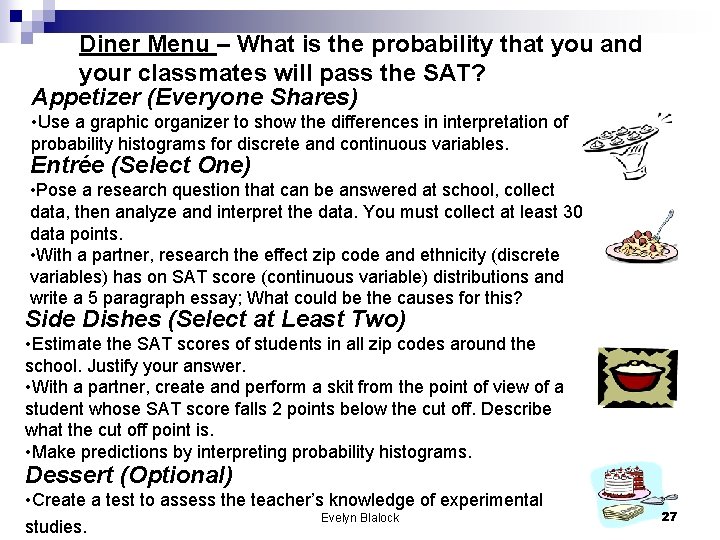
Diner Menu – What is the probability that you and your classmates will pass the SAT? Appetizer (Everyone Shares) • Use a graphic organizer to show the differences in interpretation of probability histograms for discrete and continuous variables. Entrée (Select One) • Pose a research question that can be answered at school, collect data, then analyze and interpret the data. You must collect at least 30 data points. • With a partner, research the effect zip code and ethnicity (discrete variables) has on SAT score (continuous variable) distributions and write a 5 paragraph essay; What could be the causes for this? Side Dishes (Select at Least Two) • Estimate the SAT scores of students in all zip codes around the school. Justify your answer. • With a partner, create and perform a skit from the point of view of a student whose SAT score falls 2 points below the cut off. Describe what the cut off point is. • Make predictions by interpreting probability histograms. Dessert (Optional) • Create a test to assess the teacher’s knowledge of experimental Evelyn Blalock studies. 27
Activity: Create a Menu n Choose an Objective from Math III ¨ Interest n Groups (Unit 1, 2, 3, 4, 5, 6) Create a Choice Board Menu for students ¨ Choice, some ¨ Supports a variety of learning styles, strengths, and preferences of the Teachers in this group ¨ Addresses the needs of learners at a variety of readiness levels, including students with disabilities 28 Evelyn Blalock
Flexible Grouping n Purpose: ¨ To increase learning (Piaget, Vygotsky, & Research-based Best Practice) ¨ To facilitate students with disabilities belonging and being accepted as equal members of the class community n Flexible, Heterogeneous Grouping (TAPS) ¨ Total group: Everyone should know ¨ Working Alone: problem-solve in their own way ¨ Partner (Pairs): generate more ideas, show each other the solutions ¨ Cooperative/Small group: groups ideas & talents to accelerate learning Evelyn Blalock 29
Assigning Students to Groups Heterogeneously n Random ¨ ¨ n Playing cards Pull a string Mixed by ability or learning style ¨ By academic performance n ¨ ¨ n The Wheel: Above grade level, at grade level, below grade level (Gregory & Chapman, p. 88) By Learning style or multiple intelligence By Math Learning Style Change groups periodically, i. e. within one class period, once a month Homogenously n Interests n Readiness n Knowledge about a topic Evelyn Blalock 30
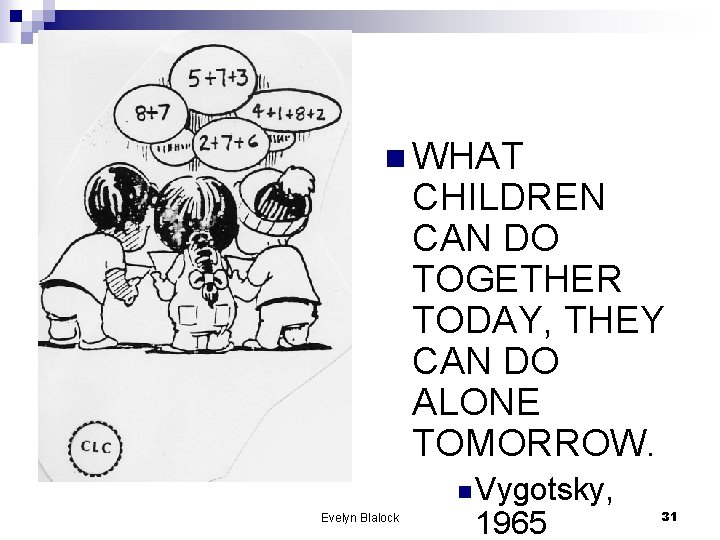
n WHAT CHILDREN CAN DO TOGETHER TODAY, THEY CAN DO ALONE TOMORROW. n Vygotsky, Evelyn Blalock 1965 31
Managing Groups using Task Cards n VIDEO- Flexible Grouping & Tiered Instruction ¨ Flexible Grouping Video: Quick Fire Challenge in History class n Heterogeneous by mixing learning styles n Use of roles n ¨ Flexible grouping n Readiness levels & interests (Mid: Respectful Tasks intro & Foreign Language class example) ¨ Tiered by Evelyn readiness 32 Blalock
Think-Pair-Share n Individually – Think How do you currently use flexible grouping in your classroom? ¨ What improvements or changes would you make as you continue to support flexible grouping in your classroom? ¨ n Pair to discuss and share uses and improvements of flexible grouping n Share strategies with group at your table Write a list of uses for flexible grouping in Math III classrooms ¨ Add Flexible Grouping to your Menu or Tiered unit ¨ ¨ Add list to your Exit Ticket Evelyn Blalock 33

Exit Ticket n Examples of Differentiating ¨ Content ¨ Process ¨ Product n Post Menus to Ning ¨ Groups can post bursts of genius that may come in the middle of the night. Evelyn Blalock 34
- Slides: 34