
Differentiating Curriculum using the Autonomous Leaner Model George

- Slides: 17
Differentiating Curriculum using the Autonomous Leaner Model George Betts & Cindy Sheets
The Five Dimensions of the Autonomous Learner Model SE ALM M IN A RS L UA T IVID MEN IND ELOP DEV IN-D STU EPTH DY ORIENTATION C I R N E T N E M H
Orientation • • Understanding giftedness Group development Self/personal development Classroom & Community Opportunities v Imbed activities, skills and content that focus on affective aspects of the model, rather than teaching them in isolation.
Individual Development • Learning Skills • Technology • College/Career • Organizational • Productivity
Enrichment • Exploration • Investigation • Cultural Activities • Service • Adventure Trips
Seminars • Futuristic • Problematic • Controversial • General Interest • Advanced Knowledge
In-Depth Study • Student differentiated study • Facilitated by the teacher or mentor
Differentiation • “Differentiation is the adjustment of the teaching process according to the learning needs of the pupils. ” • • • – – A whole class Groups within the class Individuals by task: setting different tasks for pupils of different ability; by outcome: setting open-ended tasks, allowing pupil response at different levels, – by support: giving more help or less to certain pupils within the group Ø Content Ø Process Ø Product Ø Learning Environment
Curriculum • The planned interaction of pupils with instructional content, materials, resources, and processes for evaluating the attainment of educational objectives
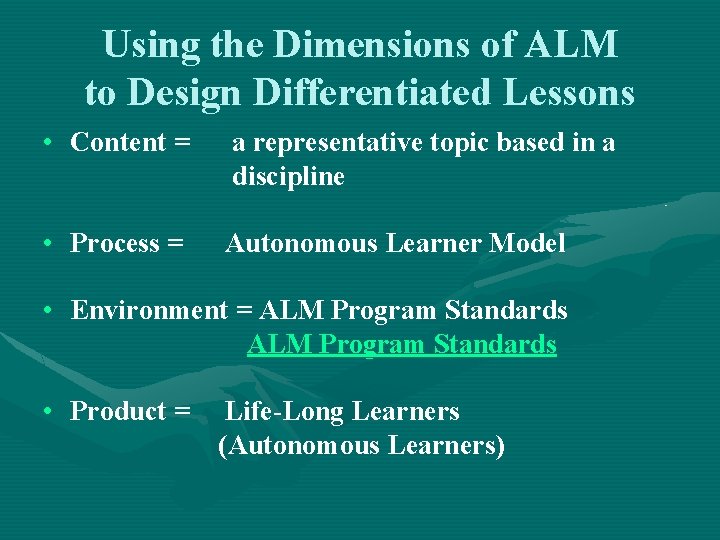
Using the Dimensions of ALM to Design Differentiated Lessons • Content = a representative topic based in a discipline • Process = Autonomous Learner Model • Environment = ALM Program Standards • Product = Life-Long Learners (Autonomous Learners)
Put the Horse before the Cart. . Before you can differentiate effectively: • You need to have quality core curriculum • You must agree on the “big ideas” and lessons students need to know, understand, and be able to do • You must understand the principles and concepts at the heart of the learning you expect
Curriculum for Gifted Students • Is it differentiated? • Is it adapted, modified, or a replacement of general education curricula? • Is the pace a match to gifted learners? • Are there opportunities to extend or go beyond the basic unit or curriculum? • Are there opportunities to explore personal areas of interest, or to highlight personal strength areas? • Does it demand sufficient depth and higher level thinking – not based just on “factual” learning?
What About the Affective Domain? • Creativity – Creative production – Creative problem solving • Understanding of Self – Intrapersonal skills • Social Skills and Interactions – Intrapersonal skills
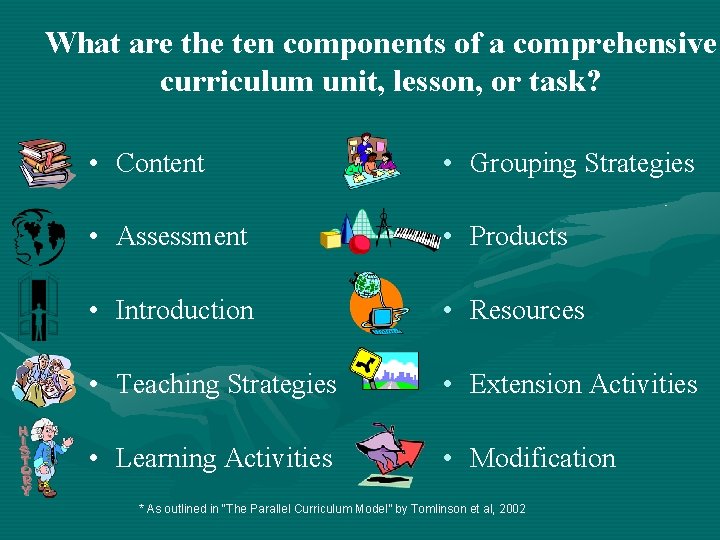
What are the ten components of a comprehensive curriculum unit, lesson, or task? • Content • Grouping Strategies • Assessment • Products • Introduction • Resources • Teaching Strategies • Extension Activities • Learning Activities • Modification * As outlined in “The Parallel Curriculum Model” by Tomlinson et al, 2002
Curriculum Components/ALM • Use Dimensions of the ALM and Ten elements of quality curriculum to develop the structure of the curriculum unit • ALM and Curriculum Components
Examples • Endangered Species • Westward Movement (Pioneers) • Creative Writing • Explorers • Template
Resources The Parallel Curriculum: A Design to Develop High Potential and Challenge High-Ability Learners, Carol Tomlinson, et al, Corwin Press, 2002 Understanding by Design, Grant Wiggins and Jay Mc. Tighe, ASCD 1998 Concept-Based Curriculum and Instruction: Teaching Beyond the Facts, by H. Lynn Erickson, Corwin Press, 2002 The Multiple Menu Model: A Practical Guide for Developing Differentiated Curriculum, by Joseph Renzulli, Jann Leppien, and Tom Hays, Creative Learning Press, 2000 Content-Based Curriculum for High Ability Learners, by Joyce Van-Tassel Baska (with Catherine A. Little) 2002 The Autonomous Learner Model, by George Betts and Jolene Kircher, Alps Publishing, 1999