
Differentiated Reading Instruction MODULE 3 Power Point Slides
- Slides: 21
Differentiated Reading Instruction MODULE 3 Power. Point Slides
No part of this publication may be reprinted, reproduced, stored in a retrieval system, or transmitted in any form without the prior written permission of PLS 3 rd Learning. Direct all such inquires to: permissions@pls 3 rdlearning. com
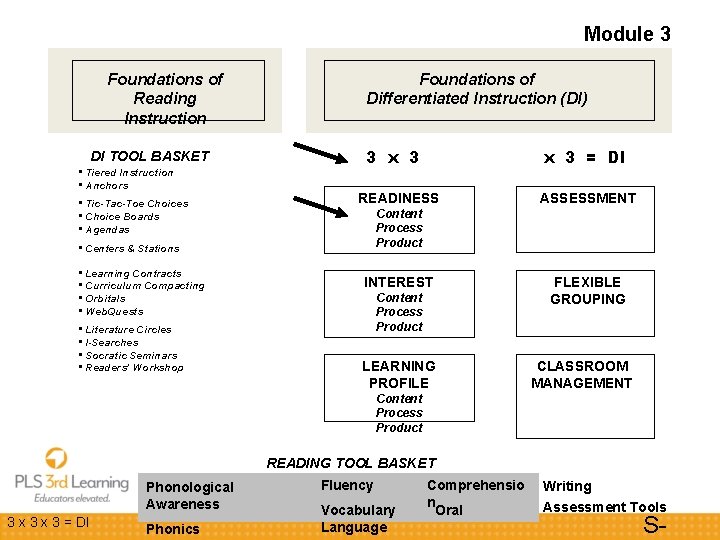
Module 3 Foundations of Reading Instruction DI TOOL BASKET • Tiered Instruction • Anchors • Tic-Tac-Toe Choices • Choice Boards • Agendas Foundations of Differentiated Instruction (DI) 3 x 3 READINESS • Literature Circles • I-Searches • Socratic Seminars • Readers’ Workshop ASSESSMENT Content Process Product • Centers & Stations • Learning Contracts • Curriculum Compacting • Orbitals • Web. Quests x 3 = DI INTEREST Content Process Product LEARNING PROFILE FLEXIBLE GROUPING CLASSROOM MANAGEMENT Content Process Product READING TOOL BASKET Phonological Awareness 3 x 3 = DI Phonics Fluency Vocabulary Language Comprehensio n Oral Writing Assessment Tools S-
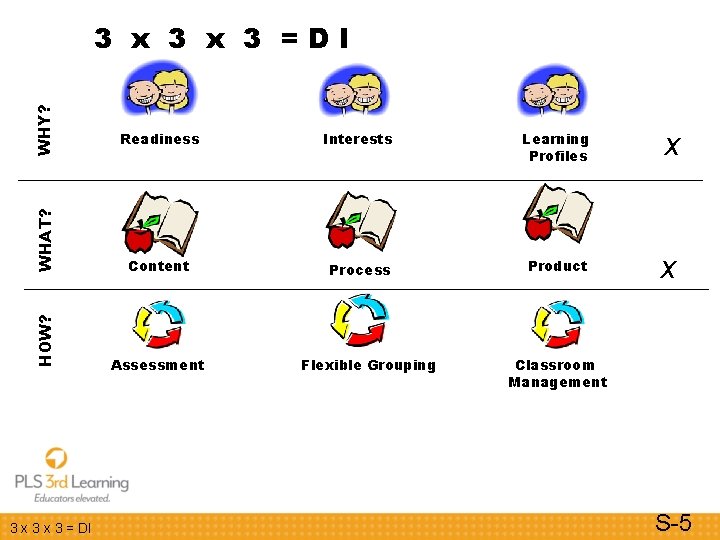
WHY? Interests Learning Profiles x Content Process Product x HOW? Readiness WHAT? 3 x 3 =DI 3 x 3 = DI Assessment Flexible Grouping Classroom Management S-5
Why? Readiness A task that’s a good match for student readiness extends that student’s knowledge, understanding, and skills a bit beyond what the student can do independently. From How to Differentiate Instruction in Mixed. Ability Classrooms – 2 nd Edition (p. 45) by Carol Ann Tomlinson. Alexandria, VA: ASCD © 2001. Used with permission. 3 x 3 = DI S-6
Interest-based differentiation is a key to engaging and motivating students. “If a student has a spark of curiosity about a topic, learning is more likely. Similarly, a sense of choice about what or how we learn is also empowering. ” Why? Interests From How to Differentiate Instruction in Mixed. Ability Classrooms – 2 nd Edition (p. 52) by Carol Ann Tomlinson. Alexandria, VA: ASCD © 2001. Used with permission. 3 x 3 = DI S-7
Why? “The goals of learning profile differentiation are to help individual learners understand modes of learning that work best for them and to offer those options so that each learner finds a good learning fit in the classroom. ” From How to Differentiate Instruction in Mixed-Ability Learning Profile Classrooms – 2 nd Edition (p. 60) by Carol Ann Tomlinson. Alexandria, VA: ASCD © 2001. Used with permission. 3 x 3 = DI S-8
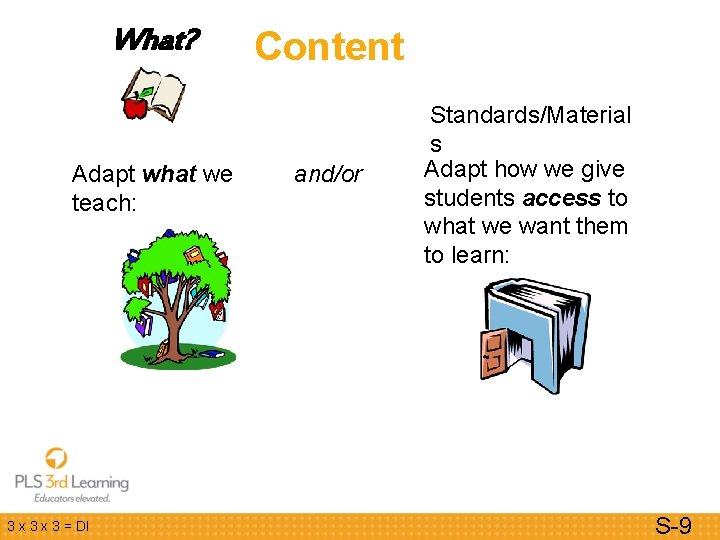
What? Adapt what we teach: 3 x 3 = DI Content and/or Standards/Material s Adapt how we give students access to what we want them to learn: S-9
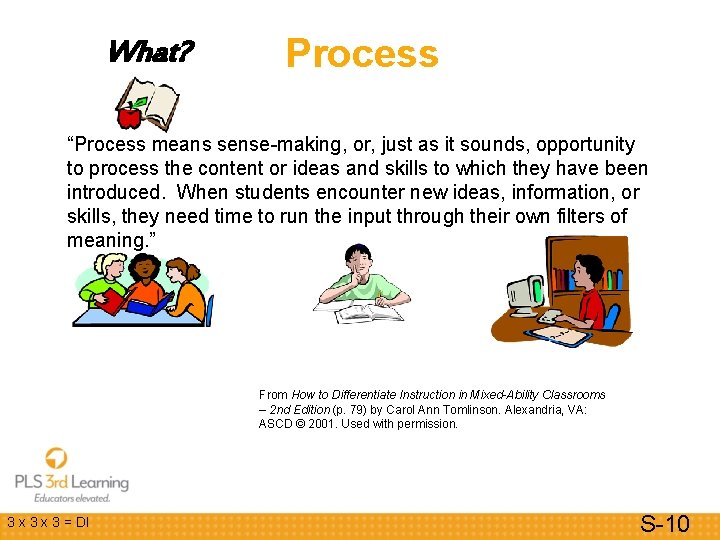
What? Process “Process means sense-making, or, just as it sounds, opportunity to process the content or ideas and skills to which they have been introduced. When students encounter new ideas, information, or skills, they need time to run the input through their own filters of meaning. ” From How to Differentiate Instruction in Mixed-Ability Classrooms – 2 nd Edition (p. 79) by Carol Ann Tomlinson. Alexandria, VA: ASCD © 2001. Used with permission. 3 x 3 = DI S-10
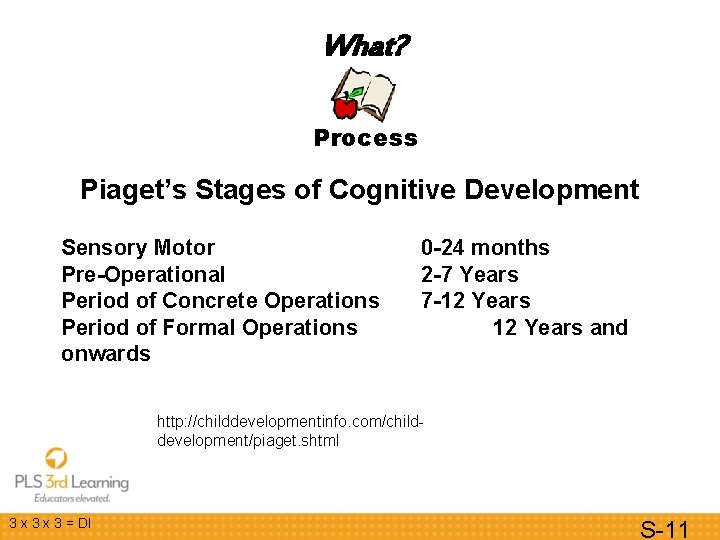
What? Process Piaget’s Stages of Cognitive Development Sensory Motor Pre-Operational Period of Concrete Operations Period of Formal Operations onwards 0 -24 months 2 -7 Years 7 -12 Years and http: //childdevelopmentinfo. com/childdevelopment/piaget. shtml 3 x 3 = DI S-11
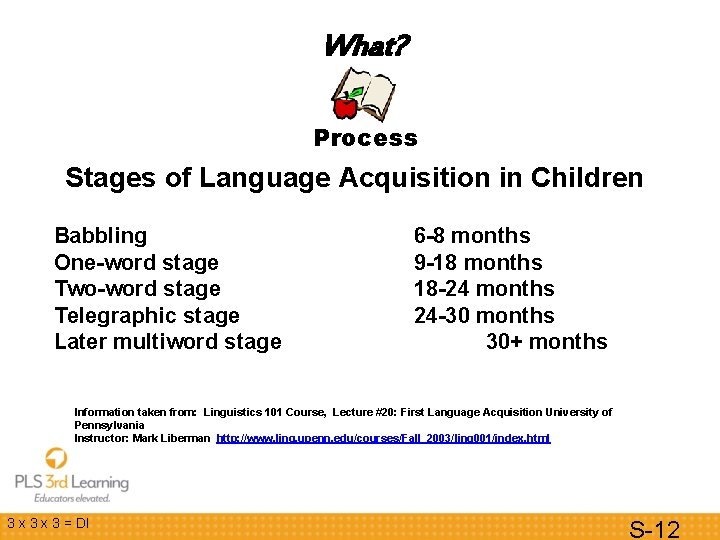
What? Process Stages of Language Acquisition in Children Babbling One-word stage Two-word stage Telegraphic stage Later multiword stage 6 -8 months 9 -18 months 18 -24 months 24 -30 months 30+ months Information taken from: Linguistics 101 Course, Lecture #20: First Language Acquisition University of Pennsylvania Instructor: Mark Liberman http: //www. ling. upenn. edu/courses/Fall_2003/ling 001/index. html 3 x 3 = DI S-12
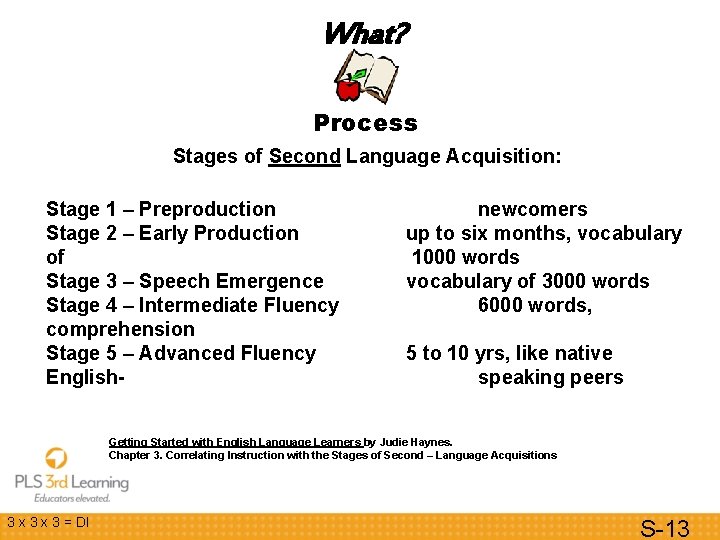
What? Process Stages of Second Language Acquisition: Stage 1 – Preproduction Stage 2 – Early Production of Stage 3 – Speech Emergence Stage 4 – Intermediate Fluency comprehension Stage 5 – Advanced Fluency English- newcomers up to six months, vocabulary 1000 words vocabulary of 3000 words 6000 words, 5 to 10 yrs, like native speaking peers Getting Started with English Language Learners by Judie Haynes. Chapter 3. Correlating Instruction with the Stages of Second – Language Acquisitions 3 x 3 = DI S-13
What? Product “Unlike a sense-making activity, which is typically short and focuses on one, or just a few, key understandings and skills, a product is a long-term endeavor. Product assignments should help students – individually or in groups – rethink, use, and extend what they have learned over a long period of time. ” From How to Differentiate Instruction in Mixed-Ability Classrooms – 2 nd Edition (p. 85) by Carol Ann Tomlinson. Alexandria, VA: ASCD © 2001. Used with permission. 3 x 3 = DI S-14
How? Assessment In a differentiated classroom, assessment is ongoing and diagnostic. Its goal is to provide teachers day-today data on students’ readiness, interests, and learning profile, . . . assessment is today’s means of understanding how to modify tomorrow’s instruction. Adapted from The Differentiated Classroom: Responding to the Needs of All Learners (p. 10) by Carol Ann Tomlinson. Alexandria, VA: ASCD © 1999. Used with permission. The Association for Supervision and Curriculum Development is a worldwide community of educators advocating sound policies and sharing best practices to achieve the success of each learner. To learn more, visit ASCD at www. ascd. org. 3 x 3 = DI S-15
How? Flexible Grouping A hallmark of an effective differentiated classroom. . . is the use of flexible grouping, which accommodates students who are strong in some areas and weaker in others. “Fluid” is a good word to describe assignment of students to groups in a [DI] classroom. From How to Differentiate Instruction in Mixed-Ability Classrooms – 2 nd Edition (p. 3) by Carol Ann Tomlinson, Alexandria, VA: ASCD © 2001. Used with permission. 3 x 3 = DI S-16
How? Classroom Management The same skills that help teachers succeed in the complex environment of a classroom can lead them toward success in a differentiated classroom environment as well. Many teachers do not appreciate how skilled they [already] are at attending to multiple signals and juggling a variety of roles. From How to Differentiate Instruction in Mixed-Ability Classrooms – 2 nd Edition (p. 32) by Carol Ann Tomlinson, Alexandria, VA: ASCD © 2001. Used with permission. 3 x 3 = DI S-17
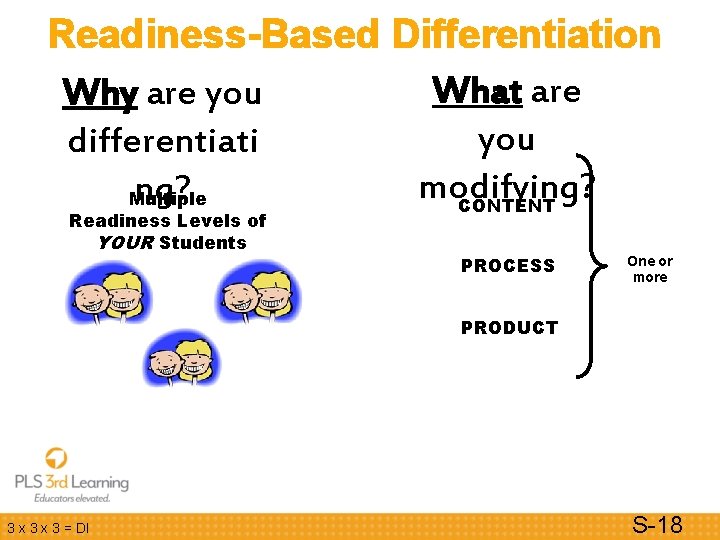
Readiness-Based Differentiation What are Why are you differentiati modifying? Multiple CONTENT Readiness Levels of YOUR Students PROCESS One or more PRODUCT 3 x 3 = DI S-18
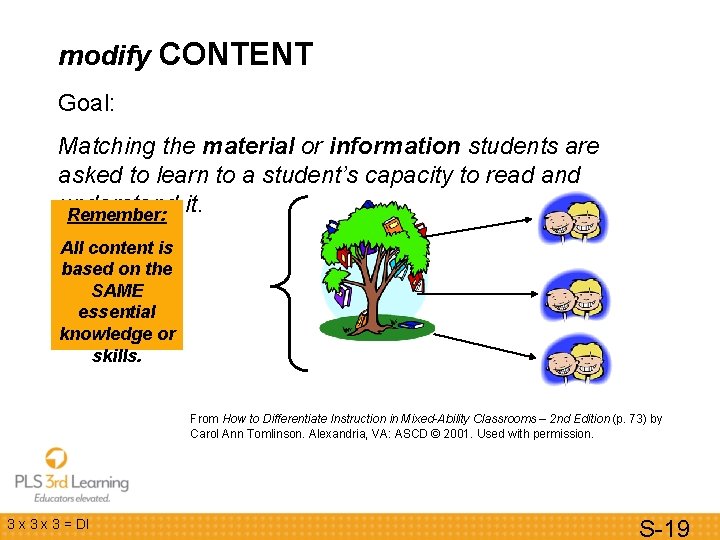
modify CONTENT Goal: Matching the material or information students are asked to learn to a student’s capacity to read and understand it. Remember: All content is based on the SAME essential knowledge or skills. From How to Differentiate Instruction in Mixed-Ability Classrooms – 2 nd Edition (p. 73) by Carol Ann Tomlinson. Alexandria, VA: ASCD © 2001. Used with permission. 3 x 3 = DI S-19
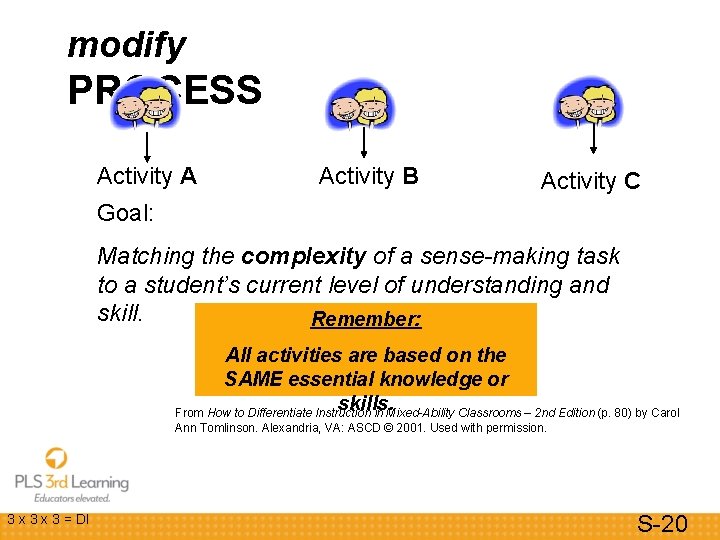
modify PROCESS Activity A Activity B Activity C Goal: Matching the complexity of a sense-making task to a student’s current level of understanding and skill. Remember: All activities are based on the SAME essential knowledge or skills. From How to Differentiate Instruction in Mixed-Ability Classrooms – 2 nd Edition (p. 80) by Carol Ann Tomlinson. Alexandria, VA: ASCD © 2001. Used with permission. 3 x 3 = DI S-20
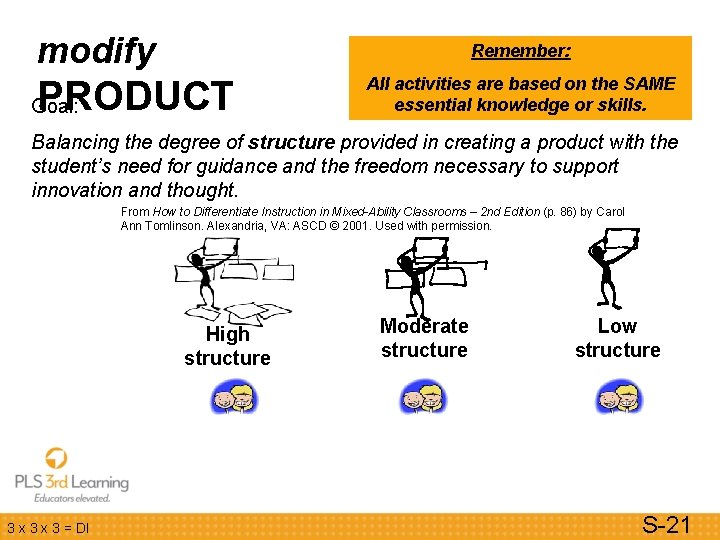
modify Remember: PRODUCT Goal: All activities are based on the SAME essential knowledge or skills. Balancing the degree of structure provided in creating a product with the student’s need for guidance and the freedom necessary to support innovation and thought. From How to Differentiate Instruction in Mixed-Ability Classrooms – 2 nd Edition (p. 86) by Carol Ann Tomlinson. Alexandria, VA: ASCD © 2001. Used with permission. High structure 3 x 3 = DI Moderate structure Low structure S-21
Differentiated Reading Instruction Power. Point Presentation Module 3 Diana Brown 352 -394 -4411 dbrown@pls 3 rdlearning. com Power. Point Presentation by: Lawanna Martinec © 2013 PLS 3 rd Learning