
Differentiated learning Stretch and challenge at every level
- Slides: 16
Differentiated learning… Stretch and challenge at every level Slides available via padlet. com: bqjbf 5 nwphdq
Alternative title: Differentiation – is that even still a thing?
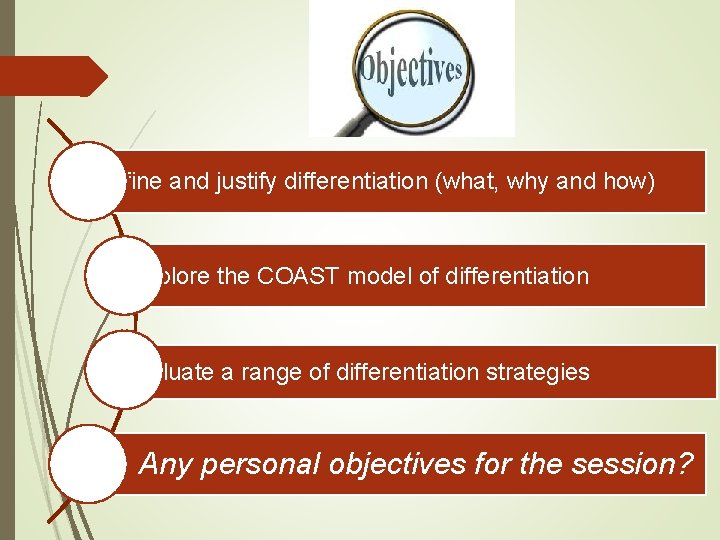
Define and justify differentiation (what, why and how) Explore the COAST model of differentiation Evaluate a range of differentiation strategies Any personal objectives for the session?
Task 1: Starting points What do you understand by differentiation? Write a short definition Why should we do it? Compare and discuss with a partner.
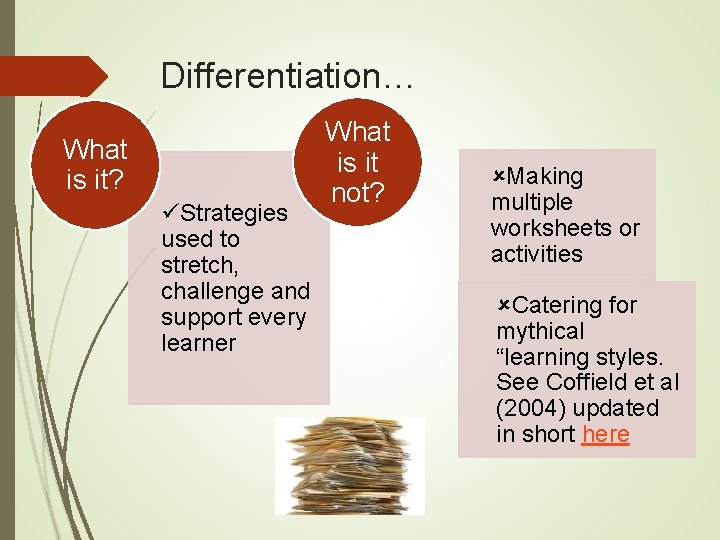
Differentiation… What is it? Strategies used to stretch, challenge and support every learner What is it not? Making multiple worksheets or activities Catering for mythical “learning styles. See Coffield et al (2004) updated in short here
Is it still a thing and if so, why do it? Differentiation is no longer explicitly mentioned in the Ofsted handbook(2016). ‘…inspire and challenge all learners and meet their different needs, including the most able and the most disadvantaged, …deliver learning appropriate to learners of all abilities, …enable all learners to make good progress …are aware of and plan for individual learners’ diverse needs in teaching or training sessions and provide effective support’
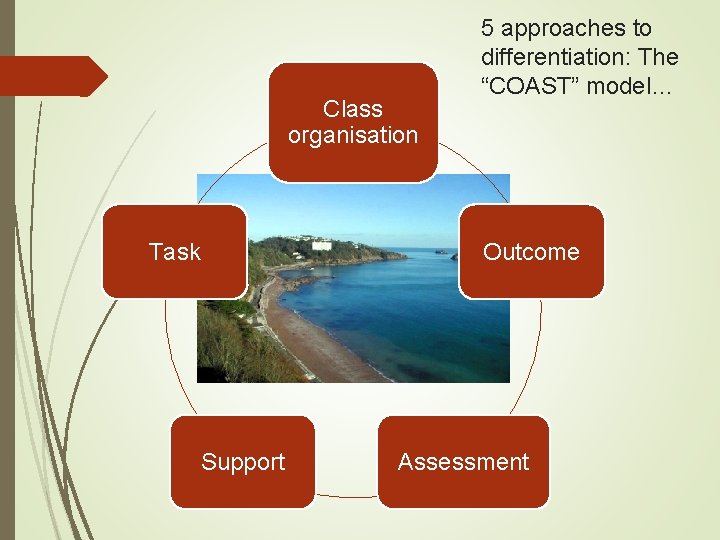
Class organisation Task 5 approaches to differentiation: The “COAST” model… Outcome Support Assessment
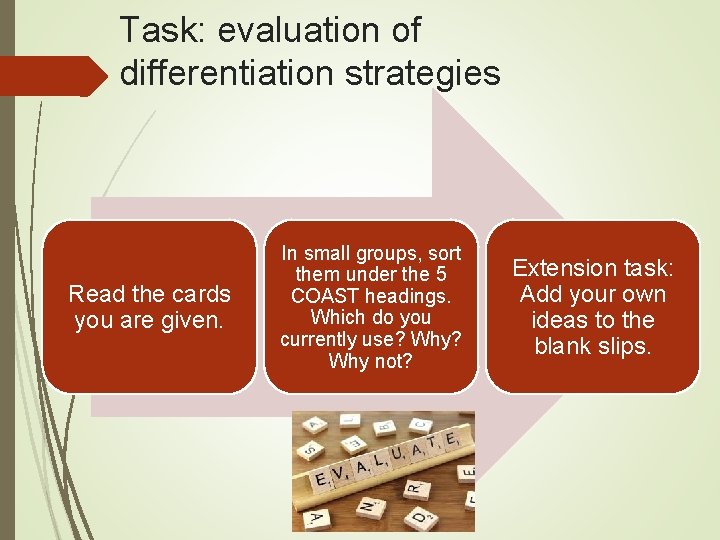
Task: evaluation of differentiation strategies Read the cards you are given. In small groups, sort them under the 5 COAST headings. Which do you currently use? Why? Why not? Extension task: Add your own ideas to the blank slips.
Key to task: Differentiation by class organisation Mix up learners into similar level pairs/groups Mix up learners into different level pairs/groups “Buddy up” learners to develop e. g. writing skills. Try to make this reciprocal if possible. Use peer tutoring/checking. Learners discuss/read answers in pairs before answering or submitting work.
Key: Differentiation by outcome Learners set themselves individual targets at the outset and review at the end Maximum/minimum objectives: Learners must…should…could… Allow a task to be performed via different media, ie learners produce a poster, make a recording, write an essay…Not necessarily catering for their preference here. Devise group tasks and projects with clearly defined roles and assessment methods
Key: Differentiation by assessment Use the “think, pair, share” model to encourage self and peer assessment Give personalised feedback based on individual learners’ previous work, to encourage them to compete against themselves. Graded questions, i. e. pitch more challenging questions to higher level learners Build in regular progress checks for all learners Plan for flexible plenaries, e. g. summarise the lesson in 3 sentences, 2 pictures and/or 1 word
Key: Differentiation by support Circulate constantly whilst learners are working independently so as to support/stretch individuals where needed. Create “crib sheets”, e. g. clues/answers at the bottom of a folded over worksheet or answers which can be accessed via Moodle once a task has been completed. Use writing models and/or frames for learners who need help structuring their work Enlist the help of curriculum support assistants – they often know more than you do about this topic! Send learner “scouts” to support peers once they have finished a task.
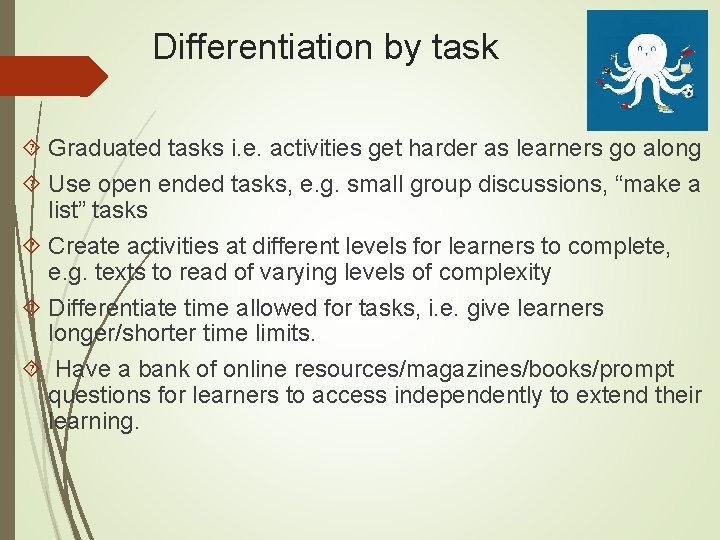
Differentiation by task Graduated tasks i. e. activities get harder as learners go along Use open ended tasks, e. g. small group discussions, “make a list” tasks Create activities at different levels for learners to complete, e. g. texts to read of varying levels of complexity Differentiate time allowed for tasks, i. e. give learners longer/shorter time limits. Have a bank of online resources/magazines/books/prompt questions for learners to access independently to extend their learning.
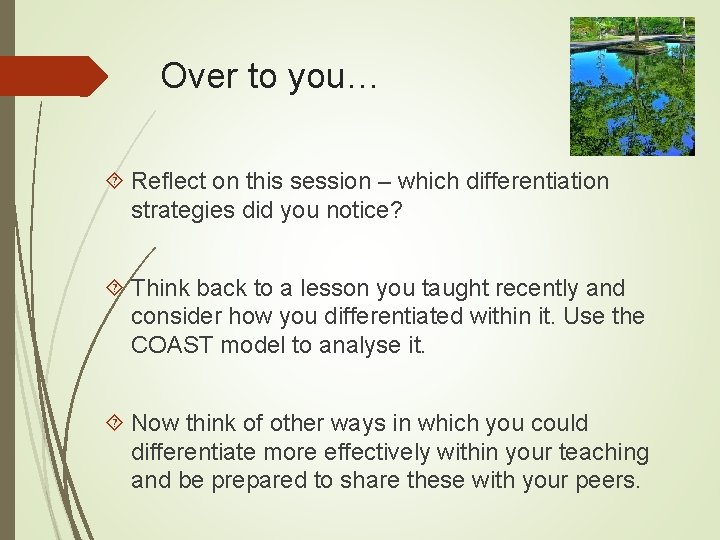
Over to you… Reflect on this session – which differentiation strategies did you notice? Think back to a lesson you taught recently and consider how you differentiated within it. Use the COAST model to analyse it. Now think of other ways in which you could differentiate more effectively within your teaching and be prepared to share these with your peers.
Define and justify differentiation (what, why and how) Explore the COAST model of differentiation Evaluate a range of differentiation strategies Any personal objectives for the session?
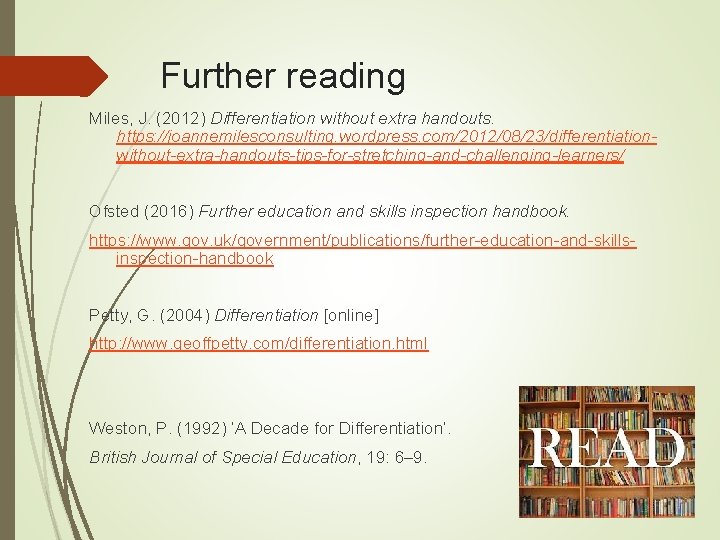
Further reading Miles, J. (2012) Differentiation without extra handouts. https: //joannemilesconsulting. wordpress. com/2012/08/23/differentiationwithout-extra-handouts-tips-for-stretching-and-challenging-learners/ Ofsted (2016) Further education and skills inspection handbook. https: //www. gov. uk/government/publications/further-education-and-skillsinspection-handbook Petty, G. (2004) Differentiation [online] http: //www. geoffpetty. com/differentiation. html Weston, P. (1992) ‘A Decade for Differentiation’. British Journal of Special Education, 19: 6– 9.