
DIFFERENTIATED INSTRUCTION STRATEGIES Enrichment for Advanced Learners Presented

- Slides: 31
DIFFERENTIATED INSTRUCTION STRATEGIES Enrichment for Advanced Learners Presented by Your Gifted Services Team
Your Gifted Services/ Project Excel Team Asst. Superintendent Walter Davis – Director of Teaching and Learning Karen Rumley – District Coordinator, High School GIS Kathryn Craig – Middle School GIS Cheryl Beisel – GIS: Pull-out housed at Lincoln, and Enrichment at Lincoln and Preston Leslie Evanoski – GIS: Enrichment at De. Witt, Price, Richardson, Silver Lake
WHY should we Differentiate? Read case study in groups How might you differentiate: Instruction Assessment Environment Why do/ would YOU differentiate for your Gifted Students?
Why do/ would YOU differentiate for your Gifted Students?
STEP ONE: PRE-ASSESSMENT!!! WHAT do they ALREADY know? (content, skills, etc. ) WHAT can they LEARN MORE QUICKLY than classmates? WHAT background is needed to understand the lesson– who has it & who does not? Learning Styles/ Preferences Interest Inventories Other?
PRE-ASSESSMENT Considerations WHO Whole class Small Group Individual HOW Pre-tests Interest Inventories Informal
SUPER RESOURCE!!!!! ODE JAVITS PROJECT: I Get GT-Ed Moodle- Based Resources for Gifted Practitioners! Teacher Module: http: //javits. etech. ohio. gov/user/view. php? id=5053& course=2 Register to Log in for first time.
MENUS, RUBRICS, and LEARNING STYLE INVENTORIES Add CHOICE and VARIETY to a lesson
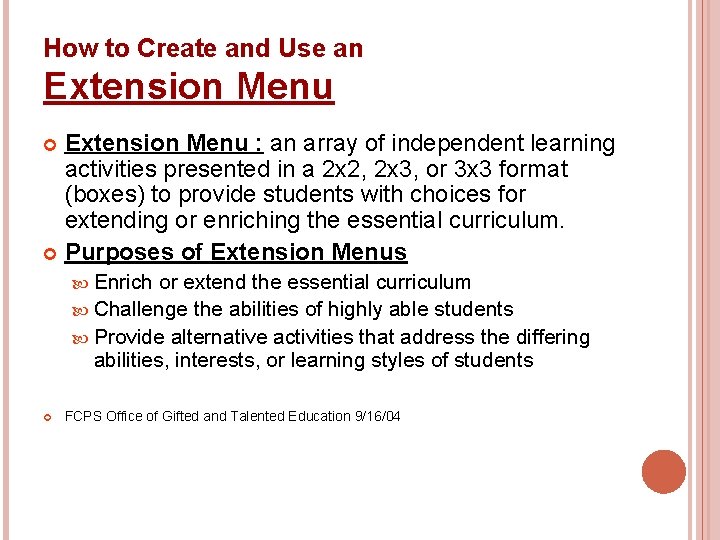
How to Create and Use an Extension Menu : an array of independent learning activities presented in a 2 x 2, 2 x 3, or 3 x 3 format (boxes) to provide students with choices for extending or enriching the essential curriculum. Purposes of Extension Menus Enrich or extend the essential curriculum Challenge the abilities of highly able students Provide alternative activities that address the differing abilities, interests, or learning styles of students FCPS Office of Gifted and Talented Education 9/16/04
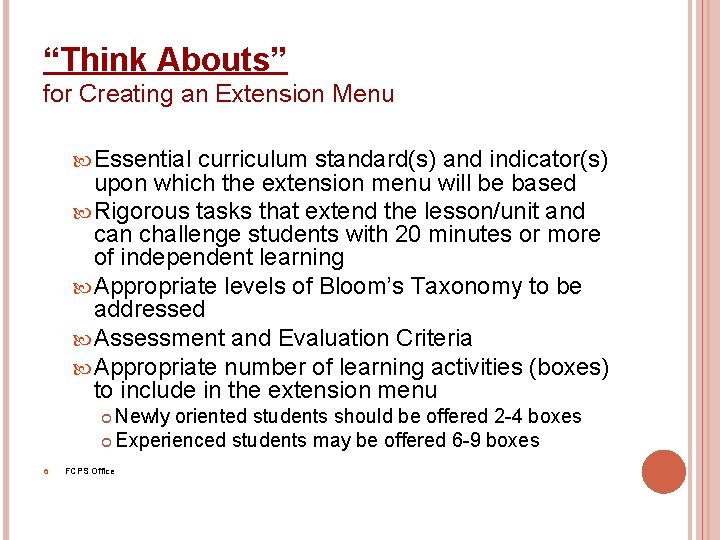
“Think Abouts” for Creating an Extension Menu Essential curriculum standard(s) and indicator(s) upon which the extension menu will be based Rigorous tasks that extend the lesson/unit and can challenge students with 20 minutes or more of independent learning Appropriate levels of Bloom’s Taxonomy to be addressed Assessment and Evaluation Criteria Appropriate number of learning activities (boxes) to include in the extension menu Newly oriented students should be offered 2 -4 boxes Experienced students may be offered 6 -9 boxes FCPS Office
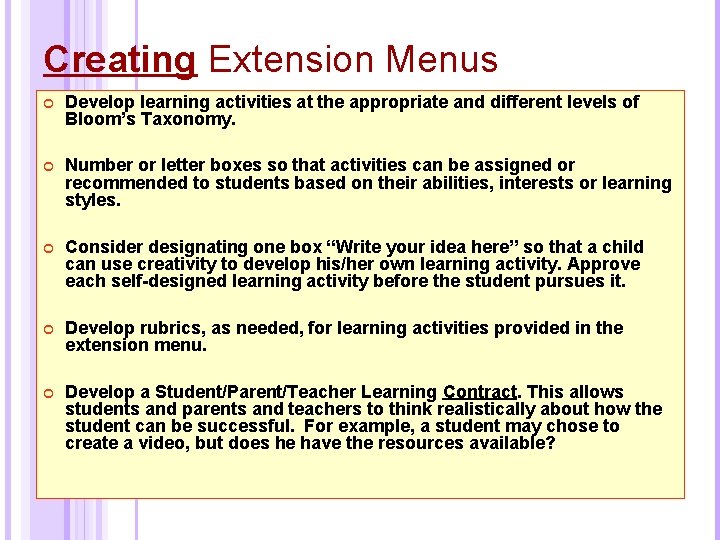
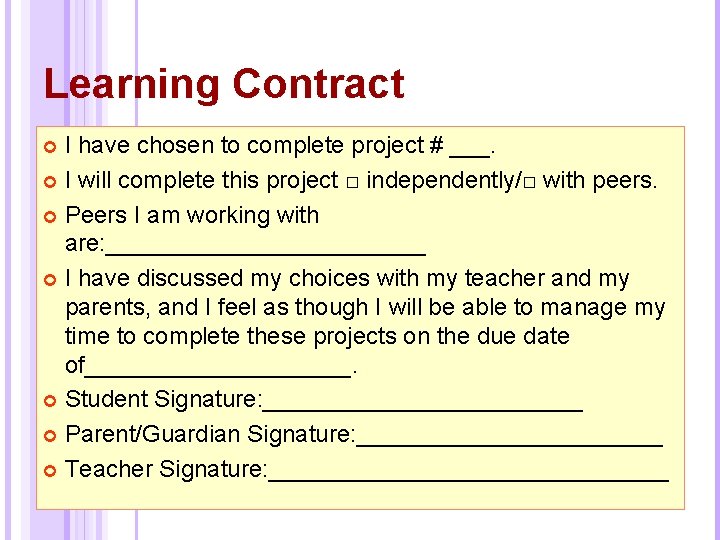
Creating Extension Menus Develop learning activities at the appropriate and different levels of Bloom’s Taxonomy. Number or letter boxes so that activities can be assigned or recommended to students based on their abilities, interests or learning styles. Consider designating one box “Write your idea here” so that a child can use creativity to develop his/her own learning activity. Approve each self-designed learning activity before the student pursues it. Develop rubrics, as needed, for learning activities provided in the extension menu. Develop a Student/Parent/Teacher Learning Contract. This allows students and parents and teachers to think realistically about how the student can be successful. For example, a student may chose to create a video, but does he have the resources available?
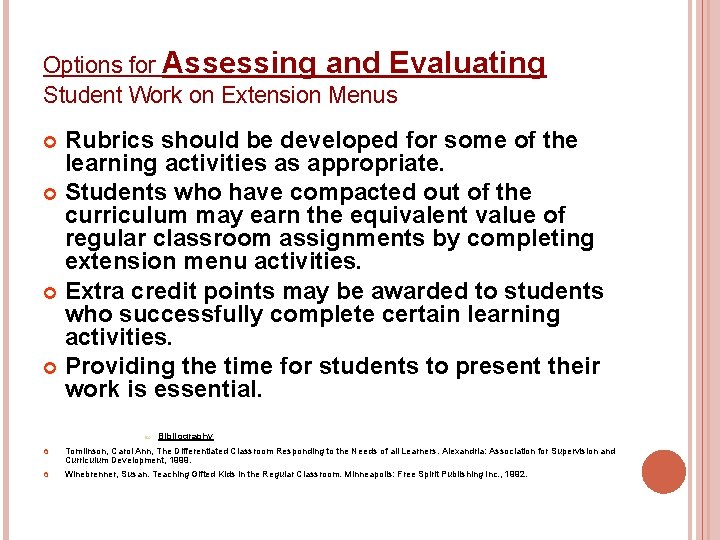
Options for Assessing and Evaluating Student Work on Extension Menus Rubrics should be developed for some of the learning activities as appropriate. Students who have compacted out of the curriculum may earn the equivalent value of regular classroom assignments by completing extension menu activities. Extra credit points may be awarded to students who successfully complete certain learning activities. Providing the time for students to present their work is essential. Bibliography Tomlinson, Carol Ann, The Differentiated Classroom Responding to the Needs of all Learners. Alexandria: Association for Supervision and Curriculum Development, 1999. Winebrenner, Susan. Teaching Gifted Kids in the Regular Classroom. Minneapolis: Free Spirit Publishing Inc. , 1992.
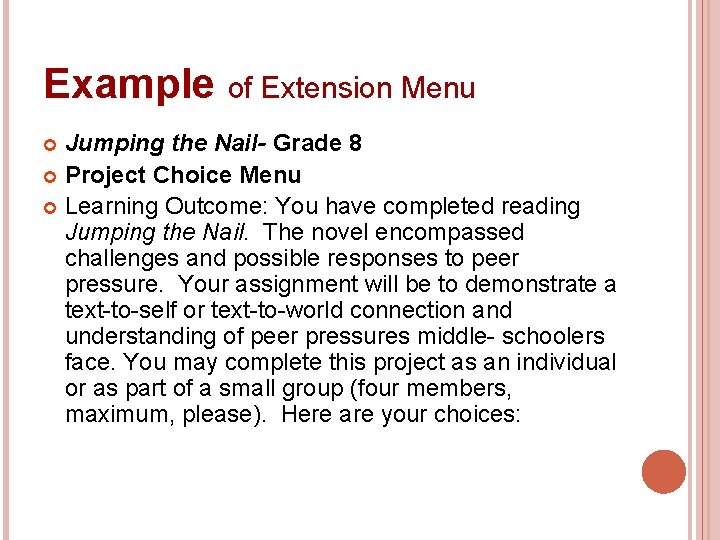
Example of Extension Menu Jumping the Nail- Grade 8 Project Choice Menu Learning Outcome: You have completed reading Jumping the Nail. The novel encompassed challenges and possible responses to peer pressure. Your assignment will be to demonstrate a text-to-self or text-to-world connection and understanding of peer pressures middle- schoolers face. You may complete this project as an individual or as part of a small group (four members, maximum, please). Here are your choices:
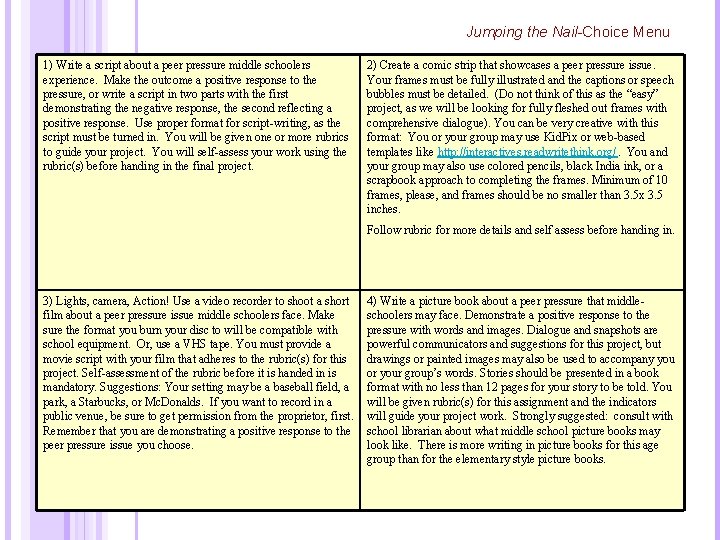
Jumping the Nail-Choice Menu 1) Write a script about a peer pressure middle schoolers experience. Make the outcome a positive response to the pressure, or write a script in two parts with the first demonstrating the negative response, the second reflecting a positive response. Use proper format for script-writing, as the script must be turned in. You will be given one or more rubrics to guide your project. You will self-assess your work using the rubric(s) before handing in the final project. 2) Create a comic strip that showcases a peer pressure issue. Your frames must be fully illustrated and the captions or speech bubbles must be detailed. (Do not think of this as the “easy” project, as we will be looking for fully fleshed out frames with comprehensive dialogue). You can be very creative with this format: You or your group may use Kid. Pix or web-based templates like http: //interactives. readwritethink. org/. You and your group may also use colored pencils, black India ink, or a scrapbook approach to completing the frames. Minimum of 10 frames, please, and frames should be no smaller than 3. 5 x 3. 5 inches. Follow rubric for more details and self assess before handing in. 3) Lights, camera, Action! Use a video recorder to shoot a short film about a peer pressure issue middle schoolers face. Make sure the format you burn your disc to will be compatible with school equipment. Or, use a VHS tape. You must provide a movie script with your film that adheres to the rubric(s) for this project. Self-assessment of the rubric before it is handed in is mandatory. Suggestions: Your setting may be a baseball field, a park, a Starbucks, or Mc. Donalds. If you want to record in a public venue, be sure to get permission from the proprietor, first. Remember that you are demonstrating a positive response to the peer pressure issue you choose. 4) Write a picture book about a peer pressure that middleschoolers may face. Demonstrate a positive response to the pressure with words and images. Dialogue and snapshots are powerful communicators and suggestions for this project, but drawings or painted images may also be used to accompany you or your group’s words. Stories should be presented in a book format with no less than 12 pages for your story to be told. You will be given rubric(s) for this assignment and the indicators will guide your project work. Strongly suggested: consult with school librarian about what middle school picture books may look like. There is more writing in picture books for this age group than for the elementary style picture books.
Learning Contract I have chosen to complete project # ___. I will complete this project □ independently/□ with peers. Peers I am working with are: ____________ I have discussed my choices with my teacher and my parents, and I feel as though I will be able to manage my time to complete these projects on the due date of__________. Student Signature: ____________ Parent/Guardian Signature: ____________ Teacher Signature: _______________
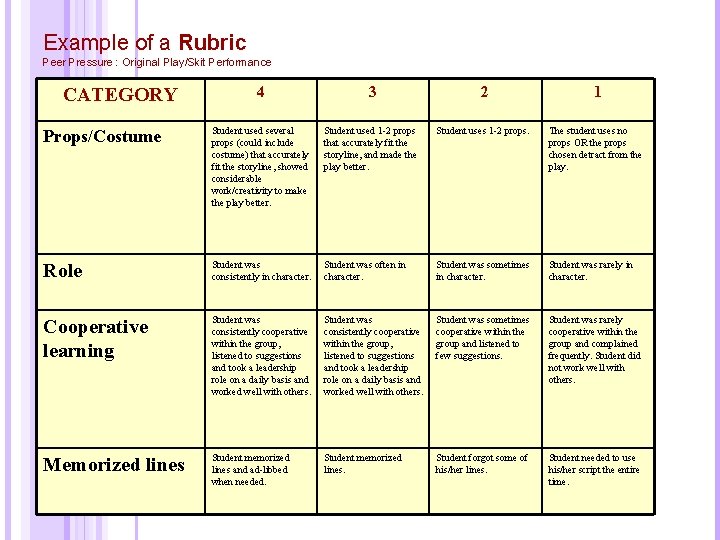
Example of a Rubric Peer Pressure : Original Play/Skit Performance 4 3 2 1 Props/Costume Student used several props (could include costume) that accurately fit the storyline, showed considerable work/creativity to make the play better. Student used 1 -2 props that accurately fit the storyline, and made the play better. Student uses 1 -2 props. The student uses no props OR the props chosen detract from the play. Role Student was consistently in character. Student was often in character. Student was sometimes in character. Student was rarely in character. Cooperative learning Student was consistently cooperative within the group, listened to suggestions and took a leadership role on a daily basis and worked well with others. Student was sometimes cooperative within the group and listened to few suggestions. Student was rarely cooperative within the group and complained frequently. Student did not work well with others. Memorized lines Student memorized lines and ad-libbed when needed. Student memorized lines. Student forgot some of his/her lines. Student needed to use his/her script the entire time. CATEGORY
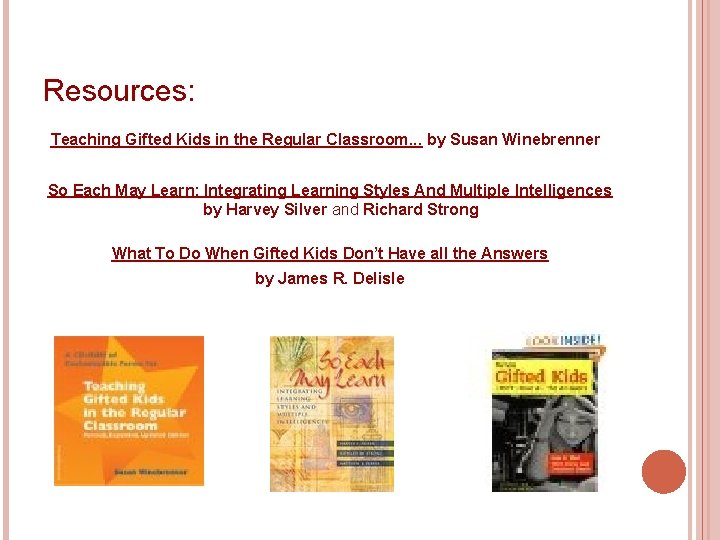
Resources: Teaching Gifted Kids in the Regular Classroom. . . by Susan Winebrenner So Each May Learn: Integrating Learning Styles And Multiple Intelligences by Harvey Silver and Richard Strong What To Do When Gifted Kids Don’t Have all the Answers by James R. Delisle
CURRICULUM COMPACTING Eliminates REPETITION Identify content or skills focused on in a unit Pretest to see what the student already knows Provide alternate tasks to extend learning and eliminate repetition
STEPS FOR COMPACTING Identify learning objectives Find or develop pre-test format Pre-test student Eliminate practice and instructional time Streamline instruction or assignments Offer enrichment or acceleration options Keep records of progress and instructional options offered
ALTERNATE ACTIVITIES Teacher selected activities Student selected activities A combination of the above Tic-Tac-Toe menu of activities Same content or skill at a more complex level Specific independent study
RECORD KEEPING Keep compactor in a binder. Keeping these record supports and justifies the curricular adjustments made and explains why the student is doing an alternate task. The records also help parents to understand what you are doing. Also have a contract with the child so the student understands expectations and consequences if the child does not follow the plan
INDEPENDENT STUDY & LEARNING CENTERS Allow for CHOICE, EXTENSION, REMEDIATION, and PERSONAL INTEREST
TIERED LESSONS Alter the DEPTH of a lesson
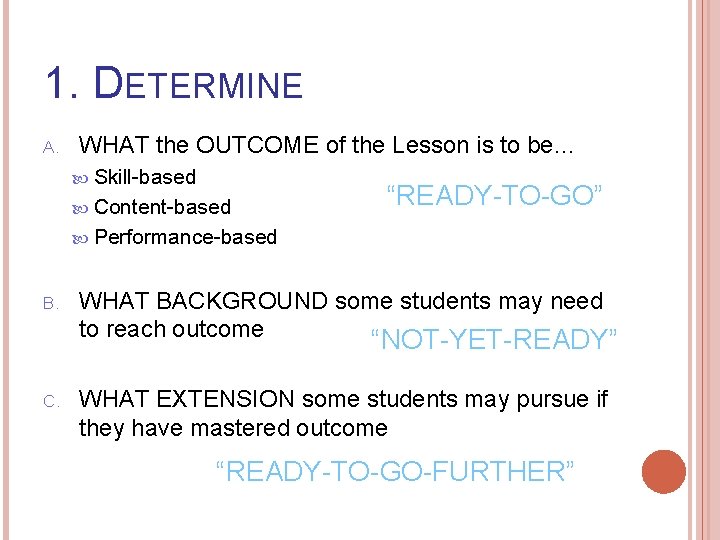
1. DETERMINE A. WHAT the OUTCOME of the Lesson is to be… Skill-based Content-based “READY-TO-GO” Performance-based B. WHAT BACKGROUND some students may need to reach outcome “NOT-YET-READY” C. WHAT EXTENSION some students may pursue if they have mastered outcome “READY-TO-GO-FURTHER”
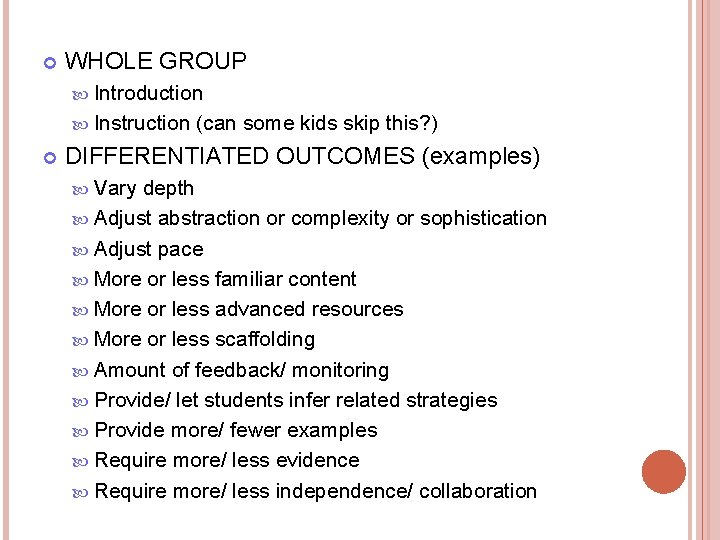
WHOLE GROUP Introduction Instruction (can some kids skip this? ) DIFFERENTIATED OUTCOMES (examples) Vary depth Adjust abstraction or complexity or sophistication Adjust pace More or less familiar content More or less advanced resources More or less scaffolding Amount of feedback/ monitoring Provide/ let students infer related strategies Provide more/ fewer examples Require more/ less evidence Require more/ less independence/ collaboration
If Assigning Tier, PREASSESS to determine appropriate placement Or, allow student to CHOOSE Tier
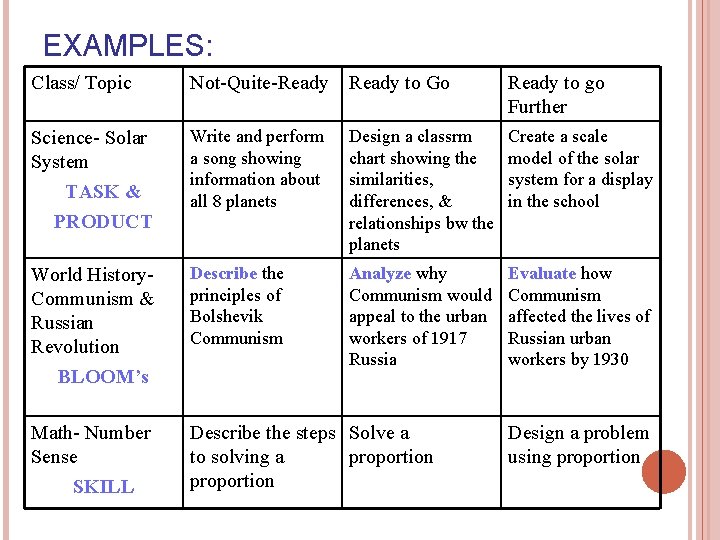
EXAMPLES: Class/ Topic Not-Quite-Ready to Go Ready to go Further Science- Solar System TASK & PRODUCT Write and perform a song showing information about all 8 planets Design a classrm chart showing the similarities, differences, & relationships bw the planets Create a scale model of the solar system for a display in the school World History. Communism & Russian Revolution BLOOM’s Describe the principles of Bolshevik Communism Analyze why Communism would appeal to the urban workers of 1917 Russia Evaluate how Communism affected the lives of Russian urban workers by 1930 Math- Number Sense SKILL Describe the steps Solve a to solving a proportion Design a problem using proportion
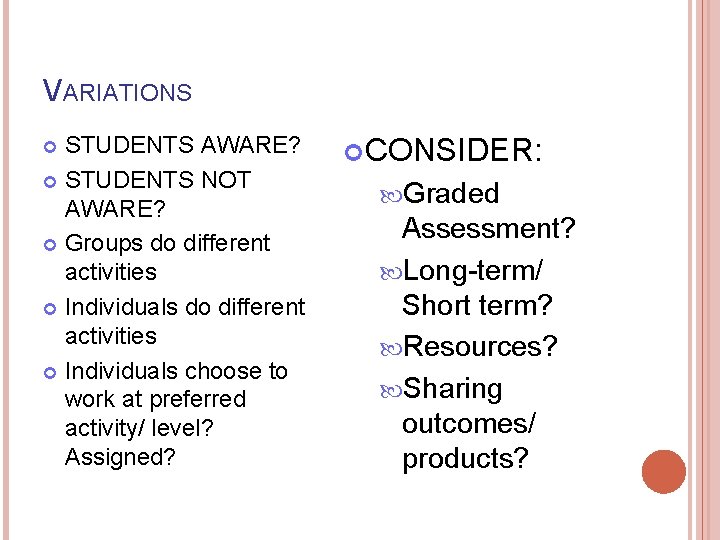
VARIATIONS STUDENTS AWARE? STUDENTS NOT AWARE? Groups do different activities Individuals choose to work at preferred activity/ level? Assigned? CONSIDER: Graded Assessment? Long-term/ Short term? Resources? Sharing outcomes/ products?
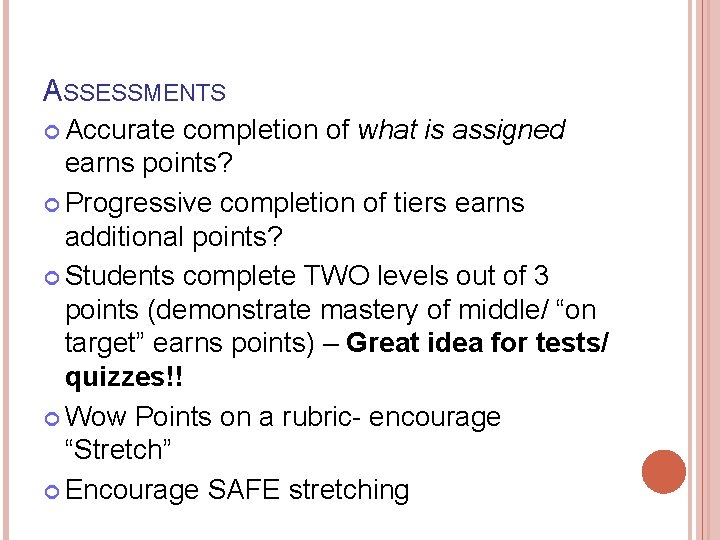
ASSESSMENTS Accurate completion of what is assigned earns points? Progressive completion of tiers earns additional points? Students complete TWO levels out of 3 points (demonstrate mastery of middle/ “on target” earns points) – Great idea for tests/ quizzes!! Wow Points on a rubric- encourage “Stretch” Encourage SAFE stretching
Save your Sanity… START SIMPLE, SMALL, SLOW!
THANK YOU!!! What Questions do YOU have? ? ? Please feel free to contact us!! Leslie Evanoski: Enrichment at De. Witt, Price, Richardson, and Silver Lake cf_evanoski@cfalls. org Cheryl Beisel: Enrichment & Pull-Out at Lincoln and Preston cf_beisel@cfalls. org Kathryn Craig– Project Excel at Bolich and Roberts Middle Schools cf_craigk@cfalls. org, http: //teacherweb. com/oh/cuyahogafalls/craig/ Karen Rumley– District Gifted Coordinator, HS Gifted Intervention Specialist cf_rumley@cfalls. org