
Differentiated Instruction Carlene Payne Differentiation Theory and Strategies




- Slides: 20
Differentiated Instruction Carlene Payne Differentiation Theory and Strategies EDU 610 March 2, 2009
Differentiated Instruction You CAN Do It!
. “Children already come to us differentiated. It just makes sense that we would differentiate our instruction in response to them. ” Carol Ann Tomlinson
Definition: Differentiated Instruction is a teaching philosophy based on the premise that teachers should adapt instruction to student differences…Teachers should modify their instruction to meet students’ varying readiness levels, learning preferences, and interests. Carol Ann Tomlinson,
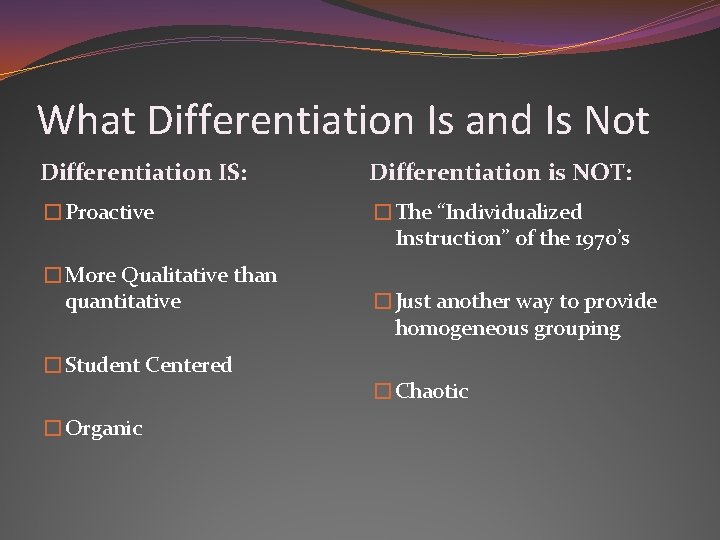
What Differentiation Is and Is Not Differentiation IS: Differentiation is NOT: �Proactive �The “Individualized Instruction” of the 1970’s �More Qualitative than quantitative �Student Centered �Organic �Just another way to provide homogeneous grouping �Chaotic
Differentiated Instruction Helps Teachers Reach: �I hate to read HOLLY �I already know this IAN �This stinks SAM �That’s cool CALLIE �What if WILLIE �I love to learn LEXIE �Never in school NANCY
The Role of the Teacher When teachers differentiate instruction, they move away from seeing themselves as keepers and dispensers of knowledge and move toward seeing themselves as organizers of learning opportunities. Carol Ann Tomlinson �Think of the teacher this way: �The teacher as director of the orchestra �The teacher as coach �The teacher as Jazz musician
Let’s peek into a differentiated classroom: �www. youtube. com/watch? v=FJMkc. L 6 Do 0 Q
Three Characteristics of Students guide Differentiation: �Readiness – Students learn better if tasks are a close match for their skills and understanding of a topic �Interest – Tasks should ignite curiosity or passion in a student �Learning Profiles – The assignments should encourage students to work in their preferred manner. Multiple Intelligence � Learning Styles �
Meet the Intelligences �Which one are you? �Verbal/Linguistic �Musical/Rhythmic �Logical/Mathematical �Visual/Spatial �Bodily/Kinesthetic �Naturalist �Intrapersonal �Interpersonal � www. internet 4 classrooms. com/di. htm
Learning Styles - (Modalities) �Audio – learns best by hearing �Visual – learns best by seeing �Kinesthetic – learns best by doing �Which one are you? � www. internet 4 Classrooms. com/di. htm
Modalities in Action! Let’s take a look! www. teachertube. com/view_video. php? viewkey=0078 ae 0895 b 5 c 06 bac 1 b
Curriculum should be differentiated in three areas: �CONTENT: Multiple options for taking in information �PROCESS: Multiple options for making sense of the ideas �PRODUCT: Multiple options for expressing what they know
CONTENT 1. Using reading materials at varying readability levels; 2. Putting text materials on tape; 3. Using spelling or vocabulary lists at readiness levels of students; 4. Presenting ideas through both auditory and visual means; 5. Using reading buddies; and 6. Meeting with small groups to re-teach an idea or skill for struggling learners, or to extend the thinking or skills of advanced learners.
PROCESS Using tiered activities through which all learners work with the same important understandings and skills; 2. Provide interest centers that encourage students to explore subsets of the class topic of particular interest to them; 3. Developing anchor activities for students who complete their work early; 4. Offer manipulatives or other hands-on support for students who need them. 1.
PRODUCTS Giving students options of how to express required learning; 2. Using rubrics that match and extend students’ varied skill levels; 3. Allowing students to work alone or in small groups on their products; and 4. Encouraging students to create their own product assignments as long as the assignments contain required elements. 1.
Assessment �Analyze individual strengths and needs �Strategically plan for each learner to improve and excel �Set new objectives �Explore abilities �Supply assistance and appropriate materials �Monitor for immediate intervention �Empower with self-directed assessment strategies �Nurture and support efforts �Translate needs and strengths into active learning
JUST TRY IT! �What will you try tomorrow? Choose one thing you will do to make differentiation a reality in your classroom. Take it one step at a time!
References Biffle, C. (2008). More Kindergarten Power Teaching with New Phonics Rap! Retrieved Feb. 2009 www. teachertube. com/view_video. php? viewkey=0078 ae 0895 b 5 c 06 bac 1 b Brooks, S. , Byles, B. (2000). Internet 4 Classrooms – Helping teachers use the Internet effectively. Retrieved Feb. 2009 www. internet 4 classrooms. com/di. htm Chapman, C. , King, R. (2005). Differentiated Assessment Strategies – One Tool Doesn’t Fit All. California: Corwin Press, Inc. Cravens, J. D. (2007). Differentiated Instruction. Retrieved Feb. 2009. www. youtube. com/watch? v=FJMkc. L 6 Do 0 Q
References (continued) Sacramento City Unified School District, (2008). What is Differentiated Instruction? Retrieved Feb. 2009. www. scusd. edu/gate_ext_learning/differentiated. htm. Tomlinson, C. , (2000). Reading Rockets – What is Differentiated Instruction? Retrieved Feb. 2009. www. readingrockets. org/article/263 Tomlinson, C. , (2001). How to Differentiate in Mixed Ability Classrooms. United States: ASCD Wille, H. , (2008). Differentiated Instruction: Better Learning Through Better Instruction. Retrieved Feb 2009. www. aea 13. org/Iowa. High. School. Project/Edgewood. Colesburg. High. School. Summit. ppt