
Differentiated Elementary Science Instruction Mary Doran Brown Archived
Differentiated Elementary Science Instruction Mary Doran Brown Archived Information
Differentiated Elementary Science Instruction n WELCOME! l As you settle in for the session, complete the following task: ¡ Write a set of directions you would follow to make a cheesecake.
Enduring Understanding n All students can learn rigorous academic material at high standards. Jon Saphier and Robert Gower: The Skillful Teacher
Essential Question n How can we best identify what students know and are able to do and subsequently plan for, instruct, and measure learner progress in mixed ability science classrooms in standards-based curriculum?
Outcomes n By the end of this session, participants will know and be able to: l define the foundations and key principles of differentiated instruction. l gain knowledge about differentiation strategies. l observe the connection between science inquiry and differentiated instruction. l explore differentiated science lessons based on Maryland State Standards. l explain the process for data-driven differentiated instructional planning. l create a differentiated science lesson plan.
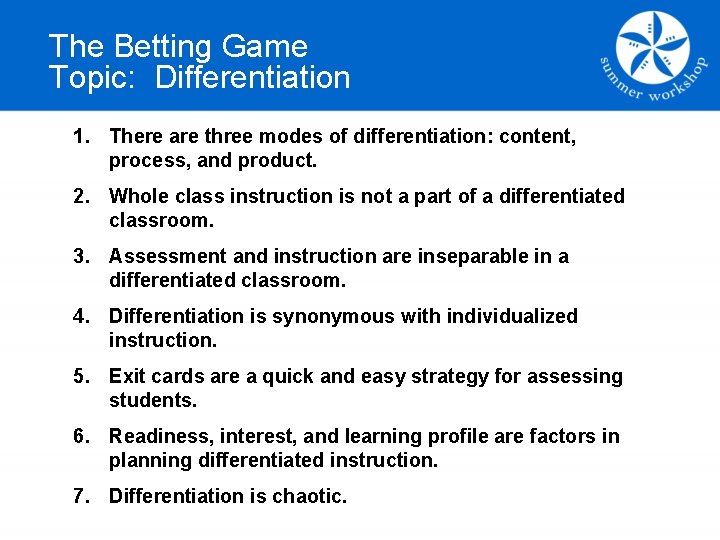
The Betting Game Topic: Differentiation 1. There are three modes of differentiation: content, process, and product. 2. Whole class instruction is not a part of a differentiated classroom. 3. Assessment and instruction are inseparable in a differentiated classroom. 4. Differentiation is synonymous with individualized instruction. 5. Exit cards are a quick and easy strategy for assessing students. 6. Readiness, interest, and learning profile are factors in planning differentiated instruction. 7. Differentiation is chaotic.
Why Differentiate? n “One size fits all” instruction does not address the needs of all students. n Children come in different shapes and sizes. They also differ in interest, readiness levels, and learning profiles.
Differentiating “How To” n How to Differentiate Instruction in Mixed Ability Classrooms – by Carol Ann Tomlinson l Be clear on the key concepts and generalizations that give meaning and structure to the topic. l Lessons for all students should emphasize critical thinking. l Lessons for all students should be engaging. l There should be a balance between student selected and teacher assigned tasks and working arrangements.
Differentiation Key Message n Tomlinson tells us: Instruction begins where the students are, not at the front of the curriculum guide.
What do students know and what are they able to do? n Pre- and on-going assessments drive instruction l Products and work samples l Standardized tests l Questioning l Every pupil response l Writing prompts l Exit cards l KWL l Paper/Pencil tests l Drawings related to the topic
Differentiated Content n Input – what the students learn l Use of multiple texts l Use of varied resources l Compact curriculum l Learning contracts
Differentiated Process n How students make sense of content l Interactive journals l Tiered assignments l Learning centers l Cubing l Anchor activities
Differentiated Product n Output – how students demonstrate what they know and are able to do l Product presentation uses varied modes of expression, materials, technologies l Advanced assignments that require higher order thinking skills l Evaluation by self and others l Authentic assessment
Pre-Assessment Data Implications n Cheesecake 911 l Direct Instruction ¡ ¡ ¡ n Cheesecake Basics l Guided Instruction ¡ ¡ ¡ n Provide varied text - content Make task simpler - process Provide small group instruction - process Provide step-by-step written instructions - process Provide modeled lessons - process Provide lab opportunity - content Cheesecake Advance l Independent Instruction ¡ Provide opportunities for learners to expand their knowledge - content
Differentiating Science Instruction n Three levels of science inquiry l Structured l Guided l Open
Structured Science Inquiry n Students provided hands-on problem to investigate with procedures and materials n Students discover relationships between variables or generalize from data n Used to teach specific content, fact, or skill
Guided Science Inquiry n Students provided materials and problem to investigate, and students compose their own procedures n Teacher facilitates and encourages student generated questions
Open Science Inquiry n Similar to guided inquiry with the addition that students also formulate their own problem to investigate
Sample Differentiated Science Lesson n Structured Inquiry l Students are given testable question and verbal procedures – Are fingerprint and toe print formulas the same? Guided Inquiry l Students select a testable question from teacher list then plan and conduct investigation Open Inquiry l Students develop a testable question and investigation
Anchor Activities n n n Reading to be Informed Inquiry Centers Structured Computer Work
Give It a Try n Paper Towel Investigation l Develop a tiered science lesson for students to create and conduct welldesigned investigations to determine the quality of several different paper towels.
Labor Intensive Strategies for Differentiation n n n Assessment, data analysis, and diagnosis Flexible grouping Tiered tasks Anchor activities Differentiated learning encounters Learning contracts Independent study
Simple Strategies for Differentiation n n n Study buddies Exit cards Student expert “Three Before Me” “The Doctor Is In” Mini-lessons Multiple text
Differentiation instruction is a critical element to… Leaving No Child Behind.
- Slides: 24