
Differentiate of Die By Jack Trout and Steve
Differentiate of Die By Jack Trout and Steve Rivkin Book Summary
Differentiate of Die : Tyranny of Choice Today, markets are driven by choice. With the average supermarket offering 40, 000 brand items – or standard stocking units – differentiating products is more challenging than ever. Companies that don’t stand out will get lost in the pack. However, companies must address differentiation in three key ways : 1) If a company ignores their uniqueness and try to be everything to everybody, then they quickly undermine what makes them different. 2) If a company ignores changes in the market, then their difference becomes less important. 3) If a company stays in the shadow of their larger competitor and never establishes their “differentness”, then they will always be weak.
Differentiate of Die : Losing and Reinventing the U. S. P. Rosser Reeves, author of Reality in Advertising (1960), defined the unique selling proposition as “something unique that a competitor cannot offer & that is strong enough that it can move the mass millions”. However, establishing a USP today is much harder because of the following three things : 1) A torrent of new products has washed over consumers, each with conflicting claims & the smallest points of difference. 2) The primary response amongst competitors is “me-tooism” - the production of knock-off products that prevent the original company from establishing their difference. 3) The speed of technology has enabled companies to reinvent themselves as quickly as often as they desire, making it difficult to differentiate on product differences alone.
Differentiate of Die : Losing and Reinventing the U. S. P. In addition, companies need to be able to understand how customers make decisions based on differentiation. In essence, there are four functions that help people make these decisions: 1) Intuition – Customers favors the “big picture” view instead of details. (Next generation ads) 2) Thinking – Customers favors analytic, precise, and logical information. (Informational/technical ads) 3) Feeling – Customers favors following their own preferences. (Third part endorsement ads) 4) Sensing – Customers favors seeing things as they are; respects facts & details and has the knack for putting things into context. (Common sense/Leadership ads)

Differentiate of Die : What Differentiation Is Not The following differentiating strategies may look appealing, but often require more effort than necessary and rarely differentiate a company : Quality & Customer Orientation • While a company should continually improve its quality & customer service, these factors rarely differentiate a company. Customers simply get more demanding & costs often exceed expectations. Creativity • Often times, creative advertising or positioning will bury important messages. • If people think an important message is being conveyed, then they will listen to it, even if the packaging is not overly creative. Price • Price is often the enemy of differentiation. • Cutting prices to build differentiation is useless if the competition can cut their prices as well. Breadth of Line • Breadth of line can be copied easily by competitors. • In addition, being “big” can alienate core customer groups, older customers, and parents with children because of the need to navigate large parking lots & floor space.

Differentiate of Die : Four Steps to Differentiation Differentiating a business does not always entail being cute, creative, or imaginative. Often times, it requires logic and tests of sound thinking. The following is a four-step process for differentiation : Step 1 : Make Sense in Context Step 2 : Find the Differentiating Idea Step 3 : Have Credentials Step 4 : Communicate Your Difference • Message must make sense in the context of the category. • “Differentness” does not have to be a product. • Credentials must support a differentiating idea. • Build a strong perception in the marketplace about your difference. • Product differences must demonstrate their uniqueness in verifiable demonstrations. • Resources must be dedicated to building a solid communications program to broadcast your difference. • From a snapshot of perceptions in the market, discern strengths and weaknesses of yourself and of your competitors. • Gauge whether the timing if right for your differentiating idea. • Find a difference that can be sued to set up a benefit for your customer.
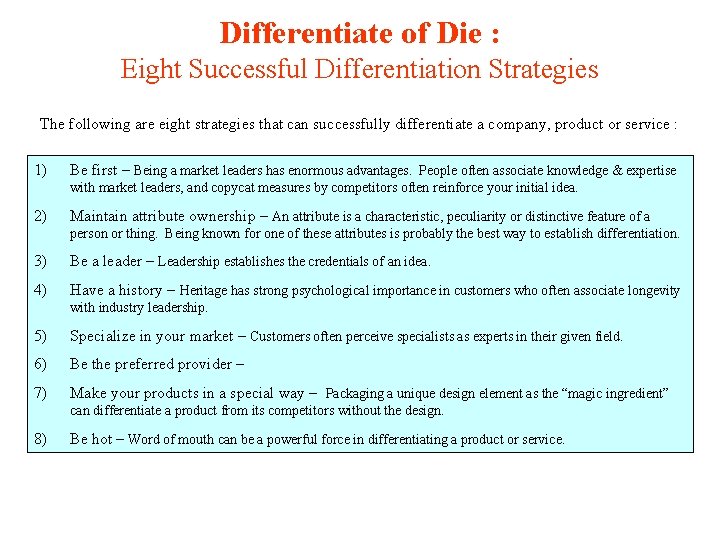
Differentiate of Die : Eight Successful Differentiation Strategies The following are eight strategies that can successfully differentiate a company, product or service : 1) Be first – Being a market leaders has enormous advantages. People often associate knowledge & expertise with market leaders, and copycat measures by competitors often reinforce your initial idea. 2) Maintain attribute ownership – An attribute is a characteristic, peculiarity or distinctive feature of a person or thing. Being known for one of these attributes is probably the best way to establish differentiation. 3) Be a leader – Leadership establishes the credentials of an idea. 4) Have a history – Heritage has strong psychological importance in customers who often associate longevity with industry leadership. 5) Specialize in your market – Customers often perceive specialists as experts in their given field. 6) Be the preferred provider – 7) Make your products in a special way – Packaging a unique design element as the “magic ingredient” can differentiate a product from its competitors without the design. 8) Be hot – Word of mouth can be a powerful force in differentiating a product or service.
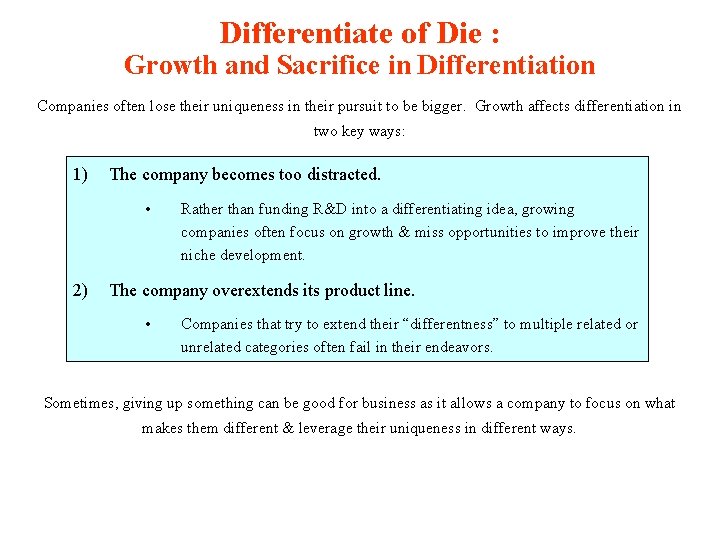
Differentiate of Die : Growth and Sacrifice in Differentiation Companies often lose their uniqueness in their pursuit to be bigger. Growth affects differentiation in two key ways: 1) The company becomes too distracted. • 2) Rather than funding R&D into a differentiating idea, growing companies often focus on growth & miss opportunities to improve their niche development. The company overextends its product line. • Companies that try to extend their “differentness” to multiple related or unrelated categories often fail in their endeavors. Sometimes, giving up something can be good for business as it allows a company to focus on what makes them different & leverage their uniqueness in different ways.
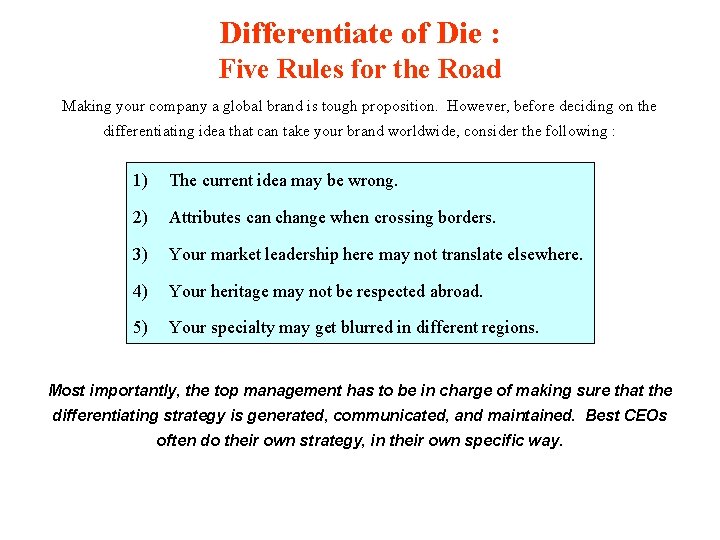
Differentiate of Die : Five Rules for the Road Making your company a global brand is tough proposition. However, before deciding on the differentiating idea that can take your brand worldwide, consider the following : 1) The current idea may be wrong. 2) Attributes can change when crossing borders. 3) Your market leadership here may not translate elsewhere. 4) Your heritage may not be respected abroad. 5) Your specialty may get blurred in different regions. Most importantly, the top management has to be in charge of making sure that the differentiating strategy is generated, communicated, and maintained. Best CEOs often do their own strategy, in their own specific way.
- Slides: 9