
Differential Reinforcement of Alternative Behavior to Decrease Aggressive
Differential Reinforcement of Alternative Behavior to Decrease Aggressive Behaviors in a Child with Autism BRSS 2012 Mac. Kenzie Sullivan
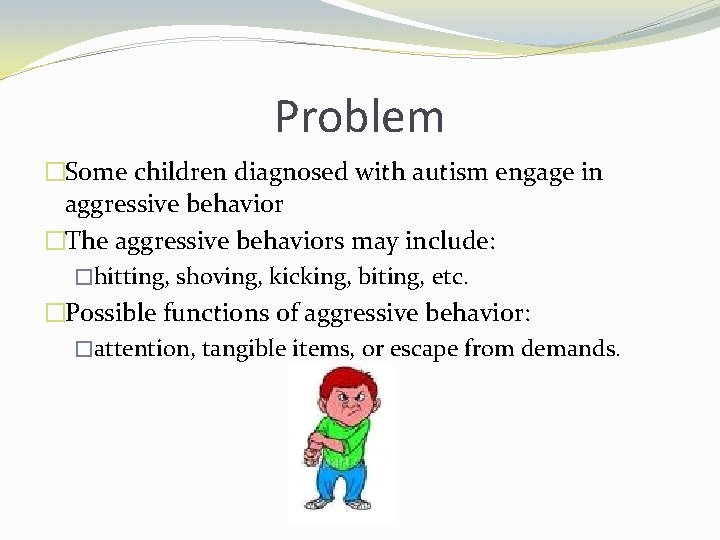
Problem �Some children diagnosed with autism engage in aggressive behavior �The aggressive behaviors may include: �hitting, shoving, kicking, biting, etc. �Possible functions of aggressive behavior: �attention, tangible items, or escape from demands.
Participant �Brian*- age 3 with a diagnoses of autism �He was engaging in a moderate frequency of aggressive behavior �Aggression would occur mainly with peers in social situations �The aggressive target behaviors mainly include hitting, pushing, and biting. �Hypothesized functions were: �The avoidance of loss of a reinforcer �To gain access to a reinforcer � * Name changed for privacy
Project Overview § A Differential Reinforcement of Alternative Behavior (DRA) procedure was implemented § DRA definition from “Principles of Behavior” § The replacement of an inappropriate response with a specific appropriate response that produces the same reinforcing outcome
Project Overview § Goal: § § extinguish aggressive behavior Train appropriate vocal responses § Two appropriate vocal responses were trained: § § “No thank you” when he wants to keep a tangible in his possession “My turn” when he would like a tangible in his peer’s possession
Lindsay Erdmann �Lindsay designed and implemented the DRA procedure. �She is a second year graduate student. �Advised and guided my participation in the Behavioral Research Supervisory System (BRSS).
Mac. Kenzie Sullivan �I am a senior and have been in BRSS for two semesters. �I assisted Lindsay in her study during this time. �I completed weekly tasks under her direction �Taking ABC data, graphing and coding data, and researching other DRA procedures
Baseline �We measured the frequency of aggressive behaviors in the absence of the intervention �Problem behavior monitored throughout the day �Brian’s tutors took ABC data on aggressive behaviors �After analyzing the data, our hypothesized functions were concluded to be correct �Avoidance of loss of a reinforcer �Access to a reinforcer
Phase 1 �There were two overall phases in the intervention �Phase 1 consisted of running the DRA procedure in ten minute sessions �The sessions took place in the playroom �Six phases to DRA procedure: Increasing time delay before prompts were provided �Phase 1 - immediate response �Faded until 10 second delay in phase 6
Phase 1 �Phase change criteria for DRA procedure: 80% or more correct responses for one session �Data was recorded as: �An (I) when an independent response was made �A (+) for every correct response � A correct response: either independent or prompted �A (-) for any instance of aggressive behavior �An (NR) when no response was made when prompted
Phase 1 �A few of Brian’s classmates chosen to help with DRA procedure �Chosen based on overall social skills and ability to share �The children were needed to create two conditions: � 1. Child would have Brian’s preferred reinforcer � 2. Attempt to get a preferred reinforcer from Brian. �Conditions were run simultaneously with each other. �All attempts of aggression made by Brian were immediately blocked by tutors.
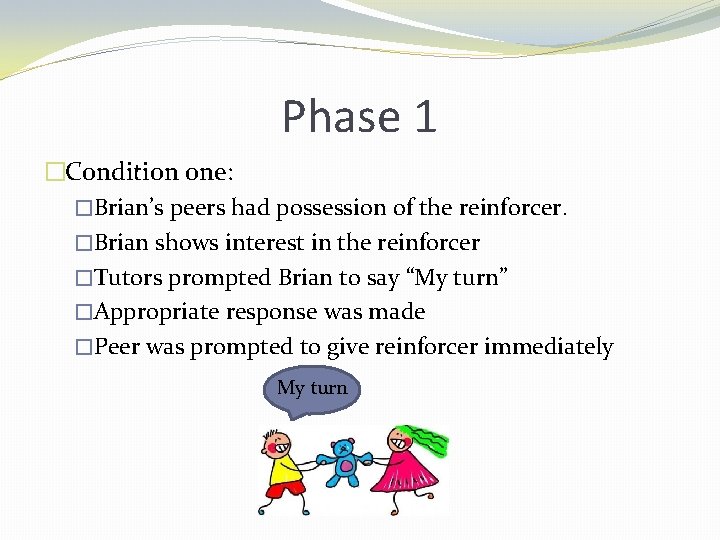
Phase 1 �Condition one: �Brian’s peers had possession of the reinforcer. �Brian shows interest in the reinforcer �Tutors prompted Brian to say “My turn” �Appropriate response was made �Peer was prompted to give reinforcer immediately My turn
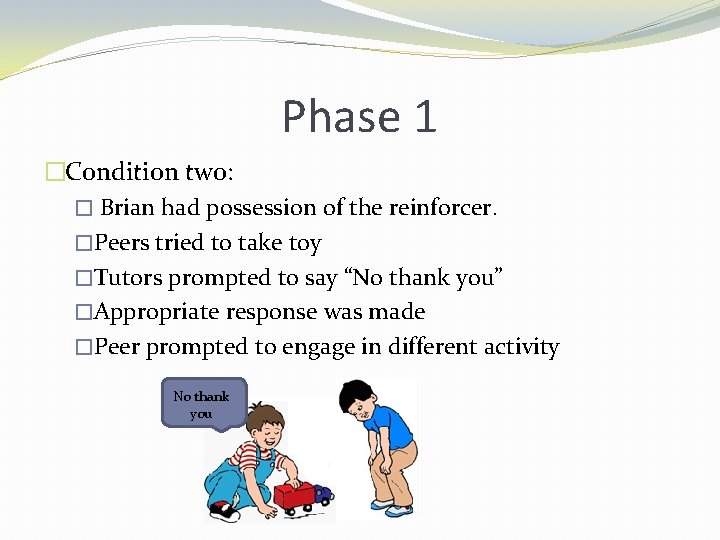
Phase 1 �Condition two: � Brian had possession of the reinforcer. �Peers tried to take toy �Tutors prompted to say “No thank you” �Appropriate response was made �Peer prompted to engage in different activity No thank you
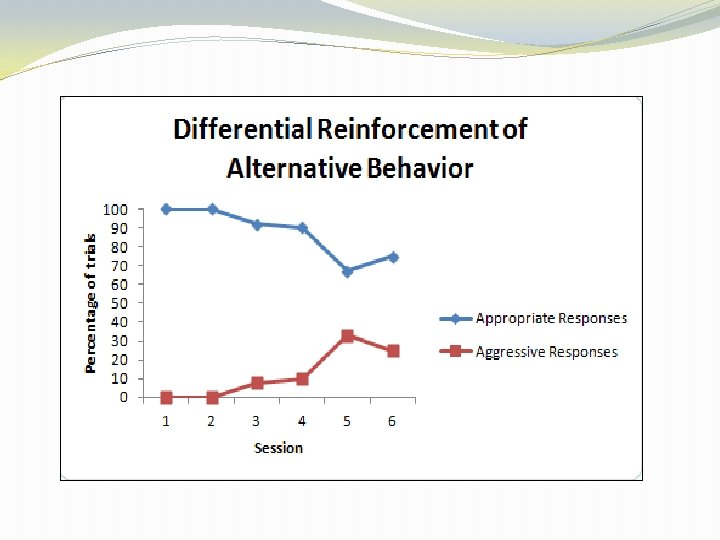
DRA � Data of intervention alone �Appropriate responses increase and aggressive behavior decreased compared to baseline �Phase changed each session �Increase in aggressive behaviors in higher phases � There phases had longer delays before prompted responses
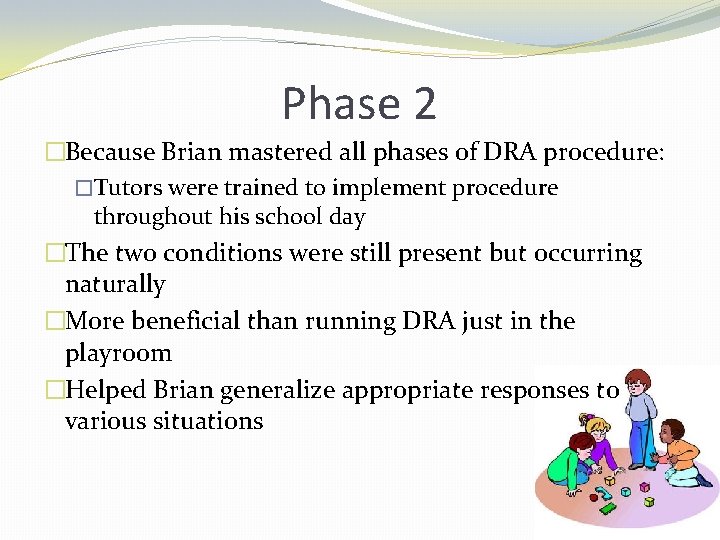
Phase 2 �Because Brian mastered all phases of DRA procedure: �Tutors were trained to implement procedure throughout his school day �The two conditions were still present but occurring naturally �More beneficial than running DRA just in the playroom �Helped Brian generalize appropriate responses to various situations
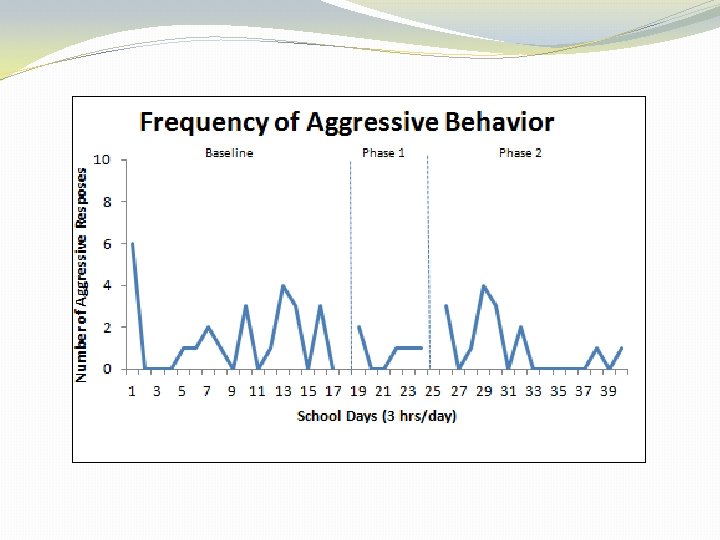
Frequency of Aggressive Behavior �Overall frequency of aggressive behavior throughout school day during baseline and intervention �Decreased during intervention �Became stable at 1 aggressive response per day during phase 1 �Slight increase in beginning of phase 2 � Decreased to approximately one aggressive response per day
Results �The DRA intervention as a whole was effective in two ways. �Participant’s aggressive behaviors in social environments decreased �Appropriate vocal responses of the participant were increased �Brian was transitioned into next classroom due to his decreased aggression �Lindsay has been checking in with his teacher �Low frequency of aggressive behaviors in new classroom
Additional Tasks �Currently enrolled in practicum at Kalamazoo Autism Center �Took ABC data for another graduate student on another child with autism �Problem behavior: Child getting out of his seat while at work station �Analysis of data: �Hypothesized function- to gain reinforcer (mainly attention) �Escape a demand placed on him
Future Studies �Future studies should implement the procedure with more children �Different problem behaviors could be studied using a DRA procedure �This study could be replicated with other children with similar behaviors �Maintenance Database
Personal Thoughts �The study had some unexpected obstacles �Effective procedure enabled Brian to be moved up to the next classroom at school. �This made it difficult to continue implementing the procedure �Beneficial to see if Brian could generalize the appropriate behavior into a new setting
BRSS Experience �Wonderful opportunity to work in the Psychology field �Gained excellent experience doing research and working with graduate students �Practice writing and implementing procedures for future endeavors � Graduate school research �I love working in the field of autism and hope to continue.
The End Questions? Comments? Thank you
- Slides: 24