
Differential Reinforcement Let this image represent the observation
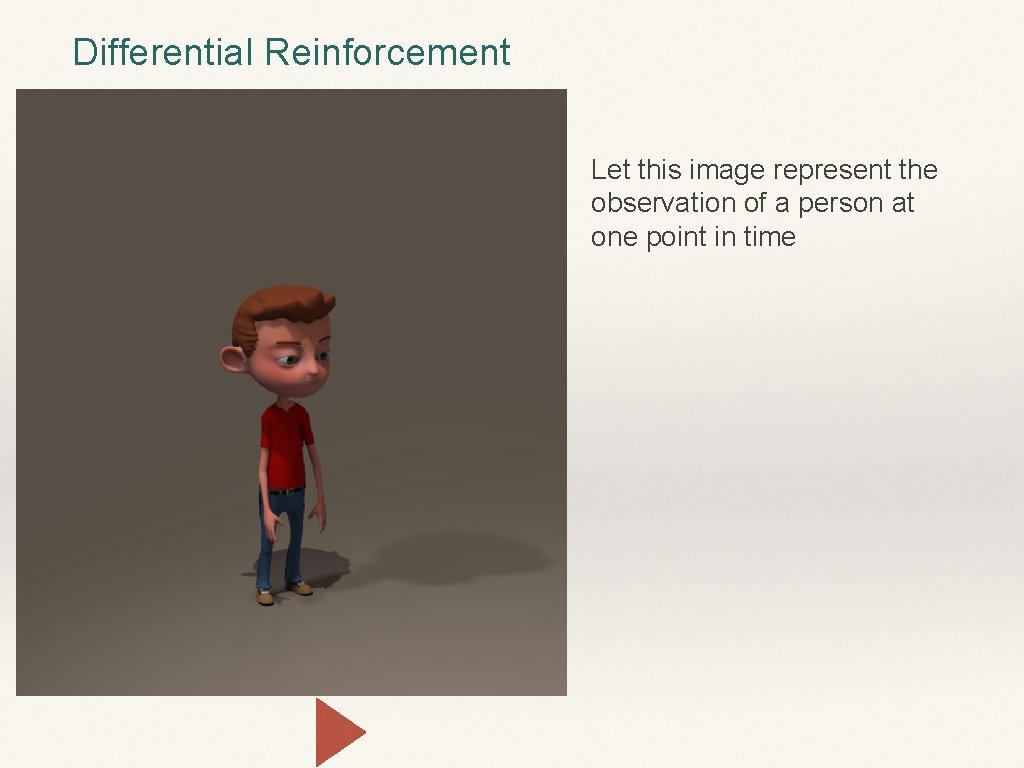
Differential Reinforcement Let this image represent the observation of a person at one point in time
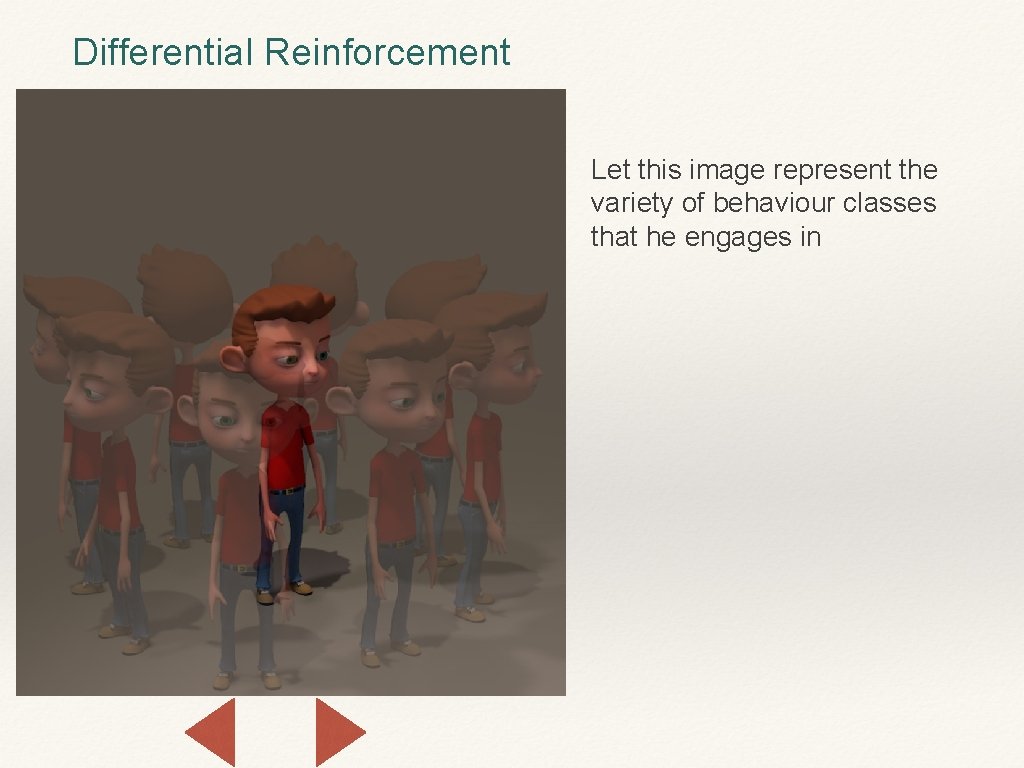
Differential Reinforcement Let this image represent the variety of behaviour classes that he engages in
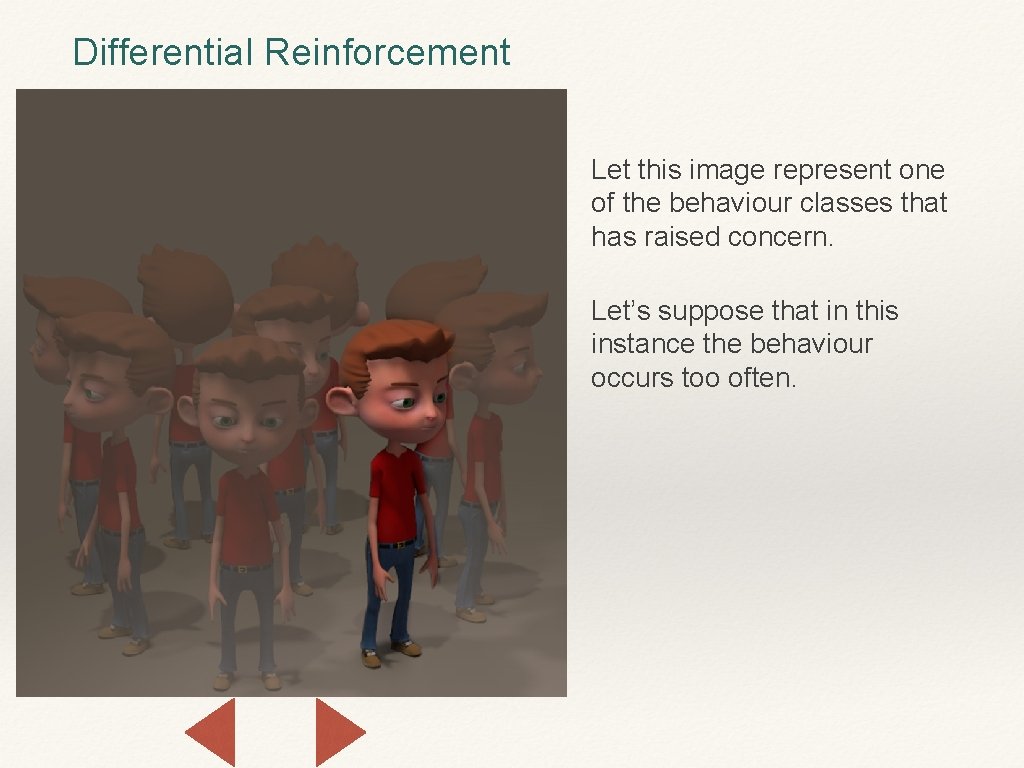
Differential Reinforcement Let this image represent one of the behaviour classes that has raised concern. Let’s suppose that in this instance the behaviour occurs too often.
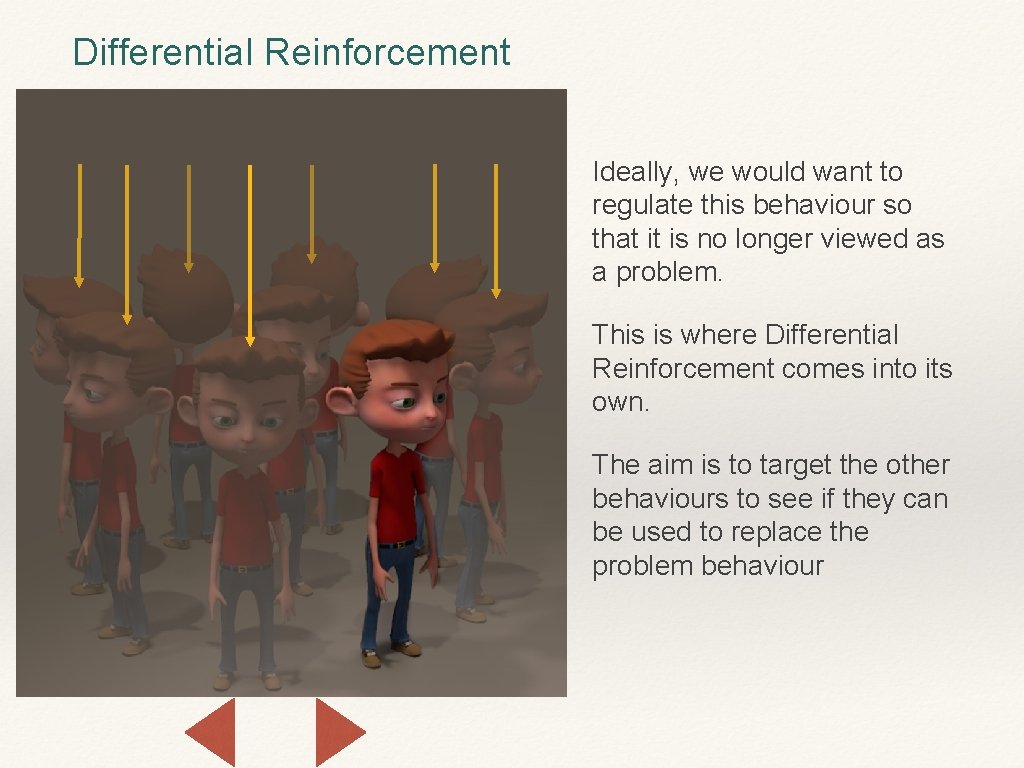
Differential Reinforcement Ideally, we would want to regulate this behaviour so that it is no longer viewed as a problem. This is where Differential Reinforcement comes into its own. The aim is to target the other behaviours to see if they can be used to replace the problem behaviour
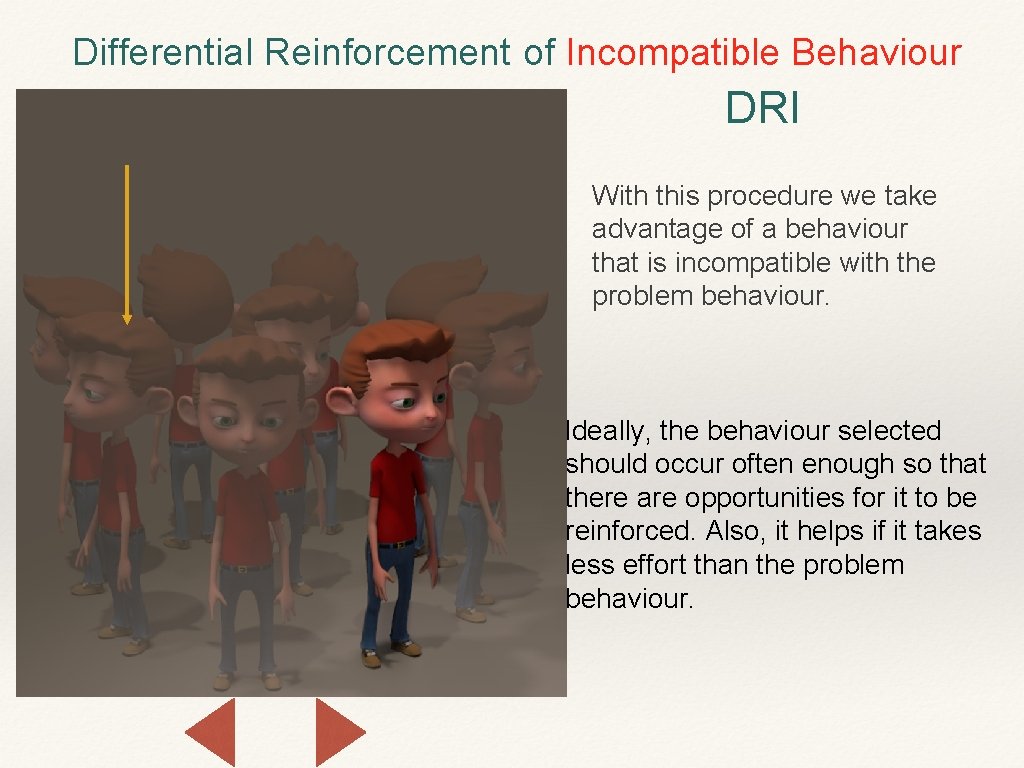
Differential Reinforcement of Incompatible Behaviour DRI With this procedure we take advantage of a behaviour that is incompatible with the problem behaviour. Ideally, the behaviour selected should occur often enough so that there are opportunities for it to be reinforced. Also, it helps if it takes less effort than the problem behaviour.
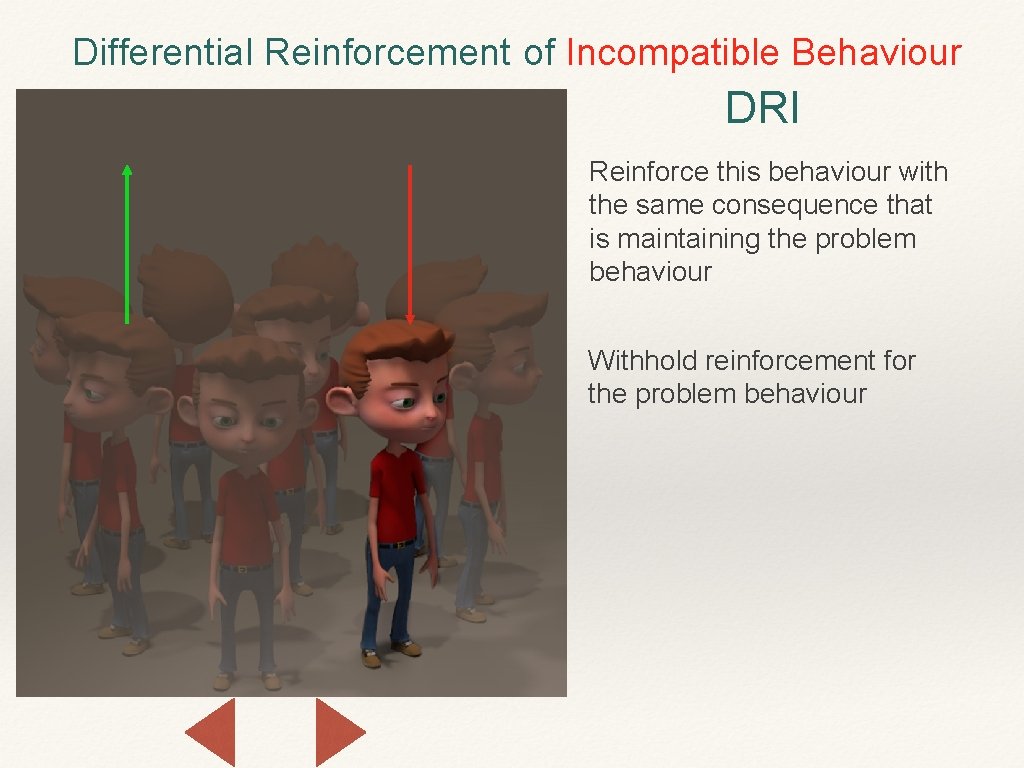
Differential Reinforcement of Incompatible Behaviour DRI Reinforce this behaviour with the same consequence that is maintaining the problem behaviour Withhold reinforcement for the problem behaviour
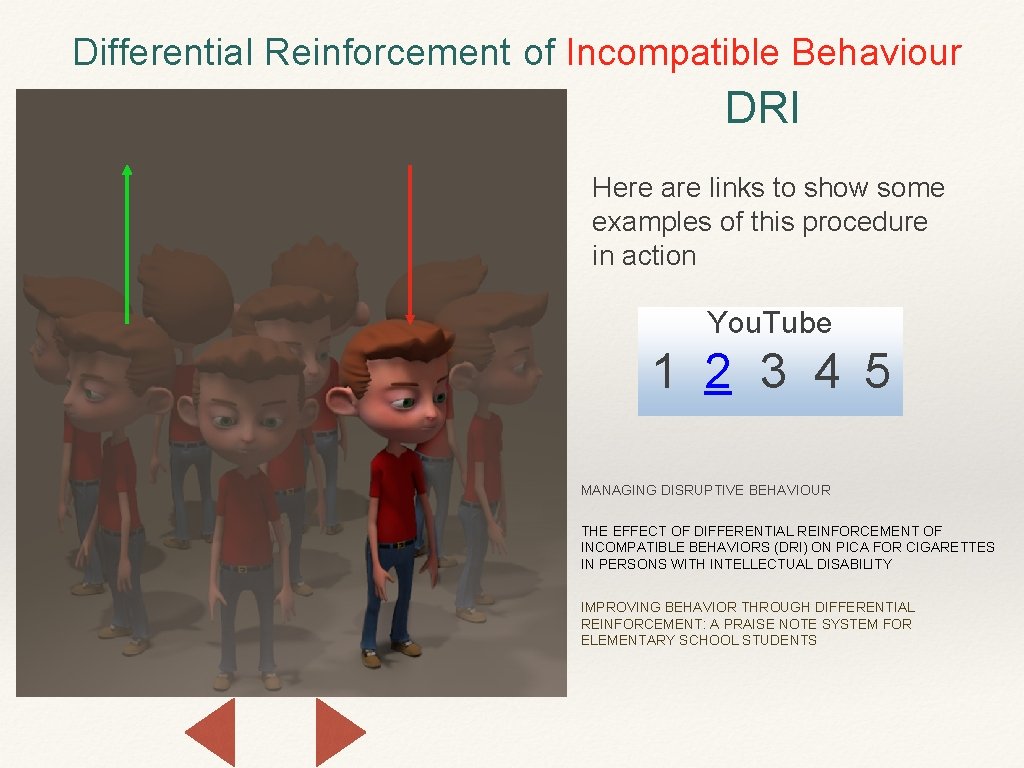
Differential Reinforcement of Incompatible Behaviour DRI Here are links to show some examples of this procedure in action You. Tube 1 2 3 4 5 MANAGING DISRUPTIVE BEHAVIOUR THE EFFECT OF DIFFERENTIAL REINFORCEMENT OF INCOMPATIBLE BEHAVIORS (DRI) ON PICA FOR CIGARETTES IN PERSONS WITH INTELLECTUAL DISABILITY IMPROVING BEHAVIOR THROUGH DIFFERENTIAL REINFORCEMENT: A PRAISE NOTE SYSTEM FOR ELEMENTARY SCHOOL STUDENTS
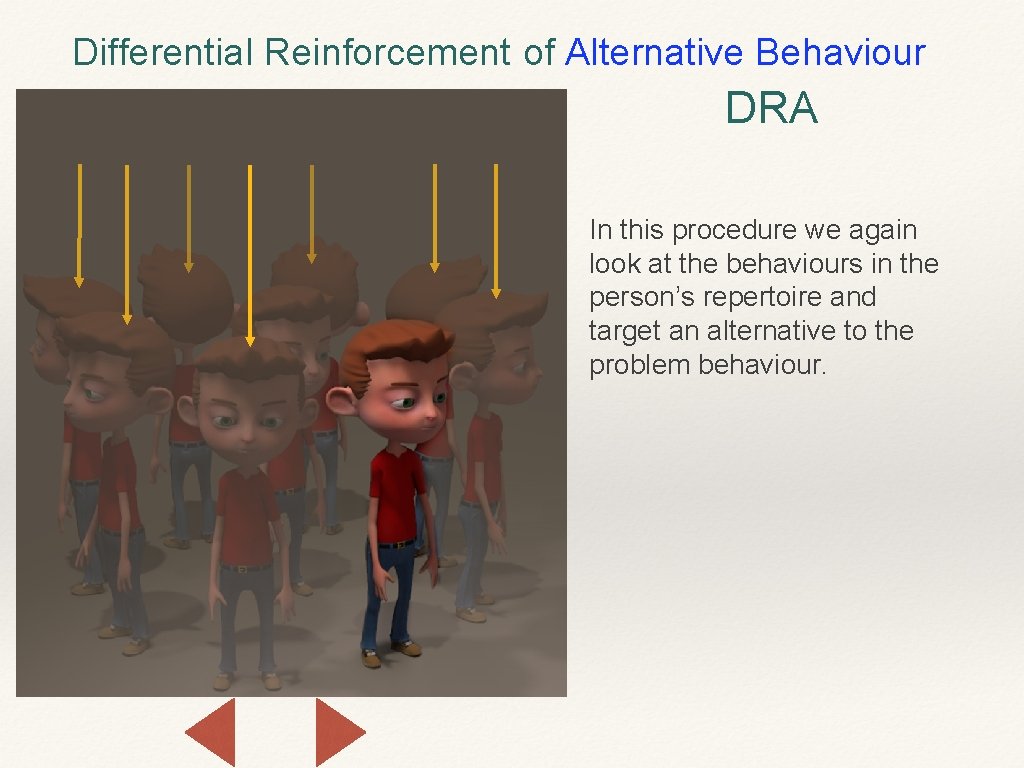
Differential Reinforcement of Alternative Behaviour DRA In this procedure we again look at the behaviours in the person’s repertoire and target an alternative to the problem behaviour.
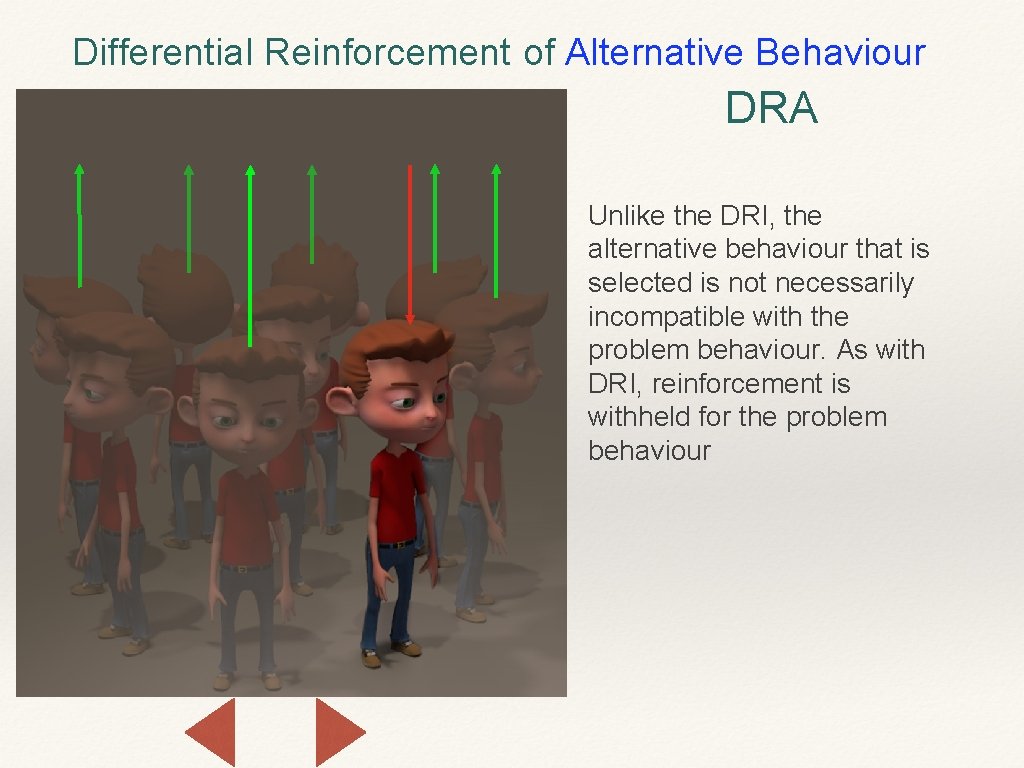
Differential Reinforcement of Alternative Behaviour DRA Unlike the DRI, the alternative behaviour that is selected is not necessarily incompatible with the problem behaviour. As with DRI, reinforcement is withheld for the problem behaviour
Differential Reinforcement of Alternative Behaviour DRA Here are links to show some examples of this procedure in action You. Tube 1 A REVIEW OF EMPIRICAL SUPPORT FOR DIFFERENTIAL REINFORCEMENT OF ALTERNATIVE BEHAVIOR AN INVESTIGATION OF DIFFERENTIAL REINFORCEMENT OF ALTERNATIVE BEHAVIOUR WITHOUT EXTINCTION EVALUATING TREATMENT CHALLENGES WITH DIFFERENTIAL REINFORCEMENT OF ALTERNATIVE BEHAVIOUR

Differential Reinforcement DRI/DRA Can DRI and DRA procedures be used with negative reinforcers? Of course they can. The two procedures are called Differential Negative Reinforcement of Incompatible Behaviour (DNRI) Differential Negative Reinforcement of Alternative Behaviour (DNRA)
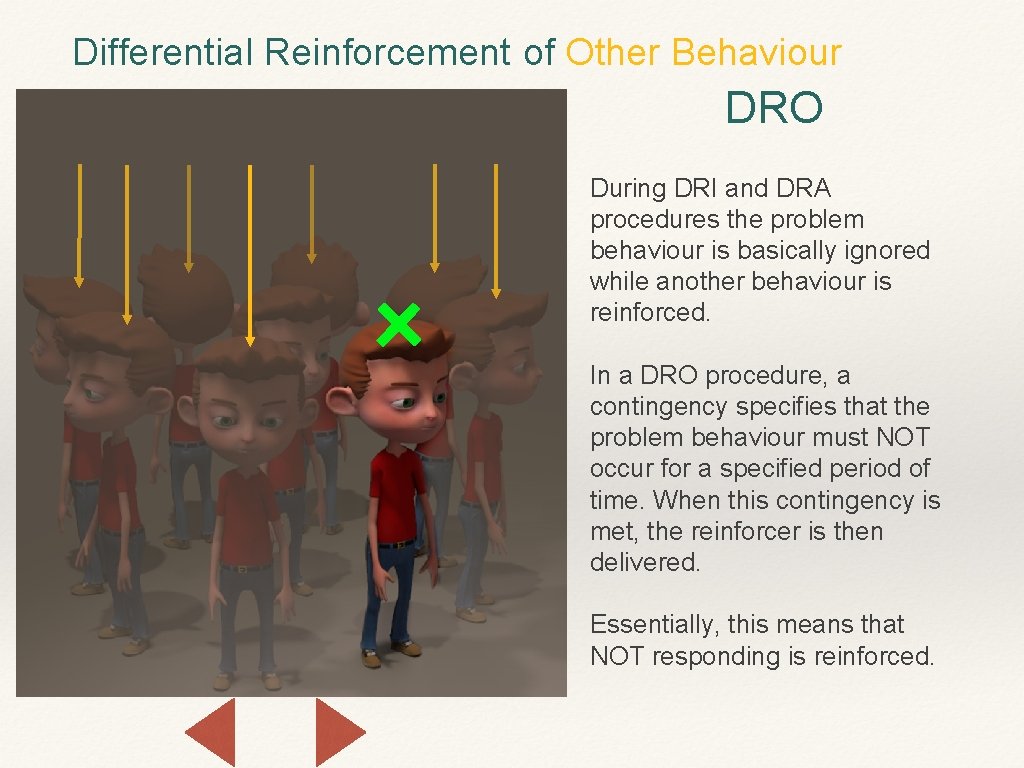
Differential Reinforcement of Other Behaviour DRO During DRI and DRA procedures the problem behaviour is basically ignored while another behaviour is reinforced. In a DRO procedure, a contingency specifies that the problem behaviour must NOT occur for a specified period of time. When this contingency is met, the reinforcer is then delivered. Essentially, this means that NOT responding is reinforced.
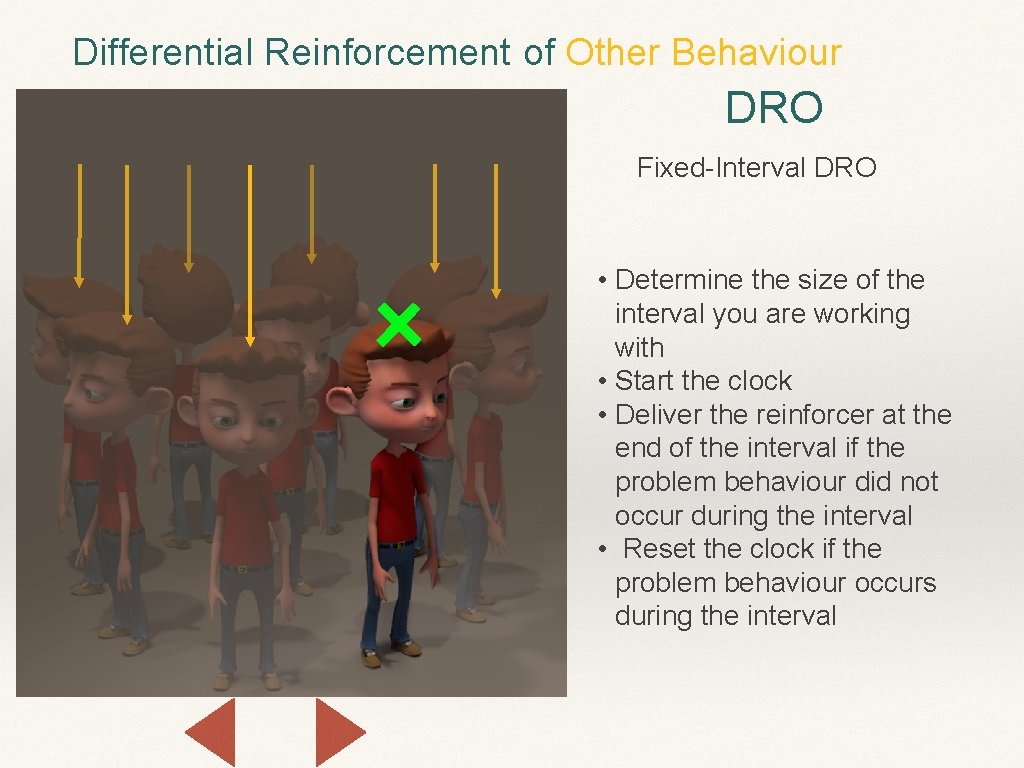
Differential Reinforcement of Other Behaviour DRO Fixed-Interval DRO • Determine the size of the interval you are working with • Start the clock • Deliver the reinforcer at the end of the interval if the problem behaviour did not occur during the interval • Reset the clock if the problem behaviour occurs during the interval
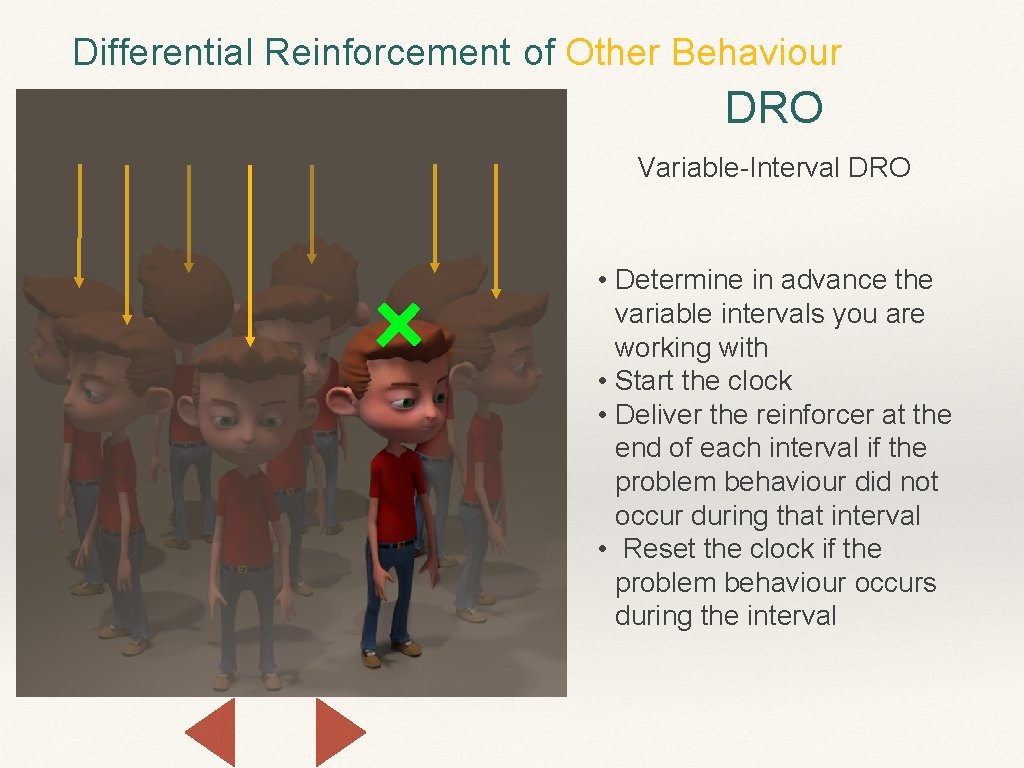
Differential Reinforcement of Other Behaviour DRO Variable-Interval DRO • Determine in advance the variable intervals you are working with • Start the clock • Deliver the reinforcer at the end of each interval if the problem behaviour did not occur during that interval • Reset the clock if the problem behaviour occurs during the interval
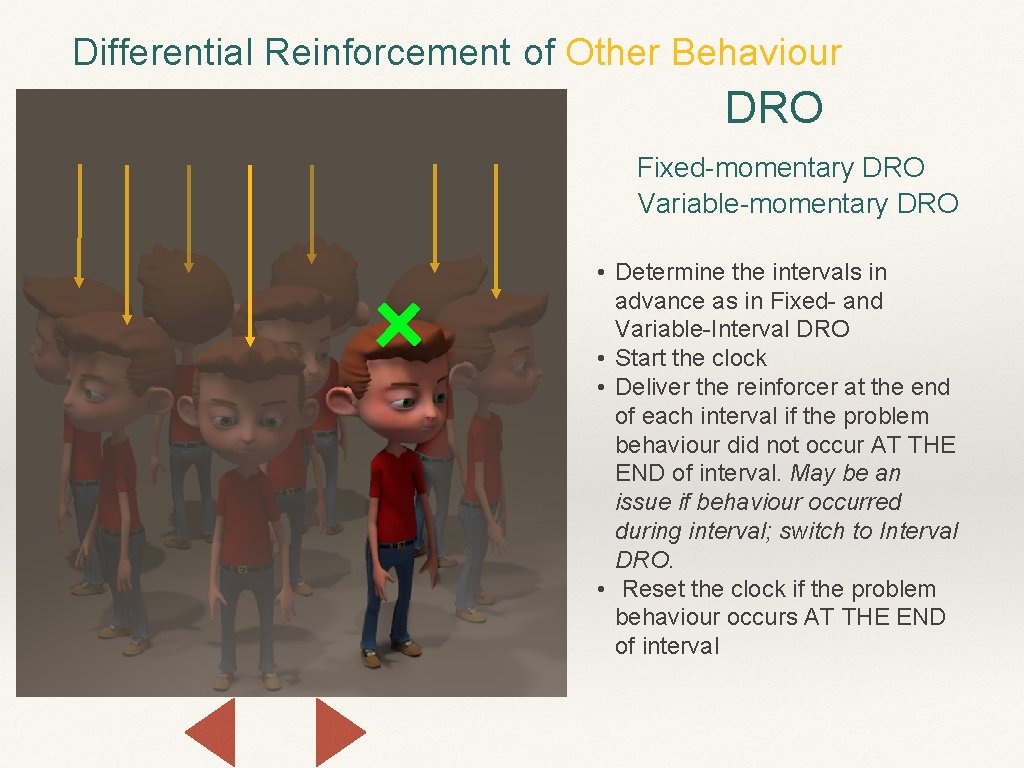
Differential Reinforcement of Other Behaviour DRO Fixed-momentary DRO Variable-momentary DRO • Determine the intervals in advance as in Fixed- and Variable-Interval DRO • Start the clock • Deliver the reinforcer at the end of each interval if the problem behaviour did not occur AT THE END of interval. May be an issue if behaviour occurred during interval; switch to Interval DRO. • Reset the clock if the problem behaviour occurs AT THE END of interval
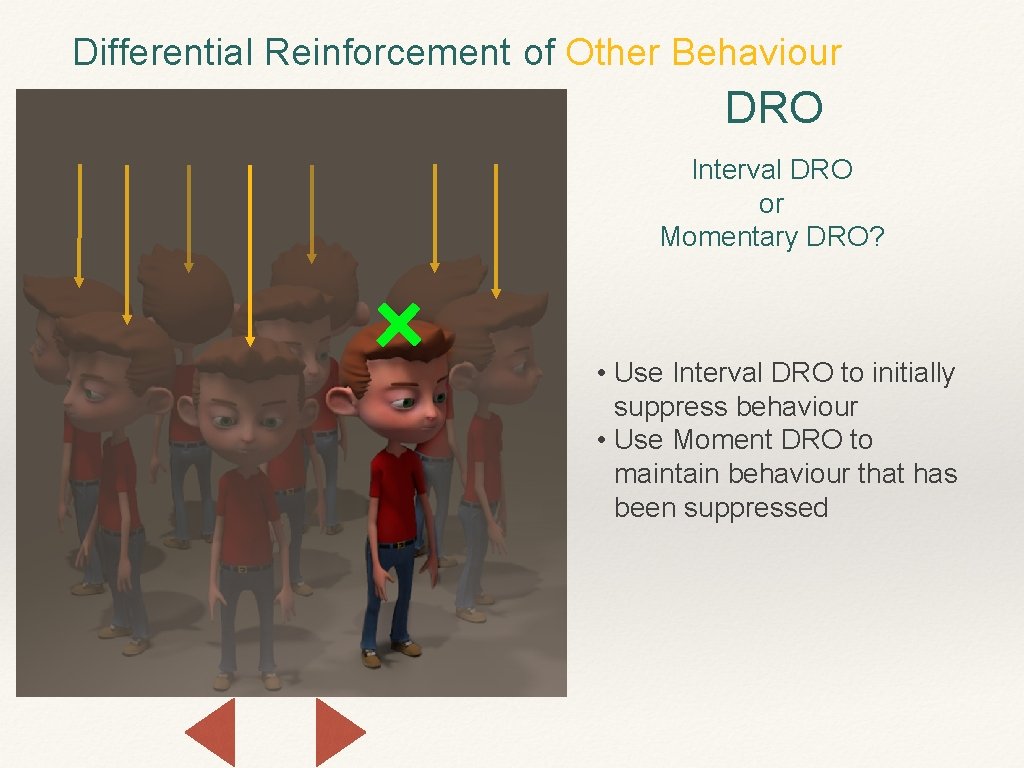
Differential Reinforcement of Other Behaviour DRO Interval DRO or Momentary DRO? • Use Interval DRO to initially suppress behaviour • Use Moment DRO to maintain behaviour that has been suppressed
Differential Reinforcement of Other Behaviour DRO Here are links to show some examples of this procedure in action You. Tube 1 2 3 4 5 A COMPARISON OF TWO PROCEDURES FOR PROGRAMMING THE DIFFERENTIAL REINFORCEMENT OF OTHER BEHAVIORS THE EFFECT OF RULES ON DIFFERENTIAL REINFORCEMENT OF OTHER BEHAVIOR THERAPIST- AND SELF-MONITORED DRO CONTINGENCIES AS A TREATMENT FOR THE SELF-INJURIOUS SKIN PICKING OF A YOUNG MAN WITH ASPERGER SYNDROME
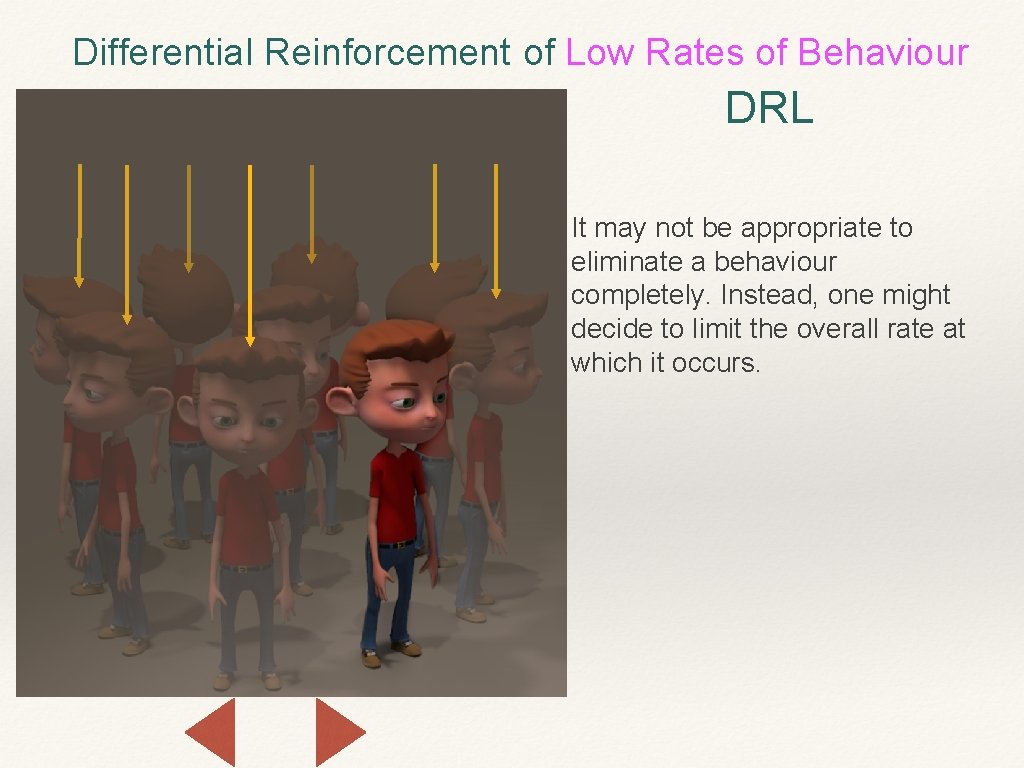
Differential Reinforcement of Low Rates of Behaviour DRL It may not be appropriate to eliminate a behaviour completely. Instead, one might decide to limit the overall rate at which it occurs.
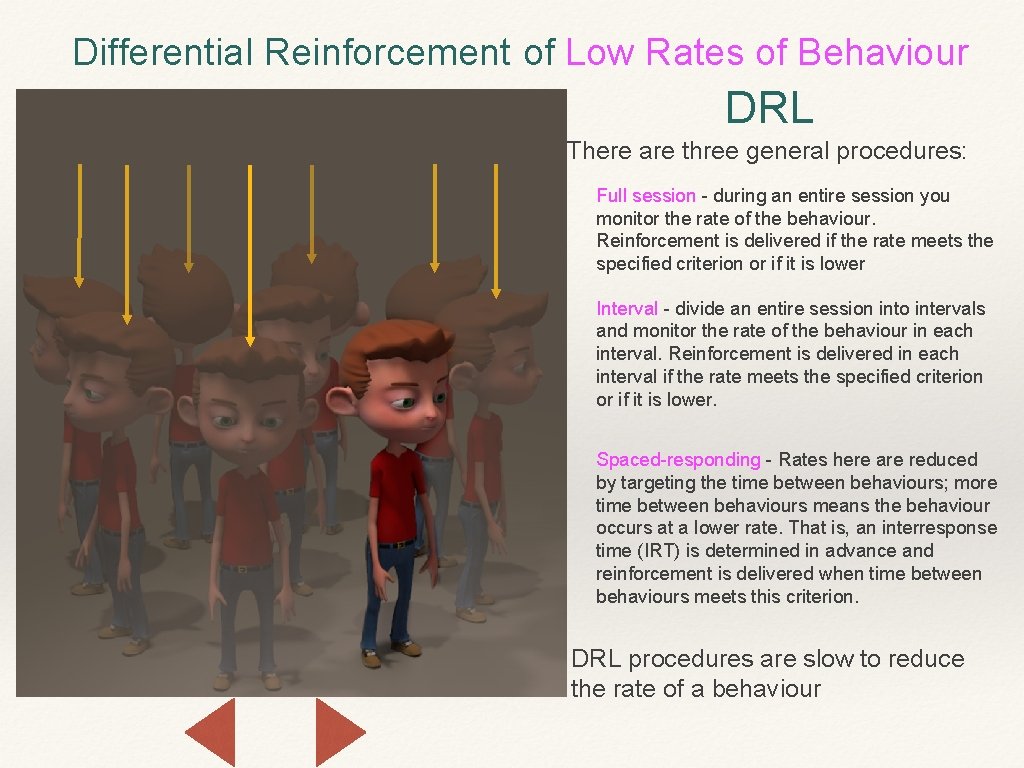
Differential Reinforcement of Low Rates of Behaviour DRL There are three general procedures: Full session - during an entire session you monitor the rate of the behaviour. Reinforcement is delivered if the rate meets the specified criterion or if it is lower Interval - divide an entire session into intervals and monitor the rate of the behaviour in each interval. Reinforcement is delivered in each interval if the rate meets the specified criterion or if it is lower. Spaced-responding - Rates here are reduced by targeting the time between behaviours; more time between behaviours means the behaviour occurs at a lower rate. That is, an interresponse time (IRT) is determined in advance and reinforcement is delivered when time between behaviours meets this criterion. DRL procedures are slow to reduce the rate of a behaviour
Differential Reinforcement of Low Rates of Behaviour DRL Here are links to show some examples of this procedure in action You. Tube 1 2 3 4 USING DIFFERENTIAL REINFORCEMENT OF LOW RATES TO REDUCE CHILDREN'S REQUESTS FOR TEACHER ATTENTION DECREASING CLASSROOM MISBEHAVIOR THROUGH THE USE OF DRL SCHEDULES OF REINFORCEMENT DIFFERENTIALLY REINFORCING LOW RATES OF MISBEHAVIOR WITH NORMAL ELEMENTARY SCHOOL CHILDREN
- Slides: 20