
Differential Privacy in Practice Georgios Kellaris Privacypreserving data

![Composition Theorem [Dwork et al. , TCC’ 06] ϵ 1 M 1 D ϵ](https://slidetodoc.com/presentation_image_h2/7899d21753b77371e9a0e03e8f47623a/image-19.jpg "Composition Theorem [Dwork et al. , TCC’ 06] ϵ 1 M 1 D ϵ")
- Slides: 88
Differential Privacy in Practice Georgios Kellaris
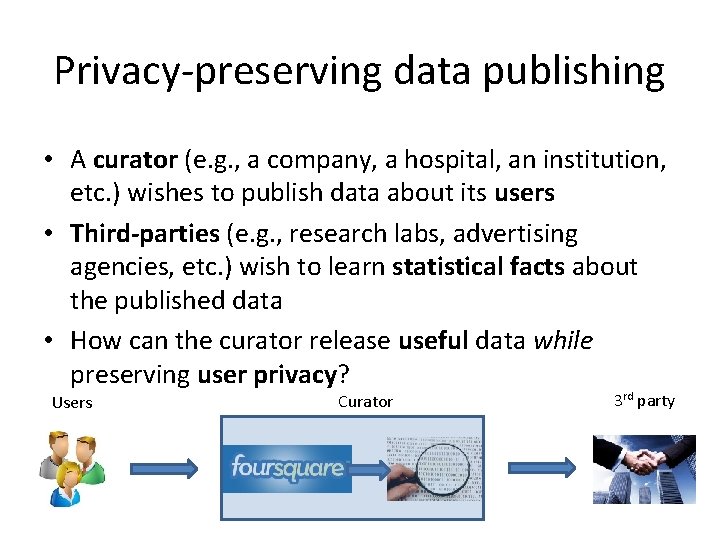
Privacy-preserving data publishing • A curator (e. g. , a company, a hospital, an institution, etc. ) wishes to publish data about its users • Third-parties (e. g. , research labs, advertising agencies, etc. ) wish to learn statistical facts about the published data • How can the curator release useful data while preserving user privacy? Users Curator 3 rd party
ϵ-differential privacy • Publishing statistics can reveal potentially private information • Goal: Encourage user participation in the statistical analysis • How? Prove that whether they participate in the analysis or not, the revealed information is almost the same
ϵ-differential privacy • Prove that the participation of any single user in the published data will not increase the adversary’s knowledge
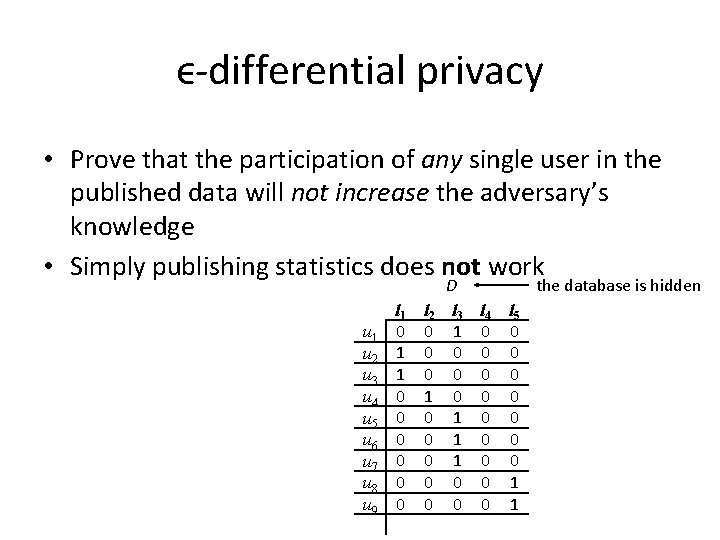
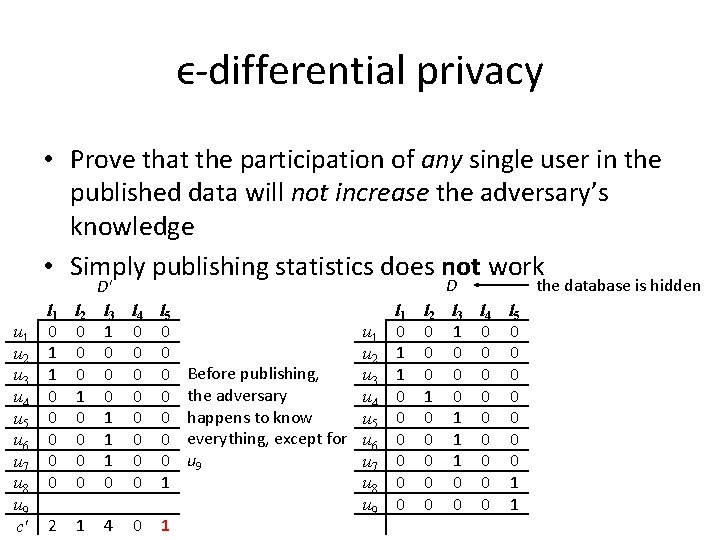
ϵ-differential privacy • Prove that the participation of any single user in the published data will not increase the adversary’s knowledge • Simply publishing statistics does not work u 1 u 2 u 3 u 4 u 5 u 6 u 7 u 8 u 9 l 1 l 2 0 0 1 0 0 0 0 0 D the database is hidden l 3 l 4 l 5 1 0 0 0 1 0 0 1 0 0 1
ϵ-differential privacy • Prove that the participation of any single user in the published data will not increase the adversary’s knowledge • Simply publishing statistics does not work u 1 u 2 u 3 u 4 u 5 u 6 u 7 u 8 u 9 c' l 1 l 2 0 0 1 0 0 0 0 2 1 D' l 3 l 4 l 5 1 0 0 0 1 0 0 1 4 0 1 u 2 Before publishing, u 3 the adversary u 4 happens to know u 5 everything, except for u 6 u 9 u 7 u 8 u 9 l 1 l 2 0 0 1 0 0 0 0 0 D the database is hidden l 3 l 4 l 5 1 0 0 0 1 0 0 1 0 0 1
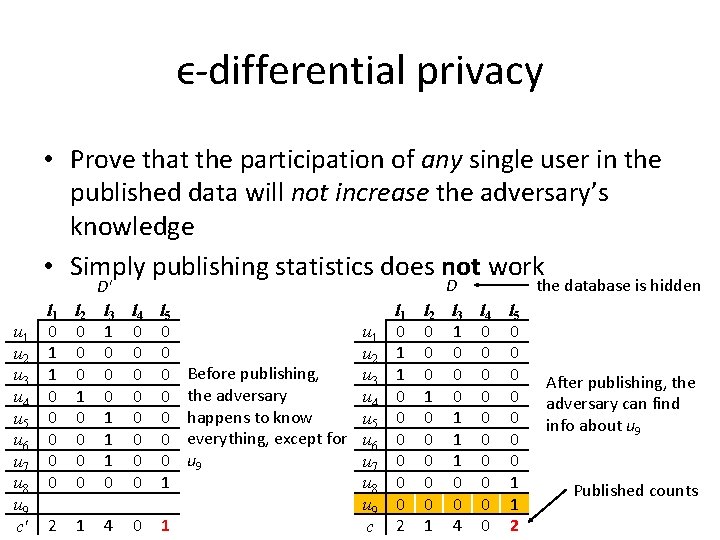
ϵ-differential privacy • Prove that the participation of any single user in the published data will not increase the adversary’s knowledge • Simply publishing statistics does not work u 1 u 2 u 3 u 4 u 5 u 6 u 7 u 8 u 9 c' l 1 l 2 0 0 1 0 0 0 0 2 1 D' l 3 l 4 l 5 1 0 0 0 1 0 0 1 4 0 u 1 u 2 Before publishing, u 3 the adversary u 4 happens to know u 5 everything, except for u 6 u 9 u 7 u 8 u 9 1 c l 1 l 2 0 0 1 0 0 0 0 0 2 1 D the database is hidden l 3 l 4 l 5 1 0 0 0 0 After publishing, the 0 0 0 adversary can find 1 0 0 info about u 9 1 0 0 0 0 1 Published counts 0 0 1 4 0 2
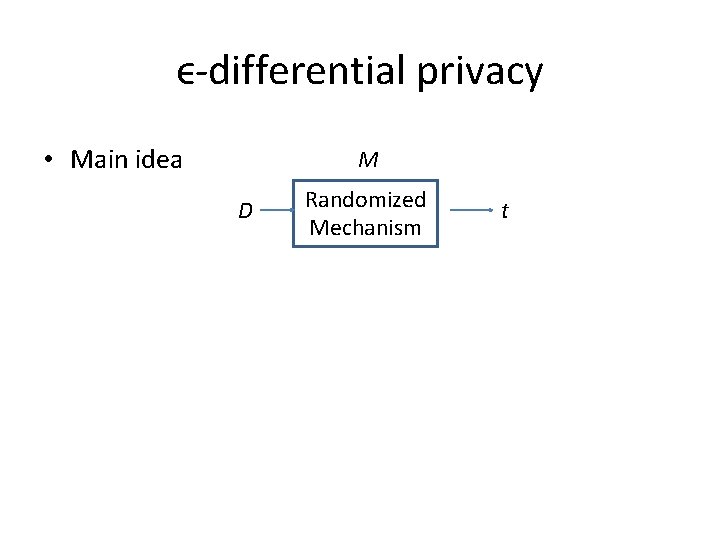
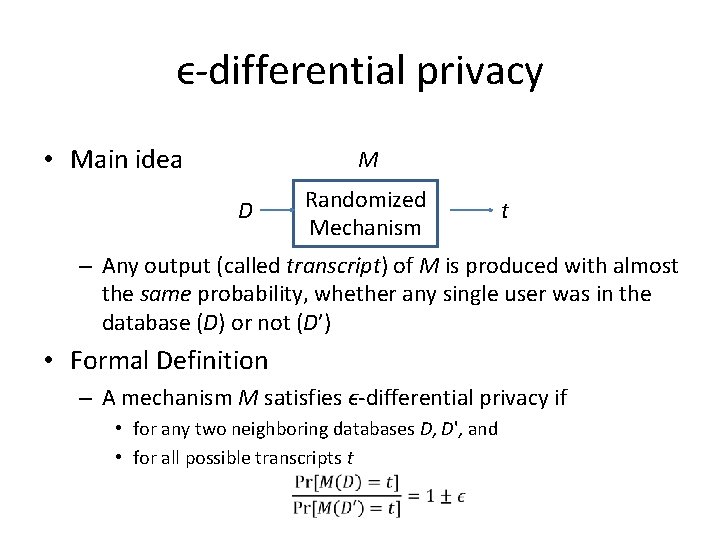
ϵ-differential privacy • Main idea M D Randomized Mechanism t
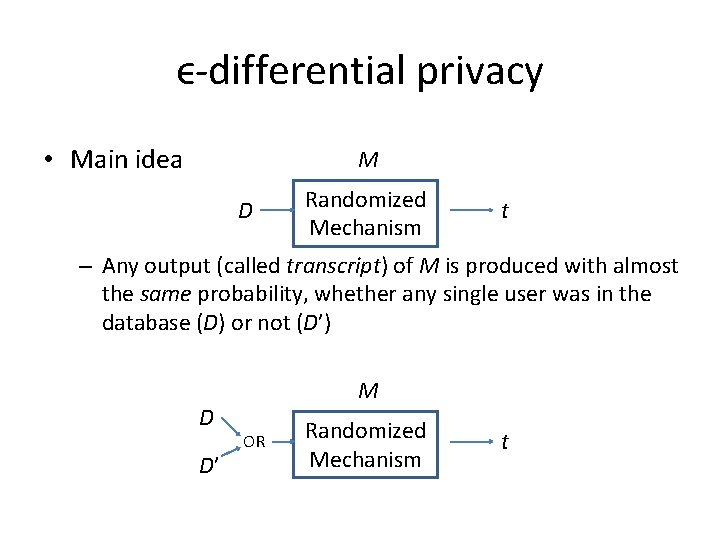
ϵ-differential privacy • Main idea M D Randomized Mechanism t – Any output (called transcript) of M is produced with almost the same probability, whether any single user was in the database (D) or not (D’) D D’ M OR Randomized Mechanism t
ϵ-differential privacy • Main idea M D Randomized Mechanism t – Any output (called transcript) of M is produced with almost the same probability, whether any single user was in the database (D) or not (D’) • Formal Definition – A mechanism M satisfies ϵ-differential privacy if • for any two neighboring databases D, D', and • for all possible transcripts t
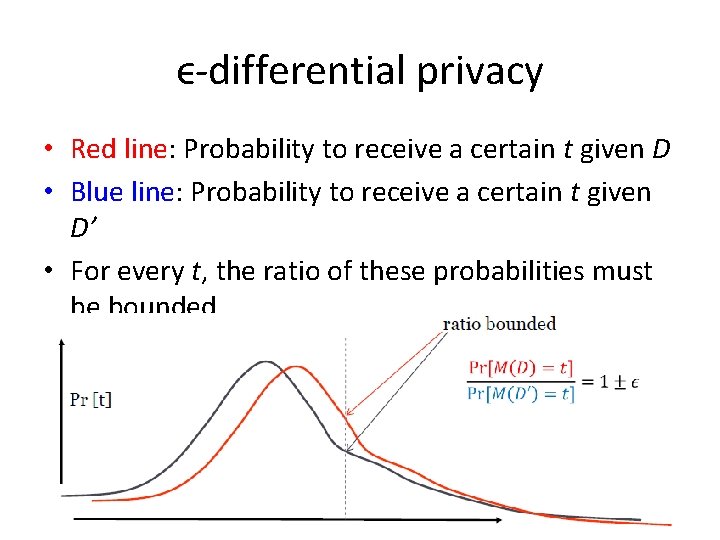
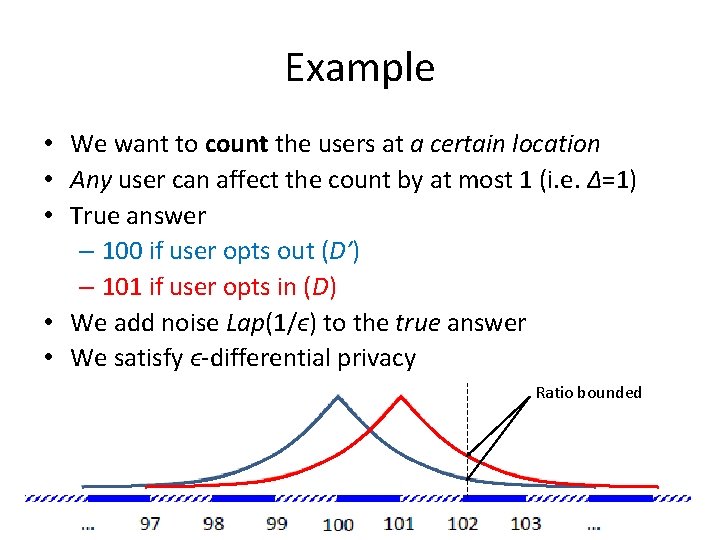
ϵ-differential privacy • Red line: Probability to receive a certain t given D • Blue line: Probability to receive a certain t given D’ • For every t, the ratio of these probabilities must be bounded
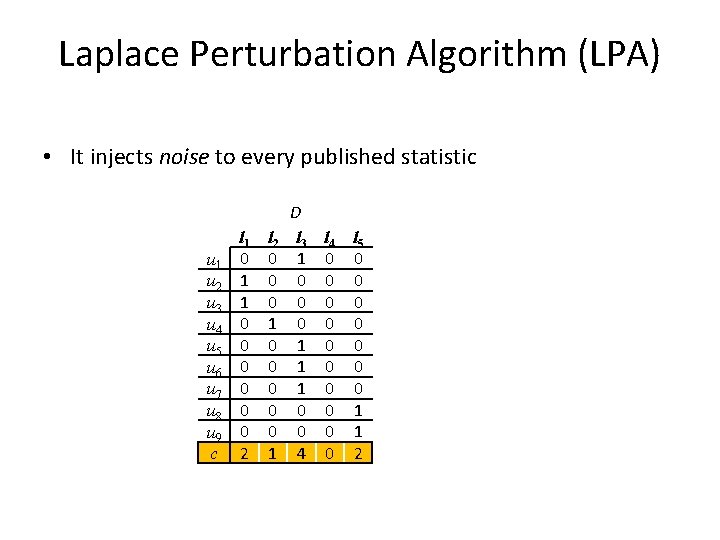
Laplace Perturbation Algorithm (LPA) • It injects noise to every published statistic u 1 u 2 u 3 u 4 u 5 u 6 u 7 u 8 u 9 c l 1 l 2 0 0 1 0 0 0 0 0 2 1 D l 3 l 4 l 5 1 0 0 0 1 0 0 1 0 0 1 4 0 2
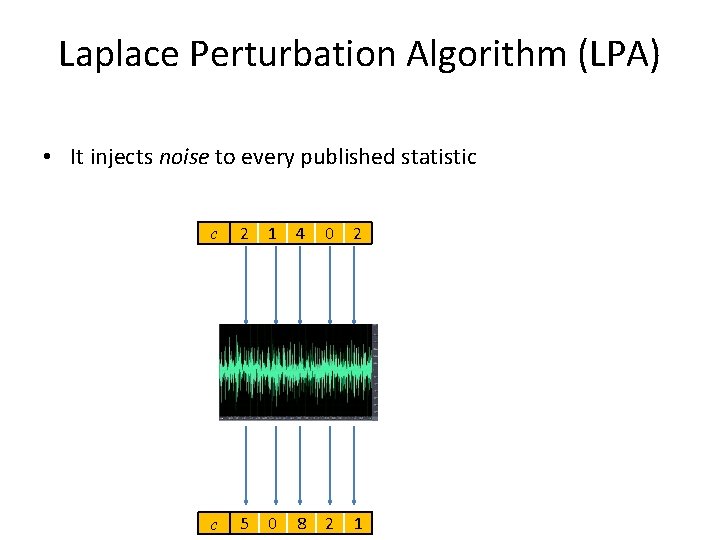
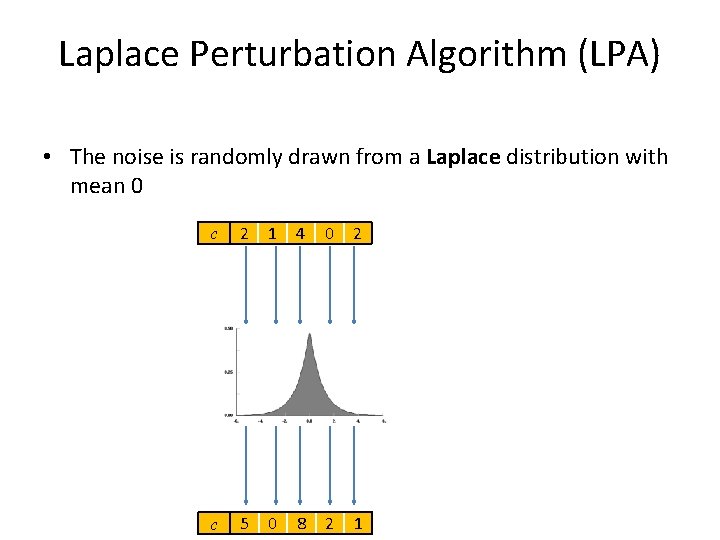
Laplace Perturbation Algorithm (LPA) • It injects noise to every published statistic c 2 1 4 0 2 c 5 0 8 2 1
Laplace Perturbation Algorithm (LPA) • The noise is randomly drawn from a Laplace distribution with mean 0 c 2 1 4 0 2 c 5 0 8 2 1
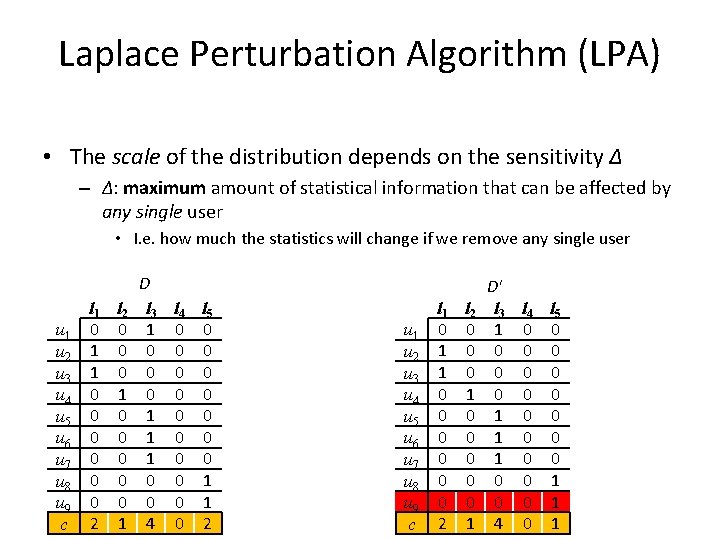
Laplace Perturbation Algorithm (LPA) • The scale of the distribution depends on the sensitivity Δ – Δ: maximum amount of statistical information that can be affected by any single user • I. e. how much the statistics will change if we remove any single user u 1 u 2 u 3 u 4 u 5 u 6 u 7 u 8 u 9 c l 1 l 2 0 0 1 0 0 0 0 0 2 1 D l 3 l 4 l 5 1 0 0 0 1 0 0 1 0 0 1 4 0 2 u 1 u 2 u 3 u 4 u 5 u 6 u 7 u 8 u 9 c l 1 l 2 0 0 1 0 0 0 0 0 2 1 D' l 3 l 4 l 5 1 0 0 0 1 0 0 1 0 0 1 4 0 1
Laplace Perturbation Algorithm (LPA) • Main Result – If the scale of the noise is λ=Δ/ϵ, LPA satisfies ϵdifferential privacy – The higher the noise scale, the less accurate the published statistics • Essentially, it hides the presence of any user, by hiding the effect she has on the published statistics
Example • We want to count the users at a certain location • Any user can affect the count by at most 1 (i. e. Δ=1) • True answer – 100 if user opts out (D’) – 101 if user opts in (D) • We add noise Lap(1/ϵ) to the true answer • We satisfy ϵ-differential privacy Ratio bounded
Privacy Levels • If a mechanism M adds noise Lap(aΔ/ϵ) to its statistics, it satisfies ϵ/a-differential privacy • E. g. let Δ=1 and a fixed ϵ – If a mechanism adds noise Lap(1/ϵ), it satisfies ϵdifferential privacy – If a mechanism adds noise Lap(2/ϵ), it satisfies ϵ/2 -differential privacy – If a mechanism adds noise Lap(3/ϵ), it satisfies ϵ/3 -differential privacy – Etc.
Composition Theorem [Dwork et al. , TCC’ 06] ϵ 1 M 1 D ϵ 2 M 2 … ϵn Mn
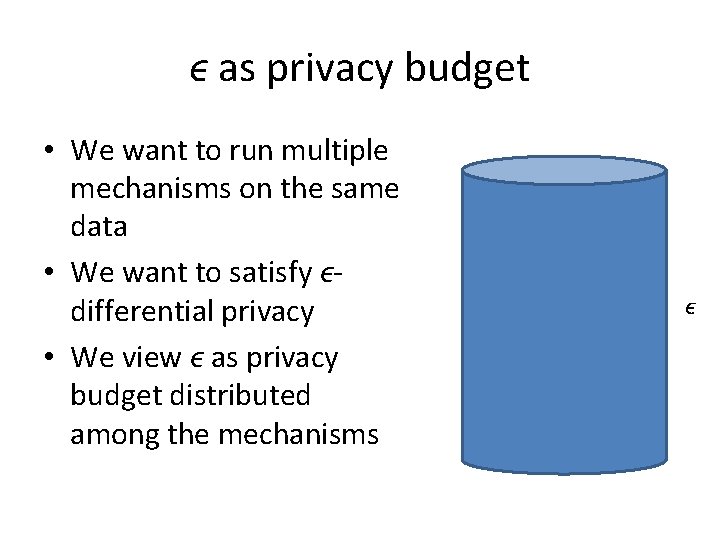
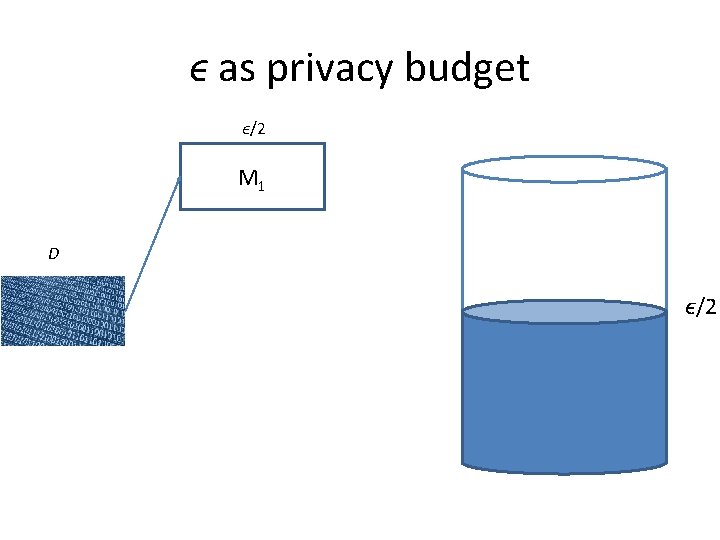
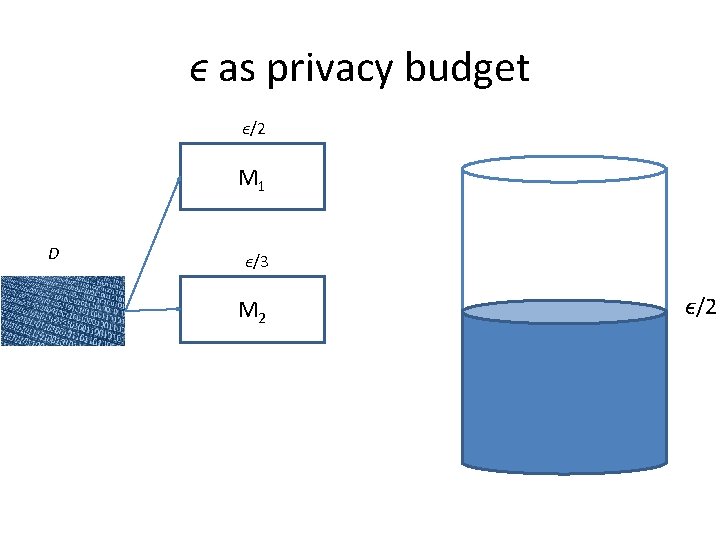
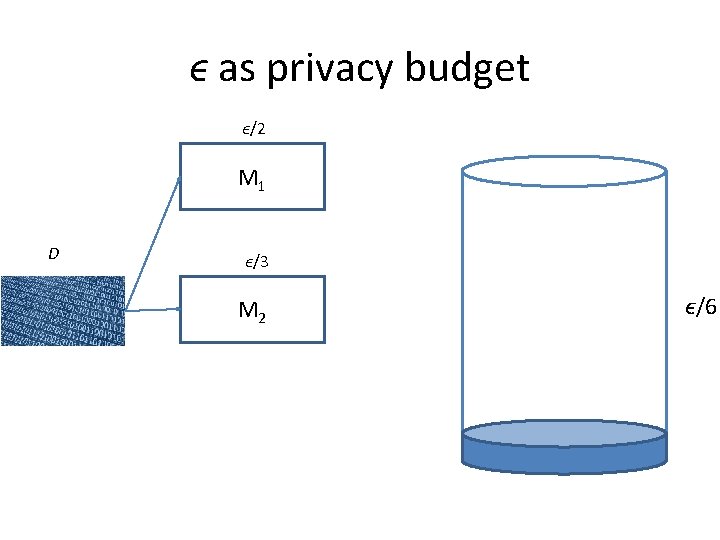
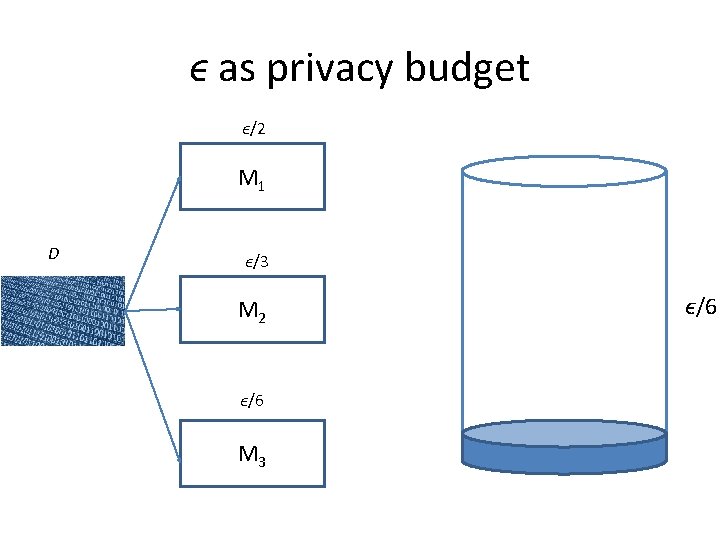
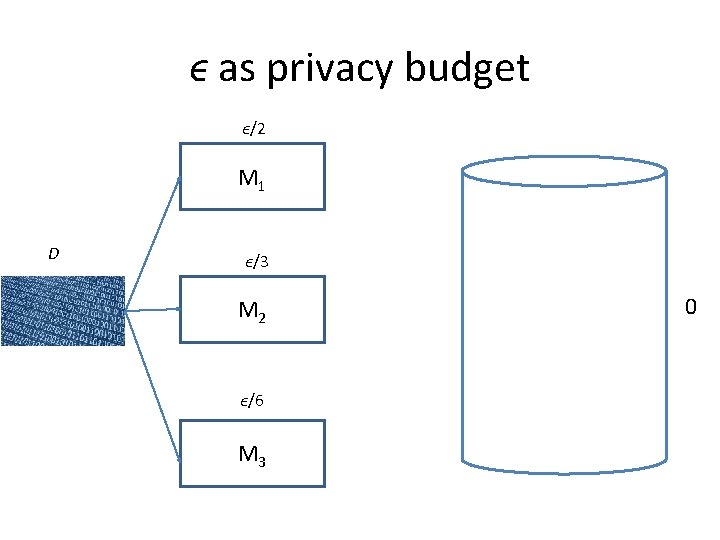
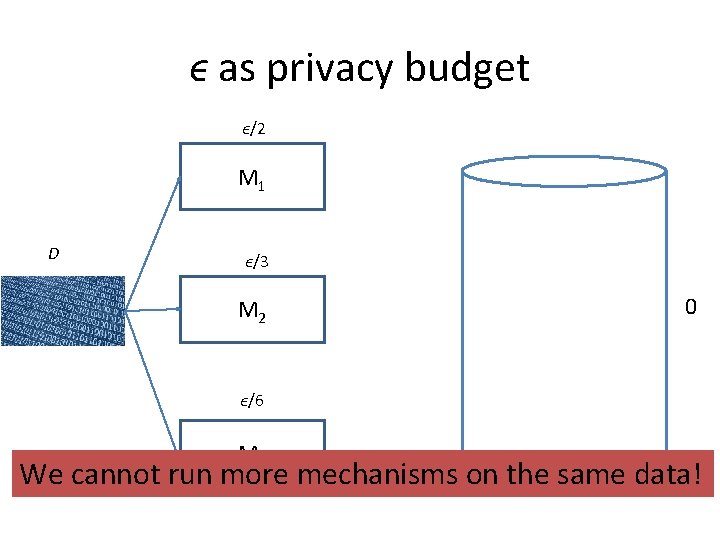
ϵ as privacy budget • We want to run multiple mechanisms on the same data • We want to satisfy ϵdifferential privacy • We view ϵ as privacy budget distributed among the mechanisms ϵ
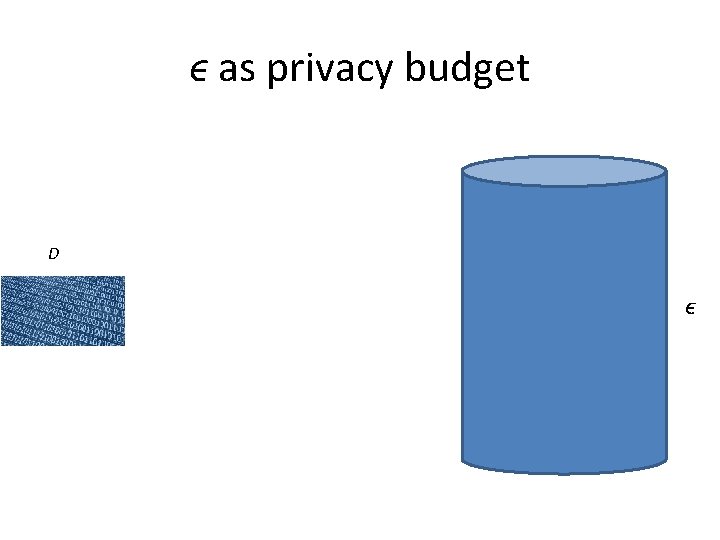
ϵ as privacy budget D ϵ
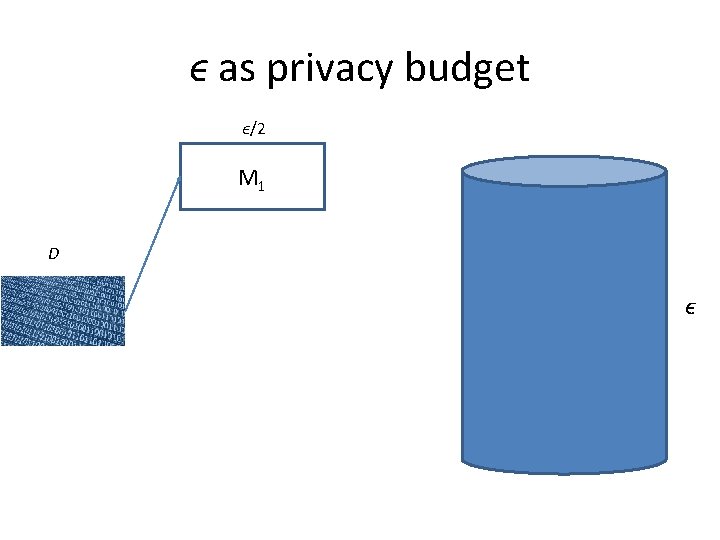
ϵ as privacy budget ϵ/2 M 1 D ϵ
ϵ as privacy budget ϵ/2 M 1 D ϵ/2
ϵ as privacy budget ϵ/2 M 1 D ϵ/3 M 2 ϵ/2
ϵ as privacy budget ϵ/2 M 1 D ϵ/3 M 2 ϵ/6
ϵ as privacy budget ϵ/2 M 1 D ϵ/3 M 2 ϵ/6 M 3 ϵ/6
ϵ as privacy budget ϵ/2 M 1 D ϵ/3 M 2 ϵ/6 M 3 0
ϵ as privacy budget ϵ/2 M 1 D ϵ/3 M 2 0 ϵ/6 M 3 We cannot run more mechanisms on the same data!
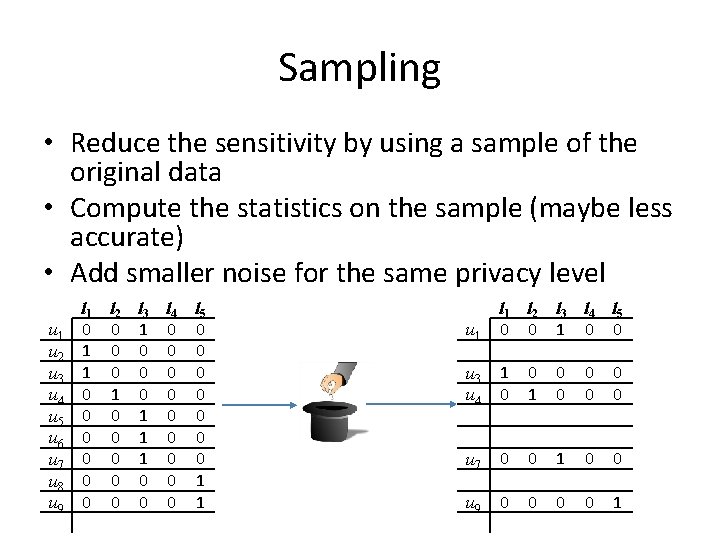
Sampling • Reduce the sensitivity by using a sample of the original data • Compute the statistics on the sample (maybe less accurate) • Add smaller noise for the same privacy level u 1 u 2 u 3 u 4 u 5 u 6 u 7 u 8 u 9 l 1 l 2 l 3 l 4 l 5 0 0 1 0 0 0 0 1 0 0 0 0 1 u 1 l 2 l 3 l 4 l 5 0 0 1 0 0 u 3 u 4 1 0 0 0 0 u 7 0 0 1 0 0 u 9 0 0 1
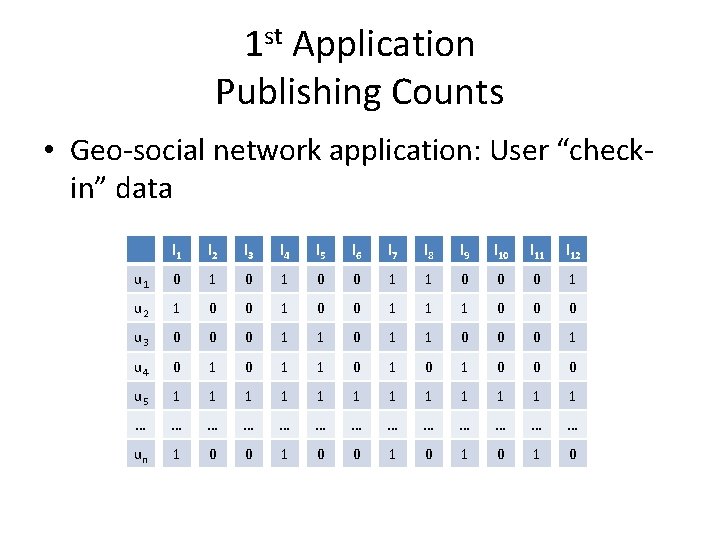
1 st Application Publishing Counts • Geo-social network application: User “checkin” data l 1 l 2 l 3 l 4 l 5 l 6 l 7 l 8 l 9 l 10 l 11 l 12 u 1 0 1 0 0 1 1 0 0 0 1 u 2 1 0 0 1 1 1 0 0 0 u 3 0 0 0 1 1 0 0 0 1 u 4 0 1 1 0 1 0 0 0 u 5 1 1 1 … … … … un 1 0 0 1 0 1 0
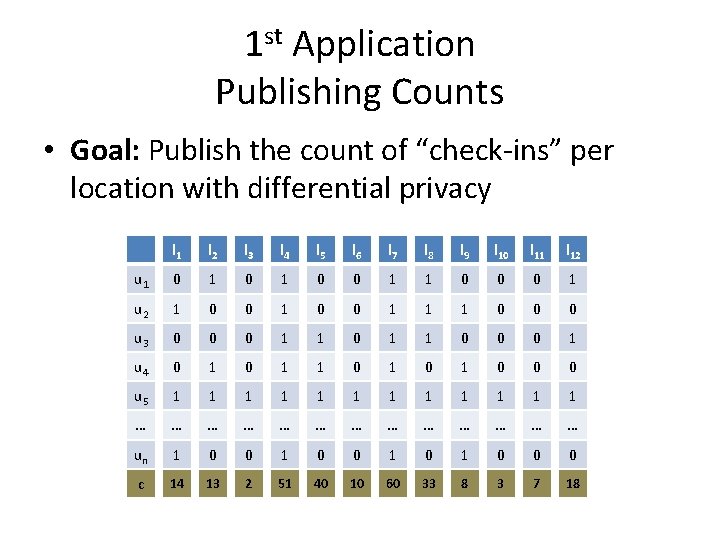
1 st Application Publishing Counts • Goal: Publish the count of “check-ins” per location with differential privacy l 1 l 2 l 3 l 4 l 5 l 6 l 7 l 8 l 9 l 10 l 11 l 12 u 1 0 1 0 0 1 1 0 0 0 1 u 2 1 0 0 1 1 1 0 0 0 u 3 0 0 0 1 1 0 0 0 1 u 4 0 1 1 0 1 0 0 0 u 5 1 1 1 … … … … un 1 0 0 0 c 14 13 2 51 40 10 60 33 8 3 7 18
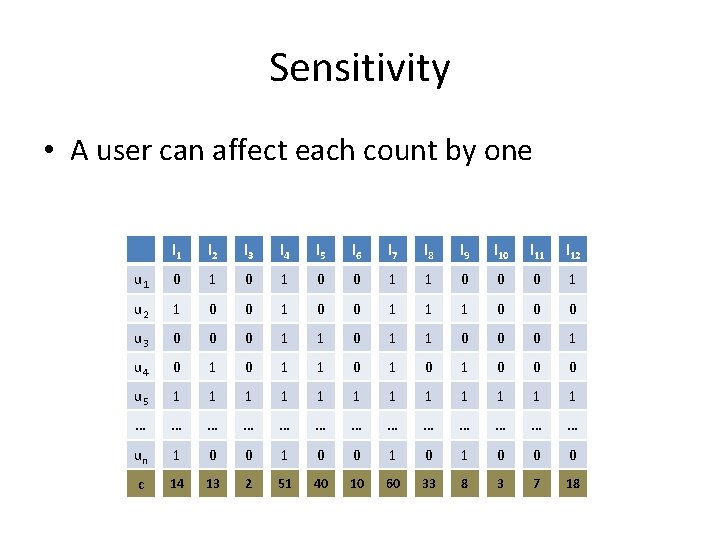
Sensitivity • A user can affect each count by one l 1 l 2 l 3 l 4 l 5 l 6 l 7 l 8 l 9 l 10 l 11 l 12 u 1 0 1 0 0 1 1 0 0 0 1 u 2 1 0 0 1 1 1 0 0 0 u 3 0 0 0 1 1 0 0 0 1 u 4 0 1 1 0 1 0 0 0 u 5 1 1 1 … … … … un 1 0 0 0 c 14 13 2 51 40 10 60 33 8 3 7 18
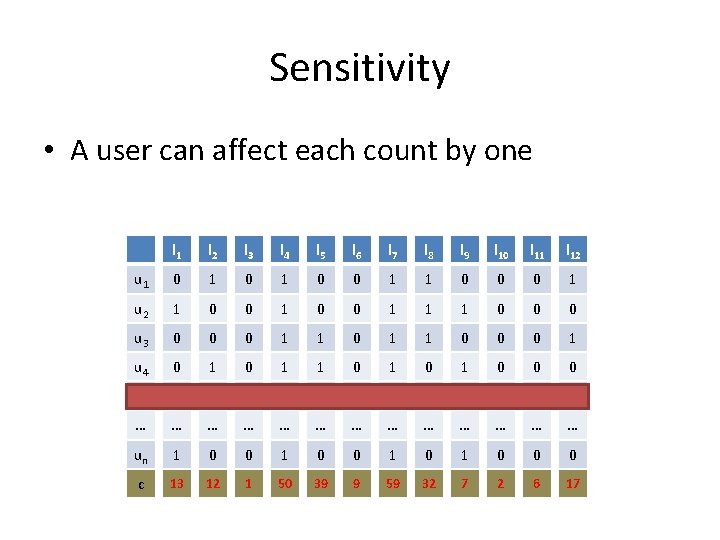
Sensitivity • A user can affect each count by one l 1 l 2 l 3 l 4 l 5 l 6 l 7 l 8 l 9 l 10 l 11 l 12 u 1 0 1 0 0 1 1 0 0 0 1 u 2 1 0 0 1 1 1 0 0 0 u 3 0 0 0 1 1 0 0 0 1 u 4 0 1 1 0 1 0 0 0 u 5 0 1 0 0 0 1 1 … … … … un 1 0 0 0 c 13 12 1 50 39 9 59 32 7 2 6 17
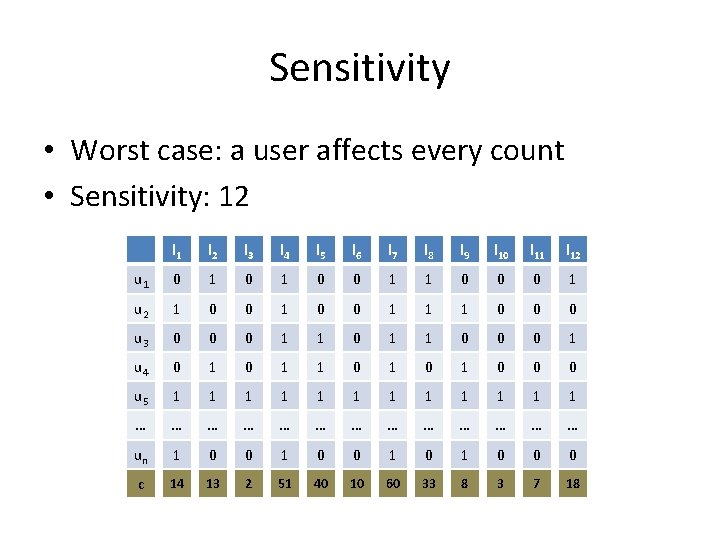
Sensitivity • Worst case: a user affects every count • Sensitivity: 12 l 1 l 2 l 3 l 4 l 5 l 6 l 7 l 8 l 9 l 10 l 11 l 12 u 1 0 1 0 0 1 1 0 0 0 1 u 2 1 0 0 1 1 1 0 0 0 u 3 0 0 0 1 1 0 0 0 1 u 4 0 1 1 0 1 0 0 0 u 5 1 1 1 … … … … un 1 0 0 0 c 14 13 2 51 40 10 60 33 8 3 7 18
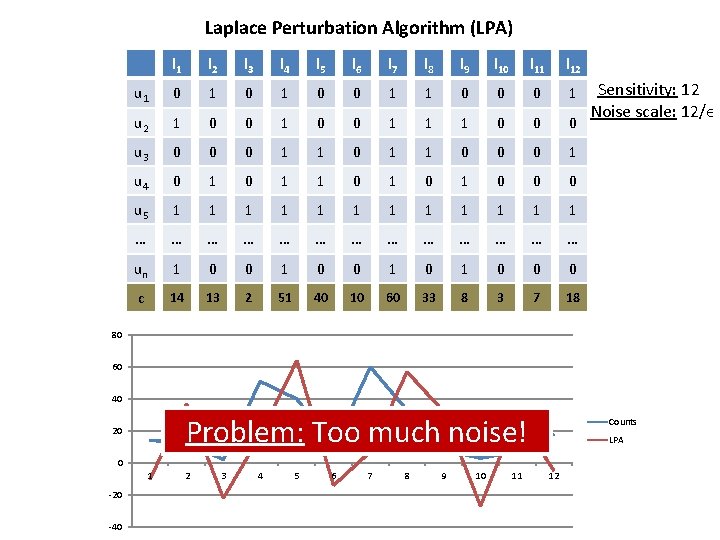
Laplace Perturbation Algorithm (LPA) l 1 l 2 l 3 l 4 l 5 l 6 l 7 l 8 l 9 l 10 l 11 l 12 u 1 0 1 0 0 1 1 0 0 0 1 u 2 1 0 0 1 1 1 0 0 0 u 3 0 0 0 1 1 0 0 0 1 u 4 0 1 1 0 1 0 0 0 u 5 1 1 1 … … … … un 1 0 0 0 c 14 13 2 51 40 10 60 33 8 3 7 18 Sensitivity: 12 Noise scale: 12/ϵ 80 60 40 Problem: Too much noise! 20 Counts LPA 0 1 -20 -40 2 3 4 5 6 7 8 9 10 11 12
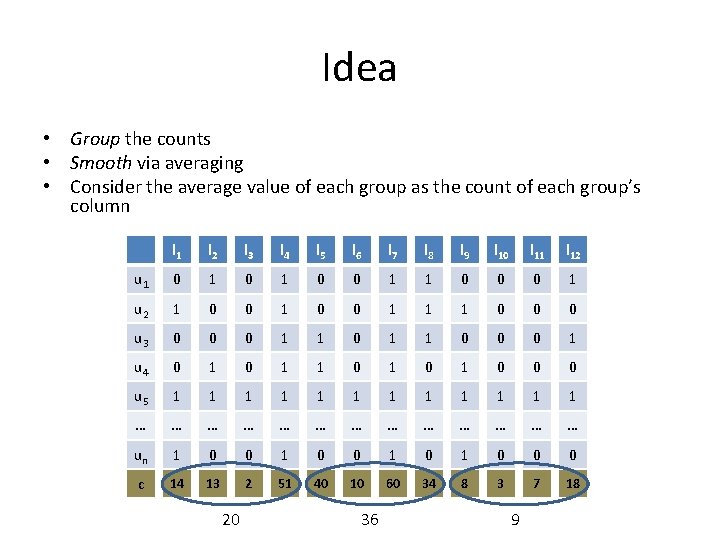
Idea • Group the counts • Smooth via averaging • Consider the average value of each group as the count of each group’s column l 1 l 2 l 3 l 4 l 5 l 6 l 7 l 8 l 9 l 10 l 11 l 12 u 1 0 1 0 0 1 1 0 0 0 1 u 2 1 0 0 1 1 1 0 0 0 u 3 0 0 0 1 1 0 0 0 1 u 4 0 1 1 0 1 0 0 0 u 5 1 1 1 … … … … un 1 0 0 0 c 14 13 2 51 40 10 60 34 8 3 7 18 20 36 9
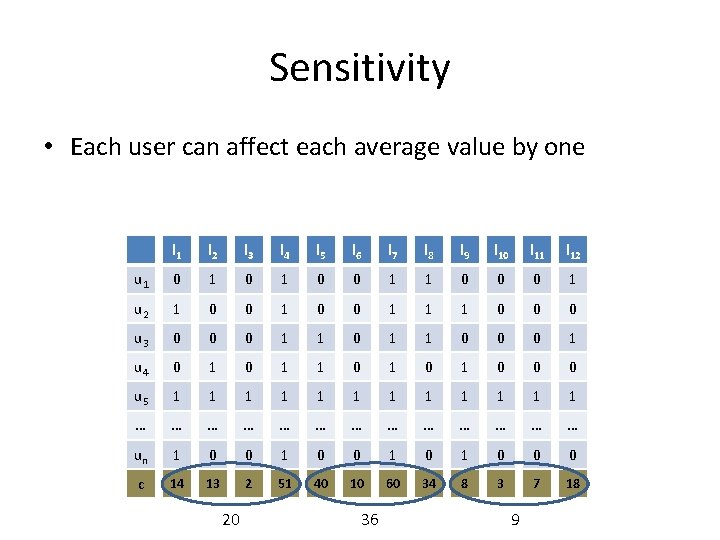
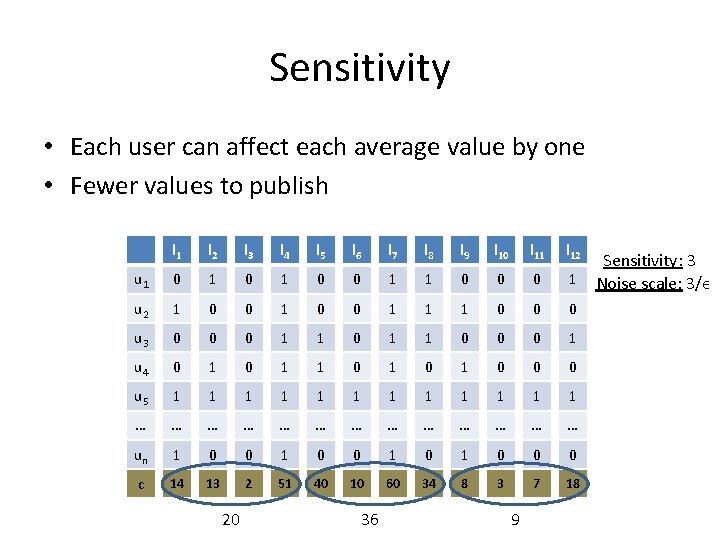
Sensitivity • Each user can affect each average value by one l 1 l 2 l 3 l 4 l 5 l 6 l 7 l 8 l 9 l 10 l 11 l 12 u 1 0 1 0 0 1 1 0 0 0 1 u 2 1 0 0 1 1 1 0 0 0 u 3 0 0 0 1 1 0 0 0 1 u 4 0 1 1 0 1 0 0 0 u 5 1 1 1 … … … … un 1 0 0 0 c 14 13 2 51 40 10 60 34 8 3 7 18 20 36 9
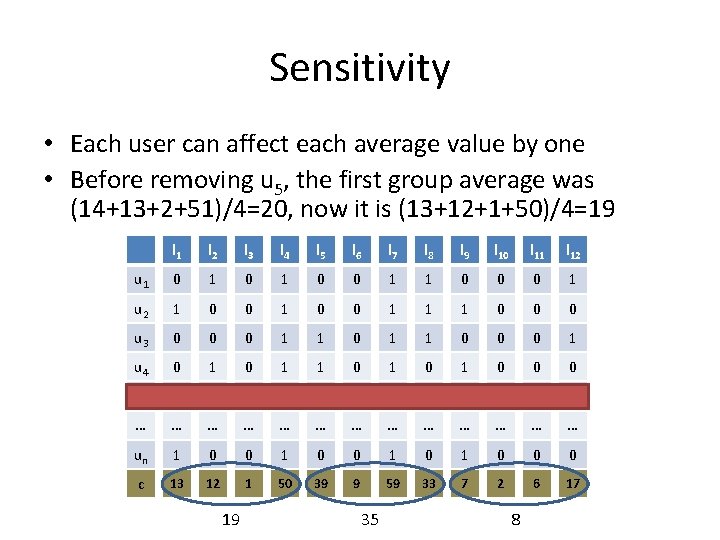
Sensitivity • Each user can affect each average value by one • Before removing u 5, the first group average was (14+13+2+51)/4=20, now it is (13+12+1+50)/4=19 l 1 l 2 l 3 l 4 l 5 l 6 l 7 l 8 l 9 l 10 l 11 l 12 u 1 0 1 0 0 1 1 0 0 0 1 u 2 1 0 0 1 1 1 0 0 0 u 3 0 0 0 1 1 0 0 0 1 u 4 0 1 1 0 1 0 0 0 u 5 1 1 1 … … … … un 1 0 0 0 c 13 12 1 50 39 9 59 33 7 2 6 17 19 35 8
Sensitivity • Each user can affect each average value by one • Fewer values to publish l 1 l 2 l 3 l 4 l 5 l 6 l 7 l 8 l 9 l 10 l 11 l 12 u 1 0 1 0 0 1 1 0 0 0 1 u 2 1 0 0 1 1 1 0 0 0 u 3 0 0 0 1 1 0 0 0 1 u 4 0 1 1 0 1 0 0 0 u 5 1 1 1 … … … … un 1 0 0 0 c 14 13 2 51 40 10 60 34 8 3 7 18 20 36 9 Sensitivity: 3 Noise scale: 3/ϵ
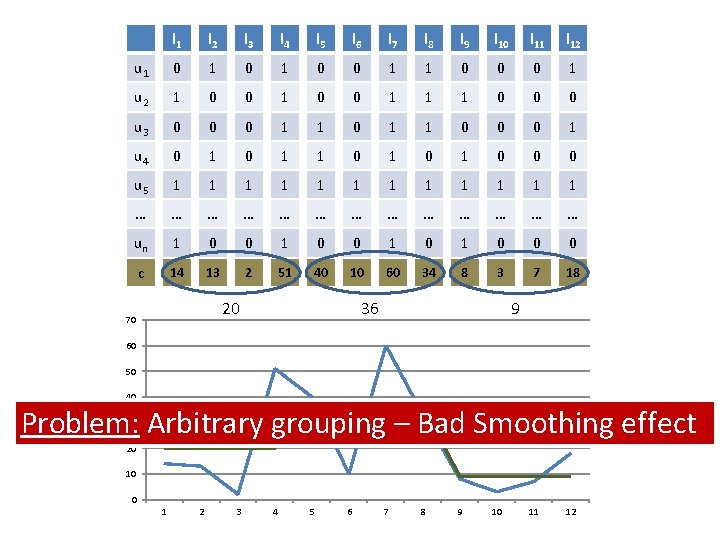
l 1 l 2 l 3 l 4 l 5 l 6 l 7 l 8 l 9 l 10 l 11 l 12 u 1 0 1 0 0 1 1 0 0 0 1 u 2 1 0 0 1 1 1 0 0 0 u 3 0 0 0 1 1 0 0 0 1 u 4 0 1 1 0 1 0 0 0 u 5 1 1 1 … … … … un 1 0 0 0 c 14 13 2 51 40 10 60 34 8 3 7 18 20 70 36 9 60 50 40 Counts Problem: Arbitrary grouping – Bad Smoothing effect 30 GS 20 10 0 1 2 3 4 5 6 7 8 9 10 11 12
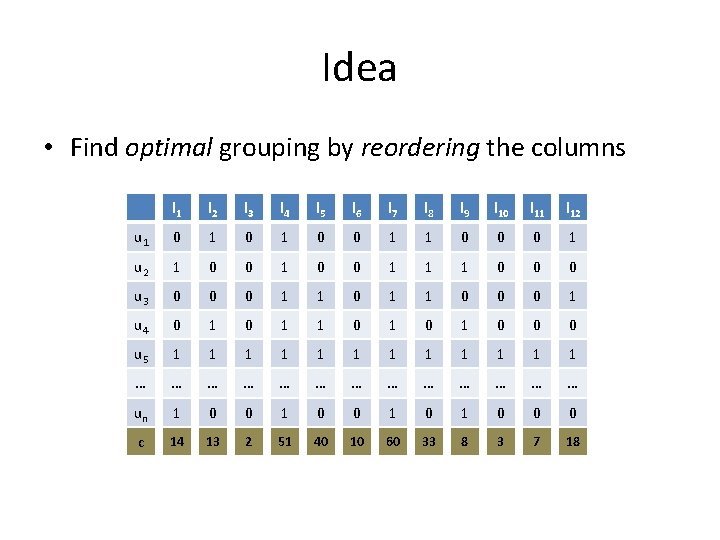
Idea • Find optimal grouping by reordering the columns l 1 l 2 l 3 l 4 l 5 l 6 l 7 l 8 l 9 l 10 l 11 l 12 u 1 0 1 0 0 1 1 0 0 0 1 u 2 1 0 0 1 1 1 0 0 0 u 3 0 0 0 1 1 0 0 0 1 u 4 0 1 1 0 1 0 0 0 u 5 1 1 1 … … … … un 1 0 0 0 c 14 13 2 51 40 10 60 33 8 3 7 18
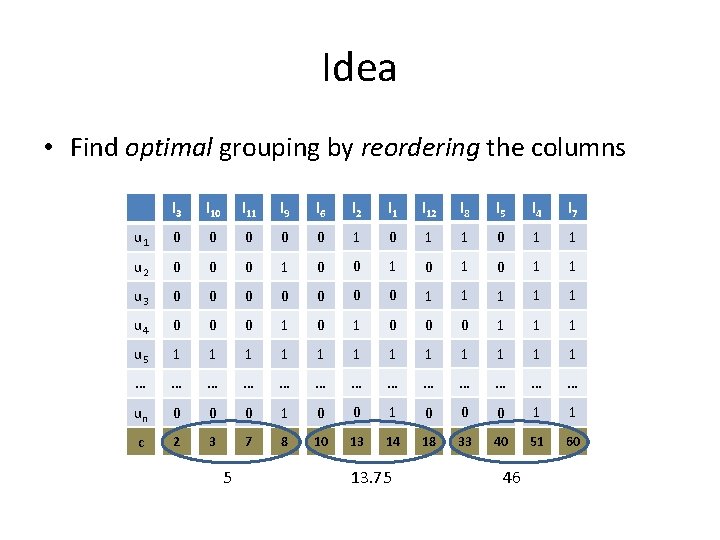
Idea • Find optimal grouping by reordering the columns l 3 l 10 l 11 l 9 l 6 l 2 l 12 l 8 l 5 l 4 l 7 u 1 0 0 0 1 1 u 2 0 0 0 1 0 1 1 u 3 0 0 0 0 1 1 1 u 4 0 0 0 1 1 1 u 5 1 1 1 … … … … un 0 0 0 1 1 c 2 3 7 8 10 13 14 18 33 40 51 60 5 13. 75 46
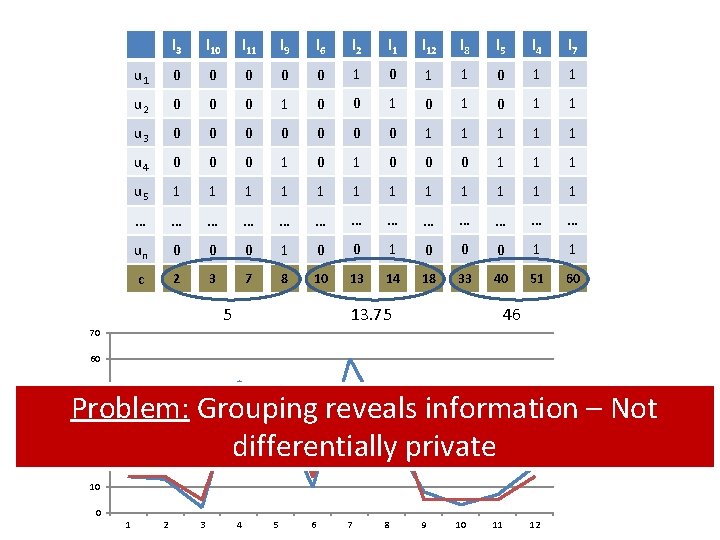
l 3 l 10 l 11 l 9 l 6 l 2 l 12 l 8 l 5 l 4 l 7 u 1 0 0 0 1 1 u 2 0 0 0 1 0 1 1 u 3 0 0 0 0 1 1 1 u 4 0 0 0 1 1 1 u 5 1 1 1 … … … … un 0 0 0 1 1 c 2 3 7 8 10 13 14 18 33 40 51 60 13. 75 5 46 70 60 50 Problem: Grouping reveals information – Not differentially private 40 Counts 30 GS 20 10 0 1 2 3 4 5 6 7 8 9 10 11 12
Challenge: Find “good” groups while retaining differential privacy
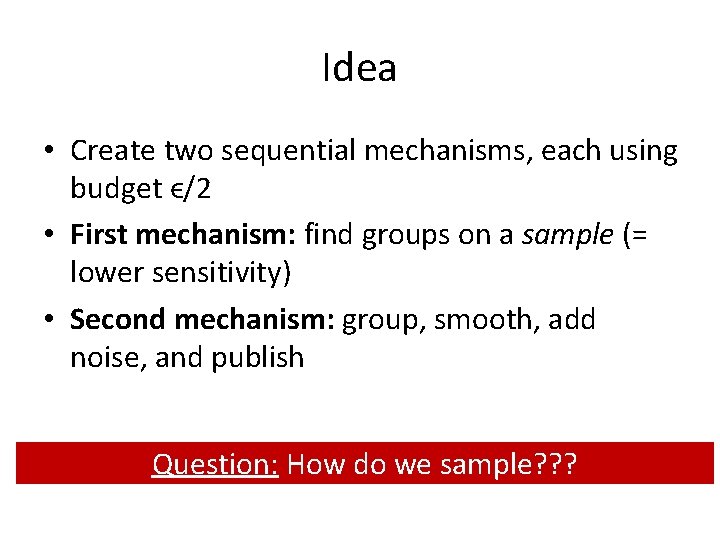
Idea • Create two sequential mechanisms, each using budget ϵ/2 • First mechanism: find groups on a sample (= lower sensitivity) • Second mechanism: group, smooth, add noise, and publish Question: How do we sample? ? ?
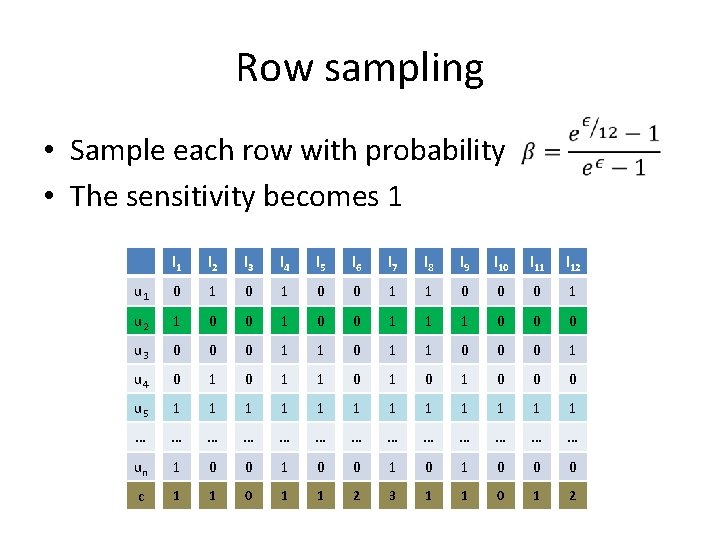
Row sampling • Sample each row with probability • The sensitivity becomes 1 l 2 l 3 l 4 l 5 l 6 l 7 l 8 l 9 l 10 l 11 l 12 u 1 0 1 0 0 1 1 0 0 0 1 u 2 1 0 0 1 1 1 0 0 0 u 3 0 0 0 1 1 0 0 0 1 u 4 0 1 1 0 1 0 0 0 u 5 1 1 1 … … … … un 1 0 0 0 c 1 1 0 1 1 2 3 1 1 0 1 2
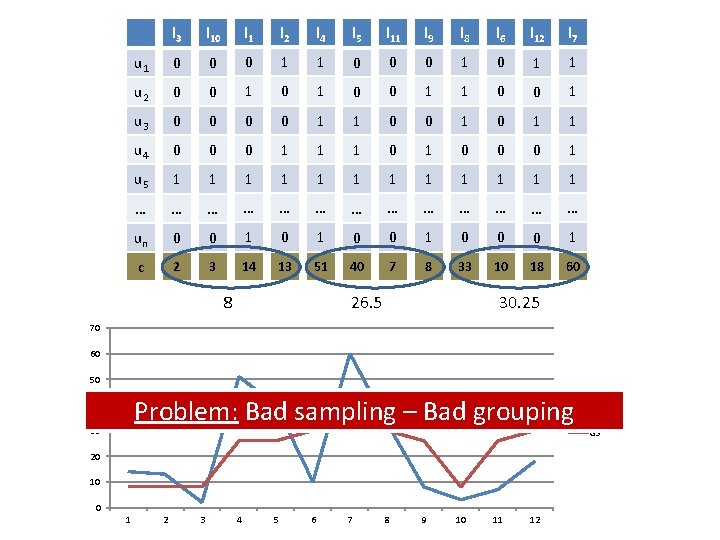
l 3 l 10 l 1 l 2 l 4 l 5 l 11 l 9 l 8 l 6 l 12 l 7 u 1 0 0 0 1 0 1 1 u 2 0 0 1 1 0 0 1 u 3 0 0 1 1 u 4 0 0 0 1 1 1 0 0 0 1 u 5 1 1 1 … … … … un 0 0 1 0 0 0 1 c 2 3 14 13 51 40 7 8 33 10 18 60 26. 5 8 30. 25 70 60 50 Problem: Bad sampling – Bad grouping 40 30 20 10 0 1 2 3 4 5 6 7 8 9 10 11 12 Counts GS
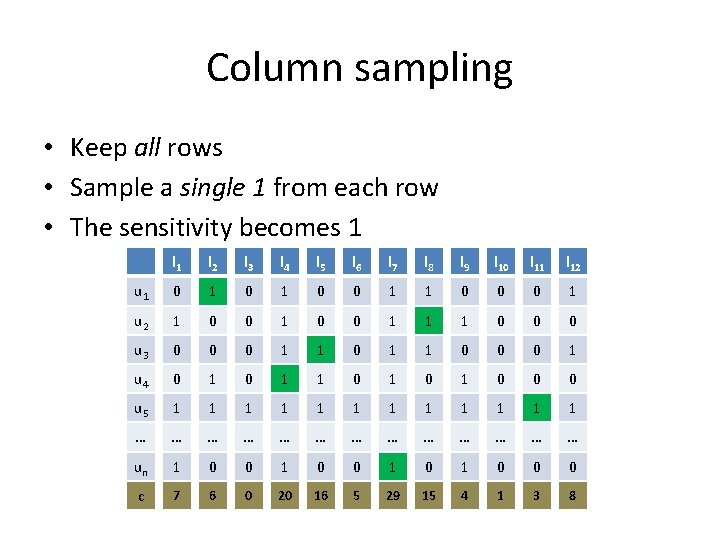
Column sampling • Keep all rows • Sample a single 1 from each row • The sensitivity becomes 1 l 2 l 3 l 4 l 5 l 6 l 7 l 8 l 9 l 10 l 11 l 12 u 1 0 1 0 0 1 1 0 0 0 1 u 2 1 0 0 1 1 1 0 0 0 u 3 0 0 0 1 1 0 0 0 1 u 4 0 1 1 0 1 0 0 0 u 5 1 1 1 … … … … un 1 0 0 0 c 7 6 0 20 16 5 29 15 4 1 3 8
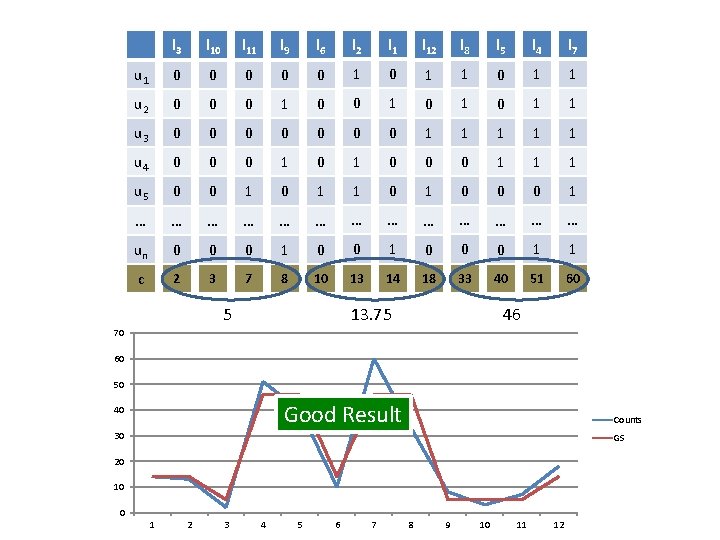
l 3 l 10 l 11 l 9 l 6 l 2 l 12 l 8 l 5 l 4 l 7 u 1 0 0 0 1 1 u 2 0 0 0 1 0 1 1 u 3 0 0 0 0 1 1 1 u 4 0 0 0 1 1 1 u 5 0 0 1 1 0 0 0 1 … … … … un 0 0 0 1 1 c 2 3 7 8 10 13 14 18 33 40 51 60 13. 75 5 46 70 60 50 Good Result 40 Counts 30 GS 20 10 0 1 2 3 4 5 6 7 8 9 10 11 12
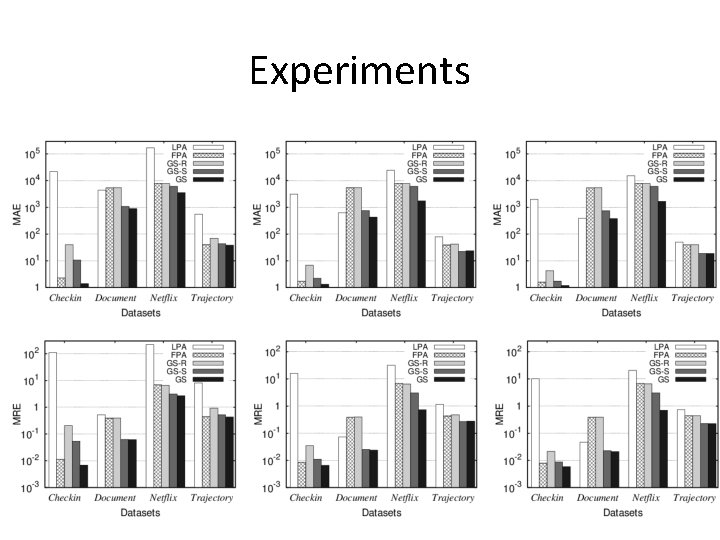
Experiments
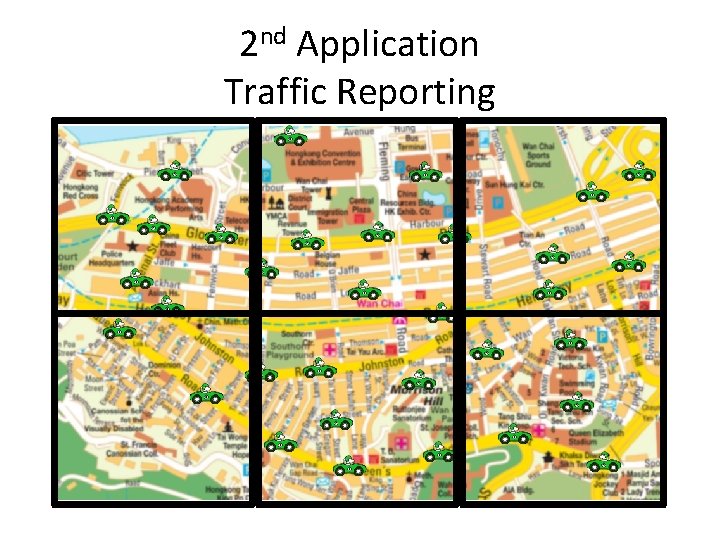
2 nd Application Traffic Reporting
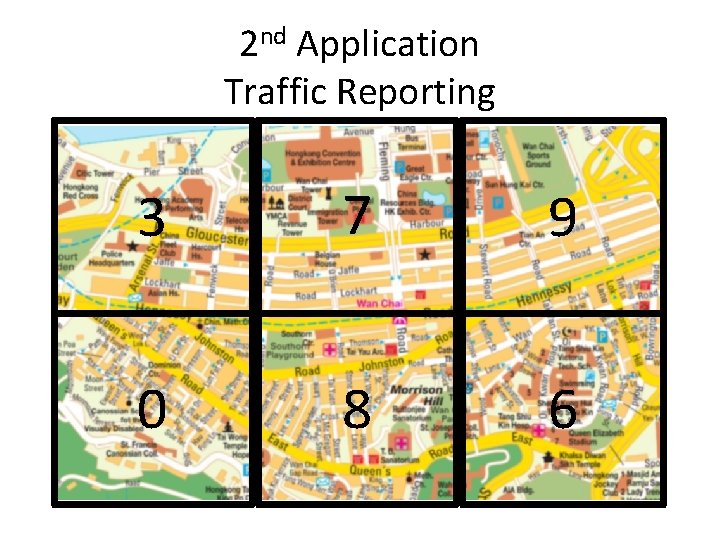
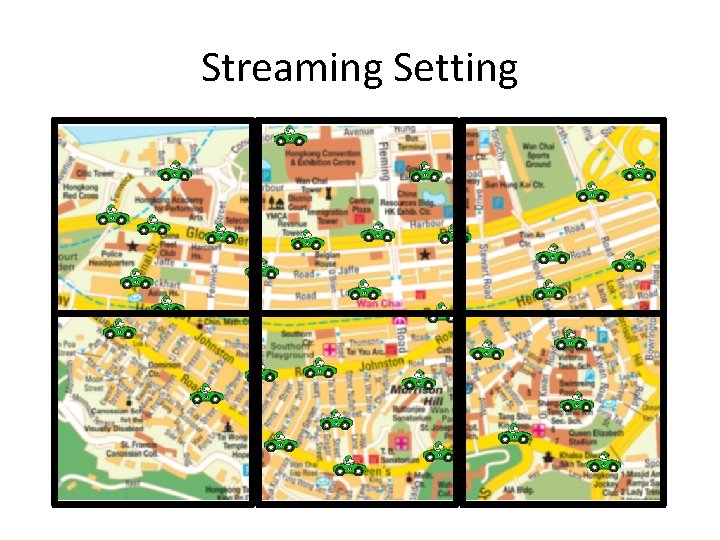
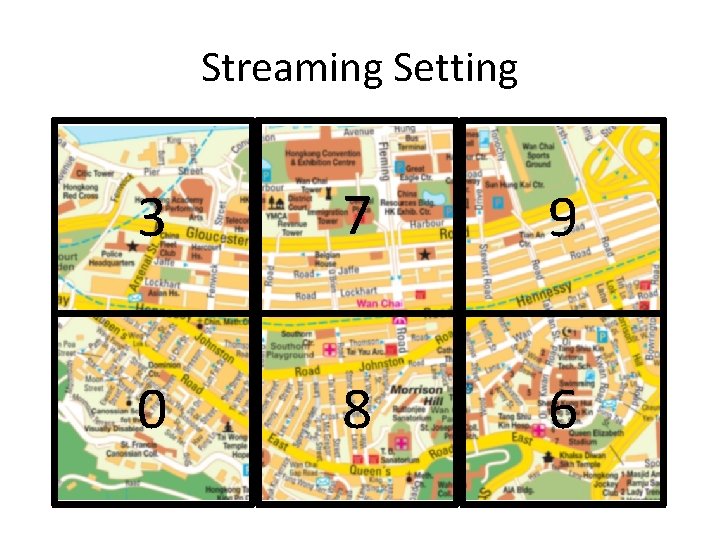
2 nd Application Traffic Reporting 3 7 9 0 8 6
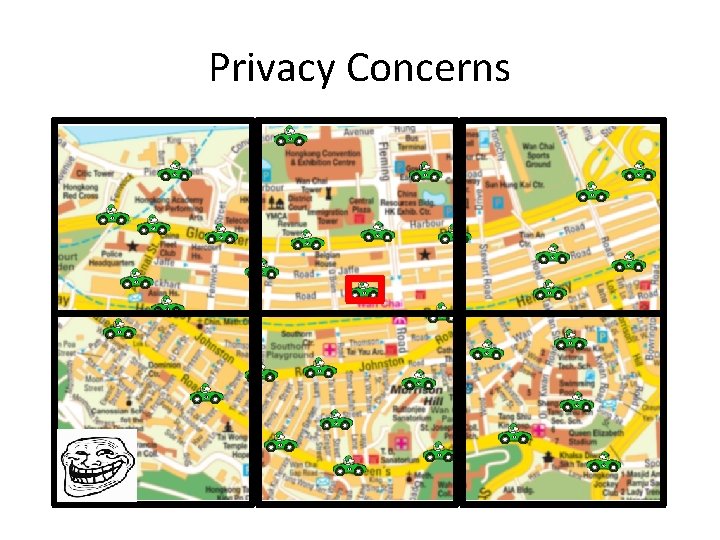
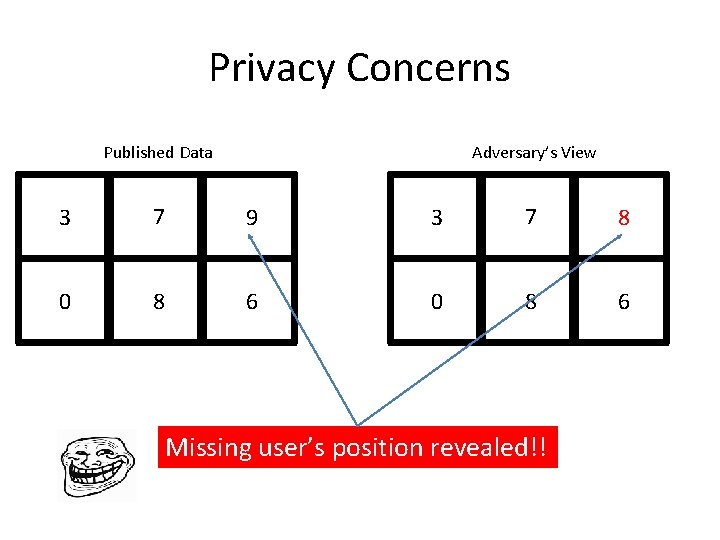
Privacy Concerns
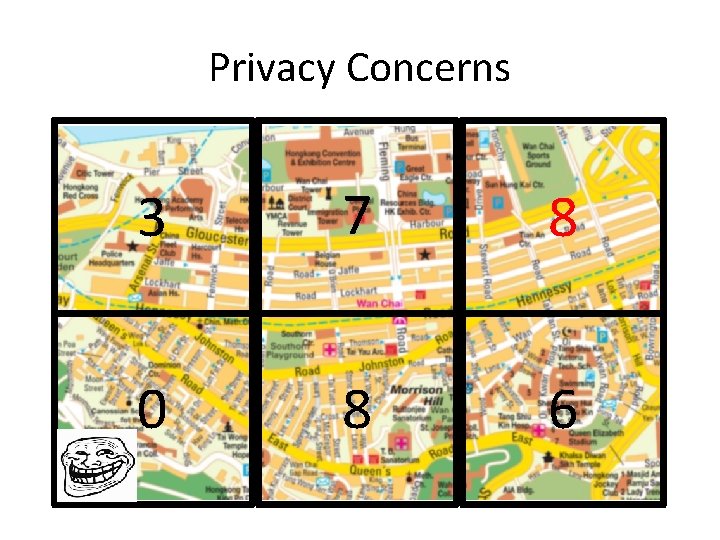
Privacy Concerns 3 7 8 0 8 6
Privacy Concerns Published Data Adversary’s View 3 7 9 3 7 8 0 8 6 Missing user’s position revealed!!
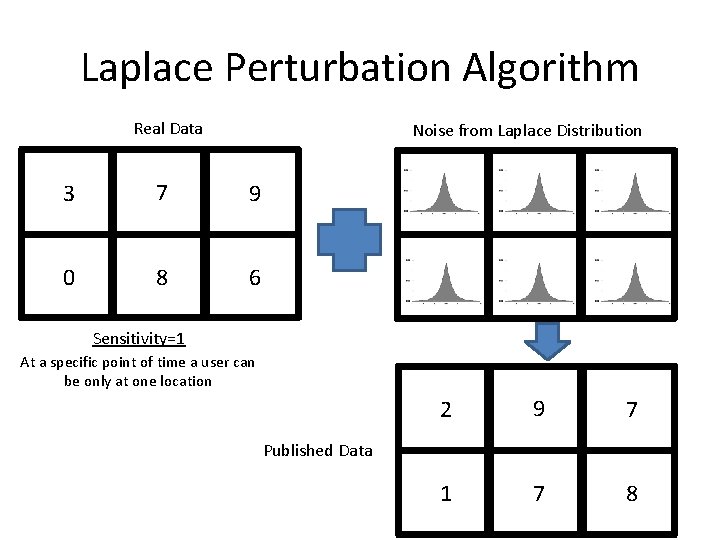
Laplace Perturbation Algorithm Real Data Noise from Laplace Distribution 3 7 9 0 8 6 Sensitivity=1 At a specific point of time a user can be only at one location 2 9 7 1 7 8 Published Data
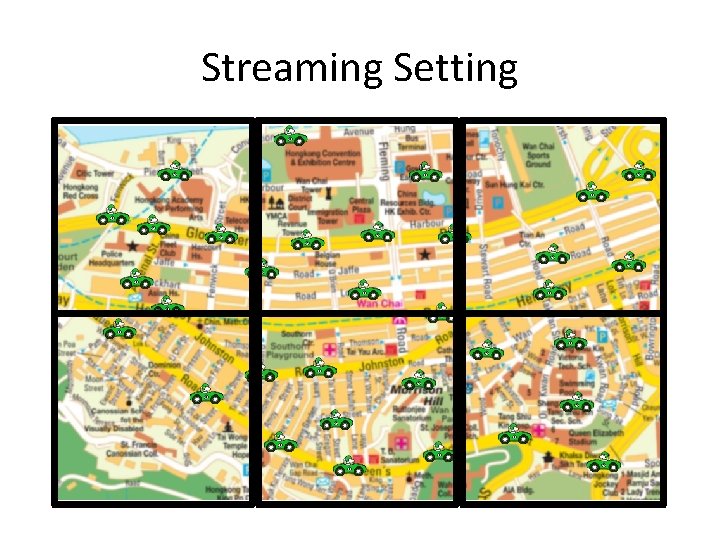
Streaming Setting
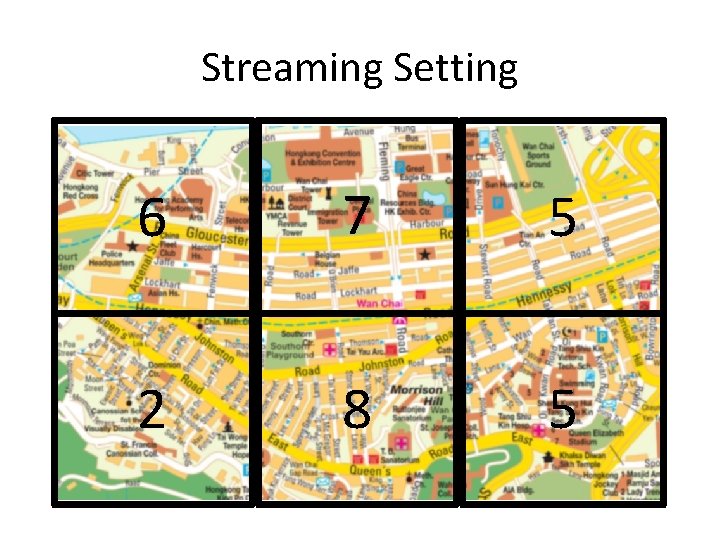
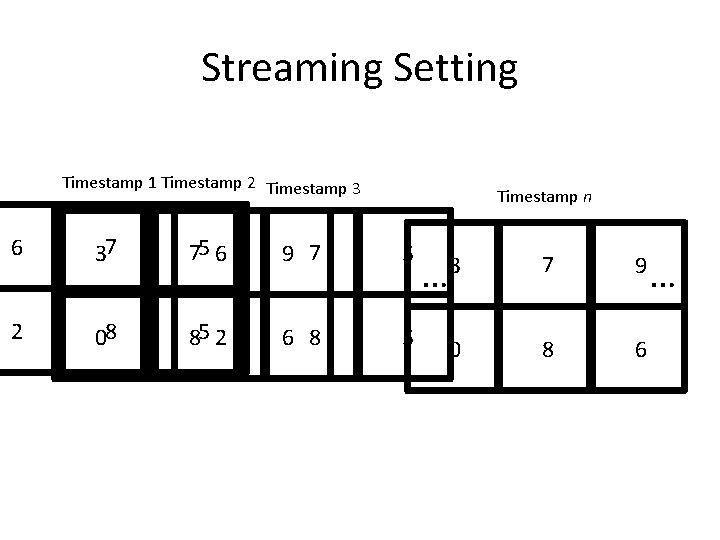
Streaming Setting 6 7 5 2 8 5
Streaming Setting
Streaming Setting 3 7 9 0 8 6
Streaming Setting Timestamp 1 Timestamp 2 Timestamp 3 Timestamp n 6 37 75 6 9 7 5 2 08 85 2 6 8 5 … 3 7 9 0 8 6 …
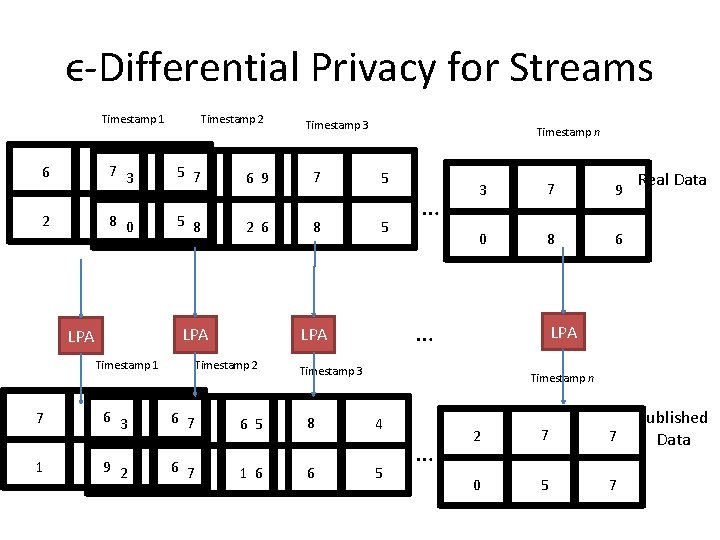
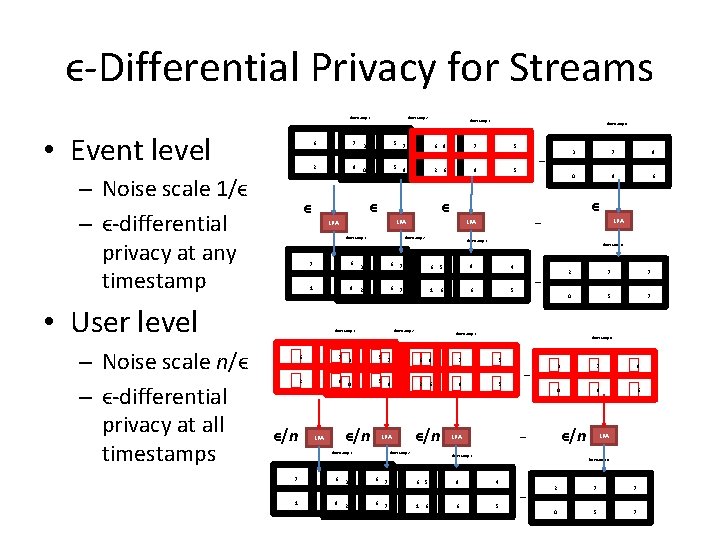
ϵ-Differential Privacy for Streams Timestamp 2 Timestamp 1 6 7 3 5 7 2 8 0 5 8 6 9 2 6 LPA Timestamp 1 6 3 6 7 1 9 2 6 7 7 8 Timestamp n 5 5 6 5 1 6 … 3 7 9 0 8 6 … LPA Timestamp 2 7 Timestamp 3 LPA Timestamp 3 8 6 Real Data Timestamp n 4 5 … 2 7 7 0 5 7 Published Data
ϵ-Differential Privacy for Streams Timestamp 2 Timestamp 1 • Event level 2 – Noise scale 1/ϵ – ϵ-differential privacy at any timestamp 5 3 8 7 8 6 1 9 7 2 6 3 6 2 5 3 8 6 9 3 2 6 7 1 6 8 8 6 LPA Timestamp n 8 5 4 6 6 5 2 7 7 0 5 7 Timestamp n 7 9 5 2 6 ϵ/n 8 5 Timestamp 3 6 5 8 1 6 6 3 7 9 0 8 6 ϵ/n … LPA Timestamp n 4 … 7 0 Timestamp 3 Timestamp 2 6 9 ϵ … 7 7 … … LPA 6 5 3 Timestamp 3 7 7 5 0 ϵ/n LPA 8 LPA Timestamp 2 Timestamp 1 1 6 Timestamp 2 Timestamp 1 7 2 LPA 7 5 ϵ Timestamp 1 6 7 9 ϵ LPA ϵ/n 6 Timestamp n … 5 0 ϵ • User level – Noise scale n/ϵ – ϵ-differential privacy at all timestamps 7 6 Timestamp 3 5 2 7 7 0 5 7
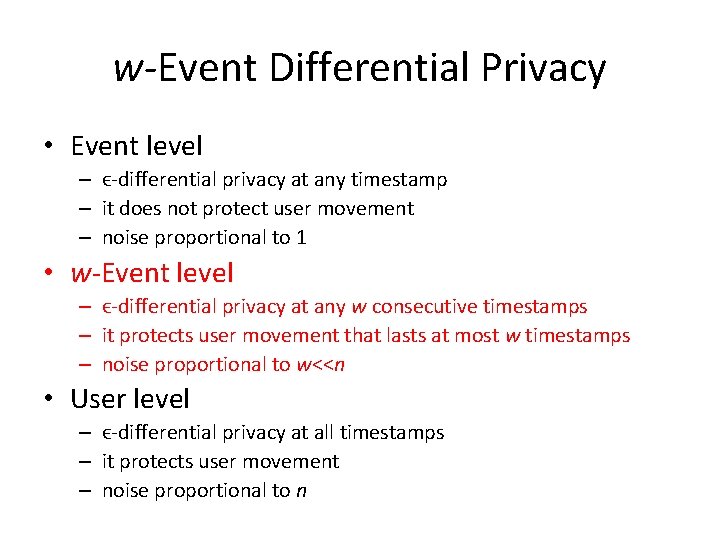
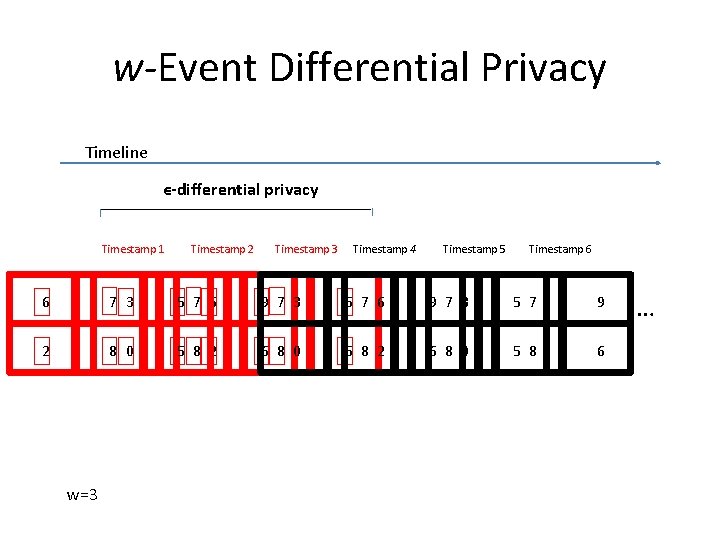
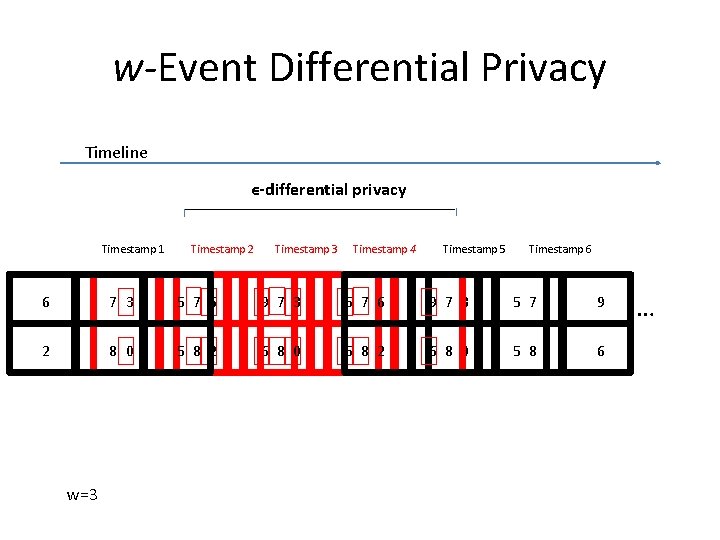
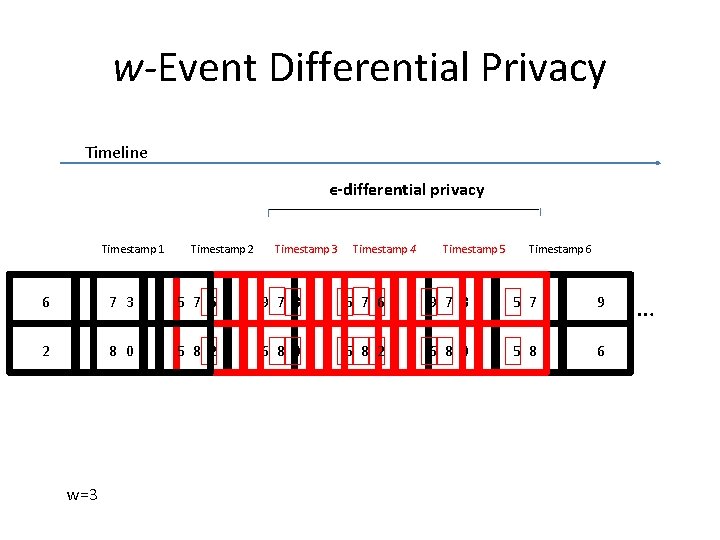
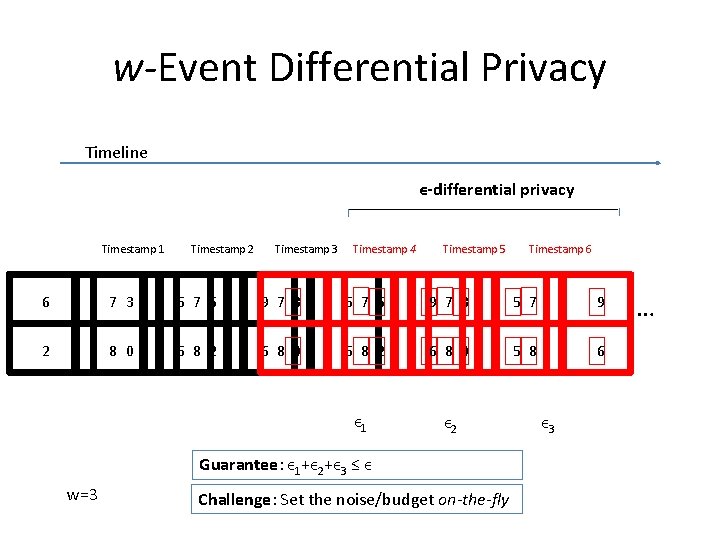
w-Event Differential Privacy • Event level – ϵ-differential privacy at any timestamp – it does not protect user movement – noise proportional to 1 • w-Event level – ϵ-differential privacy at any w consecutive timestamps – it protects user movement that lasts at most w timestamps – noise proportional to w<<n • User level – ϵ-differential privacy at all timestamps – it protects user movement – noise proportional to n
w-Event Differential Privacy Timeline ϵ-differential privacy Timestamp 1 Timestamp 2 Timestamp 3 Timestamp 4 Timestamp 5 Timestamp 6 6 7 3 5 7 6 9 7 3 5 7 9 2 8 0 5 8 2 6 8 0 5 8 6 w=3 …
w-Event Differential Privacy Timeline ϵ-differential privacy Timestamp 1 Timestamp 2 Timestamp 3 Timestamp 4 Timestamp 5 Timestamp 6 6 7 3 5 7 6 9 7 3 5 7 9 2 8 0 5 8 2 6 8 0 5 8 6 w=3 …
w-Event Differential Privacy Timeline ϵ-differential privacy Timestamp 1 Timestamp 2 Timestamp 3 Timestamp 4 Timestamp 5 Timestamp 6 6 7 3 5 7 6 9 7 3 5 7 9 2 8 0 5 8 2 6 8 0 5 8 6 w=3 …
w-Event Differential Privacy Timeline ϵ-differential privacy Timestamp 1 Timestamp 2 Timestamp 3 Timestamp 4 Timestamp 5 Timestamp 6 6 7 3 5 7 6 9 7 3 5 7 9 2 8 0 5 8 2 6 8 0 5 8 6 ϵ 1 ϵ 2 Guarantee: ϵ 1+ϵ 2+ϵ 3 ≤ ϵ w=3 Challenge: Set the noise/budget on-the-fly ϵ 3 …
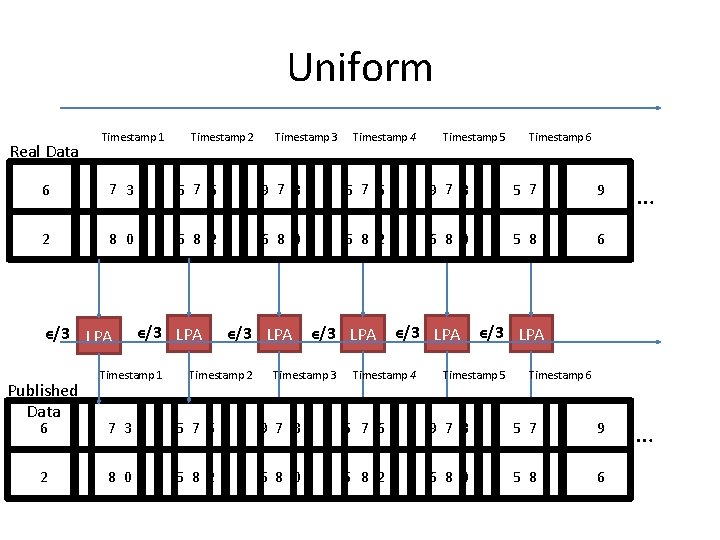
Uniform Real Data Timestamp 1 Timestamp 2 Timestamp 3 Timestamp 4 Timestamp 5 Timestamp 6 6 7 3 5 7 6 9 7 3 5 7 9 2 8 0 5 8 2 6 8 0 5 8 6 ϵ/3 LPA Published Data ϵ/3 LPA Timestamp 1 ϵ/3 LPA Timestamp 2 ϵ/3 LPA Timestamp 3 ϵ/3 LPA Timestamp 4 … ϵ/3 LPA Timestamp 5 Timestamp 6 6 7 3 5 7 6 9 7 3 5 7 9 2 8 0 5 8 2 6 8 0 5 8 6 …
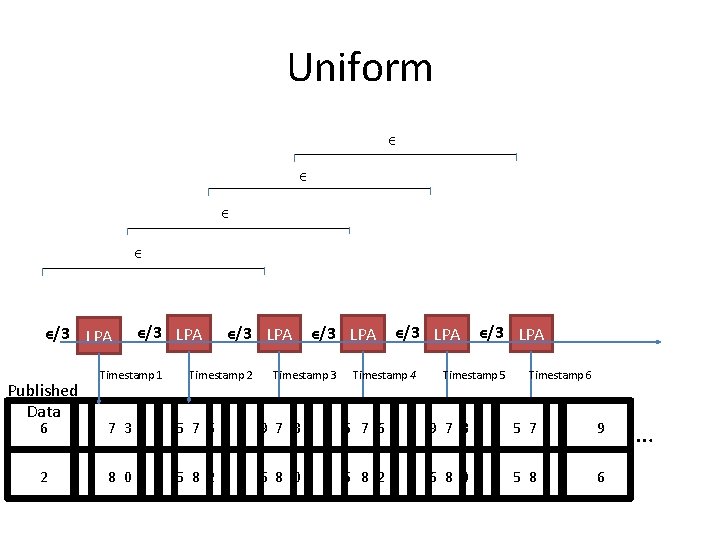
Uniform ϵ ϵ ϵ/3 LPA Published Data ϵ/3 LPA Timestamp 1 ϵ/3 LPA Timestamp 2 ϵ/3 LPA Timestamp 3 ϵ/3 LPA Timestamp 4 ϵ/3 LPA Timestamp 5 Timestamp 6 6 7 3 5 7 6 9 7 3 5 7 9 2 8 0 5 8 2 6 8 0 5 8 6 …
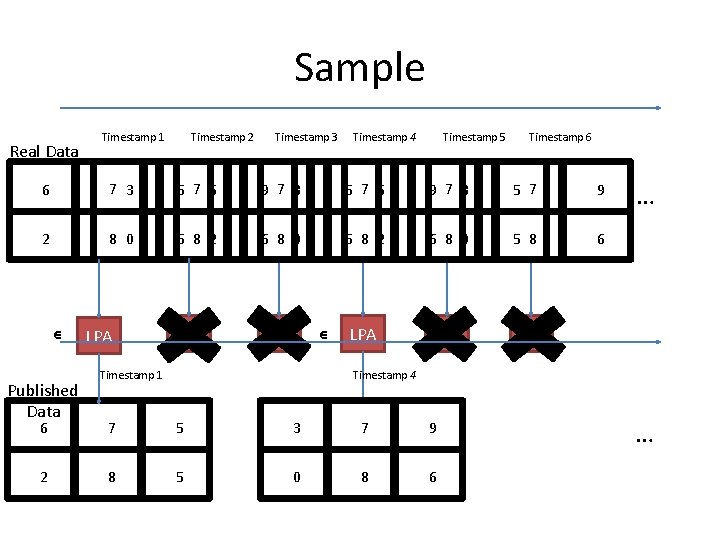
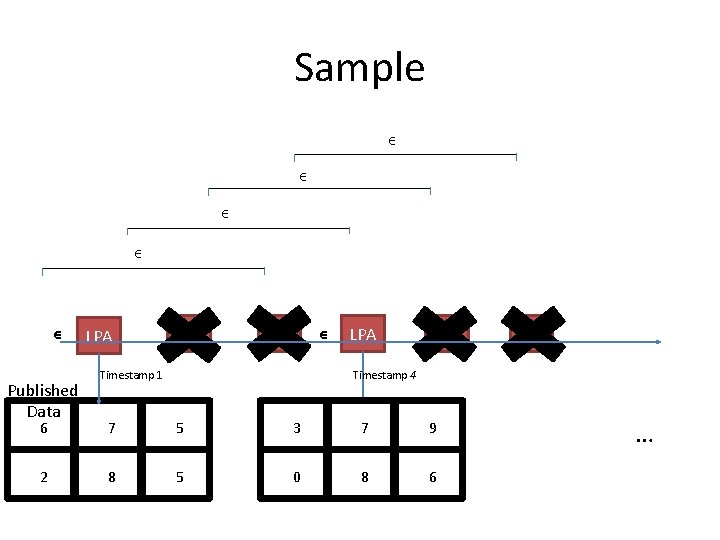
Sample Real Data Timestamp 2 Timestamp 1 Timestamp 3 Timestamp 4 Timestamp 5 Timestamp 6 6 7 3 5 7 6 9 7 3 5 7 9 2 8 0 5 8 2 6 8 0 5 8 6 LPA LPA ϵ Published Data LPA ϵ … LPA Timestamp 4 Timestamp 1 6 7 5 3 7 9 2 8 5 0 8 6 …
Sample ϵ ϵ ϵ Published Data LPA ϵ LPA LPA Timestamp 4 Timestamp 1 6 7 5 3 7 9 2 8 5 0 8 6 …
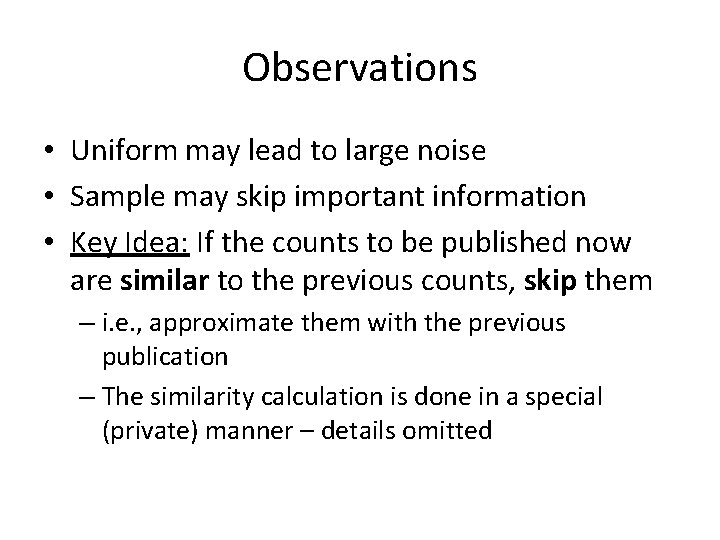
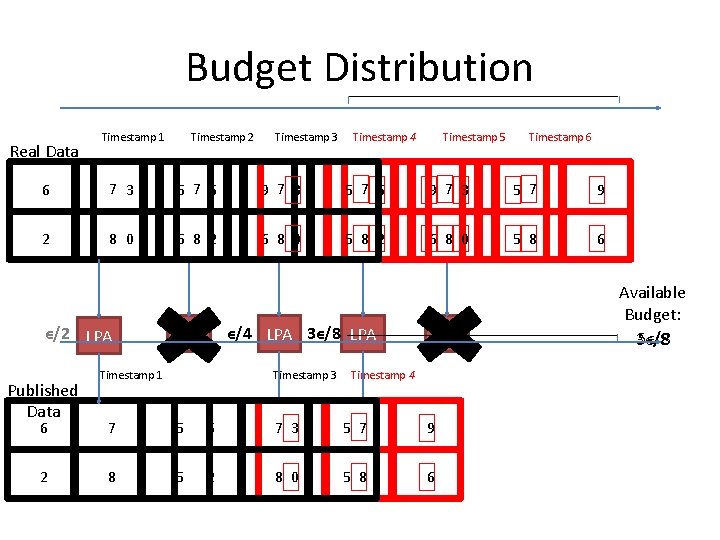
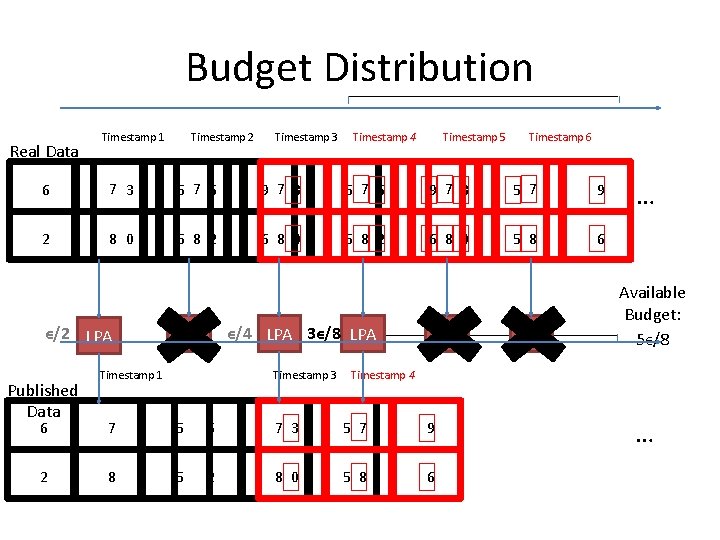
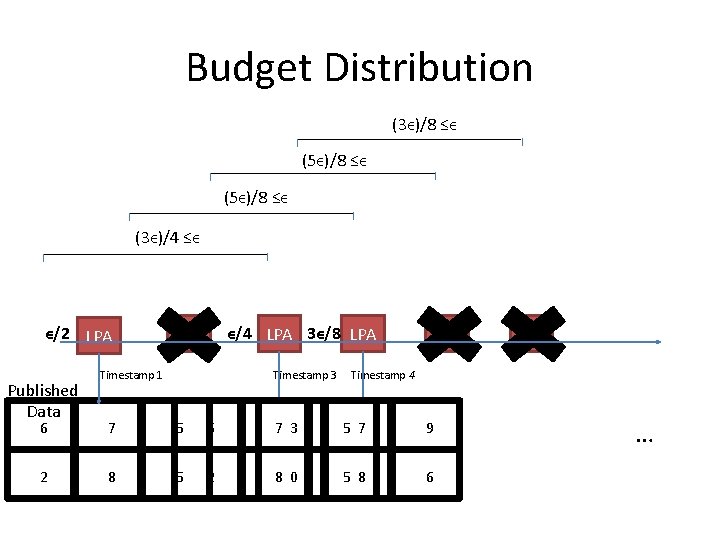
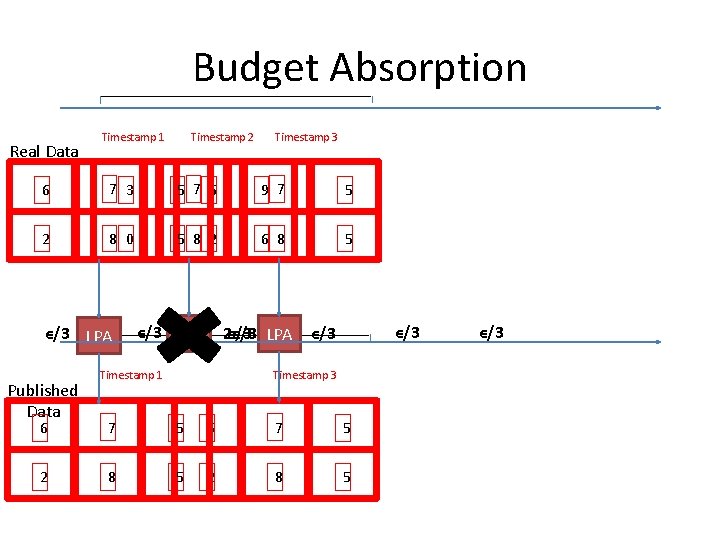
Observations • Uniform may lead to large noise • Sample may skip important information • Key Idea: If the counts to be published now are similar to the previous counts, skip them – i. e. , approximate them with the previous publication – The similarity calculation is done in a special (private) manner – details omitted
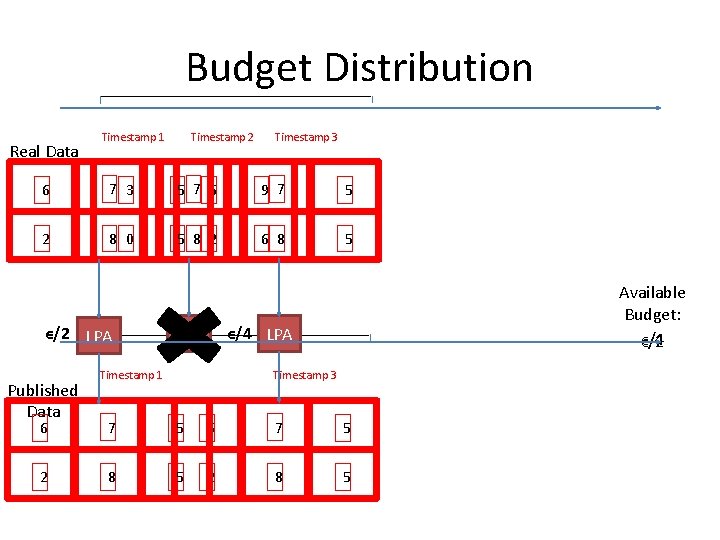
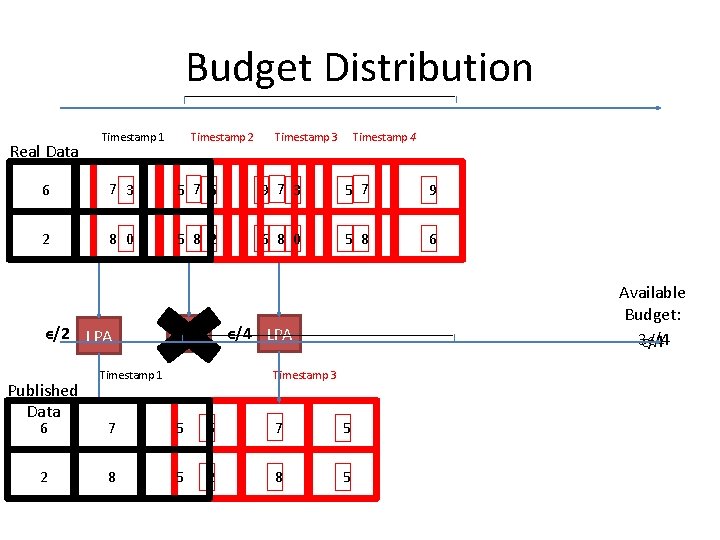
Budget Distribution Real Data Timestamp 2 Timestamp 1 Timestamp 3 6 7 3 5 7 6 9 7 5 2 8 0 5 8 2 6 8 5 ϵ/2 LPA Published Data Available Budget: ϵ/4 ϵ/2 ϵ/4 LPA Timestamp 3 Timestamp 1 6 7 5 2 8 5
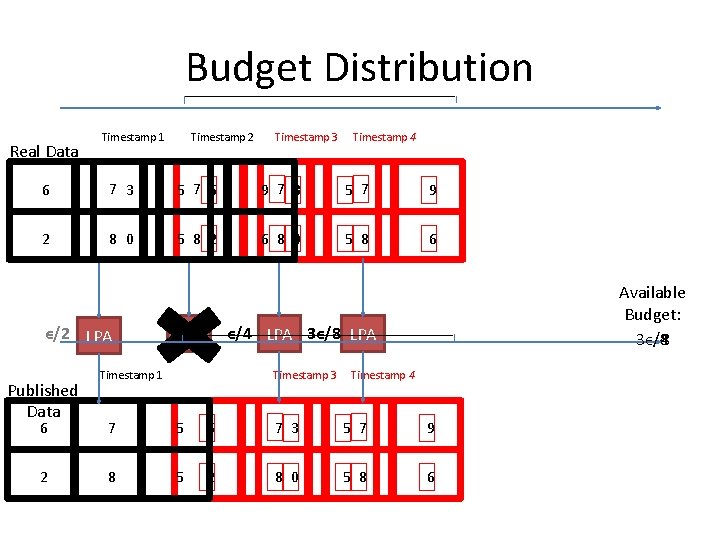
Budget Distribution Real Data Timestamp 2 Timestamp 1 Timestamp 3 Timestamp 4 6 7 3 5 7 6 9 7 3 5 7 9 2 8 0 5 8 2 6 8 0 5 8 6 ϵ/2 LPA Published Data Available Budget: 3ϵ/4 ϵ/4 LPA Timestamp 3 Timestamp 1 6 7 5 2 8 5
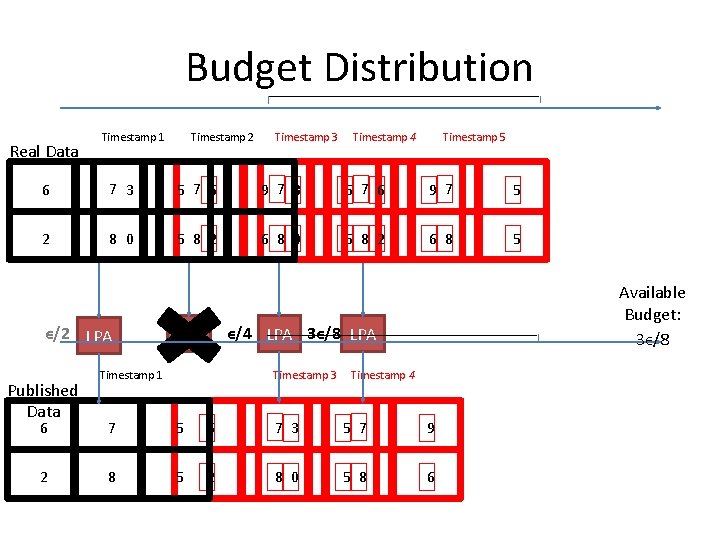
Budget Distribution Real Data Timestamp 2 Timestamp 1 Timestamp 3 Timestamp 4 6 7 3 5 7 6 9 7 3 5 7 9 2 8 0 5 8 2 6 8 0 5 8 6 ϵ/2 LPA Published Data Available Budget: 3ϵ/4 3ϵ/8 ϵ/4 LPA 3ϵ/8 LPA Timestamp 3 Timestamp 1 Timestamp 4 6 7 5 6 7 3 5 7 9 2 8 5 2 8 0 5 8 6
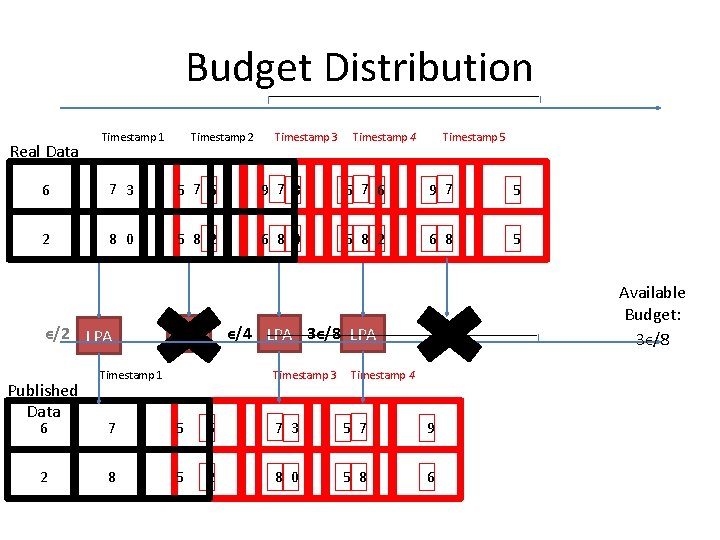
Budget Distribution Real Data Timestamp 2 Timestamp 1 Timestamp 3 Timestamp 4 Timestamp 5 6 7 3 5 7 6 9 7 5 2 8 0 5 8 2 6 8 5 ϵ/2 LPA Published Data Available Budget: 3ϵ/8 ϵ/4 LPA 3ϵ/8 LPA Timestamp 3 Timestamp 1 Timestamp 4 6 7 5 6 7 3 5 7 9 2 8 5 2 8 0 5 8 6
Budget Distribution Real Data Timestamp 2 Timestamp 1 Timestamp 3 Timestamp 4 Timestamp 5 6 7 3 5 7 6 9 7 5 2 8 0 5 8 2 6 8 5 ϵ/2 LPA Published Data Available Budget: 3ϵ/8 ϵ/4 LPA 3ϵ/8 LPA Timestamp 3 Timestamp 1 Timestamp 4 6 7 5 6 7 3 5 7 9 2 8 5 2 8 0 5 8 6
Budget Distribution Real Data Timestamp 2 Timestamp 1 Timestamp 3 Timestamp 4 Timestamp 5 Timestamp 6 6 7 3 5 7 6 9 7 3 5 7 9 2 8 0 5 8 2 6 8 0 5 8 6 ϵ/2 LPA Published Data ϵ/4 LPA 3ϵ/8 LPA Timestamp 3 Timestamp 1 LPA Timestamp 4 6 7 5 6 7 3 5 7 9 2 8 5 2 8 0 5 8 6 Available Budget: 5ϵ/8 3ϵ/8
Budget Distribution Real Data Timestamp 2 Timestamp 1 Timestamp 3 Timestamp 4 Timestamp 5 Timestamp 6 6 7 3 5 7 6 9 7 3 5 7 9 2 8 0 5 8 2 6 8 0 5 8 6 ϵ/2 LPA Published Data ϵ/4 LPA 3ϵ/8 LPA Timestamp 3 Timestamp 1 LPA … Available Budget: 5ϵ/8 Timestamp 4 6 7 5 6 7 3 5 7 9 2 8 5 2 8 0 5 8 6 …
Budget Distribution (3ϵ)/8 ≤ϵ (5ϵ)/8 ≤ϵ (3ϵ)/4 ≤ϵ ϵ/2 LPA Published Data ϵ/4 LPA 3ϵ/8 LPA Timestamp 3 Timestamp 1 LPA Timestamp 4 6 7 5 6 7 3 5 7 9 2 8 5 2 8 0 5 8 6 …
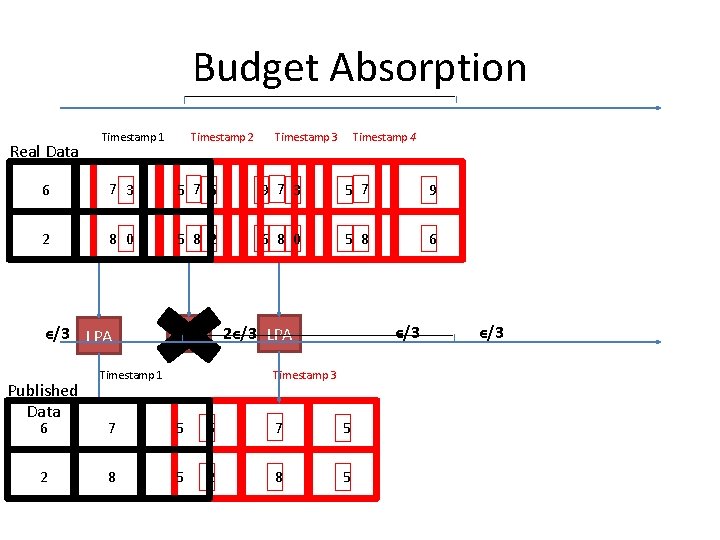
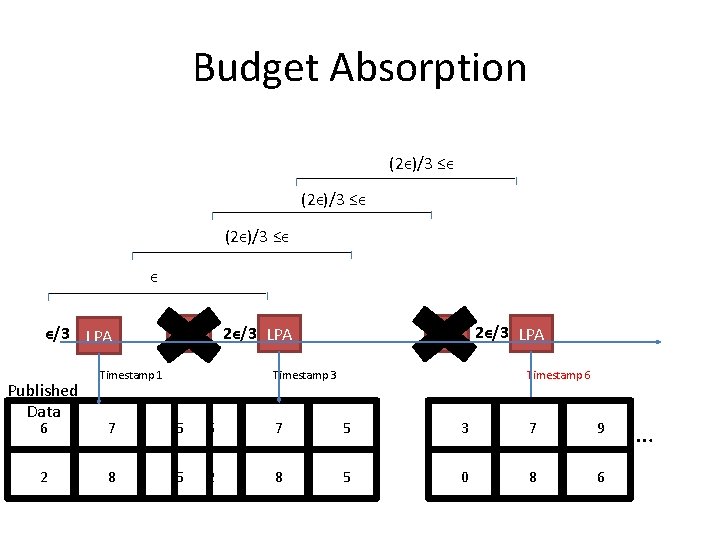
Budget Absorption Real Data Timestamp 2 Timestamp 1 Timestamp 3 6 7 3 5 7 6 9 7 5 2 8 0 5 8 2 6 8 5 ϵ/3 LPA Published Data ϵ/3 LPA 2ϵ/3 LPA ϵ/3 Timestamp 1 6 7 5 2 8 5 ϵ/3
Budget Absorption Real Data Timestamp 2 Timestamp 1 Timestamp 3 Timestamp 4 6 7 3 5 7 6 9 7 3 5 7 9 2 8 0 5 8 2 6 8 0 5 8 6 ϵ/3 LPA Published Data ϵ/3 2ϵ/3 LPA Timestamp 3 Timestamp 1 6 7 5 2 8 5 ϵ/3
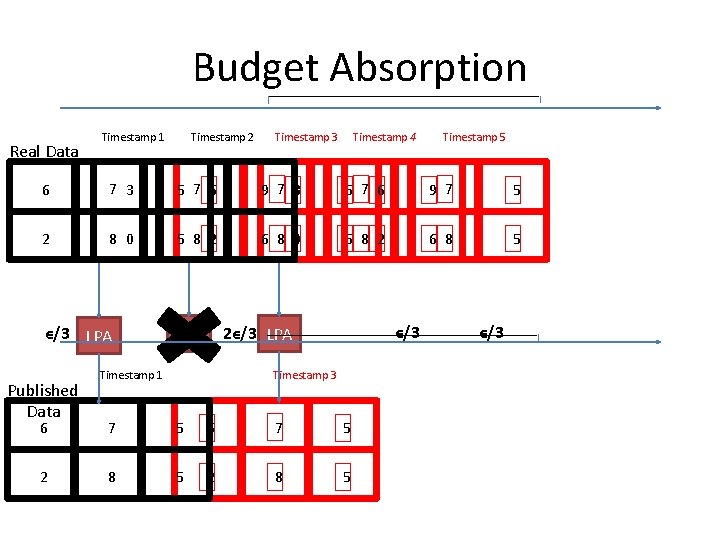
Budget Absorption Real Data Timestamp 2 Timestamp 1 Timestamp 3 Timestamp 4 Timestamp 5 6 7 3 5 7 6 9 7 5 2 8 0 5 8 2 6 8 5 ϵ/3 LPA Published Data ϵ/3 2ϵ/3 LPA Timestamp 3 Timestamp 1 6 7 5 2 8 5 ϵ/3
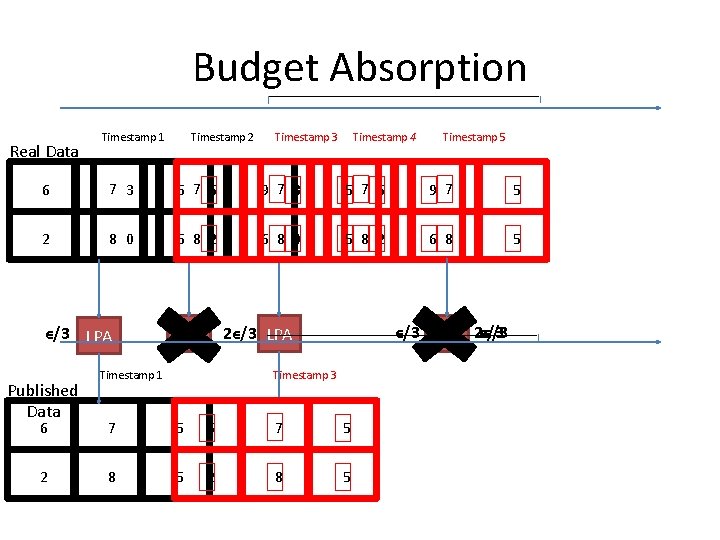
Budget Absorption Real Data Timestamp 2 Timestamp 1 Timestamp 3 Timestamp 4 Timestamp 5 6 7 3 5 7 6 9 7 5 2 8 0 5 8 2 6 8 5 ϵ/3 LPA Published Data ϵ/3 LPA 2ϵ/3 LPA Timestamp 3 Timestamp 1 6 7 5 2 8 5
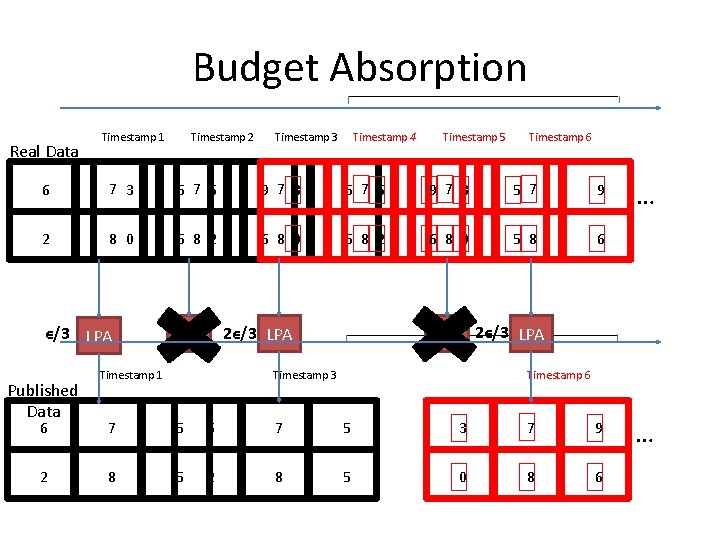
Budget Absorption Real Data Timestamp 2 Timestamp 1 Timestamp 3 Timestamp 4 Timestamp 5 Timestamp 6 6 7 3 5 7 6 9 7 3 5 7 9 2 8 0 5 8 2 6 8 0 5 8 6 ϵ/3 LPA Published Data LPA 2ϵ/3 LPA Timestamp 3 Timestamp 1 … Timestamp 6 6 7 5 3 7 9 2 8 5 0 8 6 …
Budget Absorption (2ϵ)/3 ≤ϵ ϵ ϵ/3 LPA Published Data LPA 2ϵ/3 LPA Timestamp 3 Timestamp 1 Timestamp 6 6 7 5 3 7 9 2 8 5 0 8 6 …
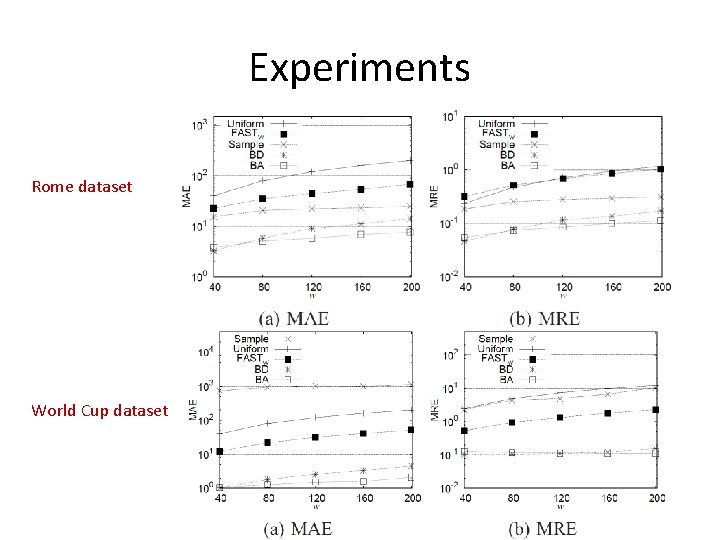
Experiments Rome dataset World Cup dataset