
Differential Privacy 6 857 These slides are adapted

![Randomized Response [Warner 1965] A • 16](https://slidetodoc.com/presentation_image_h2/bb4eae233b91d1ca283d5d6d5fa9f5d8/image-16.jpg "Randomized Response [Warner 1965] A • 16")
![Randomized Response [Warner 1965] A • 17](https://slidetodoc.com/presentation_image_h2/bb4eae233b91d1ca283d5d6d5fa9f5d8/image-17.jpg "Randomized Response [Warner 1965] A • 17")
![Frontier 1: Learning with DP [Abadi et al 2016, …] s er t e](https://slidetodoc.com/presentation_image_h2/bb4eae233b91d1ca283d5d6d5fa9f5d8/image-25.jpg "Frontier 1: Learning with DP [Abadi et al 2016, …] s er t e")

- Slides: 34
Differential Privacy 6. 857 These slides are adapted from Adam Smith
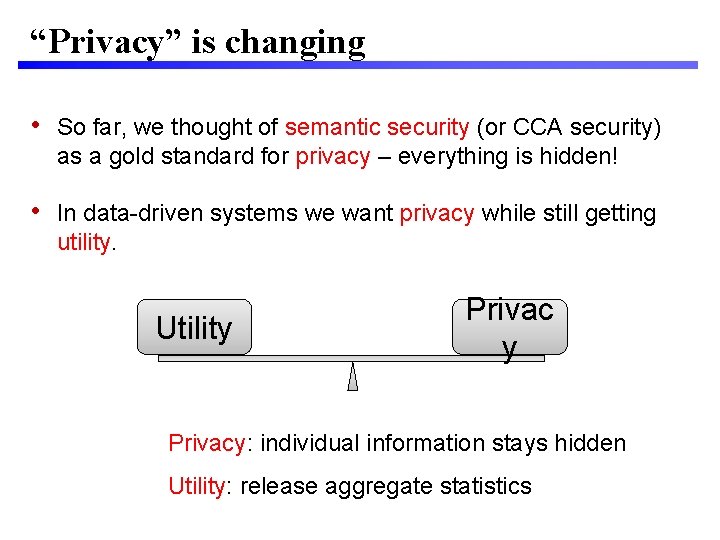
“Privacy” is changing • So far, we thought of semantic security (or CCA security) as a gold standard for privacy – everything is hidden! • In data-driven systems we want privacy while still getting utility. Utility Privacy: individual information stays hidden Utility: release aggregate statistics
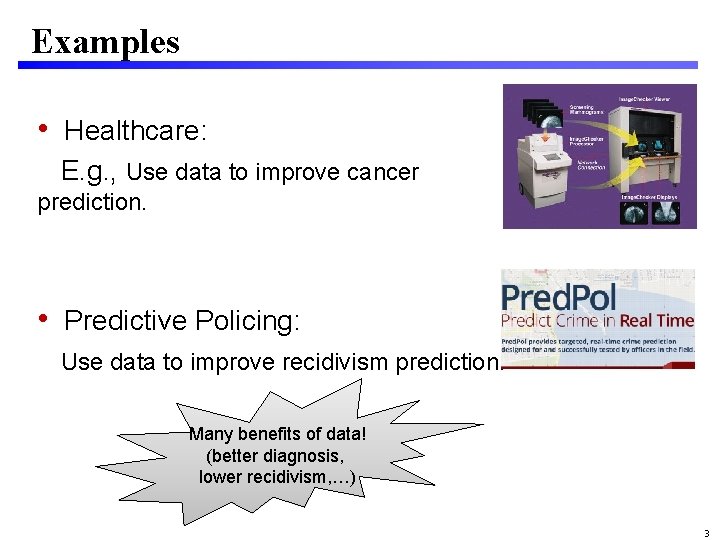
Examples • Healthcare: E. g. , Use data to improve cancer prediction. • Predictive Policing: Use data to improve recidivism prediction. Many benefits of data! (better diagnosis, lower recidivism, …) 3
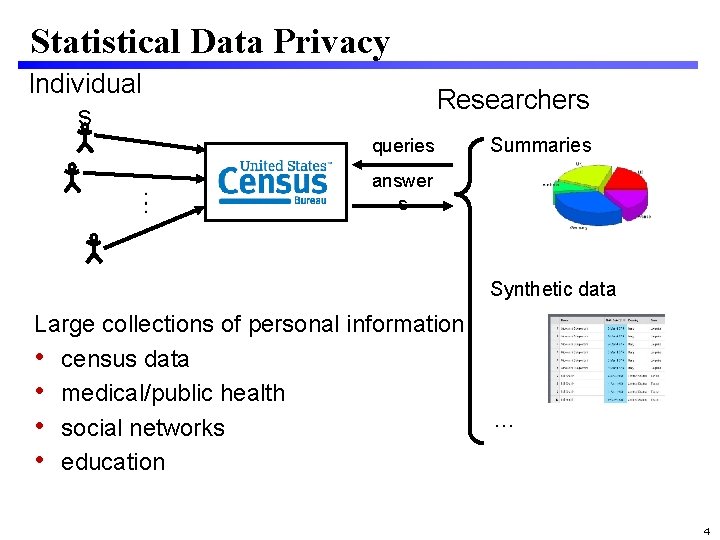
Statistical Data Privacy Individual s Researchers queries “Agency” Summaries answer s Synthetic data Large collections of personal information • census data • medical/public health • social networks • education … 4
How do we Define “Privacy”? • Studied since 1960’s in Statistics Databases & data mining Cryptography • This talk: Differential Privacy [Dwork, Mc. Sherry, Nissim, Smith 2006] 5
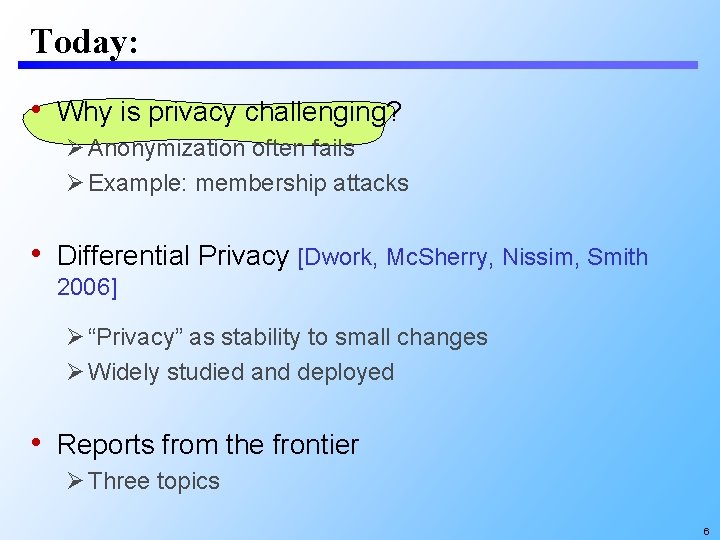
Today: • Why is privacy challenging? Anonymization often fails Example: membership attacks • Differential Privacy [Dwork, Mc. Sherry, Nissim, Smith 2006] “Privacy” as stability to small changes Widely studied and deployed • Reports from the frontier Three topics 6
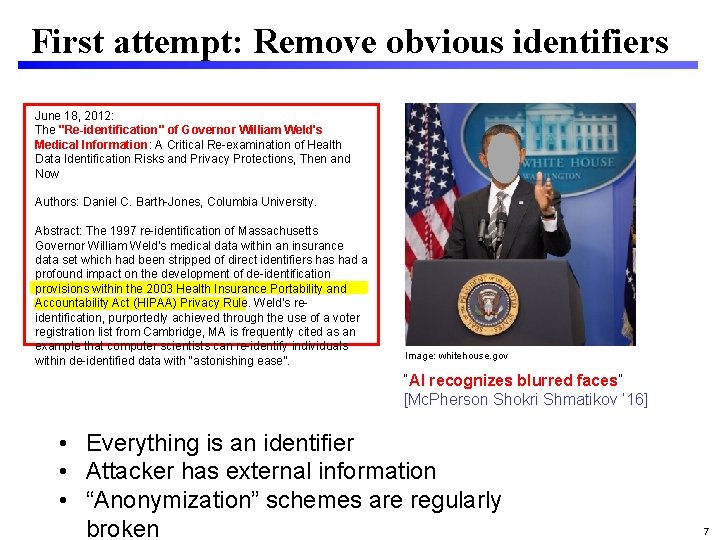
First attempt: Remove obvious identifiers June 18, 2012: The "Re-identification" of Governor William Weld's Medical Information: A Critical Re-examination of Health Data Identification Risks and Privacy Protections, Then and Now Authors: Daniel C. Barth-Jones, Columbia University. Abstract: The 1997 re-identification of Massachusetts Governor William Weld’s medical data within an insurance data set which had been stripped of direct identifiers had a profound impact on the development of de-identification provisions within the 2003 Health Insurance Portability and Accountability Act (HIPAA) Privacy Rule. Weld’s reidentification, purportedly achieved through the use of a voter registration list from Cambridge, MA is frequently cited as an example that computer scientists can re-identify individuals within de-identified data with “astonishing ease”. Image: whitehouse. gov “AI recognizes blurred faces” [Mc. Pherson Shokri Shmatikov ’ 16] • Everything is an identifier • Attacker has external information • “Anonymization” schemes are regularly broken 7
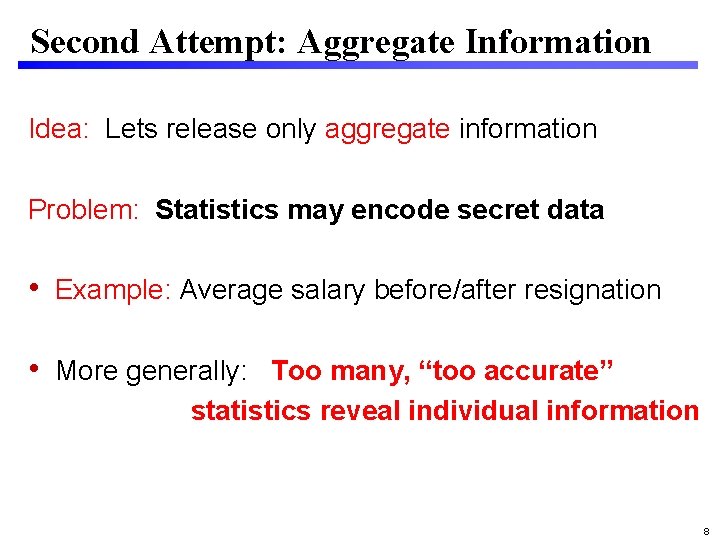
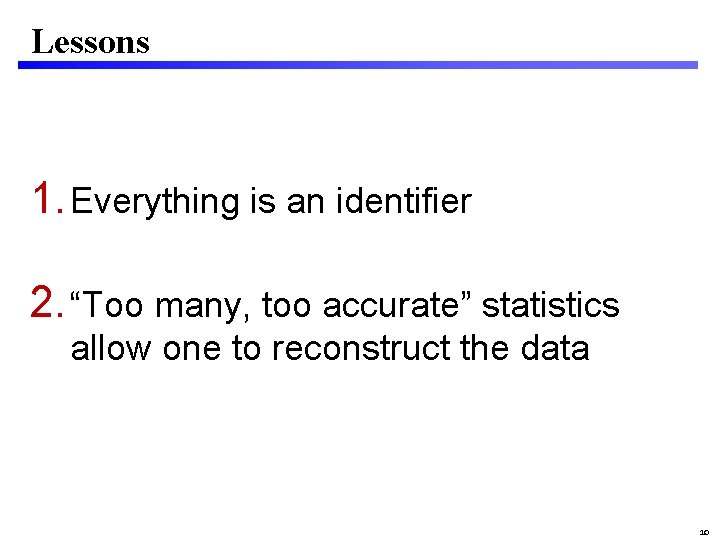
Second Attempt: Aggregate Information Idea: Lets release only aggregate information Problem: Statistics may encode secret data • Example: Average salary before/after resignation • More generally: Too many, “too accurate” statistics reveal individual information 8
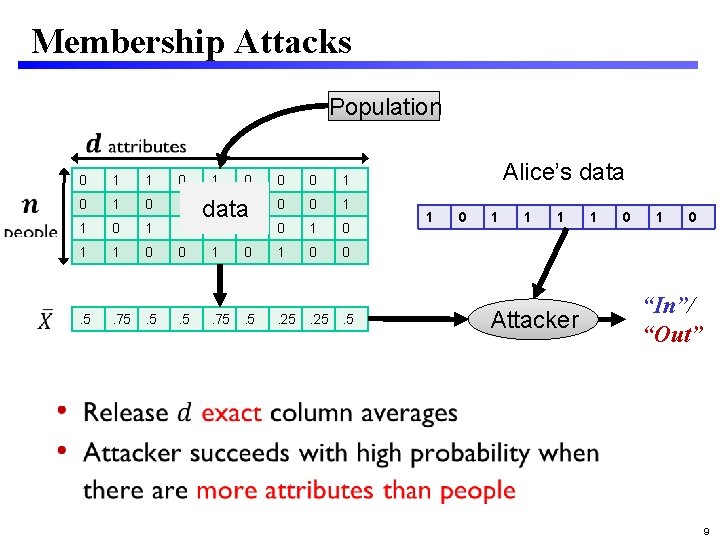
Membership Attacks Population 0 1 1 0 1 1 0 . 5 . 75. 5 1 0 0 0 1 data 0 0 1 1 1 0 1 0 0 . 5 . 75. 5 . 25. 5 Alice’s data 1 0 1 1 1 Attacker 1 0 “In”/ “Out” 9
Lessons 1. Everything is an identifier 2. “Too many, too accurate” statistics allow one to reconstruct the data 10
This talk • Why is privacy challenging? Anonymization often fails Example: membership attacks • Differential Privacy [Dwork, Mc. Sherry, Nissim, Smith 2006] “Privacy” as stability to small changes Widely studied and deployed • Reports from the frontier Three topics 11
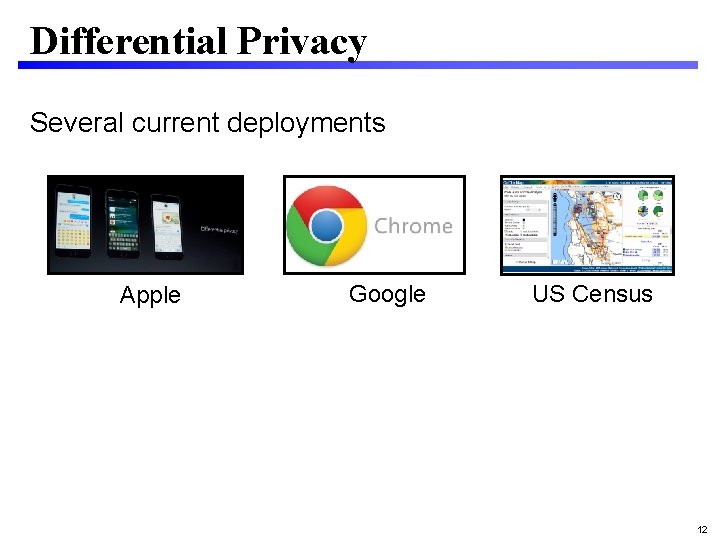
Differential Privacy Several current deployments Apple Google US Census 12
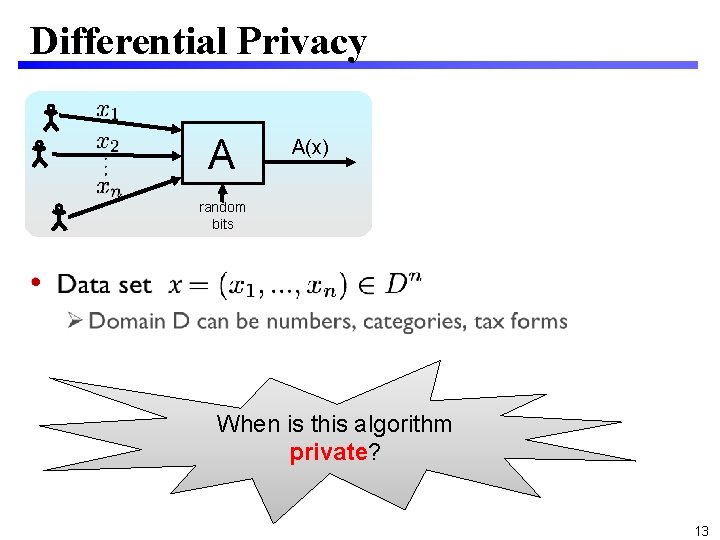
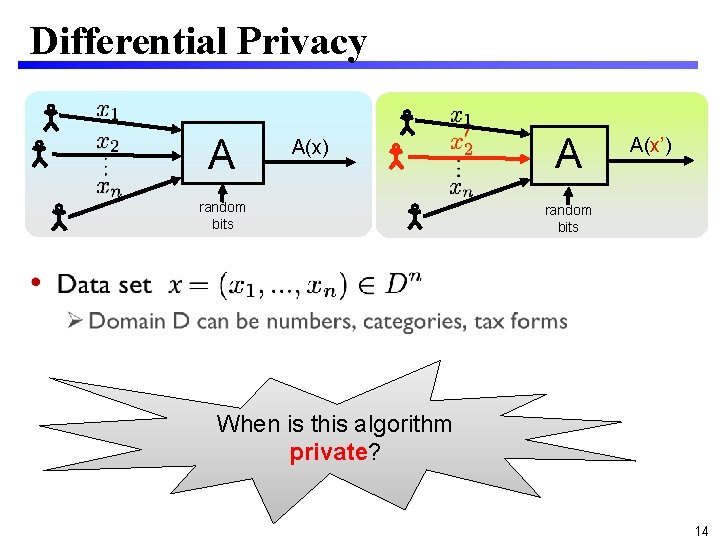
Differential Privacy A A(x) random bits • When is this algorithm private? 13
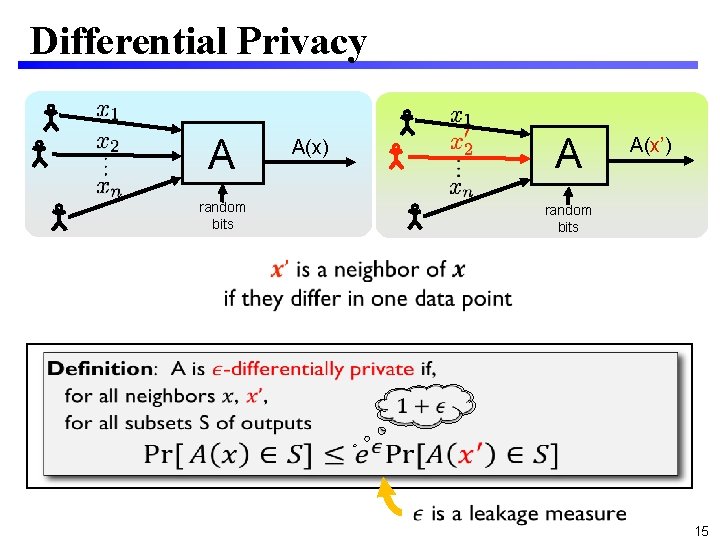
Differential Privacy A A(x) random bits A A(x’) random bits • When is this algorithm private? 14
Differential Privacy A random bits A(x) A A(x’) random bits 15
Randomized Response [Warner 1965] A • 16
Randomized Response [Warner 1965] A • 17
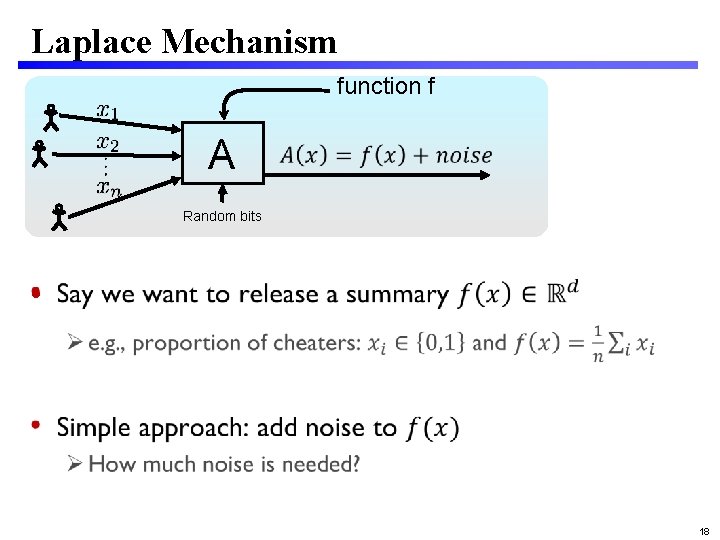
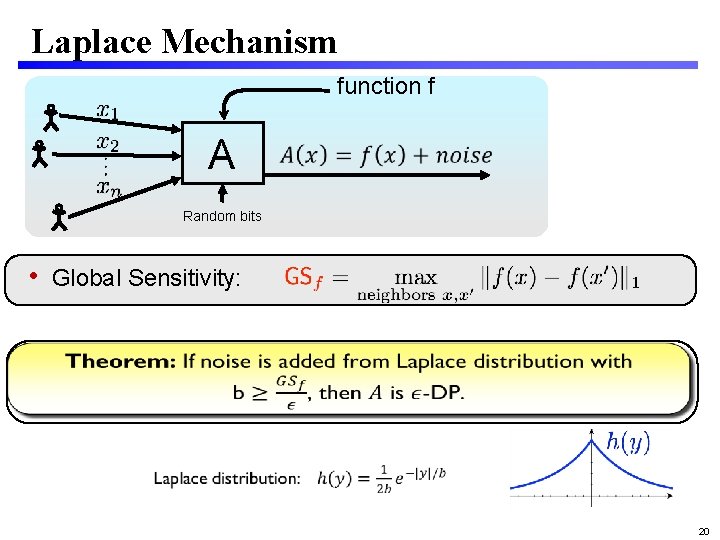
Laplace Mechanism function f A Random bits • 18
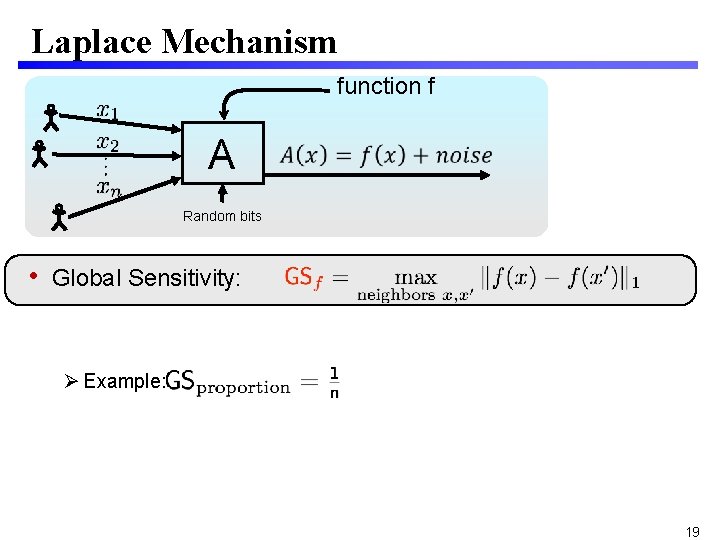
Laplace Mechanism function f A Random bits • Global Sensitivity: Example: 19
Laplace Mechanism function f A Random bits • Global Sensitivity: 20
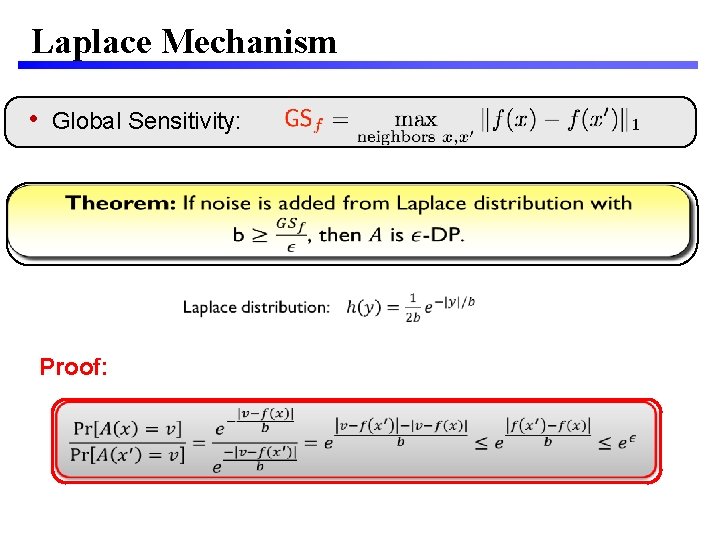
Laplace Mechanism • Global Sensitivity: Proof:
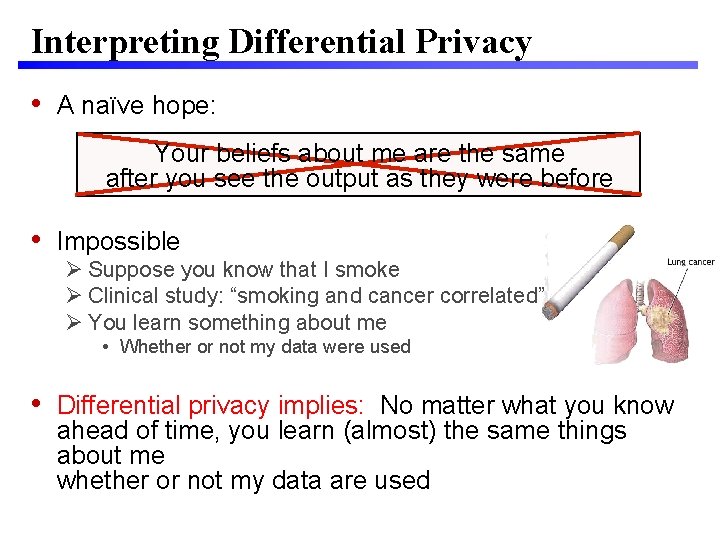
Interpreting Differential Privacy • A naïve hope: Your beliefs about me are the same after you see the output as they were before • Impossible Suppose you know that I smoke Clinical study: “smoking and cancer correlated” You learn something about me • Whether or not my data were used • Differential privacy implies: No matter what you know ahead of time, you learn (almost) the same things about me whether or not my data are used
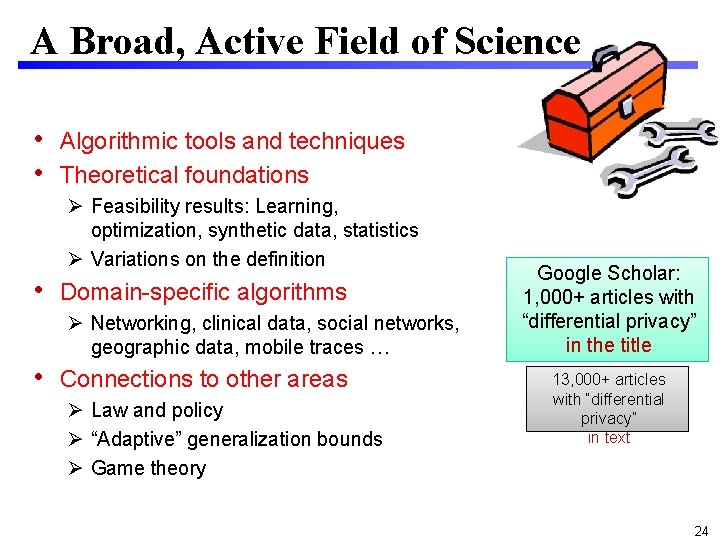
A Broad, Active Field of Science • Algorithmic tools and techniques • Theoretical foundations Feasibility results: Learning, optimization, synthetic data, statistics Variations on the definition • Domain-specific algorithms Networking, clinical data, social networks, geographic data, mobile traces … • Connections to other areas Law and policy “Adaptive” generalization bounds Game theory Google Scholar: 1, 000+ articles with “differential privacy” in the title 13, 000+ articles with “differential privacy” in text 24
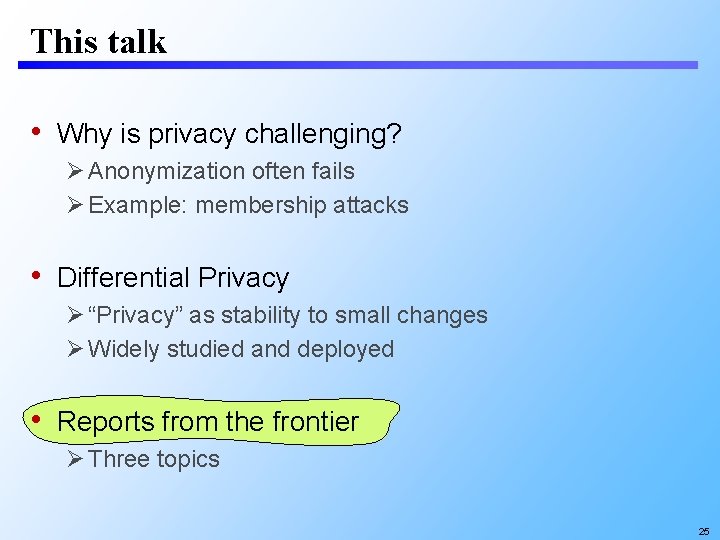
This talk • Why is privacy challenging? Anonymization often fails Example: membership attacks • Differential Privacy “Privacy” as stability to small changes Widely studied and deployed • Reports from the frontier Three topics 25
Frontier 1: Learning with DP [Abadi et al 2016, …] s er t e am Par Sensitive Data Revealed now, but should be hidden Deep Learning Should be thought of as public Model 26
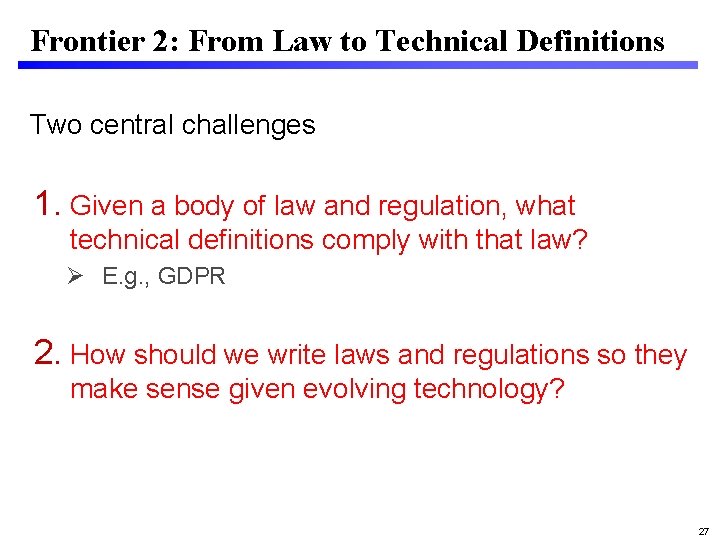
Frontier 2: From Law to Technical Definitions Two central challenges 1. Given a body of law and regulation, what technical definitions comply with that law? E. g. , GDPR 2. How should we write laws and regulations so they make sense given evolving technology? 27
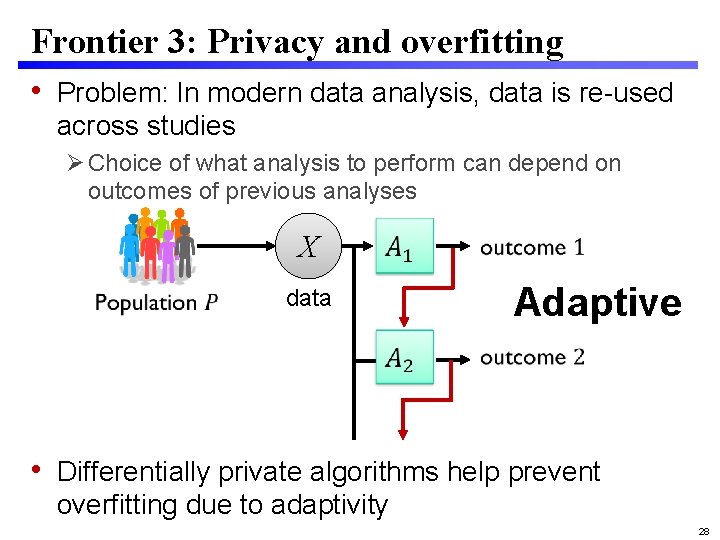
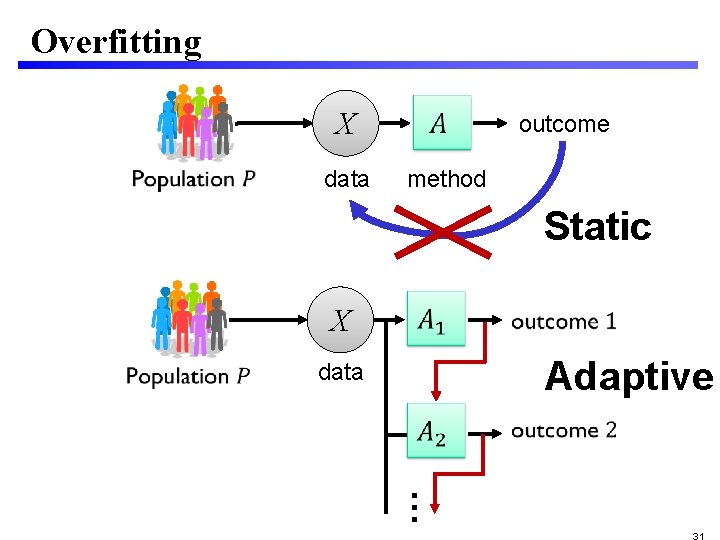
Frontier 3: Privacy and overfitting • Problem: In modern data analysis, data is re-used across studies Choice of what analysis to perform can depend on outcomes of previous analyses X data Adaptive • Differentially private algorithms help prevent overfitting due to adaptivity 28
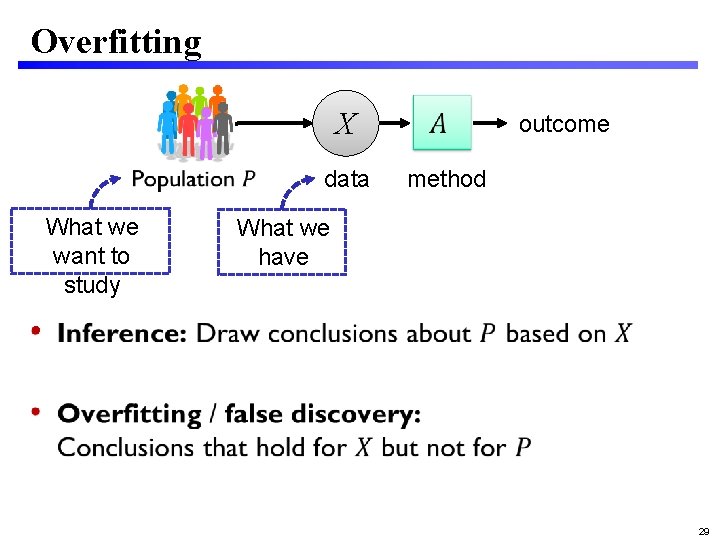
Overfitting X data What we want to study outcome method What we have • 29
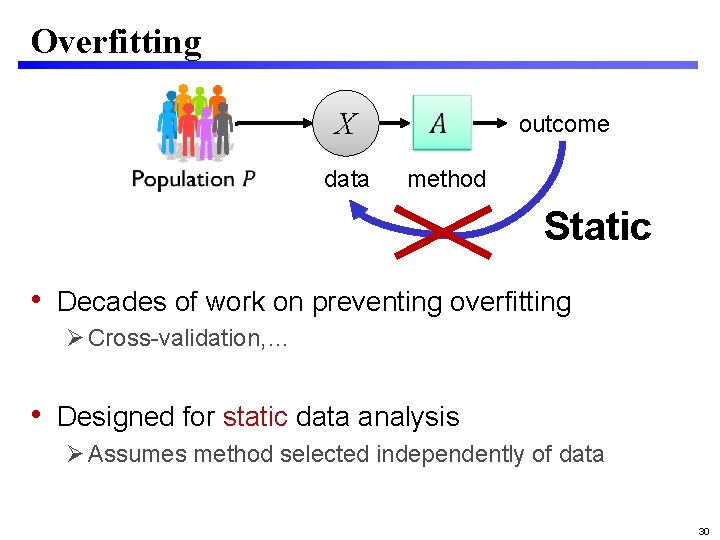
Overfitting X data outcome method Static • Decades of work on preventing overfitting Cross-validation, … • Designed for static data analysis Assumes method selected independently of data 30
Overfitting X data outcome method Static X Adaptive data …
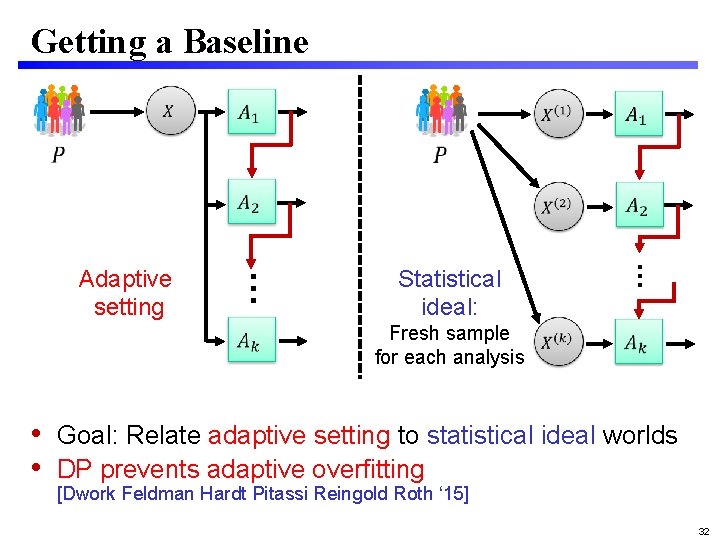
Getting a Baseline Statistical ideal: … … Adaptive setting Fresh sample for each analysis • Goal: Relate adaptive setting to statistical ideal worlds • DP prevents adaptive overfitting [Dwork Feldman Hardt Pitassi Reingold Roth ‘ 15] 32
This talk • Why is privacy challenging? Anonymization often fails Example: membership attacks • Differential Privacy “Privacy” as stability to small changes Widely studied and deployed • Reports from the frontier Three topics 33
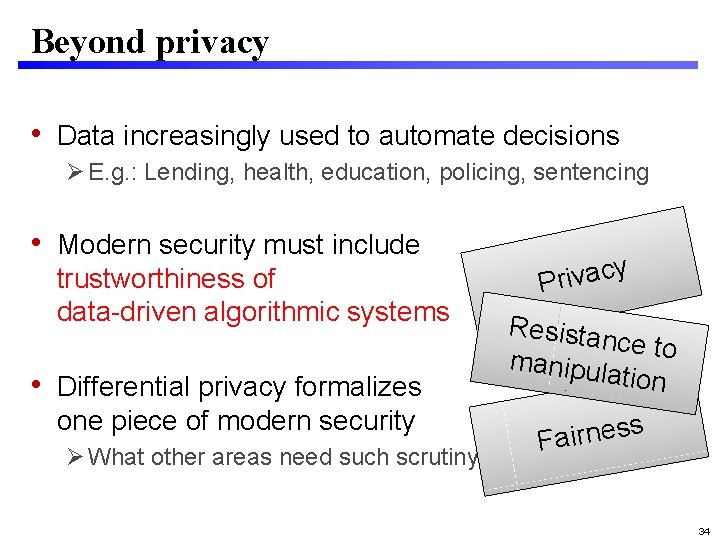
Beyond privacy • Data increasingly used to automate decisions E. g. : Lending, health, education, policing, sentencing • Modern security must include trustworthiness of data-driven algorithmic systems • Differential privacy formalizes one piece of modern security What other areas need such scrutiny? y c a v i r P Resistan ce to manipul ation s s e n r i Fa 34