
Differential O 2 Absorption Barometric Pressure Radar DIARBAR
Differential O 2 Absorption Barometric Pressure Radar (DIAR_BAR): Improvements in Tropical Storm Forecasts Qilong Min 1, Bing Lin 2, Yongxiang Hu 2 , Wei Gong 1, Steven Harrah 2, Wes Lawrence 3, Dion Fralick 2, 1 State University of New York, Albany, NY 2 NASA Langley Research Center, Hampton, VA 3 Old Dominion University, Norfolk, VA
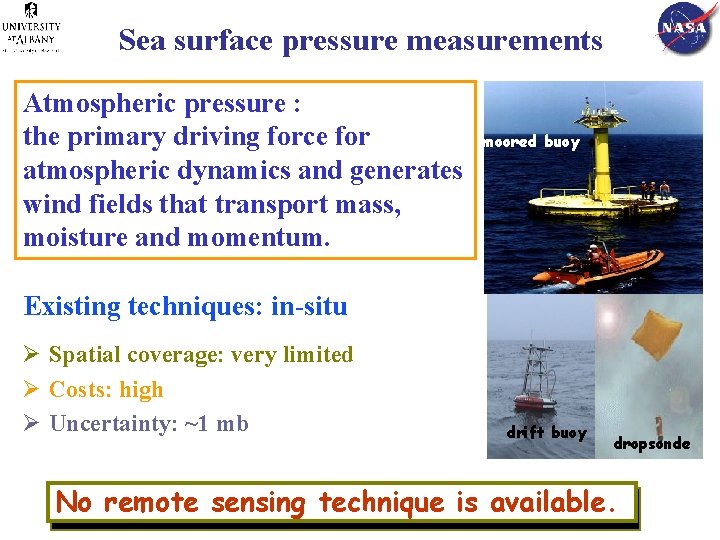
Sea surface pressure measurements Atmospheric pressure : the primary driving force for atmospheric dynamics and generates wind fields that transport mass, moisture and momentum. moored buoy Existing techniques: in-situ Ø Spatial coverage: very limited Ø Costs: high Ø Uncertainty: ~1 mb drift buoy dropsonde No remote sensing technique is available.
Historical studies • Active & passive O 2 A-band instruments active: high stable laser system --- difficult passive: daytime, cloud free, aerosol loading • Microwave sounder 25 ~ 75 GHz: multiple channels (6) absorption: LW, WV atmospheric and cloud temperature footprints, sea surface reflectivities
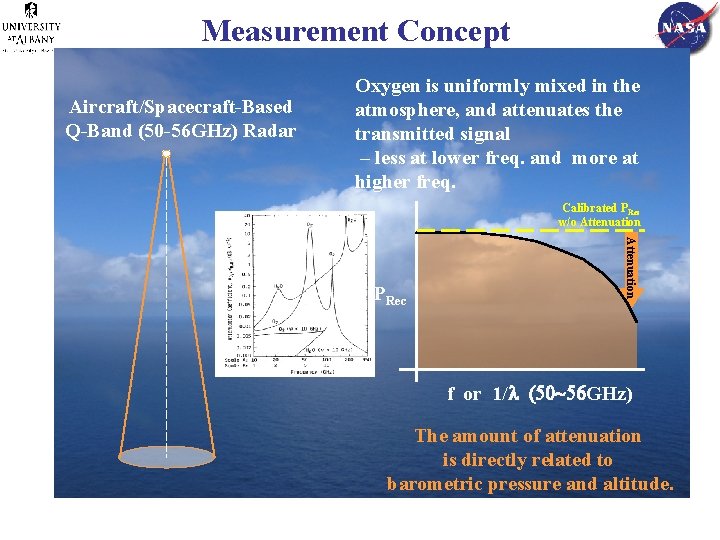
Measurement Concept Aircraft/Spacecraft-Based Q-Band (50 -56 GHz) Radar Oxygen is uniformly mixed in the atmosphere, and attenuates the transmitted signal – less at lower freq. and more at higher freq. Calibrated PRec w/o Attenuation PRec f or 1/ (50~56 GHz) The amount of attenuation is directly related to barometric pressure and altitude.
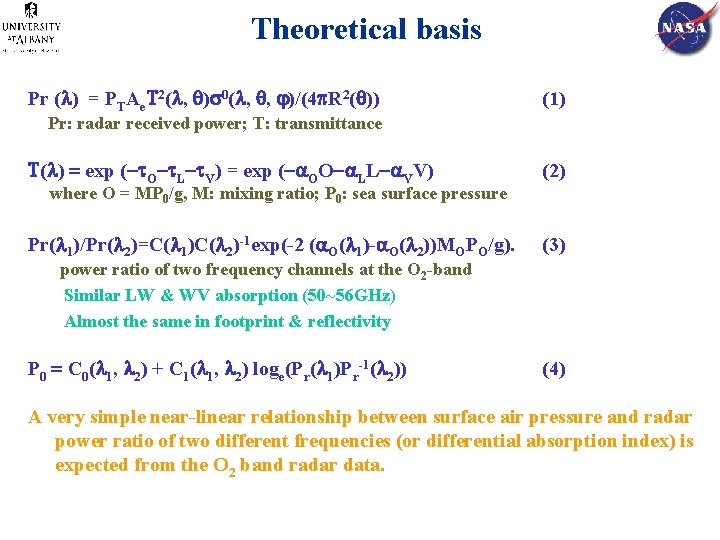
Theoretical basis Pr ( ) = PTAe 2( , ) 0( , , )/(4 R 2( )) (1) ( ) exp ( O L V) = exp ( OO LL VV) (2) Pr( 1)/Pr( 2)=C( 1)C( 2)-1 exp(-2 ( O( 1)- O( 2))MOPO/g). (3) Pr: radar received power; T: transmittance where O = MP 0/g, M: mixing ratio; P 0: sea surface pressure power ratio of two frequency channels at the O 2 -band Similar LW & WV absorption (50~56 GHz) Almost the same in footprint & reflectivity P 0 C 0( 1, 2) + C 1( 1, 2) loge(Pr( 1)Pr-1( 2)) (4) A very simple near-linear relationship between surface air pressure and radar power ratio of two different frequencies (or differential absorption index) is expected from the O 2 band radar data.

Radar simulated results Most of the variability is due to global atmospheric profile variations: temperature, water vapor, clouds, etc.
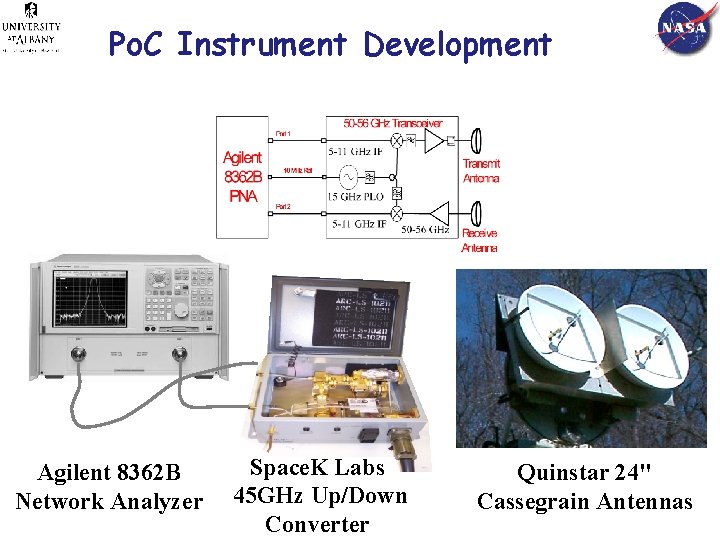
Po. C Instrument Development Agilent 8362 B Network Analyzer Space. K Labs 45 GHz Up/Down Converter Quinstar 24" Cassegrain Antennas

Ground tests relatively isolated radar reflector Projected Beamwidth • nearly spherical reflector • ~300 m clear range Radar Installed in/on Mobile Radar Lab

Ground tests Measure Water NRCS Over Wide Inc. Ang. Support Satellite Design Varina-Enon Bridge I-295 South of Richmond, VA Supported by VDOT Approx. 150’ above James River
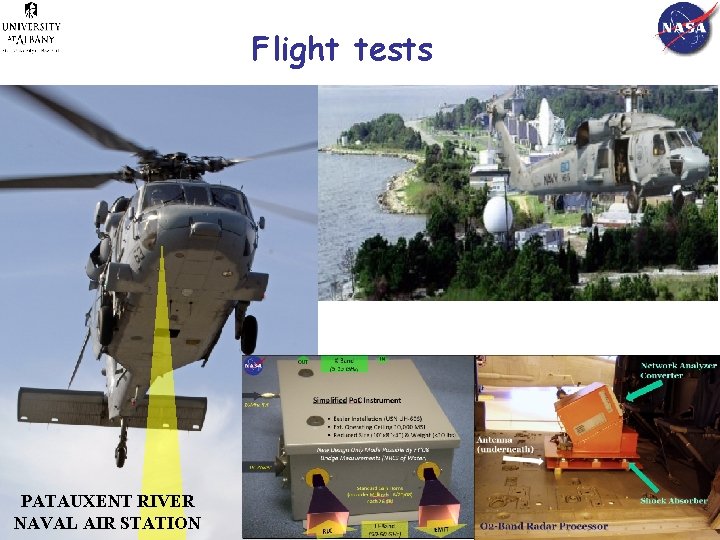
Flight tests PATAUXENT RIVER NAVAL AIR STATION

Observed and simulated Differential absorption
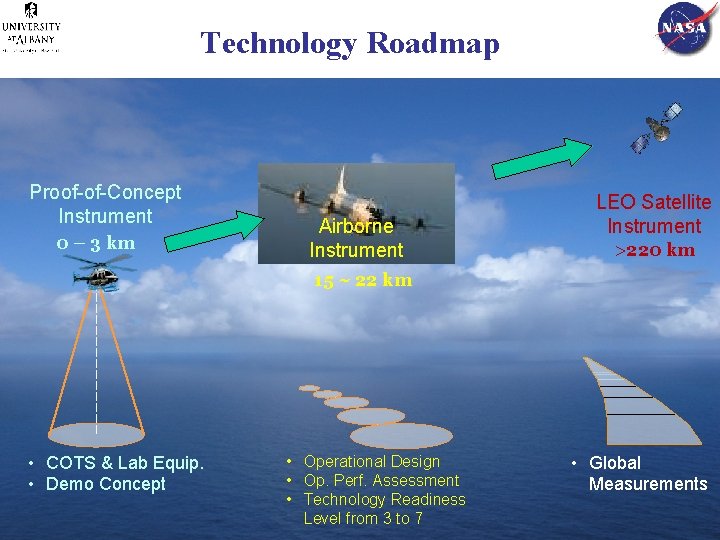
Technology Roadmap Proof-of-Concept Instrument 0 – 3 km Airborne Instrument LEO Satellite Instrument >220 km 15 ~ 22 km • COTS & Lab Equip. • Demo Concept • Operational Design • Op. Perf. Assessment • Technology Readiness Level from 3 to 7 • Global Measurements
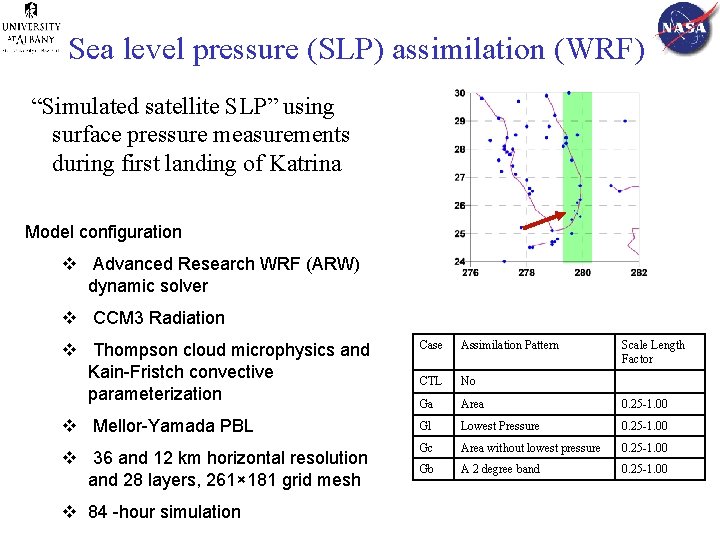
Sea level pressure (SLP) assimilation (WRF) “Simulated satellite SLP” using surface pressure measurements during first landing of Katrina Model configuration v Advanced Research WRF (ARW) dynamic solver v CCM 3 Radiation v Thompson cloud microphysics and Kain-Fristch convective parameterization Case Assimilation Pattern CTL No Ga Area 0. 25 -1. 00 v Mellor-Yamada PBL Gl Lowest Pressure 0. 25 -1. 00 Gc Area without lowest pressure 0. 25 -1. 00 Gb A 2 degree band 0. 25 -1. 00 v 36 and 12 km horizontal resolution and 28 layers, 261× 181 grid mesh v 84 -hour simulation Scale Length Factor
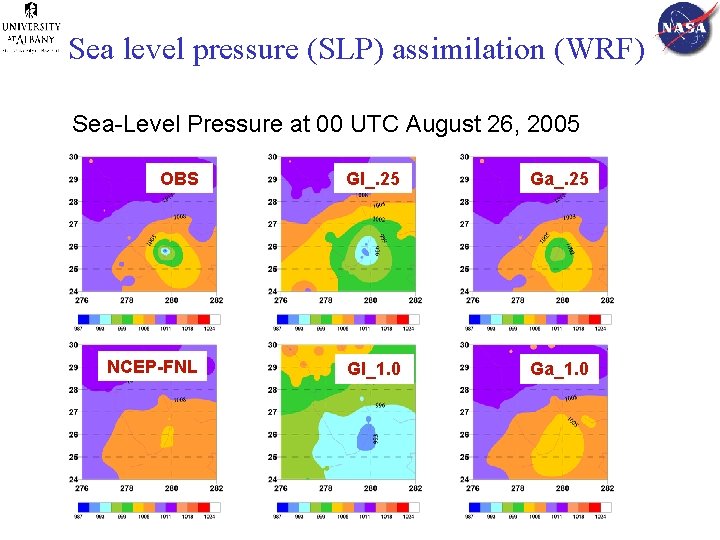
Sea level pressure (SLP) assimilation (WRF) Sea-Level Pressure at 00 UTC August 26, 2005 OBS Gl_. 25 NCEP-FNL Gl_1. 0 e Ga_. 25 Ga_1. 0 f
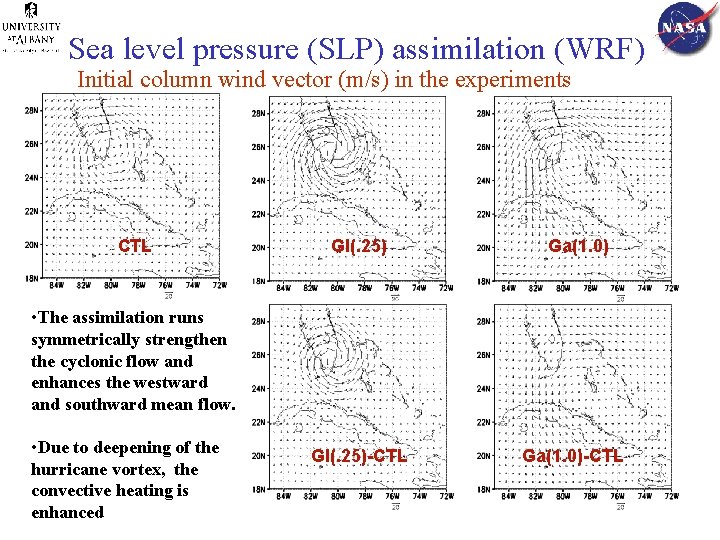
Sea level pressure (SLP) assimilation (WRF) Initial column wind vector (m/s) in the experiments CTL Gl(. 25) Ga(1. 0) • The assimilation runs symmetrically strengthen the cyclonic flow and enhances the westward and southward mean flow. • Due to deepening of the hurricane vortex, the convective heating is enhanced Gl(. 25)-CTL Ga(1. 0)-CTL
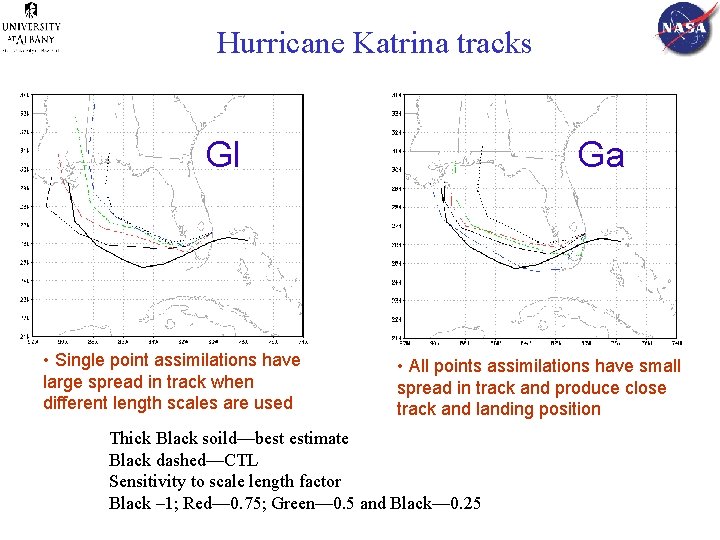
Hurricane Katrina tracks Gl • Single point assimilations have large spread in track when different length scales are used Ga • All points assimilations have small spread in track and produce close track and landing position Thick Black soild—best estimate Black dashed—CTL Sensitivity to scale length factor Black – 1; Red— 0. 75; Green— 0. 5 and Black— 0. 25
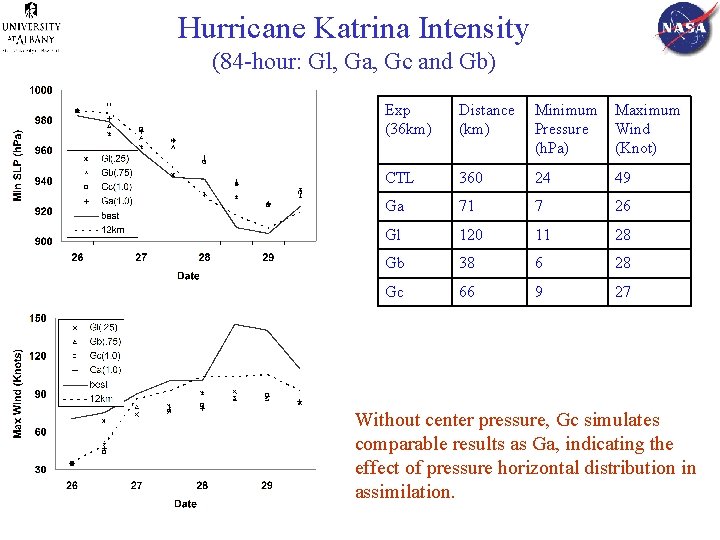
Hurricane Katrina Intensity (84 -hour: Gl, Ga, Gc and Gb) Exp (36 km) Distance (km) Minimum Pressure (h. Pa) Maximum Wind (Knot) CTL 360 24 49 Ga 71 7 26 Gl 120 11 28 Gb 38 6 28 Gc 66 9 27 Without center pressure, Gc simulates comparable results as Ga, indicating the effect of pressure horizontal distribution in assimilation.
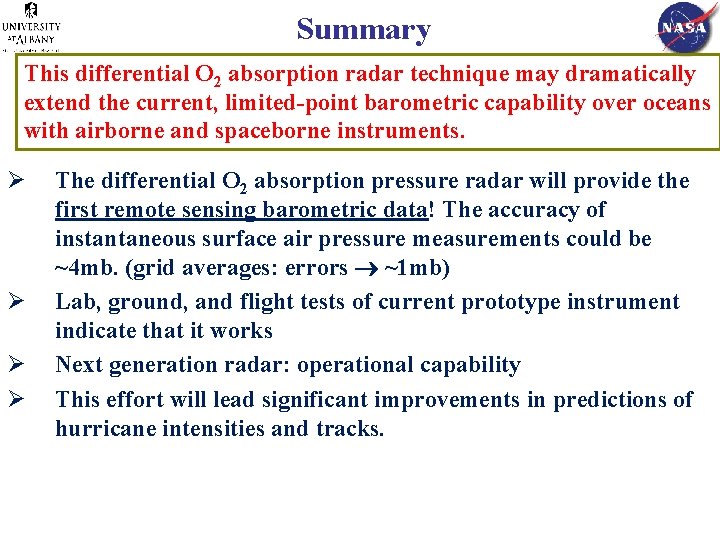
Summary This differential O 2 absorption radar technique may dramatically extend the current, limited-point barometric capability over oceans with airborne and spaceborne instruments. Ø Ø The differential O 2 absorption pressure radar will provide the first remote sensing barometric data! The accuracy of instantaneous surface air pressure measurements could be ~4 mb. (grid averages: errors ~1 mb) Lab, ground, and flight tests of current prototype instrument indicate that it works Next generation radar: operational capability This effort will lead significant improvements in predictions of hurricane intensities and tracks.
- Slides: 18