
Differential month of birth effects in the identification

Differential month of birth effects in the identification of special educational needs: An English study. Dr Garry Squires garry. squires@manchester. ac. uk 34 th ISPA Conference 9 th - 13 th July, 2012, Mc. Gill University, Montreal, Canada
Special Educational Needs • 20. 9% of pupils in England have SEN (Df. E, 2011) • Processes are identified in the Code of Practice for SEN and embedded in education law • Different levels of support are available: School Action, School Action Plus, Statement • Logic – teachers notice there is a problem and adjust educational experience; close monitoring and review; progressive assessment if problems are not resolved Dr Garry Squires 2012 2
11 Categories of SEN • • • Moderate Learning Difficulties (MLD) Behavioural, Emotional and Social Difficulties (BESD) Specific Learning Difficulties, such as dyslexia (Sp. LD) Speech, Communication and Language Needs (SCLN) Autistic Spectrum Disorders (ASD) Physical Difficulties (PD) Severe Learning Difficulties (SLD) Visual Impairment (VI) Hearing Impairment (HI) Profound Multiple Learning Disability (PMLD) Multisensory Impairment (MSI) Dr Garry Squires 2012 3
SEN: an ambiguous concept • 1944, 1981, 1996 Education Acts all define SEN in a circular way: “A child has a “learning difficulty” for the purposes of this Act if …. … he has a significantly greater difficulty in learning than the majority of children of his age … … or would be if special educational provision were not made for him • Government monitoring of schools defines what the majority of children should attain • 53% of teachers think that a child has SEN if they do not reach the expected standards (Ellis et al 2012) • Increasing concern that schools are over-identifying children with SEN (OFSTED, 2010) Dr Garry Squires 2012 4

Established month of birth effect • Children born at the beginning of the school year are at an advantage compared to those at the end of the year. This affects all children and has lifelong implications (Crawford et al, 2011) • In countries were the start of the year is different to England, then the effect is shifted accordingly • Younger children in the class tend to be identified as having SEN (Tarnowski et al, 1990; Dyson et al, 2004; Martin et al, 2004) Dr Garry Squires 2012 5

Research Questions Differential effects: • Are some of the 11 types of SEN more or less affected by the month of birth? • Is the month of birth effect reduced when there is more systematic assessment involving a wider range of professionals? Dr Garry Squires 2012 6
Method • 346 primary schools and 73 secondary schools in 10 areas in England (part of a project to evaluate Achievement for All • Pupils with SEN in Y 1 (5 -6), Y 5 (9 -10), Y 7 (1112) and Y 10 (14 -15) • Teachers completed on-line survey which included category of need and level of support • Data collected for 15, 640 pupils Dr Garry Squires 2012 7
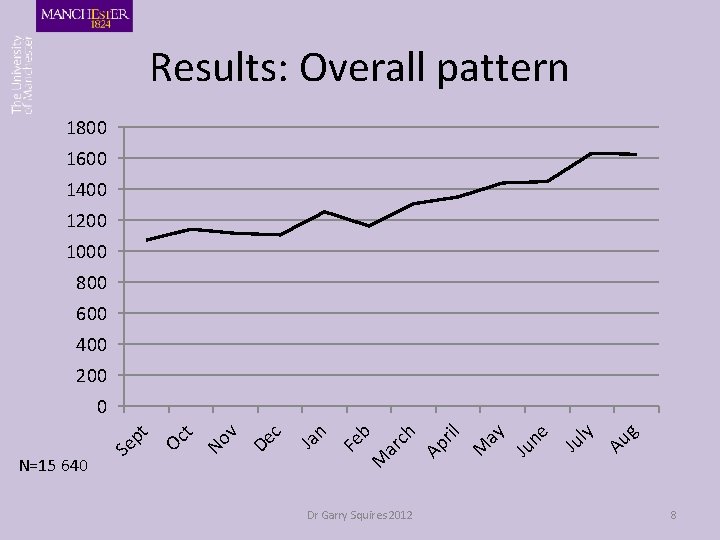
Results: Overall pattern 1800 1600 1400 1200 1000 800 600 400 200 Dr Garry Squires 2012 g Au Ju ly e Ju n ay M ril Ap ch ar b M Fe n Ja De c v t Oc No N=15 640 Se pt 0 8
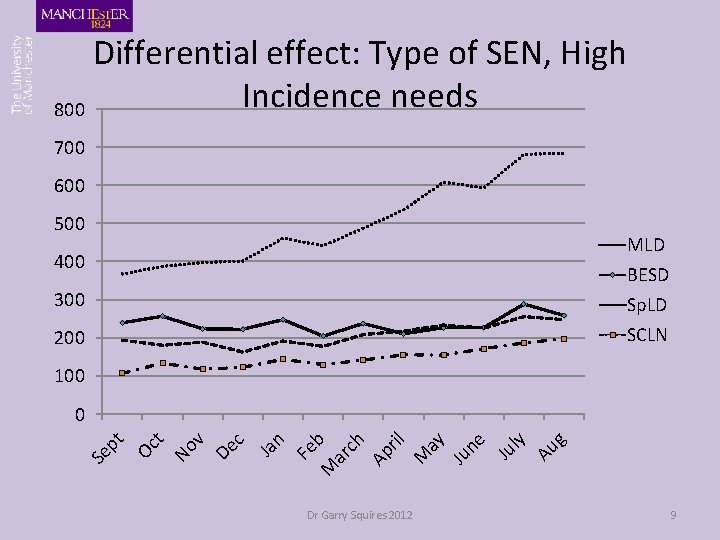
Differential effect: Type of SEN, High Incidence needs 800 700 600 500 MLD BESD Sp. LD SCLN 400 300 200 100 Dr Garry Squires 2012 Ju ly Au g e Ju n ay M ril Ap ch ar b M Fe n Ja De c v No t Oc Se pt 0 9
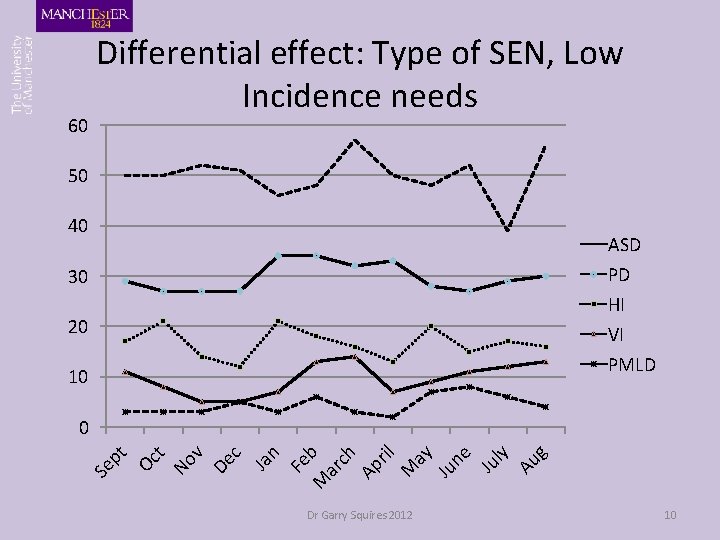
60 Differential effect: Type of SEN, Low Incidence needs 50 40 ASD PD HI VI PMLD 30 20 10 M b ar ch Ap ril M ay Ju ne Ju ly Au g Fe n Ja De c v No t Oc Se pt 0 Dr Garry Squires 2012 10
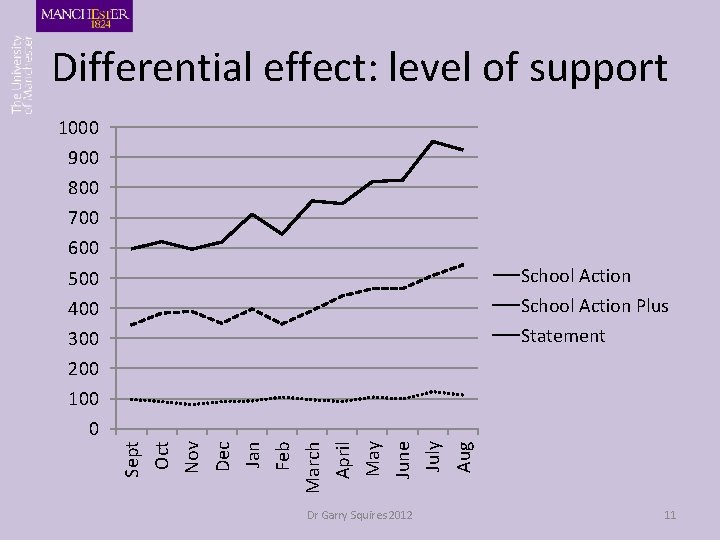
Differential effect: level of support 1000 900 800 700 600 School Action Plus Statement 500 400 300 200 100 Dr Garry Squires 2012 Aug July June May April March Feb Jan Dec Nov Oct Sept 0 11
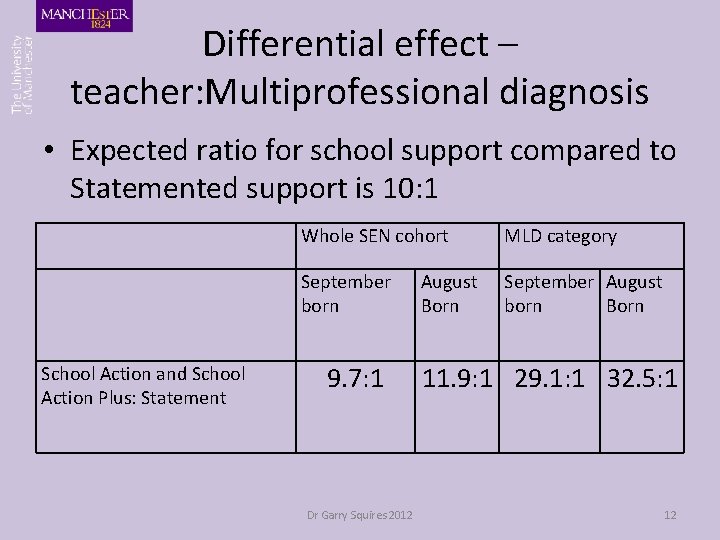
Differential effect – teacher: Multiprofessional diagnosis • Expected ratio for school support compared to Statemented support is 10: 1 School Action and School Action Plus: Statement Whole SEN cohort MLD category September born September August born Born 9. 7: 1 Dr Garry Squires 2012 August Born 11. 9: 1 29. 1: 1 32. 5: 1 12
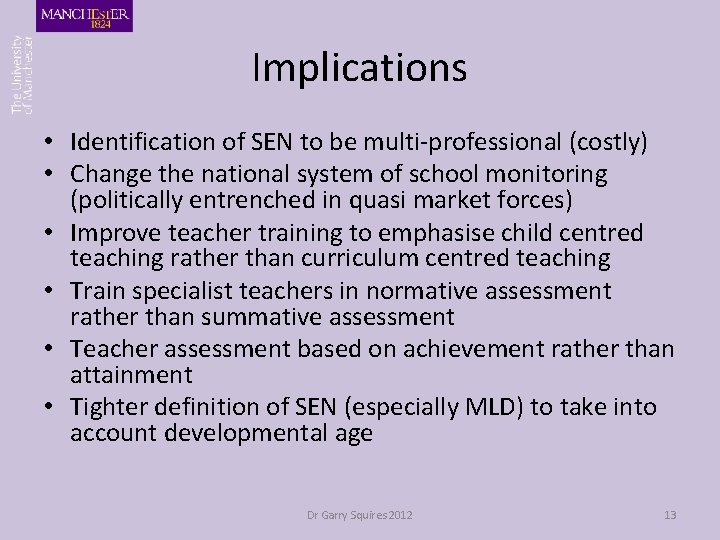
Implications • Identification of SEN to be multi-professional (costly) • Change the national system of school monitoring (politically entrenched in quasi market forces) • Improve teacher training to emphasise child centred teaching rather than curriculum centred teaching • Train specialist teachers in normative assessment rather than summative assessment • Teacher assessment based on achievement rather than attainment • Tighter definition of SEN (especially MLD) to take into account developmental age Dr Garry Squires 2012 13
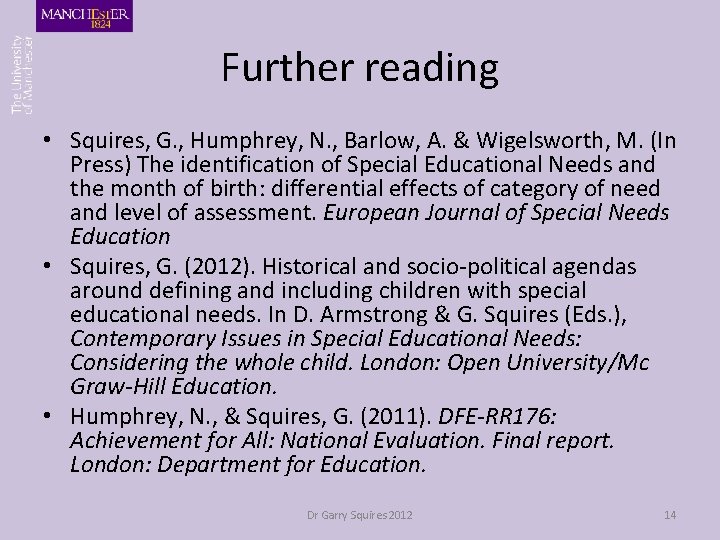
Further reading • Squires, G. , Humphrey, N. , Barlow, A. & Wigelsworth, M. (In Press) The identification of Special Educational Needs and the month of birth: differential effects of category of need and level of assessment. European Journal of Special Needs Education • Squires, G. (2012). Historical and socio-political agendas around defining and including children with special educational needs. In D. Armstrong & G. Squires (Eds. ), Contemporary Issues in Special Educational Needs: Considering the whole child. London: Open University/Mc Graw-Hill Education. • Humphrey, N. , & Squires, G. (2011). DFE-RR 176: Achievement for All: National Evaluation. Final report. London: Department for Education. Dr Garry Squires 2012 14
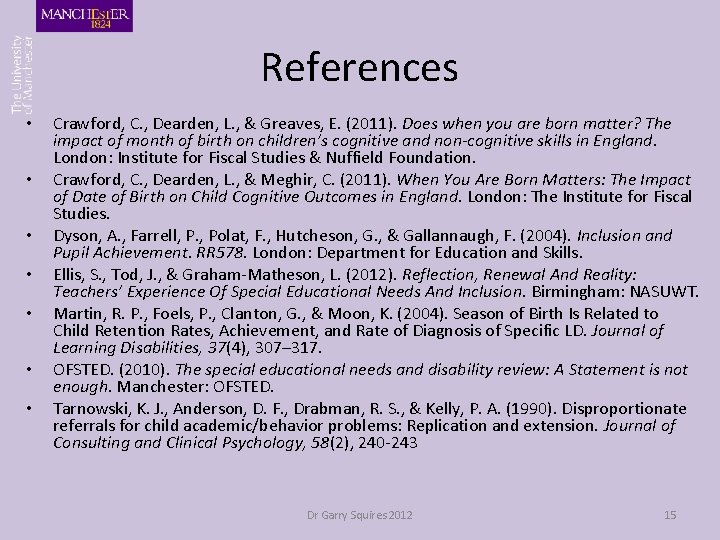
References • • Crawford, C. , Dearden, L. , & Greaves, E. (2011). Does when you are born matter? The impact of month of birth on children’s cognitive and non-cognitive skills in England. London: Institute for Fiscal Studies & Nuffield Foundation. Crawford, C. , Dearden, L. , & Meghir, C. (2011). When You Are Born Matters: The Impact of Date of Birth on Child Cognitive Outcomes in England. London: The Institute for Fiscal Studies. Dyson, A. , Farrell, P. , Polat, F. , Hutcheson, G. , & Gallannaugh, F. (2004). Inclusion and Pupil Achievement. RR 578. London: Department for Education and Skills. Ellis, S. , Tod, J. , & Graham-Matheson, L. (2012). Reflection, Renewal And Reality: Teachers’ Experience Of Special Educational Needs And Inclusion. Birmingham: NASUWT. Martin, R. P. , Foels, P. , Clanton, G. , & Moon, K. (2004). Season of Birth Is Related to Child Retention Rates, Achievement, and Rate of Diagnosis of Specific LD. Journal of Learning Disabilities, 37(4), 307– 317. OFSTED. (2010). The special educational needs and disability review: A Statement is not enough. Manchester: OFSTED. Tarnowski, K. J. , Anderson, D. F. , Drabman, R. S. , & Kelly, P. A. (1990). Disproportionate referrals for child academic/behavior problems: Replication and extension. Journal of Consulting and Clinical Psychology, 58(2), 240 -243 Dr Garry Squires 2012 15
- Slides: 15