
Differential Equations Basic Concepts Prepared by Vince Zaccone
Differential Equations Basic Concepts Prepared by Vince Zaccone For Campus Learning Assistance Services at UCSB
What is a Differential Equation? Prepared by Vince Zaccone For Campus Learning Assistance Services at UCSB
What is a Differential Equation? Short Answer: An equation involving derivatives. Prepared by Vince Zaccone For Campus Learning Assistance Services at UCSB
What is a Differential Equation? Short Answer: An equation involving derivatives. Slightly Longer Answer: When you encounter a dynamic system, where things are changing (especially as time progresses), a differential equation can help model the behavior. Here a few examples: Prepared by Vince Zaccone For Campus Learning Assistance Services at UCSB
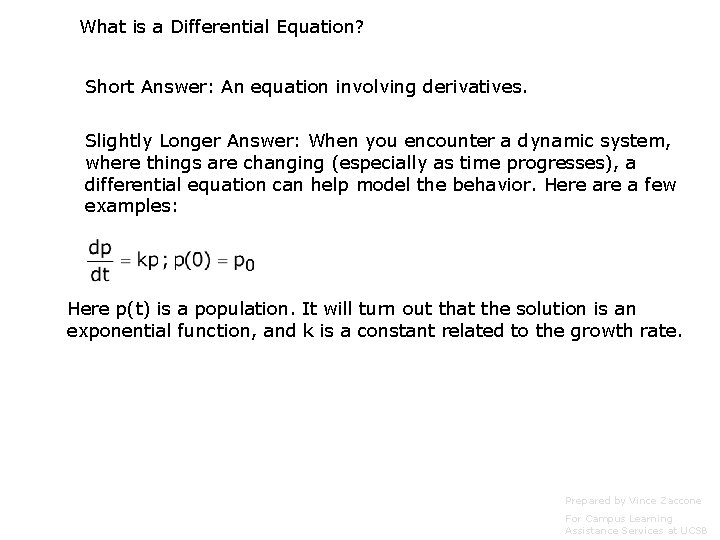
What is a Differential Equation? Short Answer: An equation involving derivatives. Slightly Longer Answer: When you encounter a dynamic system, where things are changing (especially as time progresses), a differential equation can help model the behavior. Here a few examples: Here p(t) is a population. It will turn out that the solution is an exponential function, and k is a constant related to the growth rate. Prepared by Vince Zaccone For Campus Learning Assistance Services at UCSB
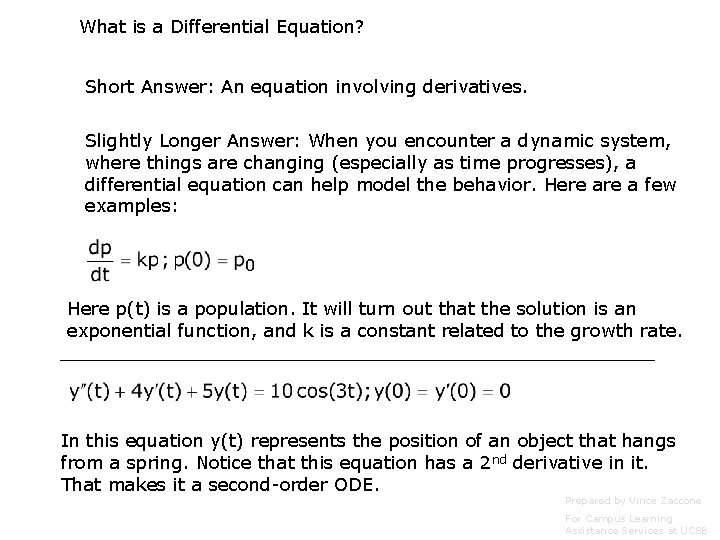
What is a Differential Equation? Short Answer: An equation involving derivatives. Slightly Longer Answer: When you encounter a dynamic system, where things are changing (especially as time progresses), a differential equation can help model the behavior. Here a few examples: Here p(t) is a population. It will turn out that the solution is an exponential function, and k is a constant related to the growth rate. In this equation y(t) represents the position of an object that hangs from a spring. Notice that this equation has a 2 nd derivative in it. That makes it a second-order ODE. Prepared by Vince Zaccone For Campus Learning Assistance Services at UCSB
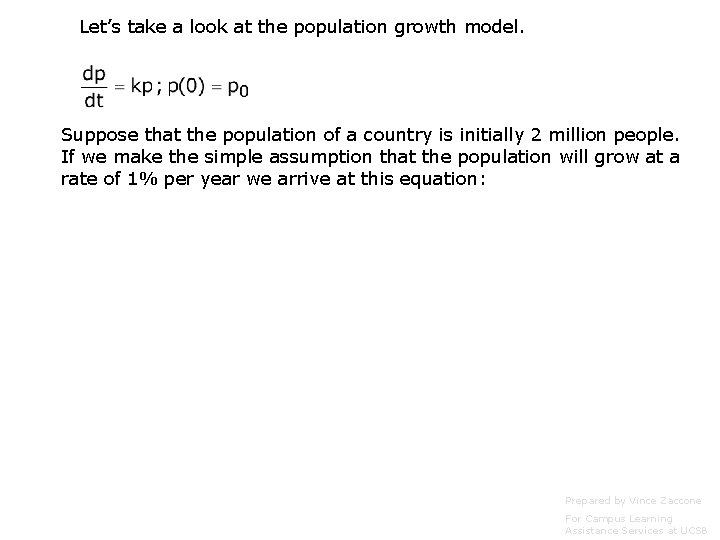
Let’s take a look at the population growth model. Suppose that the population of a country is initially 2 million people. If we make the simple assumption that the population will grow at a rate of 1% per year we arrive at this equation: Prepared by Vince Zaccone For Campus Learning Assistance Services at UCSB
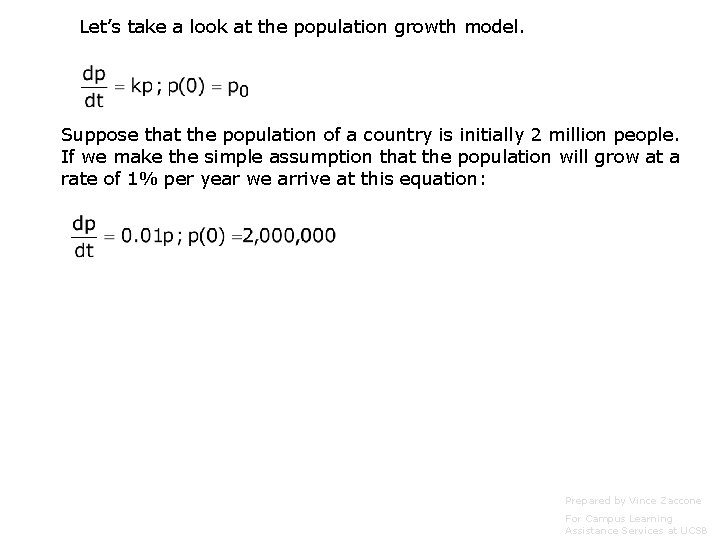
Let’s take a look at the population growth model. Suppose that the population of a country is initially 2 million people. If we make the simple assumption that the population will grow at a rate of 1% per year we arrive at this equation: Prepared by Vince Zaccone For Campus Learning Assistance Services at UCSB

Let’s take a look at the population growth model. Suppose that the population of a country is initially 2 million people. If we make the simple assumption that the population will grow at a rate of 1% per year we arrive at this equation: We will come across several ways to solve this equation. An explicit solution (a function p(t)) can be found via an integrating factor, or separation of variables. Prepared by Vince Zaccone For Campus Learning Assistance Services at UCSB
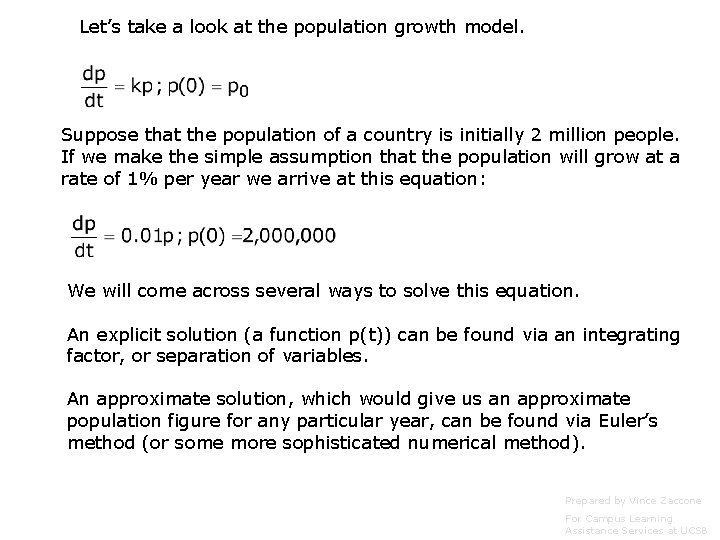
Let’s take a look at the population growth model. Suppose that the population of a country is initially 2 million people. If we make the simple assumption that the population will grow at a rate of 1% per year we arrive at this equation: We will come across several ways to solve this equation. An explicit solution (a function p(t)) can be found via an integrating factor, or separation of variables. An approximate solution, which would give us an approximate population figure for any particular year, can be found via Euler’s method (or some more sophisticated numerical method). Prepared by Vince Zaccone For Campus Learning Assistance Services at UCSB
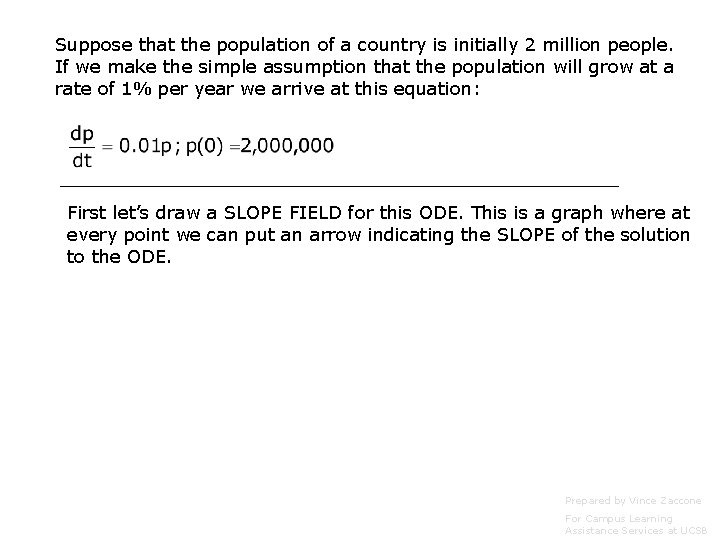
Suppose that the population of a country is initially 2 million people. If we make the simple assumption that the population will grow at a rate of 1% per year we arrive at this equation: First let’s draw a SLOPE FIELD for this ODE. This is a graph where at every point we can put an arrow indicating the SLOPE of the solution to the ODE. Prepared by Vince Zaccone For Campus Learning Assistance Services at UCSB
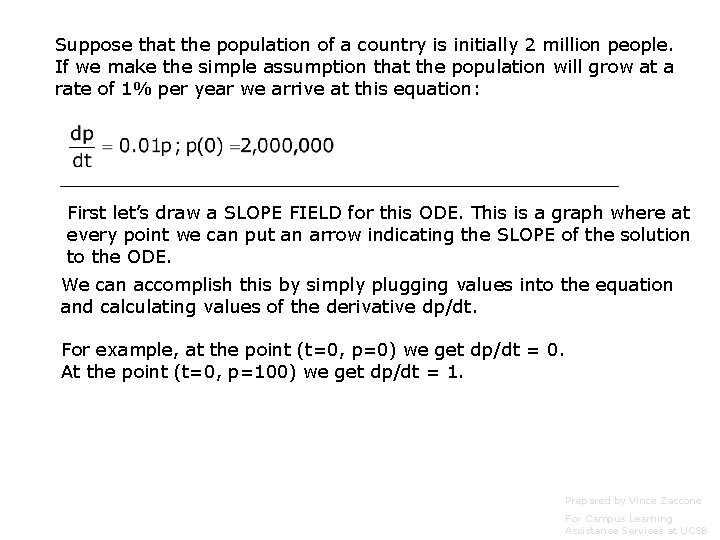
Suppose that the population of a country is initially 2 million people. If we make the simple assumption that the population will grow at a rate of 1% per year we arrive at this equation: First let’s draw a SLOPE FIELD for this ODE. This is a graph where at every point we can put an arrow indicating the SLOPE of the solution to the ODE. We can accomplish this by simply plugging values into the equation and calculating values of the derivative dp/dt. For example, at the point (t=0, p=0) we get dp/dt = 0. At the point (t=0, p=100) we get dp/dt = 1. Prepared by Vince Zaccone For Campus Learning Assistance Services at UCSB
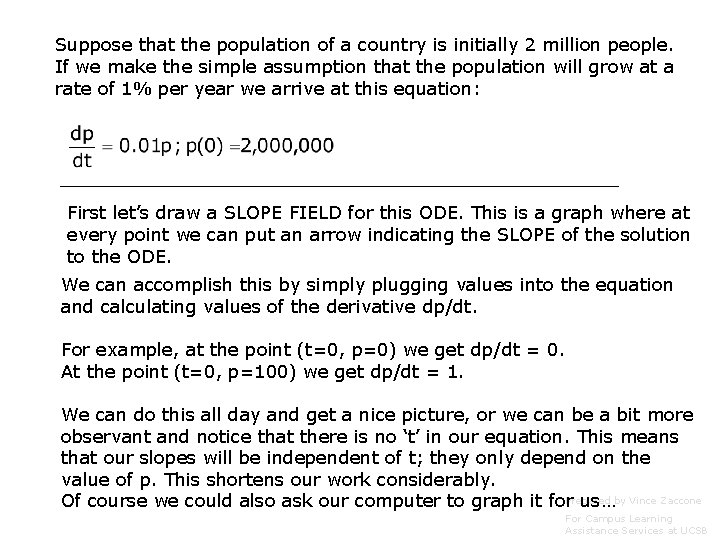
Suppose that the population of a country is initially 2 million people. If we make the simple assumption that the population will grow at a rate of 1% per year we arrive at this equation: First let’s draw a SLOPE FIELD for this ODE. This is a graph where at every point we can put an arrow indicating the SLOPE of the solution to the ODE. We can accomplish this by simply plugging values into the equation and calculating values of the derivative dp/dt. For example, at the point (t=0, p=0) we get dp/dt = 0. At the point (t=0, p=100) we get dp/dt = 1. We can do this all day and get a nice picture, or we can be a bit more observant and notice that there is no ‘t’ in our equation. This means that our slopes will be independent of t; they only depend on the value of p. This shortens our work considerably. Of course we could also ask our computer to graph it for. Prepared us…by Vince Zaccone For Campus Learning Assistance Services at UCSB
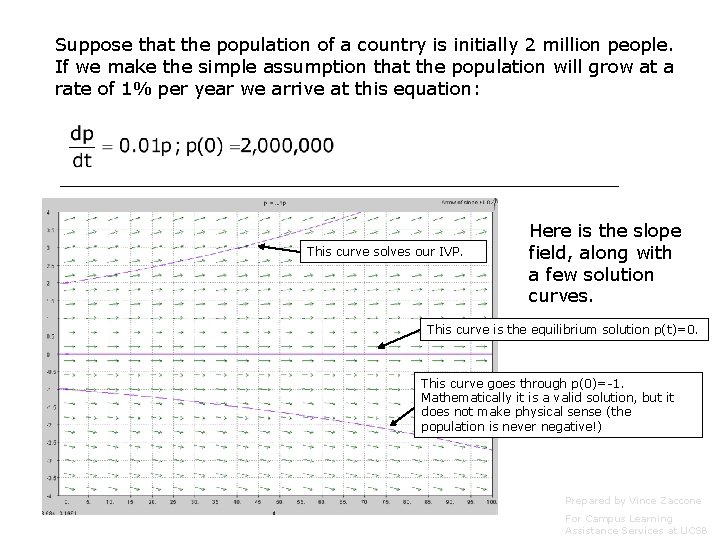
Suppose that the population of a country is initially 2 million people. If we make the simple assumption that the population will grow at a rate of 1% per year we arrive at this equation: This curve solves our IVP. Here is the slope field, along with a few solution curves. This curve is the equilibrium solution p(t)=0. This curve goes through p(0)=-1. Mathematically it is a valid solution, but it does not make physical sense (the population is never negative!) Prepared by Vince Zaccone For Campus Learning Assistance Services at UCSB
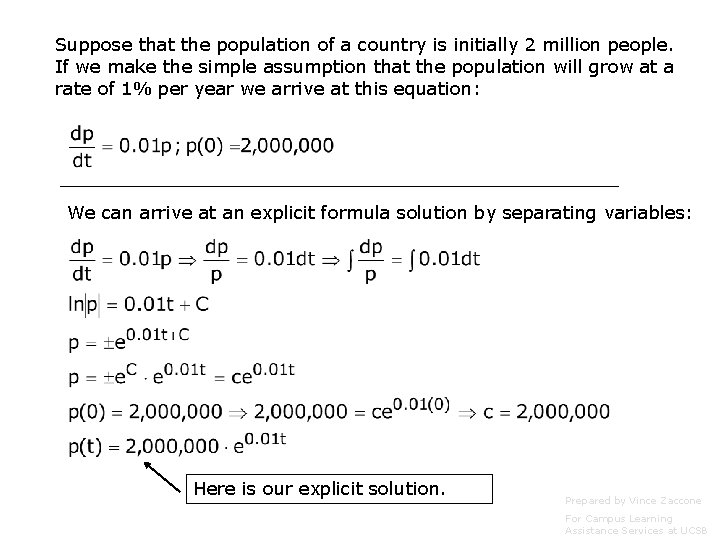
Suppose that the population of a country is initially 2 million people. If we make the simple assumption that the population will grow at a rate of 1% per year we arrive at this equation: We can arrive at an explicit formula solution by separating variables: Here is our explicit solution. Prepared by Vince Zaccone For Campus Learning Assistance Services at UCSB
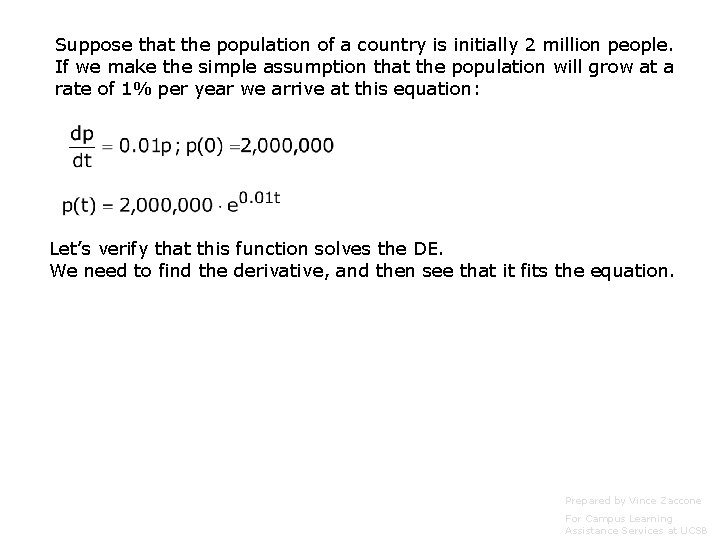
Suppose that the population of a country is initially 2 million people. If we make the simple assumption that the population will grow at a rate of 1% per year we arrive at this equation: Let’s verify that this function solves the DE. We need to find the derivative, and then see that it fits the equation. Prepared by Vince Zaccone For Campus Learning Assistance Services at UCSB
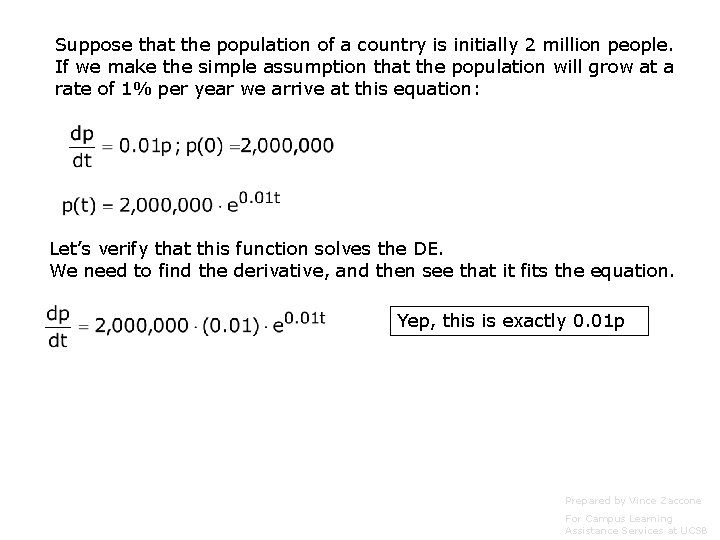
Suppose that the population of a country is initially 2 million people. If we make the simple assumption that the population will grow at a rate of 1% per year we arrive at this equation: Let’s verify that this function solves the DE. We need to find the derivative, and then see that it fits the equation. Yep, this is exactly 0. 01 p Prepared by Vince Zaccone For Campus Learning Assistance Services at UCSB
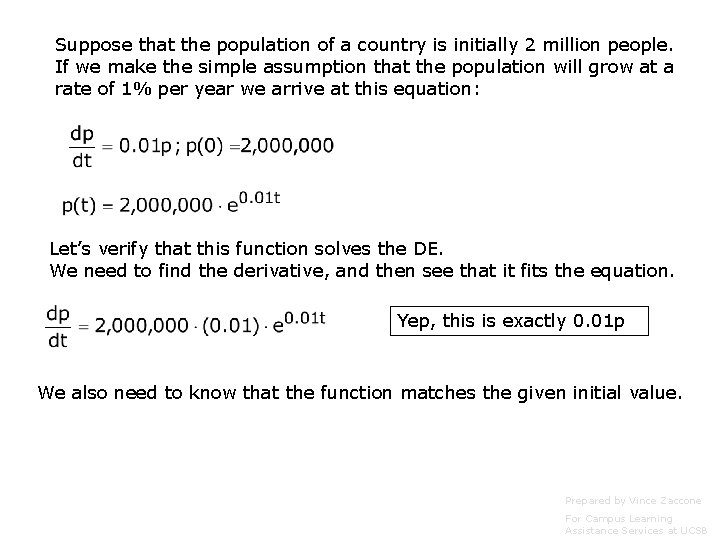
Suppose that the population of a country is initially 2 million people. If we make the simple assumption that the population will grow at a rate of 1% per year we arrive at this equation: Let’s verify that this function solves the DE. We need to find the derivative, and then see that it fits the equation. Yep, this is exactly 0. 01 p We also need to know that the function matches the given initial value. Prepared by Vince Zaccone For Campus Learning Assistance Services at UCSB
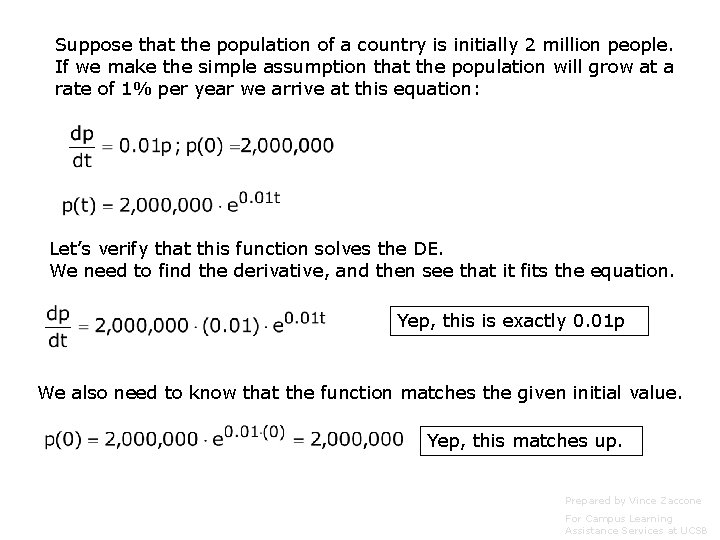
Suppose that the population of a country is initially 2 million people. If we make the simple assumption that the population will grow at a rate of 1% per year we arrive at this equation: Let’s verify that this function solves the DE. We need to find the derivative, and then see that it fits the equation. Yep, this is exactly 0. 01 p We also need to know that the function matches the given initial value. Yep, this matches up. Prepared by Vince Zaccone For Campus Learning Assistance Services at UCSB
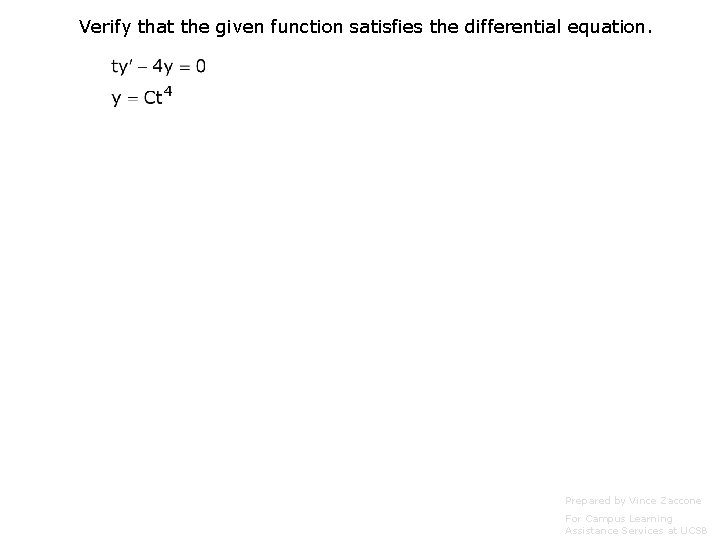
Verify that the given function satisfies the differential equation. Prepared by Vince Zaccone For Campus Learning Assistance Services at UCSB
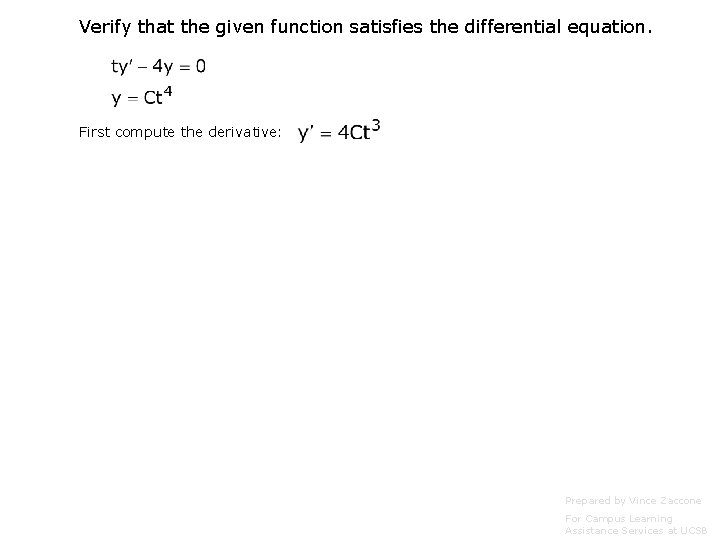
Verify that the given function satisfies the differential equation. First compute the derivative: Prepared by Vince Zaccone For Campus Learning Assistance Services at UCSB
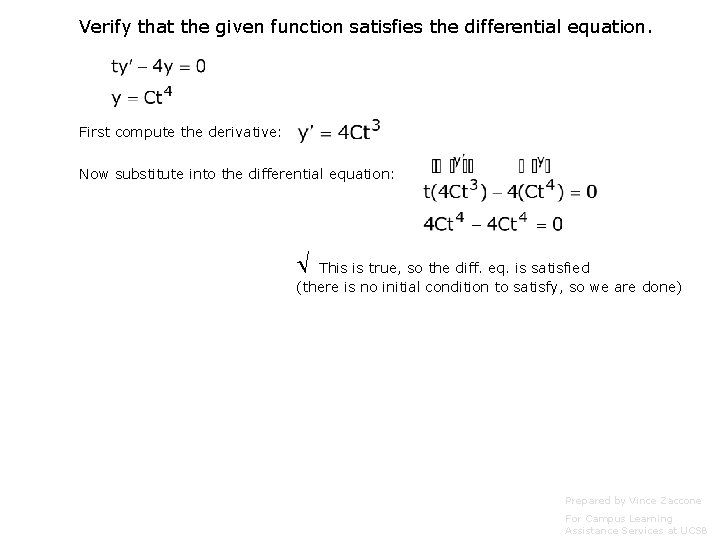
Verify that the given function satisfies the differential equation. First compute the derivative: Now substitute into the differential equation: This is true, so the diff. eq. is satisfied (there is no initial condition to satisfy, so we are done) Prepared by Vince Zaccone For Campus Learning Assistance Services at UCSB
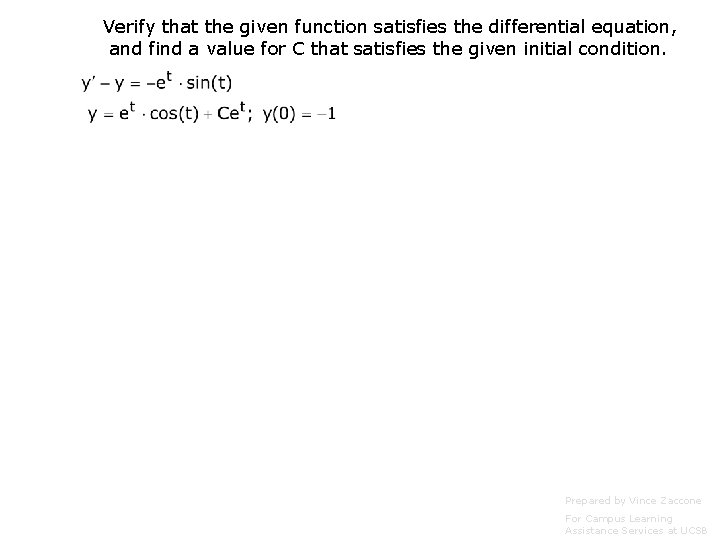
Verify that the given function satisfies the differential equation, and find a value for C that satisfies the given initial condition. Prepared by Vince Zaccone For Campus Learning Assistance Services at UCSB
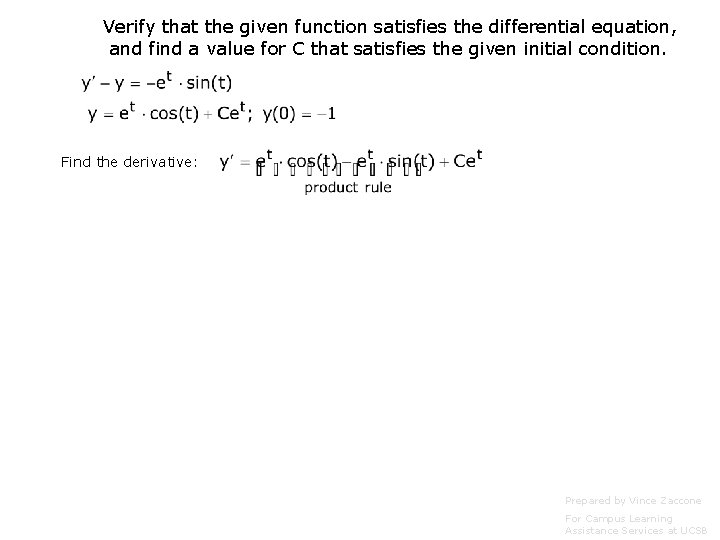
Verify that the given function satisfies the differential equation, and find a value for C that satisfies the given initial condition. Find the derivative: Prepared by Vince Zaccone For Campus Learning Assistance Services at UCSB
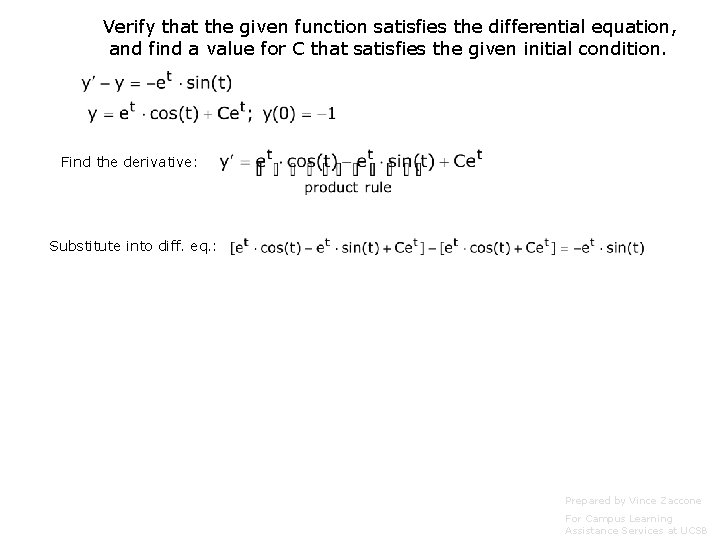
Verify that the given function satisfies the differential equation, and find a value for C that satisfies the given initial condition. Find the derivative: Substitute into diff. eq. : Prepared by Vince Zaccone For Campus Learning Assistance Services at UCSB
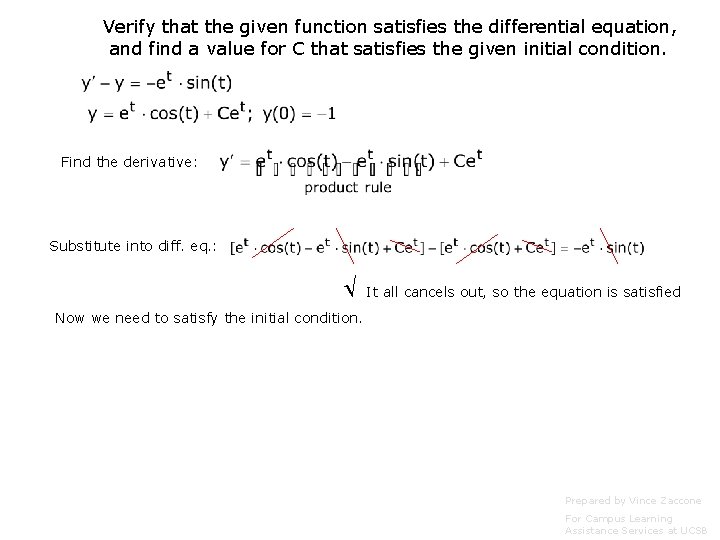
Verify that the given function satisfies the differential equation, and find a value for C that satisfies the given initial condition. Find the derivative: Substitute into diff. eq. : It all cancels out, so the equation is satisfied Now we need to satisfy the initial condition. Prepared by Vince Zaccone For Campus Learning Assistance Services at UCSB
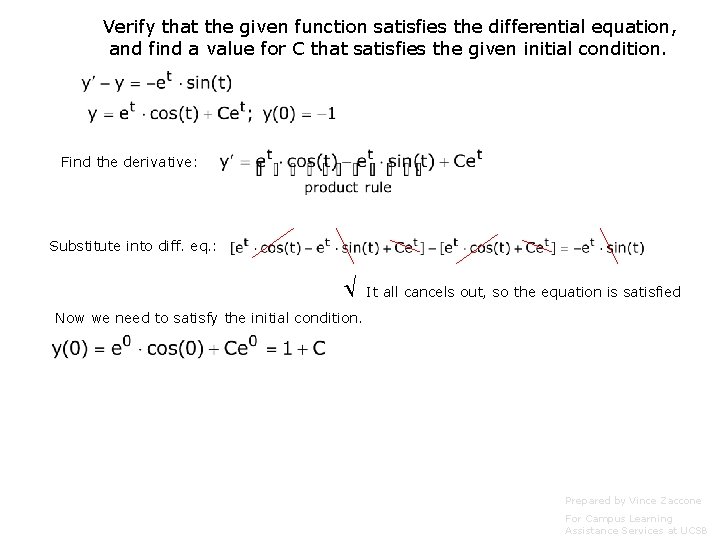
Verify that the given function satisfies the differential equation, and find a value for C that satisfies the given initial condition. Find the derivative: Substitute into diff. eq. : It all cancels out, so the equation is satisfied Now we need to satisfy the initial condition. Prepared by Vince Zaccone For Campus Learning Assistance Services at UCSB
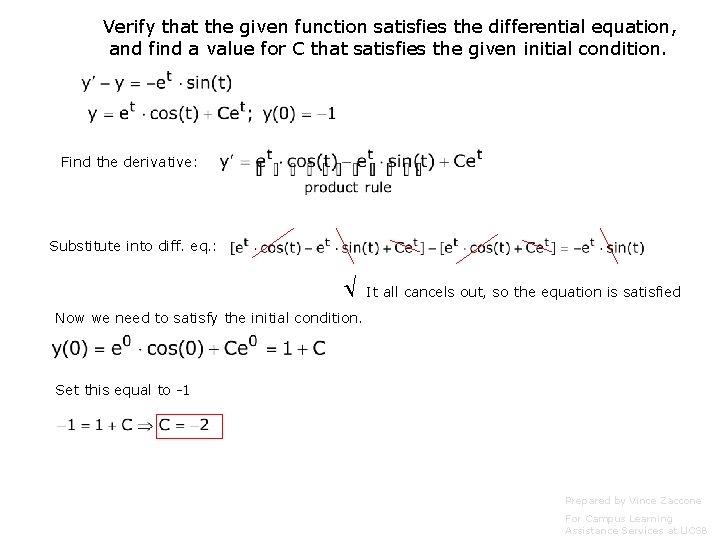
Verify that the given function satisfies the differential equation, and find a value for C that satisfies the given initial condition. Find the derivative: Substitute into diff. eq. : It all cancels out, so the equation is satisfied Now we need to satisfy the initial condition. Set this equal to -1 Prepared by Vince Zaccone For Campus Learning Assistance Services at UCSB
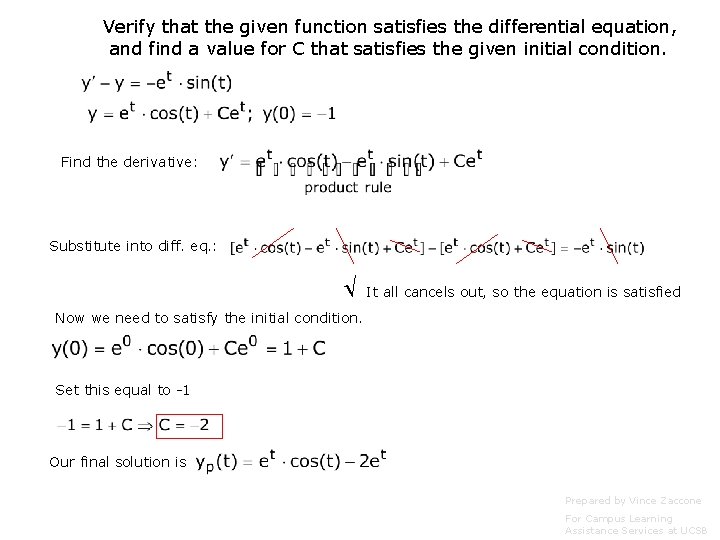
Verify that the given function satisfies the differential equation, and find a value for C that satisfies the given initial condition. Find the derivative: Substitute into diff. eq. : It all cancels out, so the equation is satisfied Now we need to satisfy the initial condition. Set this equal to -1 Our final solution is Prepared by Vince Zaccone For Campus Learning Assistance Services at UCSB
- Slides: 29