
Differential Equation Conservation of Momentum Sum of the
- Slides: 4
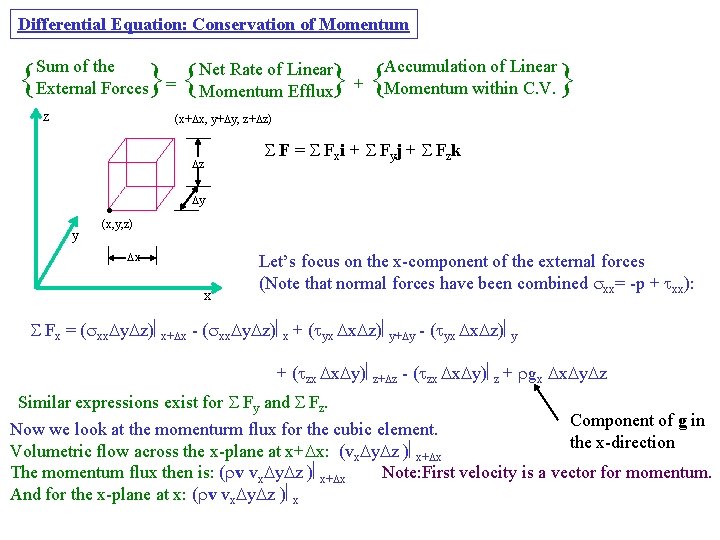
Differential Equation: Conservation of Momentum { }{ Sum of the External Forces = z }+{ Net Rate of Linear Momentum Efflux Accumulation of Linear Momentum within C. V. } (x+ x, y+ y, z+ z) z . y F = Fxi + Fyj + Fzk y (x, y, z) x x Let’s focus on the x-component of the external forces (Note that normal forces have been combined xx= -p + xx): Fx = ( xx y z) x+ x - ( xx y z) x + ( yx x z) y+ y - ( yx x z) y + ( zx x y) z+ z - ( zx x y) z + gx x y z Similar expressions exist for Fy and Fz. Component of g in Now we look at the momenturm flux for the cubic element. the x-direction Volumetric flow across the x-plane at x+ x: (vx y z ) x+ x The momentum flux then is: ( v vx y z ) x+ x Note: First velocity is a vector for momentum. And for the x-plane at x: ( v vx y z ) x
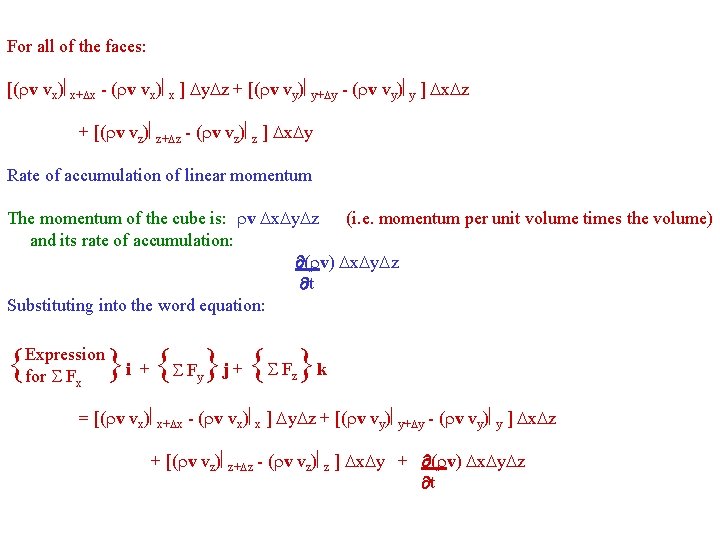
For all of the faces: [( v vx) x+ x - ( v vx) x ] y z + [( v vy) y+ y - ( v vy) y ] x z + [( v vz) z+ z - ( v vz) z ] x y Rate of accumulation of linear momentum The momentum of the cube is: v x y z (i. e. momentum per unit volume times the volume) and its rate of accumulation: ( v) x y z t Substituting into the word equation: {Expression }i + { F }j + { F }k for F x y z = [( v vx) x+ x - ( v vx) x ] y z + [( v vy) y+ y - ( v vy) y ] x z + [( v vz) z+ z - ( v vz) z ] x y + ( v) x y z t
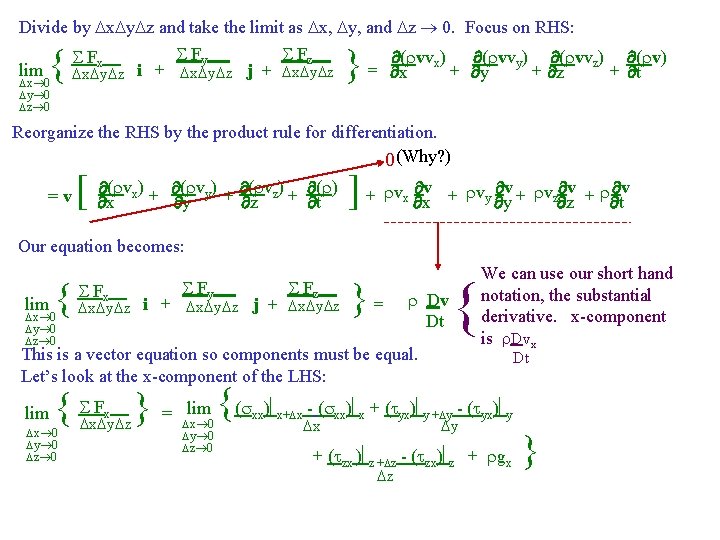
Divide by x y z and take the limit as x, y, and z 0. Focus on RHS: Fy Fz Fx ( vvx) ( vvy) ( vvz) ( v) lim i + j + = + + z + t x y z { } x 0 y 0 z 0 Reorganize the RHS by the product rule for differentiation. 0 (Why? ) =v ) + ( ) ] + v v [ x ( v ) + ( v y z t x x y z x v + vz v + vy y z t Our equation becomes: Divide by x y z and take the limit as x, y, and z 0. Focus on RHS: We can use our short hand Fy Fz Fx notation, the substantial lim = Dv x y z i + x y z j + x y z x 0 derivative. x-component Dt y 0 is Dvx z 0 This is a vector equation so components must be equal. Dt Let’s look at the x-component of the LHS: { lim { F } = x 0 y 0 z 0 { } x x y z lim x 0 y 0 z 0 {( xx) x+ x - ( xx) x + ( yx) y + y - ( yx) y x y + ( zx ) z + z - ( zx) z + gx z }
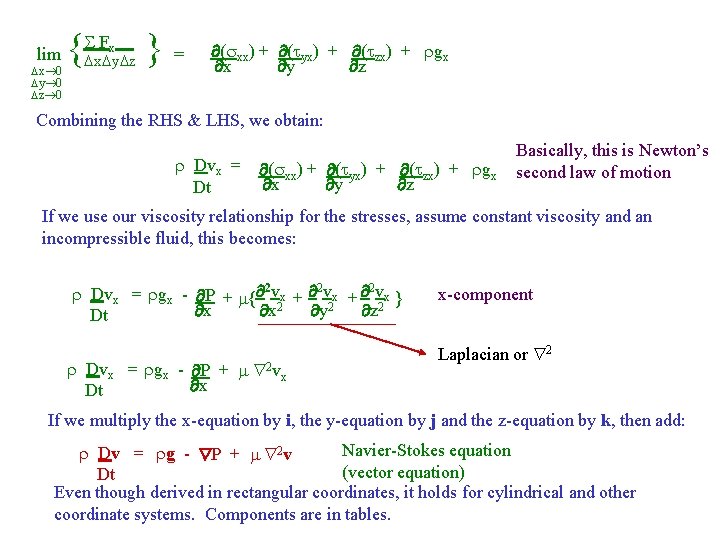
lim x 0 y 0 z 0 { Fx x y z }= ( xx) + ( yx) + ( zx) + gx x y z Combining the RHS & LHS, we obtain: Dvx = ( xx) + ( yx) + ( zx) + gx x y z Dt Basically, this is Newton’s second law of motion If we use our viscosity relationship for the stresses, assume constant viscosity and an incompressible fluid, this becomes: Dvx = gx - P + { 2 vx + 2 vx } x x 2 y 2 z 2 Dt Dvx = gx - P + 2 vx x Dt x-component Laplacian or 2 If we multiply the x-equation by i, the y-equation by j and the z-equation by k, then add: Navier-Stokes equation Dv = g - P + 2 v (vector equation) Dt Even though derived in rectangular coordinates, it holds for cylindrical and other coordinate systems. Components are in tables.