
Differential Diagnosis of Dementia Eric I Rosenberg MD
Differential Diagnosis of Dementia Eric I. Rosenberg, MD, MSPH, FACP Department of Medicine University of Florida
Objectives • Describe signs and symptoms concerning for early dementia. • Describe common causes of memory loss in the elderly. • Help integrate history, physical, and laboratory findings to diagnose “reversible” causes of dementia. • Discuss when referral to a neurologist or psychiatrist may be helpful.
• “An acquired deterioration in cognitive abilities that impairs the successful performance of activities of daily living” • Cognitive Losses in two or more: – – Memory Language Visuospatial (recognize objects) Executive function (tasks) • Progressive American Psychiatric Association. DSM IV. 1998.
A Syndrome • Made up of multiple causes, multiple disorders • Cluster of abnormal results from history, physical, and selected testing • Early detection requires continuity of care & attention to cognitive deficits Psychiatr Clin North Am 1998; 21(4).
Dementia is Common • • > 4 million cases in the U. S. > $100 billion/year 10 -15% from “reversible” causes Clinicians fail to detect in 20 -70% patients until severe • Early detection important – diagnose cause – prolong function/comfort – patient & family can plan future preferences Harrison's On. Line Internal Med 16 th ed. 2005.
Signs and Symptoms • • • Cognitive Psychiatric Personality Problem Behaviors Problems with Activities Daily of Living (ADL’s) Am Fam Physician 2001; 63: 703 -13, 717 -8.
Common Causes of Mild Memory Loss • • • (Early) Alzheimer’s Disease Depression Hearing/Visual Impairment Polypharmacy & Polyprescribers Metabolic Conditions Substance Abuse Ann Intern Med 2003; 138: 411 -419.
“Reversible” Causes of Dementia 1. CNS Conditions 2. Toxins 3. “Medical” Conditions
1. ) CNS Conditions • • Normal-Pressure Hydrocephalus Primary/Metastatic Brain Tumor Chronic infection Trauma
Normal Pressure Hydrocephalus • Abnormal gait, dementia, urinary incontinence • Likely have other concomittant dementias – 30 -50% show improvement with ventricular shunting – Balance risk of subdural hematoma/infection
Brain Tumors • Usually seizures, focal deficits • But if in frontal or temporal lobes, can present with personality changes and memory problems
Chronic Infection • HIV risk factors – Cryptococcal meningitis, neurosyphilis – 20 -30% of AIDS patients develop dementia • Headache, cranial neuropathies, radiculopathies, meningismus
Trauma • Recent head trauma/fall – Chronic Subdural Hematoma • Recurrent head trauma – Dementia Pugilistica
2. ) Toxins • Alcoholism • Other drugs of abuse • Heavy metals – Fatigue – Tremors – Neuropathy – Anemia – Abdominal pain
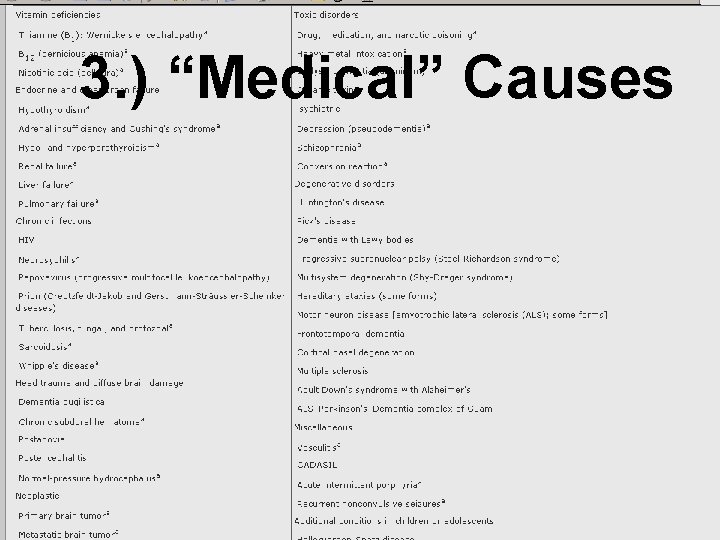
3. ) “Medical” Causes
Nutritional Deficiencies • • B-12 Niacin (Pellagra) Thiamine (Wernicke-Korsakoff) Protein, calorie malnutrition
Chronic Organ Dysfunction • Patients “lost” to medical care • Unusual weakness, malaise, physical findings – Hypothyroidism – Cushing’s/Addison’s Disease – Hypo/Hyperparathyroidism – Renal or Liver failure – Pulmonary failure
Key Historical Cues • Focus on health behaviors & ADL’s – – Prescription management Missed appointments Non-adherence Health maintenance • Neglected appearance • Family concerns – Polite, detailed probing – “How is he managing the bills? ” “What about the checkbook? Are there any changes in how that is being organized/balanced? ”
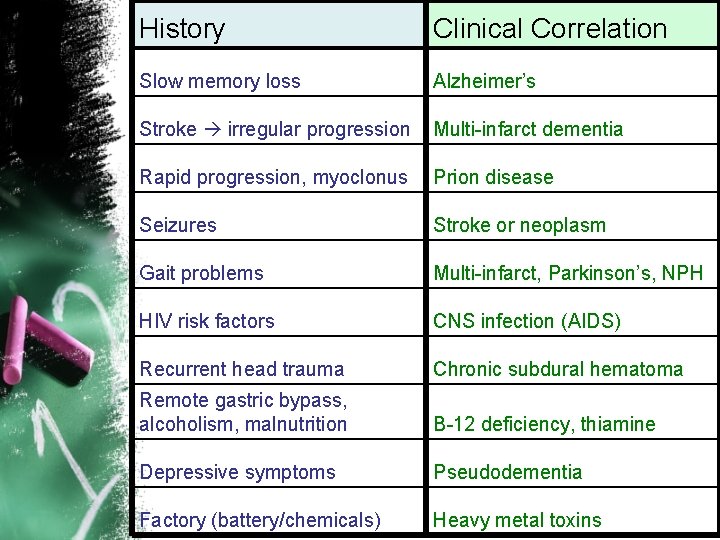
History Clinical Correlation Slow memory loss Alzheimer’s Stroke irregular progression Multi-infarct dementia Rapid progression, myoclonus Prion disease Seizures Stroke or neoplasm Gait problems Multi-infarct, Parkinson’s, NPH HIV risk factors CNS infection (AIDS) Recurrent head trauma Chronic subdural hematoma Remote gastric bypass, alcoholism, malnutrition B-12 deficiency, thiamine Depressive symptoms Pseudodementia Factory (battery/chemicals) Heavy metal toxins
Physical Exam • • General appearance Visual, auditory acuity Localizing deficits Gait abnormalities Fasiculations Gaze palsy Cogwheeling
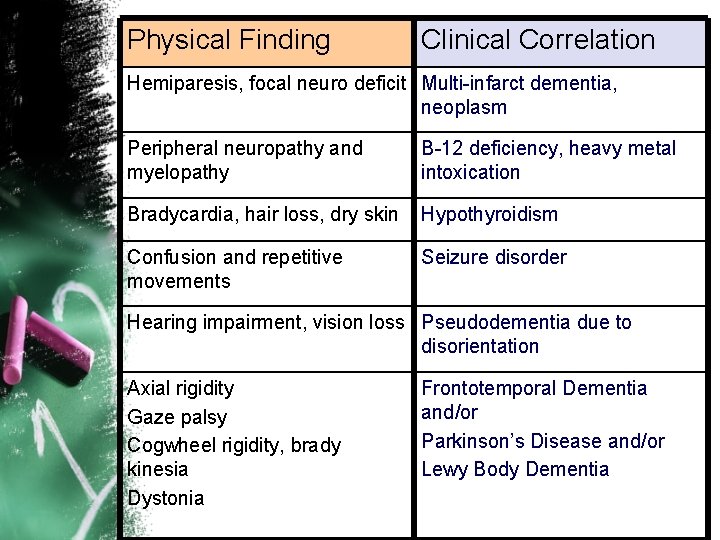
Physical Finding Clinical Correlation Hemiparesis, focal neuro deficit Multi-infarct dementia, neoplasm Peripheral neuropathy and myelopathy B-12 deficiency, heavy metal intoxication Bradycardia, hair loss, dry skin Hypothyroidism Confusion and repetitive movements Seizure disorder Hearing impairment, vision loss Pseudodementia due to disorientation Axial rigidity Gaze palsy Cogwheel rigidity, brady kinesia Dystonia Frontotemporal Dementia and/or Parkinson’s Disease and/or Lewy Body Dementia
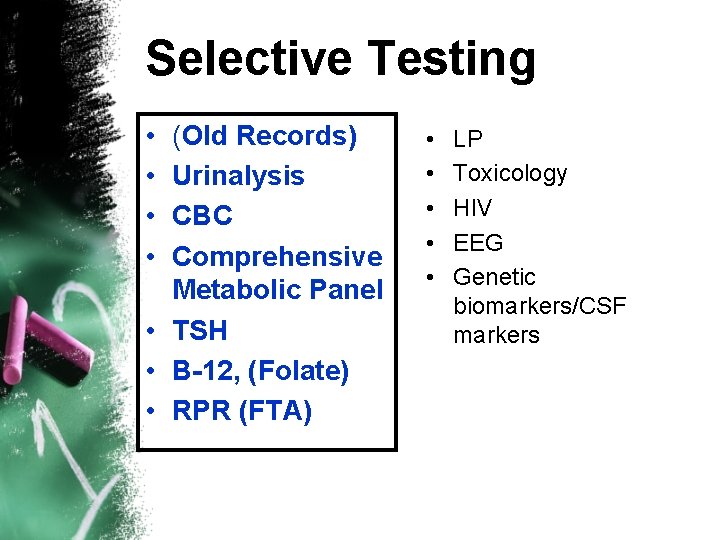
Selective Testing • • (Old Records) Urinalysis CBC Comprehensive Metabolic Panel • TSH • B-12, (Folate) • RPR (FTA) • • • LP Toxicology HIV EEG Genetic biomarkers/CSF markers
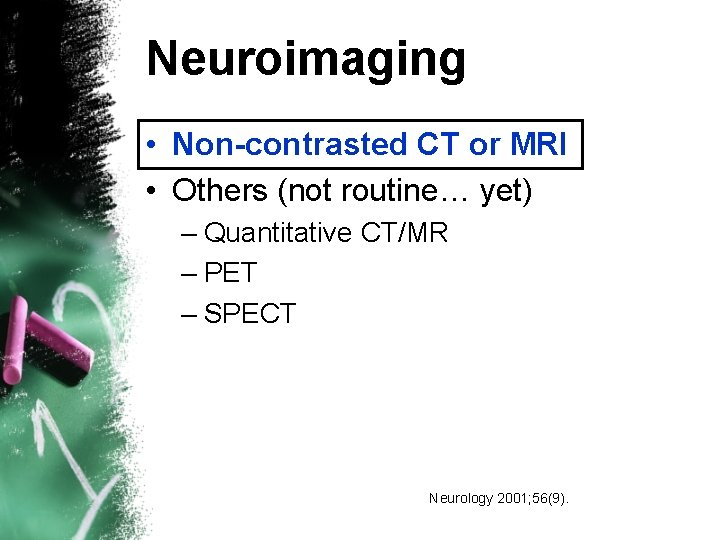
Neuroimaging • Non-contrasted CT or MRI • Others (not routine… yet) – Quantitative CT/MR – PET – SPECT Neurology 2001; 56(9).
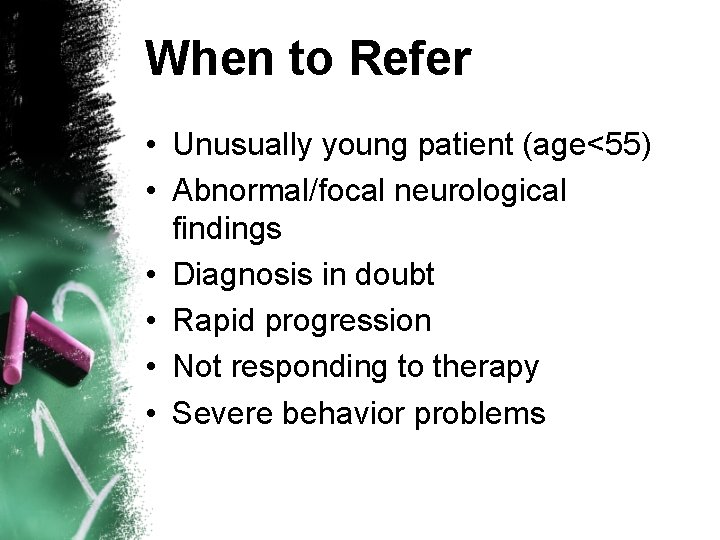
When to Refer • Unusually young patient (age<55) • Abnormal/focal neurological findings • Diagnosis in doubt • Rapid progression • Not responding to therapy • Severe behavior problems
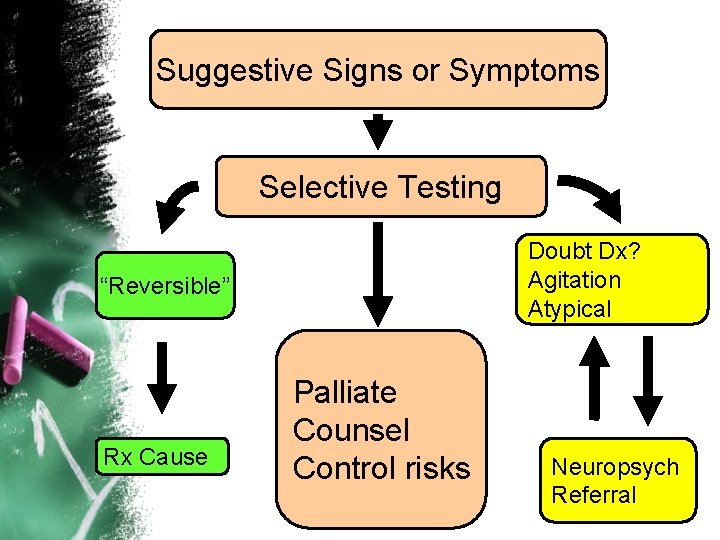
Suggestive Signs or Symptoms Selective Testing Doubt Dx? Agitation Atypical “Reversible” Rx Cause Palliate Counsel Control risks Neuropsych Referral
Objectives • Describe signs and symptoms concerning for early dementia. • Describe common causes of memory loss in the elderly. • Help integrate history, physical, and laboratory findings to diagnose “reversible” causes of dementia. • Recognize when referral to a neurologist or psychiatrist may be helpful.
Bibliography • Armon C. Western pacific ALS/PDC and flying foxes. What’s next? Neurology 2003; 61: 291 -292. • Bair BD. Diagnostic Dilemmas, Part II: frequently missed diagnosis in geriatric psychiatry. Psychiatr Clin North Am 1998; 21(4): 941 -971. • Bird TD, Miller BL. Alzheimer’s disease and other dementias. In: Kasper DL, et al (Eds. ) Harrison’s Principles of Internal Medicine, 16 th edition [Online]. Chapter 350. February 2005. • Cummings JL. Alzheimer’s disease. N Engl J Med 2004; 351(1): 56 -67. • Karlawish JHT, Clark CM. Diagnostic evaluation of elderly patients with mild memory problems. Ann Intern Med 2003; 138: 411 -419. • Knopman DS, et al. Practice parameter: diagnosis of dementia (an evidence-based review). Neurology 2001; 56(9). • Santacruz KS, Swagerty D. Early diagnosis of dementia. Am Fam Physician 2001; 63: 703 -13, 717 -8.
- Slides: 27