
Different Ways of Representing Places Key Idea 2





- Slides: 19
Different Ways of Representing Places Key Idea 2. b: Places are represented through a variety of contrasting formal and informal agencies. Learning Objectives: q. To determine what is meant by a formal agency. q. To assess the advantages and disadvantages of formal representations of a place.
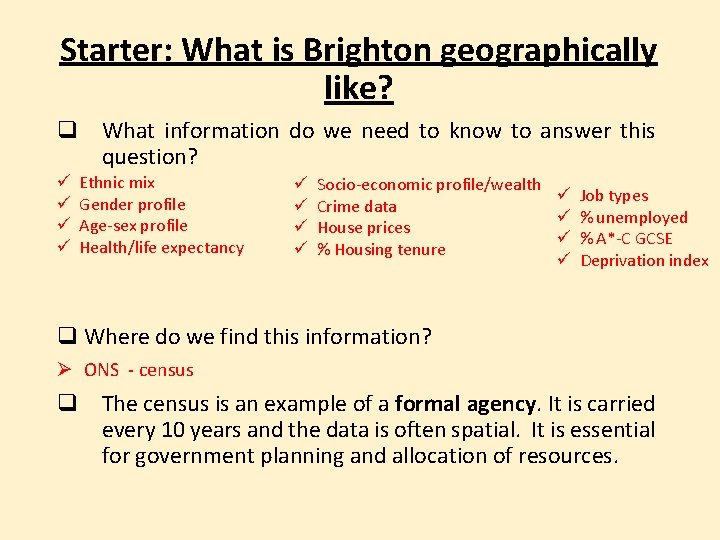
Starter: What is Brighton geographically like? q What information do we need to know to answer this question? ü ü Ethnic mix Gender profile Age-sex profile Health/life expectancy ü ü Socio-economic profile/wealth ü Job types Crime data ü % unemployed House prices ü % A*-C GCSE % Housing tenure ü Deprivation index q Where do we find this information? Ø ONS - census q The census is an example of a formal agency. It is carried every 10 years and the data is often spatial. It is essential for government planning and allocation of resources.
What is a census? According to the UN a census is: ‘the total process of collecting, compiling and publishing demographic, economic, and social data pertaining, at a specified time or times, to all persons in a country or delineated territory’. The UN recommends that a census is carried out every 10 years. What information is collected in a census?
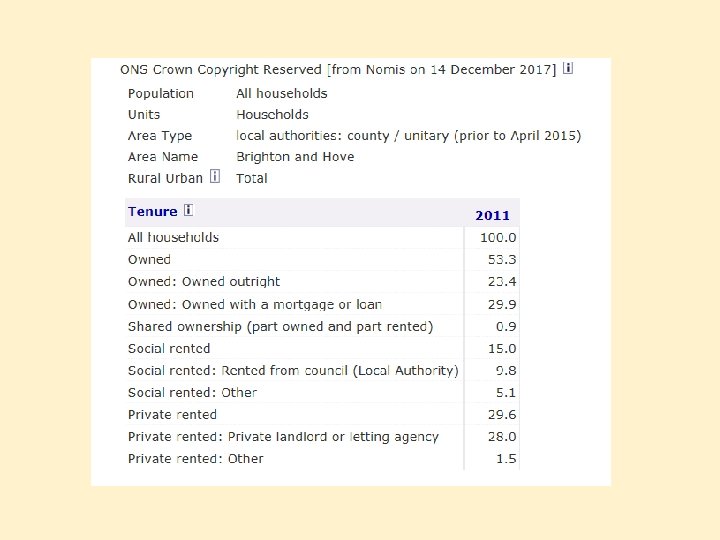
What information is collected in a census? q. Age q. Sex q. Marital status q. Birthplace q. Ethnic background q. Education q. Economic activities q. Household structure q. Housing tenure
Why is census data useful? For governments: Helps a country plan for future development For social scientists: Can be used to support collection of primary data Census data is an example of secondary data, this is data that has been collected in the past by someone else. Primary data has been collected first hand in fieldwork enquiries. This could be a questionnaire or an environmental quality assessment.
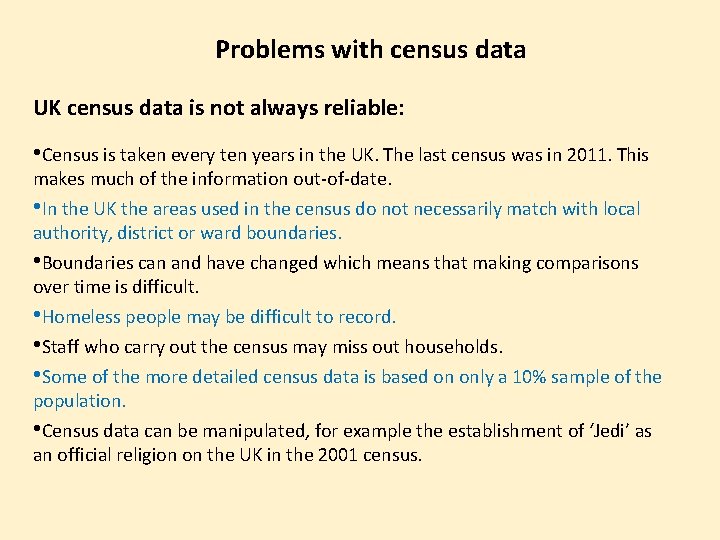
Problems with census data UK census data is not always reliable: • Census is taken every ten years in the UK. The last census was in 2011. This makes much of the information out-of-date. • In the UK the areas used in the census do not necessarily match with local authority, district or ward boundaries. • Boundaries can and have changed which means that making comparisons over time is difficult. • Homeless people may be difficult to record. • Staff who carry out the census may miss out households. • Some of the more detailed census data is based on only a 10% sample of the population. • Census data can be manipulated, for example the establishment of ‘Jedi’ as an official religion on the UK in the 2001 census.
Tasks 1. What is the census? 2. What sort of information is collected in a census? 3. How often is a census collected? 4. What is a census an example of? 5. Why is a census useful to governments? 6. What are the problems with census data?
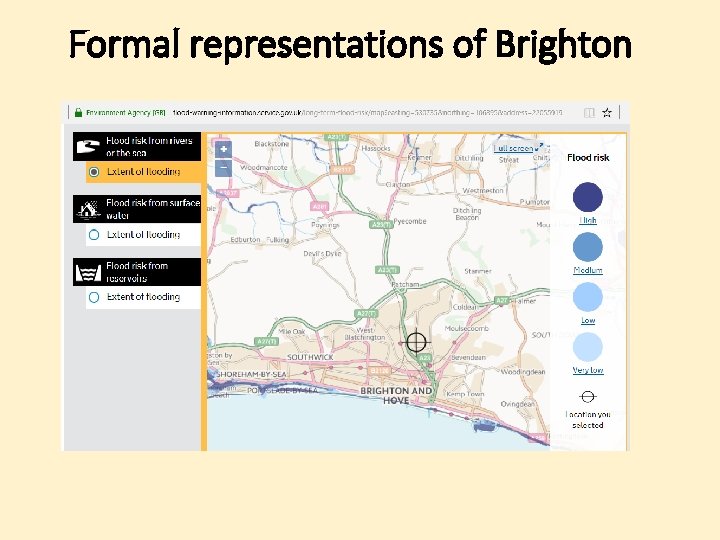
Formal representations of Brighton
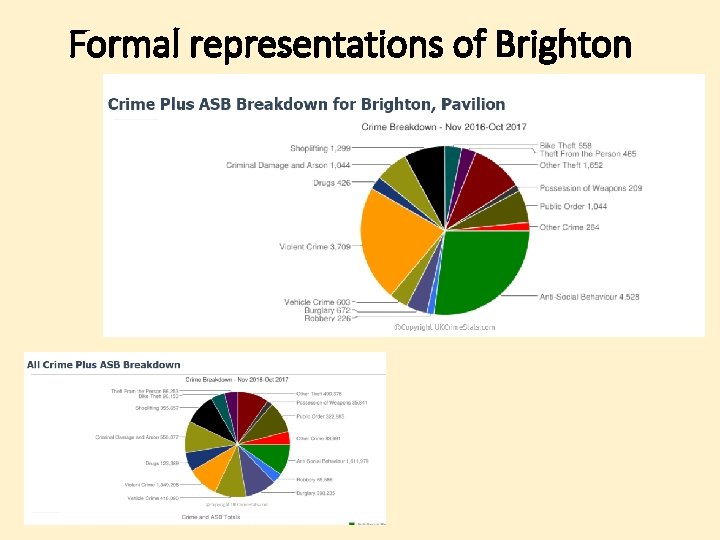
Formal representations of Brighton
Formal representations of Brighton
What are the advantages and disadvantages of formal agencies of representing a place. Make a copy of these advantages Advantages: 1. Representation is based on evidence. 2. Vast quantities of data are collected and stored, much of it spatial. Such data are invaluable in representing places, allowing them to be described and investigated. Initially a simple counting of heads, over time the census has become increasingly sophisticated and detailed. Today it includes personal information such as date of birth, gender, educational qualifications, ethnicity, religion, health, welfare, housing and employment. It is objective (no emotion). 3. It is accurate and up-to-date as census conducted every 10 years. 4. It allows for a holistic view of an area, often using quantitative data.
What are the advantages and disadvantages of formal agencies of representing a place. Disadvantages: 1. It can lack the deep and rich information on a place that is promoted by informal agencies through film or art. Tells us nothing about Brighton e. g. the fact that it has the highest density of vegetarian restaurants than anywhere else in the UK OR about the landscape (pebble beach) OR historic landmarks e. g. Pavilion Pier OR the sustainable community “New England Quarter”. **All of these portray an “alternative “ lifestyle – you don’t get this from the census. 2. Tells us nothing of the issues/challenges facing Brighton e. g. homelessness. 3. Whilst numerical data are often used to present formal and objective representations of places, they almost always include some degree of subjectivity and bias. There are problems associated with the reliability of some of this data as it assumes those completing surveys do so with total accuracy and truth. If there are inaccuracies, then it can lead to a place being misrepresented. ** Also what about the past connections of Brighton that shape it? ? Make a copy of these disadvantages
How do formal agencies represent Brighton? Tasks: Go to the Nomis website and find official labour market statistics for Brighton. https: //www. nomisweb. co. uk/home/profiles. asp Use census data from nomisweb to look at other formal representations. 1. Describe Brighton’s profile based on this evidence. For example, is Brighton wealthy, healthy, well educated, etc. ? 2. Do these statistics suggest Brighton is a rural or urban place? 3. Does this evidence support or contradict your informal representation of Brighton? 4. Do the formal and informal representations match in any way?
Summary: Places can be represented in formal and informal ways § More data about places is now collected, stored analysed than has ever been the case. § In many countries, the most effective formal representation of places are their censuses. § There has also been an increase in the quantity and quality of geospatial data accessible to the general public. Many government agencies maintain websites which present formal representations of places e. g. The EA produces maps showing risks of flooding. § Formal representations offer rational perspectives, such as numbers of people living in a place, their age, gender and educational qualifications. § They are limited in their ability to indicate aspects of a place profile as how people live their lives. § Informal representations offer subjective views of a place – they mean different things to different people in different times and different places. § They too are limited in terms of representing places.
Conclusion q Most people get a “sense of place” from both informal and formal representations. q Both are equally important in shaping a place’s identity; influencing peoples’ perceptions of the place and representing a place. q Because informal representations are subjective, it can cause conflict and contradict formal representations. q So …. 2 people from Brighton can have very different perceptions of it. It can mean different things to different people.