
Different types of Sorting Techniques used in Data

- Slides: 138
Different types of Sorting Techniques used in Data Structures By: Vishal Kumar Arora AP, CSE Department, Shaheed Bhagat Singh State Technical Campus, Ferozepur. Sumber dari : http: //112. 196. 5. 130/edusat/engg/Comp. Engg/sem%203/EDUSAT%20 Lect. ppt.
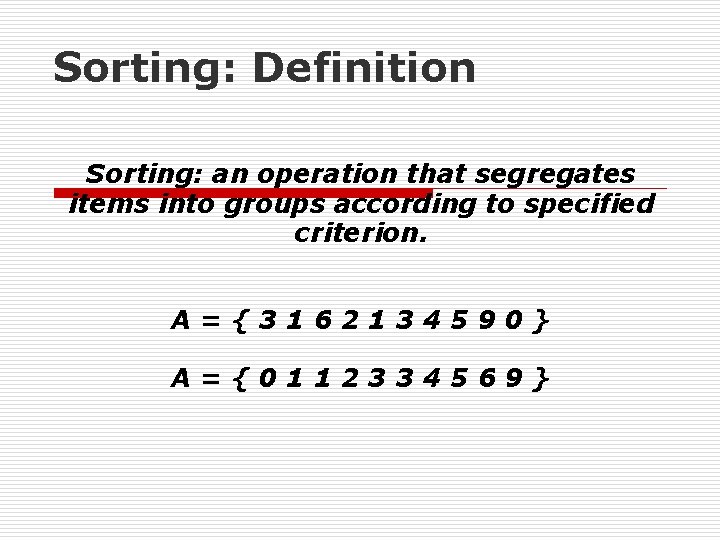
Sorting: Definition Sorting: an operation that segregates items into groups according to specified criterion. A={3162134590} A={0112334569}
Sorting o Sorting = ordering. o Sorted = ordered based on a particular way. o Generally, collections of data are presented in a sorted manner. o Examples of Sorting: n Words in a dictionary are sorted (and case distinctions are ignored). n Files in a directory are often listed in sorted order. n The index of a book is sorted (and case distinctions are ignored).
Sorting: Cont’d n Many banks provide statements that list checks in increasing order (by check number). n In a newspaper, the calendar of events in a schedule is generally sorted by date. n Musical compact disks in a record store are generally sorted by recording artist. o Why? n Imagine finding the phone number of your friend in your mobile phone, but the phone book is not sorted.
Review of Complexity Most of the primary sorting algorithms run on different space and time complexity. Time Complexity is defined to be the time the computer takes to run a program (or algorithm in our case). Space complexity is defined to be the amount of memory the computer needs to run a program.
Complexity (cont. ) Complexity in general, measures the algorithms efficiency in internal factors such as the time needed to run an algorithm. External Factors (not related to complexity): o. Size of the input of the algorithm o. Speed of the Computer o. Quality of the Compiler
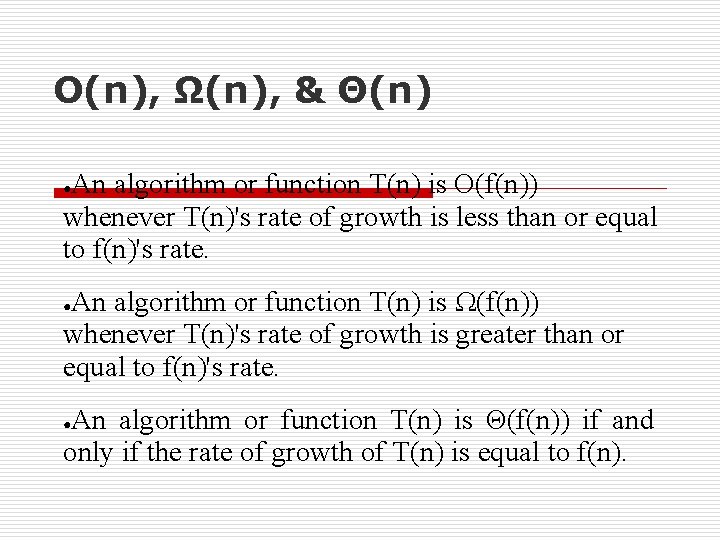
O(n), Ω(n), & Θ(n) An algorithm or function T(n) is O(f(n)) whenever T(n)'s rate of growth is less than or equal to f(n)'s rate. ● An algorithm or function T(n) is Ω(f(n)) whenever T(n)'s rate of growth is greater than or equal to f(n)'s rate. ● An algorithm or function T(n) is Θ(f(n)) if and only if the rate of growth of T(n) is equal to f(n). ●
Types of Sorting Algorithms There are many, many different types of sorting algorithms, but the primary ones are: ● Bubble Sort ●Radix Sort ● Selection Sort ● Swap Sort ● Insertion Sort ●Heap Sort ● Merge Sort ●Quick Sort ● Shell Sort
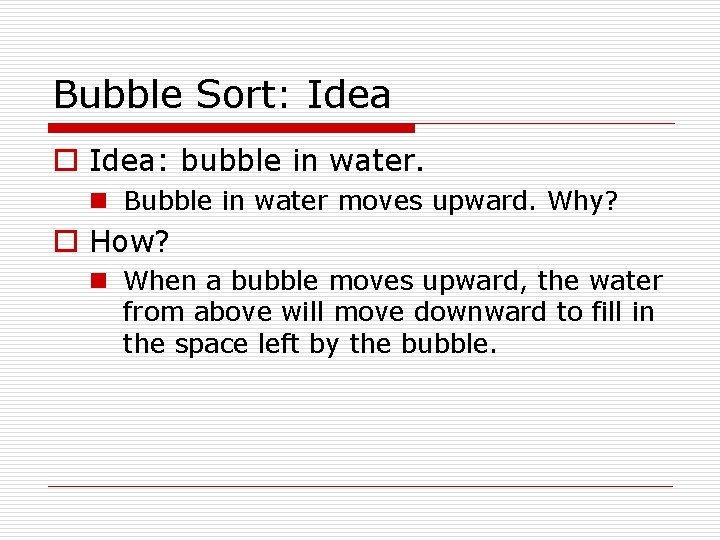
Bubble Sort: Idea o Idea: bubble in water. n Bubble in water moves upward. Why? o How? n When a bubble moves upward, the water from above will move downward to fill in the space left by the bubble.
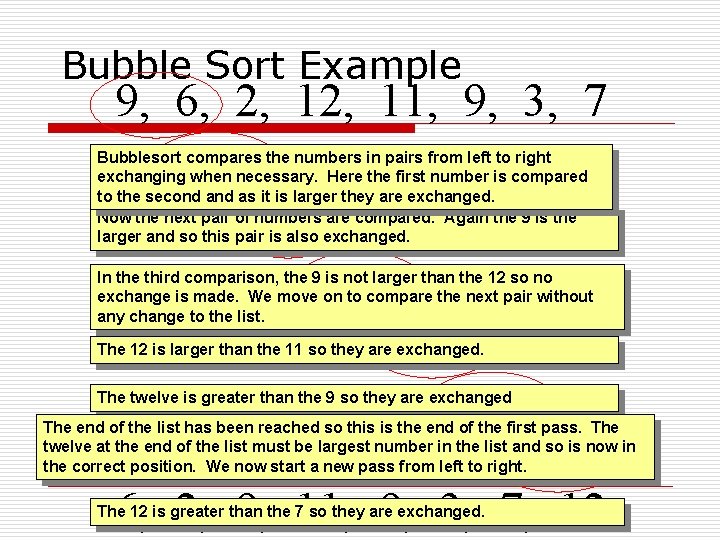
Bubble Sort Example 9, 6, 6, 9, 2, 2, 2, 9, 9, 9, 12, 12, 11, 11, 9, 3, 7 11, 9, 3, 7 12, 9, 3, 7 9, 12, 3, 7 9, 3, 12, 7 9, 3, 7, 12 Bubblesort compares the numbers in pairs from left to right exchanging when necessary. Here the first number is compared to the second as it is larger they are exchanged. Now the next pair of numbers are compared. Again the 9 is the larger and so this pair is also exchanged. In the third comparison, the 9 is not larger than the 12 so no exchange is made. We move on to compare the next pair without any change to the list. The 12 is larger than the 11 so they are exchanged. The twelve is greater than the 9 so they are exchanged The end of the list has been reached so this is the end of the first pass. The twelve at the end of the list must be largest number in the list and so is now in The 12 is greater 3 so theypass are exchanged. the correct position. Wethan now the start a new from left to right. The 12 is greater than the 7 so they are exchanged.
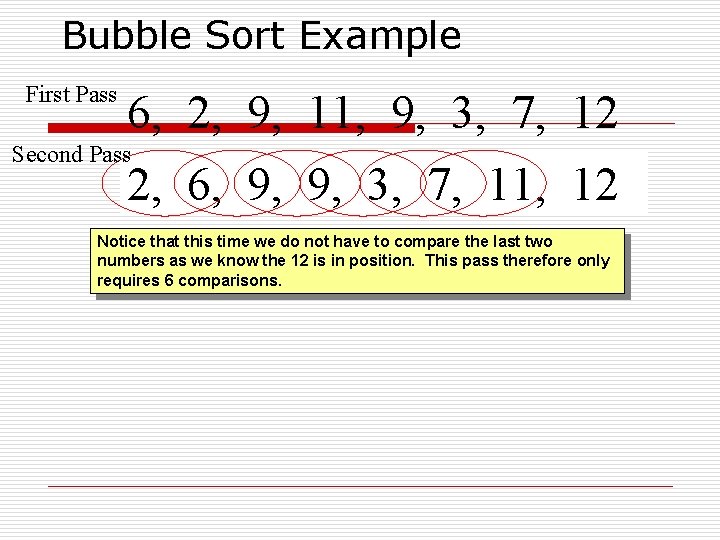
Bubble Sort Example First Pass 6, 2, 9, 11, 9, 3, 7, 12 Second Pass 6, 6, 2, 2, 9, 9, 11, 3, 11, 9, 7, 11, 3, 11, 7, 12 Notice that this time we do not have to compare the last two numbers as we know the 12 is in position. This pass therefore only requires 6 comparisons.
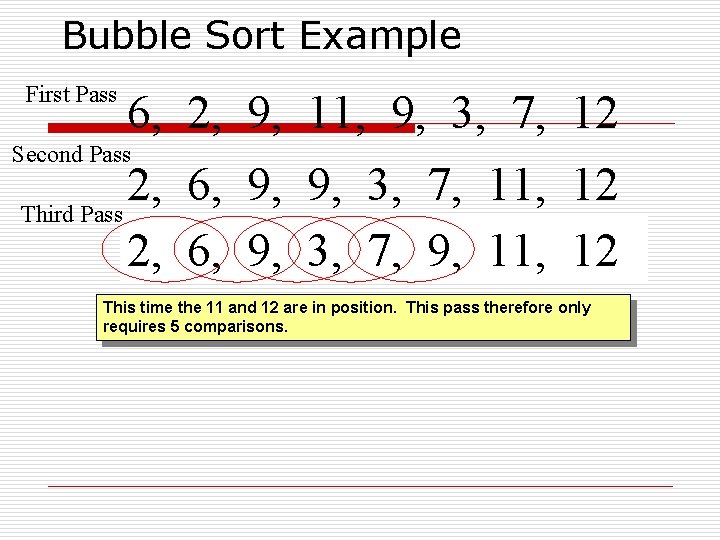
Bubble Sort Example First Pass 6, 2, 9, 11, 9, 3, 7, 12 Second Pass 2, 6, 9, 9, 3, 7, 11, 12 Third Pass 2, 6, 9, 3, 9, 9, 7, 9, 3, 7, 11, 12 This time the 11 and 12 are in position. This pass therefore only requires 5 comparisons.
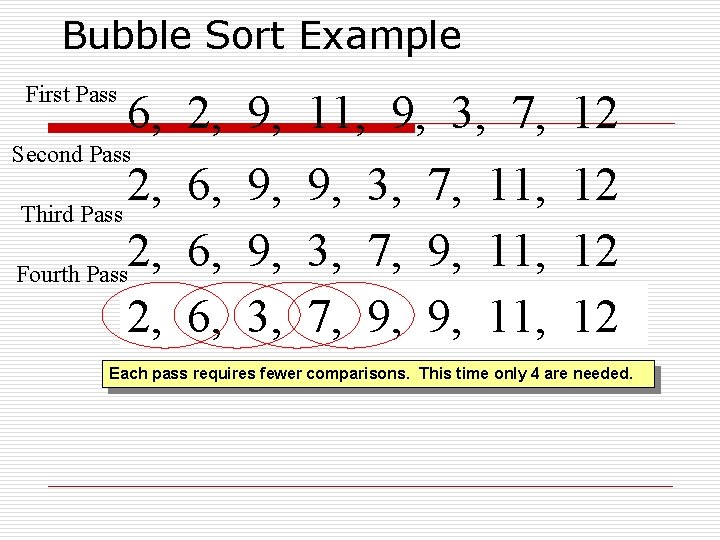
Bubble Sort Example First Pass 6, 2, 9, 11, 9, 3, 7, 12 Second Pass 2, 6, 9, 9, 3, 7, 11, 12 Third Pass 2, 6, 9, 3, 7, 9, 11, 12 Fourth Pass 2, 6, 3, 9, 9, 7, 9, 3, 7, 9, 11, 12 Each pass requires fewer comparisons. This time only 4 are needed.
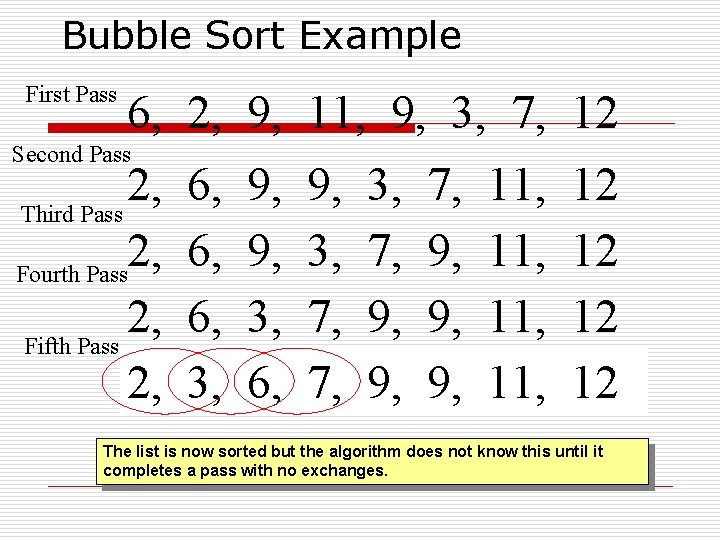
Bubble Sort Example First Pass 6, 2, 9, 11, 9, 3, 7, 12 Second Pass 2, Third Pass 2, Fourth Pass 2, Fifth Pass 2, 6, 6, 3, 9, 9, 3, 3, 6, 9, 3, 7, 7, 3, 7, 9, 9, 9, 11, 11, 12 12 The list is now sorted but the algorithm does not know this until it completes a pass with no exchanges.
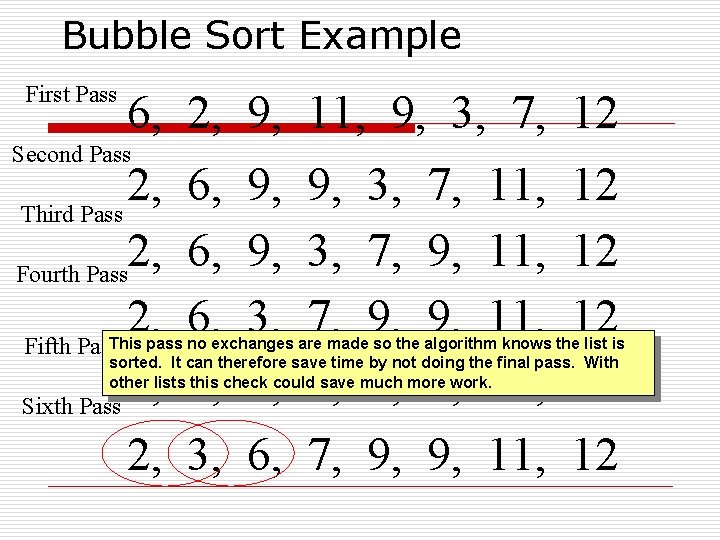
Bubble Sort Example First Pass 6, 2, 9, 11, 9, 3, 7, 12 Second Pass 2, Third Pass 2, Fourth Pass 2, Fifth Pass 2, Sixth Pass 2, 6, 6, 6, 3, 3, 9, 9, 3, 6, 6, 9, 3, 7, 7, 7, 3, 7, 9, 9, 11, 11, 11, 12 12 12 This pass no exchanges are made so the algorithm knows the list is sorted. It can therefore save time by not doing the final pass. With other lists this check could save much more work.
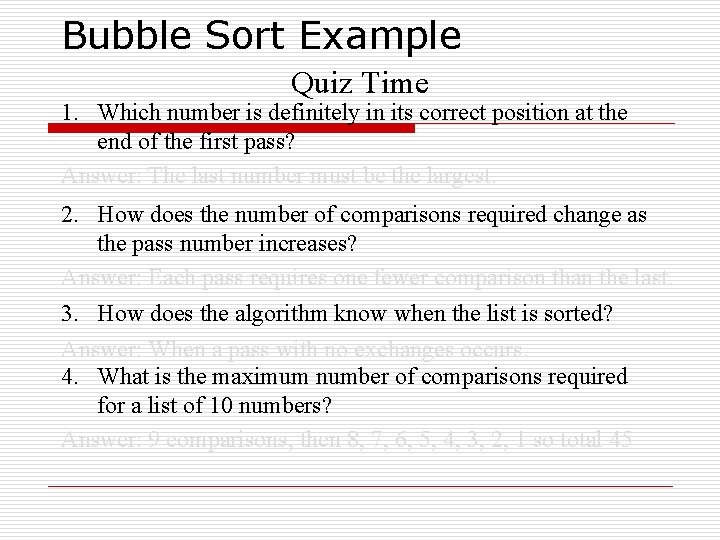
Bubble Sort Example Quiz Time 1. Which number is definitely in its correct position at the end of the first pass? Answer: The last number must be the largest. 2. How does the number of comparisons required change as the pass number increases? Answer: Each pass requires one fewer comparison than the last. 3. How does the algorithm know when the list is sorted? Answer: When a pass with no exchanges occurs. 4. What is the maximum number of comparisons required for a list of 10 numbers? Answer: 9 comparisons, then 8, 7, 6, 5, 4, 3, 2, 1 so total 45
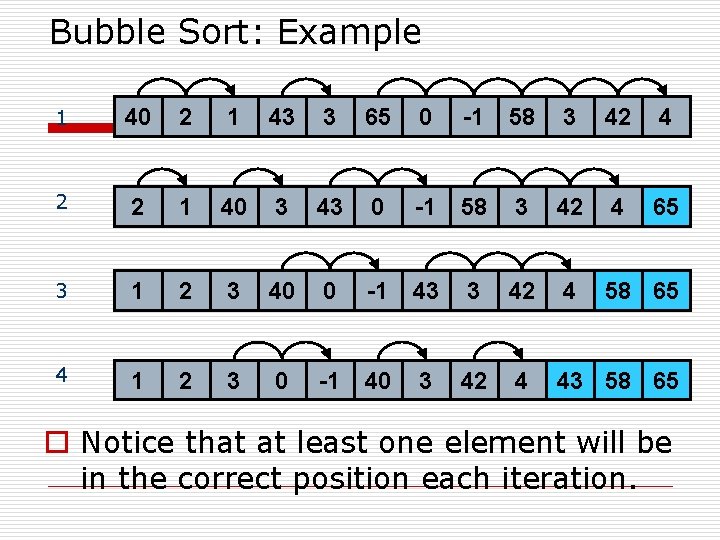
Bubble Sort: Example 1 40 2 1 43 3 65 0 2 2 1 40 3 43 0 -1 58 3 1 2 3 40 0 -1 43 4 1 2 3 0 -1 40 3 -1 58 3 42 4 65 3 42 4 58 65 42 4 43 58 65 o Notice that at least one element will be in the correct position each iteration.
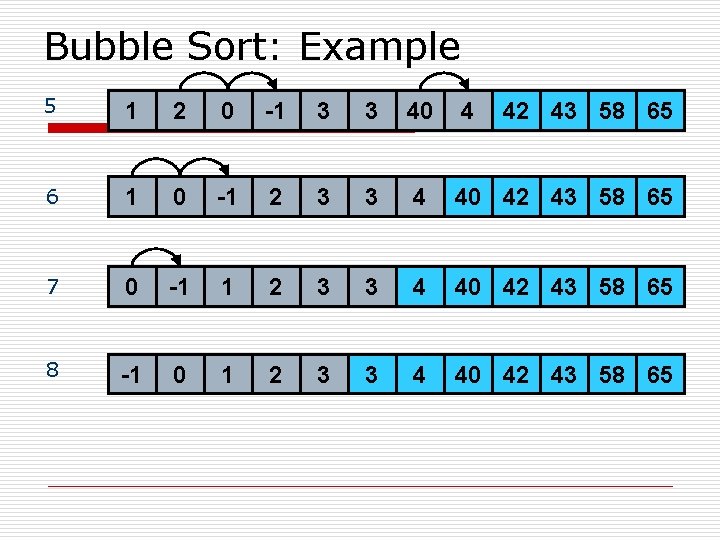
Bubble Sort: Example 5 1 2 0 -1 3 3 40 4 6 1 0 -1 2 3 3 4 40 42 43 58 65 7 0 -1 1 2 3 3 4 40 42 43 58 65 8 -1 0 1 2 3 3 4 40 42 43 58 65
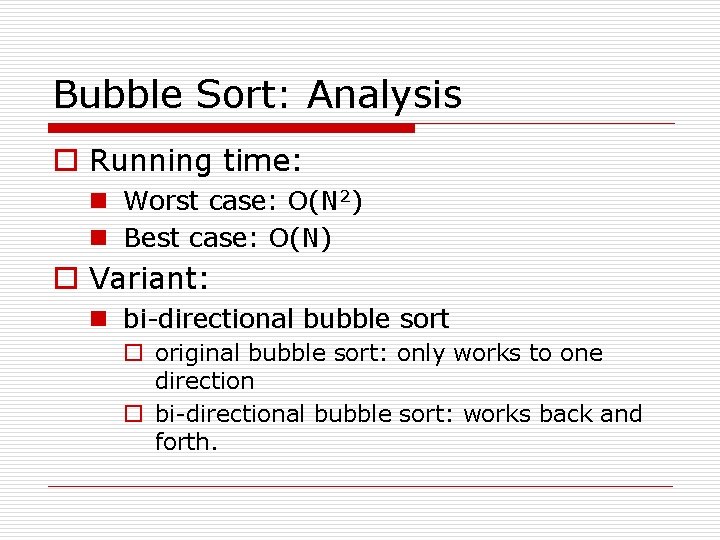
Bubble Sort: Analysis o Running time: n Worst case: O(N 2) n Best case: O(N) o Variant: n bi-directional bubble sort o original bubble sort: only works to one direction o bi-directional bubble sort: works back and forth.
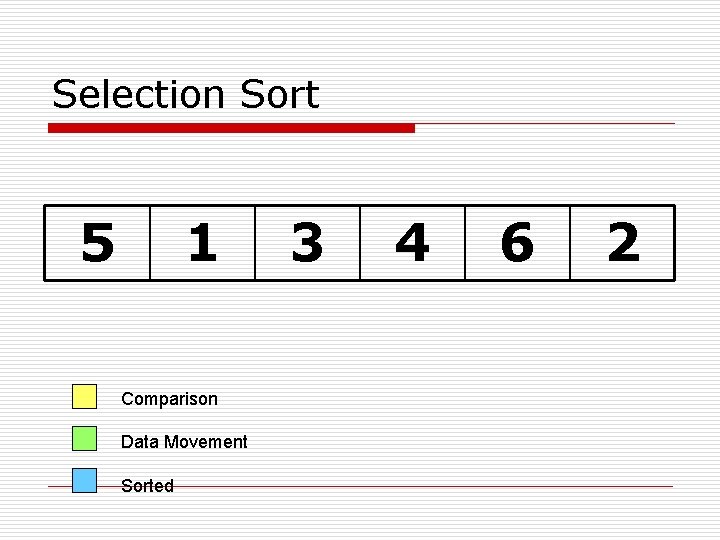
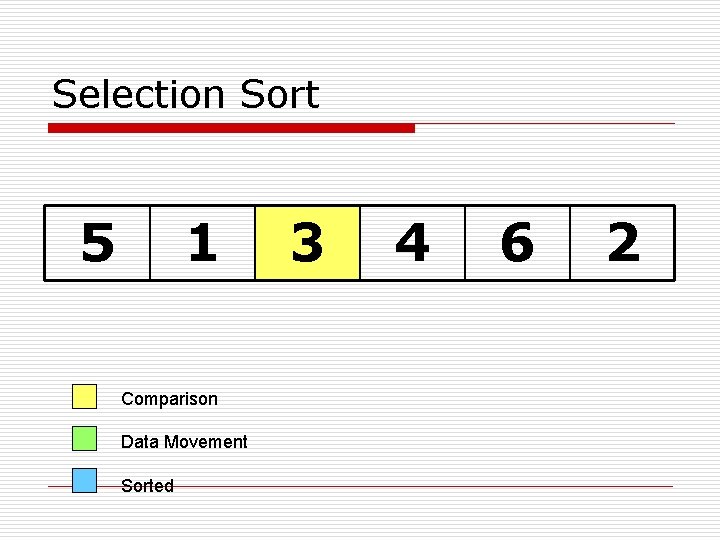
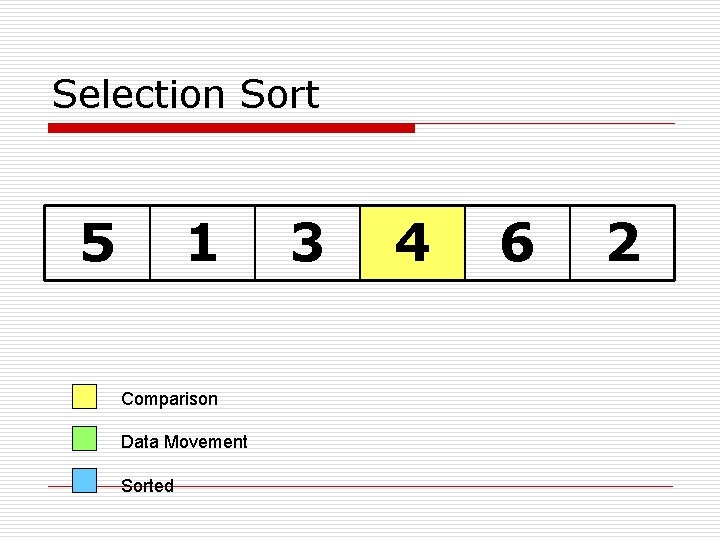
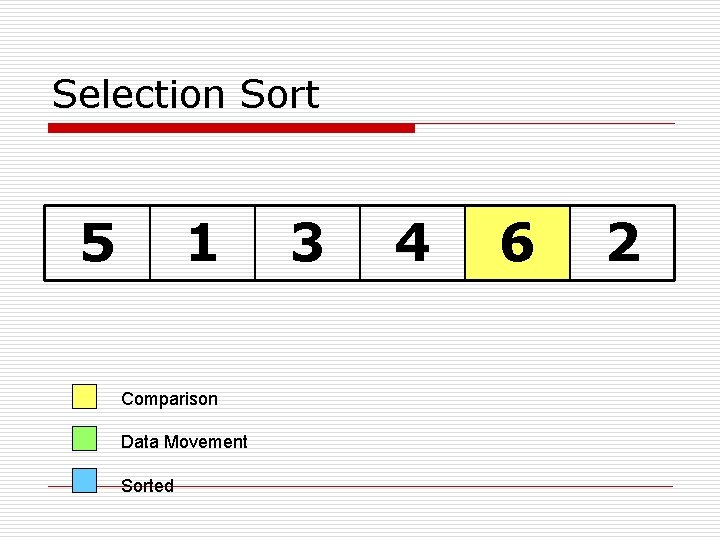
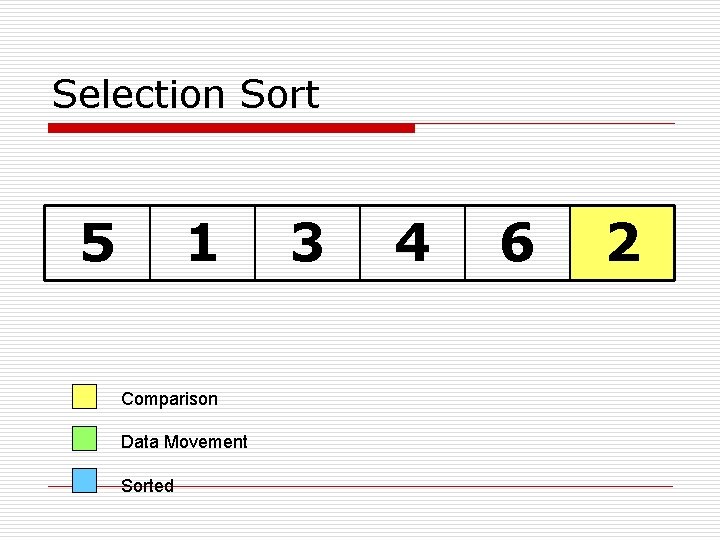
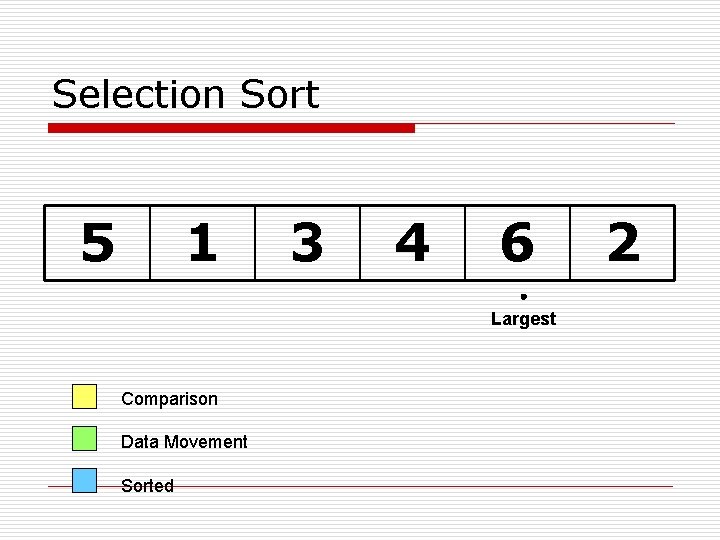
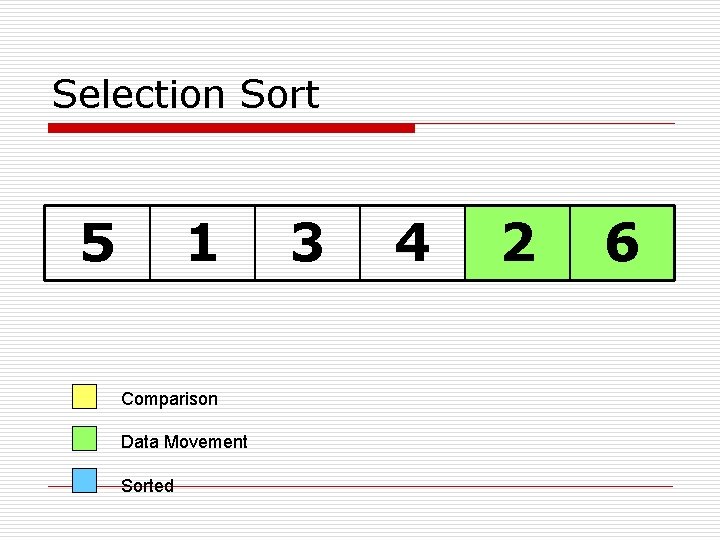
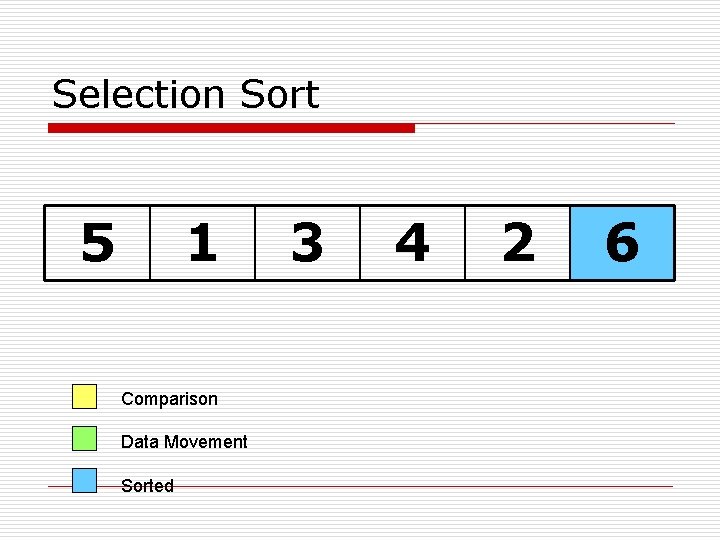
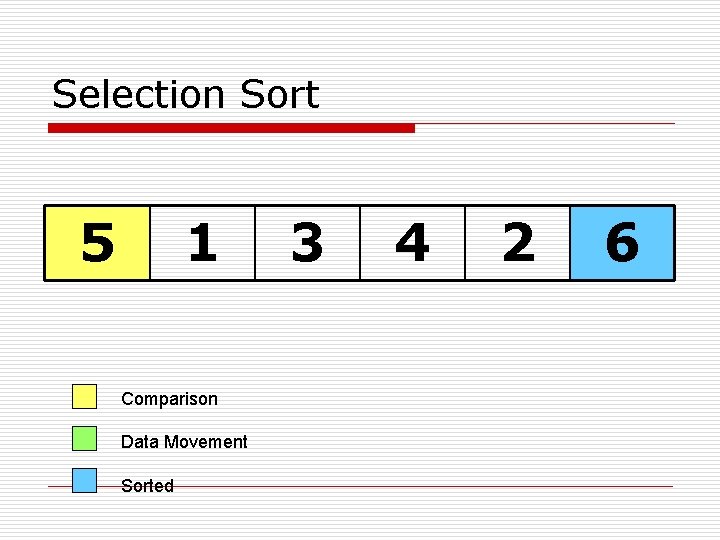
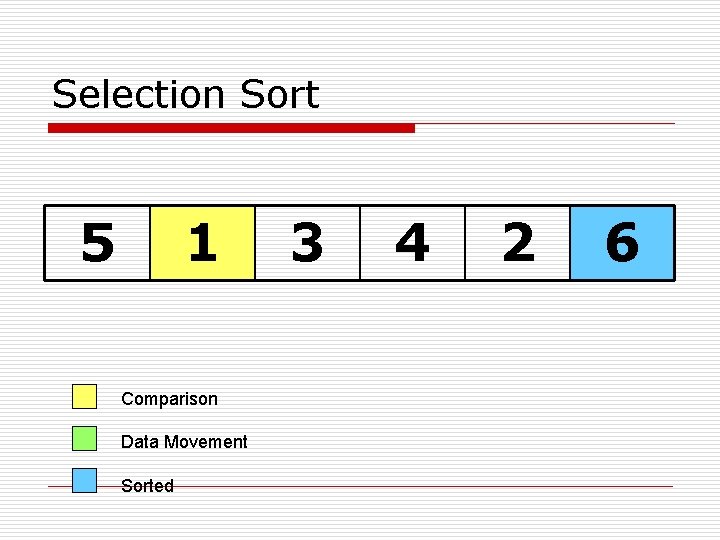
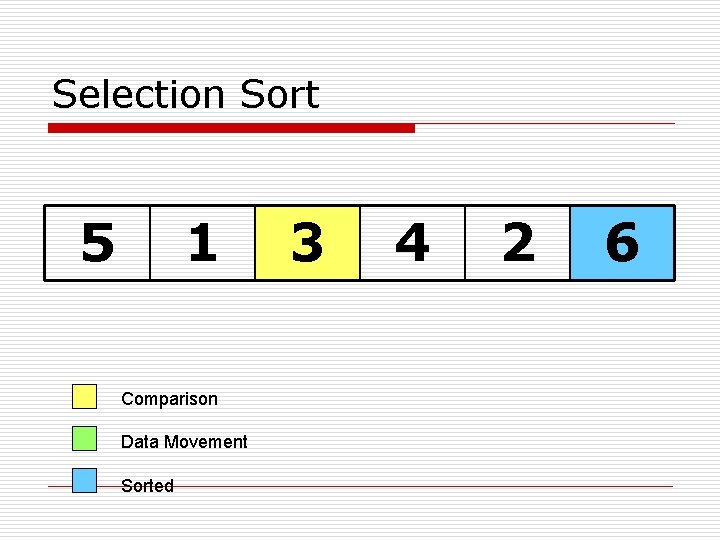
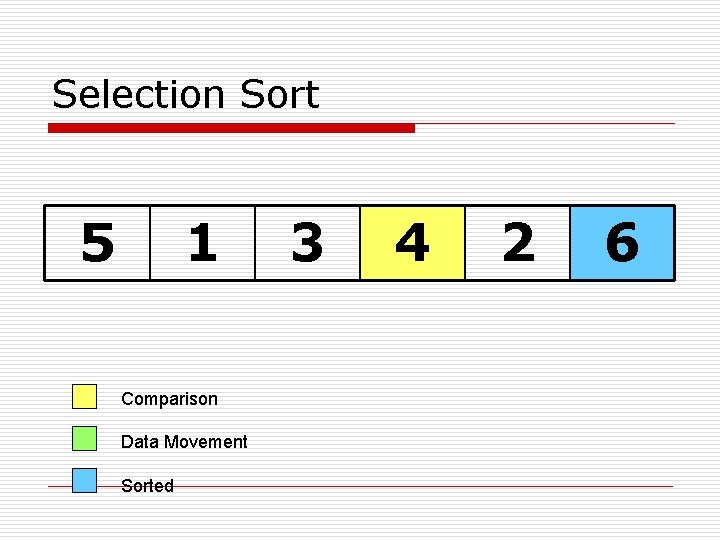
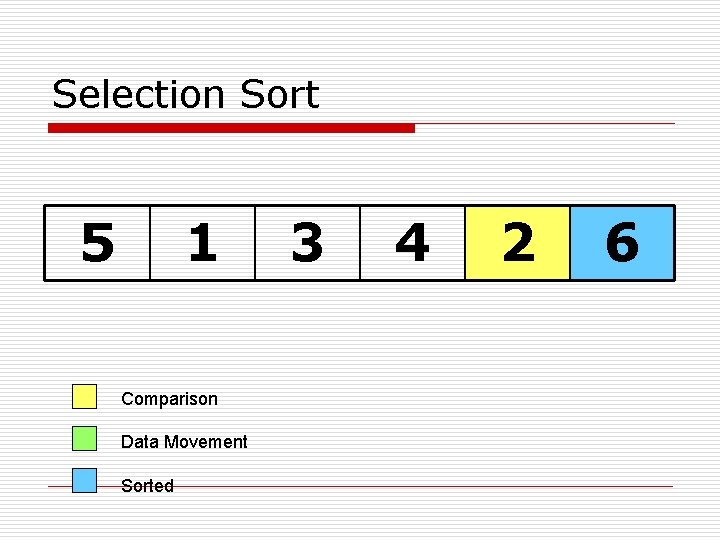
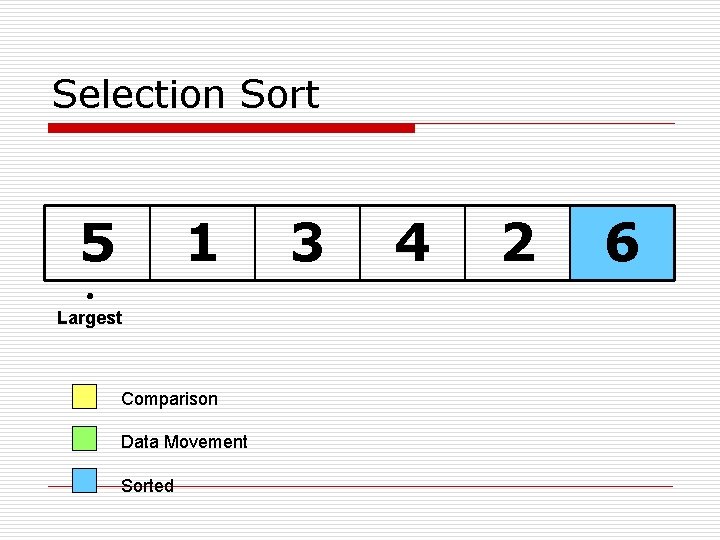
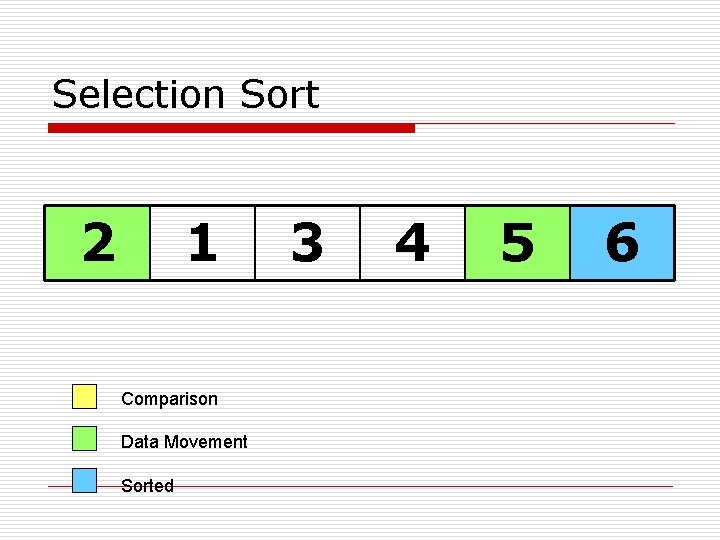
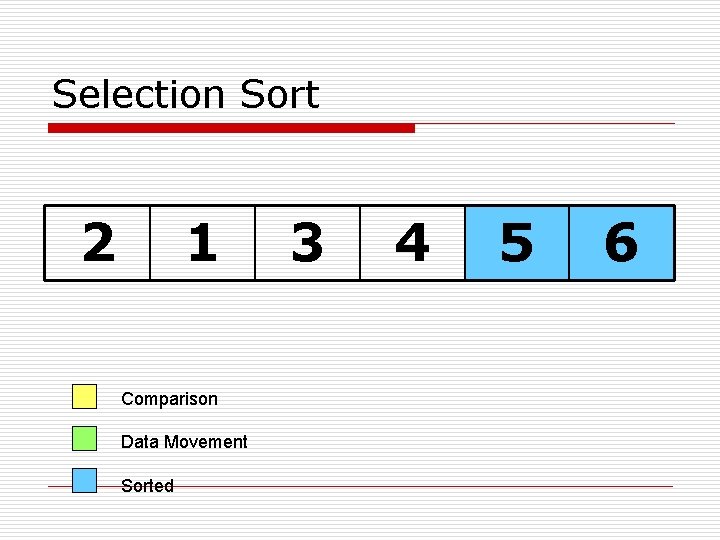
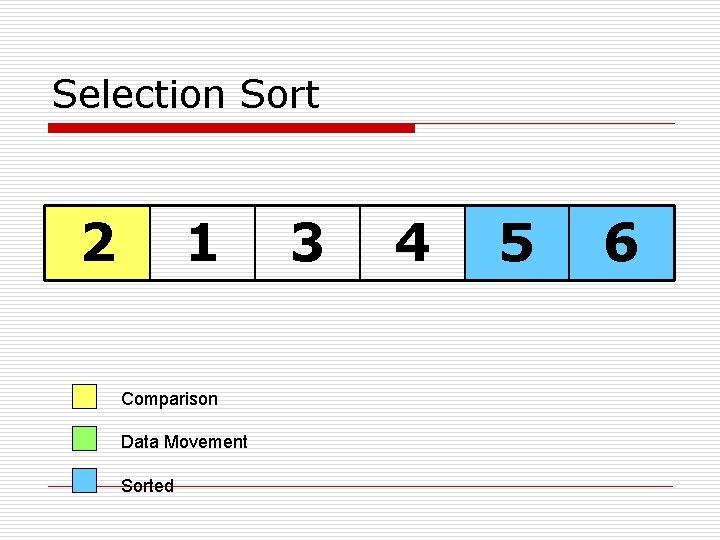
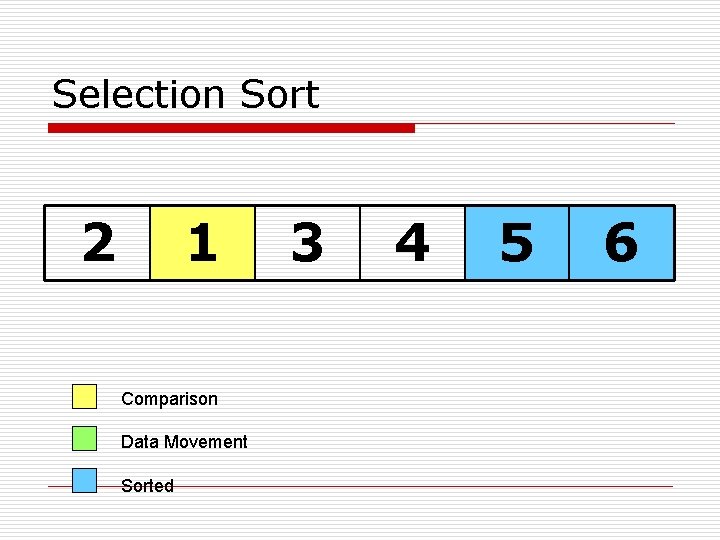
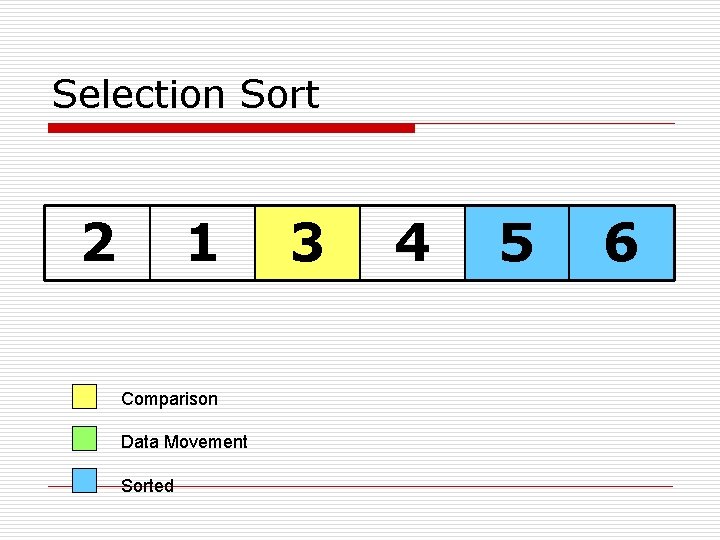
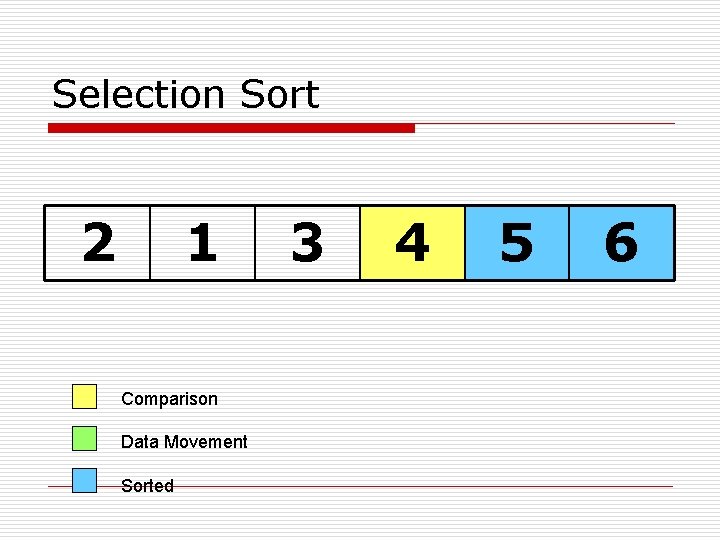
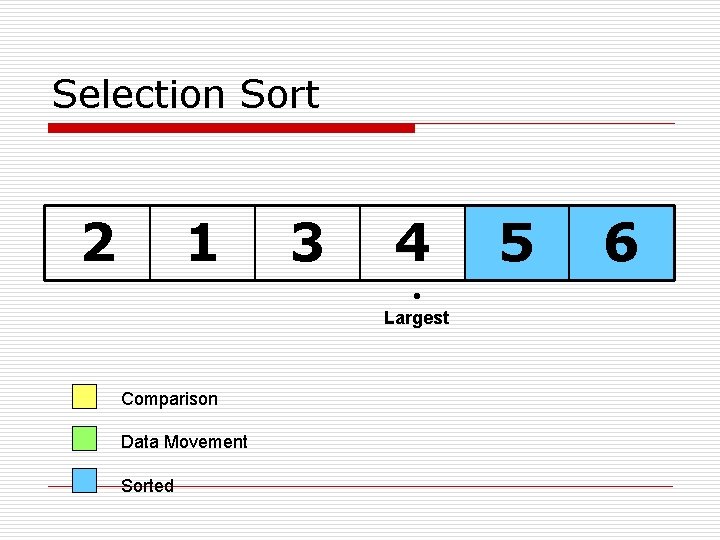
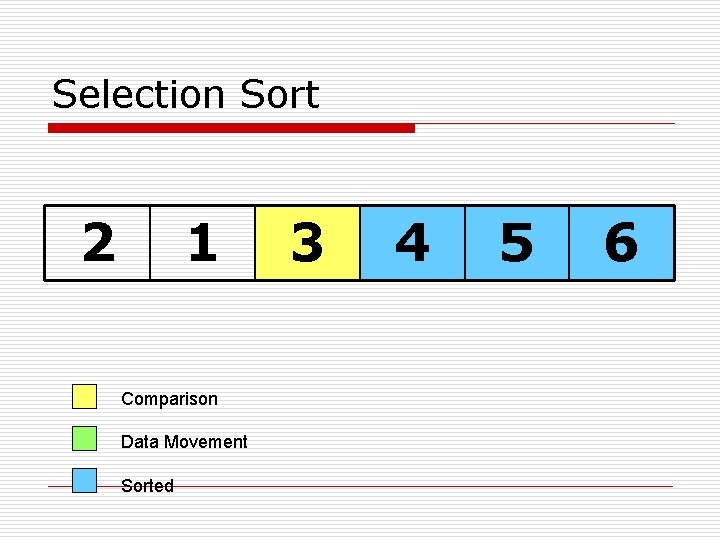
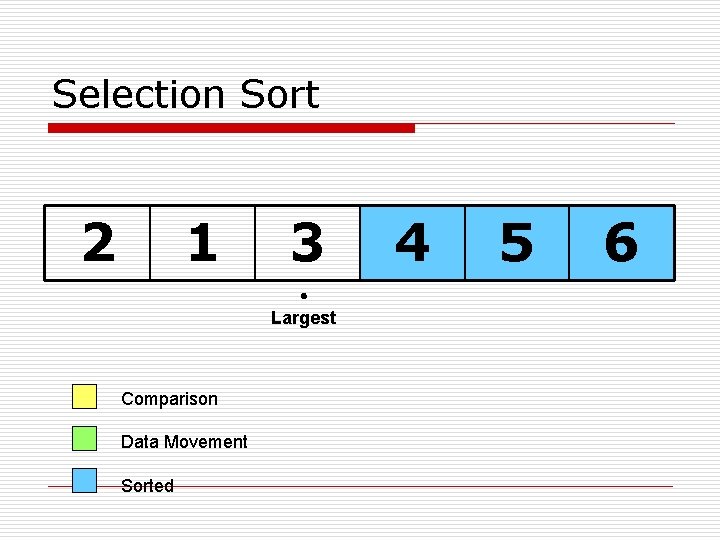
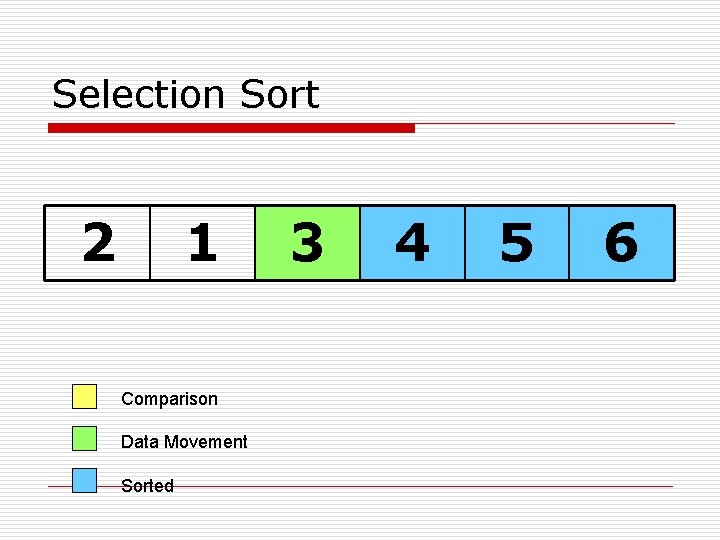
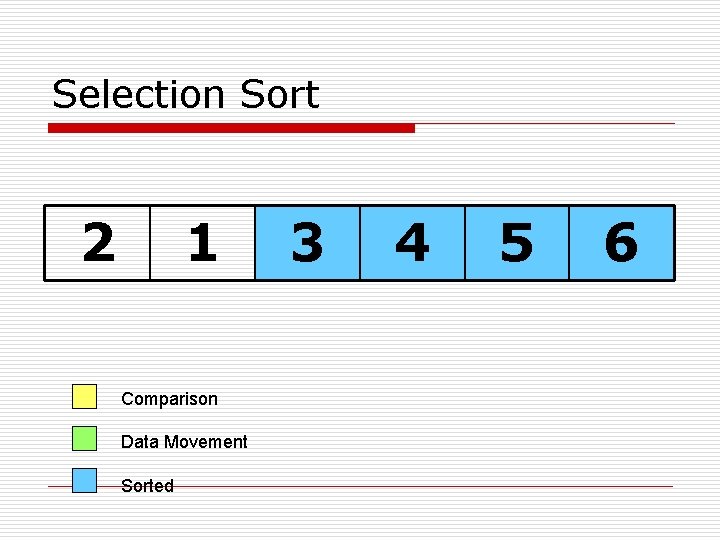
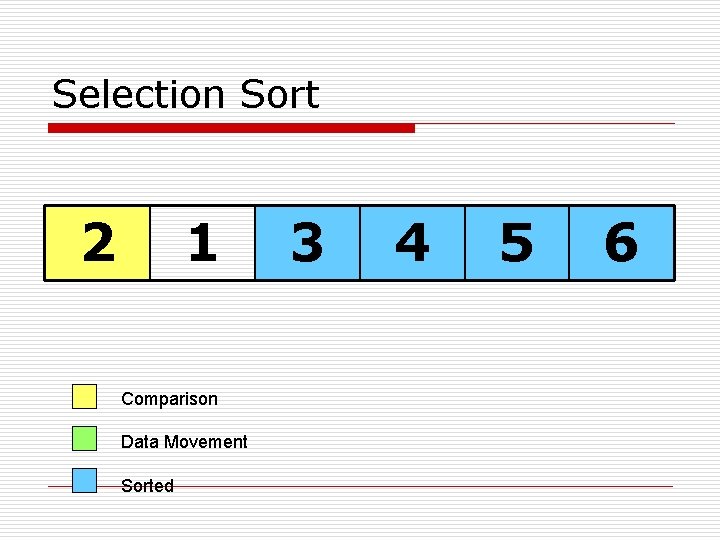
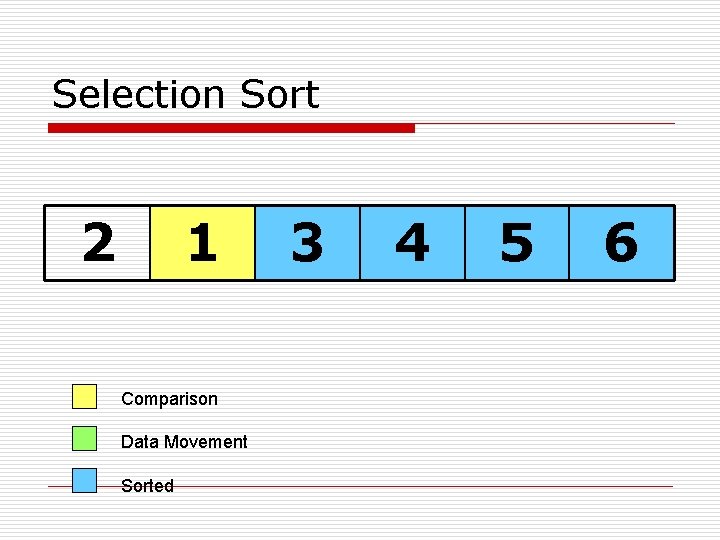
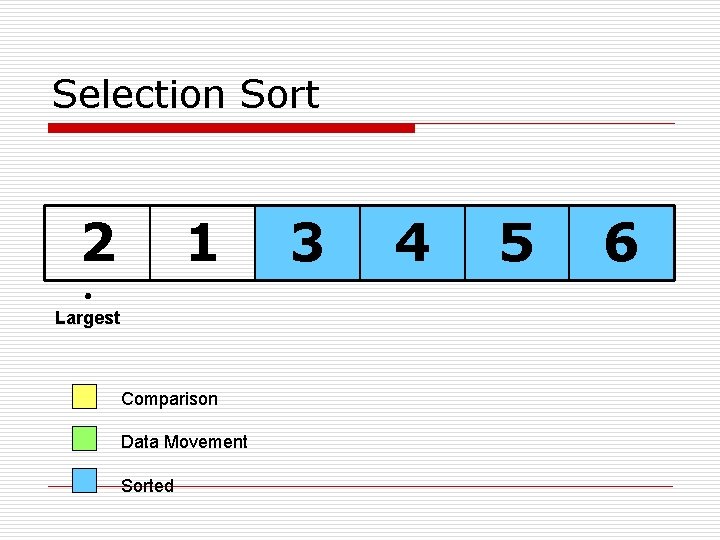
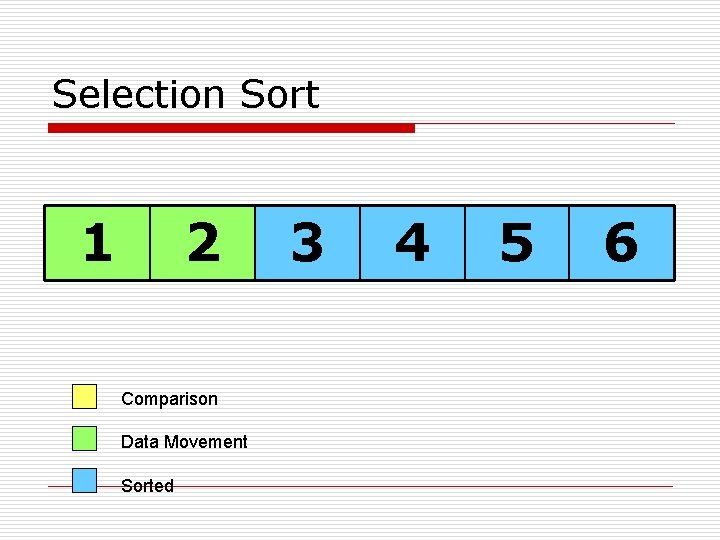
Selection Sort: Idea 1. We have two group of items: n sorted group, and n unsorted group 2. Initially, all items are in the unsorted group. The sorted group is empty. n We assume that items in the unsorted group unsorted. n We have to keep items in the sorted group sorted.
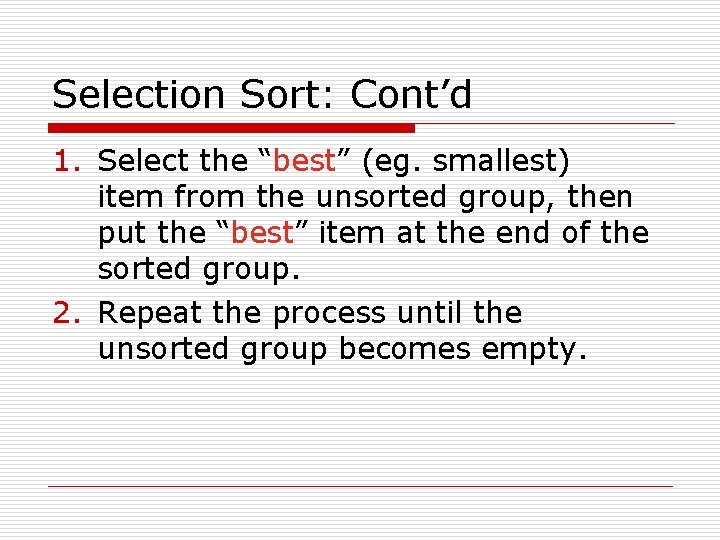
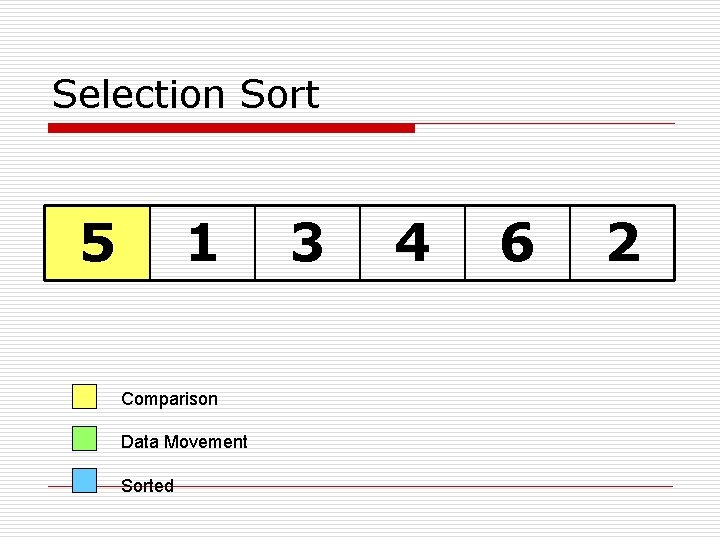
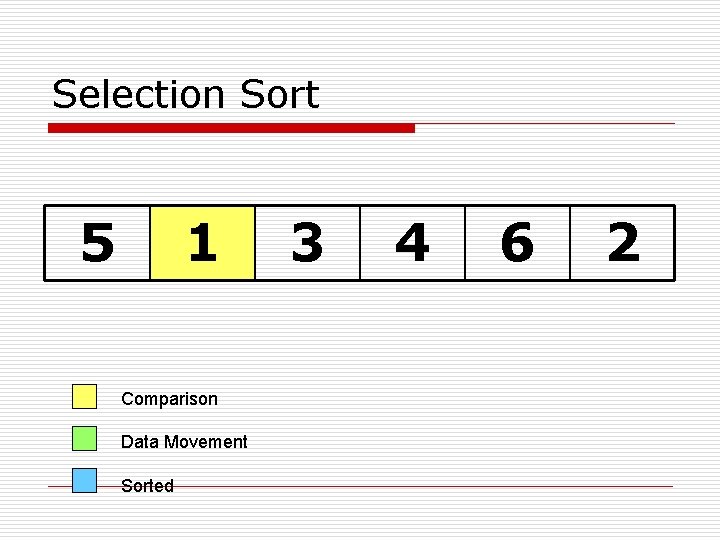
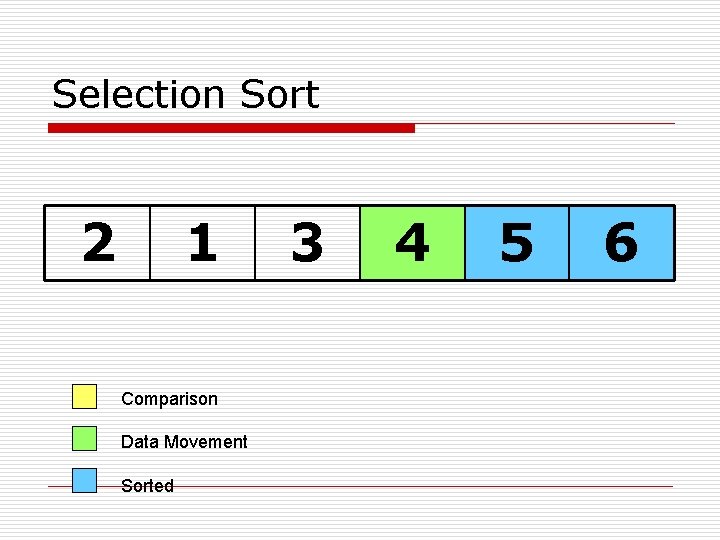
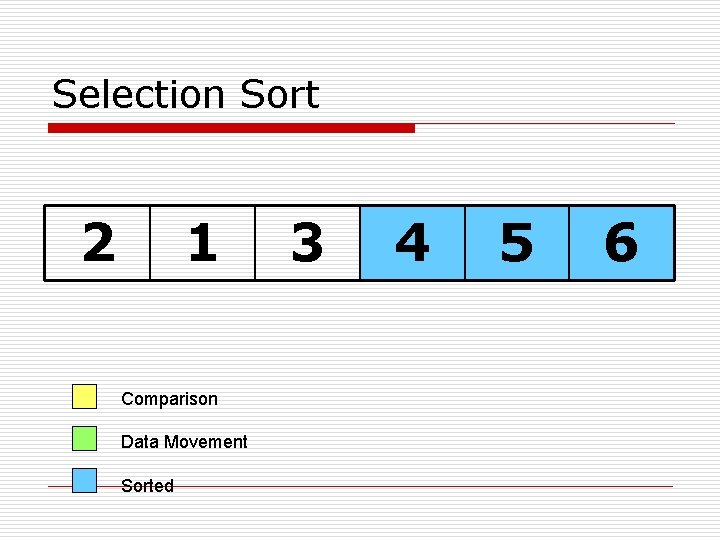
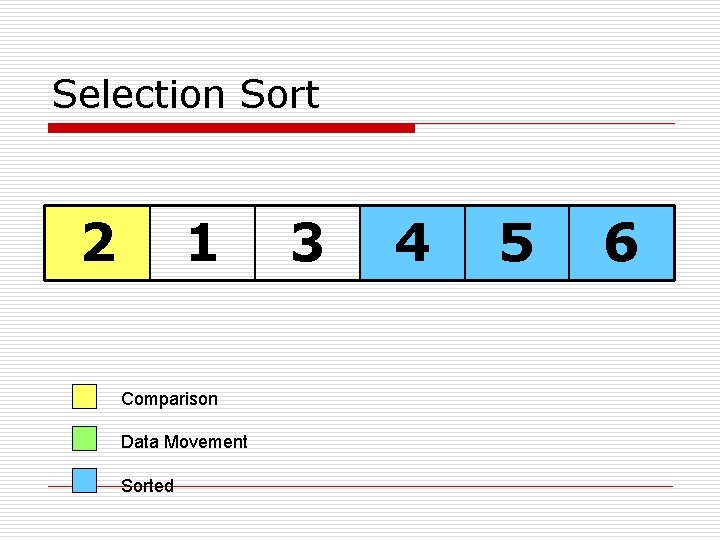
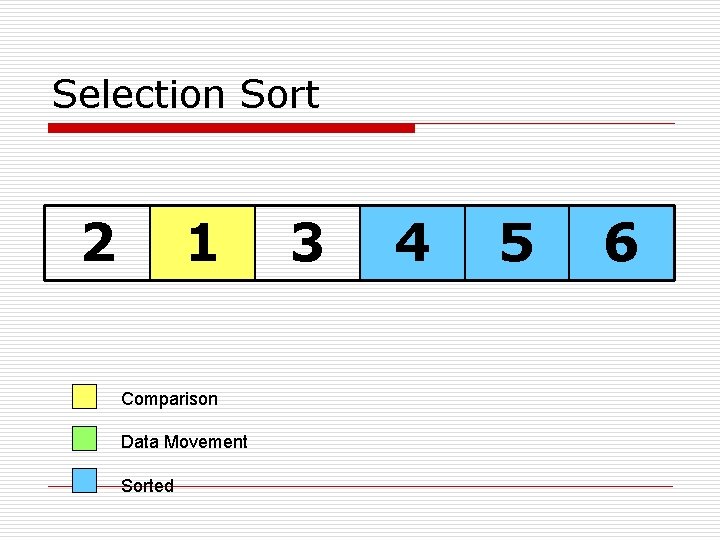
Selection Sort: Cont’d 1. Select the “best” (eg. smallest) item from the unsorted group, then put the “best” item at the end of the sorted group. 2. Repeat the process until the unsorted group becomes empty.
Selection Sort 5 1 Comparison Data Movement Sorted 3 4 6 2
Selection Sort 5 1 Comparison Data Movement Sorted 3 4 6 2
Selection Sort 5 1 Comparison Data Movement Sorted 3 4 6 2
Selection Sort 5 1 Comparison Data Movement Sorted 3 4 6 2
Selection Sort 5 1 Comparison Data Movement Sorted 3 4 6 2
Selection Sort 5 1 Comparison Data Movement Sorted 3 4 6 2
Selection Sort 5 1 Comparison Data Movement Sorted 3 4 6 2
Selection Sort 5 1 3 4 6 Largest Comparison Data Movement Sorted 2
Selection Sort 5 1 Comparison Data Movement Sorted 3 4 2 6
Selection Sort 5 1 Comparison Data Movement Sorted 3 4 2 6
Selection Sort 5 1 Comparison Data Movement Sorted 3 4 2 6
Selection Sort 5 1 Comparison Data Movement Sorted 3 4 2 6
Selection Sort 5 1 Comparison Data Movement Sorted 3 4 2 6
Selection Sort 5 1 Comparison Data Movement Sorted 3 4 2 6
Selection Sort 5 1 Comparison Data Movement Sorted 3 4 2 6
Selection Sort 5 1 Largest Comparison Data Movement Sorted 3 4 2 6
Selection Sort 2 1 Comparison Data Movement Sorted 3 4 5 6
Selection Sort 2 1 Comparison Data Movement Sorted 3 4 5 6
Selection Sort 2 1 Comparison Data Movement Sorted 3 4 5 6
Selection Sort 2 1 Comparison Data Movement Sorted 3 4 5 6
Selection Sort 2 1 Comparison Data Movement Sorted 3 4 5 6
Selection Sort 2 1 Comparison Data Movement Sorted 3 4 5 6
Selection Sort 2 1 3 4 Largest Comparison Data Movement Sorted 5 6
Selection Sort 2 1 Comparison Data Movement Sorted 3 4 5 6
Selection Sort 2 1 Comparison Data Movement Sorted 3 4 5 6
Selection Sort 2 1 Comparison Data Movement Sorted 3 4 5 6
Selection Sort 2 1 Comparison Data Movement Sorted 3 4 5 6
Selection Sort 2 1 Comparison Data Movement Sorted 3 4 5 6
Selection Sort 2 1 3 Largest Comparison Data Movement Sorted 4 5 6
Selection Sort 2 1 Comparison Data Movement Sorted 3 4 5 6
Selection Sort 2 1 Comparison Data Movement Sorted 3 4 5 6
Selection Sort 2 1 Comparison Data Movement Sorted 3 4 5 6
Selection Sort 2 1 Comparison Data Movement Sorted 3 4 5 6
Selection Sort 2 1 Largest Comparison Data Movement Sorted 3 4 5 6
Selection Sort 1 2 Comparison Data Movement Sorted 3 4 5 6
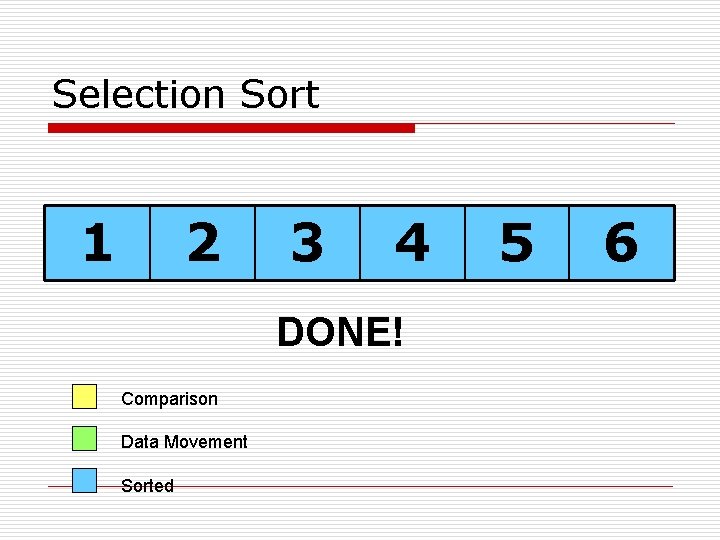
Selection Sort 1 2 3 4 DONE! Comparison Data Movement Sorted 5 6
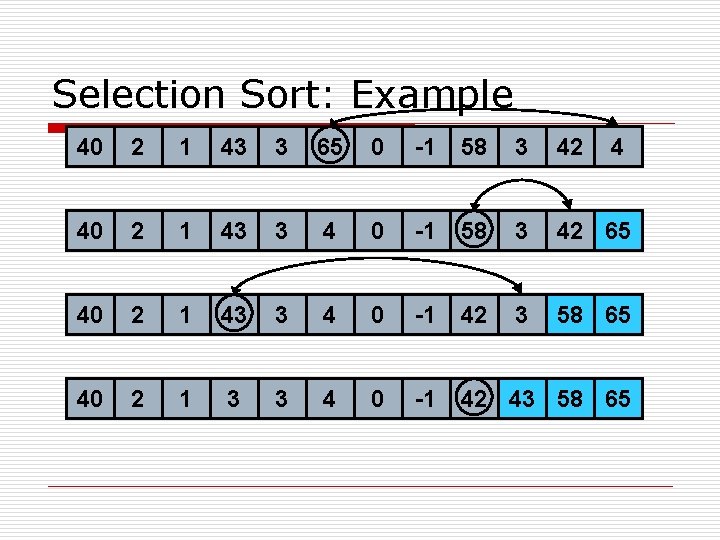
Selection Sort: Example 40 2 1 43 3 65 0 -1 58 3 42 4 40 2 1 43 3 4 0 -1 58 3 42 65 40 2 1 43 3 4 0 -1 42 3 58 65 40 2 1 3 3 4 0 -1 42 43 58 65
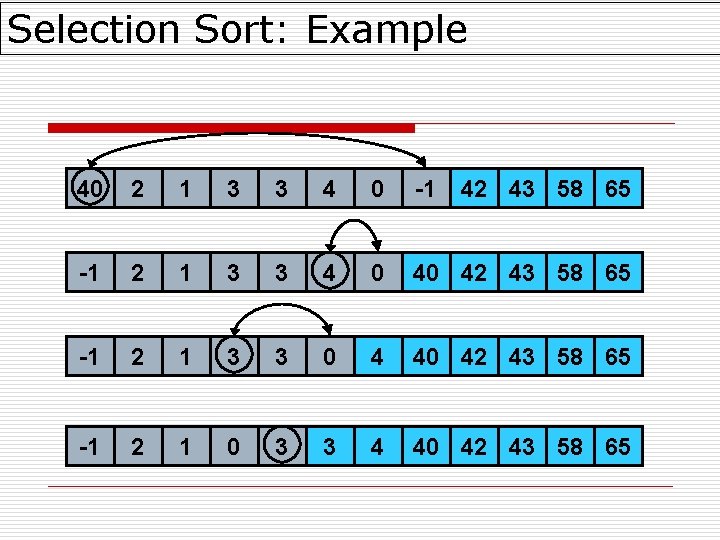
Selection Sort: Example 40 2 1 3 3 4 0 -1 42 43 58 65 -1 2 1 3 3 4 0 40 42 43 58 65 -1 2 1 3 3 0 4 40 42 43 58 65 -1 2 1 0 3 3 4 40 42 43 58 65
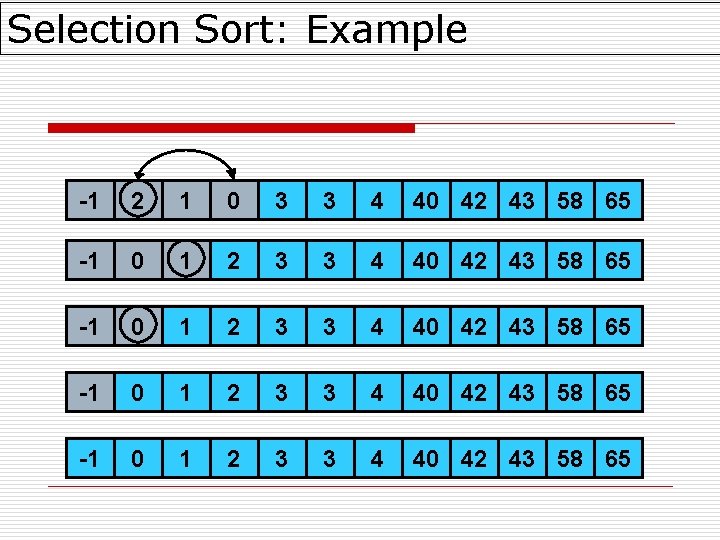
Selection Sort: Example -1 2 1 0 3 3 4 40 42 43 58 65 -1 0 1 2 3 3 4 40 42 43 58 65
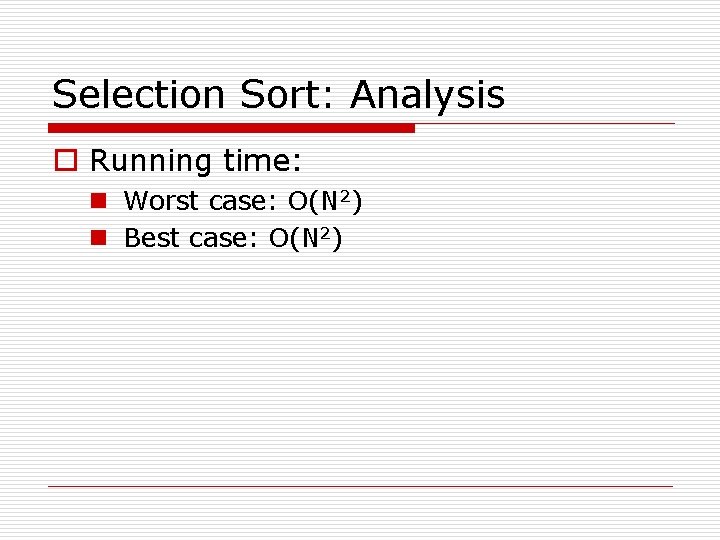
Selection Sort: Analysis o Running time: n Worst case: O(N 2) n Best case: O(N 2)
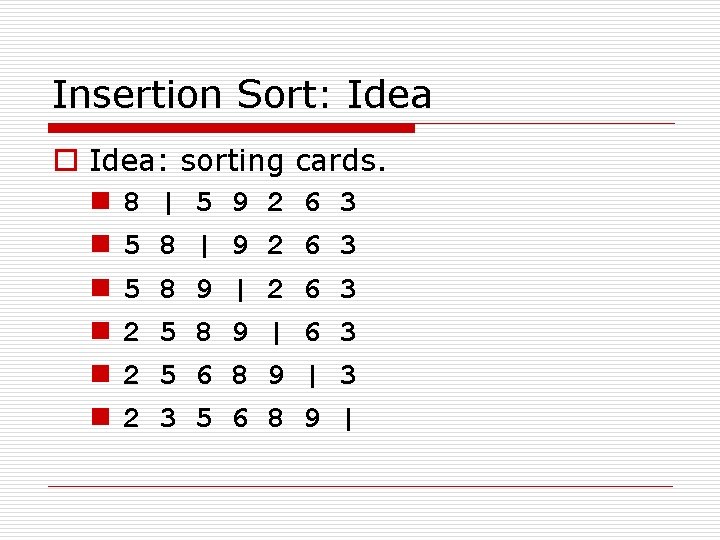
Insertion Sort: Idea o Idea: sorting n 8 | 5 9 2 n 5 8 | 9 2 n 5 8 9 | 2 n 2 5 8 9 | n 2 5 6 8 9 n 2 3 5 6 8 cards. 6 3 6 3 | 3 9 |
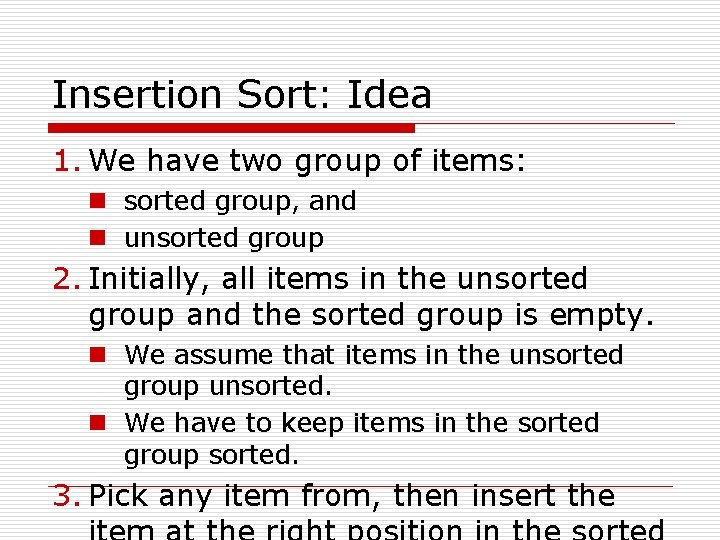
Insertion Sort: Idea 1. We have two group of items: n sorted group, and n unsorted group 2. Initially, all items in the unsorted group and the sorted group is empty. n We assume that items in the unsorted group unsorted. n We have to keep items in the sorted group sorted. 3. Pick any item from, then insert the
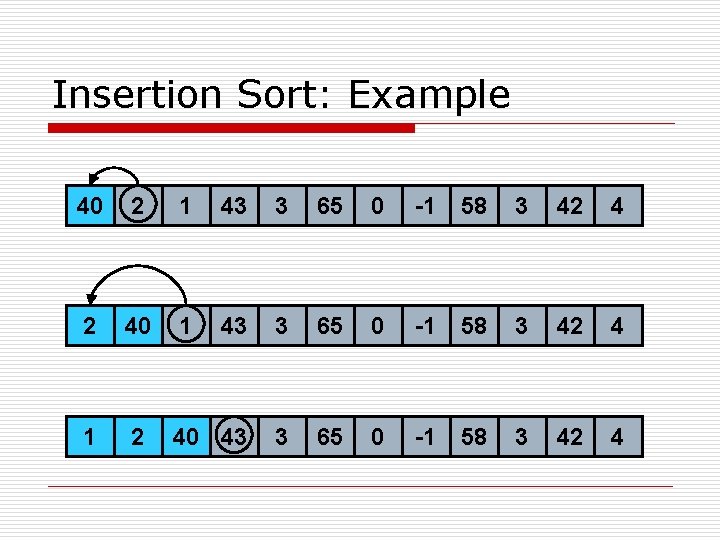
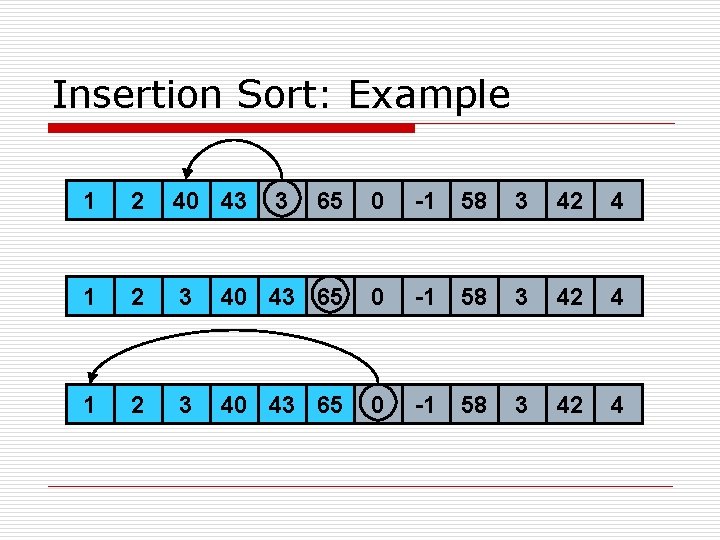
Insertion Sort: Example 40 2 1 43 3 65 0 -1 58 3 42 4 2 40 1 43 3 65 0 -1 58 3 42 4 1 2 40 43 3 65 0 -1 58 3 42 4
Insertion Sort: Example 1 2 40 43 1 2 3 65 0 -1 58 3 42 4 3 40 43 65 0 -1 58 3 42 4
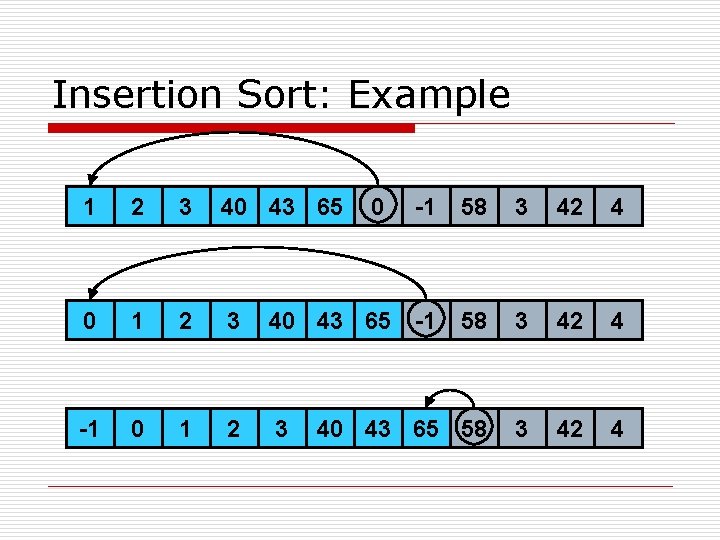
Insertion Sort: Example 1 2 3 40 43 65 0 1 2 -1 0 2 1 0 -1 58 3 42 4 3 40 43 65 -1 58 3 42 4 3 2 40 3 40 43 43 65 65 58 3 42 4
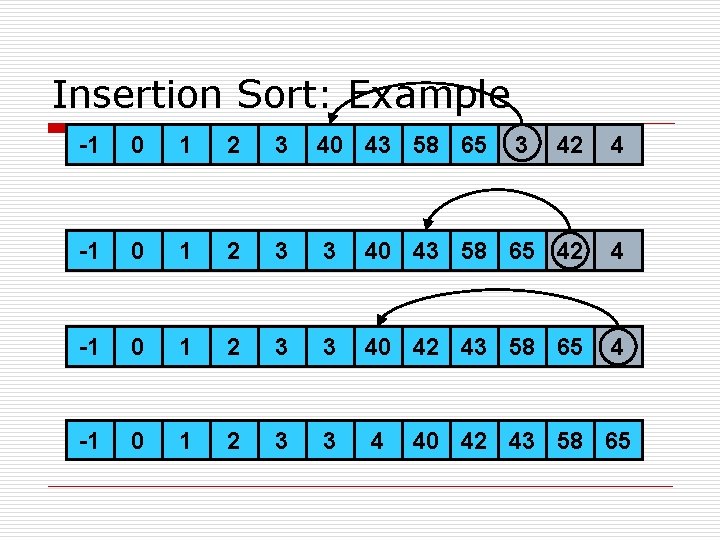
Insertion Sort: Example -1 0 2 1 3 2 40 3 40 43 43 65 58 65 3 42 4 -1 0 2 1 3 2 40 3 43 3 40 65 43 43 58 58 65 65 42 4 -1 0 2 1 3 2 40 3 43 3 40 65 42 43 43 65 58 65 4 -1 0 2 1 3 2 40 3 43 65 4 40 42 42 65 43 43 58 58 65 65
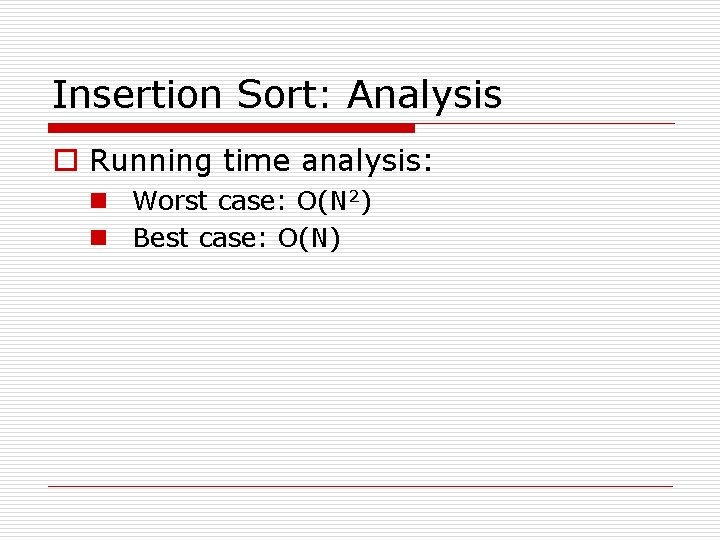
Insertion Sort: Analysis o Running time analysis: n Worst case: O(N 2) n Best case: O(N)
A Lower Bound o Bubble Sort, Selection Sort, Insertion Sort all have worst case of O(N 2). o Turns out, for any algorithm that exchanges adjacent items, this is the best worst case: Ω(N 2) o In other words, this is a lower bound!
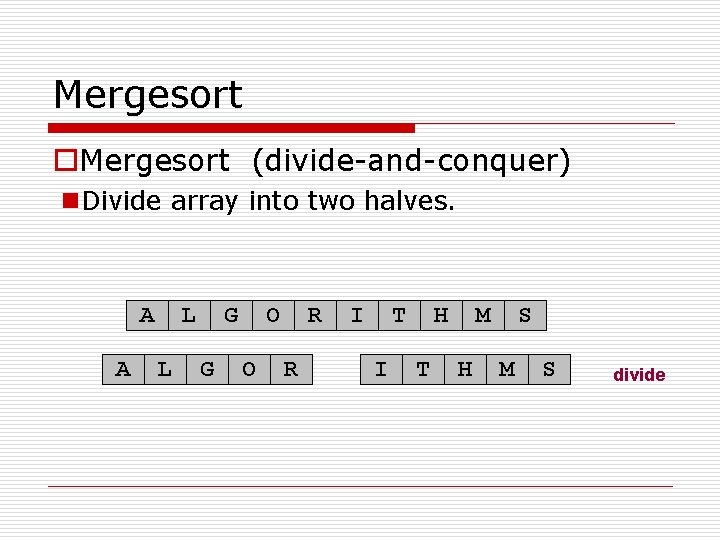
Mergesort o. Mergesort (divide-and-conquer) n. Divide array into two halves. A A L L G G O O R R I T I H T M H S M S divide
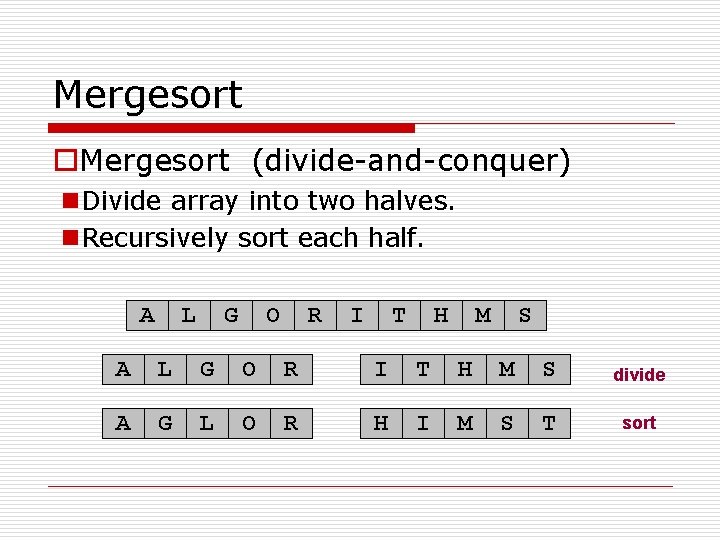
Mergesort o. Mergesort (divide-and-conquer) n. Divide array into two halves. n. Recursively sort each half. A L G O R I T H M S divide A G L O R H I M S T sort
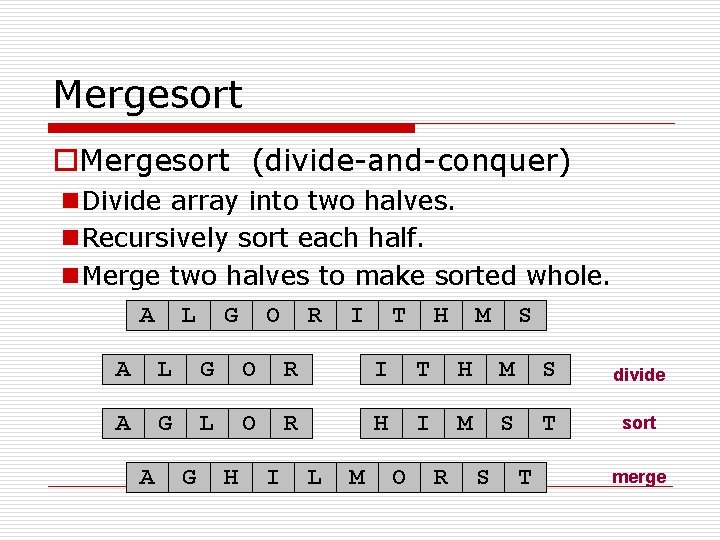
Mergesort o. Mergesort (divide-and-conquer) n. Divide array into two halves. n. Recursively sort each half. n. Merge two halves to make sorted whole. A L G O R I T H M S divide A G L O R H I M S T sort A G H I L M O R S T merge
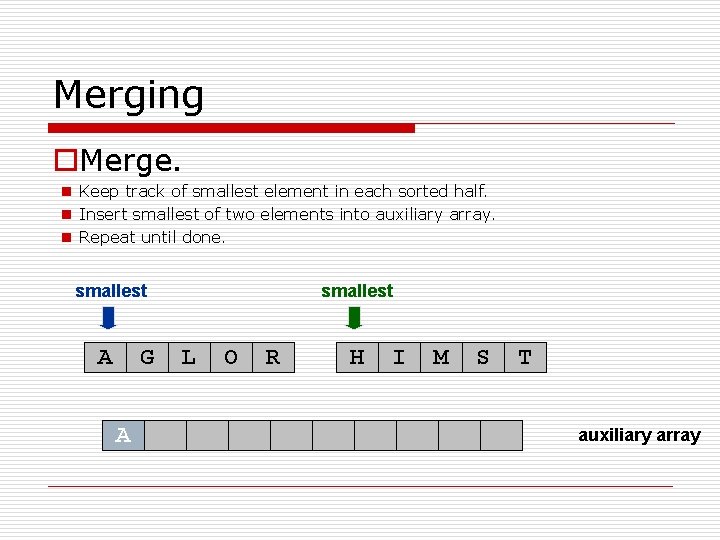
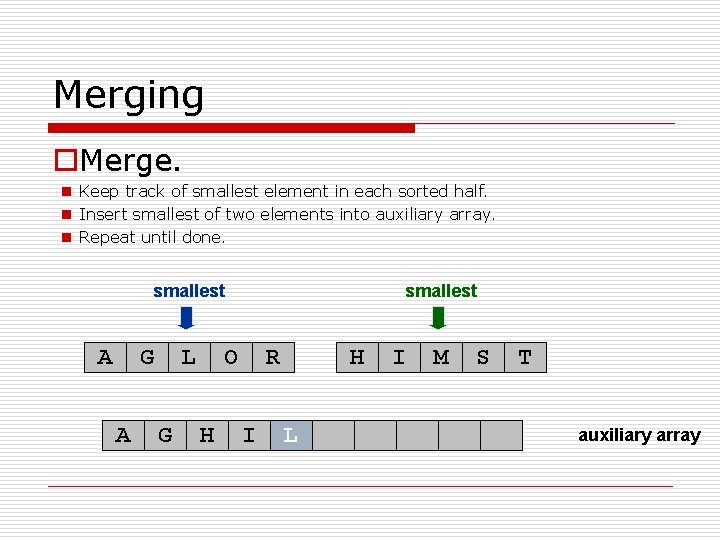
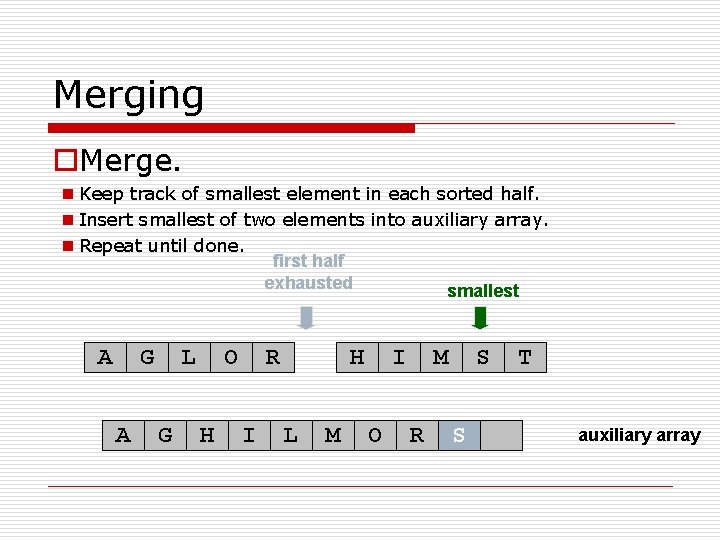
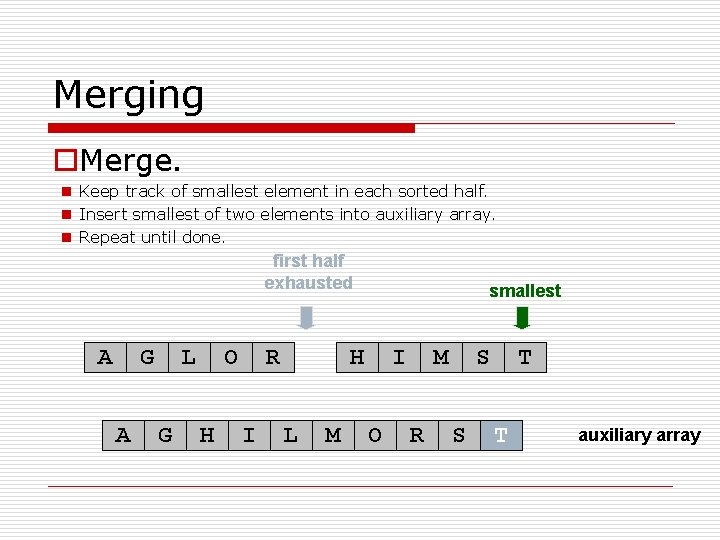
Merging o. Merge. n Keep track of smallest element in each sorted half. n Insert smallest of two elements into auxiliary array. n Repeat until done. smallest A G A smallest L O R H I M S T auxiliary array
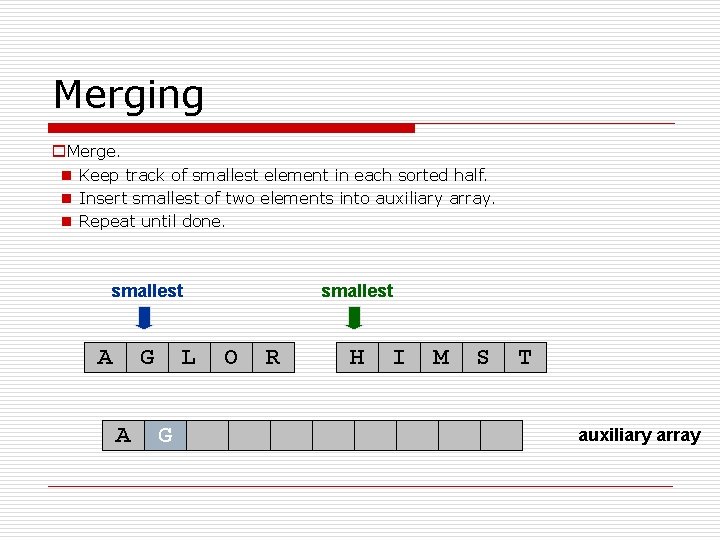
Merging o. Merge. n Keep track of smallest element in each sorted half. n Insert smallest of two elements into auxiliary array. n Repeat until done. smallest A G A L G smallest O R H I M S T auxiliary array
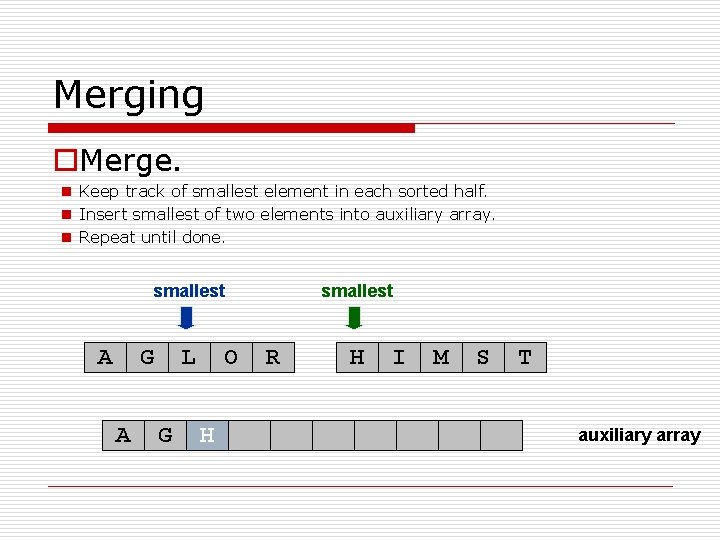
Merging o. Merge. n Keep track of smallest element in each sorted half. n Insert smallest of two elements into auxiliary array. n Repeat until done. smallest A G A L G O H smallest R H I M S T auxiliary array
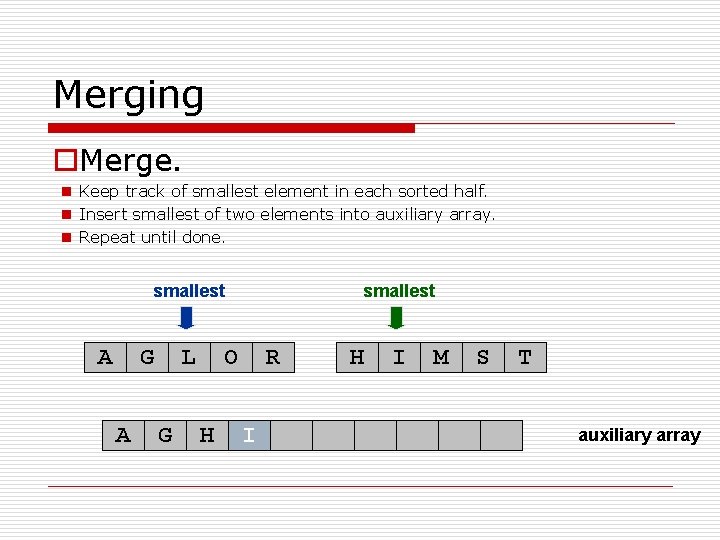
Merging o. Merge. n Keep track of smallest element in each sorted half. n Insert smallest of two elements into auxiliary array. n Repeat until done. smallest A G A L G smallest O H R I H I M S T auxiliary array
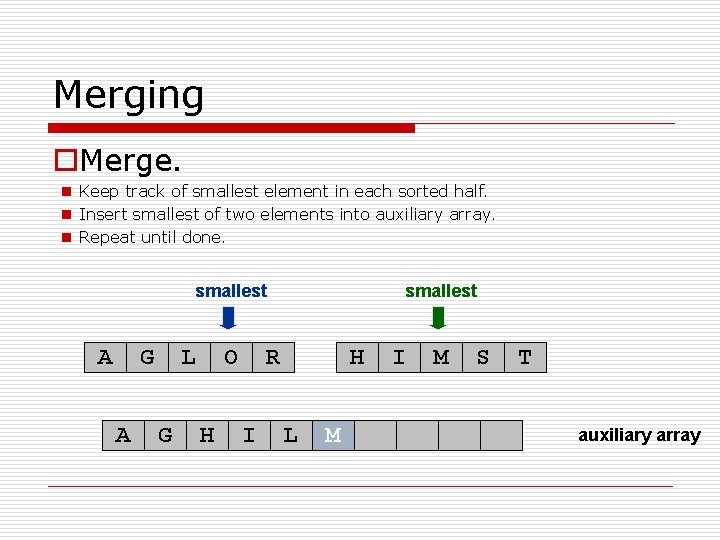
Merging o. Merge. n Keep track of smallest element in each sorted half. n Insert smallest of two elements into auxiliary array. n Repeat until done. smallest A G A L G smallest O H R I H L I M S T auxiliary array
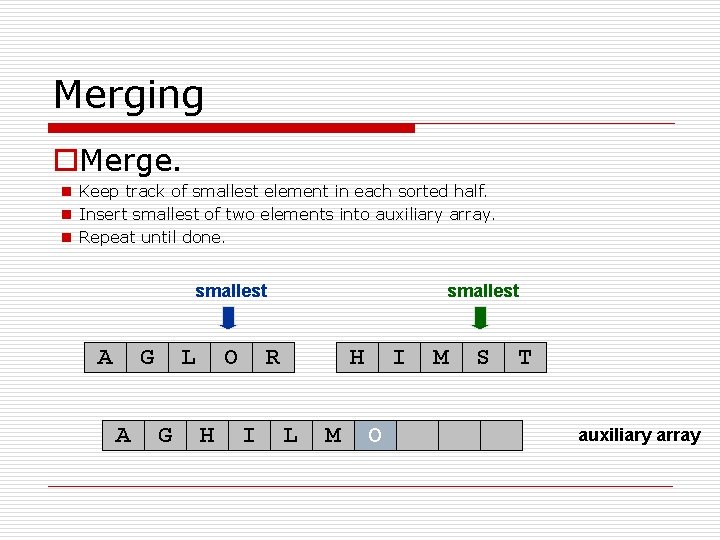
Merging o. Merge. n Keep track of smallest element in each sorted half. n Insert smallest of two elements into auxiliary array. n Repeat until done. smallest A G A L G O H smallest R I H L M I M S T auxiliary array
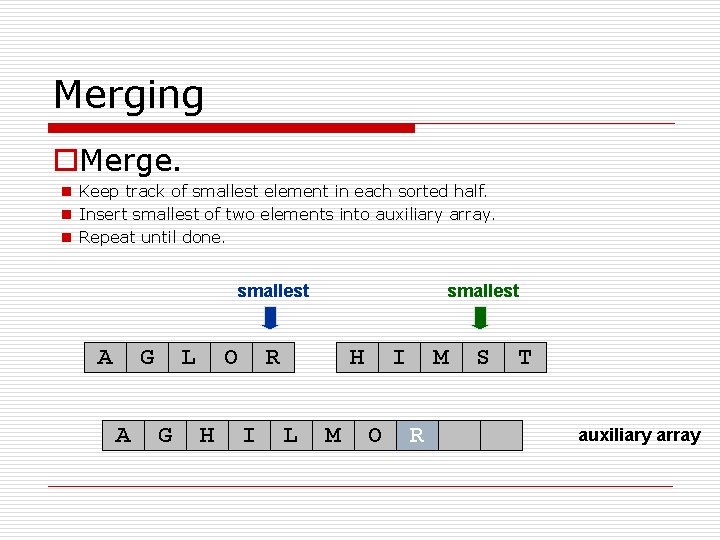
Merging o. Merge. n Keep track of smallest element in each sorted half. n Insert smallest of two elements into auxiliary array. n Repeat until done. smallest A G A L G O H smallest R I H L M I O M S T auxiliary array
Merging o. Merge. n Keep track of smallest element in each sorted half. n Insert smallest of two elements into auxiliary array. n Repeat until done. smallest A G A L G O H smallest R I H L M I O M R S T auxiliary array
Merging o. Merge. n Keep track of smallest element in each sorted half. n Insert smallest of two elements into auxiliary array. n Repeat until done. first half exhausted smallest A G A L G O H R I H L M I O M R S S T auxiliary array
Merging o. Merge. n Keep track of smallest element in each sorted half. n Insert smallest of two elements into auxiliary array. n Repeat until done. first half exhausted A G A L G O H R I smallest H L M I O M R S S T T auxiliary array
Notes on Quicksort o Quicksort is more widely used than any other sort. o Quicksort is well-studied, not difficult to implement, works well on a variety of data, and consumes fewer resources that other sorts in nearly all situations. o Quicksort is O(n*log n) time, and O(log n) additional space due to recursion.
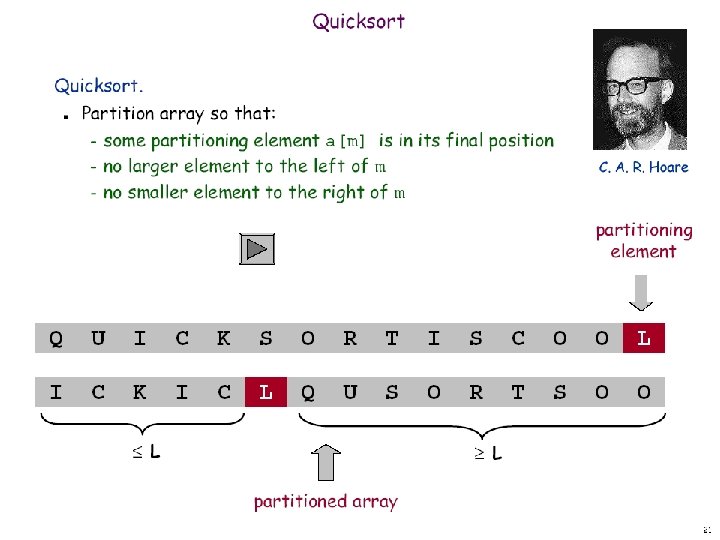
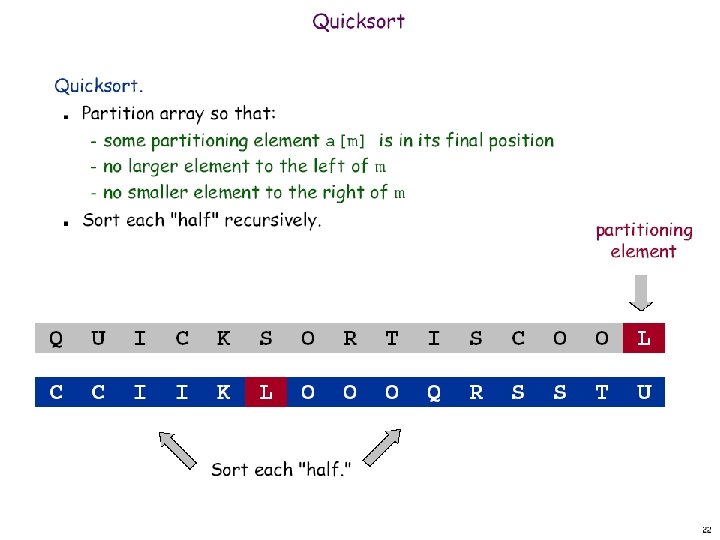
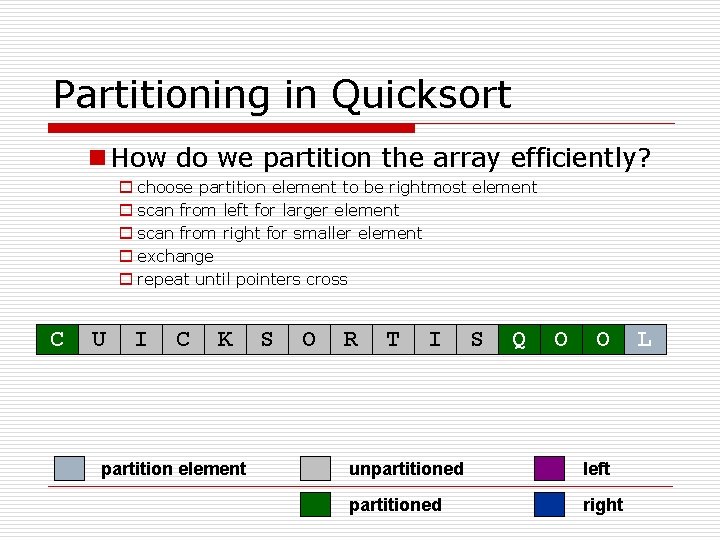
Quicksort Algorithm o Quicksort is a divide-and-conquer method for sorting. It works by partitioning an array into parts, then sorting each part independently. o The crux of the problem is how to partition the array such that the following conditions are true: n There is some element, a[i], where a[i] is in its final position. n For all l < i, a[l] < a[i]. n For all i < r, a[i] < a[r].
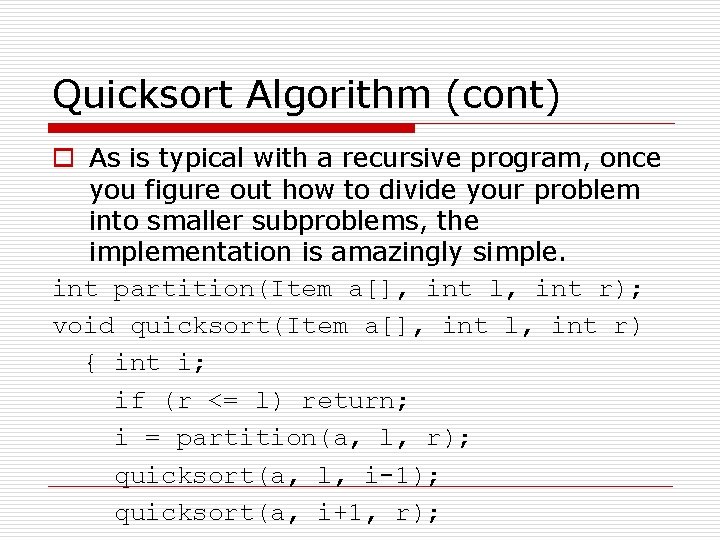
Quicksort Algorithm (cont) o As is typical with a recursive program, once you figure out how to divide your problem into smaller subproblems, the implementation is amazingly simple. int partition(Item a[], int l, int r); void quicksort(Item a[], int l, int r) { int i; if (r <= l) return; i = partition(a, l, r); quicksort(a, l, i-1); quicksort(a, i+1, r);
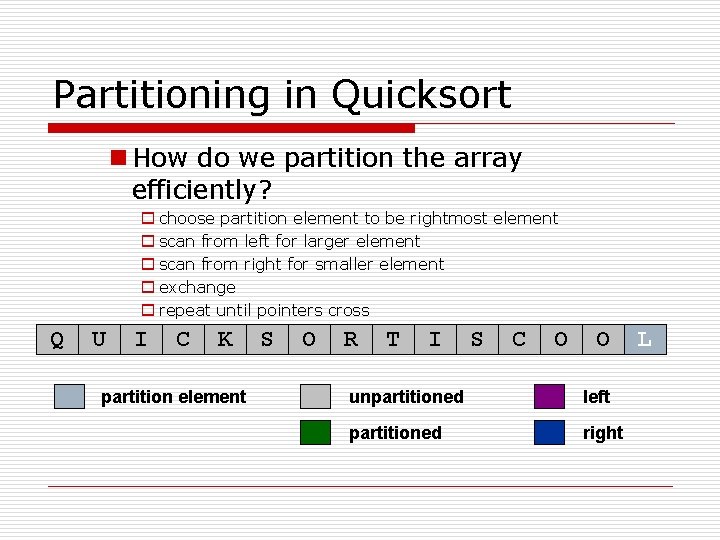
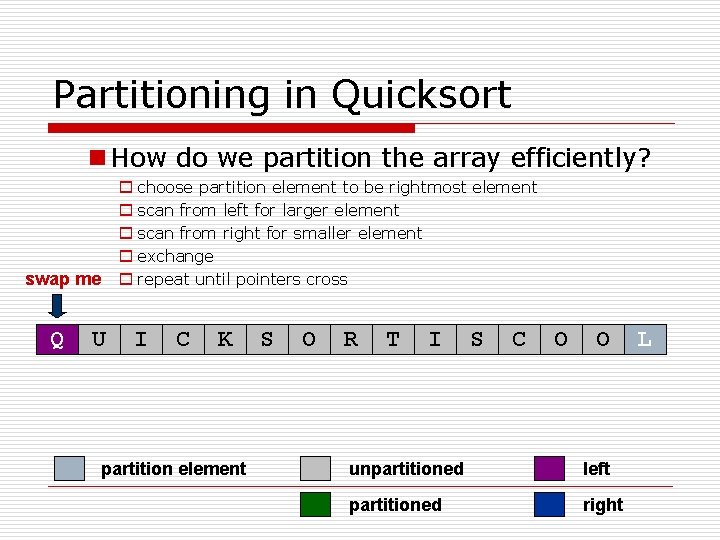
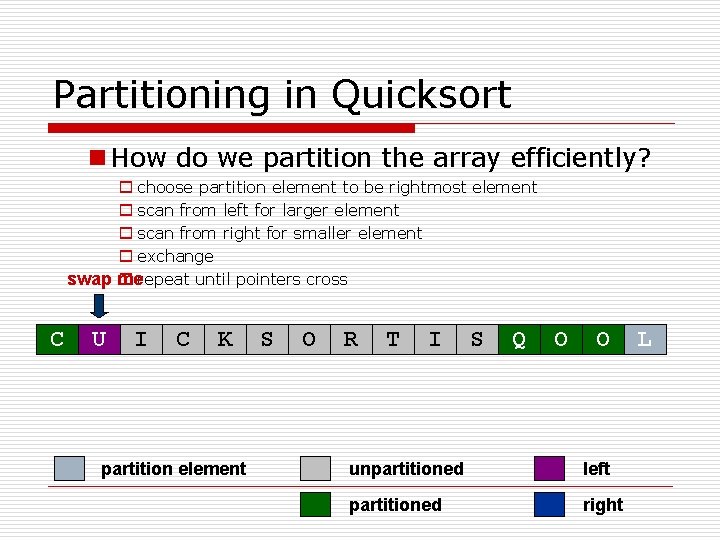
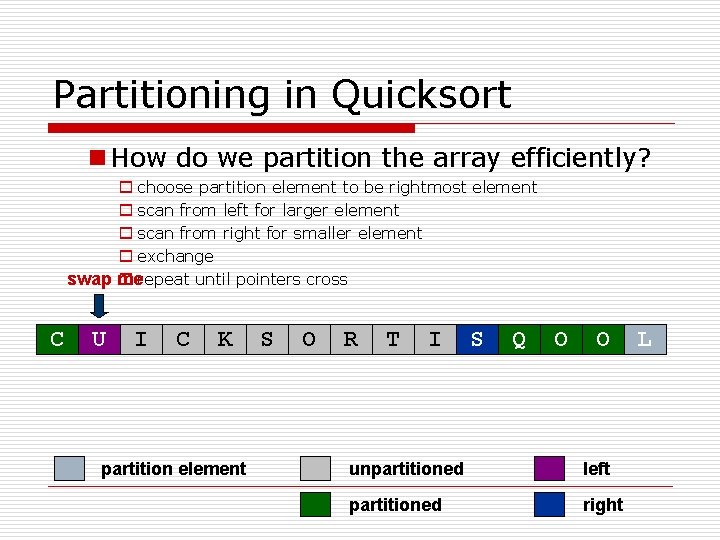
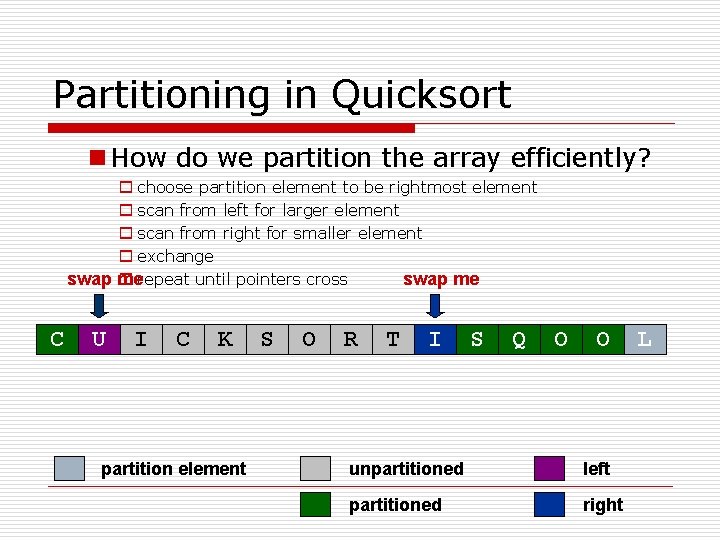
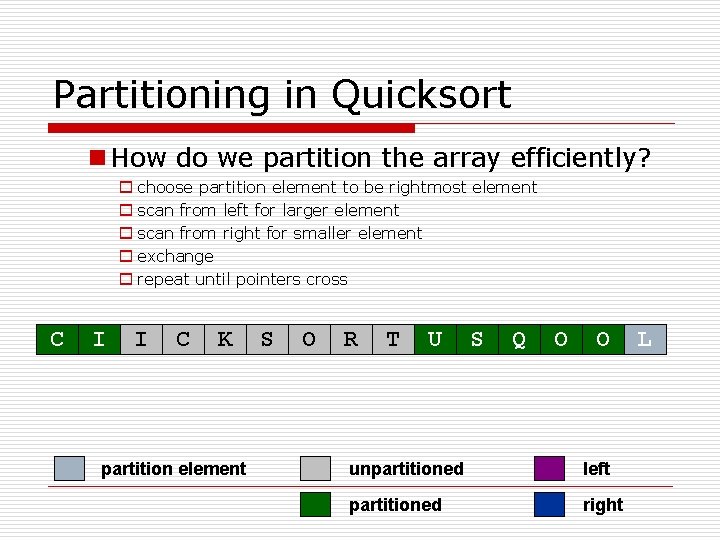
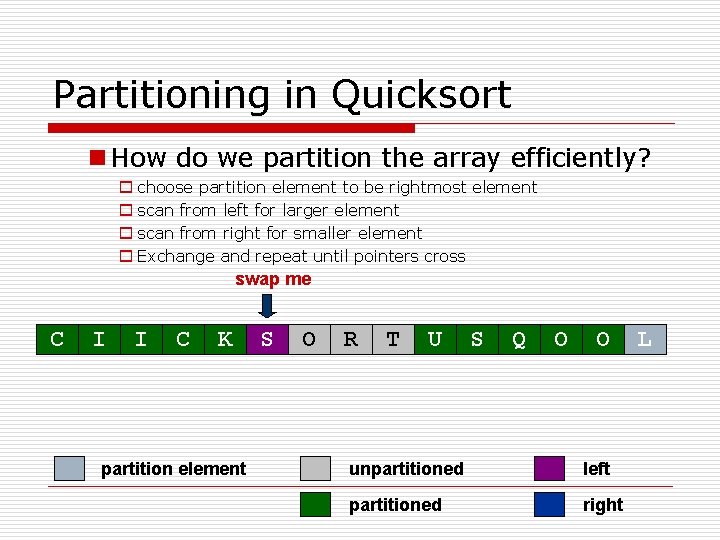
Partitioning in Quicksort n How do we partition the array efficiently? o choose partition element to be rightmost element o scan from left for larger element o scan from right for smaller element o exchange o repeat until pointers cross Q U I C K partition element S O R T I S C O O unpartitioned left partitioned right L
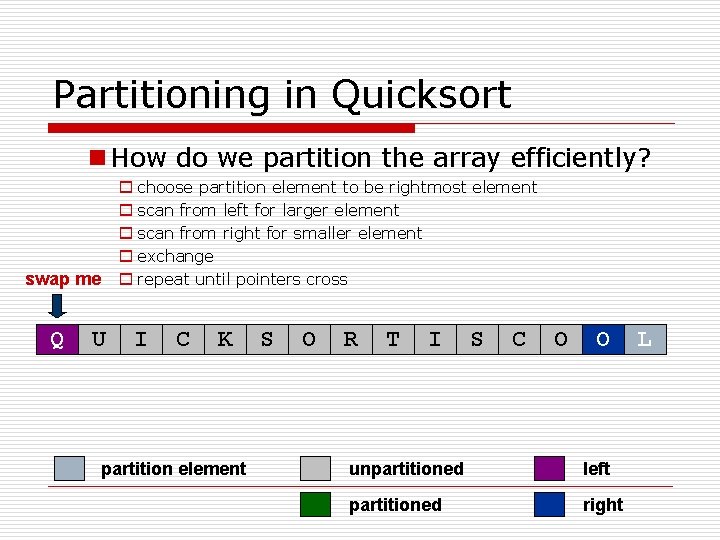
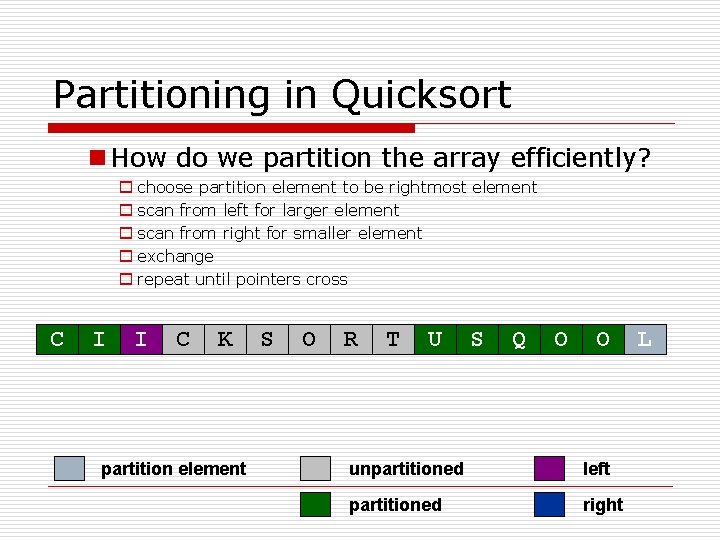
Partitioning in Quicksort n How do we partition the array efficiently? o choose partition element to be rightmost element o scan from left for larger element o scan from right for smaller element o exchange o repeat until pointers cross swap me Q U I C K partition element S O R T I S C O O unpartitioned left partitioned right L
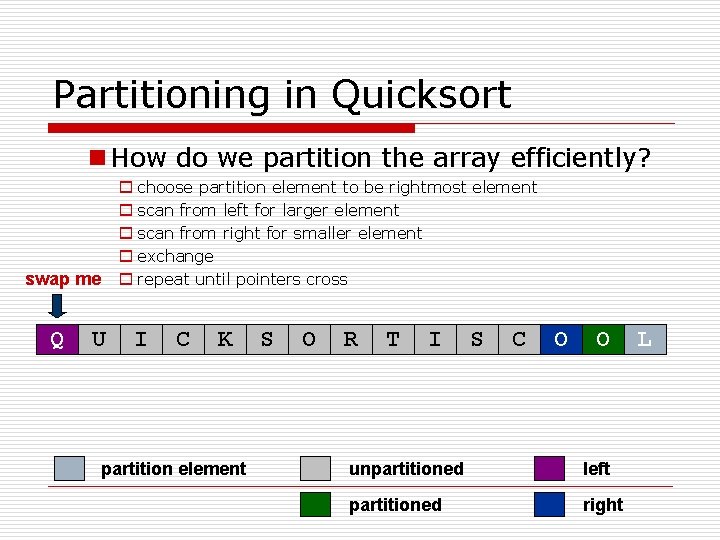
Partitioning in Quicksort n How do we partition the array efficiently? o choose partition element to be rightmost element o scan from left for larger element o scan from right for smaller element o exchange o repeat until pointers cross swap me Q U I C K partition element S O R T I S C O O unpartitioned left partitioned right L
Partitioning in Quicksort n How do we partition the array efficiently? o choose partition element to be rightmost element o scan from left for larger element o scan from right for smaller element o exchange o repeat until pointers cross swap me Q U I C K partition element S O R T I S C O O unpartitioned left partitioned right L
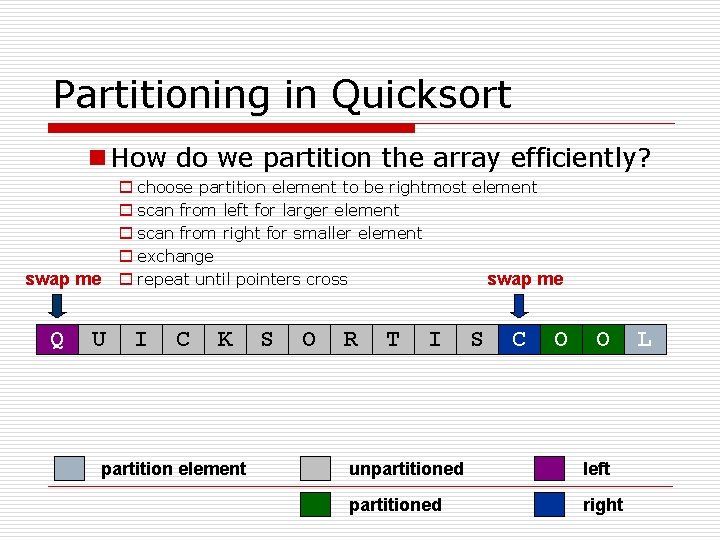
Partitioning in Quicksort n How do we partition the array efficiently? o choose partition element to be rightmost element o scan from left for larger element o scan from right for smaller element o exchange o repeat until pointers cross swap me Q U I C K partition element S O R T I S C O O unpartitioned left partitioned right L
Partitioning in Quicksort n How do we partition the array efficiently? o choose partition element to be rightmost element o scan from left for larger element o scan from right for smaller element o exchange o repeat until pointers cross C U I C K partition element S O R T I S Q O O unpartitioned left partitioned right L
Partitioning in Quicksort n How do we partition the array efficiently? o choose partition element to be rightmost element o scan from left for larger element o scan from right for smaller element o exchange o repeat until pointers cross swap me C U I C K partition element S O R T I S Q O O unpartitioned left partitioned right L
Partitioning in Quicksort n How do we partition the array efficiently? o choose partition element to be rightmost element o scan from left for larger element o scan from right for smaller element o exchange o repeat until pointers cross swap me C U I C K partition element S O R T I S Q O O unpartitioned left partitioned right L
Partitioning in Quicksort n How do we partition the array efficiently? o choose partition element to be rightmost element o scan from left for larger element o scan from right for smaller element o exchange o repeat until pointers cross swap me C U I C K partition element S O R T I S Q O O unpartitioned left partitioned right L
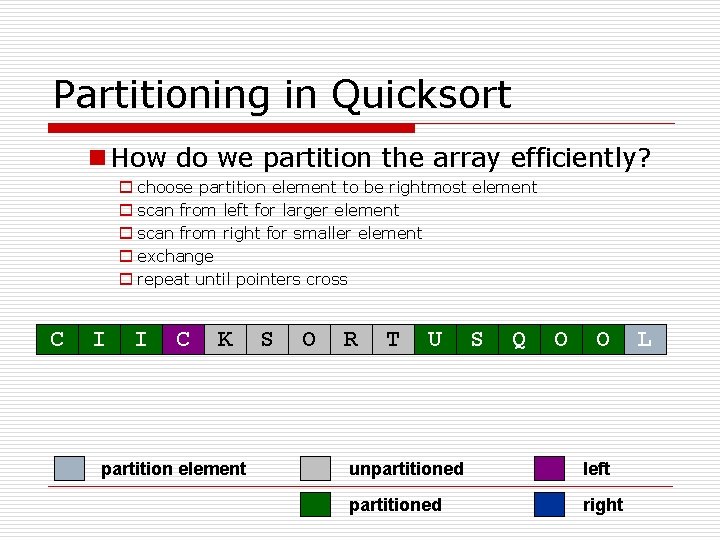
Partitioning in Quicksort n How do we partition the array efficiently? o choose partition element to be rightmost element o scan from left for larger element o scan from right for smaller element o exchange o repeat until pointers cross C I I C K partition element S O R T U S Q O O unpartitioned left partitioned right L
Partitioning in Quicksort n How do we partition the array efficiently? o choose partition element to be rightmost element o scan from left for larger element o scan from right for smaller element o exchange o repeat until pointers cross C I I C K partition element S O R T U S Q O O unpartitioned left partitioned right L
Partitioning in Quicksort n How do we partition the array efficiently? o choose partition element to be rightmost element o scan from left for larger element o scan from right for smaller element o exchange o repeat until pointers cross C I I C K partition element S O R T U S Q O O unpartitioned left partitioned right L
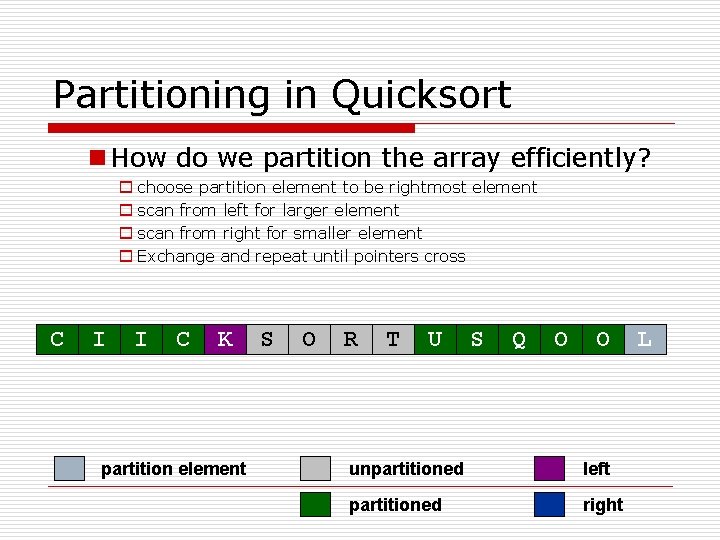
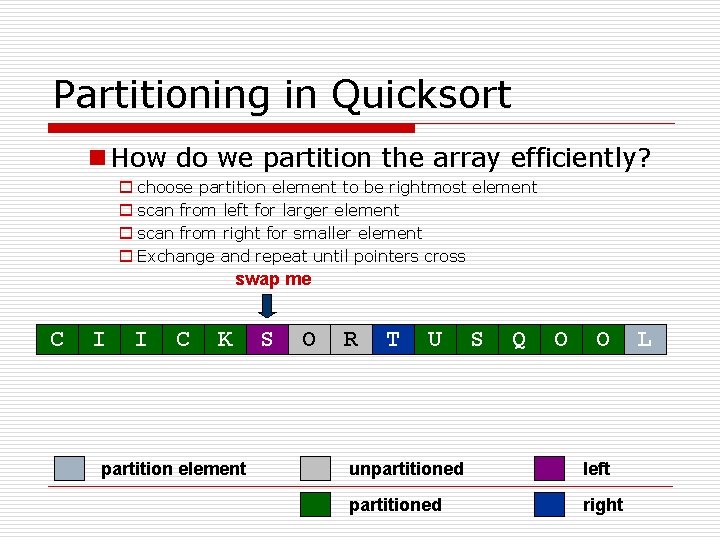
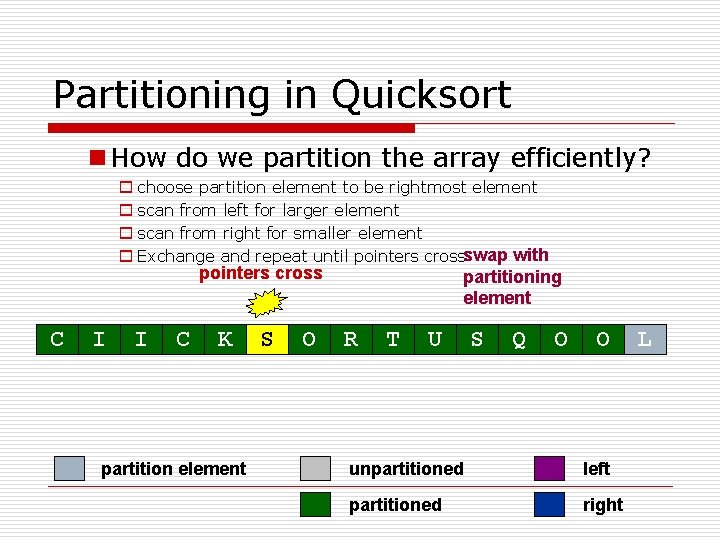
Partitioning in Quicksort n How do we partition the array efficiently? o choose partition element to be rightmost element o scan from left for larger element o scan from right for smaller element o Exchange and repeat until pointers cross C I I C K partition element S O R T U S Q O O unpartitioned left partitioned right L
Partitioning in Quicksort n How do we partition the array efficiently? o choose partition element to be rightmost element o scan from left for larger element o scan from right for smaller element o Exchange and repeat until pointers cross swap me C I I C K partition element S O R T U S Q O O unpartitioned left partitioned right L
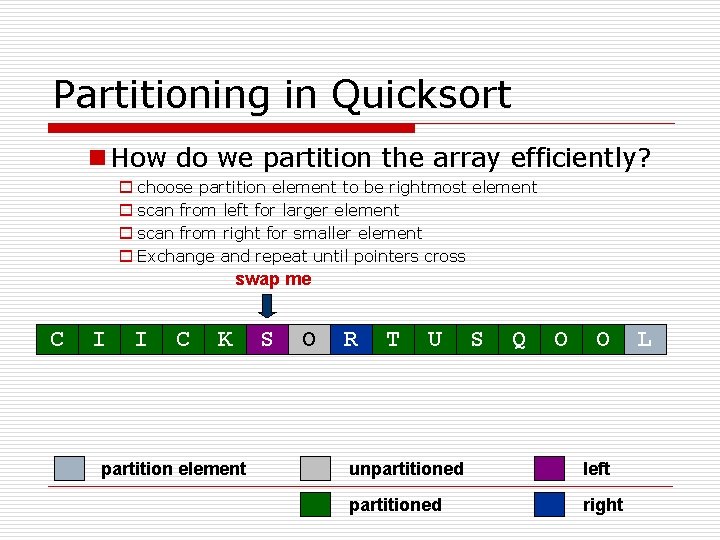
Partitioning in Quicksort n How do we partition the array efficiently? o choose partition element to be rightmost element o scan from left for larger element o scan from right for smaller element o Exchange and repeat until pointers cross swap me C I I C K partition element S O R T U S Q O O unpartitioned left partitioned right L
Partitioning in Quicksort n How do we partition the array efficiently? o choose partition element to be rightmost element o scan from left for larger element o scan from right for smaller element o Exchange and repeat until pointers cross swap me C I I C K partition element S O R T U S Q O O unpartitioned left partitioned right L
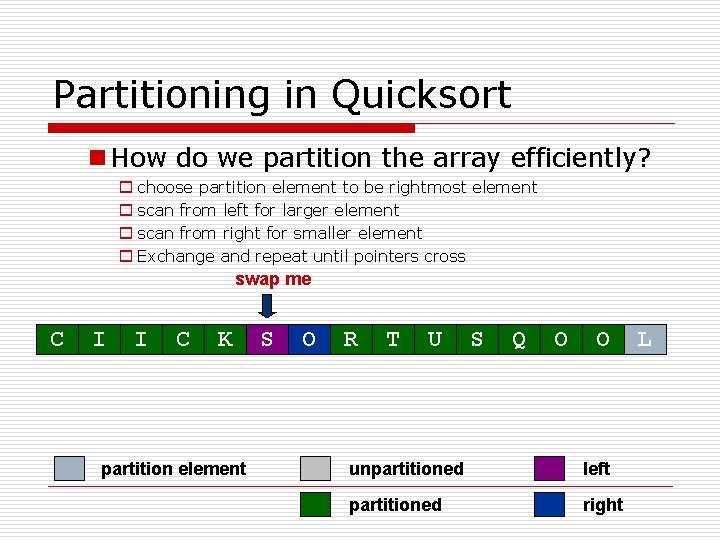
Partitioning in Quicksort n How do we partition the array efficiently? o choose partition element to be rightmost element o scan from left for larger element o scan from right for smaller element o Exchange and repeat until pointers cross swap me C I I C K partition element S O R T U S Q O O unpartitioned left partitioned right L
Partitioning in Quicksort n How do we partition the array efficiently? o choose partition element to be rightmost element o scan from left for larger element o scan from right for smaller element o Exchange and repeat until pointers crossswap with pointers cross C I I C K partition element S O partitioning element R T U S Q O O unpartitioned left partitioned right L
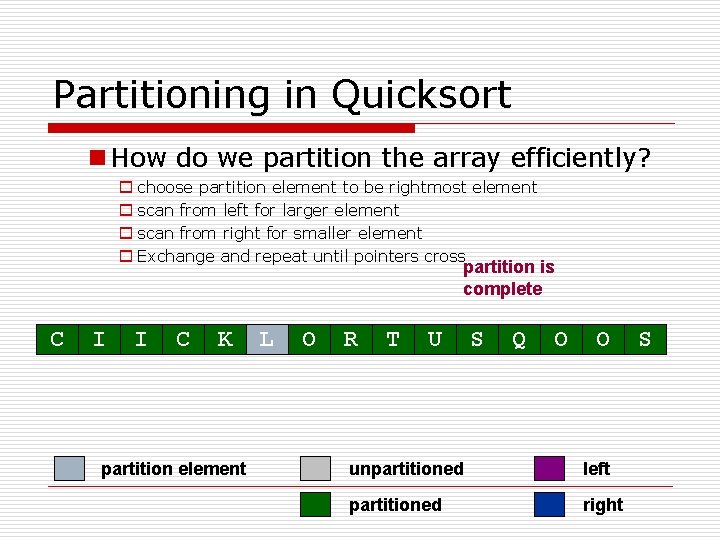
Partitioning in Quicksort n How do we partition the array efficiently? o choose partition element to be rightmost element o scan from left for larger element o scan from right for smaller element o Exchange and repeat until pointers cross partition is complete C I I C K partition element L O R T U S Q O O unpartitioned left partitioned right S
Quicksort Demo o Quicksort illustrates the operation of the basic algorithm. When the array is partitioned, one element is in place on the diagonal, the left subarray has its upper corner at that element, and the right subarray has its lower corner at that element. The original file is divided into two smaller parts that are sorted independently. The left subarray is always sorted first, so the sorted result emerges as a line of
Why study Heapsort? o It is a well-known, traditional sorting algorithm you will be expected to know o Heapsort is always O(n log n) n Quicksort is usually O(n log n) but in the worst case slows to O(n 2) n Quicksort is generally faster, but Heapsort is better in time-critical applications
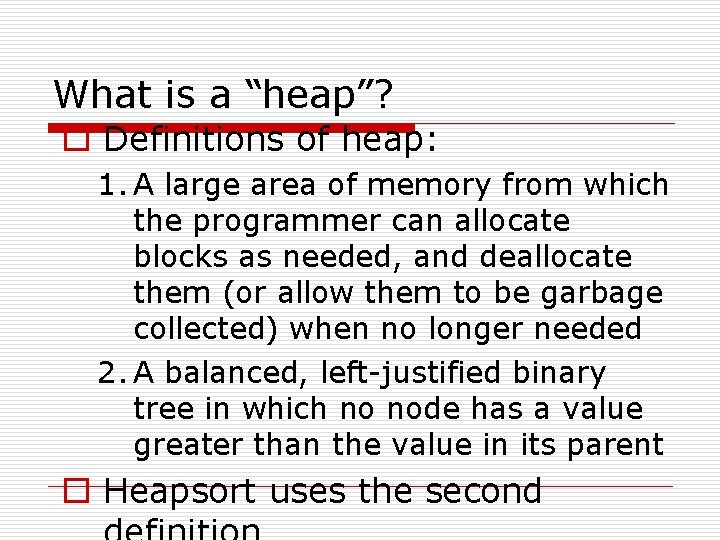
What is a “heap”? o Definitions of heap: 1. A large area of memory from which the programmer can allocate blocks as needed, and deallocate them (or allow them to be garbage collected) when no longer needed 2. A balanced, left-justified binary tree in which no node has a value greater than the value in its parent o Heapsort uses the second
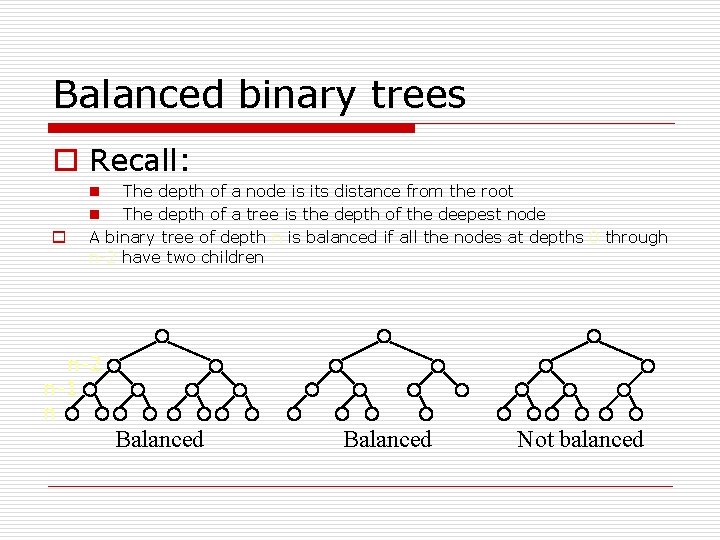
Balanced binary trees o Recall: o n The depth of a node is its distance from the root n The depth of a tree is the depth of the deepest node A binary tree of depth n is balanced if all the nodes at depths 0 through n-2 have two children n-2 n-1 n Balanced Not balanced
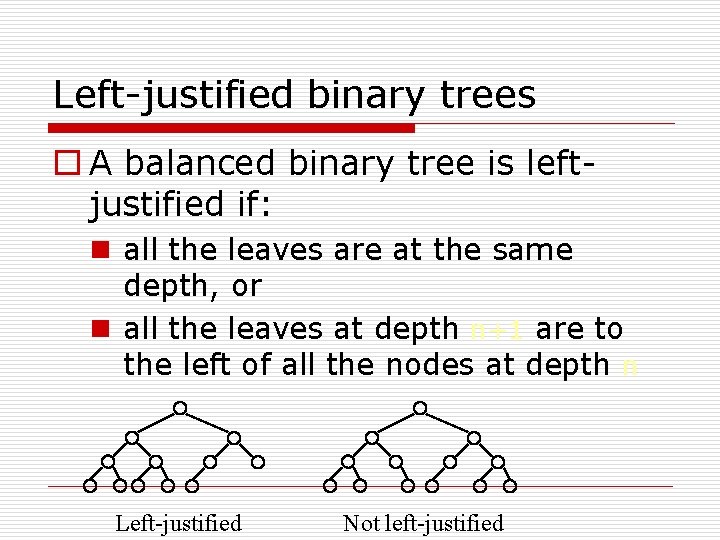
Left-justified binary trees o A balanced binary tree is leftjustified if: n all the leaves are at the same depth, or n all the leaves at depth n+1 are to the left of all the nodes at depth n Left-justified Not left-justified
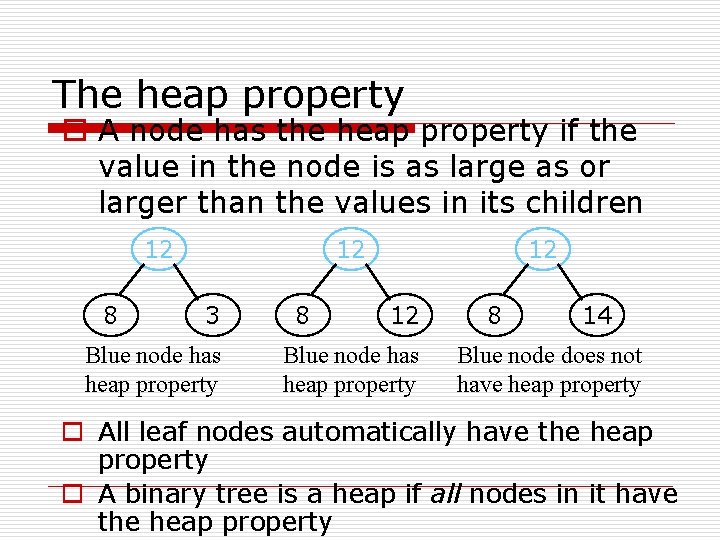
The heap property o A node has the heap property if the value in the node is as large as or larger than the values in its children 12 8 12 3 Blue node has heap property 8 12 12 Blue node has heap property 8 14 Blue node does not have heap property o All leaf nodes automatically have the heap property o A binary tree is a heap if all nodes in it have the heap property
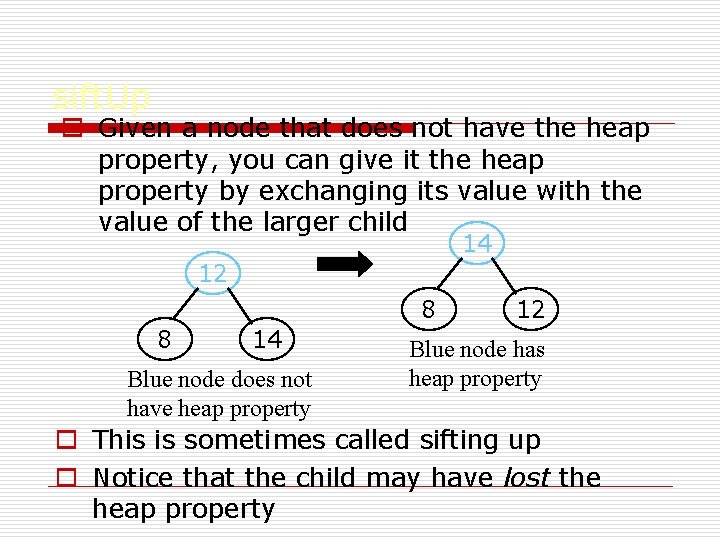
sift. Up o Given a node that does not have the heap property, you can give it the heap property by exchanging its value with the value of the larger child 14 12 8 8 14 Blue node does not have heap property 12 Blue node has heap property o This is sometimes called sifting up o Notice that the child may have lost the heap property
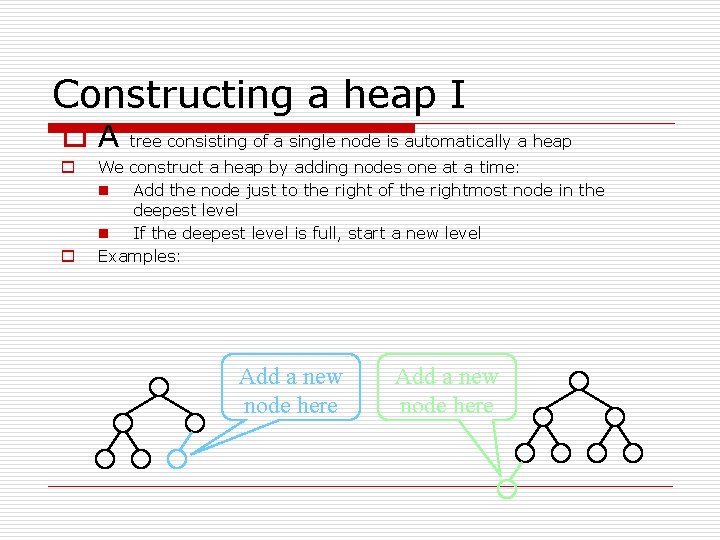
Constructing a heap I o. A o o tree consisting of a single node is automatically a heap We construct a heap by adding nodes one at a time: n Add the node just to the right of the rightmost node in the deepest level n If the deepest level is full, start a new level Examples: Add a new node here
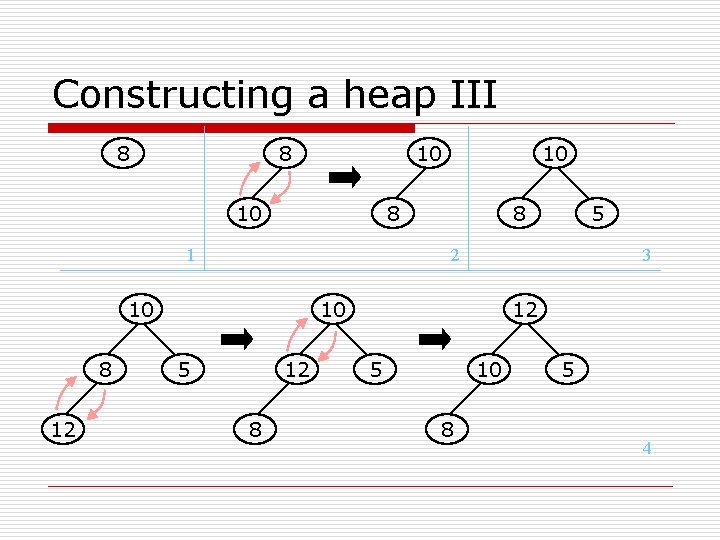
Constructing a heap II o o Each time we add a node, we may destroy the heap property of its parent node To fix this, we sift up But each time we sift up, the value of the topmost node in the sift may increase, and this may destroy the heap property of its parent node We repeat the sifting up process, moving up in the tree, until either n We reach nodes whose values don’t need to be swapped (because the parent is still larger than both children), or n We reach the root
Constructing a heap III 8 8 10 10 8 1 12 8 5 2 10 8 10 3 10 5 12 8 12 5 10 8 5 4
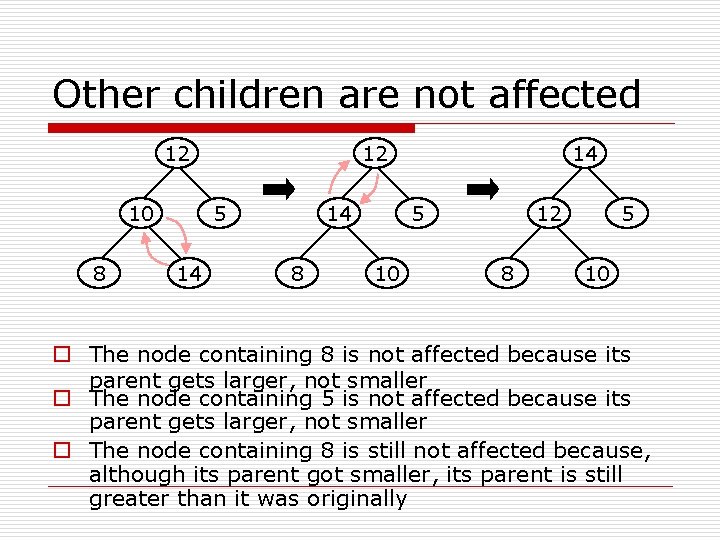
Other children are not affected 12 10 8 12 5 14 14 8 14 5 10 12 8 5 10 o The node containing 8 is not affected because its parent gets larger, not smaller o The node containing 5 is not affected because its parent gets larger, not smaller o The node containing 8 is still not affected because, although its parent got smaller, its parent is still greater than it was originally
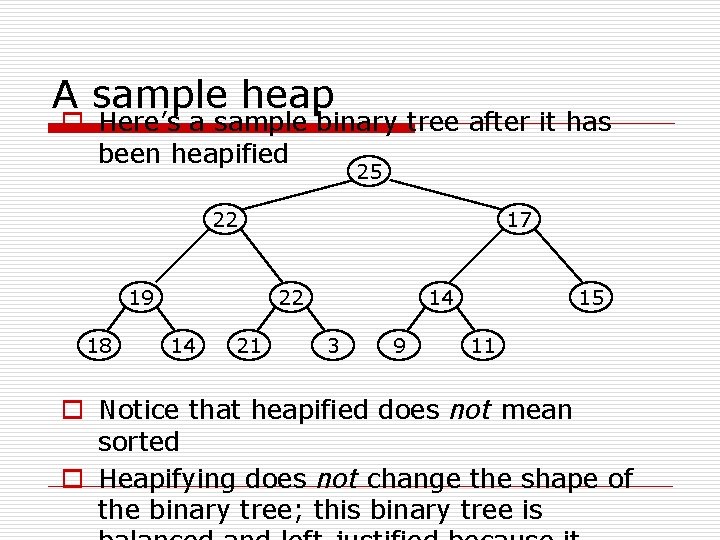
A sample heap o Here’s a sample binary tree after it has been heapified 25 22 19 18 17 22 14 21 14 3 9 15 11 o Notice that heapified does not mean sorted o Heapifying does not change the shape of the binary tree; this binary tree is
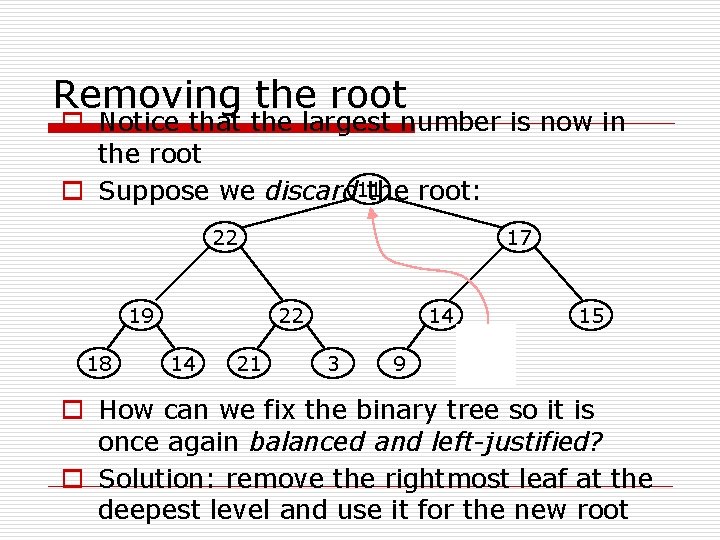
Removing the root o Notice that the largest number is now in the root o Suppose we discard 11 the root: 22 19 18 17 22 14 21 14 3 9 15 11 o How can we fix the binary tree so it is once again balanced and left-justified? o Solution: remove the rightmost leaf at the deepest level and use it for the new root
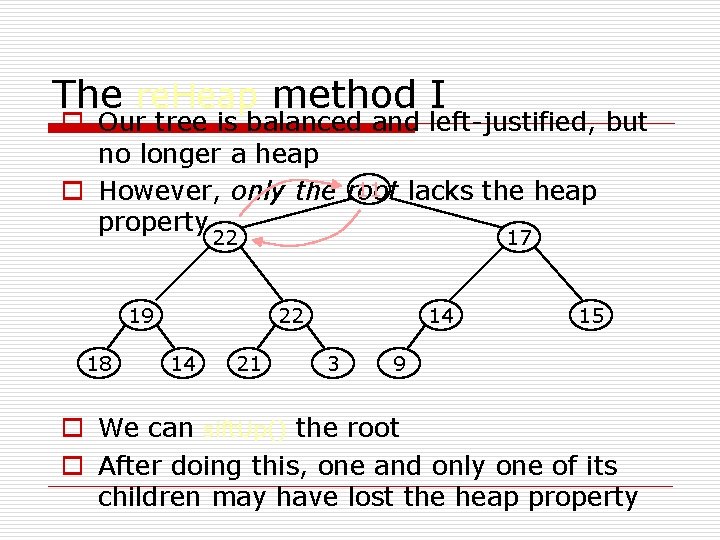
The re. Heap method I o Our tree is balanced and left-justified, but no longer a heap 11 lacks the heap o However, only the root property 22 19 18 17 22 14 21 14 3 15 9 o We can sift. Up() the root o After doing this, one and only one of its children may have lost the heap property
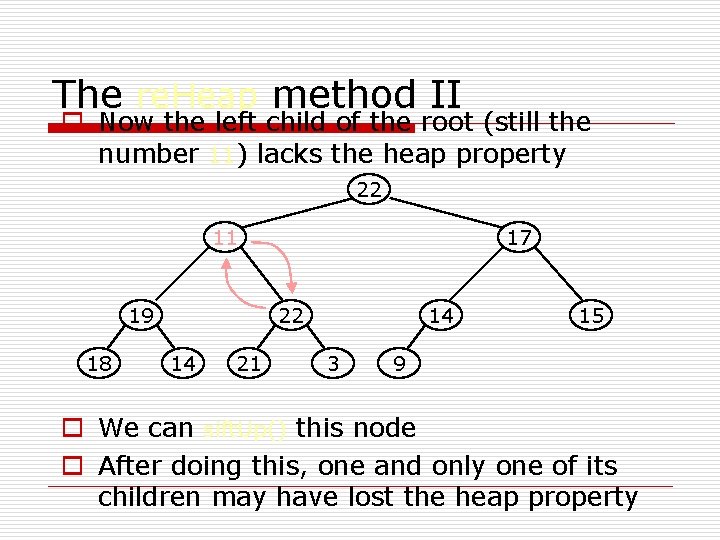
The re. Heap method II o Now the left child of the root (still the number 11) lacks the heap property 22 11 19 18 17 22 14 21 14 3 15 9 o We can sift. Up() this node o After doing this, one and only one of its children may have lost the heap property
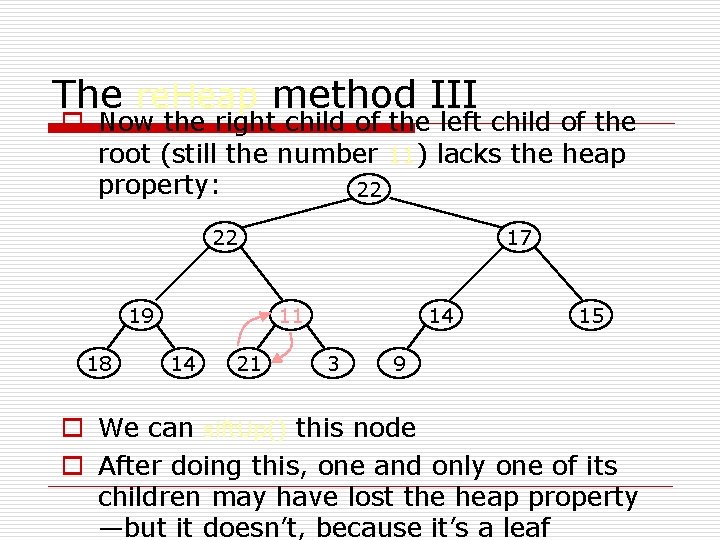
The re. Heap method III o Now the right child of the left child of the root (still the number 11) lacks the heap property: 22 22 19 18 17 11 14 21 14 3 15 9 o We can sift. Up() this node o After doing this, one and only one of its children may have lost the heap property —but it doesn’t, because it’s a leaf
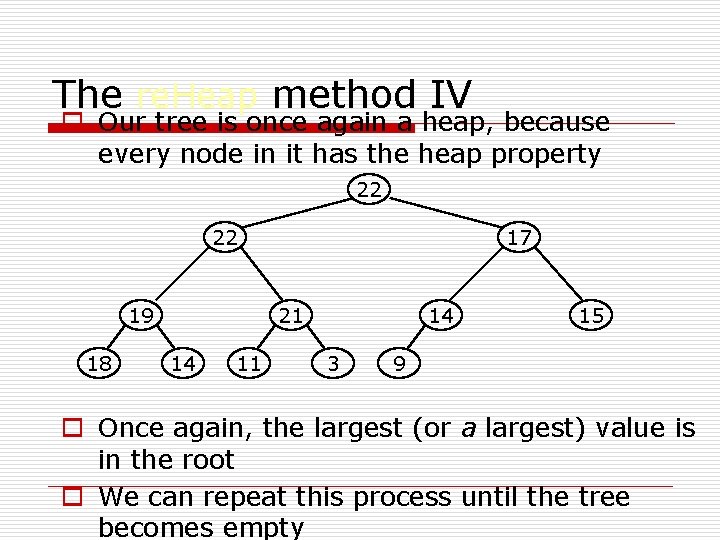
The re. Heap method IV o Our tree is once again a heap, because every node in it has the heap property 22 22 19 18 17 21 14 11 14 3 15 9 o Once again, the largest (or a largest) value is in the root o We can repeat this process until the tree becomes empty
Sorting o What do heaps have to do with sorting an array? o Here’s the neat part: n Because the binary tree is balanced and left justified, it can be represented as an array n All our operations on binary trees can be represented as operations on arrays n To sort: heapify the array; while the array isn’t empty { remove and replace the root;
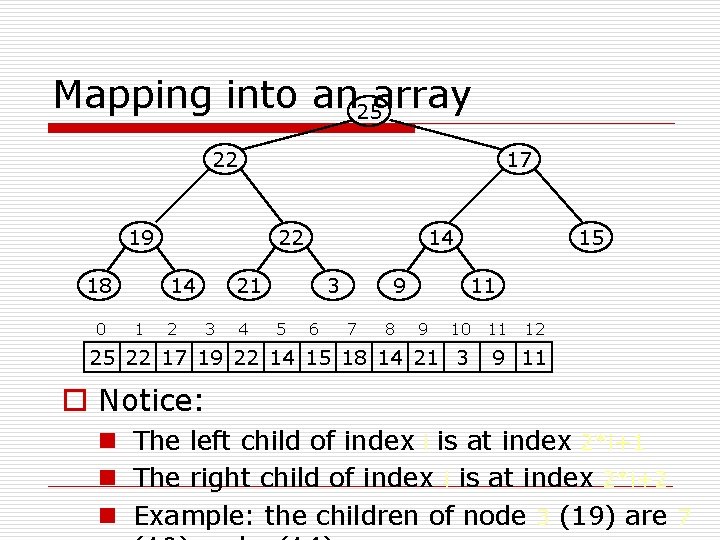
Mapping into an 25 array 22 17 19 18 0 22 14 1 2 14 21 3 4 3 5 6 9 7 8 15 11 9 10 25 22 17 19 22 14 15 18 14 21 3 11 12 9 11 o Notice: n The left child of index i is at index 2*i+1 n The right child of index i is at index 2*i+2 n Example: the children of node 3 (19) are 7
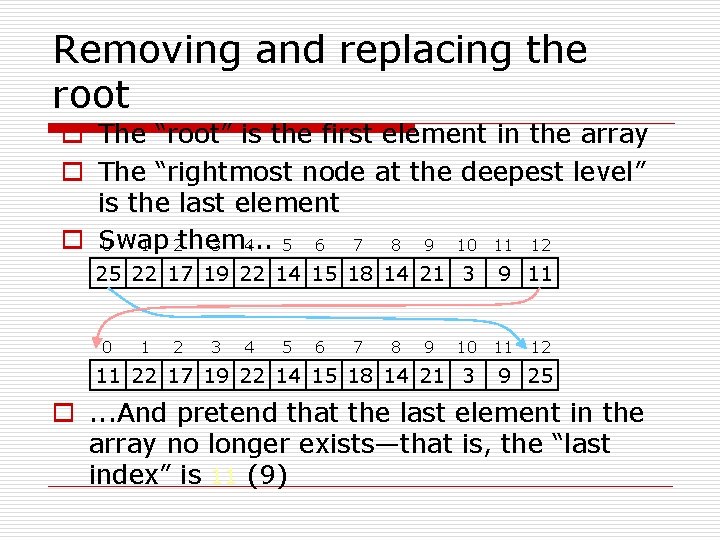
Removing and replacing the root o The “root” is the first element in the array o The “rightmost node at the deepest level” is the last element o Swap 0 1 2 them. . . 3 4 5 6 7 8 9 10 11 12 25 22 17 19 22 14 15 18 14 21 3 0 1 2 3 4 5 6 7 8 9 10 11 22 17 19 22 14 15 18 14 21 3 9 11 11 12 9 25 o. . . And pretend that the last element in the array no longer exists—that is, the “last index” is 11 (9)
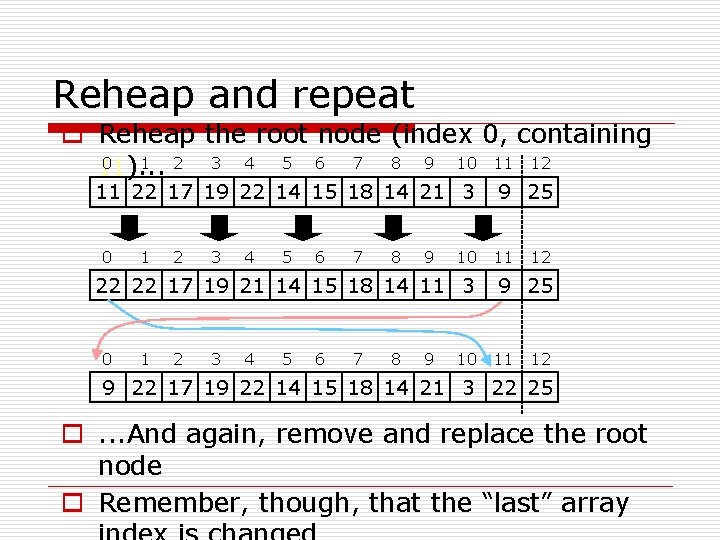
Reheap and repeat o Reheap the root node (index 0, containing 0 ). . . 1 2 3 4 5 6 7 8 9 10 11 12 11 11 22 17 19 22 14 15 18 14 21 3 0 1 2 3 4 5 6 7 8 9 10 22 22 17 19 21 14 15 18 14 11 3 0 1 2 3 4 5 6 7 8 9 10 9 25 11 12 9 22 17 19 22 14 15 18 14 21 3 22 25 o. . . And again, remove and replace the root node o Remember, though, that the “last” array
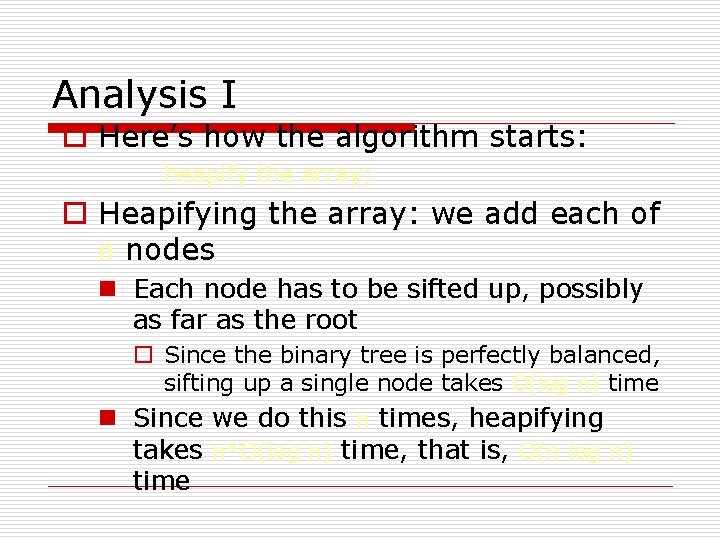
Analysis I o Here’s how the algorithm starts: heapify the array; o Heapifying the array: we add each of n nodes n Each node has to be sifted up, possibly as far as the root o Since the binary tree is perfectly balanced, sifting up a single node takes O(log n) time n Since we do this n times, heapifying takes n*O(log n) time, that is, O(n log n) time
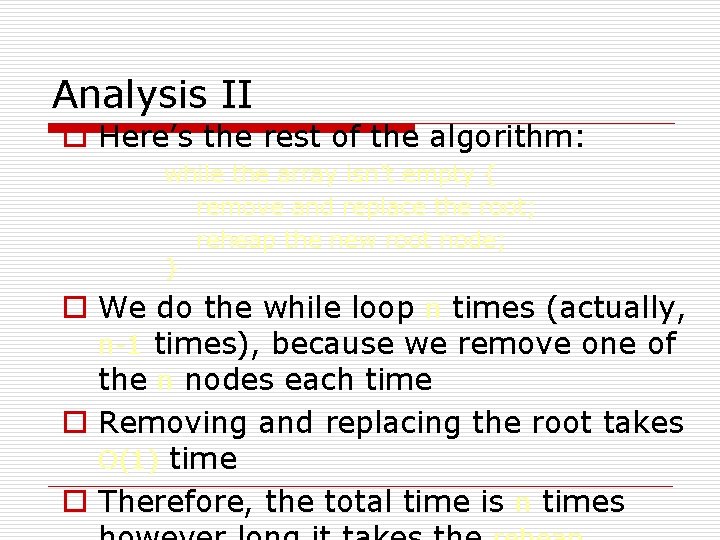
Analysis II o Here’s the rest of the algorithm: while the array isn’t empty { remove and replace the root; reheap the new root node; } o We do the while loop n times (actually, n-1 times), because we remove one of the n nodes each time o Removing and replacing the root takes O(1) time o Therefore, the total time is n times
Analysis III o To reheap the root node, we have to follow one path from the root to a leaf node (and we might stop before we reach a leaf) o The binary tree is perfectly balanced o Therefore, this path is O(log n) long n And we only do O(1) operations at each node n Therefore, reheaping takes O(log n) times
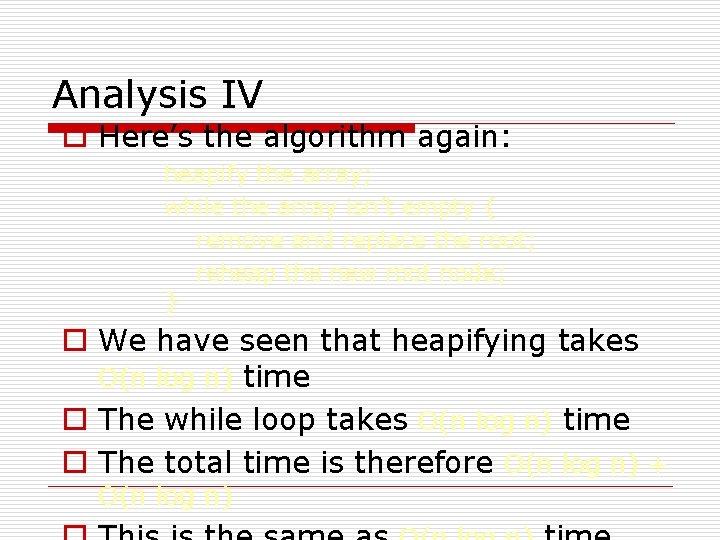
Analysis IV o Here’s the algorithm again: heapify the array; while the array isn’t empty { remove and replace the root; reheap the new root node; } o We have seen that heapifying takes O(n log n) time o The while loop takes O(n log n) time o The total time is therefore O(n log n) + O(n log n)
The End
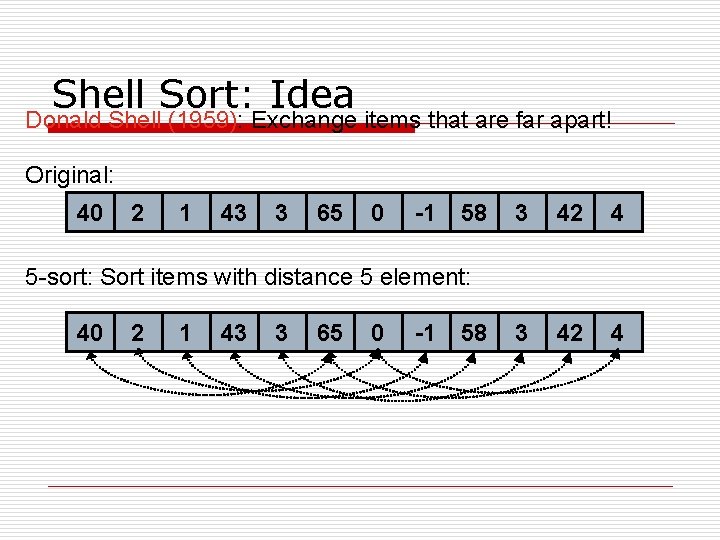
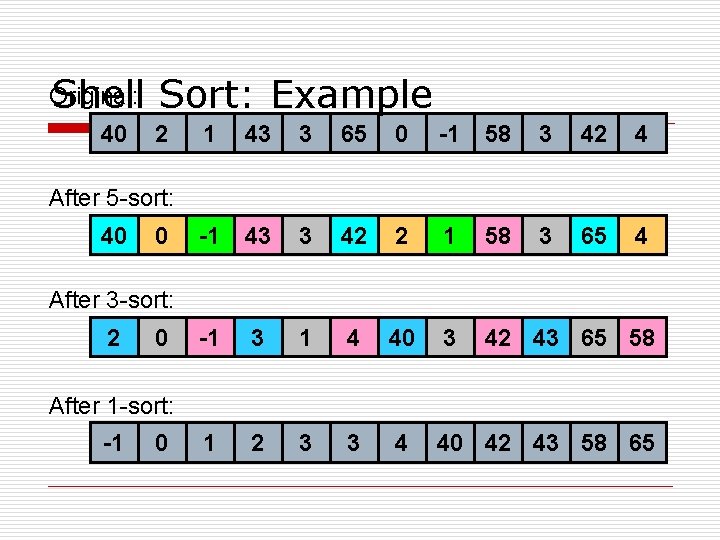
Shell Sort: Idea Donald Shell (1959): Exchange items that are far apart! Original: 40 2 1 43 3 65 0 -1 58 3 42 4 5 -sort: Sort items with distance 5 element: 40 2 1 43 3 65 0 -1 58
Original: Shell 40 Sort: Example 2 1 43 3 65 0 -1 58 3 42 4 -1 43 3 42 2 1 58 3 65 4 -1 3 1 4 40 3 42 43 65 58 2 1 3 2 40 3 43 65 4 40 42 42 65 43 43 58 58 65 65 After 5 -sort: 40 0 After 3 -sort: 2 0 After 1 -sort: -1 0
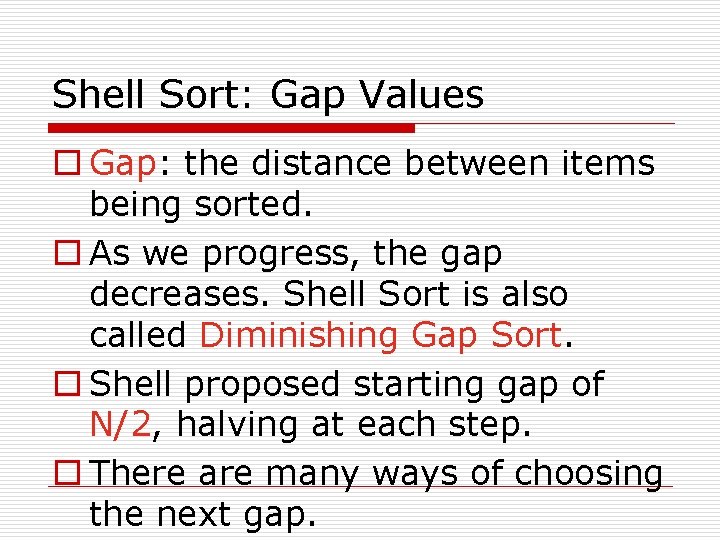
Shell Sort: Gap Values o Gap: the distance between items being sorted. o As we progress, the gap decreases. Shell Sort is also called Diminishing Gap Sort. o Shell proposed starting gap of N/2, halving at each step. o There are many ways of choosing the next gap.
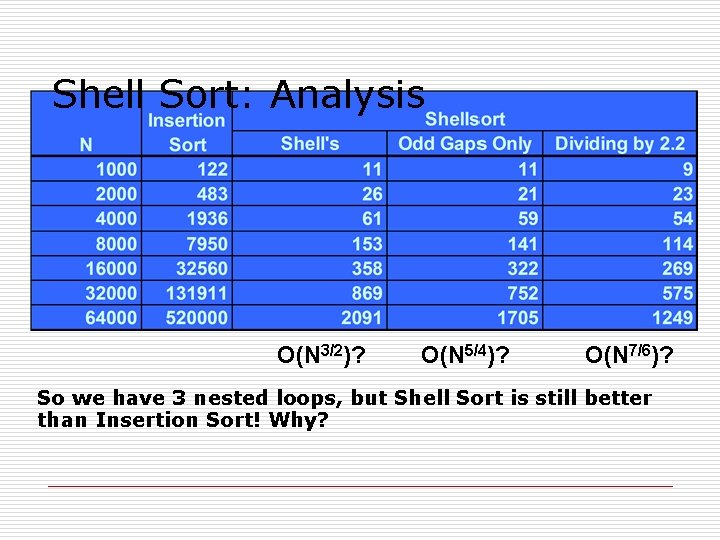
Shell Sort: Analysis O(N 3/2)? O(N 5/4)? O(N 7/6)? So we have 3 nested loops, but Shell Sort is still better than Insertion Sort! Why?
Generic Sort o So far we have methods to sort integers. What about Strings? Employees? Cookies? o A new method for each class? No! o In order to be sorted, objects should be comparable (less than, equal, greater than). o Solution: n use an interface that has a method to compare two objects.
Other kinds of sort o Heap sort. We will discuss this after tree. o Postman sort / Radix Sort. o etc.