
Different Types Of Levels The Dumpy Level The
- Slides: 29
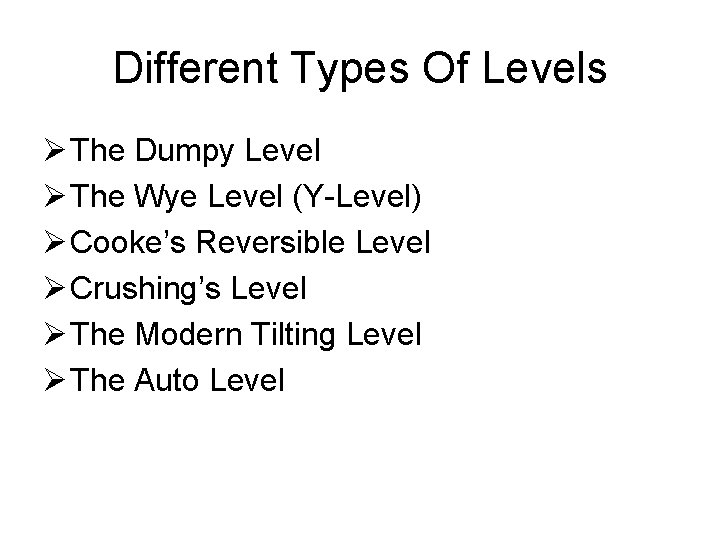
Different Types Of Levels Ø The Dumpy Level Ø The Wye Level (Y-Level) Ø Cooke’s Reversible Level Ø Crushing’s Level Ø The Modern Tilting Level Ø The Auto Level
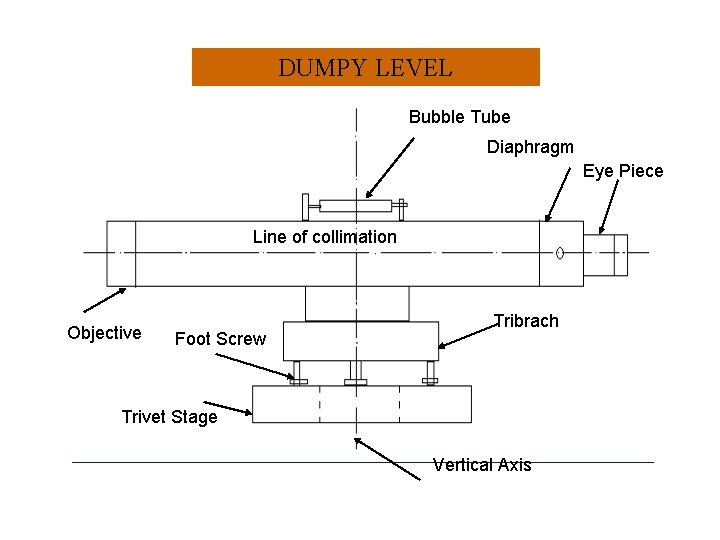
DUMPY LEVEL Bubble Tube Diaphragm Eye Piece Line of collimation Objective Foot Screw Tribrach Trivet Stage Vertical Axis
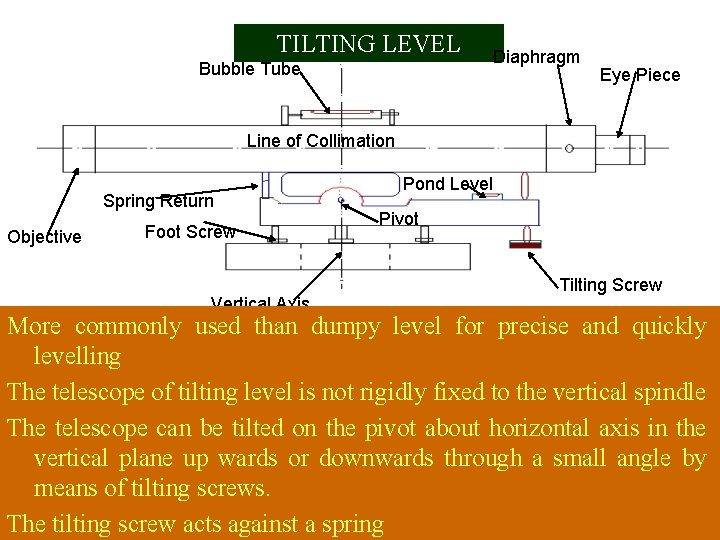
TILTING LEVEL Bubble Tube Diaphragm Eye Piece Line of Collimation Spring Return Objective Foot Screw Vertical Axis Pond Level Pivot Tilting Screw More commonly used than dumpy level for precise and quickly levelling The telescope of tilting level is not rigidly fixed to the vertical spindle The telescope can be tilted on the pivot about horizontal axis in the vertical plane up wards or downwards through a small angle by means of tilting screws. The tilting screw acts against a spring
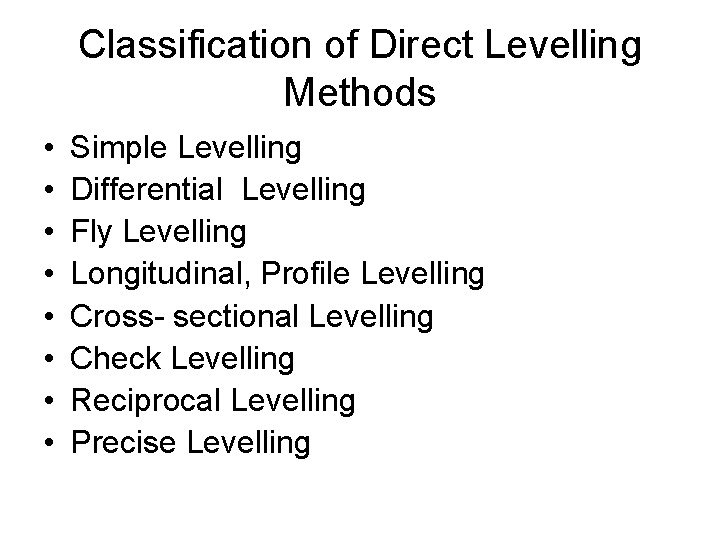
Classification of Direct Levelling Methods • • Simple Levelling Differential Levelling Fly Levelling Longitudinal, Profile Levelling Cross- sectional Levelling Check Levelling Reciprocal Levelling Precise Levelling
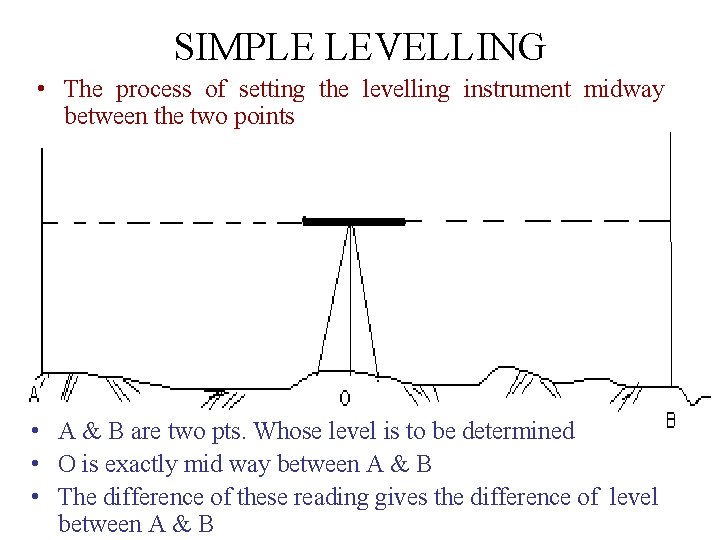
SIMPLE LEVELLING • The process of setting the levelling instrument midway between the two points • A & B are two pts. Whose level is to be determined • O is exactly mid way between A & B • The difference of these reading gives the difference of level between A & B
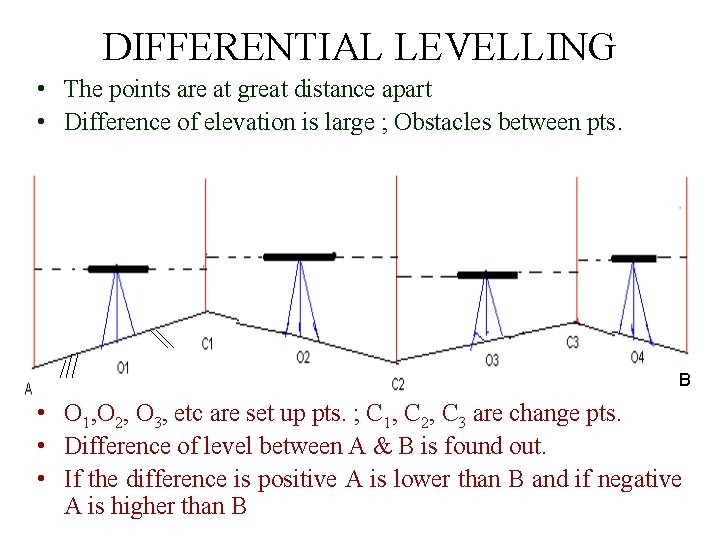
DIFFERENTIAL LEVELLING • The points are at great distance apart • Difference of elevation is large ; Obstacles between pts. B • O 1, O 2, O 3, etc are set up pts. ; C 1, C 2, C 3 are change pts. • Difference of level between A & B is found out. • If the difference is positive A is lower than B and if negative A is higher than B
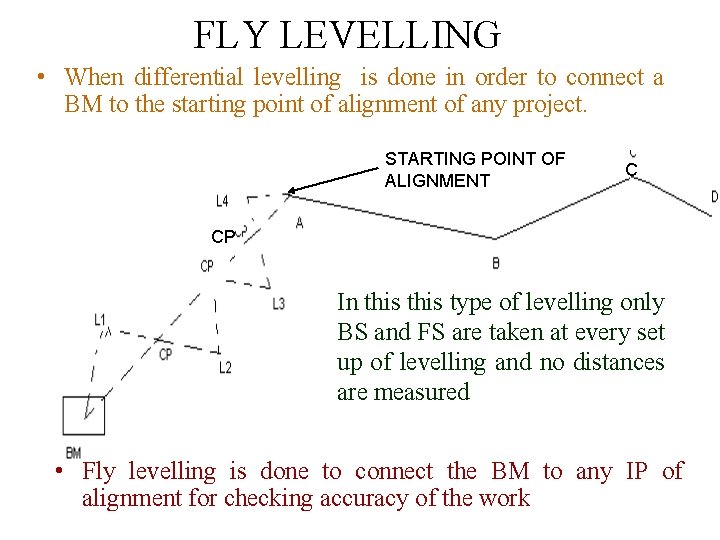
FLY LEVELLING • When differential levelling is done in order to connect a BM to the starting point of alignment of any project. STARTING POINT OF ALIGNMENT C CP In this type of levelling only BS and FS are taken at every set up of levelling and no distances are measured • Fly levelling is done to connect the BM to any IP of alignment for checking accuracy of the work
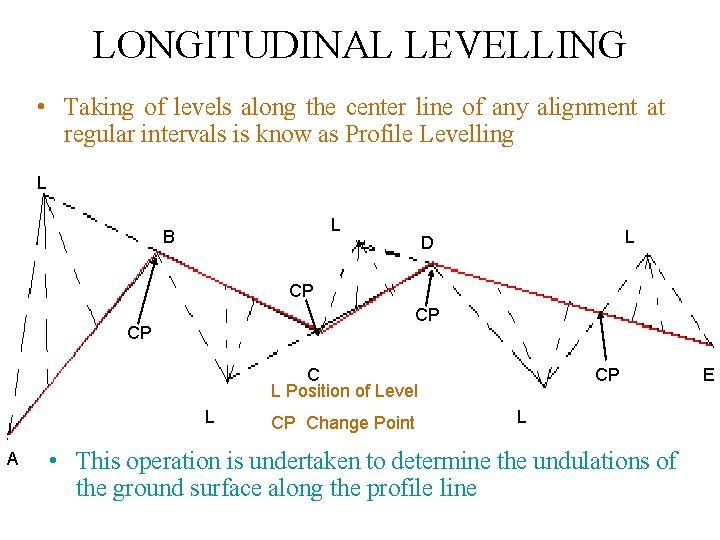
LONGITUDINAL LEVELLING • Taking of levels along the center line of any alignment at regular intervals is know as Profile Levelling L L B L D CP CP CP C L Position of Level L A CP Change Point CP L • This operation is undertaken to determine the undulations of the ground surface along the profile line E
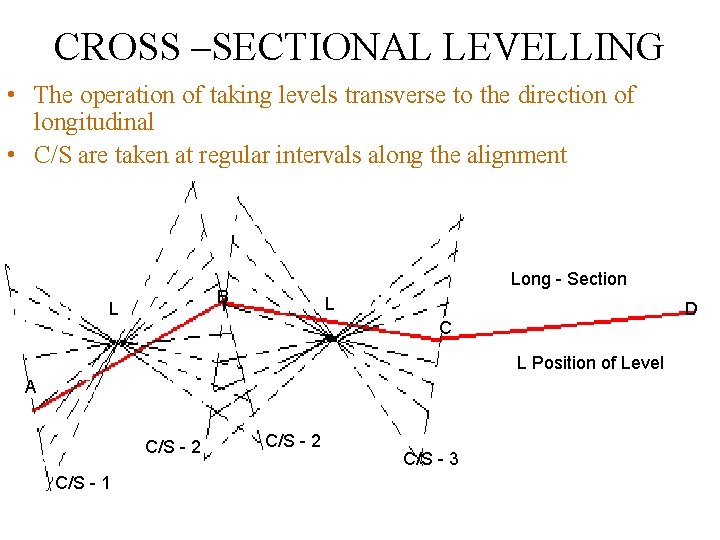
CROSS –SECTIONAL LEVELLING • The operation of taking levels transverse to the direction of longitudinal • C/S are taken at regular intervals along the alignment Long - Section B L L D C L Position of Level A C/S - 2 C/S - 1 C/S - 2 C/S - 3
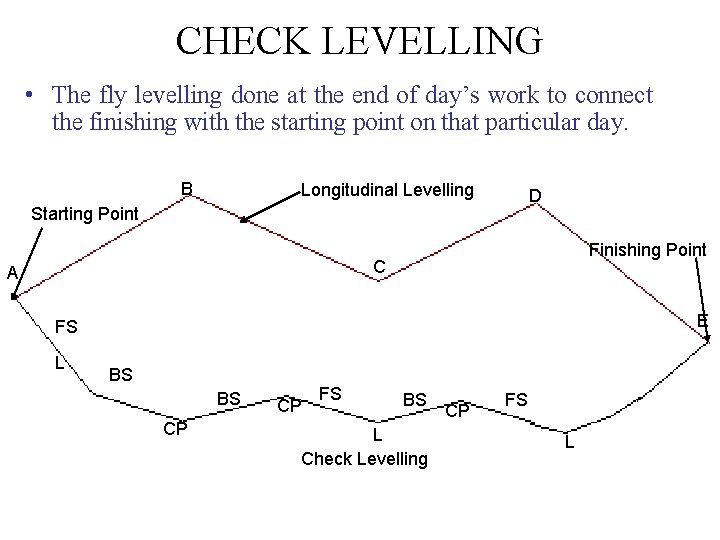
CHECK LEVELLING • The fly levelling done at the end of day’s work to connect the finishing with the starting point on that particular day. B Longitudinal Levelling D Starting Point Finishing Point C A E FS L BS BS CP CP FS BS L Check Levelling CP FS L
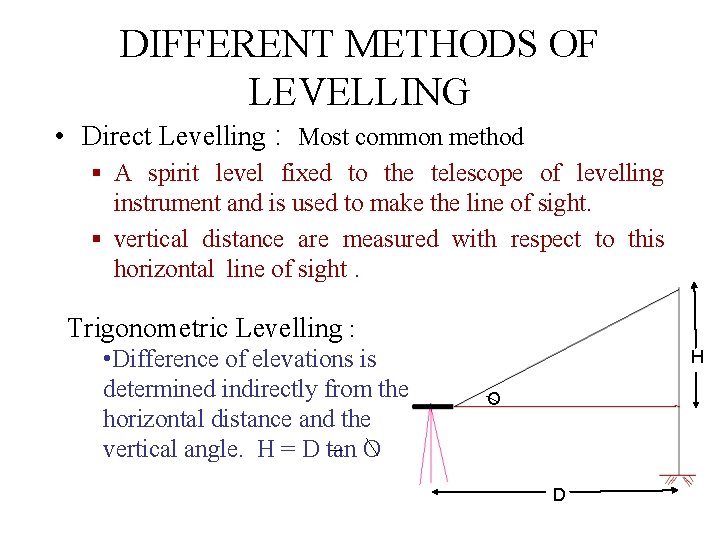
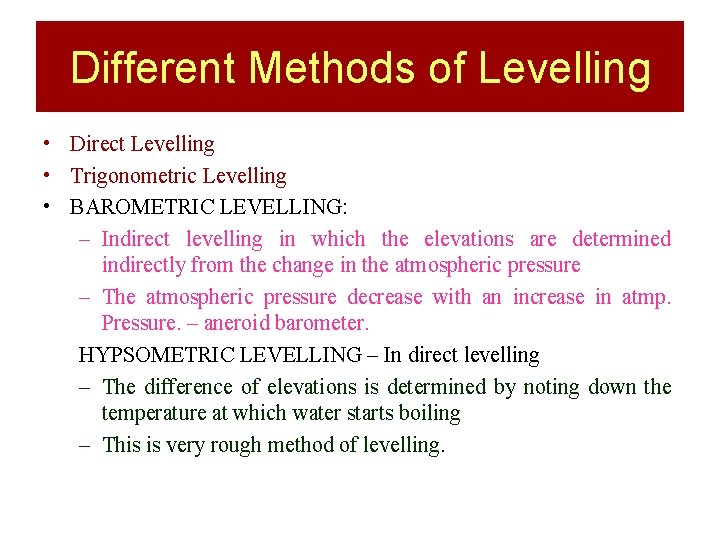
DIFFERENT METHODS OF LEVELLING • Direct Levelling : Most common method § A spirit level fixed to the telescope of levelling instrument and is used to make the line of sight. § vertical distance are measured with respect to this horizontal line of sight. Trigonometric Levelling : • Difference of elevations is determined indirectly from the horizontal distance and the vertical angle. H = D tan O H O D
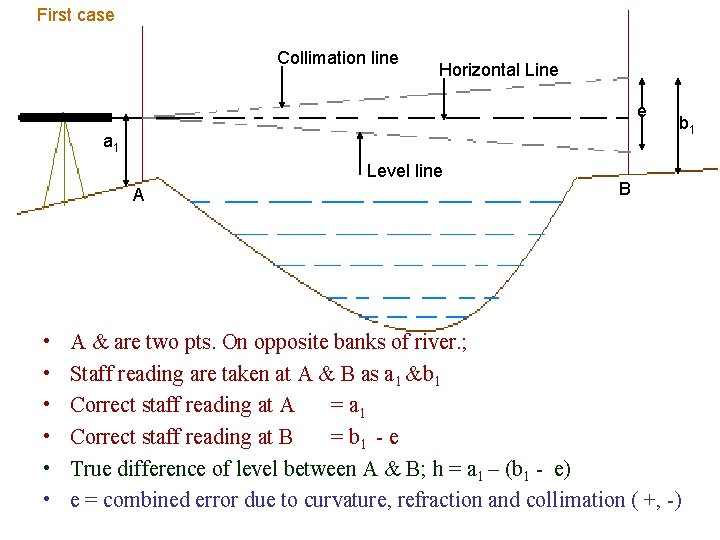
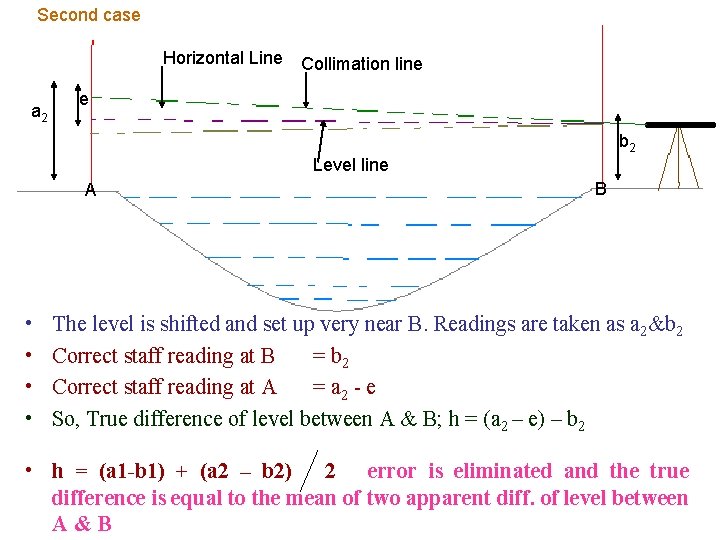
• PRECISE LEVELLING ; • Is a very accurate method of differential levelling used when high precision is required • As the cost of levelling increase rapidly with an increase in accuracy • RECIPROCAL LEVELLING ; • Levelling is used for the determination of difference of elevations of two pts. Which are situated quite apart and is not possible to set up the instrument mid way between pts. • Ex: two pts. Located on the opposite banks of river • First setting up the instrument at one bank and holding the staff at the other bank; interchange the position of staff and the instrument
First case Collimation line Horizontal Line e a 1 Level line A • • • b 1 B A & are two pts. On opposite banks of river. ; Staff reading are taken at A & B as a 1 &b 1 Correct staff reading at A = a 1 Correct staff reading at B = b 1 - e True difference of level between A & B; h = a 1 – (b 1 - e) e = combined error due to curvature, refraction and collimation ( +, -)
Second case Horizontal Line Collimation line a 2 e b 2 Level line A • • B The level is shifted and set up very near B. Readings are taken as a 2&b 2 Correct staff reading at B = b 2 Correct staff reading at A = a 2 - e So, True difference of level between A & B; h = (a 2 – e) – b 2 • h = (a 1 -b 1) + (a 2 – b 2) 2 error is eliminated and the true difference is equal to the mean of two apparent diff. of level between A&B
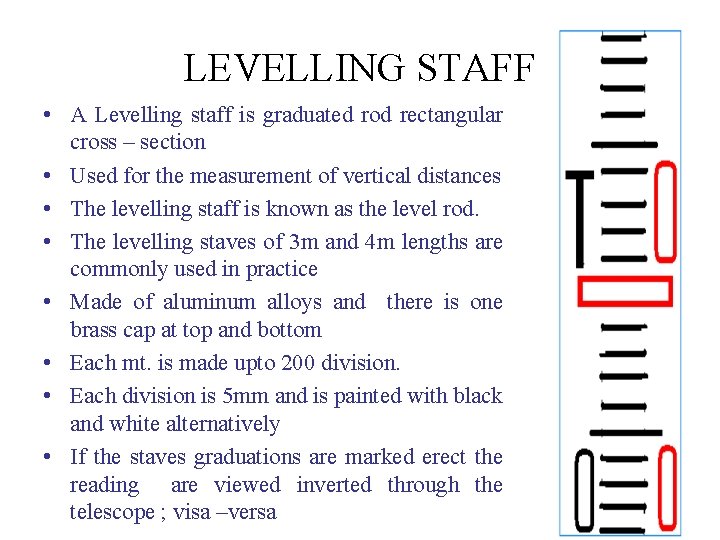
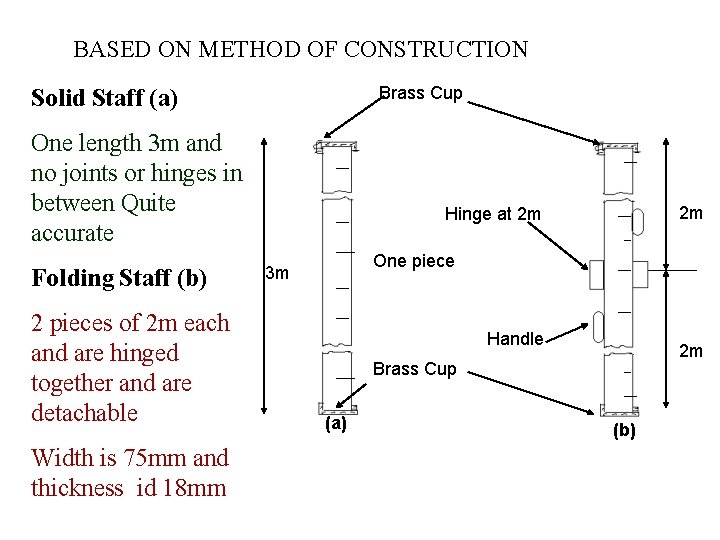
LEVELLING STAFF • A Levelling staff is graduated rod rectangular cross – section • Used for the measurement of vertical distances • The levelling staff is known as the level rod. • The levelling staves of 3 m and 4 m lengths are commonly used in practice • Made of aluminum alloys and there is one brass cap at top and bottom • Each mt. is made upto 200 division. • Each division is 5 mm and is painted with black and white alternatively • If the staves graduations are marked erect the reading are viewed inverted through the telescope ; visa –versa
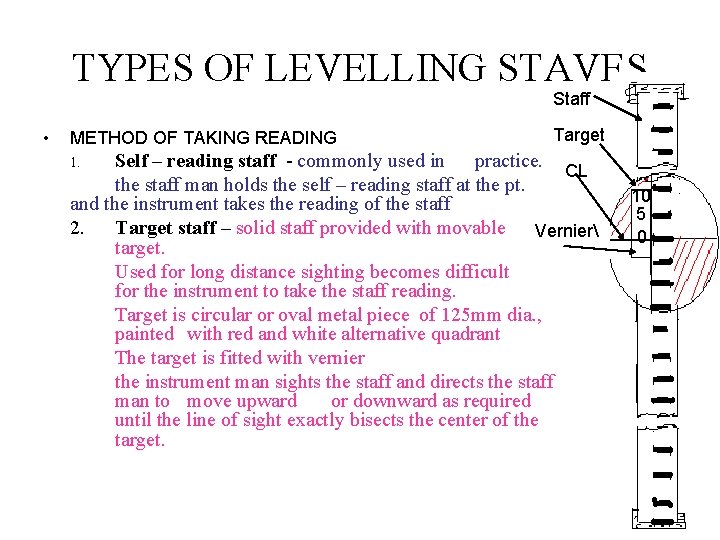
TYPES OF LEVELLING STAVES Staff • METHOD OF TAKING READING Target Self – reading staff - commonly used in practice. CL the staff man holds the self – reading staff at the pt. and the instrument takes the reading of the staff 2. Target staff – solid staff provided with movable Vernier target. Used for long distance sighting becomes difficult for the instrument to take the staff reading. Target is circular or oval metal piece of 125 mm dia. , painted with red and white alternative quadrant The target is fitted with vernier the instrument man sights the staff and directs the staff man to move upward or downward as required until the line of sight exactly bisects the center of the target. 1. 10 5 0
BASED ON METHOD OF CONSTRUCTION Brass Cup Solid Staff (a) One length 3 m and no joints or hinges in between Quite accurate Folding Staff (b) 2 pieces of 2 m each and are hinged together and are detachable Width is 75 mm and thickness id 18 mm 2 m Hinge at 2 m One piece 3 m Handle 2 m Brass Cup (a) (b)
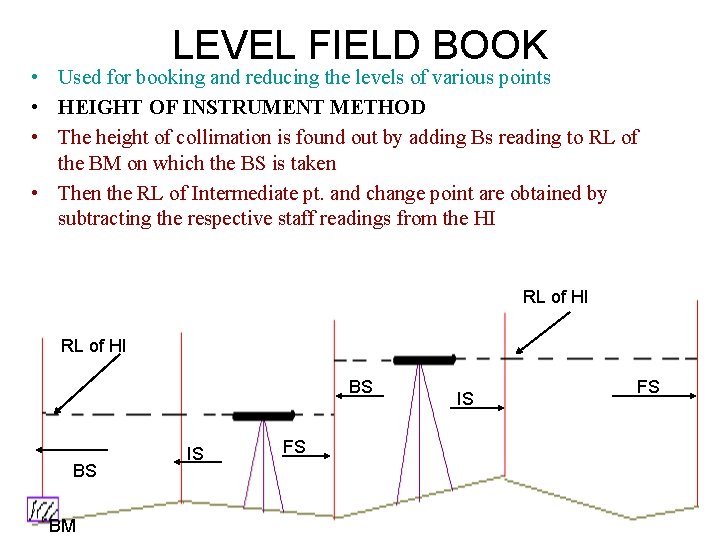
LEVEL FIELD BOOK • Used for booking and reducing the levels of various points • HEIGHT OF INSTRUMENT METHOD • The height of collimation is found out by adding Bs reading to RL of the BM on which the BS is taken • Then the RL of Intermediate pt. and change point are obtained by subtracting the respective staff readings from the HI RL of HI BS BS BM IS FS
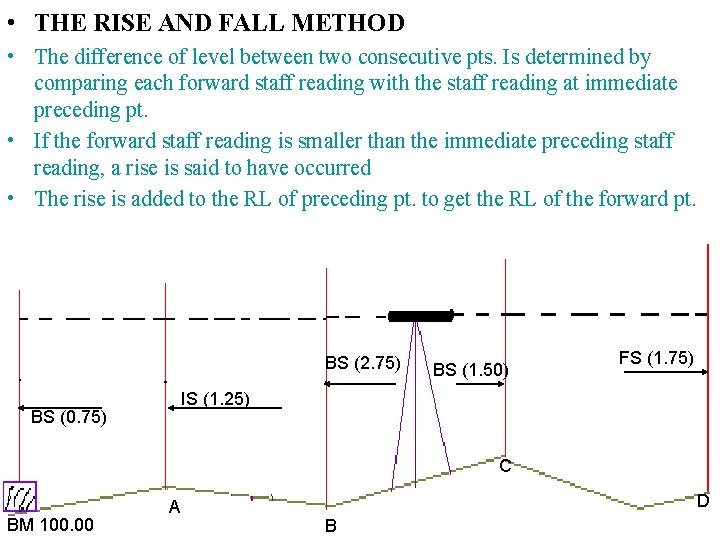
• THE RISE AND FALL METHOD • The difference of level between two consecutive pts. Is determined by comparing each forward staff reading with the staff reading at immediate preceding pt. • If the forward staff reading is smaller than the immediate preceding staff reading, a rise is said to have occurred • The rise is added to the RL of preceding pt. to get the RL of the forward pt. BS (2. 75) BS (1. 50) FS (1. 75) IS (1. 25) BS (0. 75) C BM 100. 00 A D B
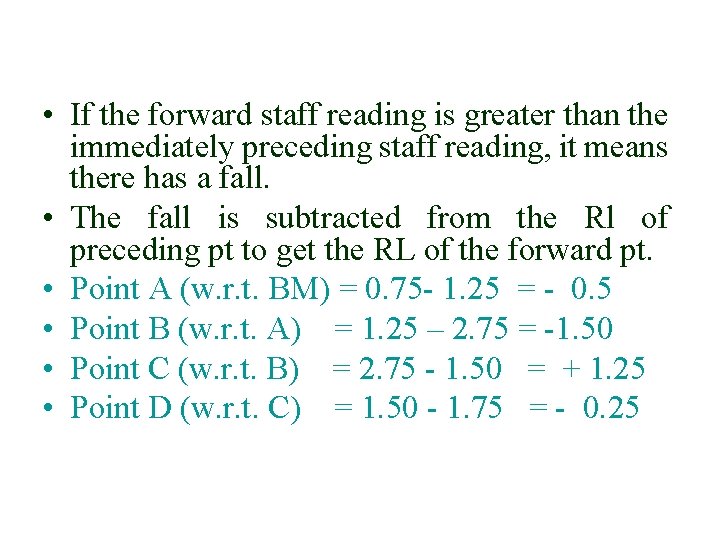
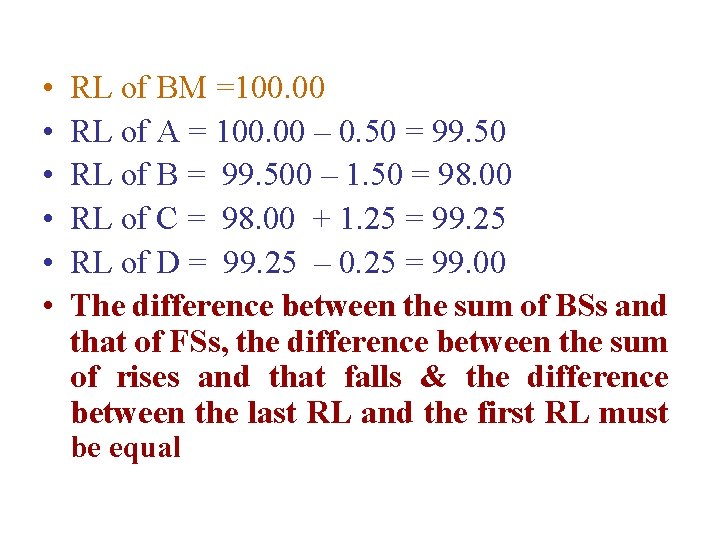
• If the forward staff reading is greater than the immediately preceding staff reading, it means there has a fall. • The fall is subtracted from the Rl of preceding pt to get the RL of the forward pt. • Point A (w. r. t. BM) = 0. 75 - 1. 25 = - 0. 5 • Point B (w. r. t. A) = 1. 25 – 2. 75 = -1. 50 • Point C (w. r. t. B) = 2. 75 - 1. 50 = + 1. 25 • Point D (w. r. t. C) = 1. 50 - 1. 75 = - 0. 25
• • • RL of BM =100. 00 RL of A = 100. 00 – 0. 50 = 99. 50 RL of B = 99. 500 – 1. 50 = 98. 00 RL of C = 98. 00 + 1. 25 = 99. 25 RL of D = 99. 25 – 0. 25 = 99. 00 The difference between the sum of BSs and that of FSs, the difference between the sum of rises and that falls & the difference between the last RL and the first RL must be equal
Different Methods of Levelling • Direct Levelling • Trigonometric Levelling • BAROMETRIC LEVELLING: – Indirect levelling in which the elevations are determined indirectly from the change in the atmospheric pressure – The atmospheric pressure decrease with an increase in atmp. Pressure. – aneroid barometer. HYPSOMETRIC LEVELLING – In direct levelling – The difference of elevations is determined by noting down the temperature at which water starts boiling – This is very rough method of levelling.
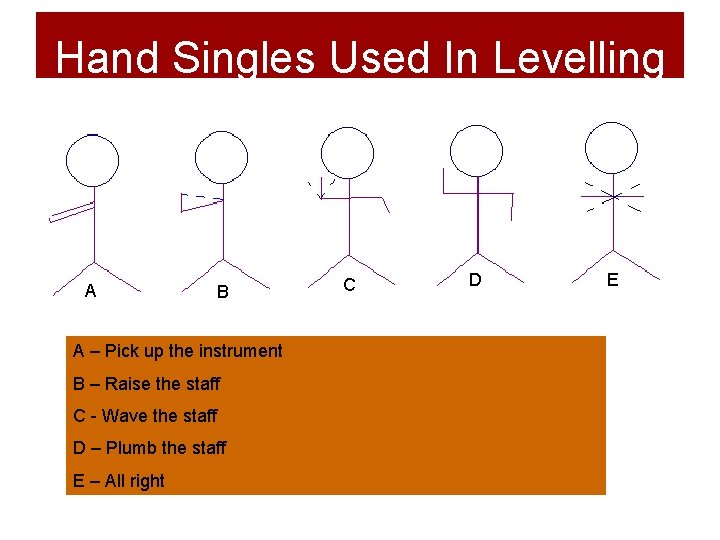
Hand Singles Used In Levelling A B A – Pick up the instrument B – Raise the staff C - Wave the staff D – Plumb the staff E – All right C D E
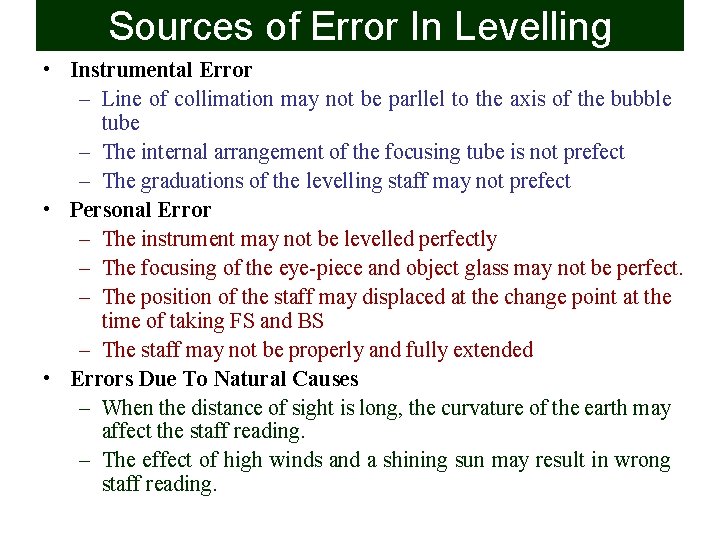
Sources of Error In Levelling • Instrumental Error – Line of collimation may not be parllel to the axis of the bubble tube – The internal arrangement of the focusing tube is not prefect – The graduations of the levelling staff may not prefect • Personal Error – The instrument may not be levelled perfectly – The focusing of the eye-piece and object glass may not be perfect. – The position of the staff may displaced at the change point at the time of taking FS and BS – The staff may not be properly and fully extended • Errors Due To Natural Causes – When the distance of sight is long, the curvature of the earth may affect the staff reading. – The effect of high winds and a shining sun may result in wrong staff reading.
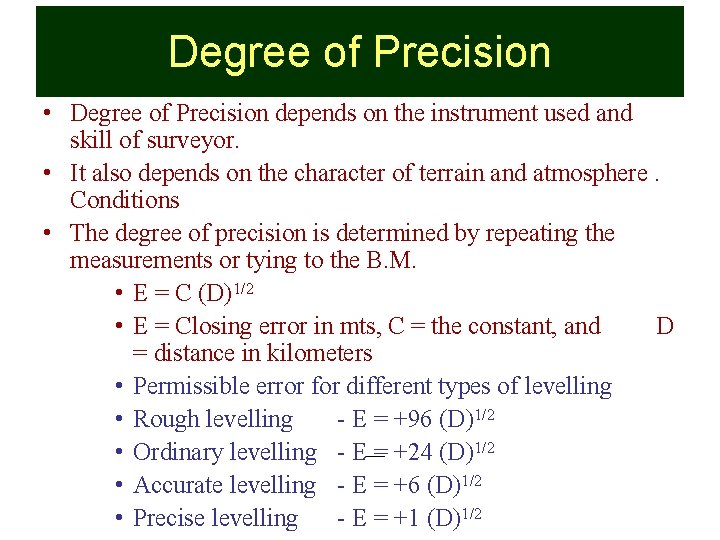
Degree of Precision • Degree of Precision depends on the instrument used and skill of surveyor. • It also depends on the character of terrain and atmosphere. Conditions • The degree of precision is determined by repeating the measurements or tying to the B. M. • E = C (D)1/2 • E = Closing error in mts, C = the constant, and D = distance in kilometers • Permissible error for different types of levelling • Rough levelling - E = +96 (D)1/2 • Ordinary levelling - E = +24 (D)1/2 • Accurate levelling - E = +6 (D)1/2 • Precise levelling - E = +1 (D)1/2
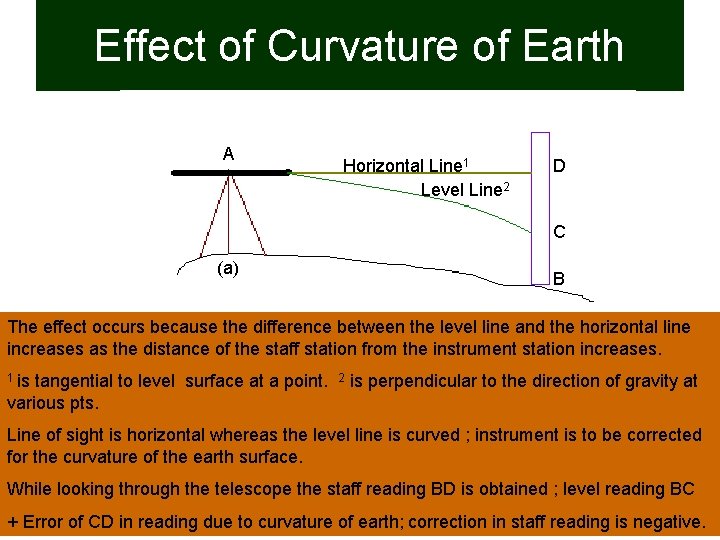
Effect of Curvature of Earth A Horizontal Line 1 Level Line 2 D C (a) B The effect occurs because the difference between the level line and the horizontal line increases as the distance of the staff station from the instrument station increases. 1 is tangential to level surface at a point. various pts. 2 is perpendicular to the direction of gravity at Line of sight is horizontal whereas the level line is curved ; instrument is to be corrected for the curvature of the earth surface. While looking through the telescope the staff reading BD is obtained ; level reading BC + Error of CD in reading due to curvature of earth; correction in staff reading is negative.
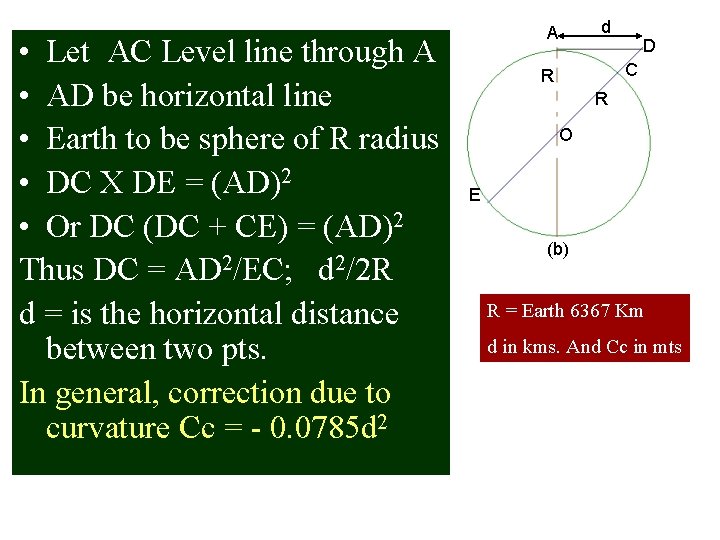
• Let AC Level line through A • AD be horizontal line • Earth to be sphere of R radius • DC X DE = (AD)2 • Or DC (DC + CE) = (AD)2 Thus DC = AD 2/EC; d 2/2 R d = is the horizontal distance between two pts. In general, correction due to curvature Cc = - 0. 0785 d 2 d A D C R R O E (b) R = Earth 6367 Km d in kms. And Cc in mts
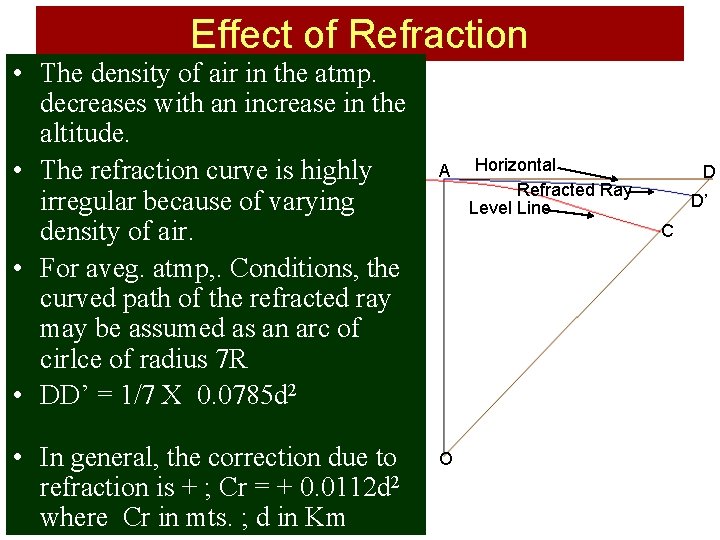
Effect of Refraction • The density of air in the atmp. decreases with an increase in the altitude. • The refraction curve is highly irregular because of varying density of air. • For aveg. atmp, . Conditions, the curved path of the refracted ray may be assumed as an arc of cirlce of radius 7 R • DD’ = 1/7 X 0. 0785 d 2 • In general, the correction due to refraction is + ; Cr = + 0. 0112 d 2 where Cr in mts. ; d in Km A Horizontal Refracted Ray Level Line D D’ C O
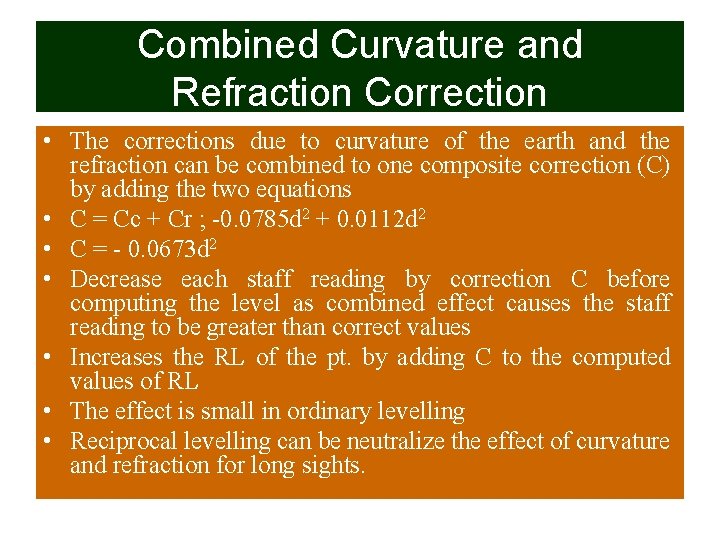
Combined Curvature and Refraction Correction • The corrections due to curvature of the earth and the refraction can be combined to one composite correction (C) by adding the two equations • C = Cc + Cr ; -0. 0785 d 2 + 0. 0112 d 2 • C = - 0. 0673 d 2 • Decrease each staff reading by correction C before computing the level as combined effect causes the staff reading to be greater than correct values • Increases the RL of the pt. by adding C to the computed values of RL • The effect is small in ordinary levelling • Reciprocal levelling can be neutralize the effect of curvature and refraction for long sights.