
Different Social Groups in Society Mr Anthony Borg
Different Social Groups in Society © Mr. Anthony Borg
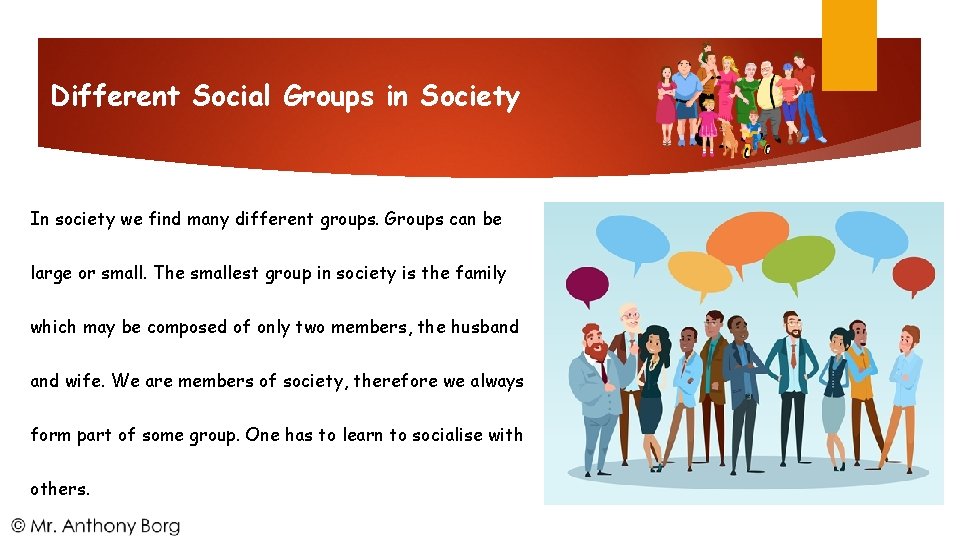
Different Social Groups in Society In society we find many different groups. Groups can be large or small. The smallest group in society is the family which may be composed of only two members, the husband wife. We are members of society, therefore we always form part of some group. One has to learn to socialise with others.
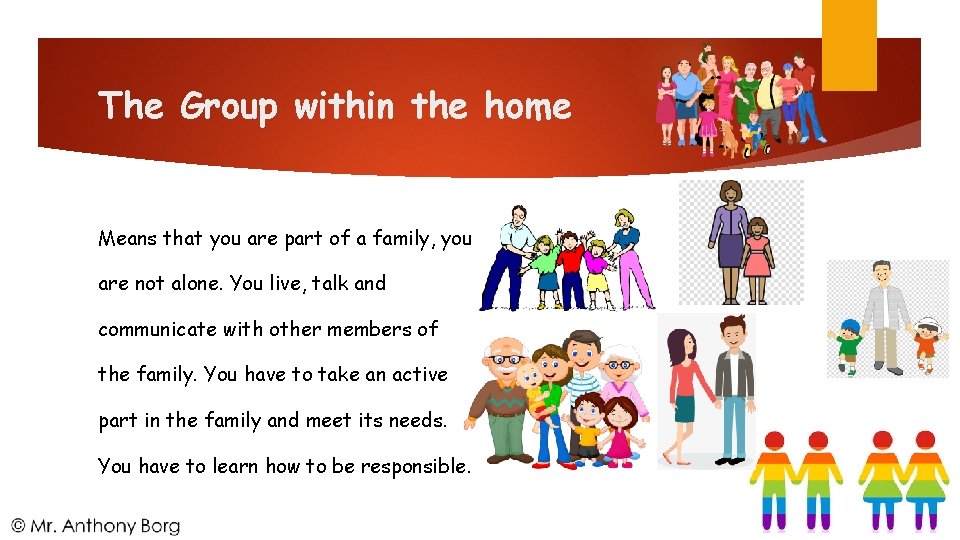
The Group within the home Means that you are part of a family, you are not alone. You live, talk and communicate with other members of the family. You have to take an active part in the family and meet its needs. You have to learn how to be responsible.
What exactly is The Gang? The Gang is a group of persons, these types of groups are generally small. There is a tendency for the Gang to expect support from its members which sometimes could lead to some form of abuse. We may find Gangs in schools where there is a lot of BULLYING, where the victim is provoked.
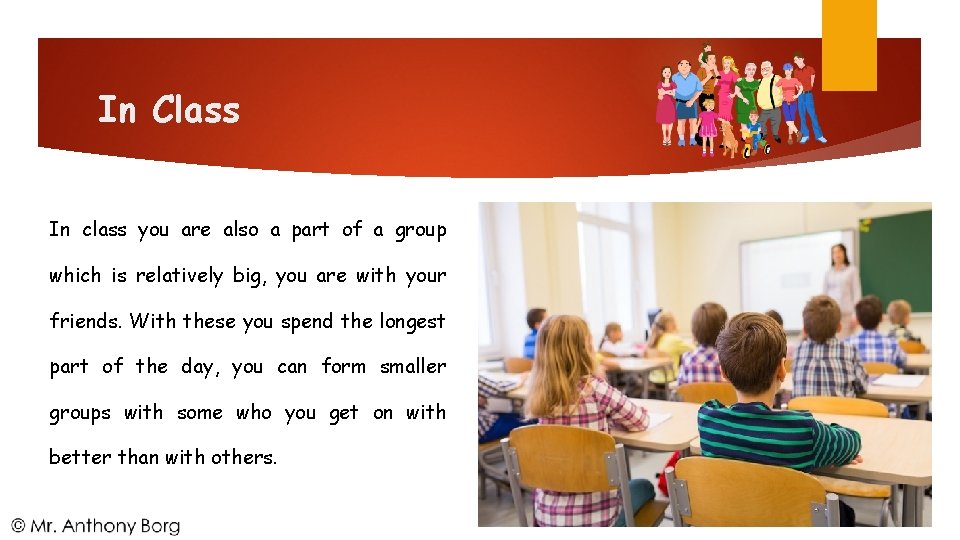
In Class In class you are also a part of a group which is relatively big, you are with your friends. With these you spend the longest part of the day, you can form smaller groups with some who you get on with better than with others.
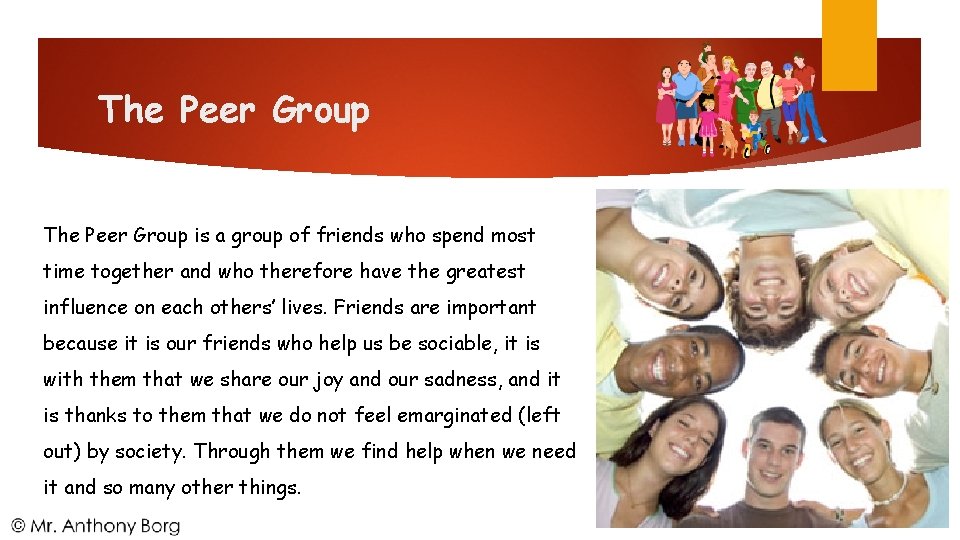
The Peer Group is a group of friends who spend most time together and who therefore have the greatest influence on each others’ lives. Friends are important because it is our friends who help us be sociable, it is with them that we share our joy and our sadness, and it is thanks to them that we do not feel emarginated (left out) by society. Through them we find help when we need it and so many other things.
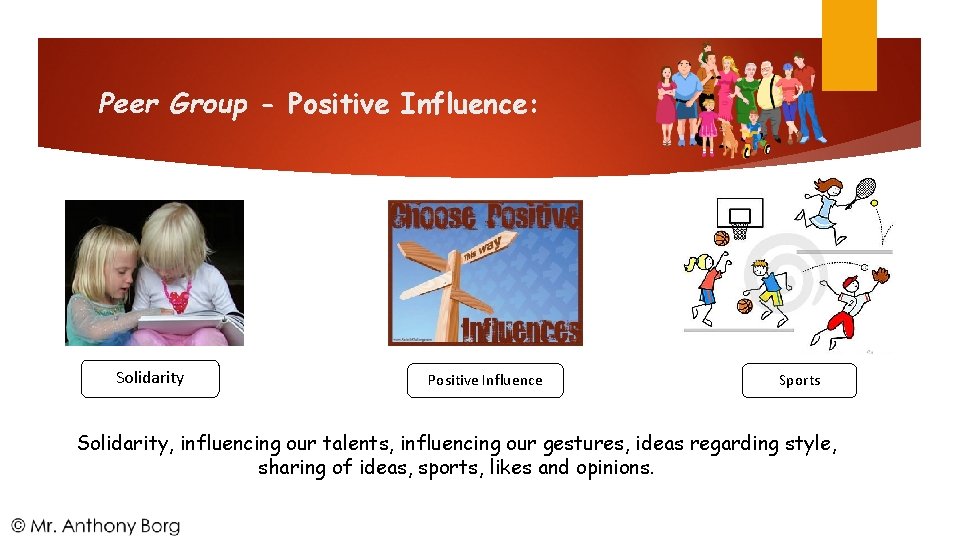
Peer Group - Positive Influence: Solidarity Positive Influence Sports Solidarity, influencing our talents, influencing our gestures, ideas regarding style, sharing of ideas, sports, likes and opinions.
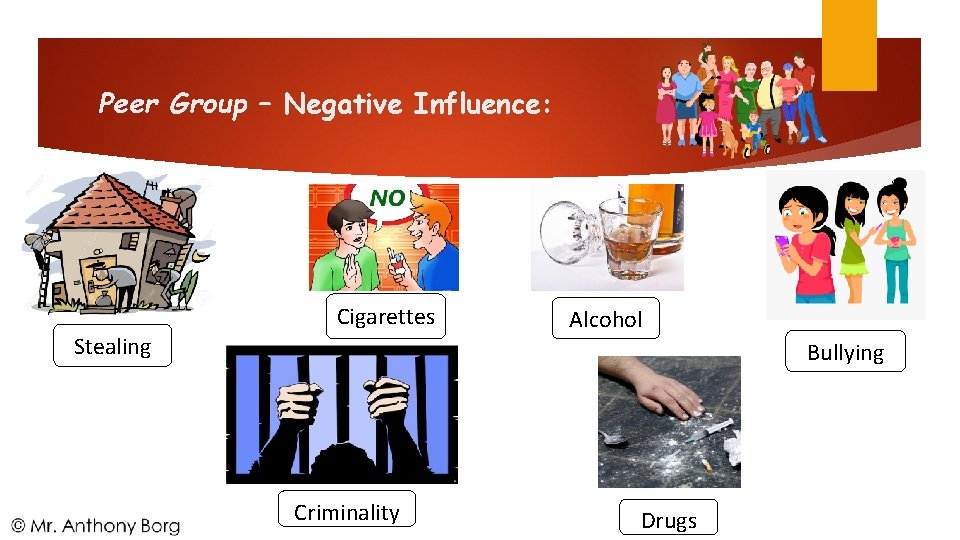
Peer Group – Negative Influence: Cigarettes Stealing Alcohol Bullying Criminality Drugs
Peer Pressure Humans are not created to live alone but we all need one another. We need others to develop our personality through sharing of ideas, thoughts and our talents with others. But we need to be very careful in our choice of friends. We should choose friends who have good characteristics: honesty, respect, helpfulness, those who give others a chance and show tolerance. Friends who have a strong character and who know how to say no when faced with dangerous situations as for example: vandalism, drugs and stealing. We must avoid friends with negative characteristics like: egoism, bad habits such as smoking, boasting, dishonesty, arrogance and stubborness.
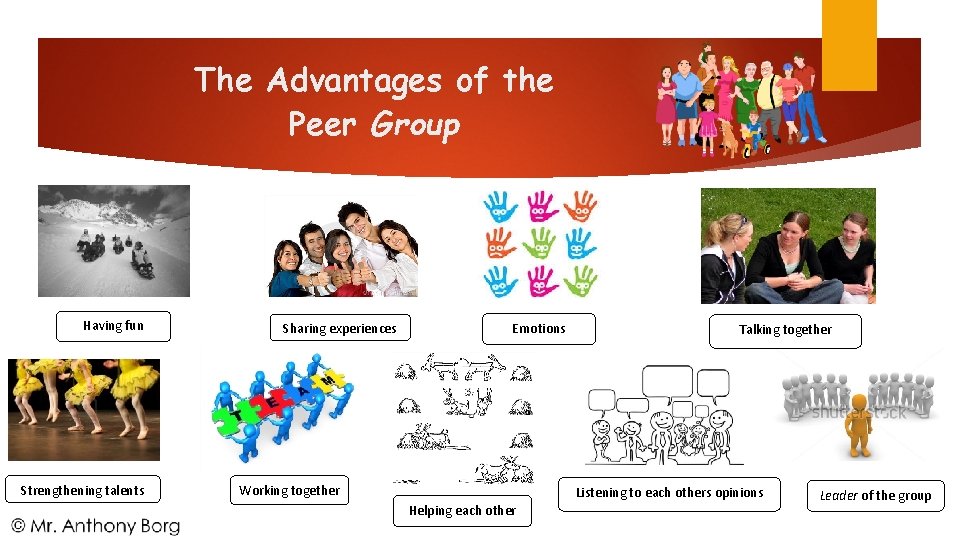
The Advantages of the Peer Group Having fun Strengthening talents Sharing experiences Emotions Working together Talking together Listening to each others opinions Helping each other Leader of the group
In the Peer Group there could be lack of agreement and this could be due to: Egoism Jealousy A lack of tolerance to different opinions Personal Interests Bullying through name calling, gossiping about others Not willing to compromise – which means that no one is willing to give in or admit a mistake or take part of the blame for a mistake. This gives rise to pride and a lack of agreement.
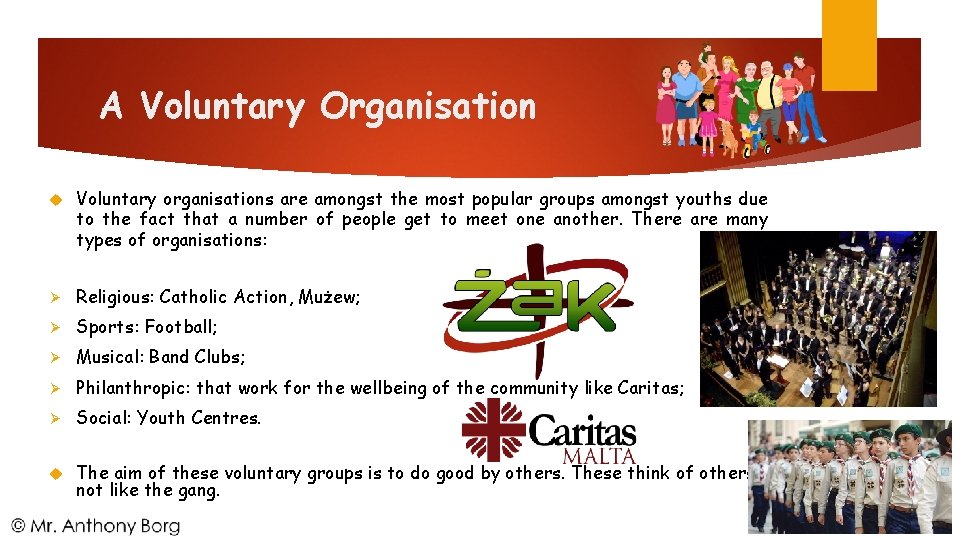
A Voluntary Organisation Voluntary organisations are amongst the most popular groups amongst youths due to the fact that a number of people get to meet one another. There are many types of organisations: Religious: Catholic Action, Mużew; Sports: Football; Musical: Band Clubs; Philanthropic: that work for the wellbeing of the community like Caritas; Social: Youth Centres. The aim of these voluntary groups is to do good by others. These think of others not like the gang.
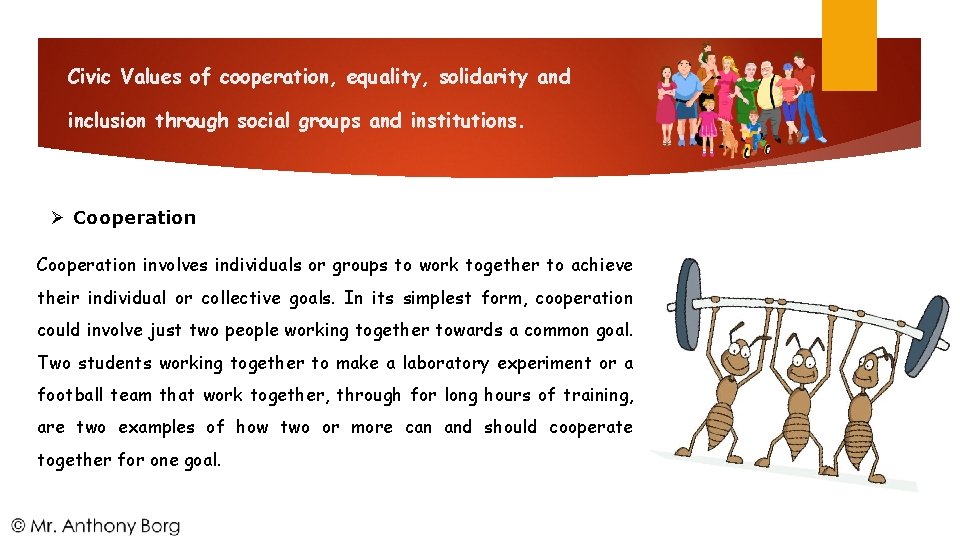
Civic Values of cooperation, equality, solidarity and inclusion through social groups and institutions. Cooperation involves individuals or groups to work together to achieve their individual or collective goals. In its simplest form, cooperation could involve just two people working together towards a common goal. Two students working together to make a laboratory experiment or a football team that work together, through for long hours of training, are two examples of how two or more can and should cooperate together for one goal.
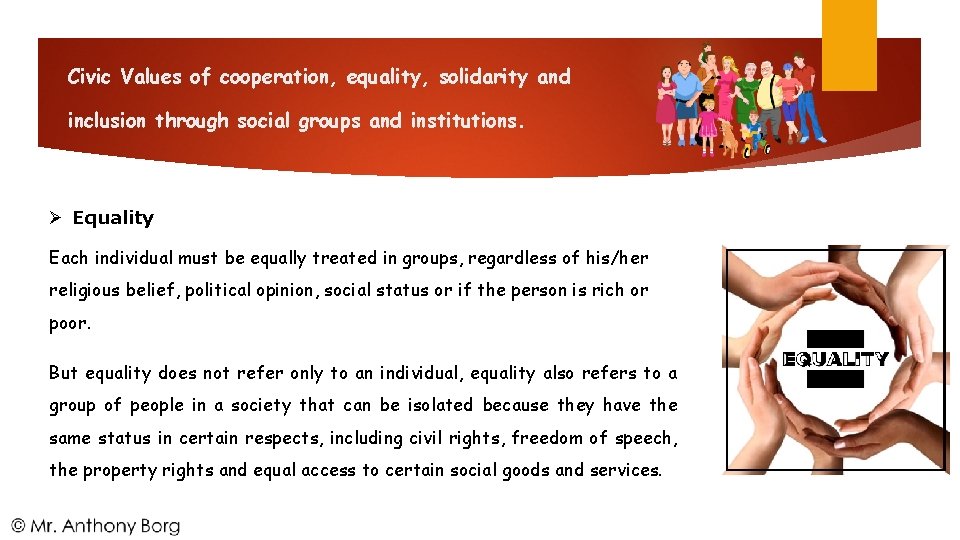
Civic Values of cooperation, equality, solidarity and inclusion through social groups and institutions. Equality Each individual must be equally treated in groups, regardless of his/her religious belief, political opinion, social status or if the person is rich or poor. But equality does not refer only to an individual, equality also refers to a group of people in a society that can be isolated because they have the same status in certain respects, including civil rights, freedom of speech, the property rights and equal access to certain social goods and services.
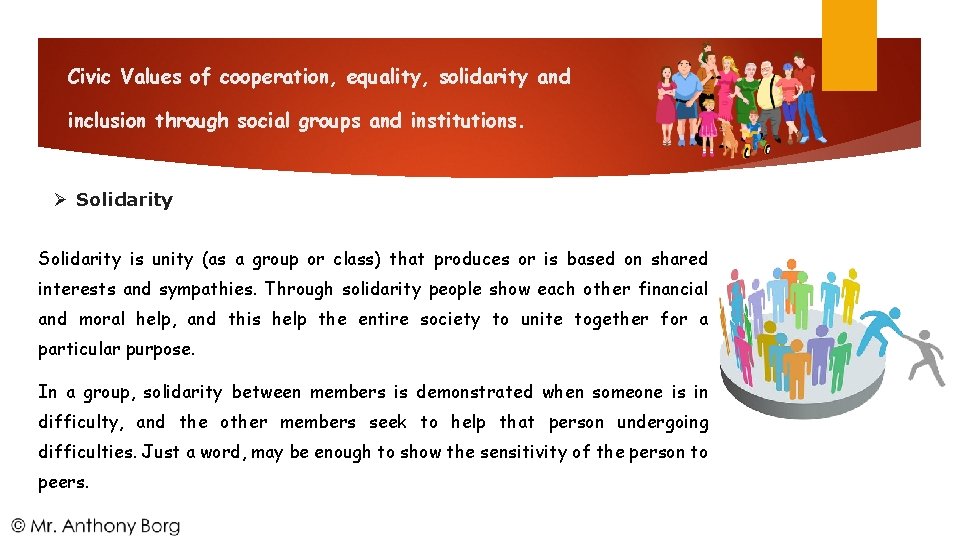
Civic Values of cooperation, equality, solidarity and inclusion through social groups and institutions. Solidarity is unity (as a group or class) that produces or is based on shared interests and sympathies. Through solidarity people show each other financial and moral help, and this help the entire society to unite together for a particular purpose. In a group, solidarity between members is demonstrated when someone is in difficulty, and the other members seek to help that person undergoing difficulties. Just a word, may be enough to show the sensitivity of the person to peers.
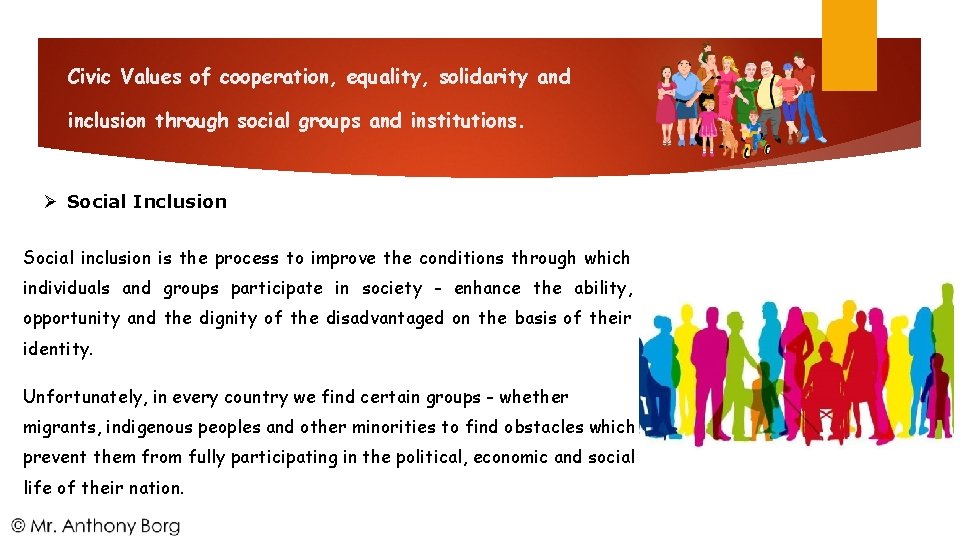
Civic Values of cooperation, equality, solidarity and inclusion through social groups and institutions. Social Inclusion Social inclusion is the process to improve the conditions through which individuals and groups participate in society - enhance the ability, opportunity and the dignity of the disadvantaged on the basis of their identity. Unfortunately, in every country we find certain groups - whether migrants, indigenous peoples and other minorities to find obstacles which prevent them from fully participating in the political, economic and social life of their nation.
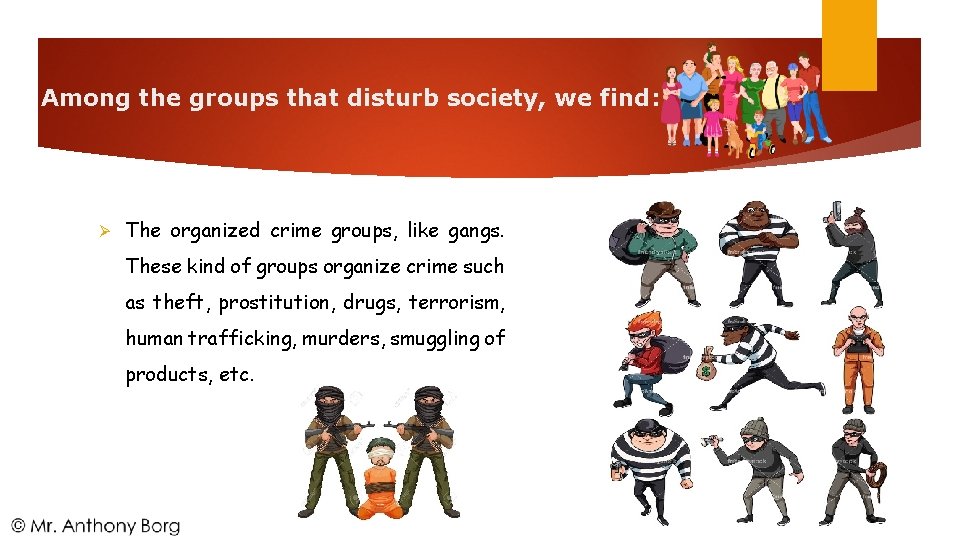
Among the groups that disturb society, we find: The organized crime groups, like gangs. These kind of groups organize crime such as theft, prostitution, drugs, terrorism, human trafficking, murders, smuggling of products, etc.
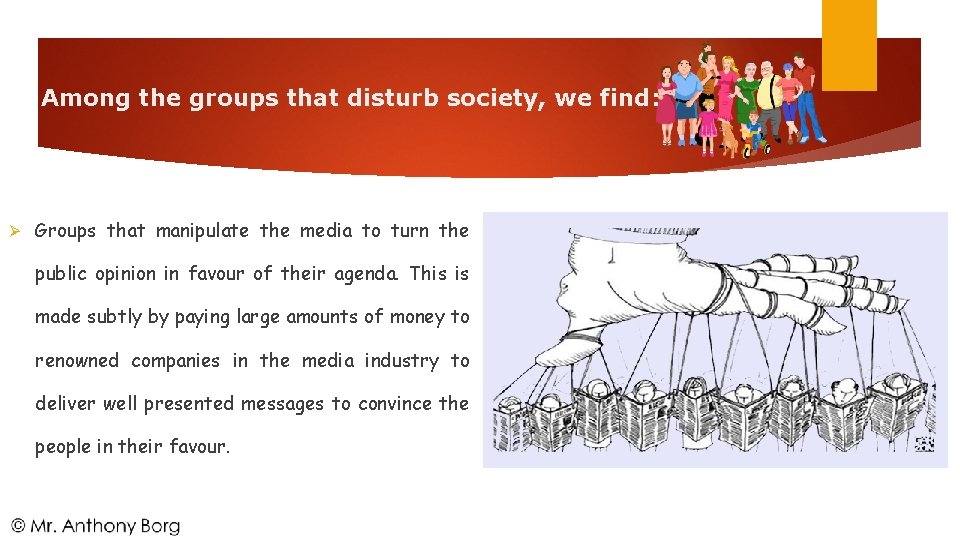
Among the groups that disturb society, we find: Groups that manipulate the media to turn the public opinion in favour of their agenda. This is made subtly by paying large amounts of money to renowned companies in the media industry to deliver well presented messages to convince the people in their favour.
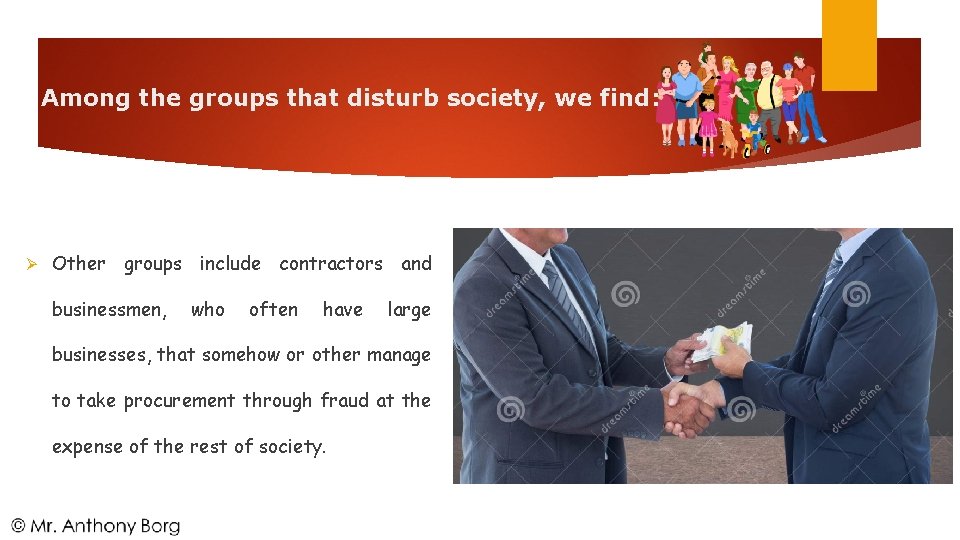
Among the groups that disturb society, we find: Other groups include contractors and businessmen, who often have large businesses, that somehow or other manage to take procurement through fraud at the expense of the rest of society.
- Slides: 19