
DIFFERENT OPTIONS FOR DECENTRALIZED WASTE MANAGEMENT Suchitwa Mission




- Slides: 51
DIFFERENT OPTIONS FOR DECENTRALIZED WASTE MANAGEMENT Suchitwa Mission Local Self Government Department Government of Kerala 1
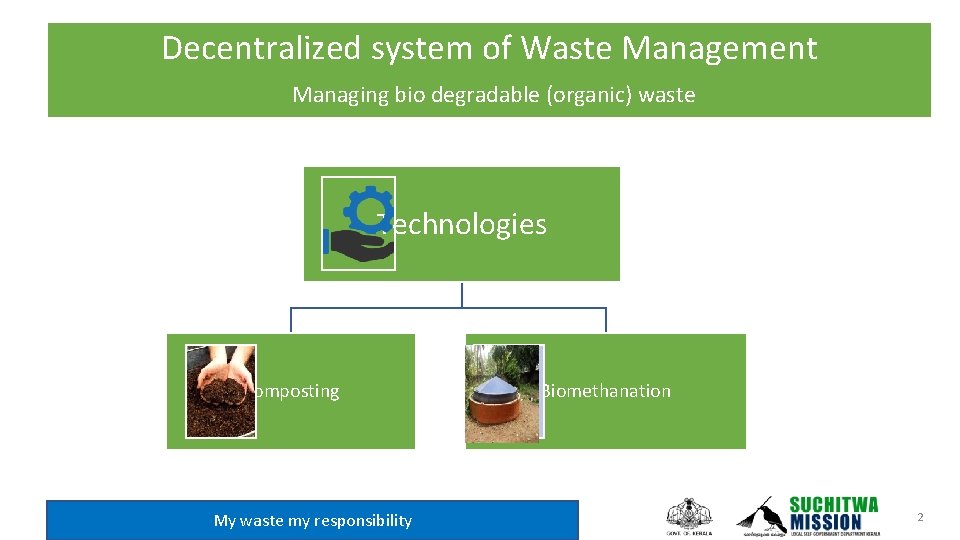
Decentralized system of Waste Management Managing bio degradable (organic) waste Technologies Composting My waste my responsibility Biomethanation 2
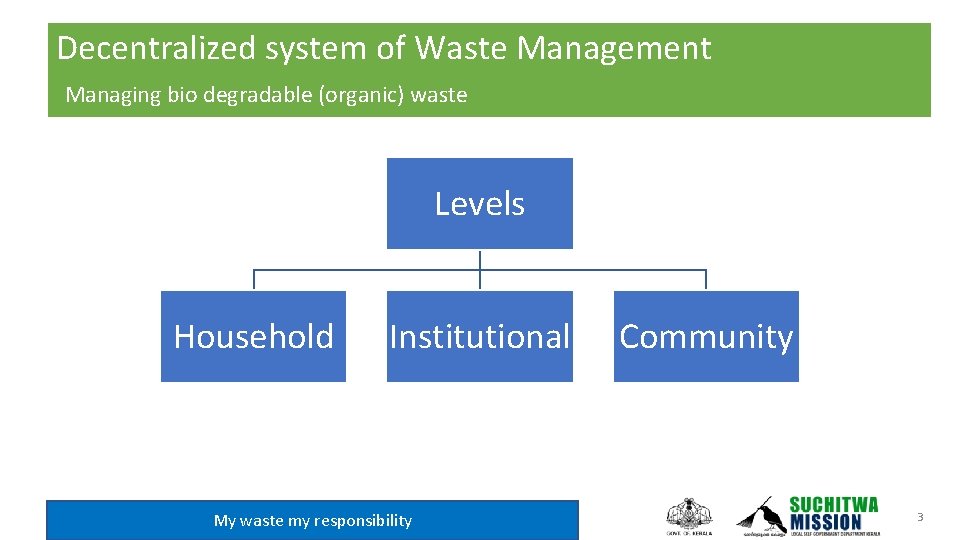
Decentralized system of Waste Management Managing bio degradable (organic) waste Levels Household Institutional My waste my responsibility Community 3
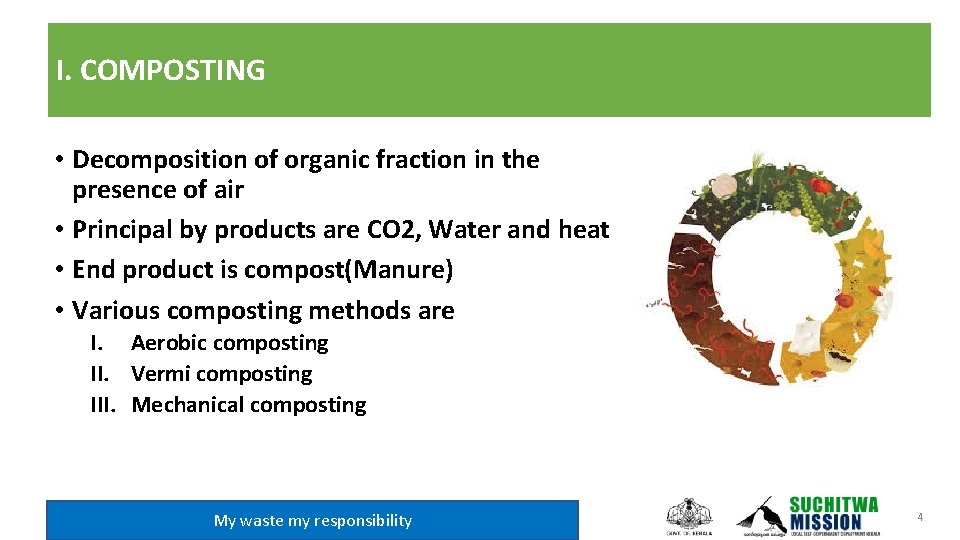
I. COMPOSTING • Decomposition of organic fraction in the presence of air • Principal by products are CO 2, Water and heat • End product is compost(Manure) • Various composting methods are I. Aerobic composting II. Vermi composting III. Mechanical composting My waste my responsibility 4
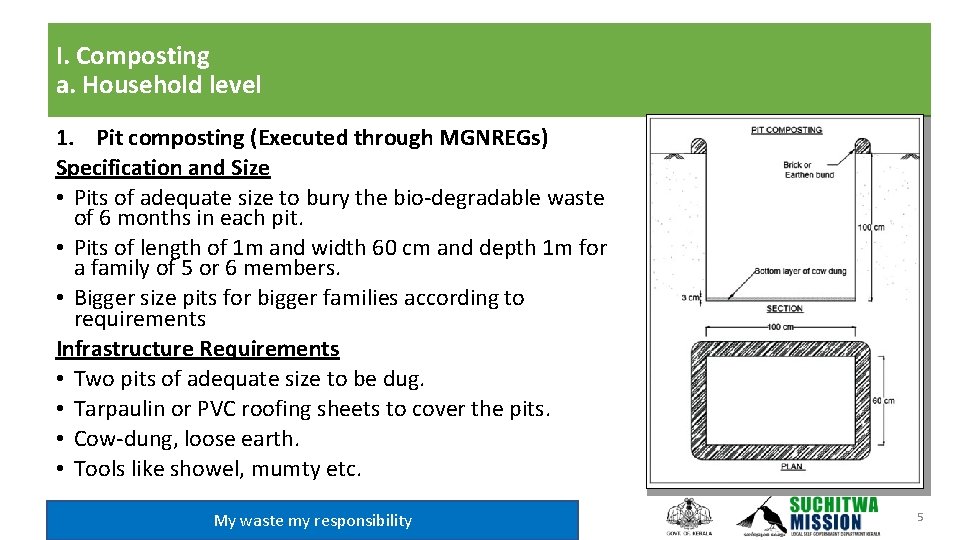
I. Composting a. Household level 1. Pit composting (Executed through MGNREGs) Specification and Size • Pits of adequate size to bury the bio-degradable waste of 6 months in each pit. • Pits of length of 1 m and width 60 cm and depth 1 m for a family of 5 or 6 members. • Bigger size pits for bigger families according to requirements Infrastructure Requirements • Two pits of adequate size to be dug. • Tarpaulin or PVC roofing sheets to cover the pits. • Cow-dung, loose earth. • Tools like showel, mumty etc. My waste my responsibility 5
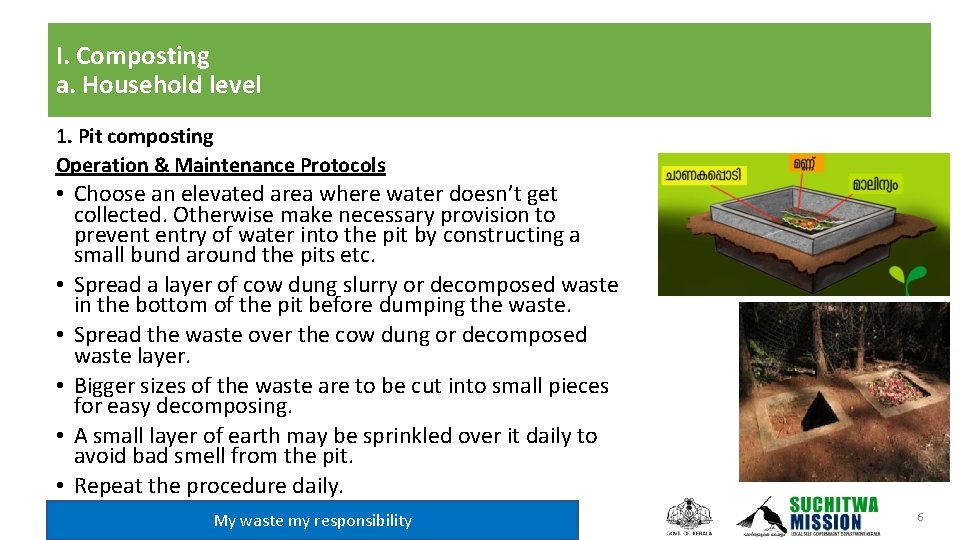
I. Composting a. Household level 1. Pit composting Operation & Maintenance Protocols • Choose an elevated area where water doesn’t get collected. Otherwise make necessary provision to prevent entry of water into the pit by constructing a small bund around the pits etc. • Spread a layer of cow dung slurry or decomposed waste in the bottom of the pit before dumping the waste. • Spread the waste over the cow dung or decomposed waste layer. • Bigger sizes of the waste are to be cut into small pieces for easy decomposing. • A small layer of earth may be sprinkled over it daily to avoid bad smell from the pit. • Repeat the procedure daily. My waste my responsibility 6
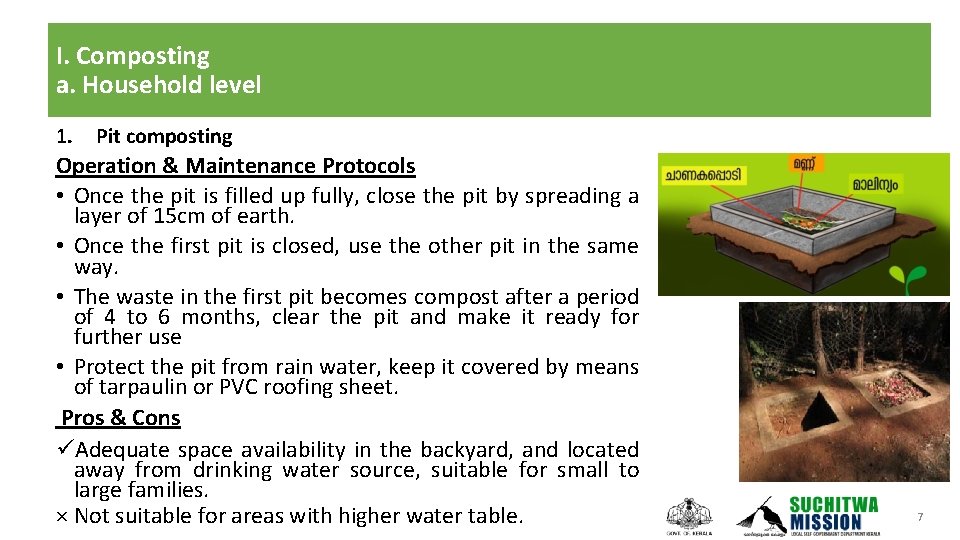
I. Composting a. Household level 1. Pit composting Operation & Maintenance Protocols • Once the pit is filled up fully, close the pit by spreading a layer of 15 cm of earth. • Once the first pit is closed, use the other pit in the same way. • The waste in the first pit becomes compost after a period of 4 to 6 months, clear the pit and make it ready for further use • Protect the pit from rain water, keep it covered by means of tarpaulin or PVC roofing sheet. Pros & Cons üAdequate space availability in the backyard, and located away from drinking water source, suitable for small to large families. × Not suitable for areas with higher water table. 7
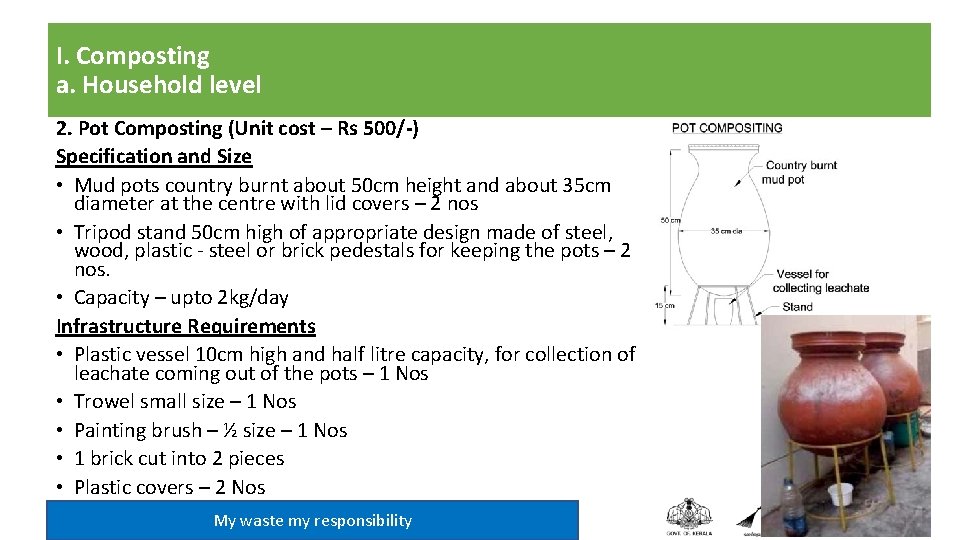
I. Composting a. Household level 2. Pot Composting (Unit cost – Rs 500/-) Specification and Size • Mud pots country burnt about 50 cm height and about 35 cm diameter at the centre with lid covers – 2 nos • Tripod stand 50 cm high of appropriate design made of steel, wood, plastic - steel or brick pedestals for keeping the pots – 2 nos. • Capacity – upto 2 kg/day Infrastructure Requirements • Plastic vessel 10 cm high and half litre capacity, for collection of leachate coming out of the pots – 1 Nos • Trowel small size – 1 Nos • Painting brush – ½ size – 1 Nos • 1 brick cut into 2 pieces • Plastic covers – 2 Nos My waste my responsibility 8
I. Composting a. Household level 2. Pot Composting Operation & Maintenance Protocols • Make a small hole in the bottom of the pots. • Place the pots with lids on the tripods at a convenient place. • Place the half litre capacity plastic vessel below the first pot. • Start filling the segregated bio waste (do not put slow degrading items and non degradable items into the pots) daily into one pot and keep the pot closed. This type of waste treatment is capable of treating 1 to 2 Kg of waste per day only. • Leachate coming out of the pot gets collected inside the plastic vessel placed below the pot. • Put some salt powder into the plastic vessel to avoid entry of flies into the vessel. The leachate collected can be diluted with water and used as manure in the garden. My waste my responsibility 9
I. Composting a. Household level 2. Pot Composting Operation & Maintenance Protocols • Once the first pot is full start using the second pot • By the time the second pot becomes full the waste in the first pot gets converted into compost. • After first week of commencement, lot of worms will be seen in the pot. Do not try to kill them, they activate the composting process and they die after 3 weeks. • During rainy season spread the plastic sheets over the pots and place the brick pieces over the sheet to protect the pots from rains. • If the quantity of the water inside the pot is more, add some saw dust to absorb the water. • If too much of flies seen around the pot, make a solution of camphor in coconut oil (dissolve 2 tablets in 25 ml of oil) and apply it on the bottom and top cover of the pot, by means of the brush. • Sprinkling diluted rotten curd or cow dung solution etc into the waste will speed up the composting process. My waste my responsibility 10
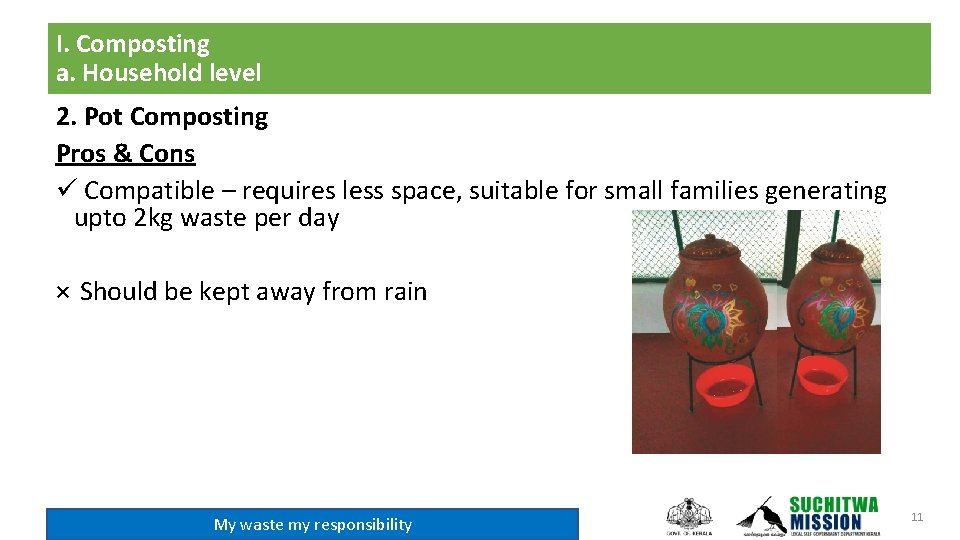
I. Composting a. Household level 2. Pot Composting Pros & Cons ü Compatible – requires less space, suitable for small families generating upto 2 kg waste per day × Should be kept away from rain My waste my responsibility 11
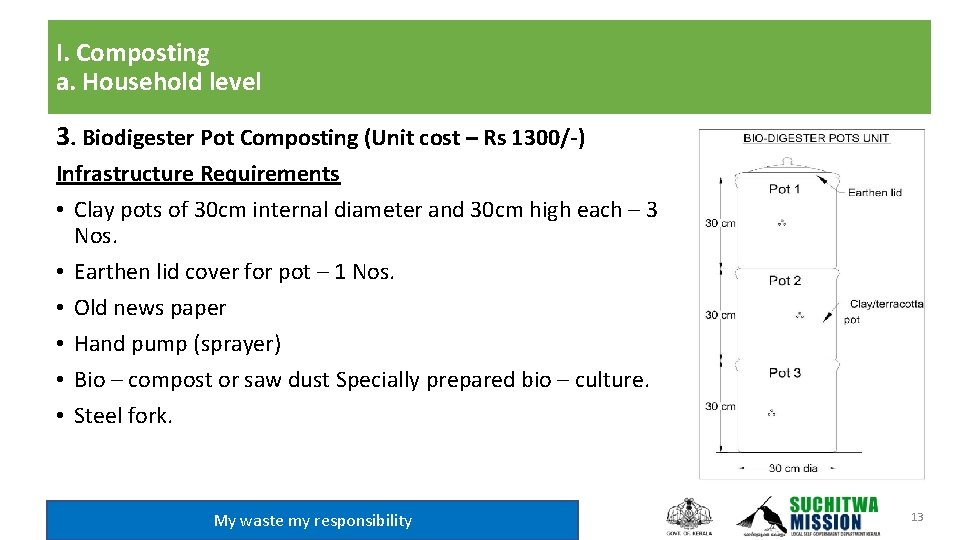
I. Composting a. Household level 3. Biodigester Pot Composting (Unit cost – Rs 1300/-) Specification and Size • The pots are locally moulded with clay/terracotta and oven dried to be kept vertically one above the other and the pot on the top is covered by a lid. • The pot number 1 and 2 are kept at the top and middle position and are open on the top as well as bottom. The bottom open portion is weaved with plastic wires. • Pot number 3 is kept at the bottom and is open at the top and closed at the bottom. • Capacity – upto 2 kg/day (Family of 4 -5 members) My waste my responsibility 12
I. Composting a. Household level 3. Biodigester Pot Composting (Unit cost – Rs 1300/-) Infrastructure Requirements • Clay pots of 30 cm internal diameter and 30 cm high each – 3 Nos. • Earthen lid cover for pot – 1 Nos. • Old news paper • Hand pump (sprayer) • Bio – compost or saw dust Specially prepared bio – culture. • Steel fork. My waste my responsibility 13
I. Composting a. Household level 3. Biodigester Pot Composting (Unit cost – Rs 1300/-) Operation & Maintenance Protocols • Place news paper sheets at the bottom of pot numbers 1 and 2 over the plastic thread to form a bio-platform. • Spread starter material in 1 inch thick layer over the bio-platform (either prepared biocompost or saw dust treated with bio-culture be used as starter material. Mix saw • Dust with diluted bio-culture (bio-culture water ratio 1: 50) and keep it in a sack bag duly tied. After two days, saw dust mixture becomes hot by the activities of the bacteria. This hot mixture can be used as the starter. • Spread the shredded waste over the starter layer • Spray diluted bio-culture mixture over the waste • Before closing the pot with the lid, sprinkle starter mixture over the waste layer. Ensure water used for mixing the bio culture does not contain chlorine. For that keep the tap water in an open vessel for two days. • Keep spreading the waste daily as above • Third day onwards stir/mix the old waste layer by using a fork without tearing the paper at the bottom, before placing the fresh waste on the top. My waste my responsibility 14
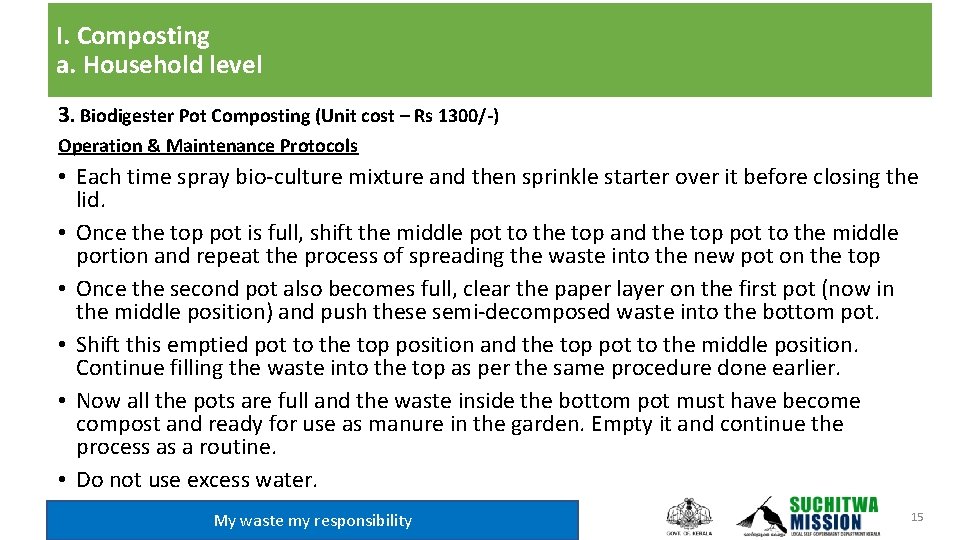
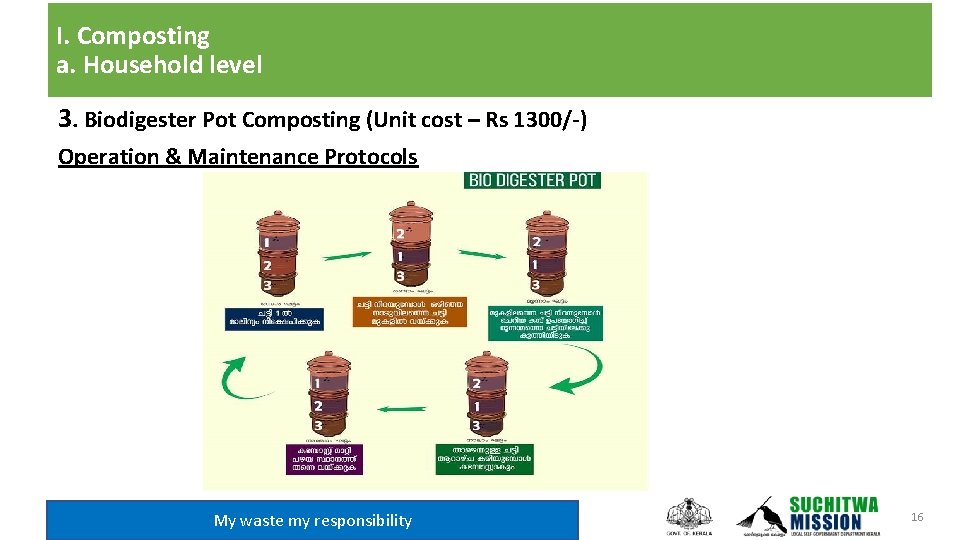
I. Composting a. Household level 3. Biodigester Pot Composting (Unit cost – Rs 1300/-) Operation & Maintenance Protocols • Each time spray bio-culture mixture and then sprinkle starter over it before closing the lid. • Once the top pot is full, shift the middle pot to the top and the top pot to the middle portion and repeat the process of spreading the waste into the new pot on the top • Once the second pot also becomes full, clear the paper layer on the first pot (now in the middle position) and push these semi-decomposed waste into the bottom pot. • Shift this emptied pot to the top position and the top pot to the middle position. Continue filling the waste into the top as per the same procedure done earlier. • Now all the pots are full and the waste inside the bottom pot must have become compost and ready for use as manure in the garden. Empty it and continue the process as a routine. • Do not use excess water. My waste my responsibility 15
I. Composting a. Household level 3. Biodigester Pot Composting (Unit cost – Rs 1300/-) Operation & Maintenance Protocols My waste my responsibility 16
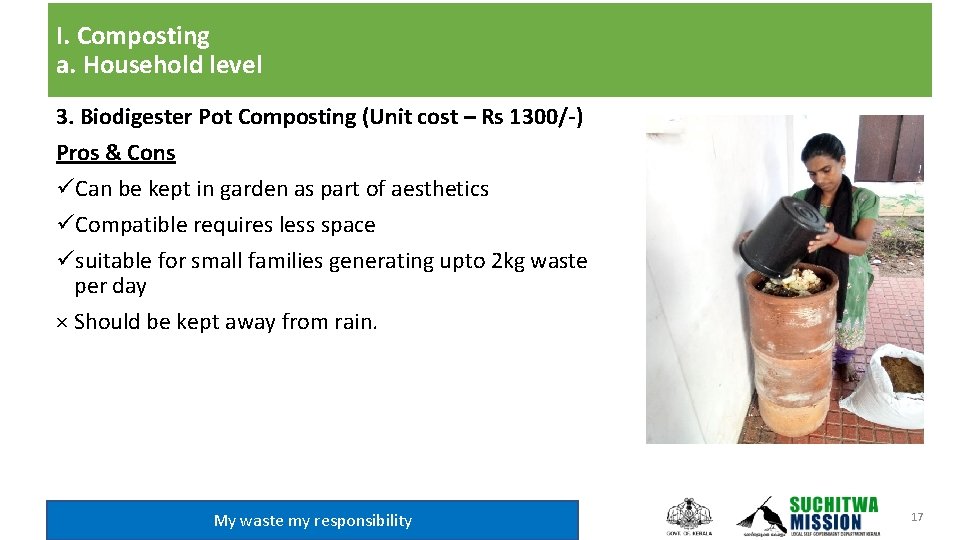
I. Composting a. Household level 3. Biodigester Pot Composting (Unit cost – Rs 1300/-) Pros & Cons üCan be kept in garden as part of aesthetics üCompatible requires less space üsuitable for small families generating upto 2 kg waste per day × Should be kept away from rain. My waste my responsibility 17
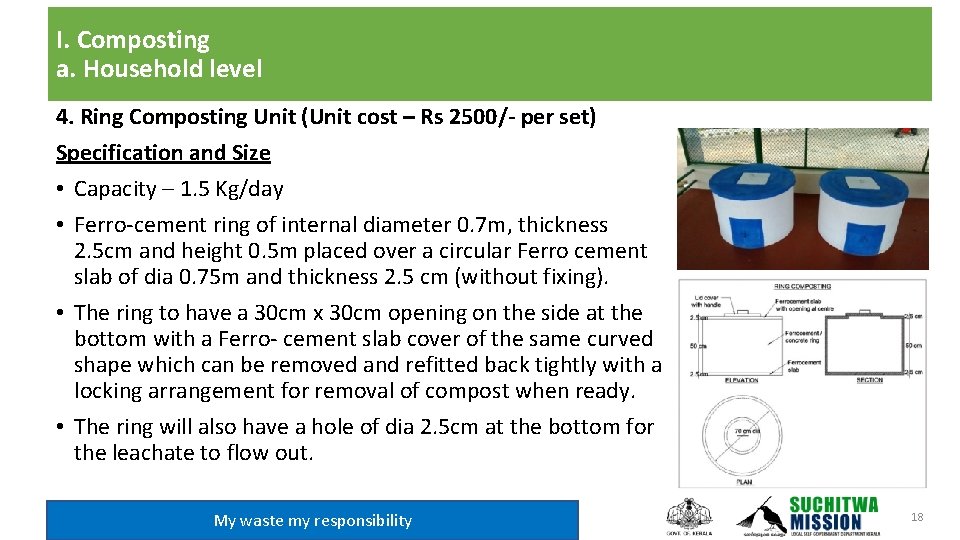
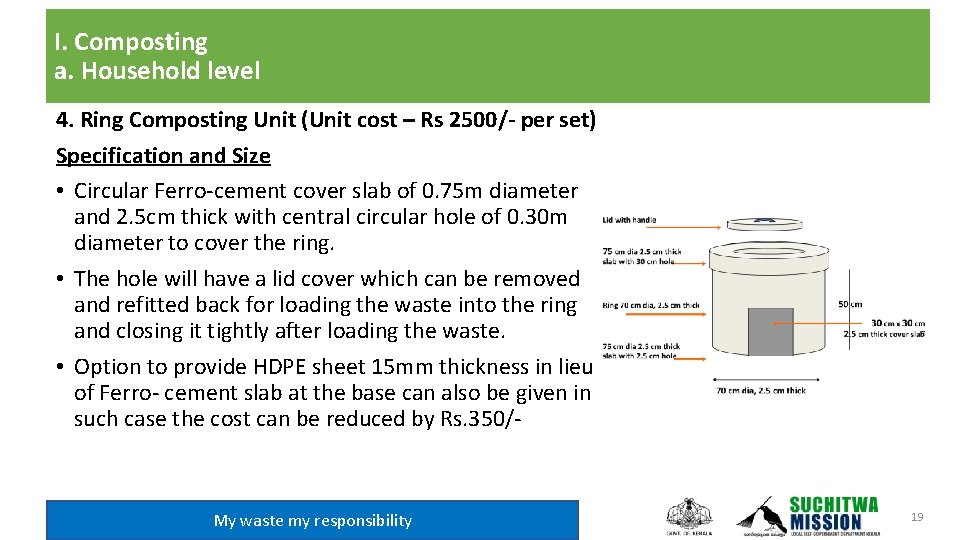
I. Composting a. Household level 4. Ring Composting Unit (Unit cost – Rs 2500/- per set) Specification and Size • Capacity – 1. 5 Kg/day • Ferro-cement ring of internal diameter 0. 7 m, thickness 2. 5 cm and height 0. 5 m placed over a circular Ferro cement slab of dia 0. 75 m and thickness 2. 5 cm (without fixing). • The ring to have a 30 cm x 30 cm opening on the side at the bottom with a Ferro- cement slab cover of the same curved shape which can be removed and refitted back tightly with a locking arrangement for removal of compost when ready. • The ring will also have a hole of dia 2. 5 cm at the bottom for the leachate to flow out. My waste my responsibility 18
I. Composting a. Household level 4. Ring Composting Unit (Unit cost – Rs 2500/- per set) Specification and Size • Circular Ferro-cement cover slab of 0. 75 m diameter and 2. 5 cm thick with central circular hole of 0. 30 m diameter to cover the ring. • The hole will have a lid cover which can be removed and refitted back for loading the waste into the ring and closing it tightly after loading the waste. • Option to provide HDPE sheet 15 mm thickness in lieu of Ferro- cement slab at the base can also be given in such case the cost can be reduced by Rs. 350/- My waste my responsibility 19
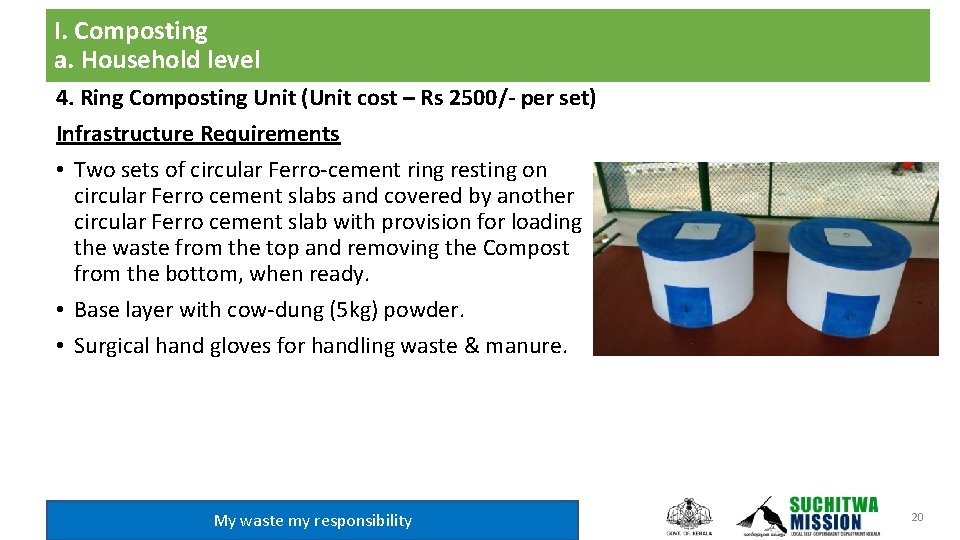
I. Composting a. Household level 4. Ring Composting Unit (Unit cost – Rs 2500/- per set) Infrastructure Requirements • Two sets of circular Ferro-cement ring resting on circular Ferro cement slabs and covered by another circular Ferro cement slab with provision for loading the waste from the top and removing the Compost from the bottom, when ready. • Base layer with cow-dung (5 kg) powder. • Surgical hand gloves for handling waste & manure. My waste my responsibility 20
I. Composting a. Household level 4. Ring Composting Unit (Unit cost – Rs 2500/- per set) Operation & Maintenance Protocols • First apply a base layer with cow-dung (5 kg) powder in the ring. • Chop the waste to size less than 5 cm before placing in the Basin. • Remove the top central lid cover of the ring and drop the waste inside the ring. • Spread the waste evenly in within the ring. • Use first ring for the first 90 days and then use the second ring after the first ring is filled. • After 175 days, compost from the first ring can be emptied from the side opening and the ring can be used for further waste feeding. • Renew the base layer annually My waste my responsibility 21
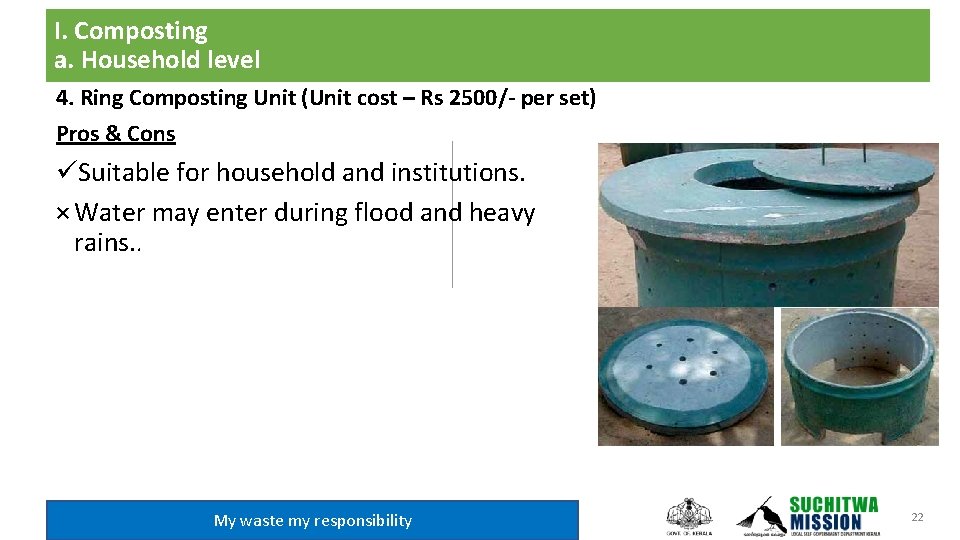
I. Composting a. Household level 4. Ring Composting Unit (Unit cost – Rs 2500/- per set) Pros & Cons üSuitable for household and institutions. × Water may enter during flood and heavy rains. . My waste my responsibility 22
I. Composting a. Household level 5. Kitchen bin composting unit (Unit cost – Rs 410/-) Specification and Size • 25 litre plastic bin with lid – 1 Nos. • Grow bag – 3 Nos • Capacity – 2 Kg/day Infrastructure Requirements • Trowel small size • Small fork My waste my responsibility 23
I. Composting a. Household level 5. Kitchen bin composting unit (Unit cost – Rs 410/-) Operation & Maintenance Protocols • Place the plastic bag inside the bucket • Spread starter material in 1 inch thick layer over the bio-platform (either prepared bio- compost or saw dust treated with bio-culture be used as starter material. Mix saw dust with diluted bio-culture (bioculture water ratio 1: 50) and keep it in a sack bag duly tied. • After two days, saw dust mixture becomes hot by the activities of the bacteria. This hot mixture can be used as the starter. • Spread the shredded waste over the starter layer • Spray diluted bio-culture mixture over the waste. After third day, use the fork to mix the contents of old layer and new layer. • Repeat the procedure till the bin is filled. • Tie the grow bag and remove it and store it. • Keep the second grow bag inside the bin and continue the process. My waste my responsibility 24
I. Composting a. Household level 5. Kitchen bin composting unit (Unit cost – Rs 410/-) Operation & Maintenance Protocols • Once the second bag is filled, remove it and store it. • Open the first grow bag and remove the contents and start using it again. • If the waste quantity is more than 2 kg/day increase the number of grow bags to give at least 20 days of storing time for filled grow bag. Pros & Cons üCompatible – requires less space, Can be kept in kitchen, suitable for small families generating upto 2 kg waste per day, easy to maintain. × Should be kept away from rodent attack. My waste my responsibility 25
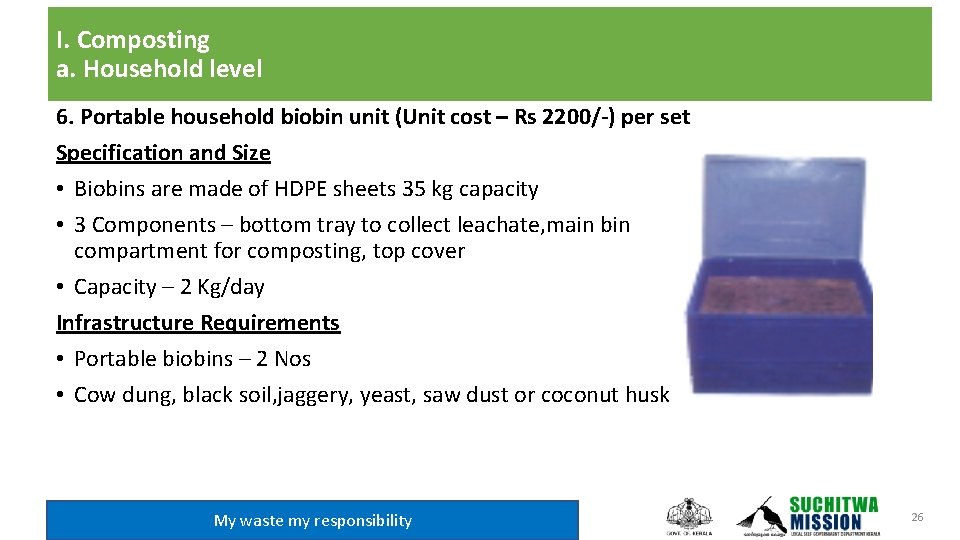
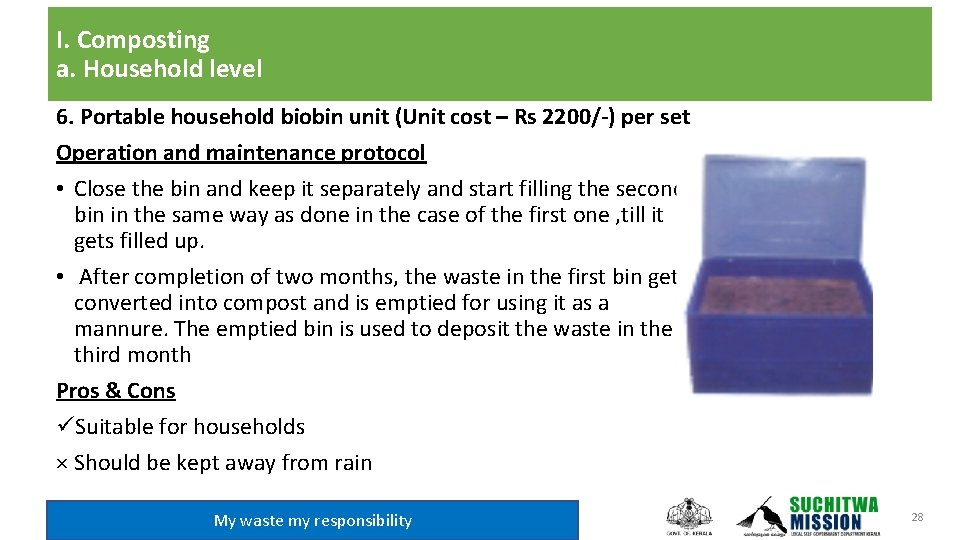
I. Composting a. Household level 6. Portable household biobin unit (Unit cost – Rs 2200/-) per set Specification and Size • Biobins are made of HDPE sheets 35 kg capacity • 3 Components – bottom tray to collect leachate, main bin compartment for composting, top cover • Capacity – 2 Kg/day Infrastructure Requirements • Portable biobins – 2 Nos • Cow dung, black soil, jaggery, yeast, saw dust or coconut husk My waste my responsibility 26
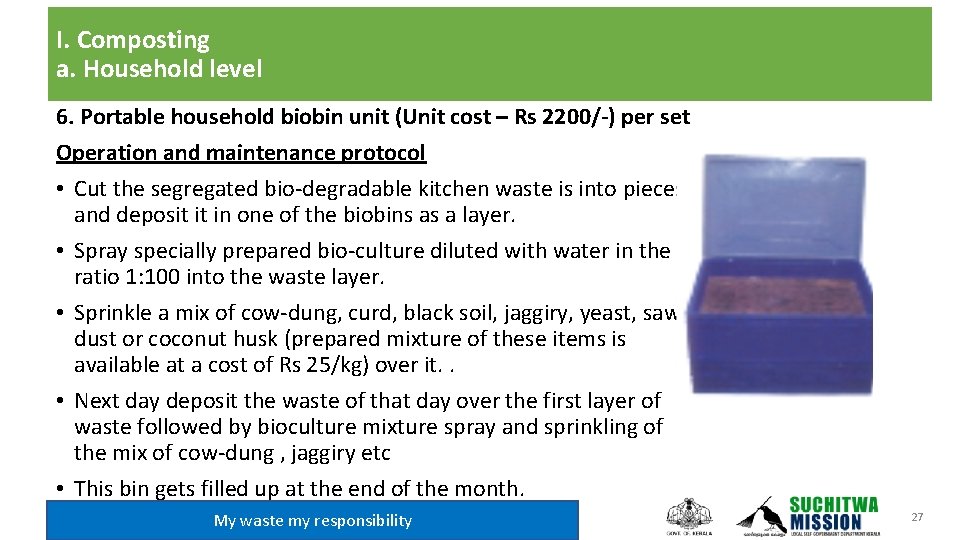
I. Composting a. Household level 6. Portable household biobin unit (Unit cost – Rs 2200/-) per set Operation and maintenance protocol • Cut the segregated bio-degradable kitchen waste is into pieces and deposit it in one of the biobins as a layer. • Spray specially prepared bio-culture diluted with water in the ratio 1: 100 into the waste layer. • Sprinkle a mix of cow-dung, curd, black soil, jaggiry, yeast, sawdust or coconut husk (prepared mixture of these items is available at a cost of Rs 25/kg) over it. . • Next day deposit the waste of that day over the first layer of waste followed by bioculture mixture spray and sprinkling of the mix of cow-dung , jaggiry etc • This bin gets filled up at the end of the month. My waste my responsibility 27
I. Composting a. Household level 6. Portable household biobin unit (Unit cost – Rs 2200/-) per set Operation and maintenance protocol • Close the bin and keep it separately and start filling the second bin in the same way as done in the case of the first one , till it gets filled up. • After completion of two months, the waste in the first bin gets converted into compost and is emptied for using it as a mannure. The emptied bin is used to deposit the waste in the third month Pros & Cons üSuitable for households × Should be kept away from rain My waste my responsibility 28
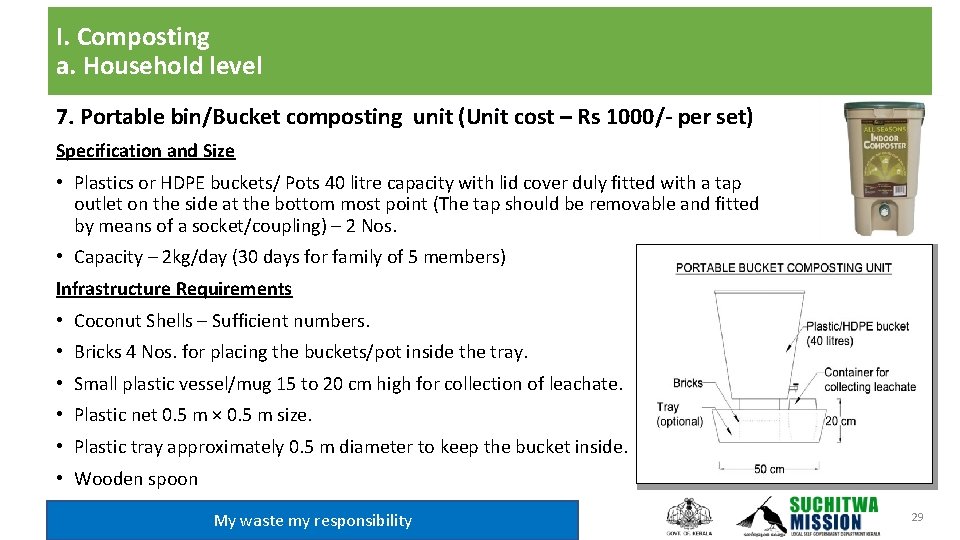
I. Composting a. Household level 7. Portable bin/Bucket composting unit (Unit cost – Rs 1000/- per set) Specification and Size • Plastics or HDPE buckets/ Pots 40 litre capacity with lid cover duly fitted with a tap outlet on the side at the bottom most point (The tap should be removable and fitted by means of a socket/coupling) – 2 Nos. • Capacity – 2 kg/day (30 days for family of 5 members) Infrastructure Requirements • Coconut Shells – Sufficient numbers. • Bricks 4 Nos. for placing the buckets/pot inside the tray. • Small plastic vessel/mug 15 to 20 cm high for collection of leachate. • Plastic net 0. 5 m × 0. 5 m size. • Plastic tray approximately 0. 5 m diameter to keep the bucket inside. • Wooden spoon My waste my responsibility 29
I. Composting a. Household level 7. Portable bin/Bucket composting unit (Unit cost – Rs 1000/- per set) Operation & Maintenance Protocols • Stock a layer of coconut shells in inverted position at the bottom of the bucket/pot. Place the plastic net cut to the shape over the layer of coconut shell. • Place two sets of bricks inside plastic tray and keep the prepared bucket/pot as above over the bricks for convenience of draining the leachate into a plastic vessel to be placed inside the plastic tray just below the tap outlet. Placing the bucket inside the tray is optional. • Start loading the bio waste into the bucket/pot on the layer of coconut shells daily. • Occasionally mix the fresh waste with the old waste by using the wooden spoon. Keep the bucket/pot closed with the lid cover. • One bucket/pot will be filled in 25 to 30 days time in a family of 5 members. My waste my responsibility 30
I. Composting a. Household level 7. Portable bin/Bucket composting unit (Unit cost – Rs 1000/- per set) Operation & Maintenance Protocols • Close the bucket/pot with lid cover and start using the second set. • Keep sprinkling a mug of water into the waste inside the bucket once in a week. Drain the leachate as it comes out. The drained leachate can be used as manure in the garden. • Once the second bucket gets filled, the waste in the first one will be ready as compost. • Empty it and reuse the bucket/pot for further storing the waste. Pros & Cons üCompatible – requires less space, suitable for small families generating upto 2 kg waste per day, easy to maintain. × Should be kept away from rain. My waste my responsibility 31
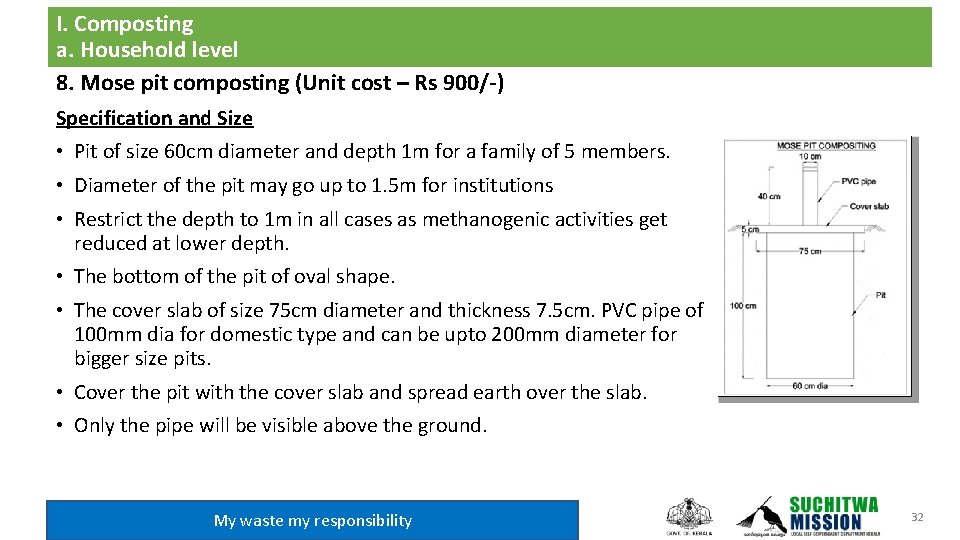
I. Composting a. Household level 8. Mose pit composting (Unit cost – Rs 900/-) Specification and Size • Pit of size 60 cm diameter and depth 1 m for a family of 5 members. • Diameter of the pit may go up to 1. 5 m for institutions • Restrict the depth to 1 m in all cases as methanogenic activities get reduced at lower depth. • The bottom of the pit of oval shape. • The cover slab of size 75 cm diameter and thickness 7. 5 cm. PVC pipe of 100 mm dia for domestic type and can be upto 200 mm diameter for bigger size pits. • Cover the pit with the cover slab and spread earth over the slab. • Only the pipe will be visible above the ground. My waste my responsibility 32
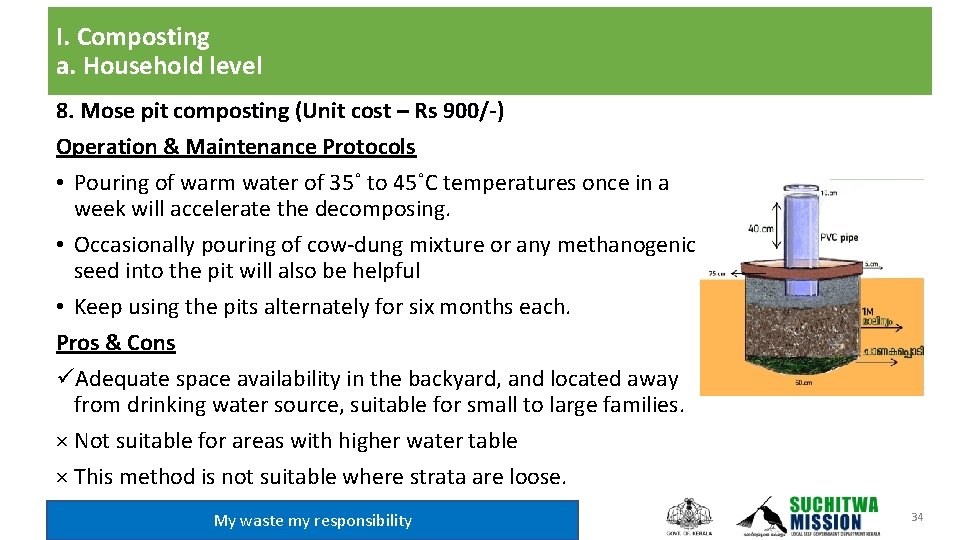
I. Composting a. Household level 8. Mose pit composting (Unit cost – Rs 900/-) Infrastructure Requirements • Circular pits of required diameter and depth 1 m in a convenient location – 2 Nos • Circular/ rectangular slabs • PVC pipe of required diameter, 50 cm long- 2 sets. • PVC caps to close opening of the pipe – 2 Nos Operation & Maintenance Protocols • Ensure methanisation before putting the waste into the pit by sprinkling cow-dung/ decomposed waste into the pit. • Drop the shredded bio-waste into the pit through the pipe opening daily and keep the pipe end closed always. My waste my responsibility 33
I. Composting a. Household level 8. Mose pit composting (Unit cost – Rs 900/-) Operation & Maintenance Protocols • Pouring of warm water of 35˚ to 45˚C temperatures once in a week will accelerate the decomposing. • Occasionally pouring of cow-dung mixture or any methanogenic seed into the pit will also be helpful • Keep using the pits alternately for six months each. Pros & Cons üAdequate space availability in the backyard, and located away from drinking water source, suitable for small to large families. × Not suitable for areas with higher water table × This method is not suitable where strata are loose. My waste my responsibility 34
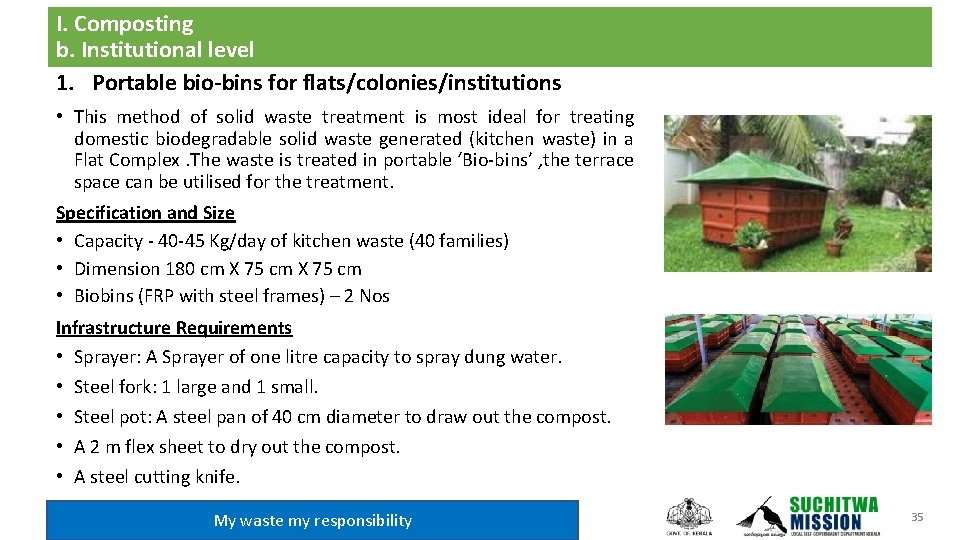
I. Composting b. Institutional level 1. Portable bio-bins for flats/colonies/institutions • This method of solid waste treatment is most ideal for treating domestic biodegradable solid waste generated (kitchen waste) in a Flat Complex. The waste is treated in portable ‘Bio-bins’ , the terrace space can be utilised for the treatment. Specification and Size • Capacity - 40 -45 Kg/day of kitchen waste (40 families) • Dimension 180 cm X 75 cm • Biobins (FRP with steel frames) – 2 Nos Infrastructure Requirements • Sprayer: A Sprayer of one litre capacity to spray dung water. • Steel fork: 1 large and 1 small. • Steel pot: A steel pan of 40 cm diameter to draw out the compost. • A 2 m flex sheet to dry out the compost. • A steel cutting knife. My waste my responsibility 35
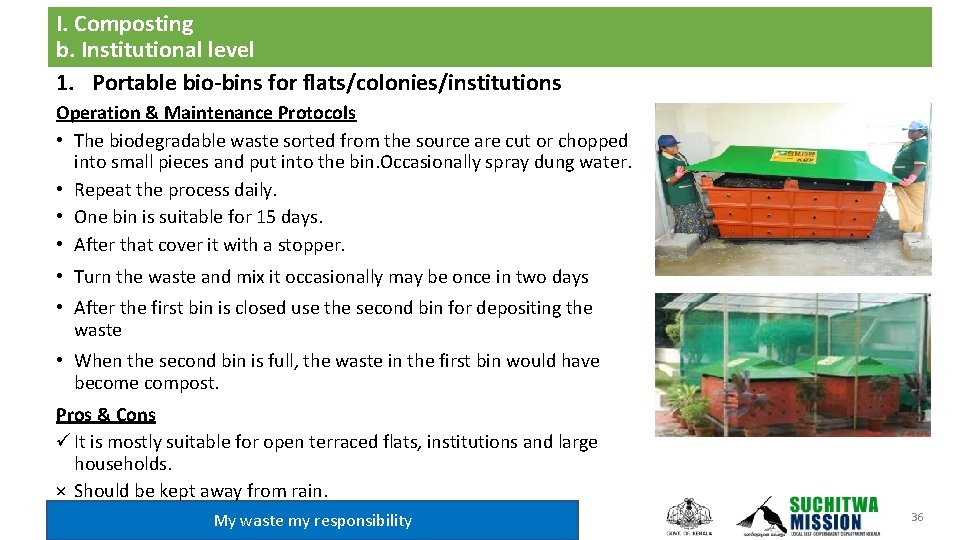
I. Composting b. Institutional level 1. Portable bio-bins for flats/colonies/institutions Operation & Maintenance Protocols • The biodegradable waste sorted from the source are cut or chopped into small pieces and put into the bin. Occasionally spray dung water. • Repeat the process daily. • One bin is suitable for 15 days. • After that cover it with a stopper. • Turn the waste and mix it occasionally may be once in two days • After the first bin is closed use the second bin for depositing the waste • When the second bin is full, the waste in the first bin would have become compost. Pros & Cons ü It is mostly suitable for open terraced flats, institutions and large households. × Should be kept away from rain. My waste my responsibility 36
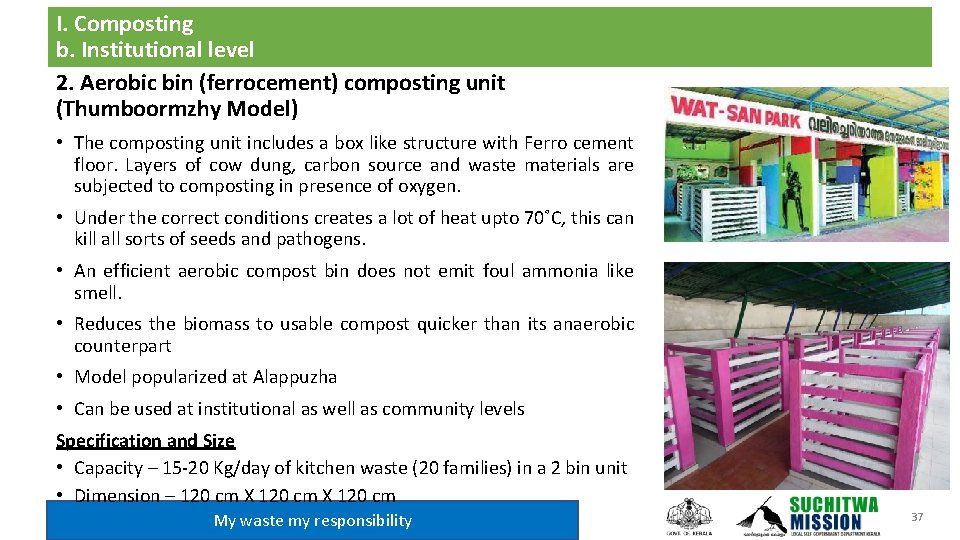
I. Composting b. Institutional level 2. Aerobic bin (ferrocement) composting unit (Thumboormzhy Model) • The composting unit includes a box like structure with Ferro cement floor. Layers of cow dung, carbon source and waste materials are subjected to composting in presence of oxygen. • Under the correct conditions creates a lot of heat upto 70˚C, this can kill all sorts of seeds and pathogens. • An efficient aerobic compost bin does not emit foul ammonia like smell. • Reduces the biomass to usable compost quicker than its anaerobic counterpart • Model popularized at Alappuzha • Can be used at institutional as well as community levels Specification and Size • Capacity – 15 -20 Kg/day of kitchen waste (20 families) in a 2 bin unit • Dimension – 120 cm X 120 cm My waste my responsibility 37
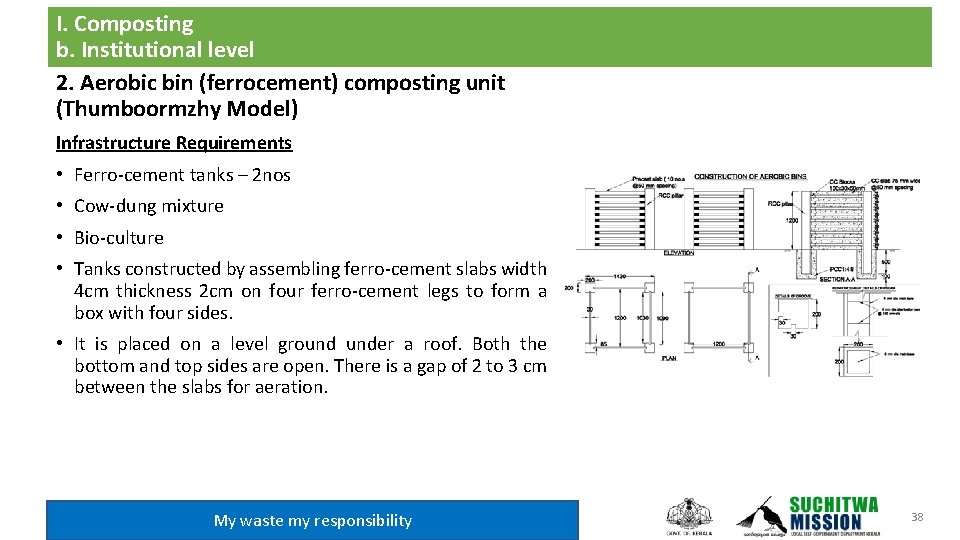
I. Composting b. Institutional level 2. Aerobic bin (ferrocement) composting unit (Thumboormzhy Model) Infrastructure Requirements • Ferro-cement tanks – 2 nos • Cow-dung mixture • Bio-culture • Tanks constructed by assembling ferro-cement slabs width 4 cm thickness 2 cm on four ferro-cement legs to form a box with four sides. • It is placed on a level ground under a roof. Both the bottom and top sides are open. There is a gap of 2 to 3 cm between the slabs for aeration. My waste my responsibility 38
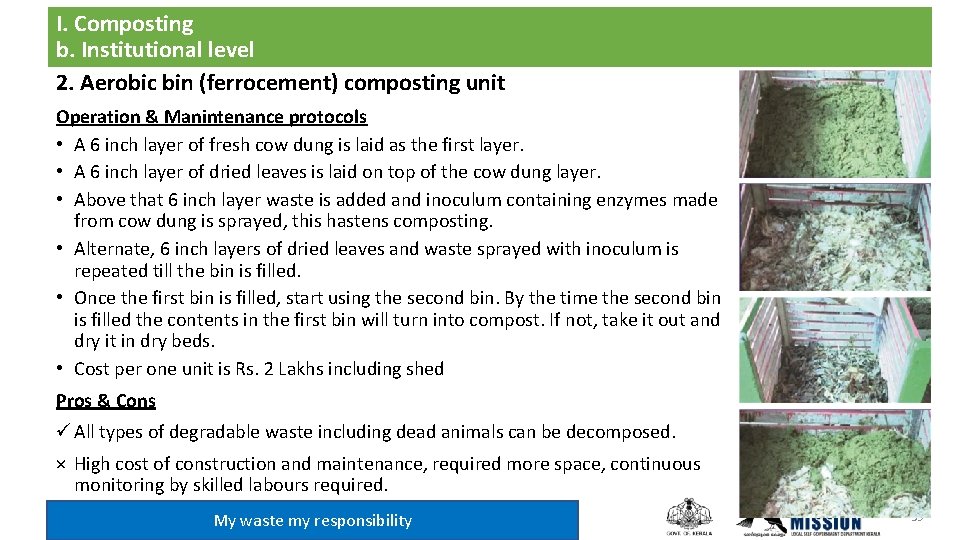
I. Composting b. Institutional level 2. Aerobic bin (ferrocement) composting unit Operation & Manintenance protocols • A 6 inch layer of fresh cow dung is laid as the first layer. • A 6 inch layer of dried leaves is laid on top of the cow dung layer. • Above that 6 inch layer waste is added and inoculum containing enzymes made from cow dung is sprayed, this hastens composting. • Alternate, 6 inch layers of dried leaves and waste sprayed with inoculum is repeated till the bin is filled. • Once the first bin is filled, start using the second bin. By the time the second bin is filled the contents in the first bin will turn into compost. If not, take it out and dry it in dry beds. • Cost per one unit is Rs. 2 Lakhs including shed Pros & Cons ü All types of degradable waste including dead animals can be decomposed. × High cost of construction and maintenance, required more space, continuous monitoring by skilled labours required. My waste my responsibility 39
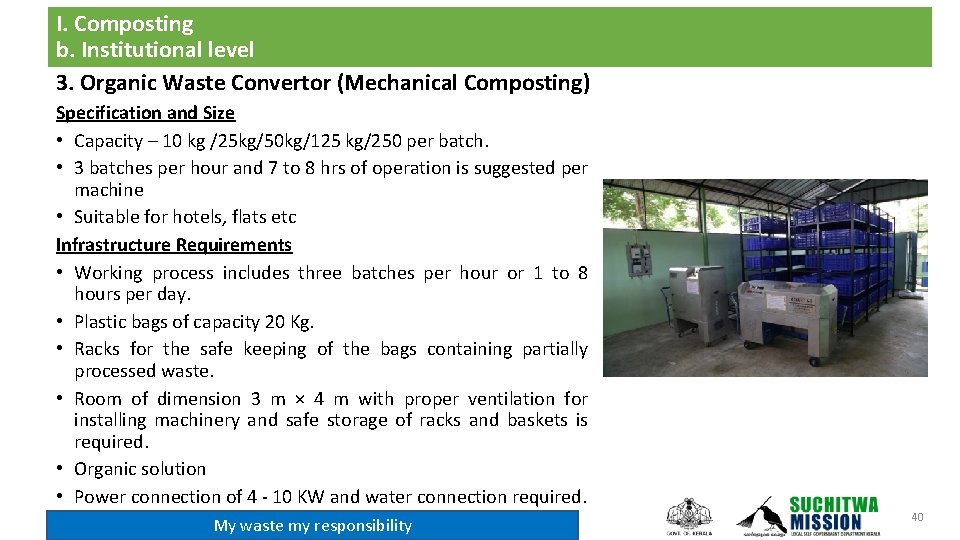
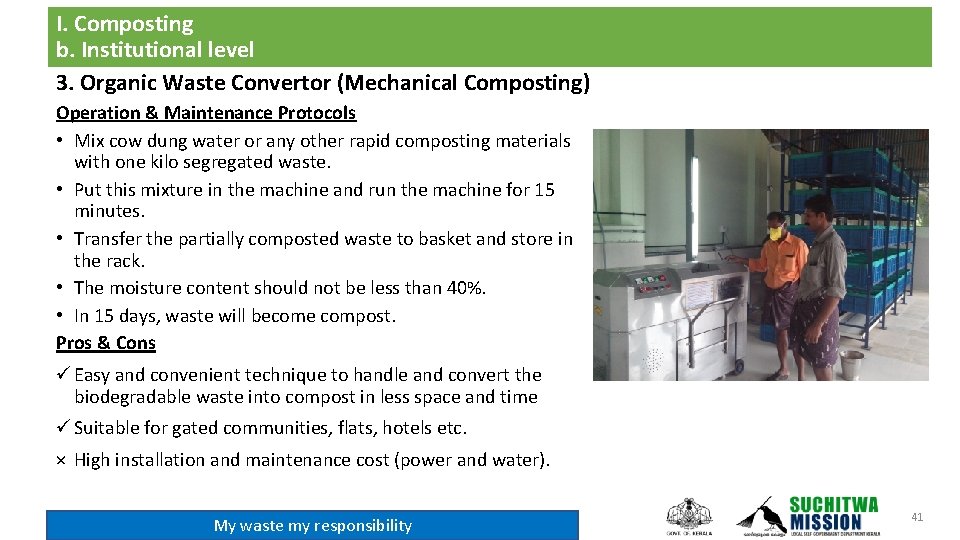
I. Composting b. Institutional level 3. Organic Waste Convertor (Mechanical Composting) Specification and Size • Capacity – 10 kg /25 kg/50 kg/125 kg/250 per batch. • 3 batches per hour and 7 to 8 hrs of operation is suggested per machine • Suitable for hotels, flats etc Infrastructure Requirements • Working process includes three batches per hour or 1 to 8 hours per day. • Plastic bags of capacity 20 Kg. • Racks for the safe keeping of the bags containing partially processed waste. • Room of dimension 3 m × 4 m with proper ventilation for installing machinery and safe storage of racks and baskets is required. • Organic solution • Power connection of 4 - 10 KW and water connection required. My waste my responsibility 40
I. Composting b. Institutional level 3. Organic Waste Convertor (Mechanical Composting) Operation & Maintenance Protocols • Mix cow dung water or any other rapid composting materials with one kilo segregated waste. • Put this mixture in the machine and run the machine for 15 minutes. • Transfer the partially composted waste to basket and store in the rack. • The moisture content should not be less than 40%. • In 15 days, waste will become compost. Pros & Cons ü Easy and convenient technique to handle and convert the biodegradable waste into compost in less space and time ü Suitable for gated communities, flats, hotels etc. × High installation and maintenance cost (power and water). My waste my responsibility 41
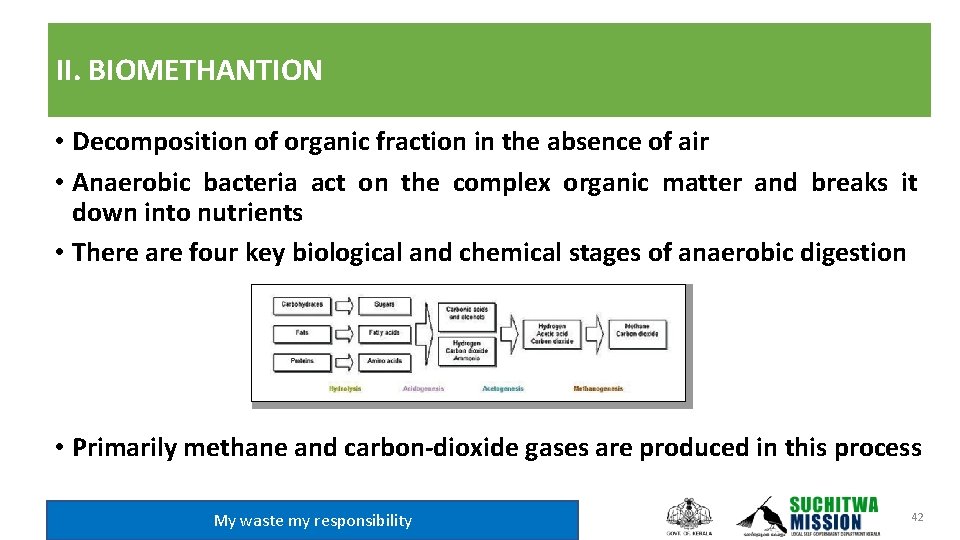
II. BIOMETHANTION • Decomposition of organic fraction in the absence of air • Anaerobic bacteria act on the complex organic matter and breaks it down into nutrients • There are four key biological and chemical stages of anaerobic digestion • Primarily methane and carbon-dioxide gases are produced in this process My waste my responsibility 42
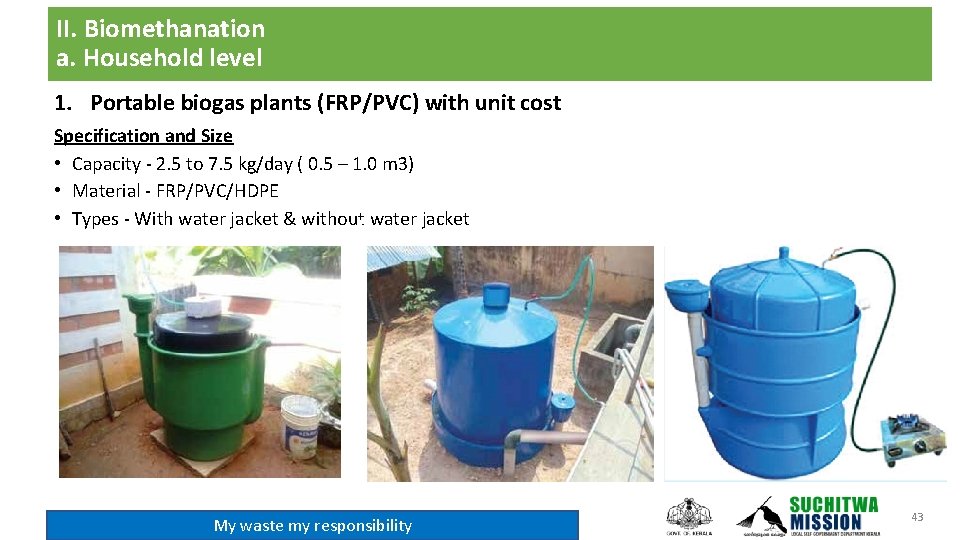
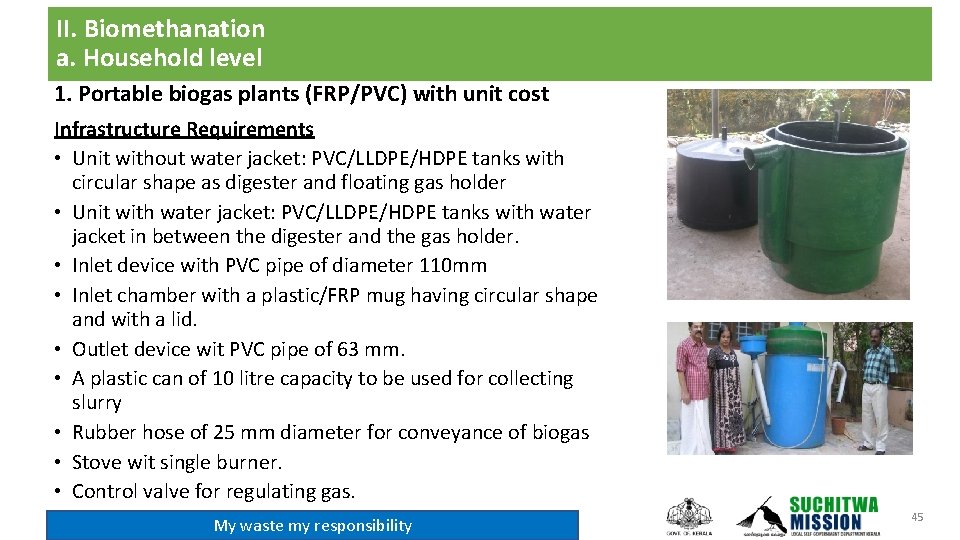
II. Biomethanation a. Household level 1. Portable biogas plants (FRP/PVC) with unit cost Specification and Size • Capacity - 2. 5 to 7. 5 kg/day ( 0. 5 – 1. 0 m 3) • Material - FRP/PVC/HDPE • Types - With water jacket & without water jacket My waste my responsibility 43
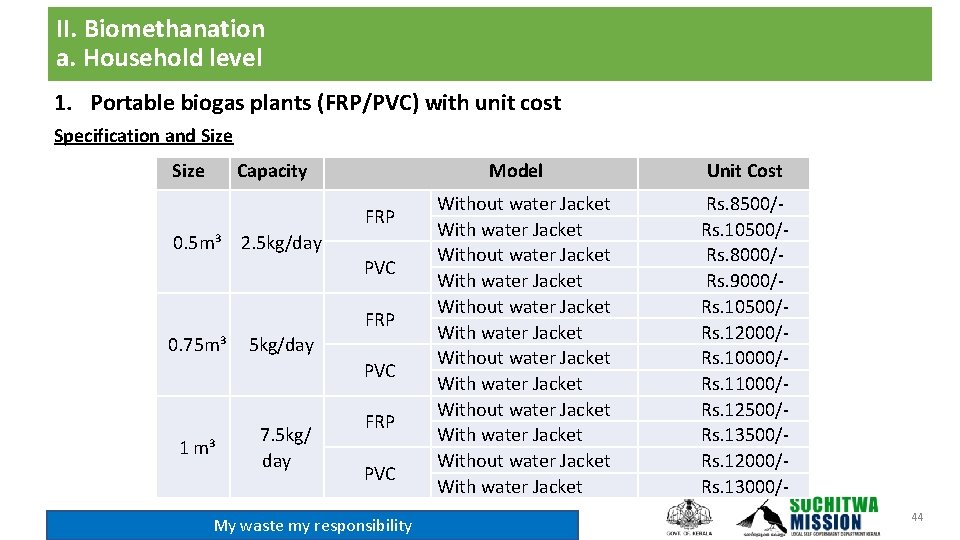
II. Biomethanation a. Household level 1. Portable biogas plants (FRP/PVC) with unit cost Specification and Size Capacity Model FRP 0. 5 m³ 2. 5 kg/day PVC FRP 0. 75 m³ 5 kg/day PVC 1 m³ 7. 5 kg/ day FRP PVC My waste my responsibility Without water Jacket With water Jacket Without water Jacket With water Jacket Unit Cost Rs. 8500/Rs. 10500/Rs. 8000/Rs. 9000/Rs. 10500/Rs. 12000/Rs. 10000/Rs. 11000/Rs. 12500/Rs. 13500/Rs. 12000/Rs. 13000/44
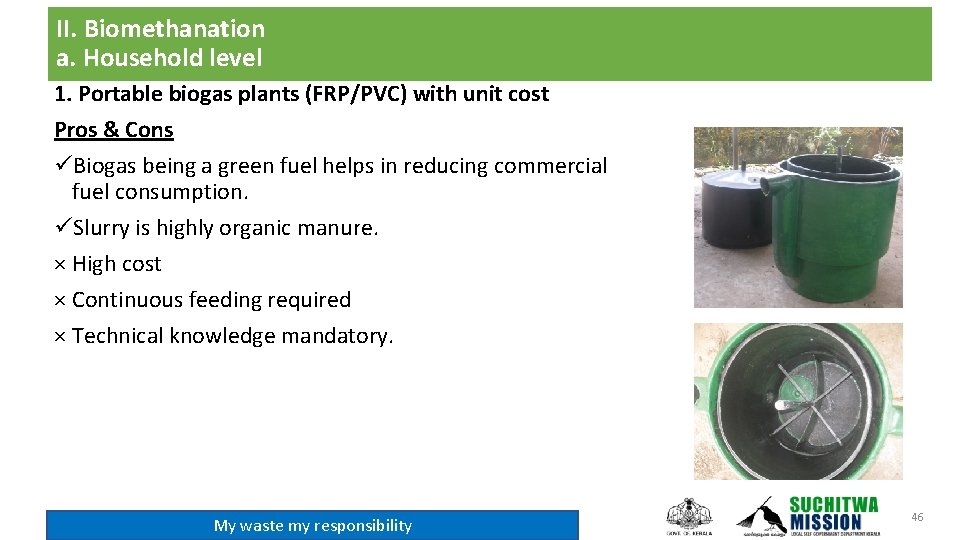
II. Biomethanation a. Household level 1. Portable biogas plants (FRP/PVC) with unit cost Infrastructure Requirements • Unit without water jacket: PVC/LLDPE/HDPE tanks with circular shape as digester and floating gas holder • Unit with water jacket: PVC/LLDPE/HDPE tanks with water jacket in between the digester and the gas holder. • Inlet device with PVC pipe of diameter 110 mm • Inlet chamber with a plastic/FRP mug having circular shape and with a lid. • Outlet device wit PVC pipe of 63 mm. • A plastic can of 10 litre capacity to be used for collecting slurry • Rubber hose of 25 mm diameter for conveyance of biogas • Stove wit single burner. • Control valve for regulating gas. My waste my responsibility 45
II. Biomethanation a. Household level 1. Portable biogas plants (FRP/PVC) with unit cost Pros & Cons üBiogas being a green fuel helps in reducing commercial fuel consumption. üSlurry is highly organic manure. × High cost × Continuous feeding required × Technical knowledge mandatory. My waste my responsibility 46
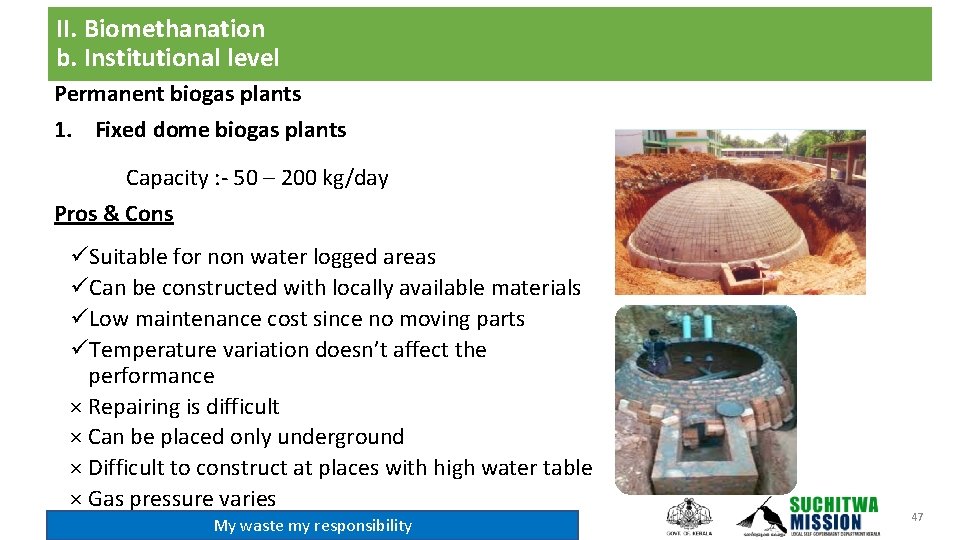
II. Biomethanation b. Institutional level Permanent biogas plants 1. Fixed dome biogas plants Capacity : - 50 – 200 kg/day Pros & Cons üSuitable for non water logged areas üCan be constructed with locally available materials üLow maintenance cost since no moving parts üTemperature variation doesn’t affect the performance × Repairing is difficult × Can be placed only underground × Difficult to construct at places with high water table × Gas pressure varies My waste my responsibility 47
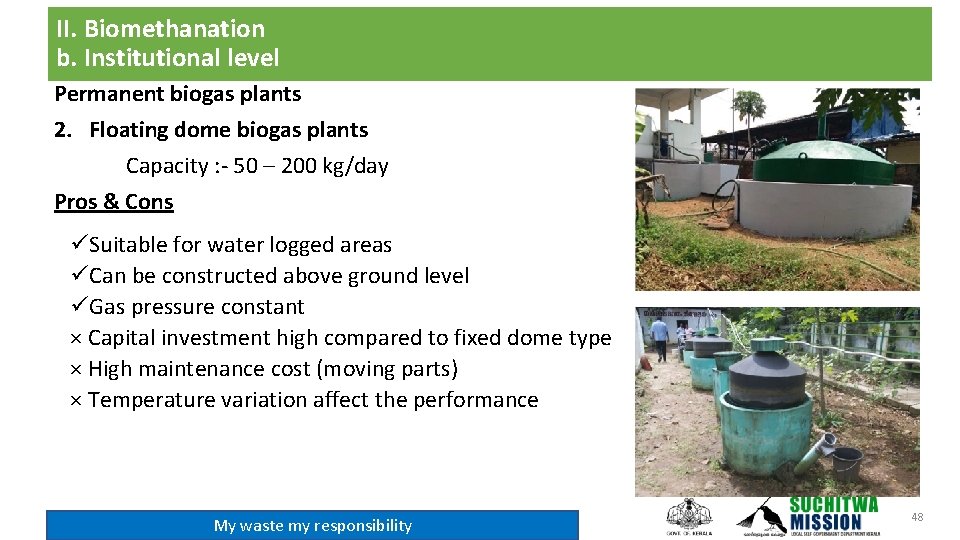
II. Biomethanation b. Institutional level Permanent biogas plants 2. Floating dome biogas plants Capacity : - 50 – 200 kg/day Pros & Cons üSuitable for water logged areas üCan be constructed above ground level üGas pressure constant × Capital investment high compared to fixed dome type × High maintenance cost (moving parts) × Temperature variation affect the performance My waste my responsibility 48
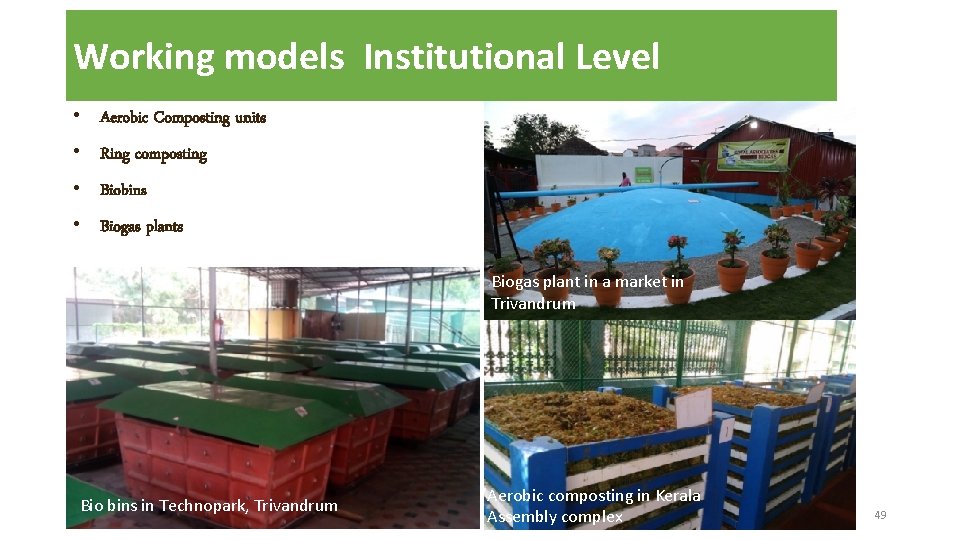
Working models Institutional Level • Aerobic Composting units • Ring composting • Biobins • Biogas plants Biogas plant in a market in Trivandrum Bio bins in Technopark, Trivandrum Aerobic composting in Kerala Assembly complex 49
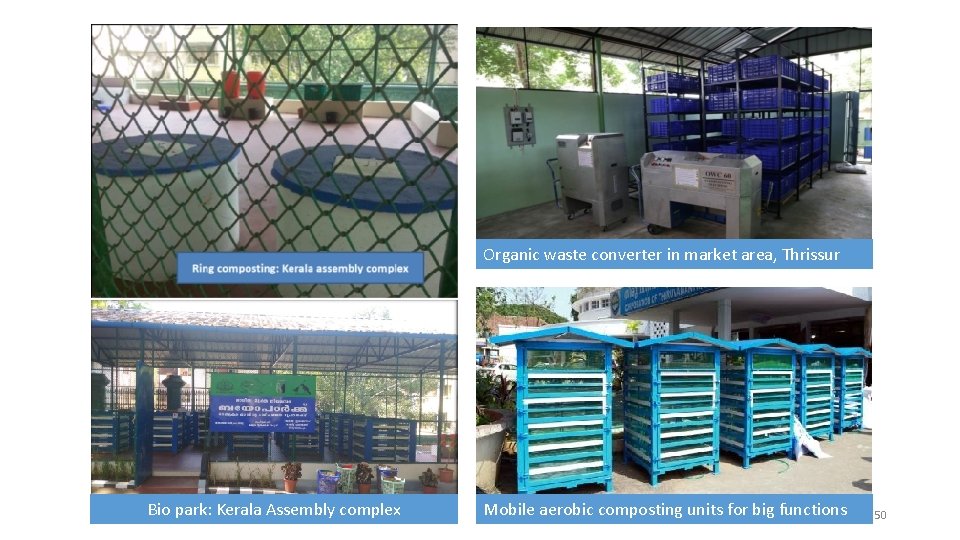
Organic waste converter in market area, Thrissur Bio park: Kerala Assembly complex Mobile aerobic composting units for big functions 50
Thanks you Renju R Pillai Director (SWM)i/c Suchitwa Mission, Kerala 51