
Different forms of the verb to be be
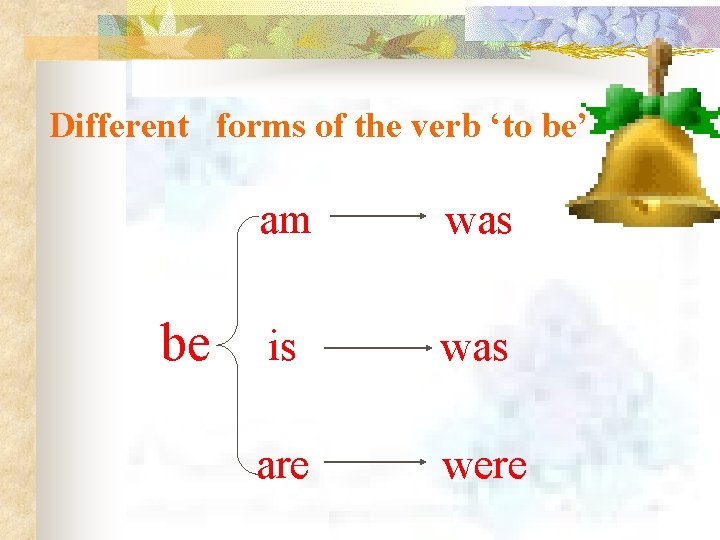
Different forms of the verb ‘to be’ be am was is was are were
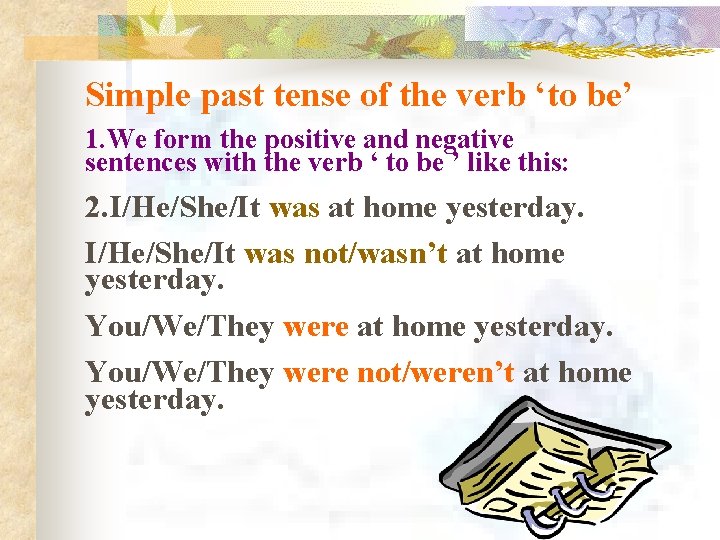
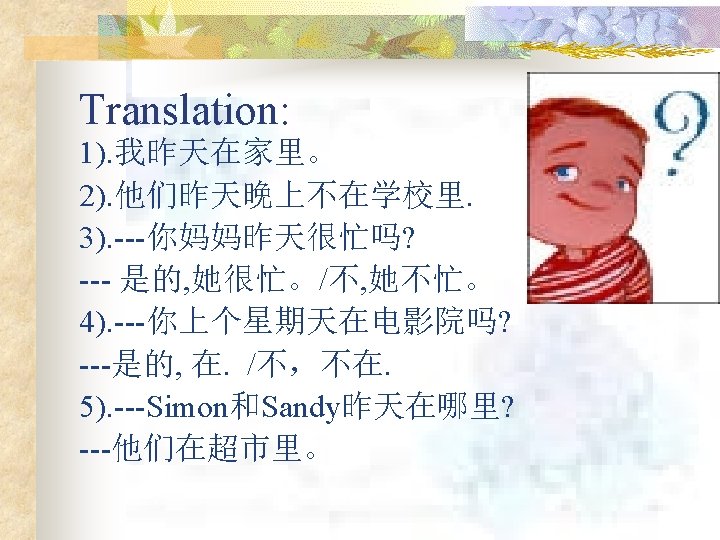
Simple past tense of the verb ‘to be’ 1. We form the positive and negative sentences with the verb ‘ to be ’ like this: 2. I/He/She/It was at home yesterday. I/He/She/It was not/wasn’t at home yesterday. You/We/They were not/weren’t at home yesterday.
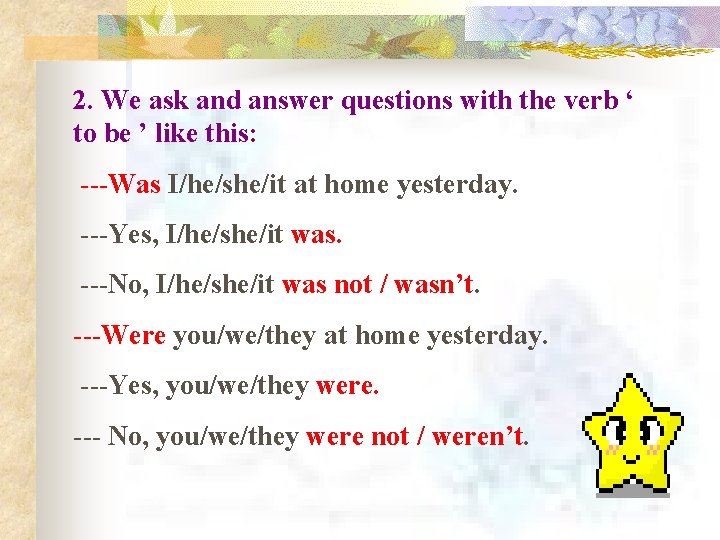
2. We ask and answer questions with the verb ‘ to be ’ like this: ---Was I/he/she/it at home yesterday. ---Yes, I/he/she/it was. ---No, I/he/she/it was not / wasn’t. ---Were you/we/they at home yesterday. ---Yes, you/we/they were. --- No, you/we/they were not / weren’t.
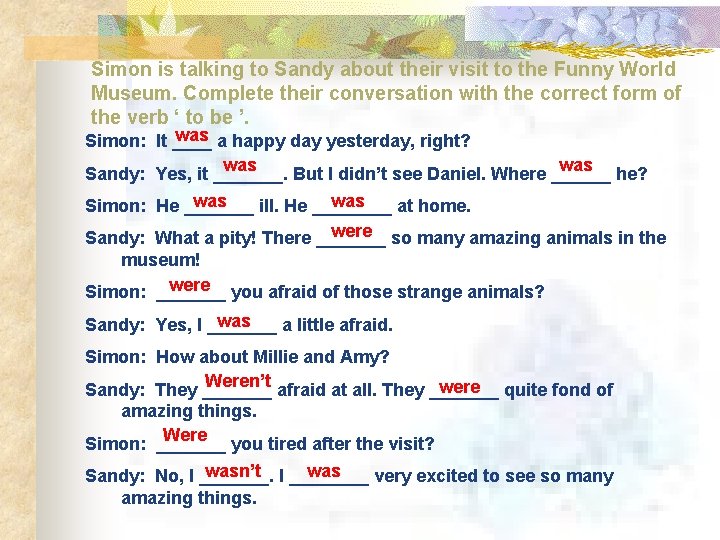
Simon is talking to Sandy about their visit to the Funny World Museum. Complete their conversation with the correct form of the verb ‘ to be ’. was a happy day yesterday, right? Simon: It ____ was he? Sandy: Yes, it _______. But I didn’t see Daniel. Where ______ was Simon: He _______ ill. He ____ at home. were so many amazing animals in the Sandy: What a pity! There _______ museum! were you afraid of those strange animals? Simon: _______ was Sandy: Yes, I _______ a little afraid. Simon: How about Millie and Amy? Weren’t afraid at all. They _______ were quite fond of Sandy: They _______ amazing things. Were you tired after the visit? Simon: _______ wasn’t I ____ was Sandy: No, I _______. very excited to see so many amazing things.
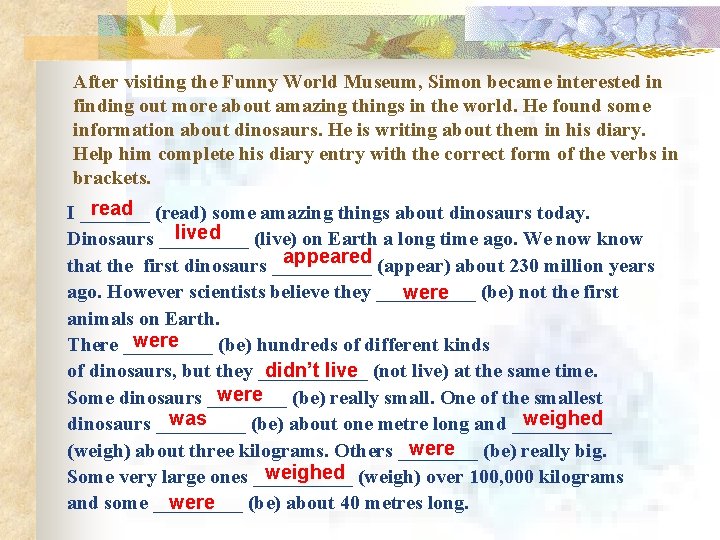
After visiting the Funny World Museum, Simon became interested in finding out more about amazing things in the world. He found some information about dinosaurs. He is writing about them in his diary. Help him complete his diary entry with the correct form of the verbs in brackets. read (read) some amazing things about dinosaurs today. I _______ lived Dinosaurs _____ (live) on Earth a long time ago. We now know appeared (appear) about 230 million years that the first dinosaurs _____ ago. However scientists believe they _____ (be) not the first were animals on Earth. were There _____ (be) hundreds of different kinds didn’t live (not live) at the same time. of dinosaurs, but they ______ were (be) really small. One of the smallest Some dinosaurs ____ was weighed dinosaurs _____ (be) about one metre long and _____ were (be) really big. (weigh) about three kilograms. Others ____ weighed (weigh) over 100, 000 kilograms Some very large ones _____ were and some _____ (be) about 40 metres long.
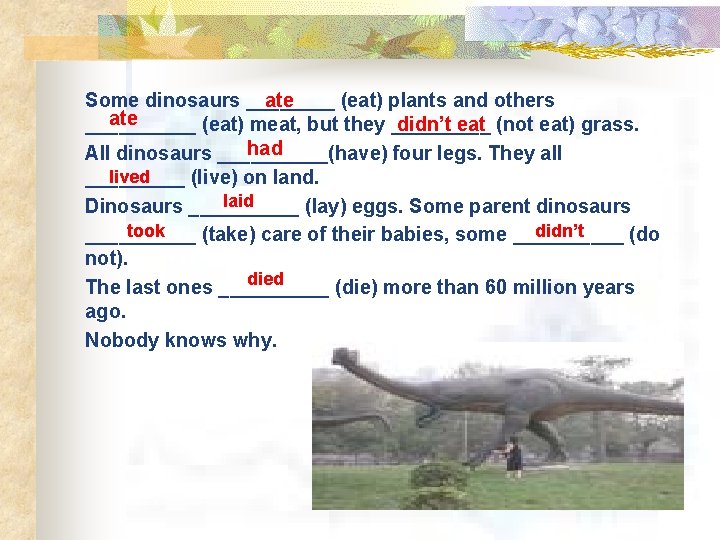
ate Some dinosaurs ____ (eat) plants and others ate didn’t eat (not eat) grass. _____ (eat) meat, but they _____ had All dinosaurs _____(have) four legs. They all lived _____ (live) on land. laid Dinosaurs _____ (lay) eggs. Some parent dinosaurs took didn’t _____ (take) care of their babies, some _____ (do not). died The last ones _____ (die) more than 60 million years ago. Nobody knows why.
Useful expressions: 1. 3. 5. 7. 8. 9. 11. be afraid of 2. not… at all be fond of 4. a long time ago hundreds of 6. different kinds of at the same time weigh (about three kilograms) over (100, 000 kilograms) 10. on land take care of 12. more than
Homework: 1. Recite the simple past tense of the verb “to be ”. 2. Write a passage about an activity that students had in the past. 1) 字数 60字左右。 2) 什么时间去了哪里(公园、动物园……)。 3) 做了什么有趣的事情。 4) 看到或了解到什么有趣的事物。

- Slides: 11