
Different Forms of Government Exploring the isms Key
- Slides: 34
Different Forms of Government Exploring the “isms”
Key Question n What is the relationship between the individual and the state in each of these systems?
Anarchism n The belief that all existing governmental authority should be abolished and replaced by free cooperation among individuals— Dictionary of Cultural Literacy 312 n No Government, “Can’t we just all get along”
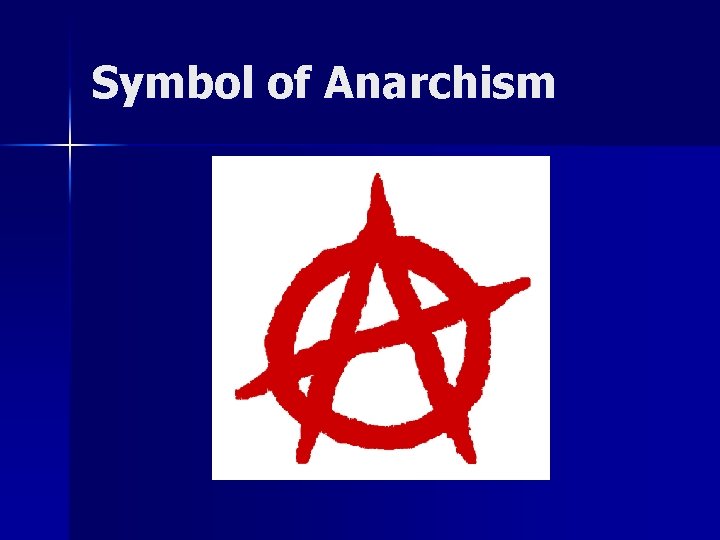
Symbol of Anarchism
Authoritarianism a form of government in which the ruler is an absolute dictator (not restricted by a constitution or laws or opposition etc. ) -- Dictionary. com July 18, 2007 n Authoritarianism takes many forms n
Totalitarianism A dictatorial form of centralized government that regulates every aspect of state and private behavior. n Fascist and communists regimes fall into this category n
Absolute Monarchy Rule by one person—a monarch, usually a king or a queen--n whose actions are restricted neither by written law nor by custom; different from a constitutional monarchy and from a republic. Think Russia before 1917, France pre-1789 -- Dictionary of n Cultural Literacy 312
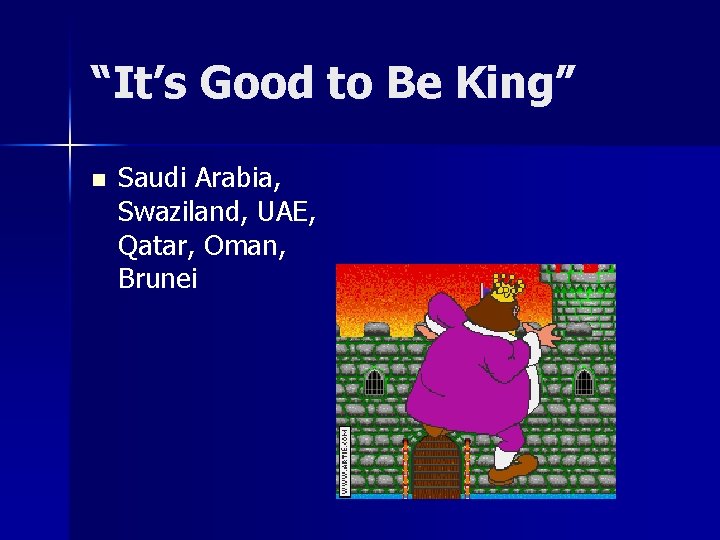
“It’s Good to Be King” n Saudi Arabia, Swaziland, UAE, Qatar, Oman, Brunei
Autocracy/Autocratic Regimes n n A system of government in which supreme political power is held by one person Bhutan, Syria, Saddam’s Iraq, Kazakhstan
Where is Power in an Autocratic Regime? n The Government “I’ve got the Power and I am not afraid to use it!” The People “Out of Luck! We’re hosed!”
Despotism Unlimited political rule by one person a (despot) n Refers to unscrupulous rule of tyranny (a Tyrant) n Despots can be Absolute monarchs, dictators, Autocrats n A dated term refers to people like Louis XIV of France, Charles I of Prussia n
Dictatorship/Dictator Government by a single person or by a junta (military group) that is not responsible to the people or their elected representatives. n Term comes from ancient Rome— magistrates handed absolute power in times of crisis n
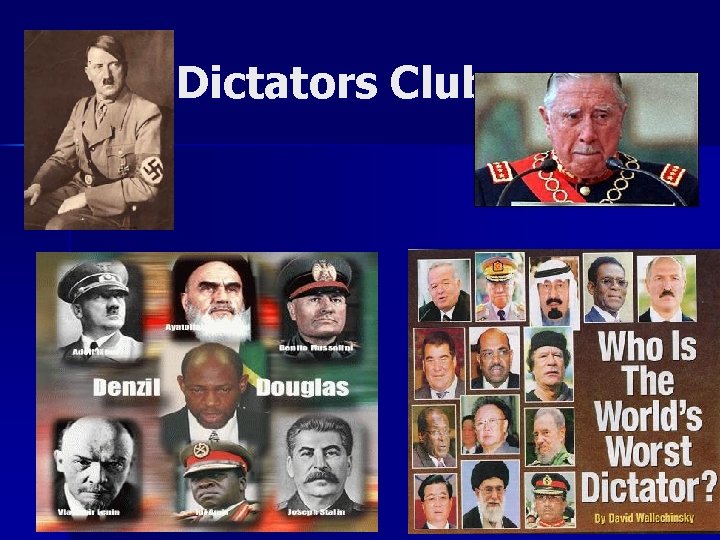
Dictators Club
Fascism n An Authoritarian form of government
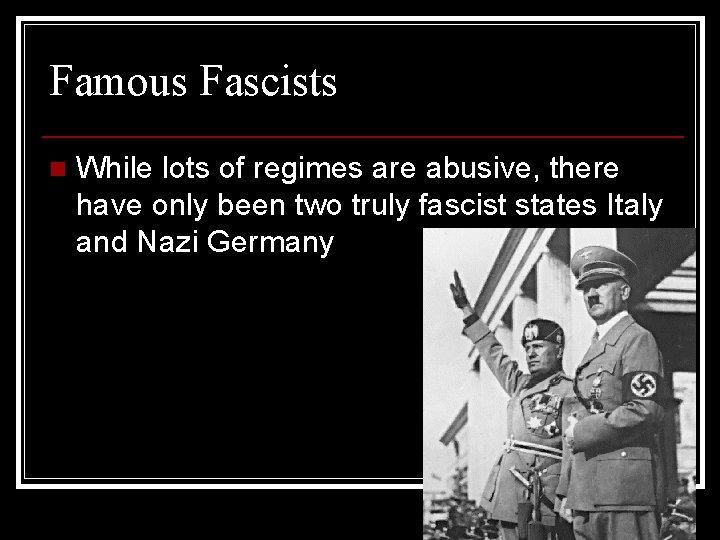
Famous Fascists n While lots of regimes are abusive, there have only been two truly fascist states Italy and Nazi Germany
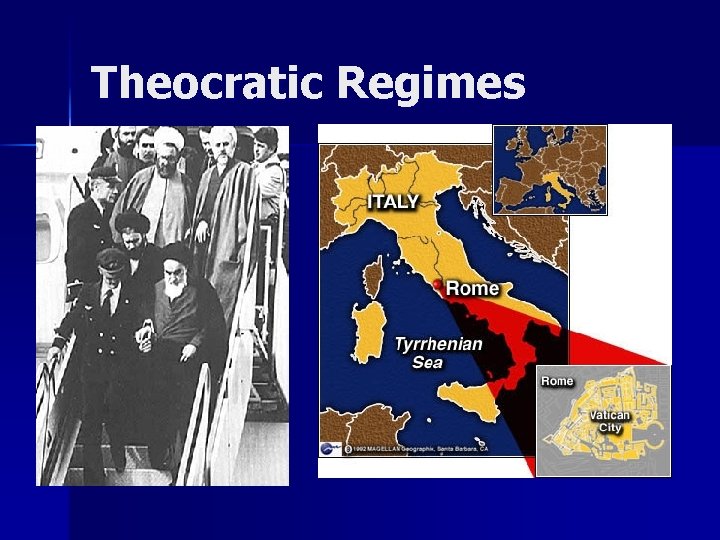
Theocracy n A nation or state in which the clergy exercise political over and in which religious law is dominant over civil law. –Dictionary of Cultural Literacy, page 327
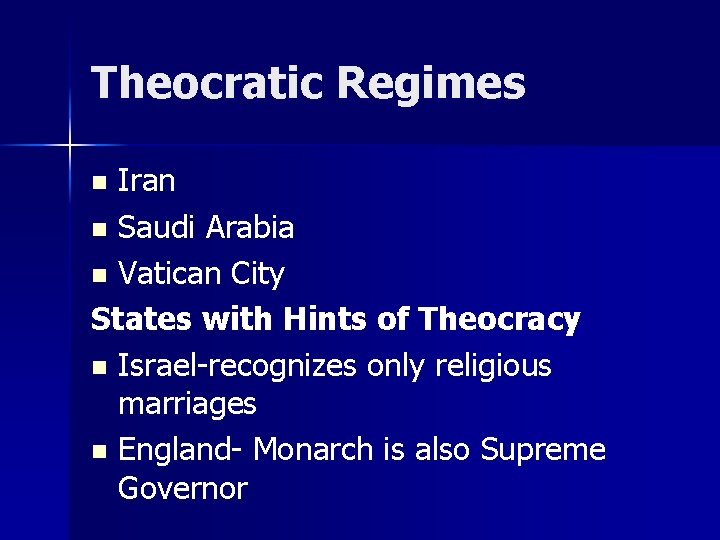
Theocratic Regimes Iran n Saudi Arabia n Vatican City States with Hints of Theocracy n Israel-recognizes only religious marriages n England- Monarch is also Supreme Governor n
Theocratic Regimes
Totalitarianism Domination by a government of all political, social and economic activities in a nation. n Totalitarianism is a phenomenon of the 20 th century: n Earlier forms of Despotism and autocracy lacked the technical capacity to control every aspect of life. n
Police State A nation whose rulers maintain order and obedience by the threat of police or military force; one with a brutal arbitrary government n Totalitarian regimes are police states n
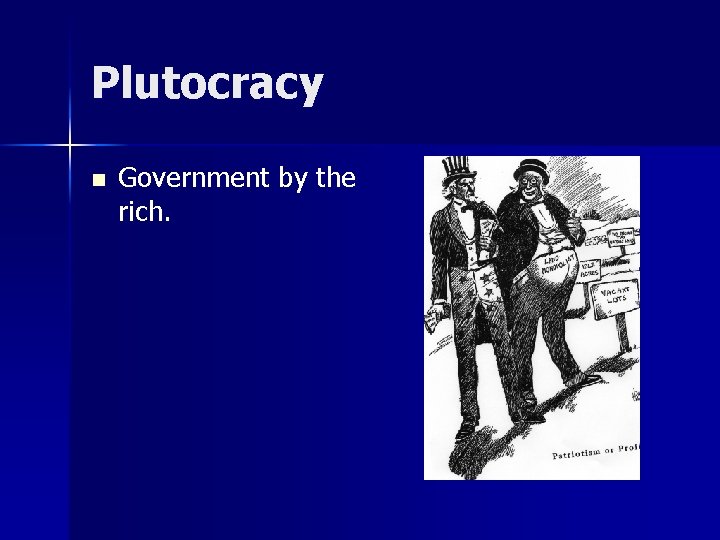
Plutocracy n Government by the rich.
Oligarchy A system of government in which power is held by a small group (if the groups is the rich, than it is an aristocracy) n Examples: Sparta (Helots ruled) n Modern example: South Africa (until 1994) where rule was based on race n
Monarchy n A system of government in which one person reign, usually a king or queen. The authority, or crown, in a monarchy is generally inherited. The ruler, or monarch, is often only the head of state, not the head of government. –Dictionary of Cultural Literacy, page 320
Constitutional Monarchy n A form of national government in which the power of the monarch is restrained by a PARLIAMENT (like our Congress), by law, or by custom. Several nations, especially in modern times have passed from ABSOUTE MONARCY to a constitutional monarchy
Communism n An economic and social system envisioned by the 19 th century German scholar Karl Marx. n In theory, under communism, all means of production are owned in common, rather than by individuals. In practice, a single authoritarian party controls both the political and economic systems.
Socialism An economic system in which the production and distribution of goods are controlled substantially by the government rather than by private enterprise, and in which cooperation rather than competition guides economic activity. n There are many varieties of socialism. n Some socialists tolerate capitalism, as long as the government maintains the dominant influence over the economy; others insist on an abolition of private enterprise. n
Capitalism n An economic and political system characterized by FREE MARKET for GOODS and SERVICES and private control of production and consumption
Democracy n A system of government in which power is vested in the people, who rule either directly or through freely elected representatives.
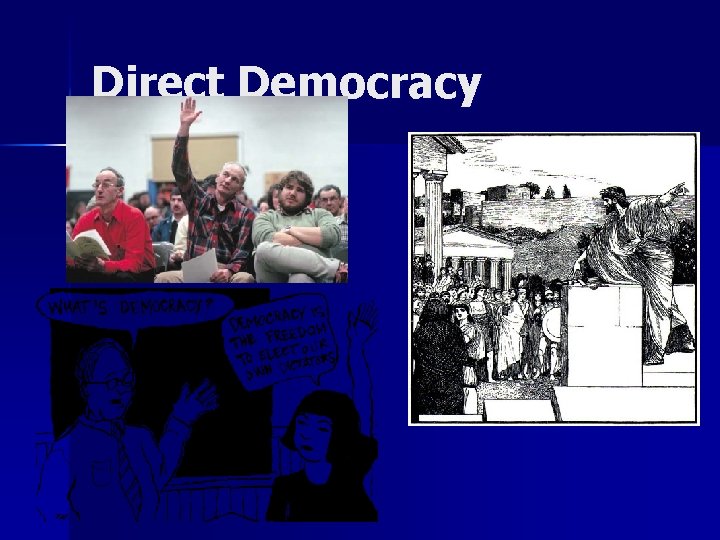
Direct Democracy Government in which citizens vote on laws and select officials directly. (Burns 3) n Present in Ancient Greek city-states, but did not last, succumbed to mob rule n Thus direct democracy was not looked highly upon n
Direct Democracy
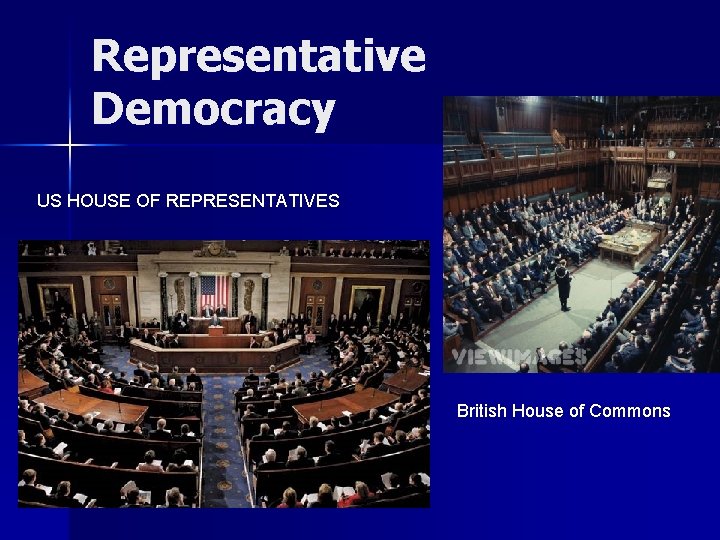
Representative Democracy This is today’s democracy n Also referred to as indirect democracy n Government that derives (gets) its powers indirectly from the people, who elect those who will govern; also called n a republic. (Burns 3)
Representative Democracy US HOUSE OF REPRESENTATIVES British House of Commons
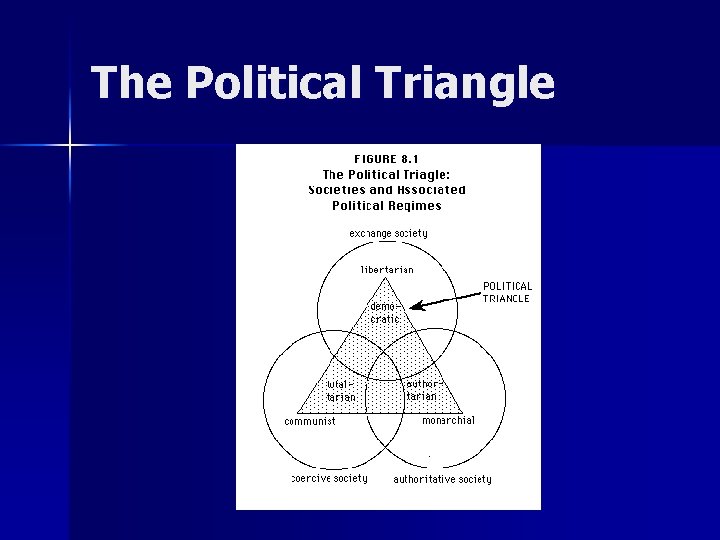
The Political Triangle
Works Cited n n Burns, James. Government by the People, 5 th Editions. Pearson Education: Upper Saddle River, 2003. Hirsch, E. D. Jr. The New Dictionary of Cultural Literacy. Houghton Mifflin: Boston. 2002. Mclean, Iain & Mc. Millan Alistair. Concise Dictionary of Politics. Oxford University Press: Oxford, 2003. Shively, W. Phillips. Power and Choice, Eight Edition. Mc. Graw Hill: New York, 2003.