
Different Flavors of OFDM There are different flavors

- Slides: 36
Different “Flavors” of OFDM
There are different “flavors” of OFDM according what we put in the Prefix: Prefix data P time Three main choices: • CP-OFDM with Cyclic Prefix (CP) • ZP-OFDM with Zero Prefix (ZP) • TDS-OFDM (Time Domain Synchronous) with Pseudo-Random Prefix
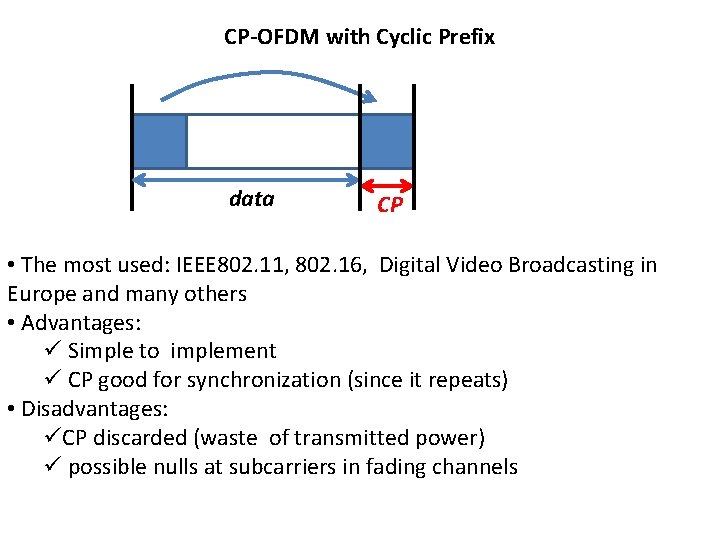
CP-OFDM with Cyclic Prefix data CP • The most used: IEEE 802. 11, 802. 16, Digital Video Broadcasting in Europe and many others • Advantages: ü Simple to implement ü CP good for synchronization (since it repeats) • Disadvantages: üCP discarded (waste of transmitted power) ü possible nulls at subcarriers in fading channels
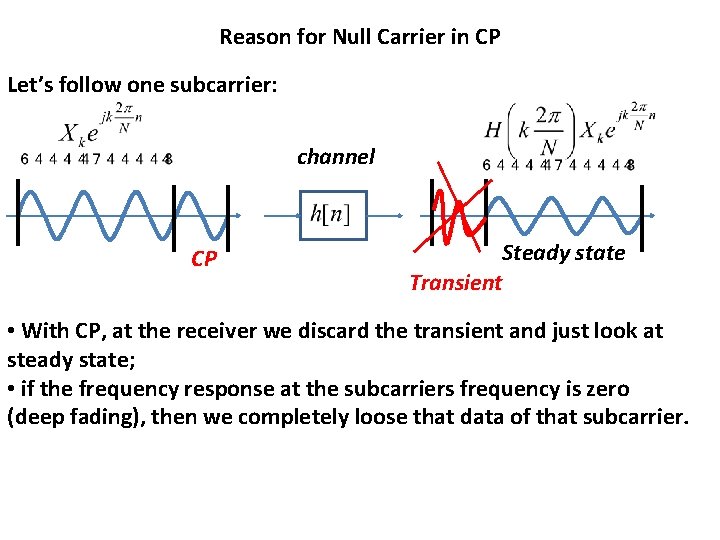
Reason for Null Carrier in CP Let’s follow one subcarrier: channel CP Steady state Transient • With CP, at the receiver we discard the transient and just look at steady state; • if the frequency response at the subcarriers frequency is zero (deep fading), then we completely loose that data of that subcarrier.
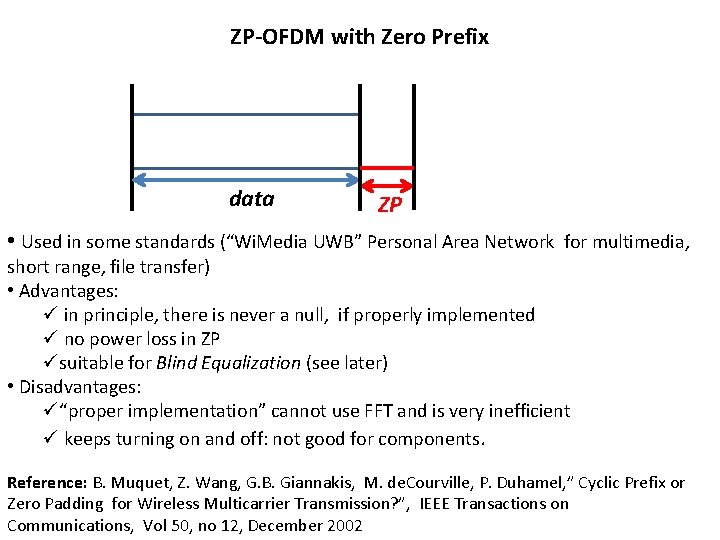
ZP-OFDM with Zero Prefix data ZP • Used in some standards (“Wi. Media UWB” Personal Area Network for multimedia, short range, file transfer) • Advantages: ü in principle, there is never a null, if properly implemented ü no power loss in ZP üsuitable for Blind Equalization (see later) • Disadvantages: ü“proper implementation” cannot use FFT and is very inefficient ü keeps turning on and off: not good for components. Reference: B. Muquet, Z. Wang, G. B. Giannakis, M. de. Courville, P. Duhamel, ” Cyclic Prefix or Zero Padding for Wireless Multicarrier Transmission? ”, IEEE Transactions on Communications, Vol 50, no 12, December 2002
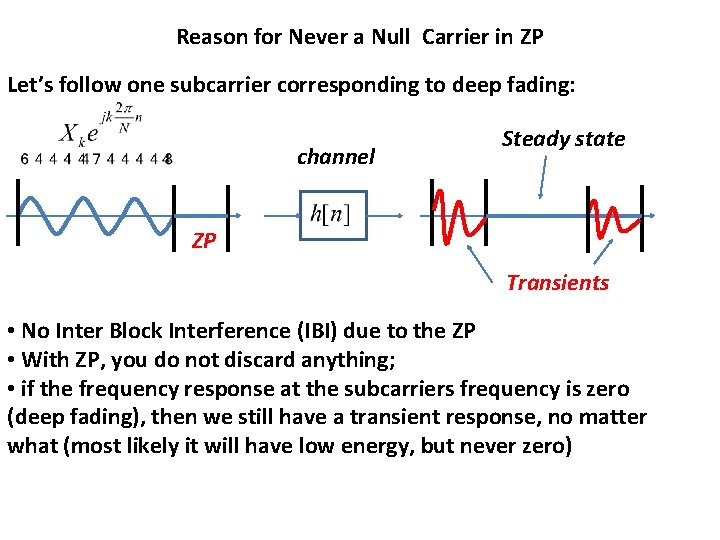
Reason for Never a Null Carrier in ZP Let’s follow one subcarrier corresponding to deep fading: channel Steady state ZP Transients • No Inter Block Interference (IBI) due to the ZP • With ZP, you do not discard anything; • if the frequency response at the subcarriers frequency is zero (deep fading), then we still have a transient response, no matter what (most likely it will have low energy, but never zero)
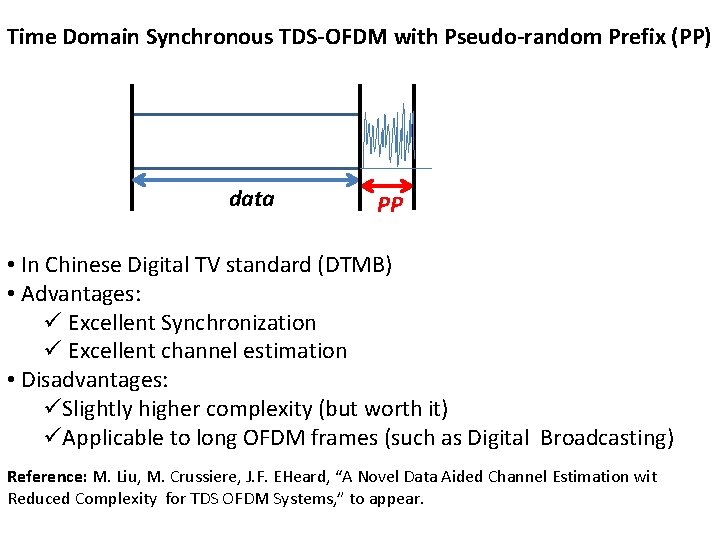
Time Domain Synchronous TDS-OFDM with Pseudo-random Prefix (PP) data PP • In Chinese Digital TV standard (DTMB) • Advantages: ü Excellent Synchronization ü Excellent channel estimation • Disadvantages: üSlightly higher complexity (but worth it) üApplicable to long OFDM frames (such as Digital Broadcasting) Reference: M. Liu, M. Crussiere, J. F. EHeard, “A Novel Data Aided Channel Estimation wit Reduced Complexity for TDS OFDM Systems, ” to appear.
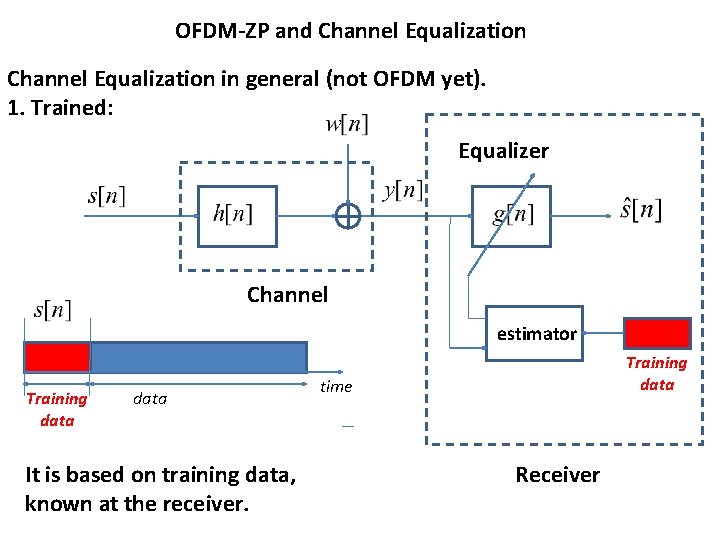
OFDM-ZP and Channel Equalization in general (not OFDM yet). 1. Trained: Equalizer Channel estimator Training data It is based on training data, known at the receiver. Training data time Receiver
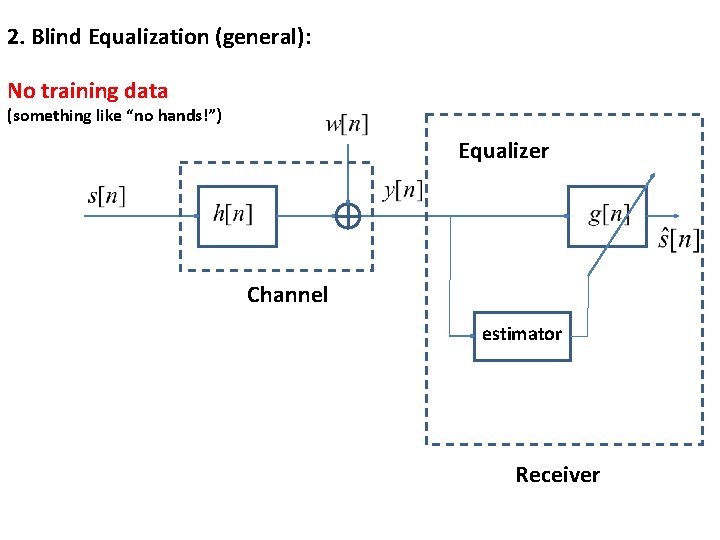
2. Blind Equalization (general): No training data (something like “no hands!”) Equalizer Channel estimator Receiver
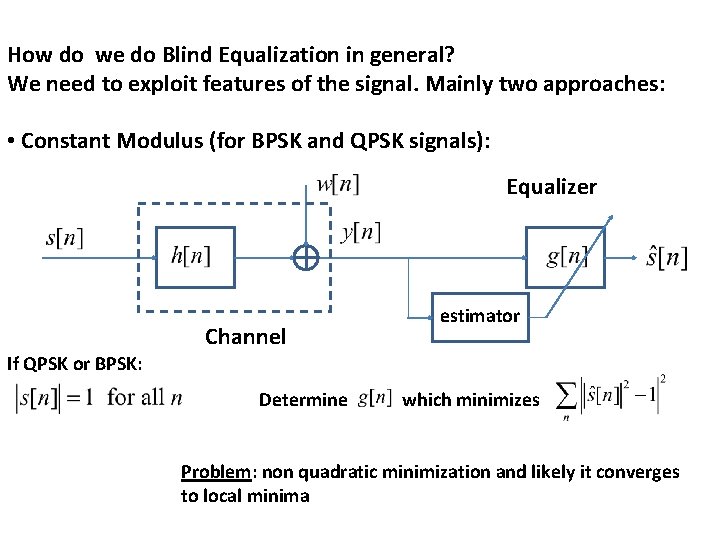
How do we do Blind Equalization in general? We need to exploit features of the signal. Mainly two approaches: • Constant Modulus (for BPSK and QPSK signals): Equalizer Channel estimator If QPSK or BPSK: Determine which minimizes Problem: non quadratic minimization and likely it converges to local minima
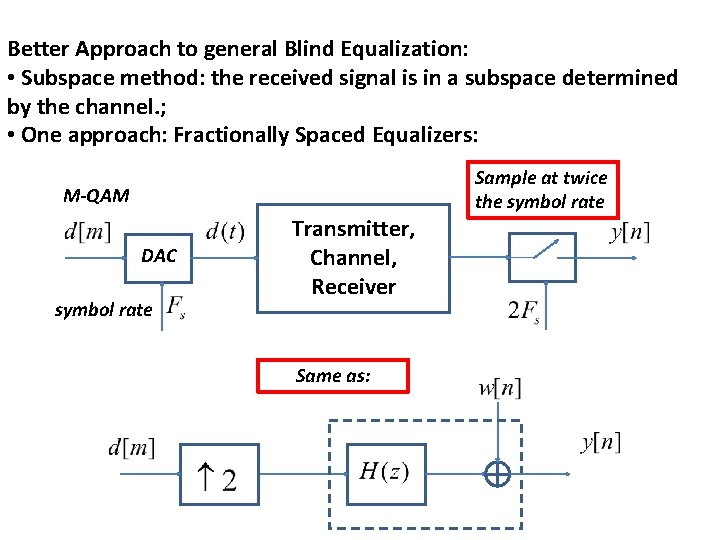
Better Approach to general Blind Equalization: • Subspace method: the received signal is in a subspace determined by the channel. ; • One approach: Fractionally Spaced Equalizers: M-QAM DAC symbol rate Transmitter, Channel, Receiver Same as: Sample at twice the symbol rate
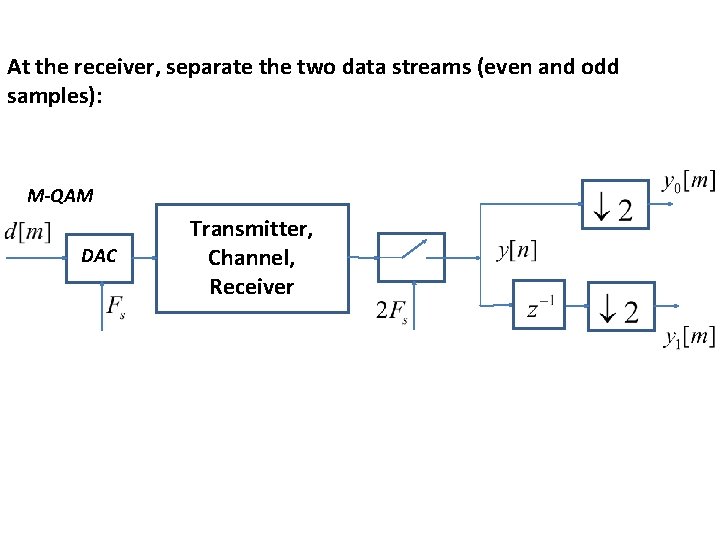
At the receiver, separate the two data streams (even and odd samples): M-QAM DAC Transmitter, Channel, Receiver
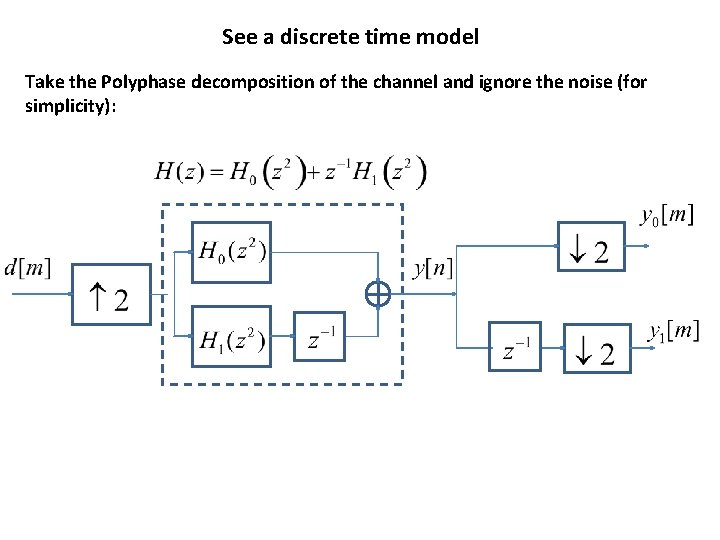
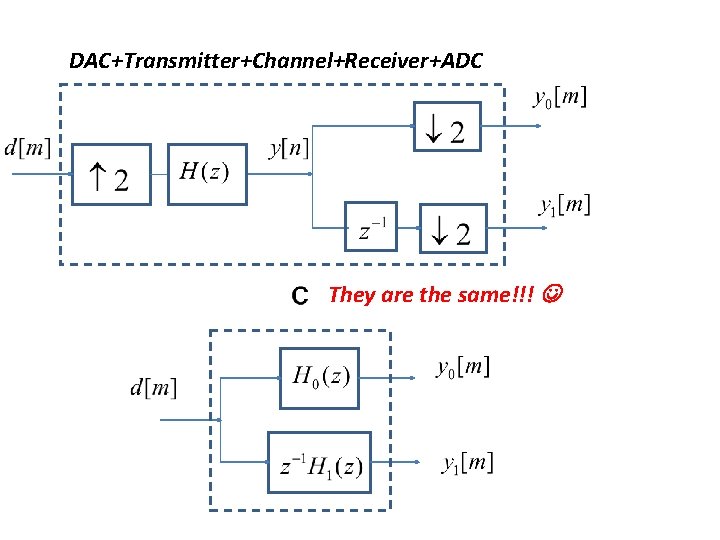
See a discrete time model Take the Polyphase decomposition of the channel and ignore the noise (for simplicity):
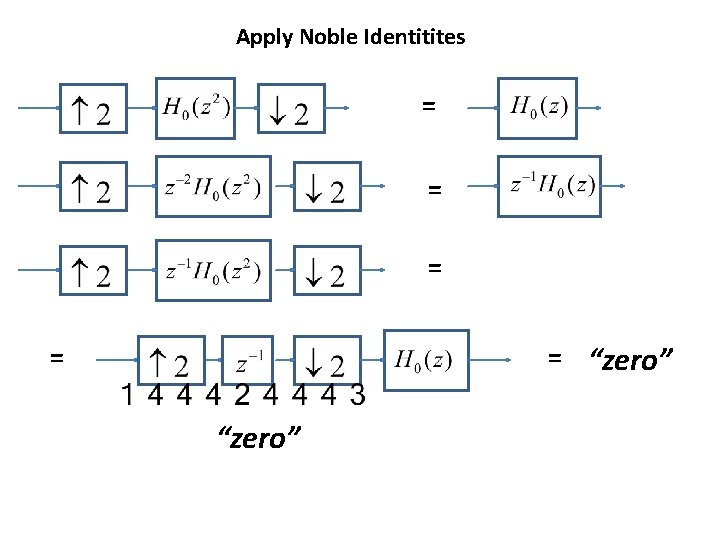
Apply Noble Identitites = = “zero”
DAC+Transmitter+Channel+Receiver+ADC They are the same!!!
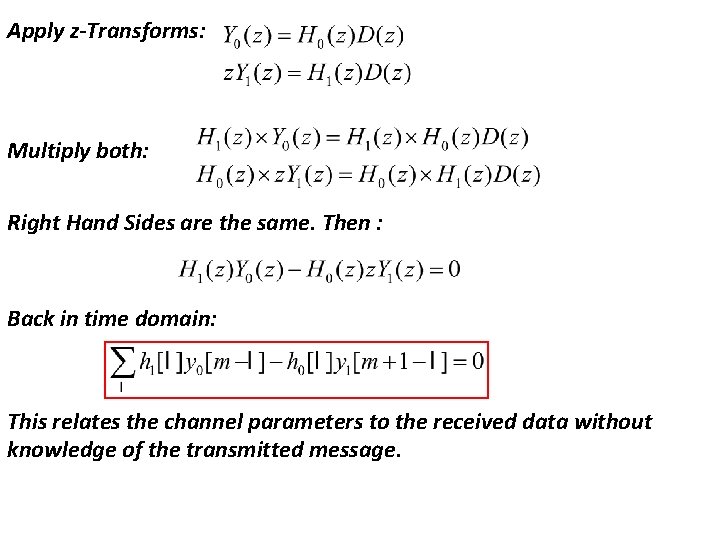
Apply z-Transforms: Multiply both: Right Hand Sides are the same. Then : Back in time domain: This relates the channel parameters to the received data without knowledge of the transmitted message.
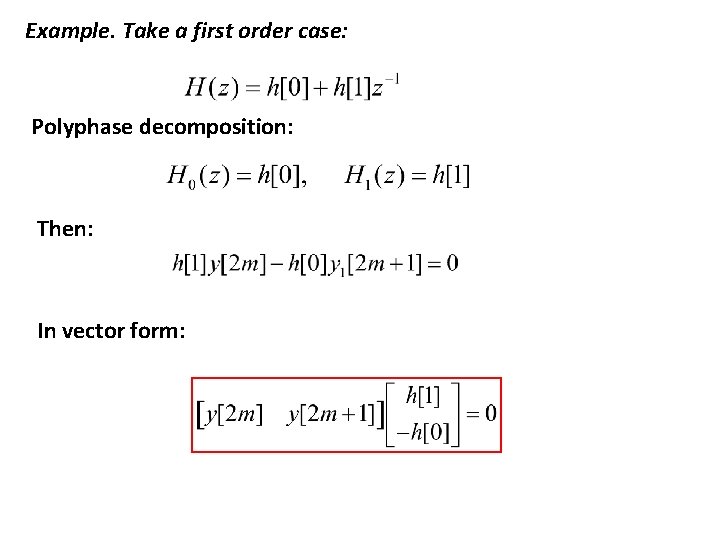
Example. Take a first order case: Polyphase decomposition: Then: In vector form:
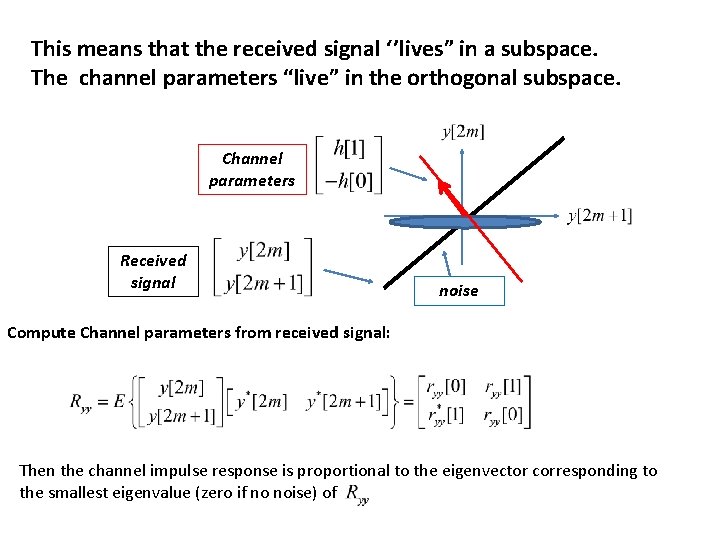
This means that the received signal ‘’lives” in a subspace. The channel parameters “live” in the orthogonal subspace. Channel parameters Received signal noise Compute Channel parameters from received signal: Then the channel impulse response is proportional to the eigenvector corresponding to the smallest eigenvalue (zero if no noise) of
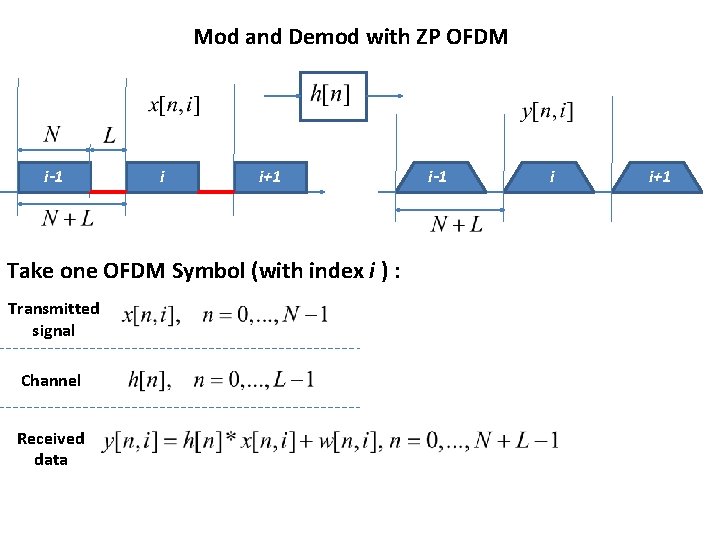
Mod and Demod with ZP OFDM i-1 i i+1 Take one OFDM Symbol (with index i ) : Transmitted signal Channel Received data i-1 i i+1
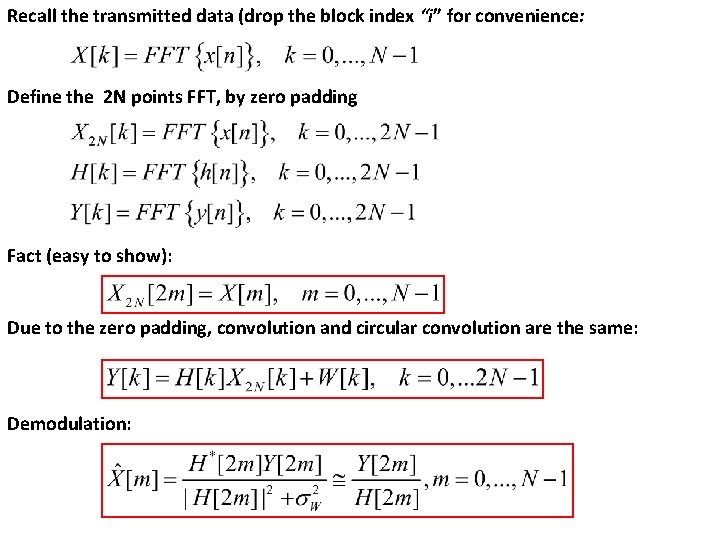
Recall the transmitted data (drop the block index “i” for convenience: Define the 2 N points FFT, by zero padding Fact (easy to show): Due to the zero padding, convolution and circular convolution are the same: Demodulation:
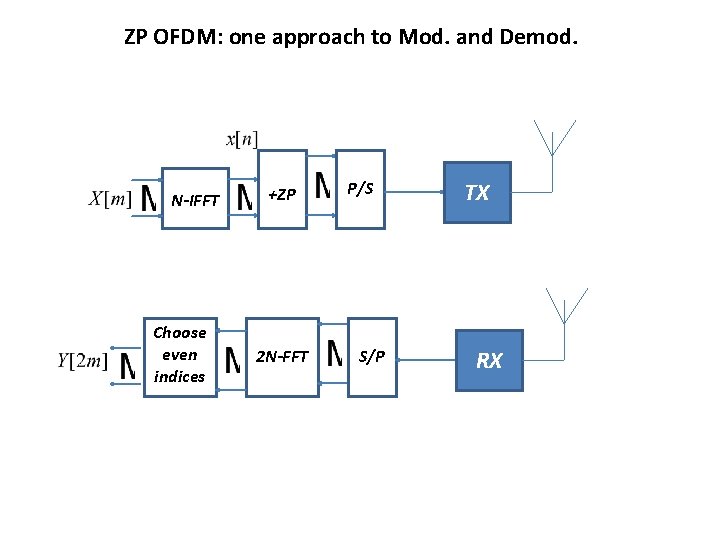
ZP OFDM: one approach to Mod. and Demod. N-IFFT Choose even indices +ZP 2 N-FFT P/S S/P TX RX
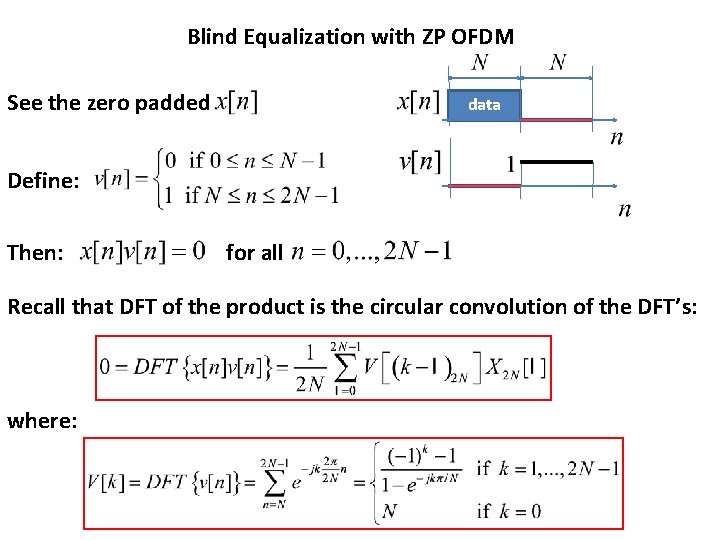
Blind Equalization with ZP OFDM See the zero padded data Define: Then: for all Recall that DFT of the product is the circular convolution of the DFT’s: where:
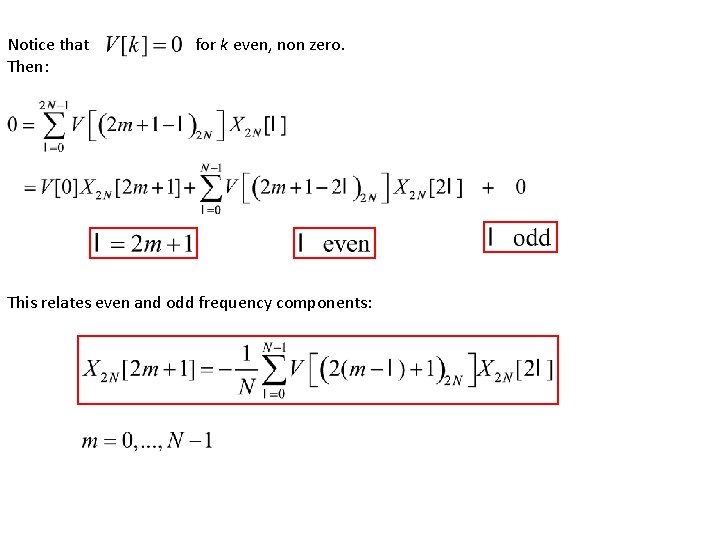
Notice that Then: for k even, non zero. This relates even and odd frequency components:
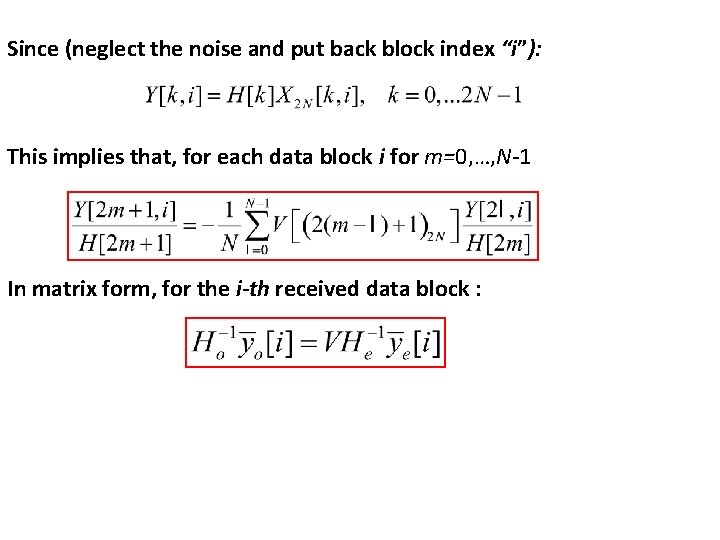
Since (neglect the noise and put back block index “i”): This implies that, for each data block i for m=0, …, N-1 In matrix form, for the i-th received data block :
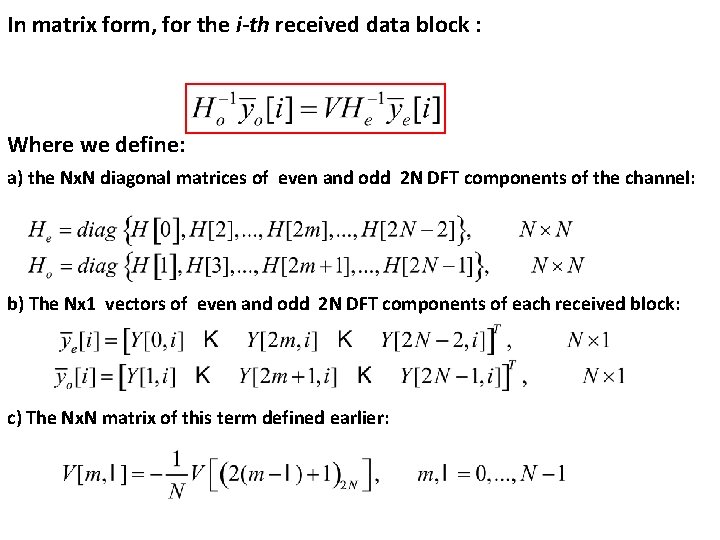
In matrix form, for the i-th received data block : Where we define: a) the Nx. N diagonal matrices of even and odd 2 N DFT components of the channel: b) The Nx 1 vectors of even and odd 2 N DFT components of each received block: c) The Nx. N matrix of this term defined earlier:
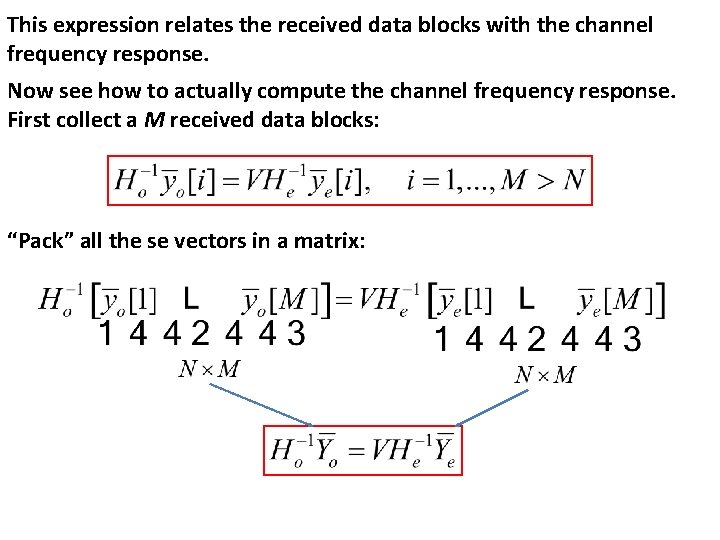
This expression relates the received data blocks with the channel frequency response. Now see how to actually compute the channel frequency response. First collect a M received data blocks: “Pack” all the se vectors in a matrix:
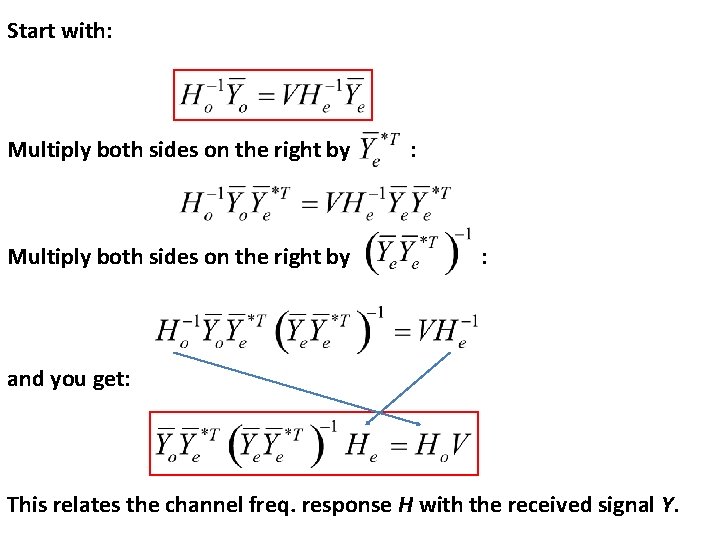
Start with: Multiply both sides on the right by : : and you get: This relates the channel freq. response H with the received signal Y.
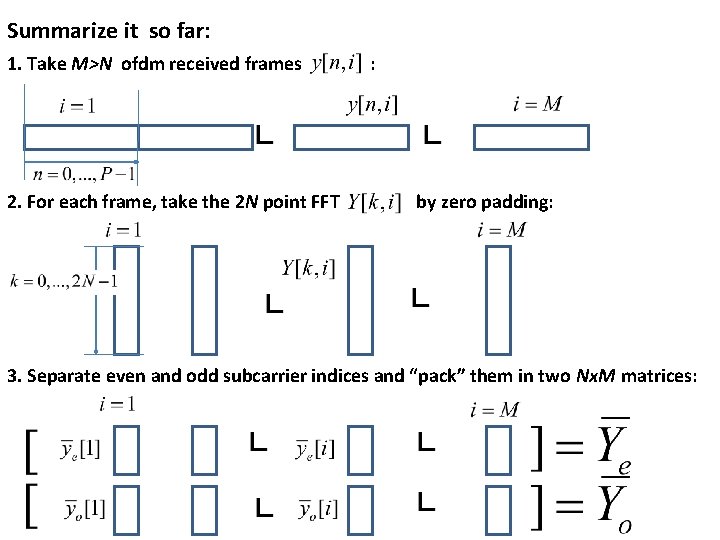
Summarize it so far: 1. Take M>N ofdm received frames 2. For each frame, take the 2 N point FFT : by zero padding: 3. Separate even and odd subcarrier indices and “pack” them in two Nx. M matrices:
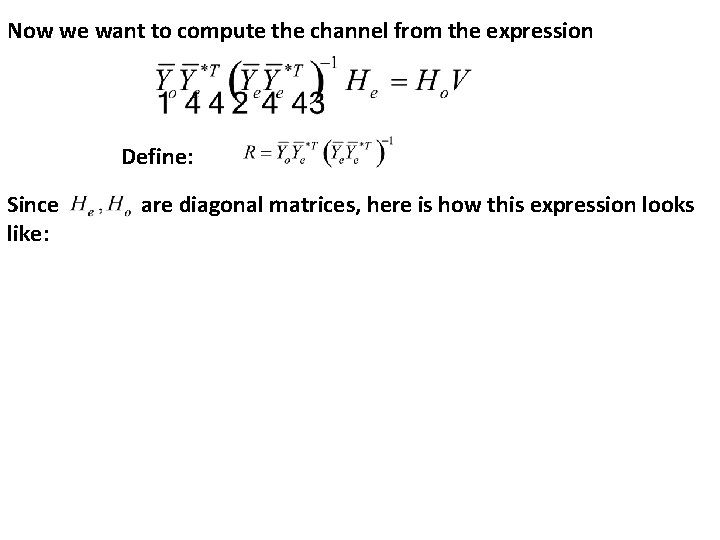
Now we want to compute the channel from the expression Define: Since like: are diagonal matrices, here is how this expression looks
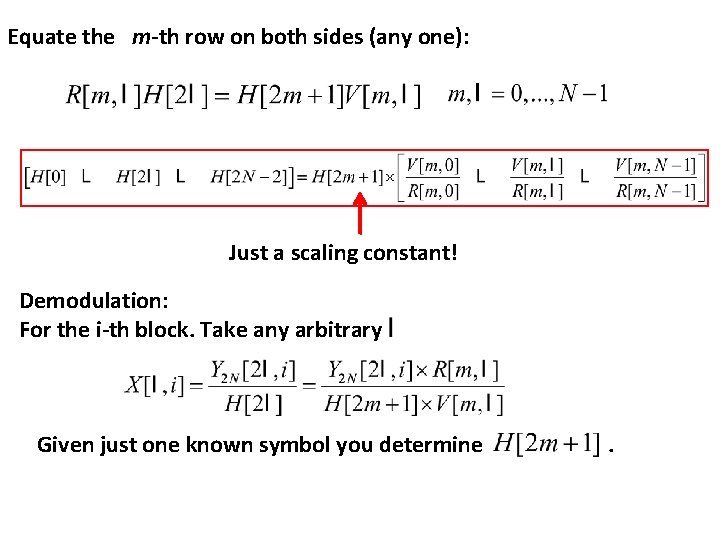
Equate the m-th row on both sides (any one): Just a scaling constant! Demodulation: For the i-th block. Take any arbitrary Given just one known symbol you determine .
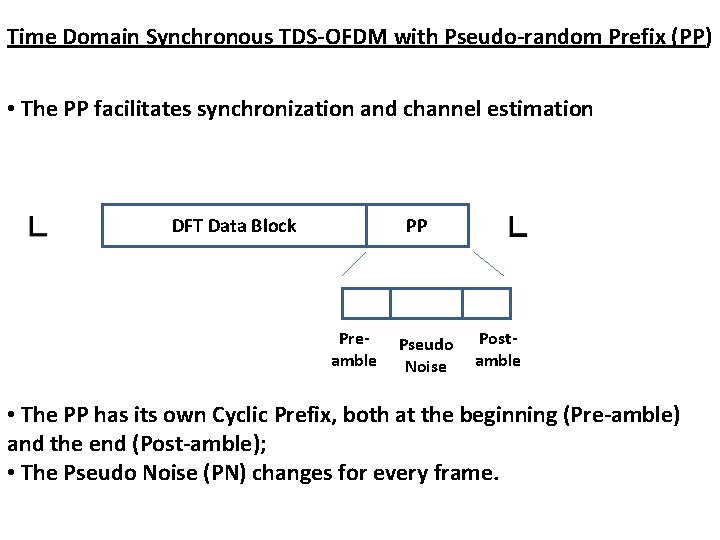
Time Domain Synchronous TDS-OFDM with Pseudo-random Prefix (PP) • The PP facilitates synchronization and channel estimation DFT Data Block PP Preamble Pseudo Noise Postamble • The PP has its own Cyclic Prefix, both at the beginning (Pre-amble) and the end (Post-amble); • The Pseudo Noise (PN) changes for every frame.
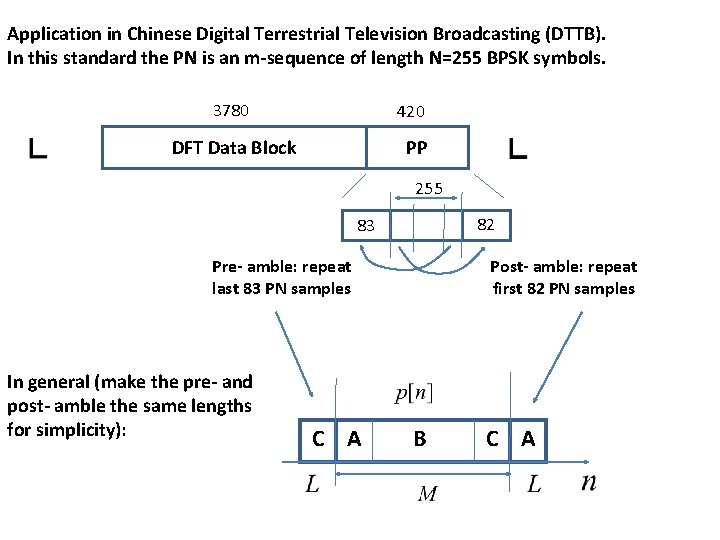
Application in Chinese Digital Terrestrial Television Broadcasting (DTTB). In this standard the PN is an m-sequence of length N=255 BPSK symbols. 3780 420 DFT Data Block PP 255 82 83 Pre- amble: repeat last 83 PN samples In general (make the pre- and post- amble the same lengths for simplicity): C A Post- amble: repeat first 82 PN samples B C A
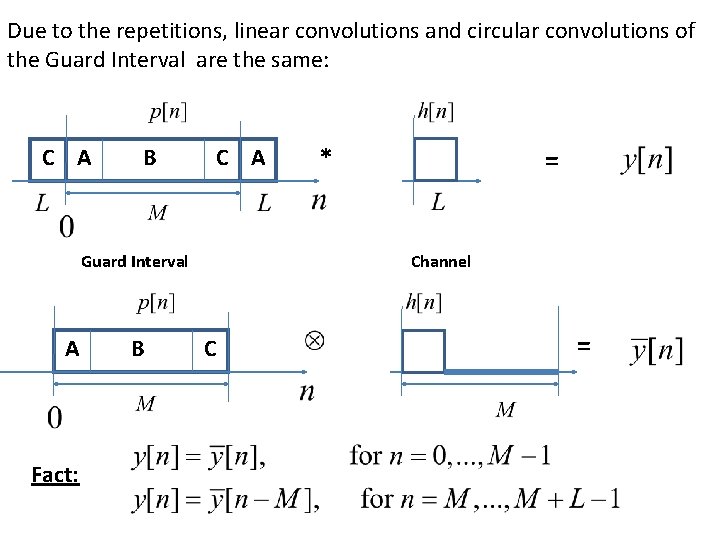
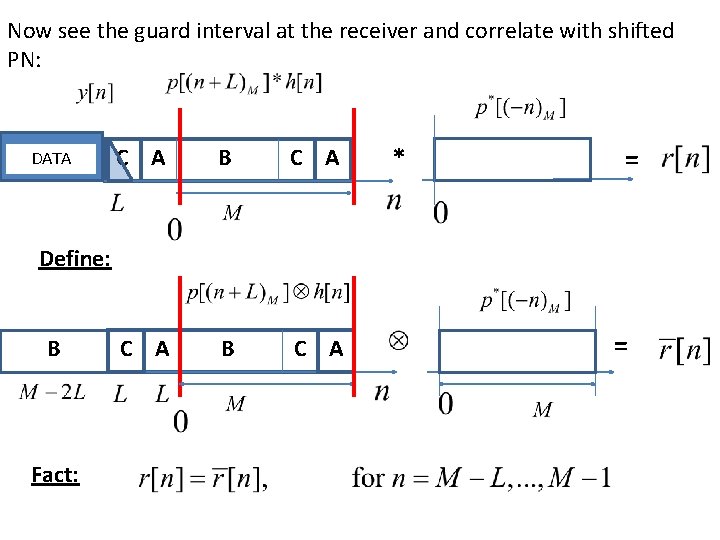
Due to the repetitions, linear convolutions and circular convolutions of the Guard Interval are the same: C A B C A Guard Interval A Fact: B * = Channel C =
Now see the guard interval at the receiver and correlate with shifted PN: DATA C A B C A * = Define: B Fact: =
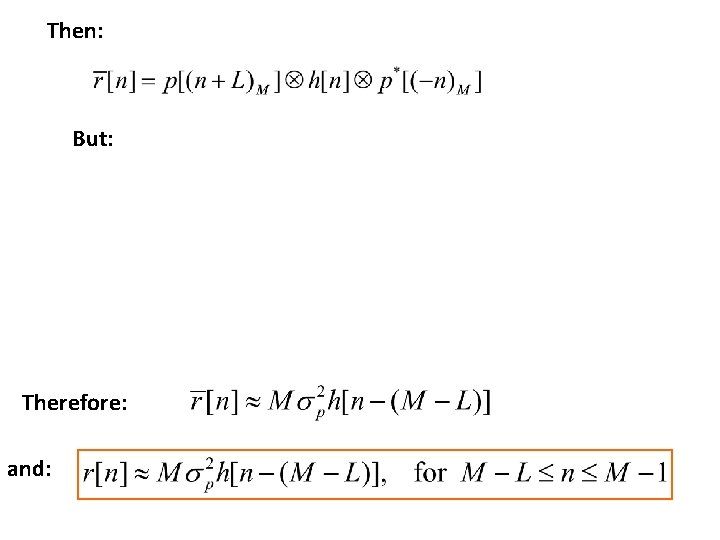
Then: But: Therefore: and:
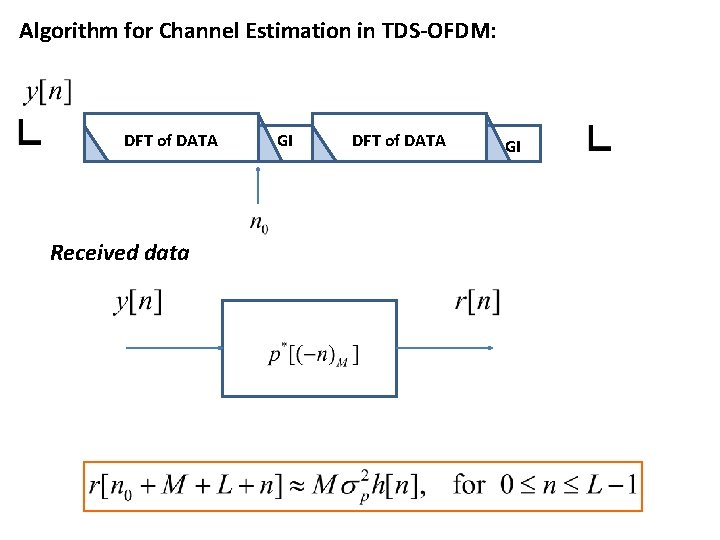
Algorithm for Channel Estimation in TDS-OFDM: DFT of DATA Received data GI DFT of DATA GI