
Differences in learning potential assessment of disabled and
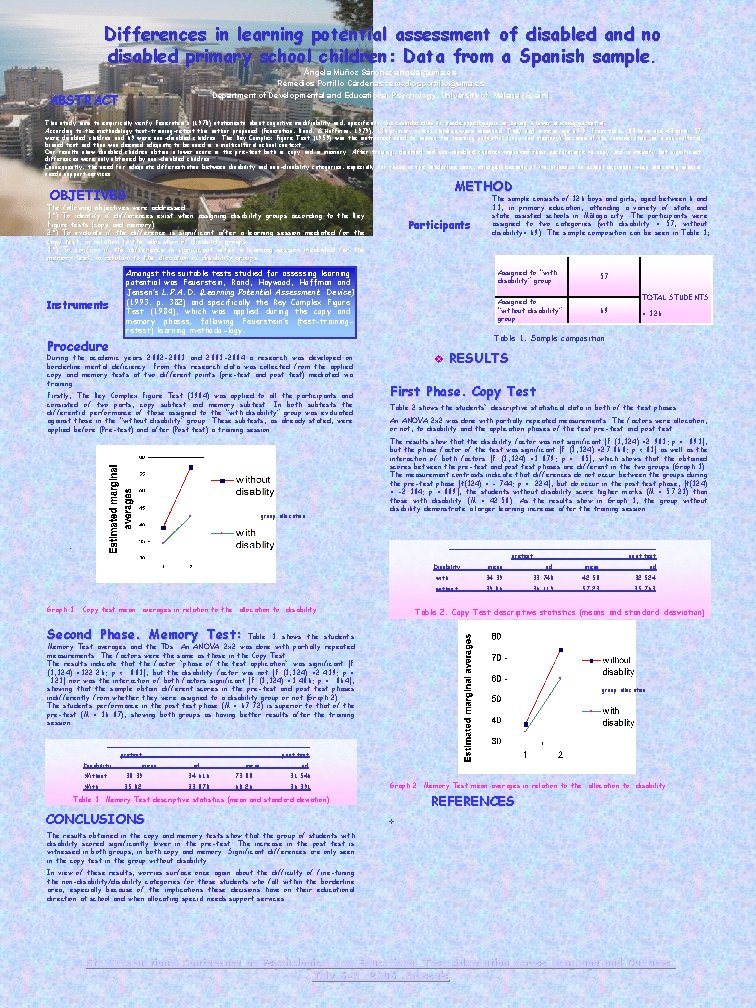
Differences in learning potential assessment of disabled and no disabled primary school children: Data from a Spanish sample. Ángela Muñoz Sánchez angela@uma. es Remedios Portillo Cárdenas remediosportillo@uma. es Department of Developmental and Educational Psychology. University of Málaga (Spain) ABSTRACT This study aims to empirically verify Feuerstein’s (1970) statements about cognitive modifiability and, specifically, his consideration of handicapped pupils as having a lower learning potential. According to the methodology test-training-retest this author proposed (Feuerstein, Rand, & Hoffman, 1979), 126 primary school children were assessed. They had a mean age of 9. From them, 83 boys and 43 girls; 57 were disabled children and 69 were non-disabled children. The Rey Complex Figure Test (1959) was the instrument used to assess the learning potential (copy and memory) because of its consideration as a non-cultural biased test and thus was deemed adequate to be used in a multicultural school context. Our results show disabled children obtain a lower score in the pre-test both in copy and in memory. After training, disabled and non-disabled children improved their performance in copy and in memory but significant differences were only obtained by non-disabled children. Consequently, the need for adequate differentiation between disability and non-disability categories, especially for those in the borderline zone, emerged because of its influence on school decisions when allocating special needs support services. METHOD OBJETIVES The following objectives were addressed 1º) To identify if differences exist when assigning disability groups according to the Rey Figure tests (copy and memory). 2º) To evaluate if the difference is significant after a learning session mediated for the copy test, in relation to the allocation of disability groups. 3º) To confirm if the difference is significant after a learning session mediated for the memory test, in relation to the allocation of disability groups. Instruments Participants Assigned to “with disability” group Amongst the suitable tests studied for assessing learning potential was Feuerstein, Rand, Haywood, Hoffman and Jensen’s L. P. A. D. (Learning Potential Assessment Device) (1993. p. 382) and specifically the Rey Complex Figure Test (1984), which was applied during the copy and memory phases, following Feuerstein’s (test-trainingretest) learning methodo-logy. Firstly, The Rey Complex Figure Test (1984) was applied to all the participants and consisted of two parts, copy subtest and memory subtest. In both subtests the differential performance of those assigned to the “with disability” group was evaluated against those in the “without disability” group. These subtests, as already stated, were applied before (Pre-test) and after (Post test) a training session. group allocation 57 TOTAL STUDENTS Assigned to “without disability” group 69 = 126 Table 1. Sample composition Procedure During the academic years 2002 -2003 and 2003 -2004 a research was developed on borderline mental deficiency. From this research data was collected from the applied copy and memory tests at two different points (pre-test and post test) mediated via training. The sample consists of 126 boys and girls, aged between 6 and 11, in primary education, attending a variety of state and state assisted schools in Málaga city. The participants were assigned to two categories (with disability = 57, without disability= 69). The sample composition can be seen in Table 1: v RESULTS First Phase. Copy Test Table 2 shows the students` descriptive statistical data in both of the test phases. An ANOVA 2 x 2 was done with partially repeated measurements. The factors were allocation, or not, to disability and the application phases of the test pre-test and post test. The results show that the disability factor was not significant [F (1, 124) =2. 903; p =. 091], but the phase factor of the test was significant [F (1, 124) =27. 068; p <. 01] as well as the interaction of both factors [F (1, 124) =3. 879; p =. 05], which shows that the obtained scores between the pre-test and post test phases are different in the two groups (Graph 1). The measurement contrasts indicate that differences do not occur between the groups during the pre-test phase [t(124) = -. 744; p =. 224], but do occur in the post test phase, [t(124) = -2. 384; p =. 009], the students without disability score higher marks (M = 57. 23) than those with disability (M = 42. 58). As the results show in Graph 1, the group without disability demonstrate a larger learning increase after the training session. ____________________________ . pretest Disability Graph 1. Copy test mean averages in relation to the allocation to disability post test mean sd with 34. 39 33. 740 42. 58 32. 524 without 39. 06 36. 119 57. 23 35. 763 Table 2. Copy Test descriptive statistics (means and standard desviation) Second Phase. Memory Test: Table 3 shows the student’s Memory Test averages and the TDs. An ANOVA 2 x 2 was done with partially repeated measurements. The factors were the same as those in the Copy Test. The results indicate that the factor `phase of the test application` was significant [F (1, 124) =122. 26; p <. 001], but the disability factor was not [F (1, 124) =2. 439; p =. 121] nor was the interaction of both factors significant [F (1, 124) =3. 486; p =. 064], showing that the sample obtain different scores in the pre-test and post test phases indifferently from whether they were assigned to a disability group or not (Graph 2). The students’ performance in the post test phase (M = 67. 72) is superior to that of the pre-test (M = 36. 87), showing both groups as having better results after the training session. group allocation ___________________________ pretest Disability post test mean sd Without 38. 39 34. 616 73. 88 31. 546 With 35. 02 33. 870 60. 26 36. 391 Graph 2. Memory Test mean averages in relation to the allocation to disability REFERENCES Table 3. Memory Test descriptive statistics (mean and standard deviation) CONCLUSIONS v The results obtained in the copy and memory tests show that the group of students with disability scored significantly lower in the pre-test. The increase in the post test is witnessed in both groups, in both copy and memory. Significant differences are only seen in the copy test in the group without disability. In view of these results, worries surface once again about the difficulty of fine-tuning the non-disability/disability categories for those students who fall within the borderline area, especially because of the implications these decisions have on their educational direction at school and when allocating special needs support services. 5 th International Conference on Psychological and Educational Test Adaptation across Language and Cultures. July 6 -8, 2006, Brussels
- Slides: 1